2006 MERCEDES-BENZ SPRINTER torque
[x] Cancel search: torquePage 1898 of 2305
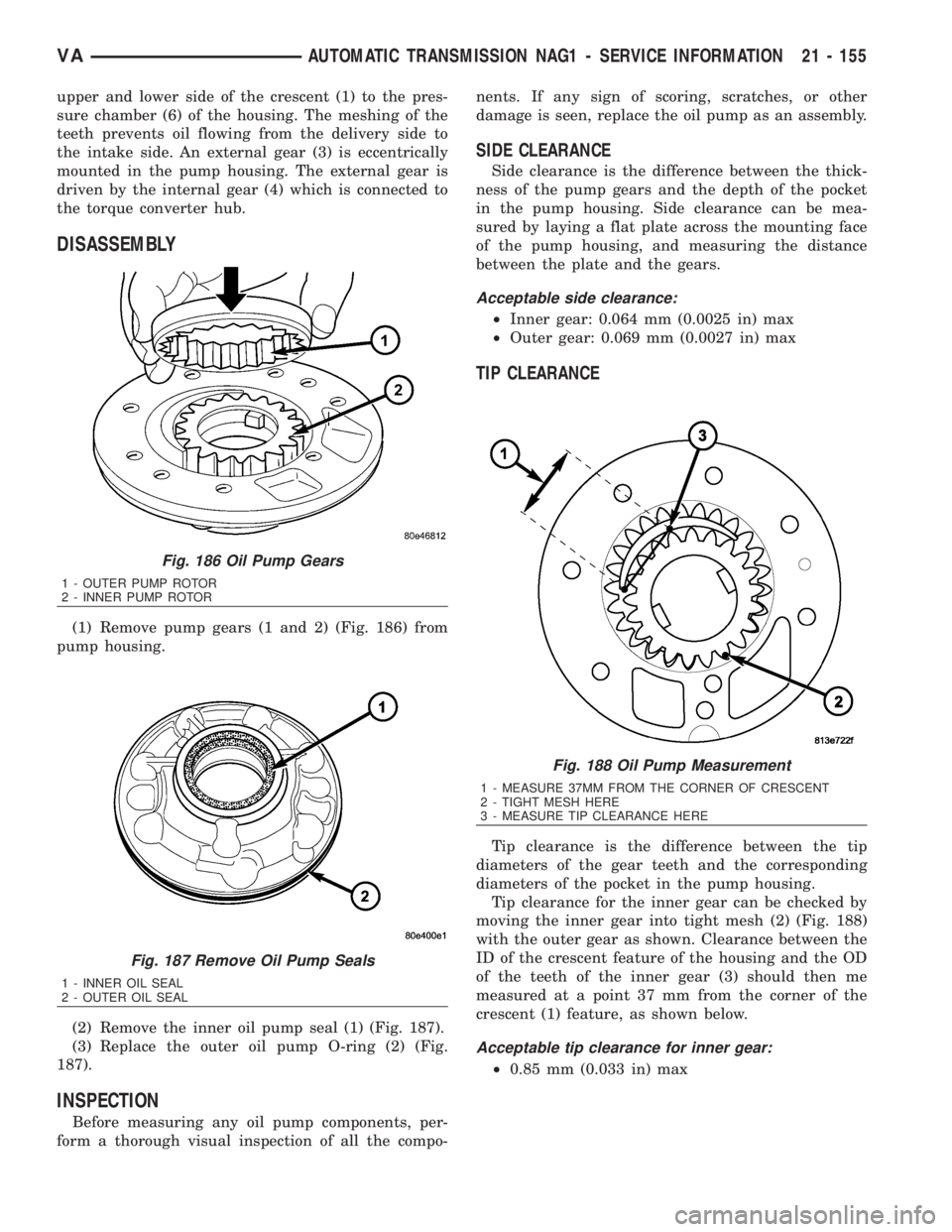
upper and lower side of the crescent (1) to the pres-
sure chamber (6) of the housing. The meshing of the
teeth prevents oil flowing from the delivery side to
the intake side. An external gear (3) is eccentrically
mounted in the pump housing. The external gear is
driven by the internal gear (4) which is connected to
the torque converter hub.
DISASSEMBLY
(1) Remove pump gears (1 and 2) (Fig. 186) from
pump housing.
(2) Remove the inner oil pump seal (1) (Fig. 187).
(3) Replace the outer oil pump O-ring (2) (Fig.
187).
INSPECTION
Before measuring any oil pump components, per-
form a thorough visual inspection of all the compo-nents. If any sign of scoring, scratches, or other
damage is seen, replace the oil pump as an assembly.
SIDE CLEARANCE
Side clearance is the difference between the thick-
ness of the pump gears and the depth of the pocket
in the pump housing. Side clearance can be mea-
sured by laying a flat plate across the mounting face
of the pump housing, and measuring the distance
between the plate and the gears.
Acceptable side clearance:
²Inner gear: 0.064 mm (0.0025 in) max
²Outer gear: 0.069 mm (0.0027 in) max
TIP CLEARANCE
Tip clearance is the difference between the tip
diameters of the gear teeth and the corresponding
diameters of the pocket in the pump housing.
Tip clearance for the inner gear can be checked by
moving the inner gear into tight mesh (2) (Fig. 188)
with the outer gear as shown. Clearance between the
ID of the crescent feature of the housing and the OD
of the teeth of the inner gear (3) should then me
measured at a point 37 mm from the corner of the
crescent (1) feature, as shown below.
Acceptable tip clearance for inner gear:
²0.85 mm (0.033 in) max
Fig. 186 Oil Pump Gears
1 - OUTER PUMP ROTOR
2 - INNER PUMP ROTOR
Fig. 187 Remove Oil Pump Seals
1 - INNER OIL SEAL
2 - OUTER OIL SEAL
Fig. 188 Oil Pump Measurement
1 - MEASURE 37MM FROM THE CORNER OF CRESCENT
2 - TIGHT MESH HERE
3 - MEASURE TIP CLEARANCE HERE
VAAUTOMATIC TRANSMISSION NAG1 - SERVICE INFORMATION 21 - 155
Page 1908 of 2305
OPERATION
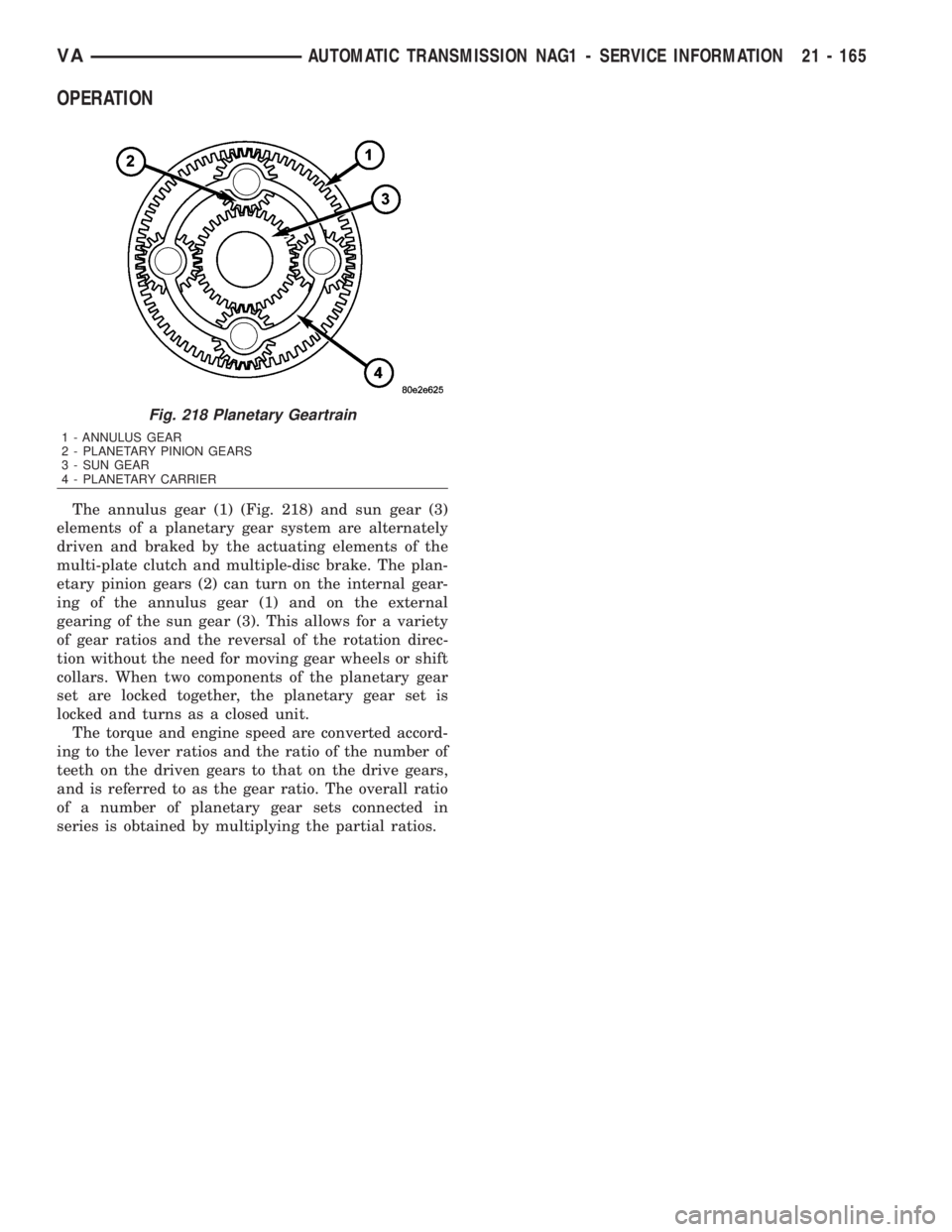
The annulus gear (1) (Fig. 218) and sun gear (3)
elements of a planetary gear system are alternately
driven and braked by the actuating elements of the
multi-plate clutch and multiple-disc brake. The plan-
etary pinion gears (2) can turn on the internal gear-
ing of the annulus gear (1) and on the external
gearing of the sun gear (3). This allows for a variety
of gear ratios and the reversal of the rotation direc-
tion without the need for moving gear wheels or shift
collars. When two components of the planetary gear
set are locked together, the planetary gear set is
locked and turns as a closed unit.
The torque and engine speed are converted accord-
ing to the lever ratios and the ratio of the number of
teeth on the driven gears to that on the drive gears,
and is referred to as the gear ratio. The overall ratio
of a number of planetary gear sets connected in
series is obtained by multiplying the partial ratios.
Fig. 218 Planetary Geartrain
1 - ANNULUS GEAR
2 - PLANETARY PINION GEARS
3 - SUN GEAR
4 - PLANETARY CARRIER
VAAUTOMATIC TRANSMISSION NAG1 - SERVICE INFORMATION 21 - 165
Page 1916 of 2305
MODULATING PRESSURE CONTROL SOLENOID
VALVE
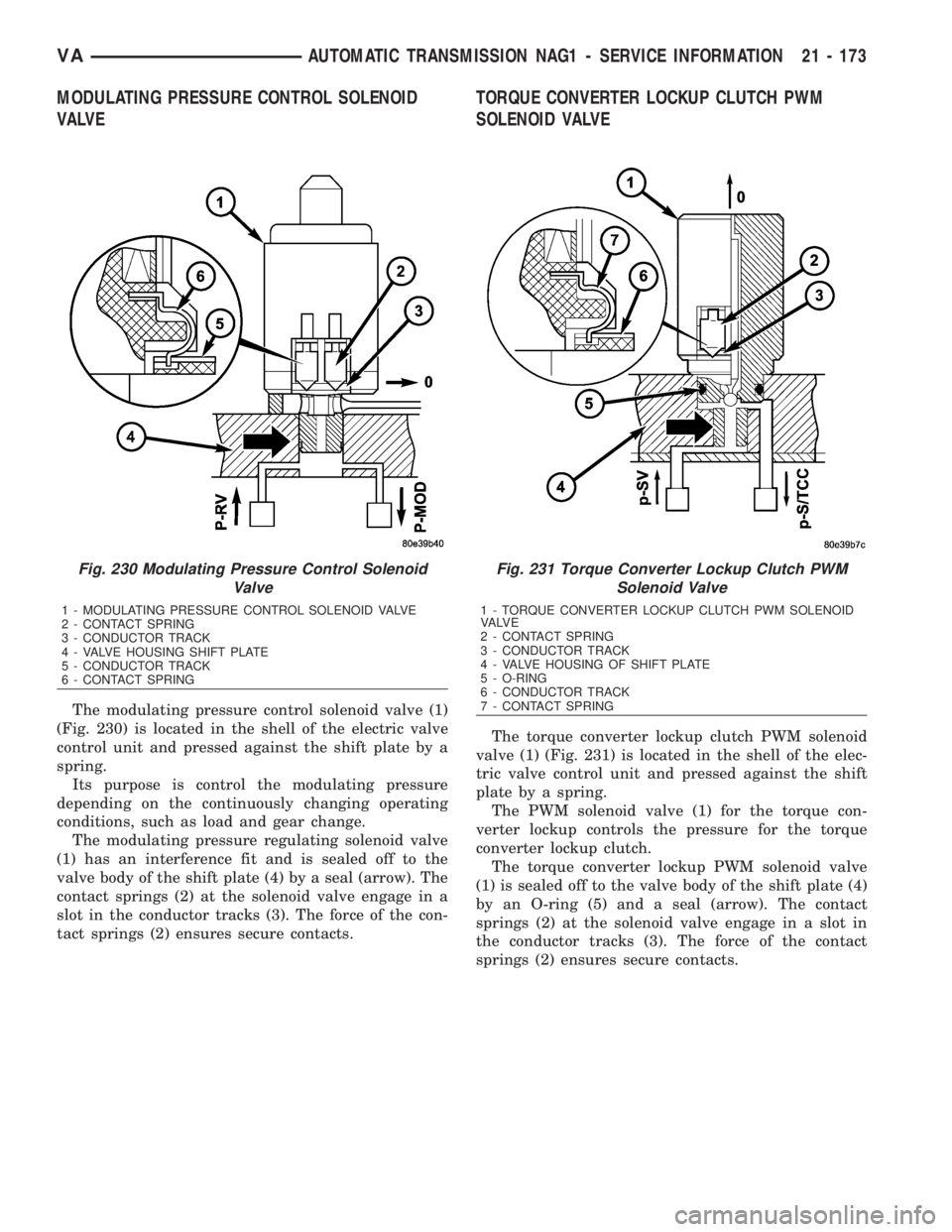
The modulating pressure control solenoid valve (1)
(Fig. 230) is located in the shell of the electric valve
control unit and pressed against the shift plate by a
spring.
Its purpose is control the modulating pressure
depending on the continuously changing operating
conditions, such as load and gear change.
The modulating pressure regulating solenoid valve
(1) has an interference fit and is sealed off to the
valve body of the shift plate (4) by a seal (arrow). The
contact springs (2) at the solenoid valve engage in a
slot in the conductor tracks (3). The force of the con-
tact springs (2) ensures secure contacts.
TORQUE CONVERTER LOCKUP CLUTCH PWM
SOLENOID VALVE
The torque converter lockup clutch PWM solenoid
valve (1) (Fig. 231) is located in the shell of the elec-
tric valve control unit and pressed against the shift
plate by a spring.
The PWM solenoid valve (1) for the torque con-
verter lockup controls the pressure for the torque
converter lockup clutch.
The torque converter lockup PWM solenoid valve
(1) is sealed off to the valve body of the shift plate (4)
by an O-ring (5) and a seal (arrow). The contact
springs (2) at the solenoid valve engage in a slot in
the conductor tracks (3). The force of the contact
springs (2) ensures secure contacts.
Fig. 230 Modulating Pressure Control Solenoid
Valve
1 - MODULATING PRESSURE CONTROL SOLENOID VALVE
2 - CONTACT SPRING
3 - CONDUCTOR TRACK
4 - VALVE HOUSING SHIFT PLATE
5 - CONDUCTOR TRACK
6 - CONTACT SPRING
Fig. 231 Torque Converter Lockup Clutch PWM
Solenoid Valve
1 - TORQUE CONVERTER LOCKUP CLUTCH PWM SOLENOID
VA LV E
2 - CONTACT SPRING
3 - CONDUCTOR TRACK
4 - VALVE HOUSING OF SHIFT PLATE
5 - O-RING
6 - CONDUCTOR TRACK
7 - CONTACT SPRING
VAAUTOMATIC TRANSMISSION NAG1 - SERVICE INFORMATION 21 - 173
Page 1918 of 2305
MODULATING PRESSURE CONTROL SOLENOID
VALVE
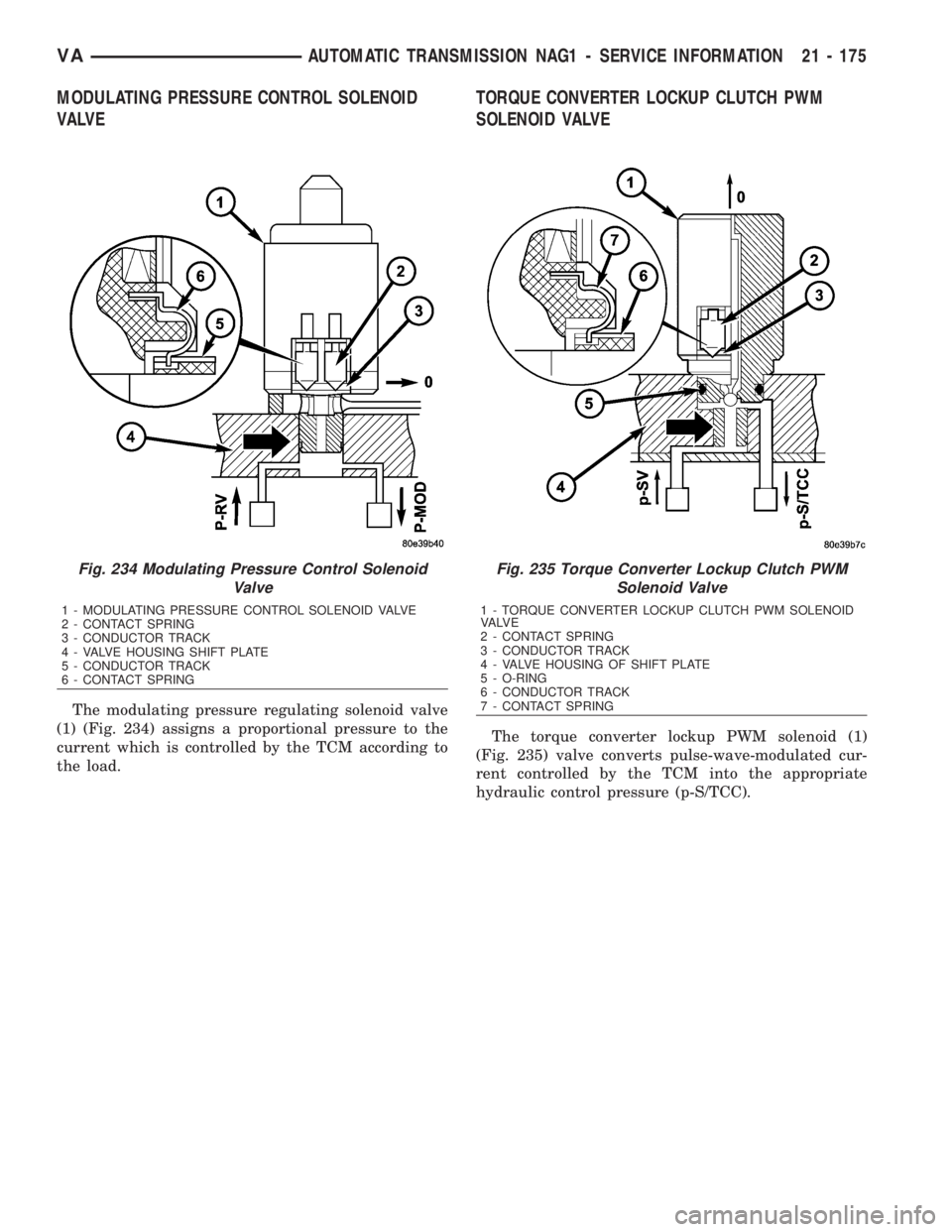
The modulating pressure regulating solenoid valve
(1) (Fig. 234) assigns a proportional pressure to the
current which is controlled by the TCM according to
the load.
TORQUE CONVERTER LOCKUP CLUTCH PWM
SOLENOID VALVE
The torque converter lockup PWM solenoid (1)
(Fig. 235) valve converts pulse-wave-modulated cur-
rent controlled by the TCM into the appropriate
hydraulic control pressure (p-S/TCC).
Fig. 234 Modulating Pressure Control Solenoid
Valve
1 - MODULATING PRESSURE CONTROL SOLENOID VALVE
2 - CONTACT SPRING
3 - CONDUCTOR TRACK
4 - VALVE HOUSING SHIFT PLATE
5 - CONDUCTOR TRACK
6 - CONTACT SPRING
Fig. 235 Torque Converter Lockup Clutch PWM
Solenoid Valve
1 - TORQUE CONVERTER LOCKUP CLUTCH PWM SOLENOID
VA LV E
2 - CONTACT SPRING
3 - CONDUCTOR TRACK
4 - VALVE HOUSING OF SHIFT PLATE
5 - O-RING
6 - CONDUCTOR TRACK
7 - CONTACT SPRING
VAAUTOMATIC TRANSMISSION NAG1 - SERVICE INFORMATION 21 - 175
Page 1921 of 2305
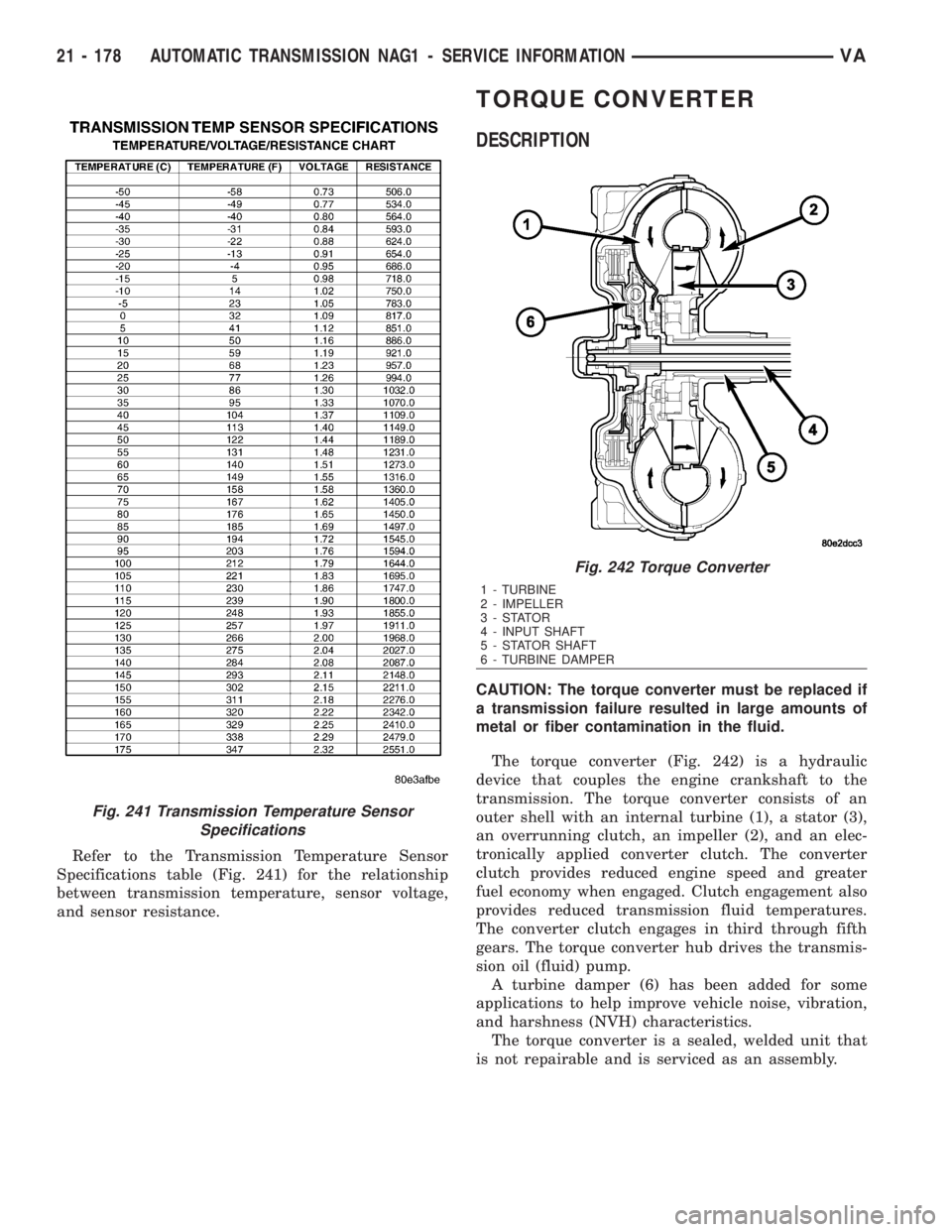
Refer to the Transmission Temperature Sensor
Specifications table (Fig. 241) for the relationship
between transmission temperature, sensor voltage,
and sensor resistance.
TORQUE CONVERTER
DESCRIPTION
CAUTION: The torque converter must be replaced if
a transmission failure resulted in large amounts of
metal or fiber contamination in the fluid.
The torque converter (Fig. 242) is a hydraulic
device that couples the engine crankshaft to the
transmission. The torque converter consists of an
outer shell with an internal turbine (1), a stator (3),
an overrunning clutch, an impeller (2), and an elec-
tronically applied converter clutch. The converter
clutch provides reduced engine speed and greater
fuel economy when engaged. Clutch engagement also
provides reduced transmission fluid temperatures.
The converter clutch engages in third through fifth
gears. The torque converter hub drives the transmis-
sion oil (fluid) pump.
A turbine damper (6) has been added for some
applications to help improve vehicle noise, vibration,
and harshness (NVH) characteristics.
The torque converter is a sealed, welded unit that
is not repairable and is serviced as an assembly.
Fig. 241 Transmission Temperature Sensor
Specifications
Fig. 242 Torque Converter
1 - TURBINE
2 - IMPELLER
3-STATOR
4 - INPUT SHAFT
5 - STATOR SHAFT
6 - TURBINE DAMPER
21 - 178 AUTOMATIC TRANSMISSION NAG1 - SERVICE INFORMATIONVA
Page 1923 of 2305
TURBINE
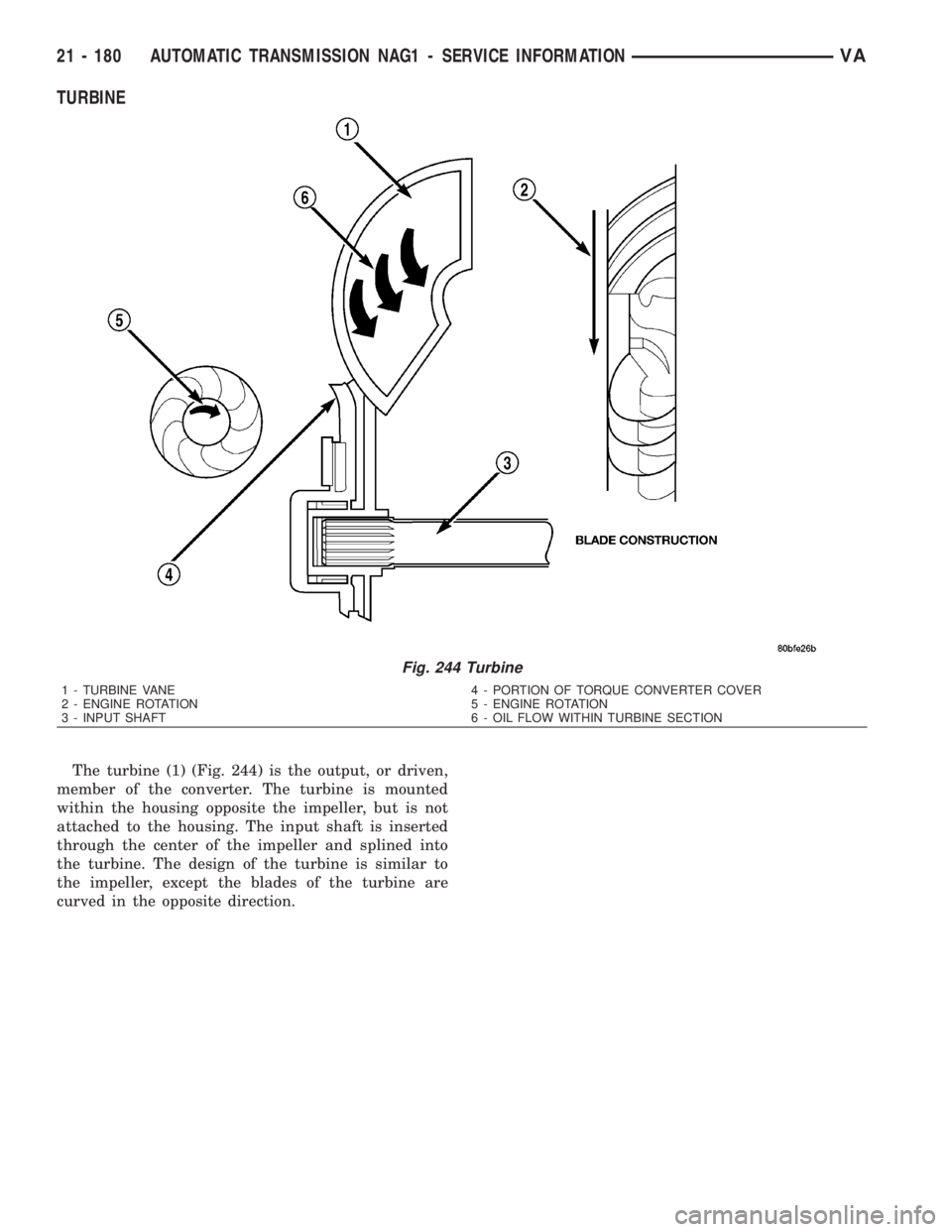
The turbine (1) (Fig. 244) is the output, or driven,
member of the converter. The turbine is mounted
within the housing opposite the impeller, but is not
attached to the housing. The input shaft is inserted
through the center of the impeller and splined into
the turbine. The design of the turbine is similar to
the impeller, except the blades of the turbine are
curved in the opposite direction.
Fig. 244 Turbine
1 - TURBINE VANE 4 - PORTION OF TORQUE CONVERTER COVER
2 - ENGINE ROTATION 5 - ENGINE ROTATION
3 - INPUT SHAFT 6 - OIL FLOW WITHIN TURBINE SECTION
21 - 180 AUTOMATIC TRANSMISSION NAG1 - SERVICE INFORMATIONVA
Page 1924 of 2305
STATOR
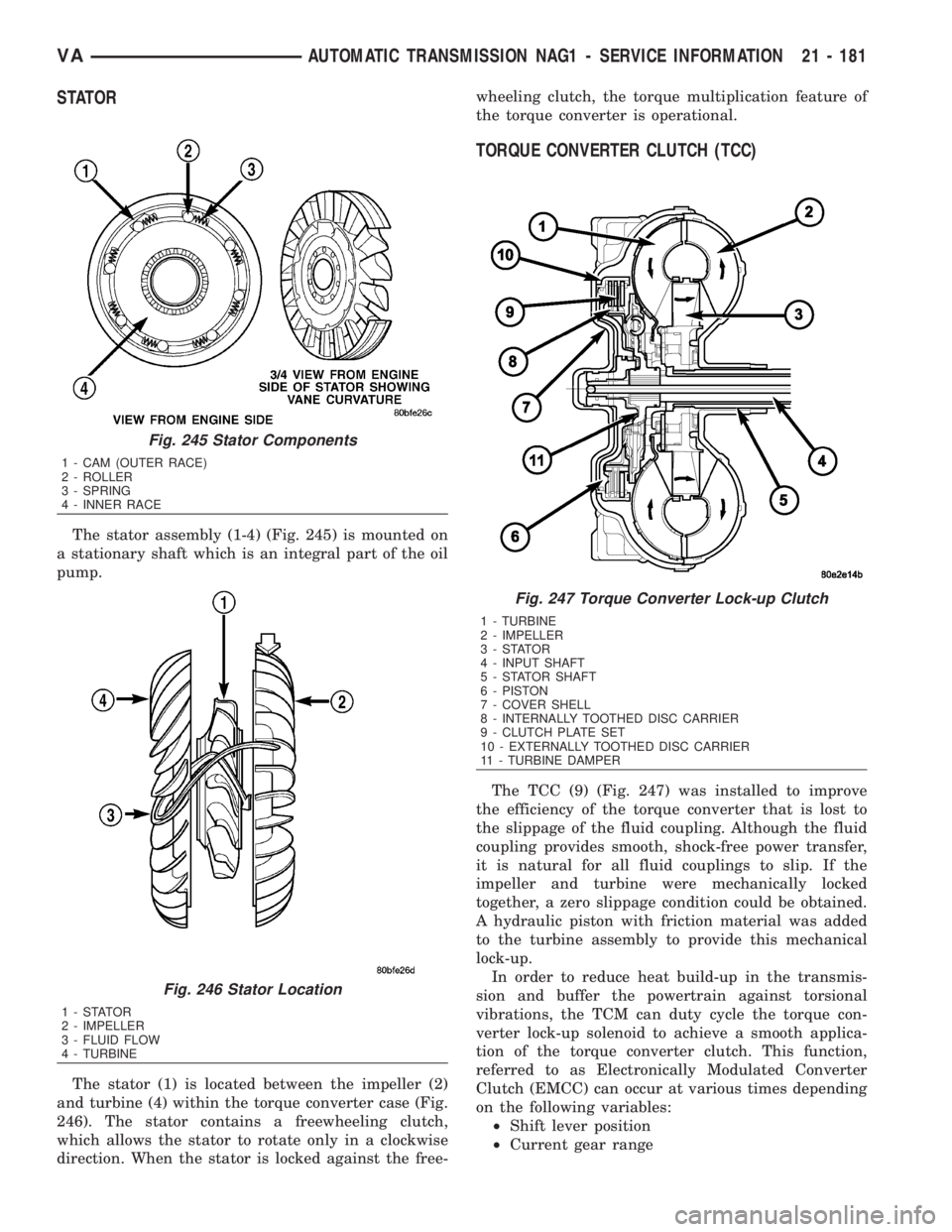
The stator assembly (1-4) (Fig. 245) is mounted on
a stationary shaft which is an integral part of the oil
pump.
The stator (1) is located between the impeller (2)
and turbine (4) within the torque converter case (Fig.
246). The stator contains a freewheeling clutch,
which allows the stator to rotate only in a clockwise
direction. When the stator is locked against the free-wheeling clutch, the torque multiplication feature of
the torque converter is operational.
TORQUE CONVERTER CLUTCH (TCC)
The TCC (9) (Fig. 247) was installed to improve
the efficiency of the torque converter that is lost to
the slippage of the fluid coupling. Although the fluid
coupling provides smooth, shock-free power transfer,
it is natural for all fluid couplings to slip. If the
impeller and turbine were mechanically locked
together, a zero slippage condition could be obtained.
A hydraulic piston with friction material was added
to the turbine assembly to provide this mechanical
lock-up.
In order to reduce heat build-up in the transmis-
sion and buffer the powertrain against torsional
vibrations, the TCM can duty cycle the torque con-
verter lock-up solenoid to achieve a smooth applica-
tion of the torque converter clutch. This function,
referred to as Electronically Modulated Converter
Clutch (EMCC) can occur at various times depending
on the following variables:
²Shift lever position
²Current gear range
Fig. 245 Stator Components
1 - CAM (OUTER RACE)
2 - ROLLER
3 - SPRING
4 - INNER RACE
Fig. 246 Stator Location
1-STATOR
2 - IMPELLER
3 - FLUID FLOW
4 - TURBINE
Fig. 247 Torque Converter Lock-up Clutch
1 - TURBINE
2 - IMPELLER
3-STATOR
4 - INPUT SHAFT
5 - STATOR SHAFT
6 - PISTON
7 - COVER SHELL
8 - INTERNALLY TOOTHED DISC CARRIER
9 - CLUTCH PLATE SET
10 - EXTERNALLY TOOTHED DISC CARRIER
11 - TURBINE DAMPER
VAAUTOMATIC TRANSMISSION NAG1 - SERVICE INFORMATION 21 - 181
Page 1925 of 2305
²Transmission fluid temperature
²Engine coolant temperature
²Input speed
²Throttle angle
²Engine speed
OPERATION
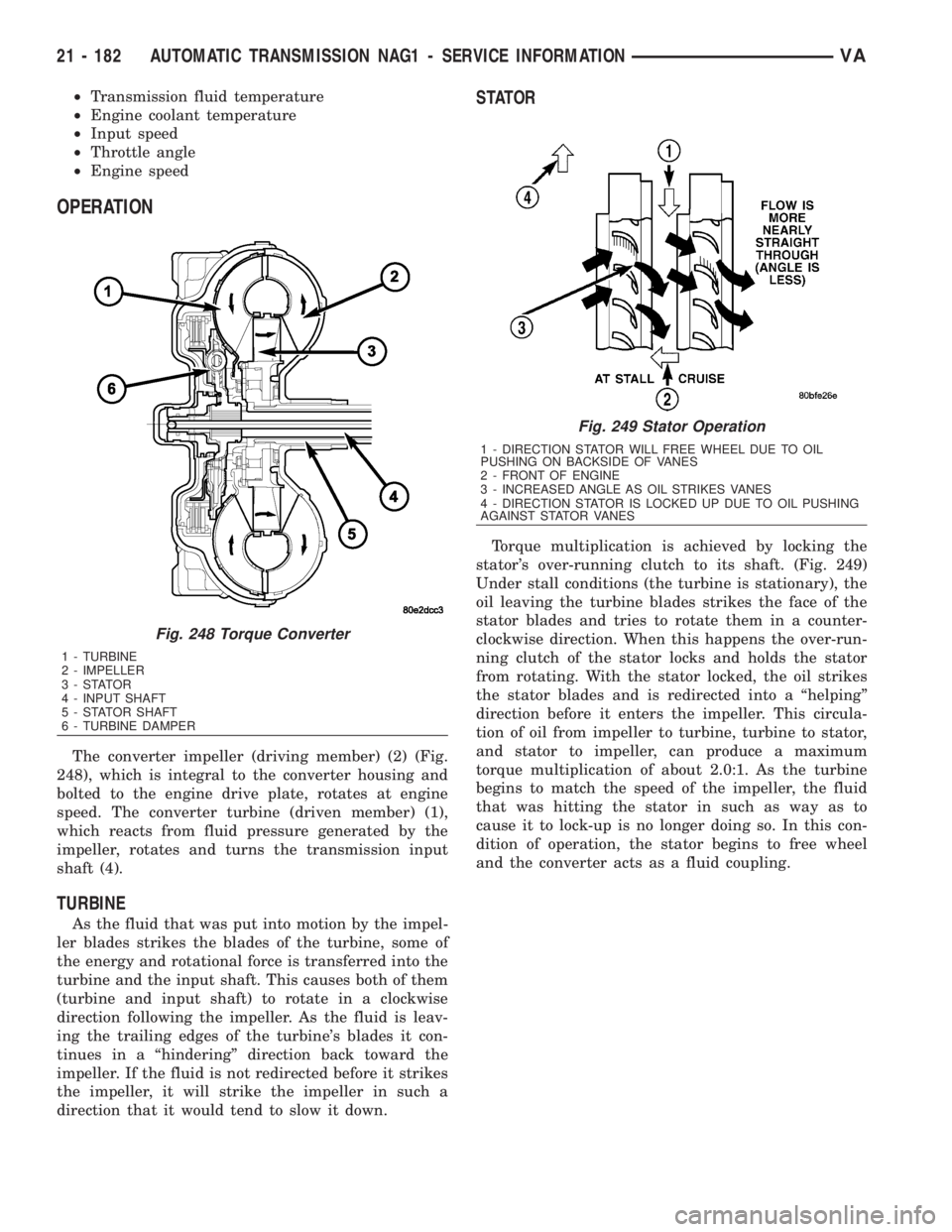
The converter impeller (driving member) (2) (Fig.
248), which is integral to the converter housing and
bolted to the engine drive plate, rotates at engine
speed. The converter turbine (driven member) (1),
which reacts from fluid pressure generated by the
impeller, rotates and turns the transmission input
shaft (4).
TURBINE
As the fluid that was put into motion by the impel-
ler blades strikes the blades of the turbine, some of
the energy and rotational force is transferred into the
turbine and the input shaft. This causes both of them
(turbine and input shaft) to rotate in a clockwise
direction following the impeller. As the fluid is leav-
ing the trailing edges of the turbine's blades it con-
tinues in a ªhinderingº direction back toward the
impeller. If the fluid is not redirected before it strikes
the impeller, it will strike the impeller in such a
direction that it would tend to slow it down.
STATOR
Torque multiplication is achieved by locking the
stator's over-running clutch to its shaft. (Fig. 249)
Under stall conditions (the turbine is stationary), the
oil leaving the turbine blades strikes the face of the
stator blades and tries to rotate them in a counter-
clockwise direction. When this happens the over-run-
ning clutch of the stator locks and holds the stator
from rotating. With the stator locked, the oil strikes
the stator blades and is redirected into a ªhelpingº
direction before it enters the impeller. This circula-
tion of oil from impeller to turbine, turbine to stator,
and stator to impeller, can produce a maximum
torque multiplication of about 2.0:1. As the turbine
begins to match the speed of the impeller, the fluid
that was hitting the stator in such as way as to
cause it to lock-up is no longer doing so. In this con-
dition of operation, the stator begins to free wheel
and the converter acts as a fluid coupling.
Fig. 248 Torque Converter
1 - TURBINE
2 - IMPELLER
3-STATOR
4 - INPUT SHAFT
5 - STATOR SHAFT
6 - TURBINE DAMPER
Fig. 249 Stator Operation
1 - DIRECTION STATOR WILL FREE WHEEL DUE TO OIL
PUSHING ON BACKSIDE OF VANES
2 - FRONT OF ENGINE
3 - INCREASED ANGLE AS OIL STRIKES VANES
4 - DIRECTION STATOR IS LOCKED UP DUE TO OIL PUSHING
AGAINST STATOR VANES
21 - 182 AUTOMATIC TRANSMISSION NAG1 - SERVICE INFORMATIONVA