2006 MERCEDES-BENZ SPRINTER coolant level
[x] Cancel search: coolant levelPage 18 of 2305

3.2.2 CAN BUS
The CAN bus (controller area network) is a data
bus system specifically design for inter module
communication on this vehicle. The CAN bus con-
sists of a special twisted two-core cable. Control
modules are connected to this9twisted pair9. The
CAN bus incorporates two terminating resistors.
One terminator is built into the Engine Control
Module (ECM) and the other is built into the Sentry
Key Remote Entry Module (SKREEM). Each resis-
tor has a value of 120 ohms. The resistor condition
can be confirmed by disconnecting the control mod-
ule and measuring the resistance value at the
appropriate control module pins. This measure-
ment should read 120 ohms. The two CAN circuits,
CAN C Bus (+) and CAN C Bus (-), are bridged by
these two terminating resistors when all control
modules are connected to the bus. These two resis-
tors are connected to the CAN bus network in
parallel. The measurement between the two
twisted CAN circuits, with both the ECM and
SKREEM connected, should measure a value of 60
ohms.
The CAN bus is bi-directional. This means that
each connected control module can send and receive
information. Transmission of data takes place re-
dundantly via both circuits. The data bus levels are
mirrored, meaning that if the binary level on one
circuit is 0, the other circuit transmits binary level
1 and vice versa. The two line concept is used for
two reasons: for fault identification and as a safety
concept.
If a voltage peak occurs on just one circuit, the
receivers can identify this as a fault and ignore the
voltage peak. If a short circuit or interruption
occurs on one of the two CAN circuits, a software-
hardware linked safety concept allows switching to
a single-line operation. The defective CAN circuit is
shut down. A specific data protocol controls how and
when the participants can send and receive.
NOTE: It is important to note the CAN Bus
circuits are used for inter-module
communication only, and is no way
connected to the K-Lines.
The following modules that use the CAN Bus on
this vehicle are:
²Automatic Temperature Control (ATC)
²Controller Antilock Brake (CAB)
²Engine Control Module (ECM)
²Instrument Cluster (IC)
²Sentry Key Remote Entry Module (SKREEM)
²Shifter Assembly (SA)
²Transmission Control Module (TCM)
3.3 HEATING & A/C SYSTEM
3.3.1 AUTOMATIC TEMPERATURE
CONTROL (ATC)
3.3.1.1 SYSTEM CONTROLS
The ATC Module:
²is fully addressable with the DRBIIIt.
IThe DRBIIItcommunicates with the ATC
Module through the Diagnostic Link Connector
(DLC) via a K-Line.
²communicates with other modules over the Con-
troller Area Network (CAN) C Bus.
²controls A/C clutch operation.
²controls EBL operation.
²controls water cycle valve operation.
IThe water cycle valve is a normally open valve,
meaning that it allows full engine coolant flow
through the heater core when no power is
delivered to the valve. The ATC controls the
valve with a pulse width signal. The lower the
percentage of the pulse width signal the more
the valve is open.
²controls Residual Heat Utilization (REST) func-
tion.
²controls blower motor operation, providing four
blower speeds (Low, M1, M2, & High).
²controls recirculation air solenoid valve.
²controls the mode door via cables.
²controls the main power supply to the Heater
Booster (if equipped).
²uses air inlet temperature sensor, air outlet tem-
perature sensor, and evaporator temperature
sensor input, as well as data from other modules
to maintain occupant comfort levels.
3.3.1.2 SYSTEM DIAGNOSTICS
Fault detection is through active and stored Diag-
nostic Trouble Codes (DTCs)
²DTCs are displayed by the DRBIIIt.
²Active DTCs are those which currently exist in
the system. The condition causing the fault must
be repaired in order to clear this type of DTC.
²Stored DTCs are those which occurred in the
system since the ATC Module received the last
9clear diagnostic info9message.
Testing Preparation & Diagnostics
Set the necessary system functions accordingly so
that all of the following prerequisites are met prior
to performing diagnostic tests on the ATC system:
5
GENERAL INFORMATION
Page 22 of 2305
Static Heater Signal
A status of9ON9indicates that the heater module
sees the9Stationary Heating Mode ON9signal after
switching on the heater with the heater timer or the
auxiliary heater switch. A status of9OFF9indicates
that the9Stationary Heating Mode ON9signal is
not present at the heater module.
Heater Booster Mode Signal
A status of9ON9indicates that the heater module
sees the9Heater Booster Mode ON9signal after
switching on the heater with the auxiliary heater
switch. A status of9OFF9indicates that the9Heater
Booster Mode ON9signal is not present at the
heater module.
3.4 INSTRUMENT CLUSTER
The Instrument Cluster has easy-to-read instru-
ments, is capable of CAN bus communication and
provides a diagnostic function. The Instrument
Cluster with analog speedometer, tachometer, fuel
and coolant temperature gauges comes in two ver-
sions.
²Speedometer with outer miles-per-hour (mph)
scale and inner kilometers-per-hour (km/h) scale.
Coolant temperature is indicated in Fahrenheit
(for US).
²Speedometer with outer kilometers-per-hour
(km/h) scale and inner miles-per-hours (mph)
scale. Coolant temperature is indicated in de-
grees Celsius (for Canada).
Below the speedometer, there is a LCD multi-
function indicator in clear view of the driver. Warn-
ing and indicator lights (based on colored light
emitting diodes) are located in the bottom of the
instrument cluster with the exception of the turn
signal indicator lights, ASR warning light and re-
serve fuel warning light. The warning lights for the
seat belt usage and parking brake/brake fluid level
are located in the line above the bottom line. The
indicator that illuminates up when the parking
brake is applied or the brake fluid level is low is
different for U.S. and Canada.
When the key is turned to the 2nd position in the
ignition, the function of the following indicator
lights is checked automatically: High Beam ON,
Preheating, airbag malfunction. In case of a broken
LED of the airbag malfunction light, the seat belt
usage warning light will flash for 6 seconds after
the function check is finished. The Instrument
Cluster is operated with the help of 4 buttons
located below the multifunction indicator. The back-
lighting for the instrument cluster uses yellow
LED's and can be adjusted electronically to daylight
and darkness.The instrument cluster includes a warning
buzzer, which sounds (in addition to a warning light
in some cases) when:
²The headlights are on with the ignition off and
the door opened.
²The driver 's seat belt is not fastened with the
ignition on.
²The key is in the ignition and the door is open.
²Critical ASSYST information is displayed in the
multifunction indicator.
3.5 POWER DOOR LOCKS/RKE
3.5.1 CENTRAL LOCKING
The Central Locking System locks all vehicle
doors if any door is locked from the inside or
mechanically locked with the key from the outside.
However, unlocking any door, in that manner, will
only unlock that particular door. The Master Door
Lock Switch on the dash enables the operator to
lock/unlock all doors. By pressing the top of the
rocker type switch once, all doors will lock. Pressing
the switch again will unlock all doors. Pressing the
lower part of the switch once will lock all doors
except the driver door. Pressing the lower part
again will unlock all doors except the driver door. If
the Central Locking System automatically unlocks
after the vehicle was attempted to be locked, at
least one door is not properly closed.
There are two LED indicators in the Master Door
Lock Switch. The left indicator is for the driver door
and the right indicator is for all passenger/cargo
doors. These will indicate if a door is ajar or if the
doors are locked. The door ajar switches are part of
the door lock motor and are mounted in the door
latch assembly.
Inside each door lock motor there is a command
switch. The command switch is operated by the
plunger and signals any change in the lock status,
locked or unlocked. Each command switch is wired
to the Central Timer Module (CTM) sometimes
referred to as the Central Locking Module. If all
doors are closed and are unlocked, and any door is
locked by the key or the interior handle, thereby
changing the command switch, all doors will be
locked. If one of the door lock motors does not reach
the end position after a locking command, it will be
detected by the CTM (command switch not in
9Locked9position) and the vehicle will be unlocked.
3.5.2 REMOTE KEYLESS ENTRY (RKE)
The SKREEM is a combination of the Remote
Keyless Entry Module and the SKIM (Sentry Key
Immobilizer Module). It is located behind the In-
strument Cluster and has an antenna that goes up
9
GENERAL INFORMATION
Page 292 of 2305

INSTRUMENT CLUSTER C1CAV CIRCUIT FUNCTION
1 20BR FUEL LEVEL SENSOR SIGNAL RETURN
2 20BR/DG AMBIENT TEMPERATURE SENSOR SIGNAL RETURN
4 20WT/GY K-IC/ATC/HBM/CHM
5 20BR/BK PARK BRAKE INDICATOR SIGNAL
7 20BK/DG RIGHT TURN SIGNAL
10 20BL/BK FUEL LEVEL SENSOR SIGNAL (+)
11 20BL/DG AMBIENT TEMPERATURE SENSOR SIGNAL (+)
14 20DG/WT/BL ENGINE COOLANT LEVEL SWITCH SIGNAL
15 20BR/WT FRONT COURTESY LAMPS CONTROL
16 20YL/RD SEAT BELT SWITCH SIGNAL
17 20DG CAN C BUS (-)
18 20DG/WT CAN C BUS (+)
INSTRUMENT CLUSTER C2 - WHITECAV CIRCUIT FUNCTION
1- -
2- -
3 20RD/YL FUSED B(+)
4 20BR/WT BRAKE WEAR SENSOR SIGNAL
5- -
6 18BR GROUND
7 20GY/DG/RD LAMP DRIVER
8 20BL/WT FUSED HIGH BEAM SWITCH OUTPUT
9 20BL/RD/WT VEHICLE SPEED SENSOR OUTPUT
10 20BK FUSED IGNITION SWITCH OUTPUT (RUN-START)
11 20BL/BK KEY-IN IGNITION SWITCH SIGNAL
12 - -
13 20BK/WT LEFT TURN SIGNAL
14 20BR/YL BRAKE FLUID LEVEL INDICATOR SIGNAL
15 20BL GENERATOR FIELD DRIVER
16 20YL AIRBAG WARNING INDICATOR DRIVER
17 - -
18 20BL/VT D(+) RELAY NO. 1 CONTROL
18 20BL/VT D(+) RELAY NO. 1 CONTROL
INTRUSION SENSOR NO. 1 - BLACKCAV CIRCUIT FUNCTION
1 20BR GROUND
2 20DG/BK INTRUSION SENSOR 1 SIGNAL
3 20DG/YL INTRUSION SENSOR INTERFACE
4 20RD/DG FUSED B(+)
INTRUSION SENSOR NO. 2 - BLACKCAV CIRCUIT FUNCTION
1 20BR GROUND
2 20GY/BK INTRUSION SENSOR 2 SIGNAL
3 20DG/YL INTRUSION SENSOR INTERFACE
4 20RD/DG FUSED B(+)
C
O
N
N
E
C
T
O
R
P
I
N
O
U
T
S
279
CONNECTOR PINOUTS
Page 428 of 2305

ecm internal error 3
ecm internal error 4
ecm internal error 4
ecm internal error 5
ecm internal fault
ecm invalid coding
ecm invalid data
ecm read error
ecm read/write error
ecm supply voltage too low
ecm voltage supply is too high
ecm voltage supply is too low
ecm write error
egr flow rate is too high
egr flow rate is too low
egr valve excessive current
egr valve signal circuit open circuit
egr valve signal circuit shorted to ground
egr valve signal circuit shorted to ground
egr valve signal circuit shorted to voltage
engine control relay plausibility
engine control relay shuts off too early
engine control relay shuts off too late
engine coolant temp sensor circuit plausibility
engine coolant temp sensor circuit plausibility
engine coolant temp sensor circuit plausibility with
engine oil sensor
engine coolant temp sensor circuit signal voltage too
high
engine coolant temp sensor circuit signal voltage too
high
engine coolant temp sensor circuit signal voltage too
low
engine coolant temp sensor circuit signal voltage too
low
*engine cranks but will not start
engine oil sensor circuit invalid level
engine oil sensor circuit level out of range
engine oil sensor circuit level out of range
engine oil sensor monitoring error
engine oil sensor oil temperature plausibility
engine oil sensor open circuit
engine oil sensor poor oil quality
engine oil sensor quality measurement error
engine oil sensor quality plausibility
engine oil sensor signal error
engine oil sensor signal plausibility
engine oil sensor signal voltage is too high
engine oil sensor signal voltage is too low
engine oil sensor synchronization error
engine oil sensor water contamination
*engine will not crank
esm can message missing or incorrect
etc can message missing or incorrect
fuel injector 1 read too large
fuel injector 1 read too large
fuel injector 1 read too small
fuel injector 1 read too smallfuel injector 2 read too large
fuel injector 2 read too large
fuel injector 2 read too small
fuel injector 2 read too small
fuel injector 3 read too large
fuel injector 3 read too large
fuel injector 3 read too small
fuel injector 3 read too small
fuel injector 4 read too large
fuel injector 4 read too large
fuel injector 4 read too small
fuel injector 4 read too small
fuel injector 5 read too large
fuel injector 5 read too large
fuel injector 5 read too small
fuel injector 5 read too small
fuel press sensor circuit malf signal voltage too high
fuel press sensor circuit malf signal voltage too low
fuel press solenoid signal plausibility high
fuel press solenoid signal plausibility low
fuel pressure sensor circuit signal voltage too high
fuel pressure sensor circuit signal voltage too low
fuel pressure solenoid circuit excessive current
fuel pressure solenoid circuit open circuit
fuel pressure solenoid circuit shorted to ground or
b+
fuel pump relay circuit open circuit
fuel pump relay circuit shorted to ground
fuel pump relay circuit shorted to voltage
fuel pump relay excessive current
fuel quantity solenoid ecm thermal overload
fuel quantity solenoid open circuit
fuel quantity solenoid short to ground
fuel quantity solenoid short to ground
fuel quantity solenoid short to voltage
fuel rail pressure malfunction deceleration error
fuel rail pressure malfunction deceleration error
fuel rail pressure malfunction fuel flow below min-
imum quantity
fuel rail pressure malfunction maximum fuel flow
exceeded
fuel rail pressure malfunction maximum fuel pres-
sure exceeded
fuel rail pressure malfunction maximum fuel pres-
sure exceeded
fuel rail pressure malfunction maximum fuel pres-
sure exceeded
fuel rail pressure malfunction plausibility with fuel
pressure solenoid
fuel rail pressure malfunction rail pressure is too
high
fuel rail pressure malfunction rail pressure is too
low
fuel rail pressure malfunction rail pressure is too
low
fuel rail pressure malfunction rail pressure is too
low
fuel rail pressure malfunction rail pressure too high
5
GENERAL INFORMATION
Page 463 of 2305

Symptom List:
P0115-ENGINE COOLANT TEMP SENSOR CIRCUIT PLAUSIBILITY
P2012-ENGINE COOLANT TEMP SENSOR CIRCUIT PLAUSIBILITY
Test Note: All symptoms listed above are diagnosed using the same tests.
The title for the tests will be P0115-ENGINE COOLANT TEMP
SENSOR CIRCUIT PLAUSIBILITY.
POSSIBLE CAUSES
ECT SENSOR
ECT SENSOR - COLD
ECT SENSOR - HOT
HGH RESISTANCE IN ECT SENSOR CIRCUITS
ENGINE COLD TOO LONG
TEST ACTION APPLICABILITY
1Note: The best way to diagnose this DTC is to allow the vehicle to remain
outside overnight in order to have a completely cold soaked engine.
Note: Extremely cold outside ambient temperatures may cause this DTC to
set.
Verify that the coolant level is correct.
Start the engine.
With the DRBIIIt, set the engine RPM to 1500 and allow the engine to warm up for
10-15 minutes.
With the DRBIIIt, monitor the Engine Coolant Temperature value during the warm
up cycle. Make sure the transition of temperature change is smooth.
Did the engine temperature reach a minimum of 80É C (176É F)?All
Ye s!Go To 2
No!Refer to the Service Information for cooling system performance
diagnosis. The most probable cause is a Thermostat problem.
Also, refer to any related TSBs.
Perform ROAD TEST VERIFICATION - VER-2.
2NOTE: The engine temperature must be below 50ÉC (120ÉF) for this test.
NOTE: The thermostat must be operating correctly for this test to be valid.
With the DRBIIItin Sensors, read and note the engine coolant temperature.
Using a temperature probe, measure the engine block temperature near the ECT
Sensor.
Are the readings within 7ÉC (13ÉF) of each other?All
Ye s!Go To 3
No!Go To 4
40
DRIVEABILITY - DIESEL
Page 465 of 2305

Symptom:
P0115-ENGINE COOLANT TEMP SENSOR CIRCUIT PLAUSIBILITY
WITH ENGINE OIL SENSOR
When Monitored and Set Condition:
P0115-ENGINE COOLANT TEMP SENSOR CIRCUIT PLAUSIBILITY WITH EN-
GINE OIL SENSOR
When Monitored: With the engine running.
Set Condition: The ECT Sensor signal indicates a different engine temperature than the
EOS Sensor.
POSSIBLE CAUSES
CURRENT DTC
ECT SENSOR
ECT SENSOR - COLD
ECT SENSOR - HOT
ENGINE OIL SENSOR SENSOR
HGH RESISTANCE IN ECT SENSOR CIRCUITS
ENGINE COLD TOO LONG
TEST ACTION APPLICABILITY
1 Verify that the coolant level is correct.
Start the engine.
NOTE: The thermostat must be operating correctly for this test to be valid.
With the DRBIIIt, erase ECM DTCs.
With the DRBIIIt, set the engine RPM to 1500 and allow the engine to warm up for
10-15 minutes.
With the DRBIIIt, monitor the Engine Coolant Temperature value during the warm
up cycle. Make sure the transition of temperature change is smooth.
Did the engine temperature reach a minimum of 80É C (176É F)?All
Ye s!Go To 2
No!Refer to the Service Information for cooling system performance
diagnosis. The most probable cause is a Thermostat problem.
Also, refer to any related TSBs.
Perform ROAD TEST VERIFICATION - VER-2.
2 Turn the ignition on.
With the DRBIIIt, read the ECM DTCs.
Did this DTC return after performing the previous test?All
Ye s!Go To 3
No!Check for possible connecor or wiring problems at the ECT sensor
that may cause an intermittent problem. Repair as necessary.
Test Complete.
Perform ROAD TEST VERIFICATION - VER-2.
42
DRIVEABILITY - DIESEL
Page 537 of 2305

TEST ACTION APPLICABILITY
1NOTE: If DTC P1611, P2306 or P2332 is present with this DTC, diagnose
DTCs P1611, P2306 or P2332 before diagnosing this DTC.
NOTE: If the ECM detects and stores a DTC, the ECM also stores the
engine/vehicle operating conditions under which the DTC was set. Some of
these conditions are displayed on the DRB at the same time the DTC is
displayed.
NOTE: Before erasing stored DTCs, record these conditions. Attempting to
duplicate these conditions may assist when checking for an active DTC.
NOTE: The engine oil must be at the proper level for this test to be valid.
Refer to the Service Information and ensure the engine oil level is at the
specified level.
Turn the ignition on.
With the DRB, erase ECM DTCs.
Start the engine several times, letting the engine run for at least 30 seconds at a
time.
With the DRB, read ECM DTCs.
Did this DTC set again?All
Ye s!Go To 2
No!Go To 10
2WARNING: WHEN THE ENGINE IS OPERATING, DO NOT STAND IN A
DIRECT LINE WITH THE FAN. DO NOT PUT YOUR HANDS NEAR THE
PULLEYS, BELTS OR FAN. DO NOT WEAR LOOSE CLOTHING.
Refer to any Technical Service Bulletins (TSB) that may apply.
Turn the ignition off.
NOTE: This DTC implies that the engine may be contaminated by water,
engine coolant or other material due to a mechanical or service failures
such as failed gaskets, seals, cracks or incorrectly installed components.
Inspect the engine for conditions referred to in the above note.
Were any of the above conditions present?All
Ye s!Repair as necessary.
Perform ROAD TEST VERIFICATION - VER-2.
No!Go To 3
3 Turn the ignition off.
Disconnect the Engine Oil Sensor harness connector.
Turn the ignition on.
Measure the voltage of the Engine Oil Sensor Signal circuit.
Select the appropriate voltage reading.All
Voltage is above 5.4 volts.
Go To 4
Voltage is between 4.7 and 5.4 volts.
Go To 5
Voltage is below 4.7 volts.
Go To 7
11 4
DRIVEABILITY - DIESEL
P2014-ENGINE OIL SENSOR OIL TEMPERATURE PLAUSIBILITY Ð
Continued
Page 716 of 2305
LUBRICATION & MAINTENANCE
TABLE OF CONTENTS
page page
FLUID TYPES
DESCRIPTION
PARTS AND LUBRICANT
RECOMMENDATIONS...................1
AUTOMATIC TRANSMISSION FLUID - NAG1 . 1
AXLE FLUID..........................2
BRAKE FLUID.........................2
HOAT COOLANT.......................2
ENGINE OIL - DIESEL ENGINES...........3
FUEL REQUIREMENTS - DIESEL ENGINE . . . 4
POWER STEERING FLUID...............5
OPERATION - AUTOMATIC TRANSMISSION
FLUID...............................5
FLUID CAPACITIES
SPECIFICATIONS - FLUID CAPACITIES.......5FLUID FILL/CHECK LOCATIONS
INSPECTION - FLUID FILL/CHECK
LOCATIONS..........................5
HOISTING
STANDARD PROCEDURE - HOISTING........5
JUMP STARTING
STANDARD PROCEDURE - JUMP STARTING . . 6
TOWING
STANDARD PROCEDURE - TOWING.........7
MAINTENANCE SCHEDULES
DESCRIPTION..........................8
INTERNATIONAL SYMBOLS
DESCRIPTION..........................9
FLUID TYPES
DESCRIPTION
PARTS AND LUBRICANT RECOMMENDATIONS
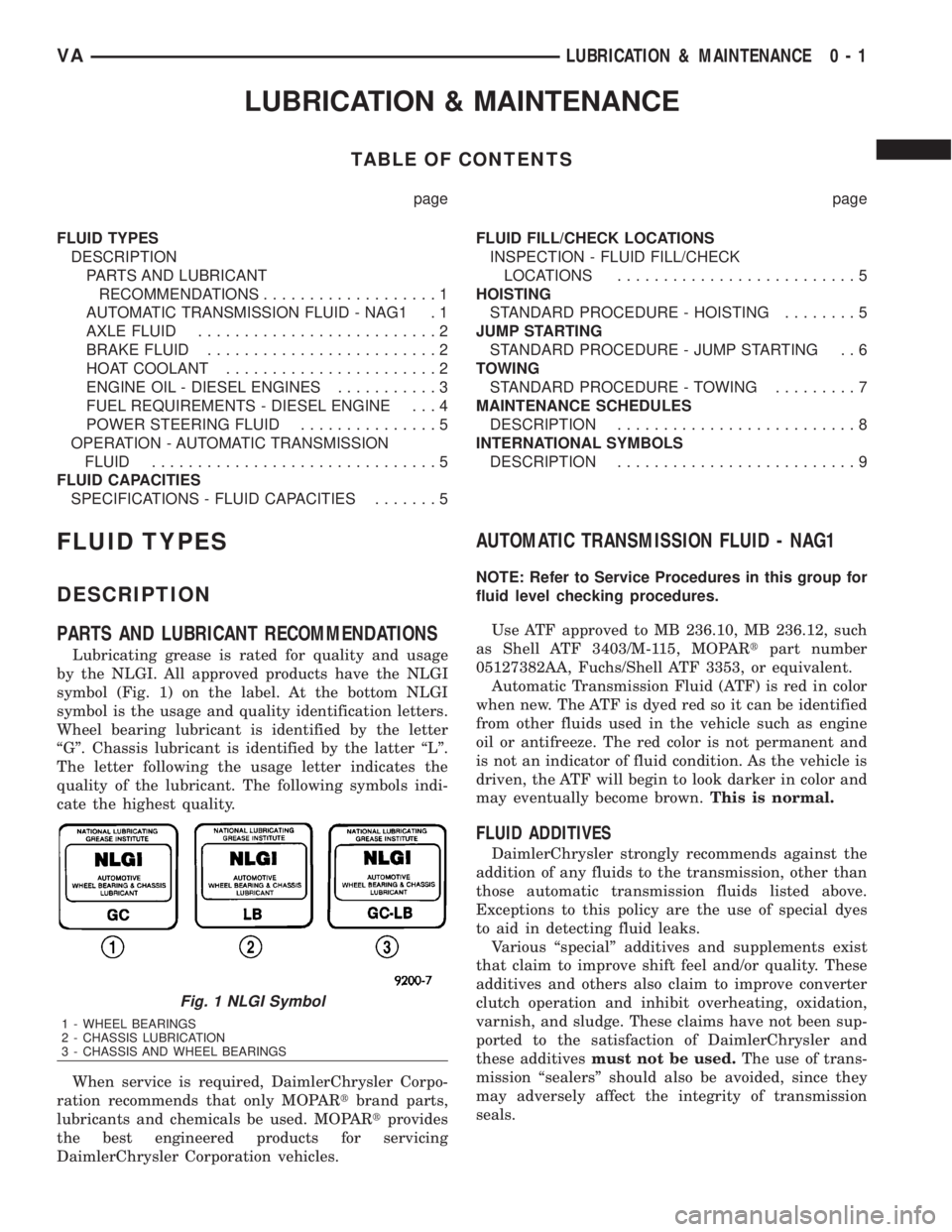
Lubricating grease is rated for quality and usage
by the NLGI. All approved products have the NLGI
symbol (Fig. 1) on the label. At the bottom NLGI
symbol is the usage and quality identification letters.
Wheel bearing lubricant is identified by the letter
ªGº. Chassis lubricant is identified by the latter ªLº.
The letter following the usage letter indicates the
quality of the lubricant. The following symbols indi-
cate the highest quality.
When service is required, DaimlerChrysler Corpo-
ration recommends that only MOPARtbrand parts,
lubricants and chemicals be used. MOPARtprovides
the best engineered products for servicing
DaimlerChrysler Corporation vehicles.
AUTOMATIC TRANSMISSION FLUID - NAG1
NOTE: Refer to Service Procedures in this group for
fluid level checking procedures.
Use ATF approved to MB 236.10, MB 236.12, such
as Shell ATF 3403/M-115, MOPARtpart number
05127382AA, Fuchs/Shell ATF 3353, or equivalent.
Automatic Transmission Fluid (ATF) is red in color
when new. The ATF is dyed red so it can be identified
from other fluids used in the vehicle such as engine
oil or antifreeze. The red color is not permanent and
is not an indicator of fluid condition. As the vehicle is
driven, the ATF will begin to look darker in color and
may eventually become brown.This is normal.
FLUID ADDITIVES
DaimlerChrysler strongly recommends against the
addition of any fluids to the transmission, other than
those automatic transmission fluids listed above.
Exceptions to this policy are the use of special dyes
to aid in detecting fluid leaks.
Various ªspecialº additives and supplements exist
that claim to improve shift feel and/or quality. These
additives and others also claim to improve converter
clutch operation and inhibit overheating, oxidation,
varnish, and sludge. These claims have not been sup-
ported to the satisfaction of DaimlerChrysler and
these additivesmust not be used.The use of trans-
mission ªsealersº should also be avoided, since they
may adversely affect the integrity of transmission
seals.
Fig. 1 NLGI Symbol
1 - WHEEL BEARINGS
2 - CHASSIS LUBRICATION
3 - CHASSIS AND WHEEL BEARINGS
VALUBRICATION & MAINTENANCE 0 - 1