2006 DODGE RAM SRT-10 check engine light
[x] Cancel search: check engine lightPage 1246 of 5267
When Monitored:
With battery voltage greater than 8 volts during engine cranking or greater than 12 volts with engine running,
engine rpm less than 2016, and none of the coils in dwell when checked.
Set Condition:
Peak current is not achieved with battery based dwell plus 1.5 ms of diagnostic offset. It takes less than 3
seconds during cranking or up to 6 seconds while running to set.
Possible Causes
(K343) ASD RELAY OUTPUT CIRCUIT
IGNITION COIL
(K17) IGNITION COIL NO.2 CONTROL CIRCUIT OPEN
(K17) IGNITION COIL NO.2 CONTROL CIRCUIT SHORTED TO GROUND
PCM
Always perform the Pre-Diagnostic Troubleshooting procedure before proceeding. (Refer to 9 - ENGINE -
DIAGNOSIS AND TESTING)
1.GOOD TRIP EQUAL TO ZERO
Ignition on, engine not running.
With the scan tool, read DTCs and record the related Freeze Frame data.
Is the Good Trip Counter displayed and equal to zero?
Ye s>>
Go To 2
No>>
Refer to the INTERMITTENT CONDTION Diagnostic Procedure.
Perform POWERTRAIN VERIFICATION TEST. (Refer to 9 - ENGINE - STANDARD PROCEDURE)
2.(K343) ASD RELAY OUTPUT CIRCUIT
Turn the ignition off.
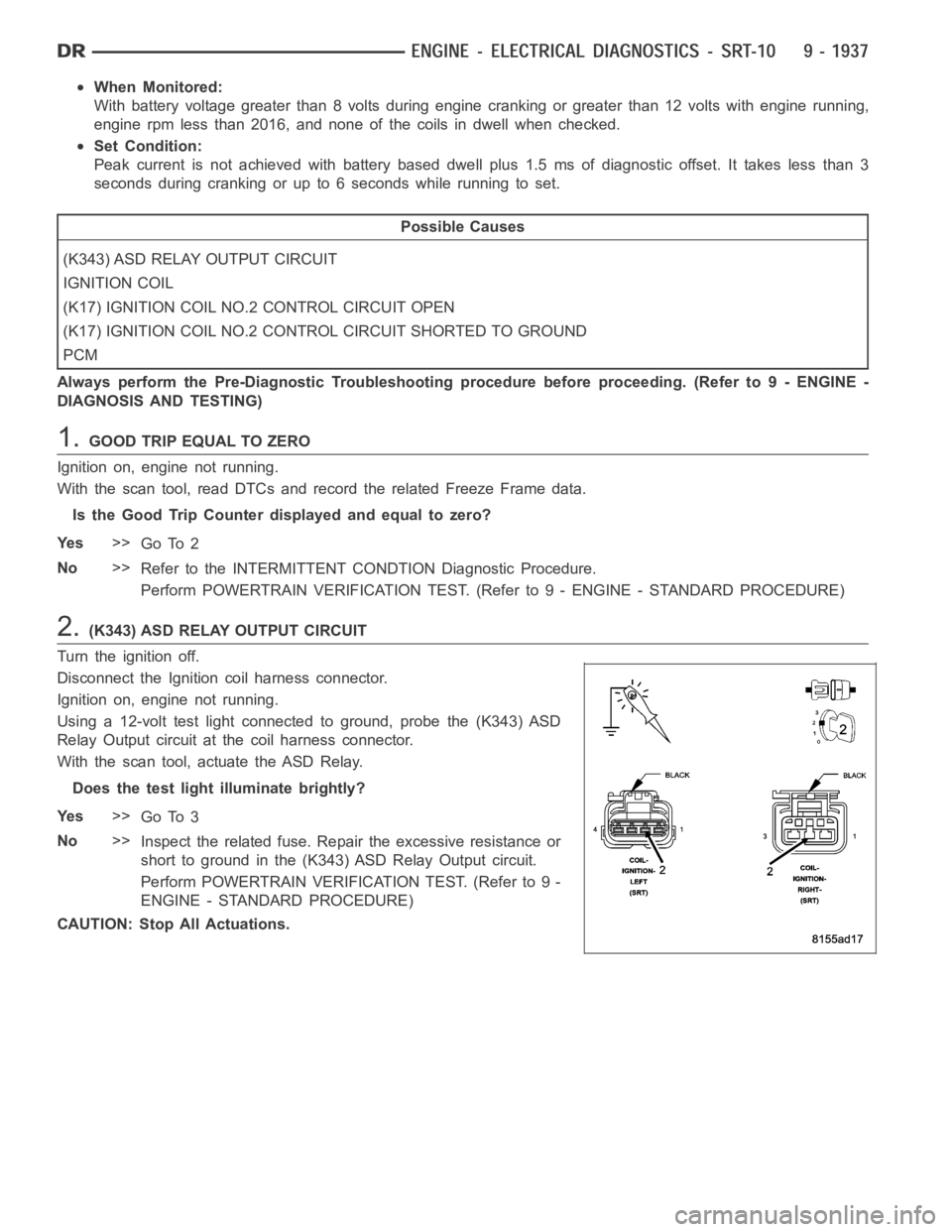
Disconnect the Ignition coil harness connector.
Ignition on, engine not running.
Using a 12-volt test light connected to ground, probe the (K343) ASD
Relay Output circuit at the coil harness connector.
With the scan tool, actuate the ASD Relay.
Does the test light illuminate brightly?
Ye s>>
Go To 3
No>>
Inspect the related fuse. Repair the excessive resistance or
short to ground in the (K343) ASD Relay Output circuit.
Perform POWERTRAIN VERIFICATION TEST. (Refer to 9 -
ENGINE - STANDARD PROCEDURE)
CAUTION: Stop All Actuations.
Page 1250 of 5267
When Monitored:
With battery voltage greater than 8 volts during engine cranking or greater than 12 volts with engine running,
engine rpm less than 2016, and none of the coils in dwell when checked.
Set Condition:
Peak current is not achieved with battery based dwell plus 1.5 ms of diagnostic offset. It takes less than 3
seconds during cranking or up to 6 seconds while running to set.
Possible Causes
(K343) ASD RELAY OUTPUT CIRCUIT
IGNITION COIL
(K18) IGNITION COIL CONTROL NO.3 CIRCUIT OPEN
(K18) IGNITION COIL CONTROL NO.3 CIRCUIT SHORTED TO GROUND
PCM
Always perform the Pre-Diagnostic Troubleshooting procedure before proceeding. (Refer to 9 - ENGINE -
DIAGNOSIS AND TESTING)
1.GOOD TRIP EQUAL TO ZERO
Ignition on, engine not running.
With the scan tool, read DTCs and record the related Freeze Frame data.
Is the Good Trip Counter displayed and equal to zero?
Ye s>>
Go To 2
No>>
Refer to the INTERMITTENT CONDTION Diagnostic Procedure.
Perform POWERTRAIN VERIFICATION TEST. (Refer to 9 - ENGINE - STANDARD PROCEDURE)
2.(K343) ASD RELAY OUTPUT CIRCUIT
Turn the ignition off.
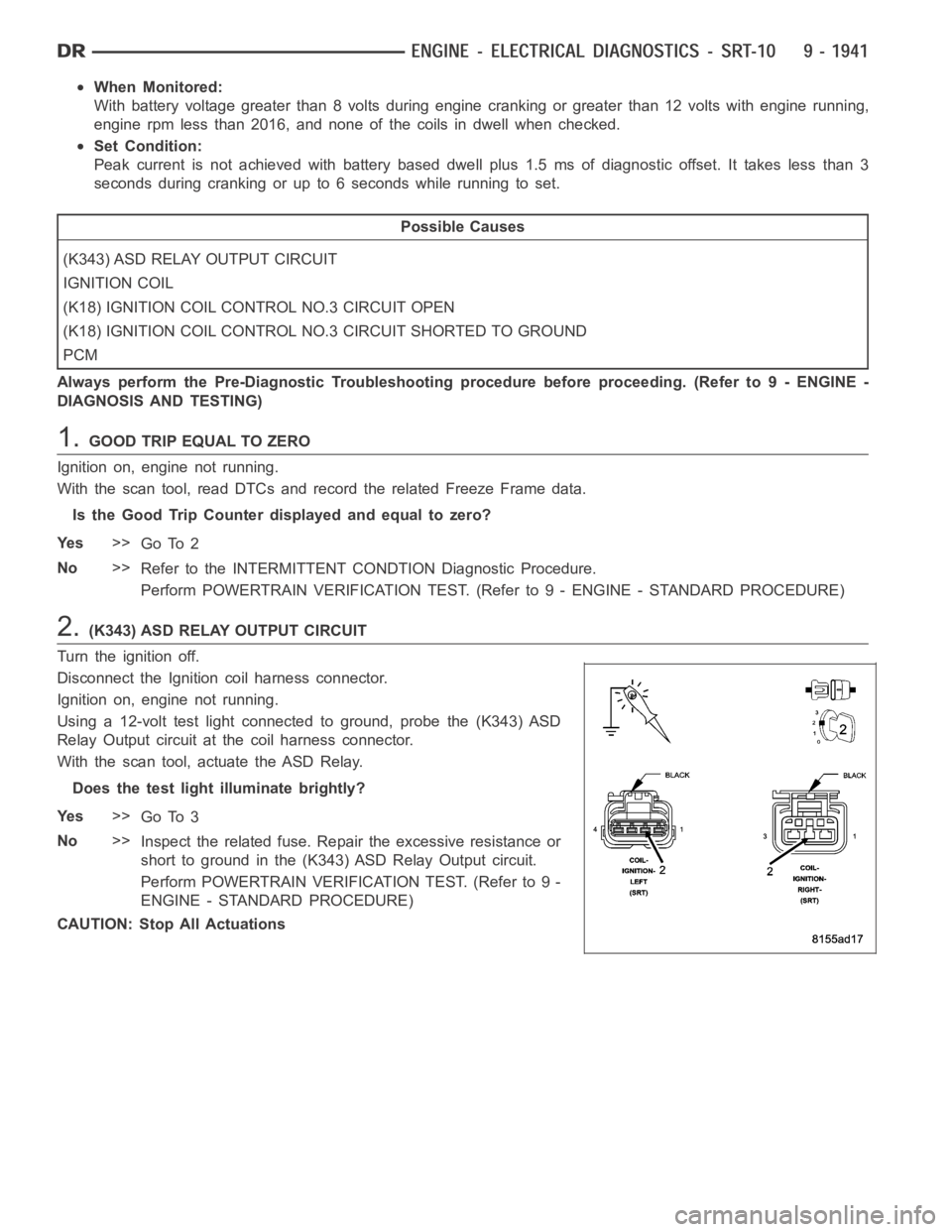
Disconnect the Ignition coil harness connector.
Ignition on, engine not running.
Using a 12-volt test light connected to ground, probe the (K343) ASD
Relay Output circuit at the coil harness connector.
With the scan tool, actuate the ASD Relay.
Does the test light illuminate brightly?
Ye s>>
Go To 3
No>>
Inspect the related fuse. Repair the excessive resistance or
short to ground in the (K343) ASD Relay Output circuit.
Perform POWERTRAIN VERIFICATION TEST. (Refer to 9 -
ENGINE - STANDARD PROCEDURE)
CAUTION: Stop All Actuations
Page 1254 of 5267
When Monitored:
With battery voltage greater than 8 volts during engine cranking or greater than 12 volts with engine running,
engine rpm less than 2016, and none of the coils in dwell when checked.
Set Condition:
Peak current is not achieved with battery based dwell plus 1.5 ms of diagnostic offset. It takes less than 3
seconds during cranking or up to 6 seconds while running to set.
Possible Causes
(K343) ASD RELAY OUTPUT CIRCUIT
IGNITION COIL
(K133) IGNITION COIL CONTROL NO.4 CIRCUIT OPEN
(K133) IGNITION COIL CONTROL NO.4 CIRCUIT SHORTED TO GROUND
PCM
Always perform the Pre-Diagnostic Troubleshooting procedure before proceeding. (Refer to 9 - ENGINE -
DIAGNOSIS AND TESTING)
1.GOOD TRIP EQUAL TO ZERO
Ignition on, engine not running.
With the scan tool, read DTCs and record the related Freeze Frame data.
Is the Good Trip Counter displayed and equal to zero?
Ye s>>
Go To 2
No>>
Refer to the INTERMITTENT CONDTION Diagnostic Procedure.
Perform POWERTRAIN VERIFICATION TEST. (Refer to 9 - ENGINE - STANDARD PROCEDURE)
2.(K343) ASD RELAY OUTPUT CIRCUIT
Turn the ignition off.
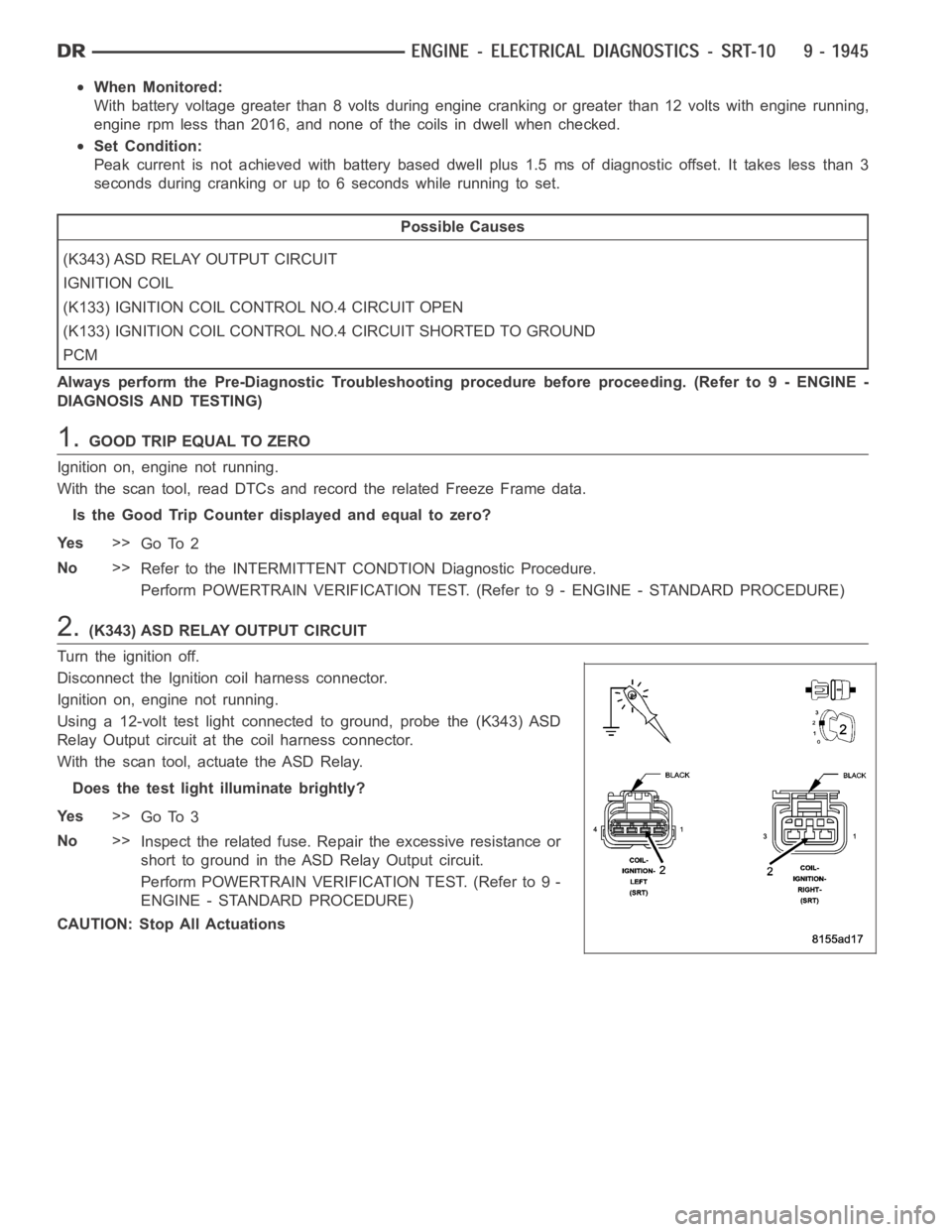
Disconnect the Ignition coil harness connector.
Ignition on, engine not running.
Using a 12-volt test light connected to ground, probe the (K343) ASD
Relay Output circuit at the coil harness connector.
With the scan tool, actuate the ASD Relay.
Does the test light illuminate brightly?
Ye s>>
Go To 3
No>>
Inspect the related fuse. Repair the excessive resistance or
short to ground in the ASD Relay Output circuit.
Perform POWERTRAIN VERIFICATION TEST. (Refer to 9 -
ENGINE - STANDARD PROCEDURE)
CAUTION: Stop All Actuations
Page 1258 of 5267
When Monitored:
With battery voltage greater than 8 volts during engine cranking or greater than 12 volts with engine running,
engine rpm less than 2016, and none of the coils in dwell when checked.
Set Condition:
Peak current is not achieved with battery based dwell plus 1.5 ms of diagnostic offset. It takes less than 3
seconds during cranking or up to 6 seconds while running to set.
Possible Causes
(K343) ASD RELAY OUTPUT CIRCUIT
IGNITION COIL
(K134) IGNITION COIL CONTROL NO.5 CIRCUIT OPEN
(K134) IGNITION COIL CONTROL NO.5 CIRCUIT SHORTED TO GROUND
PCM
Always perform the Pre-Diagnostic Troubleshooting procedure before proceeding. (Refer to 9 - ENGINE -
DIAGNOSIS AND TESTING)
1.GOOD TRIP EQUAL TO ZERO
Ignition on, engine not running.
With the scan tool, read DTCs and record the related Freeze Frame data.
Is the Good Trip Counter displayed and equal to zero?
Ye s>>
Go To 2
No>>
Refer to the INTERMITTENT CONDTION Diagnostic Procedure.
Perform POWERTRAIN VERIFICATION TEST. (Refer to 9 - ENGINE - STANDARD PROCEDURE)
2.(K343) ASD RELAY OUTPUT CIRCUIT
Turn the Ignition off.
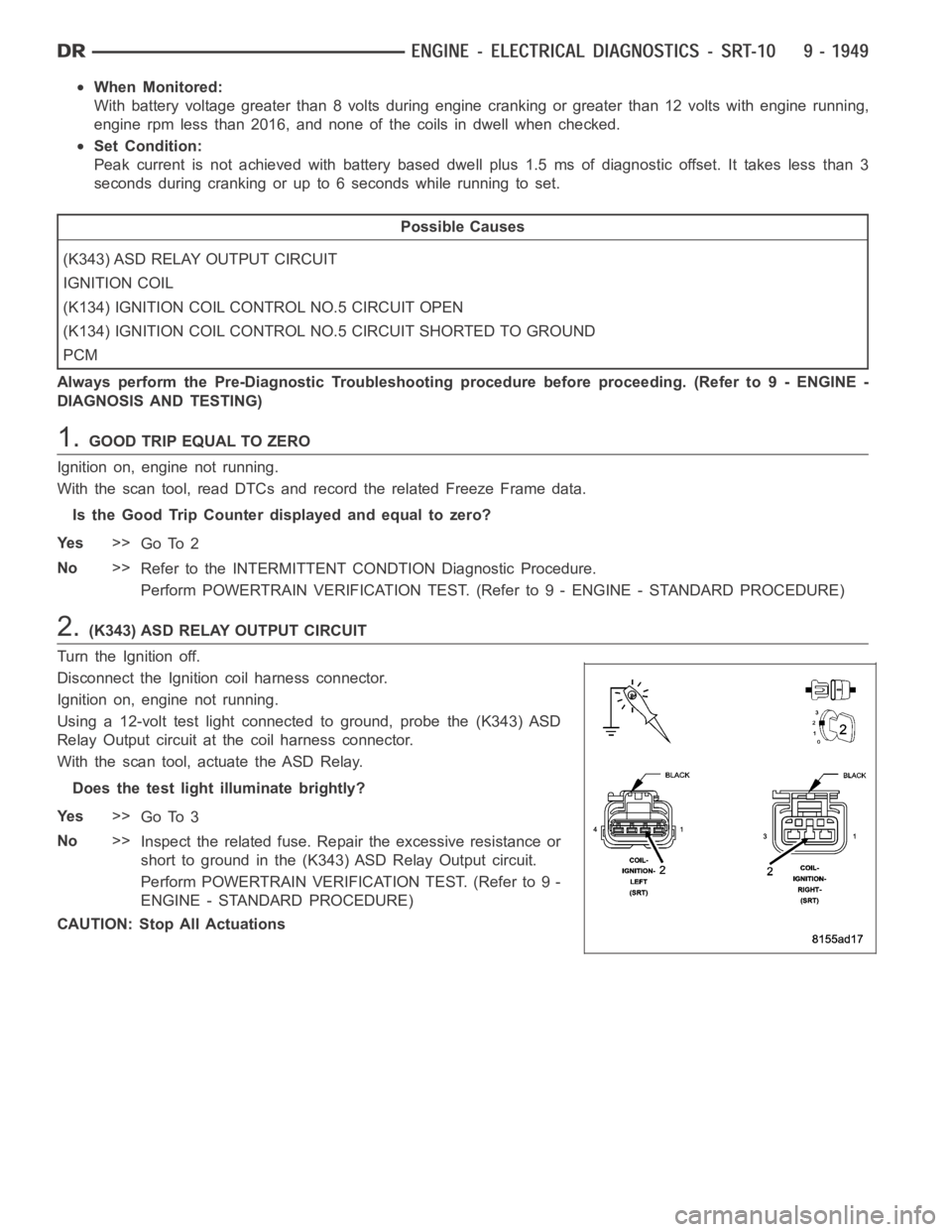
Disconnect the Ignition coil harness connector.
Ignition on, engine not running.
Using a 12-volt test light connected to ground, probe the (K343) ASD
Relay Output circuit at the coil harness connector.
With the scan tool, actuate the ASD Relay.
Does the test light illuminate brightly?
Ye s>>
Go To 3
No>>
Inspect the related fuse. Repair the excessive resistance or
short to ground in the (K343) ASD Relay Output circuit.
Perform POWERTRAIN VERIFICATION TEST. (Refer to 9 -
ENGINE - STANDARD PROCEDURE)
CAUTION: Stop All Actuations
Page 1279 of 5267
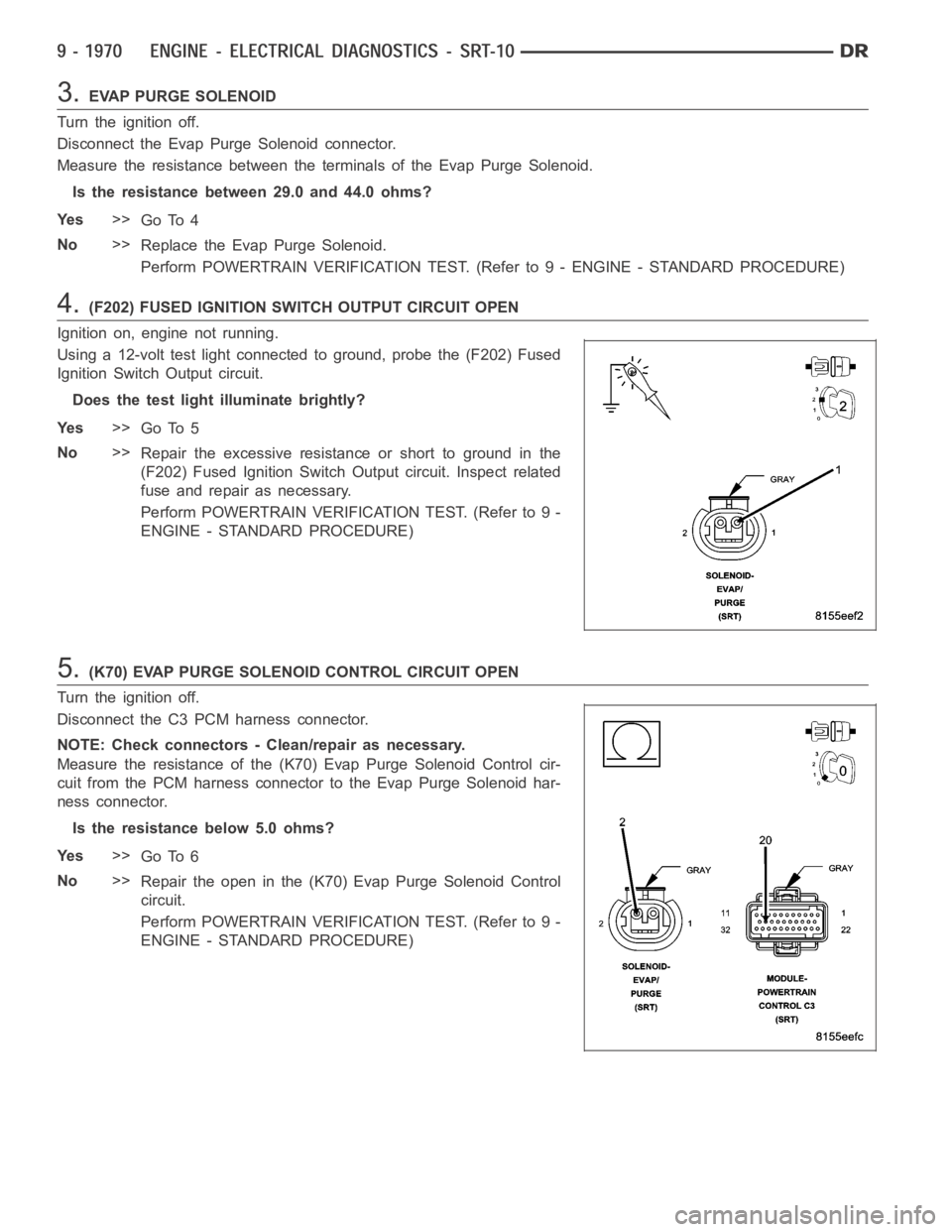
3.EVAP PURGE SOLENOID
Turn the ignition off.
Disconnect the Evap Purge Solenoid connector.
Measure the resistance between the terminals of the Evap Purge Solenoid.
Is the resistance between 29.0 and 44.0 ohms?
Ye s>>
Go To 4
No>>
Replace the Evap Purge Solenoid.
Perform POWERTRAIN VERIFICATION TEST. (Refer to 9 - ENGINE - STANDARD PROCEDURE)
4.(F202) FUSED IGNITION SWITCH OUTPUT CIRCUIT OPEN
Ignition on, engine not running.
Using a 12-volt test light connected to ground, probe the (F202) Fused
Ignition Switch Output circuit.
Does the test light illuminate brightly?
Ye s>>
Go To 5
No>>
Repair the excessive resistanceorshorttogroundinthe
(F202) Fused Ignition Switch Output circuit. Inspect related
fuse and repair as necessary.
Perform POWERTRAIN VERIFICATION TEST. (Refer to 9 -
ENGINE - STANDARD PROCEDURE)
5.(K70) EVAP PURGE SOLENOID CONTROL CIRCUIT OPEN
Turn the ignition off.
Disconnect the C3 PCM harness connector.
NOTE: Check connectors - Clean/repair as necessary.
Measure the resistance of the (K70) Evap Purge Solenoid Control cir-
cuit from the PCM harness connector to the Evap Purge Solenoid har-
ness connector.
Is the resistance below 5.0 ohms?
Ye s>>
Go To 6
No>>
Repair the open in the (K70) Evap Purge Solenoid Control
circuit.
Perform POWERTRAIN VERIFICATION TEST. (Refer to 9 -
ENGINE - STANDARD PROCEDURE)
Page 1319 of 5267
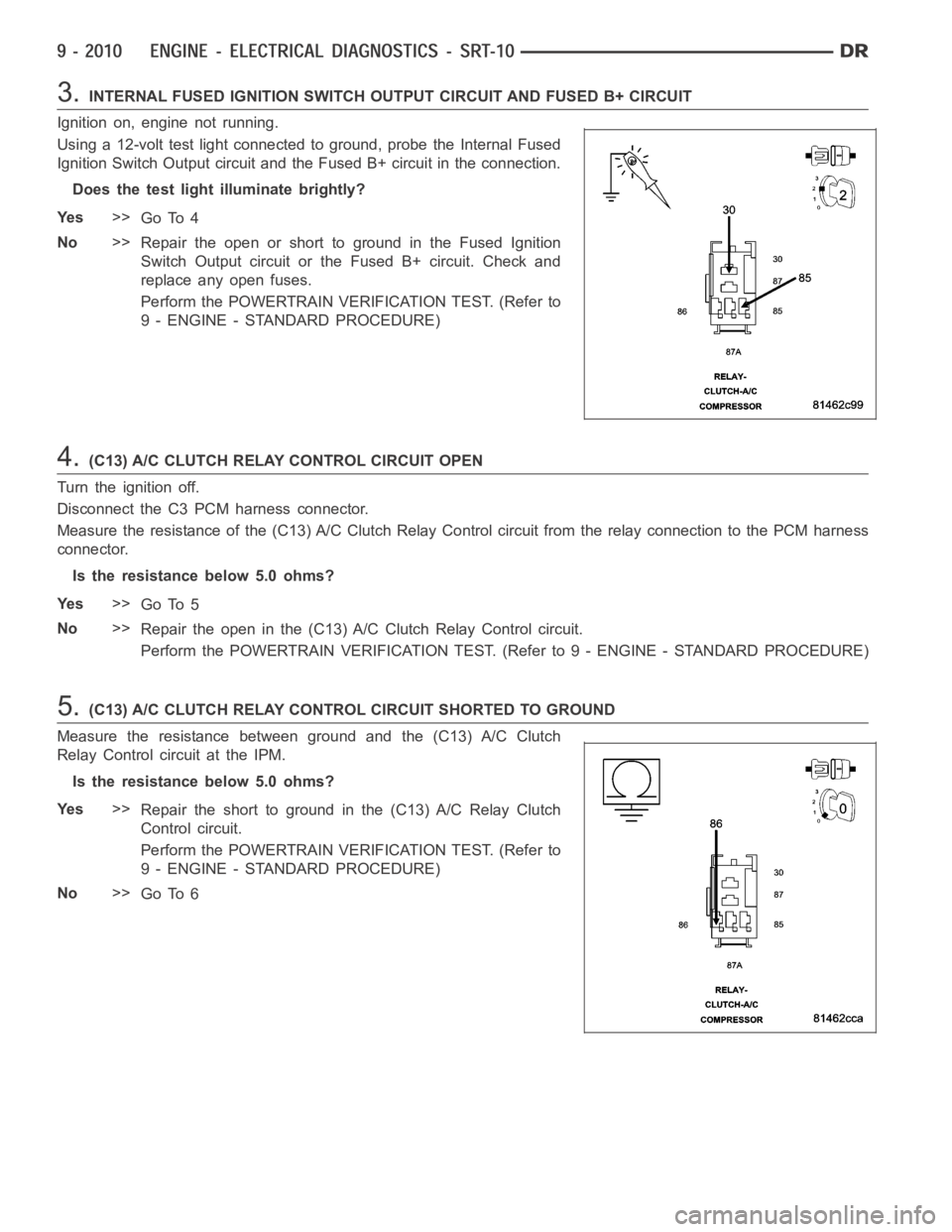
3.INTERNAL FUSED IGNITION SWITCH OUTPUT CIRCUIT AND FUSED B+ CIRCUIT
Ignition on, engine not running.
Using a 12-volt test light connected to ground, probe the Internal Fused
Ignition Switch Output circuit and the Fused B+ circuit in the connection.
Does the test light illuminate brightly?
Ye s>>
Go To 4
No>>
Repair the open or short to ground in the Fused Ignition
Switch Output circuit or the Fused B+ circuit. Check and
replace any open fuses.
Perform the POWERTRAIN VERIFICATION TEST. (Refer to
9 - ENGINE - STANDARD PROCEDURE)
4.(C13) A/C CLUTCH RELAY CONTROL CIRCUIT OPEN
Turn the ignition off.
Disconnect the C3 PCM harness connector.
Measure the resistance of the (C13) A/C Clutch Relay Control circuit from the relay connection to the PCM harness
connector.
Is the resistance below 5.0 ohms?
Ye s>>
Go To 5
No>>
Repair the open in the (C13) A/C Clutch Relay Control circuit.
Perform the POWERTRAIN VERIFICATION TEST. (Refer to 9 - ENGINE - STANDARD PROCEDURE)
5.(C13) A/C CLUTCH RELAY CONTROL CIRCUIT SHORTED TO GROUND
Measure the resistance between ground and the (C13) A/C Clutch
Relay Control circuit at the IPM.
Is the resistance below 5.0 ohms?
Ye s>>
Repair the short to ground in the (C13) A/C Relay Clutch
Control circuit.
Perform the POWERTRAIN VERIFICATION TEST. (Refer to
9 - ENGINE - STANDARD PROCEDURE)
No>>
Go To 6
Page 1322 of 5267
When Monitored:
Engine at operating temperature, Engine RPM above 608 rpm’s, and Vehicle Speed above 5 MPH.
Set Condition:
Reverse Gear Lockout Solenoid Control circuit is not in the expected statewhen requested to operate by the
PCM. Note: When Vehicle Speed is less then 5 MPH the PCM provides a ground forthe solenoid which ener-
gizes the solenoid. (Allowing Reverse).
Possible Causes
(A917) FUSED IGNITION SWITCH OUTPUT CIRCUIT
(K333) REVERSE LOCKOUT SOLENOID CONTROL CIRCUIT OPEN
(K333) REVERSE LOCKOUT SOLENOID CONTROL CIRCUIT SHORT TO GROUND
REVERSE LOCKOUT SOLENOID
PCM
Always perform the Pre-Diagnostic Troubleshooting procedure before proceeding. (Refer to 9 - ENGINE -
DIAGNOSIS AND TESTING)
1.GOOD TRIP EQUAL TO ZERO
With the scan tool, read DTCs and record the related Freeze Frame data.
Is the Good Trip Counter displayed and equal to zero?
Ye s>>
Go To 2
No>>
Refer to the INTERMITTENT CONDITION Diagnostic Procedure.
Perform POWERTRAIN VERIFICATION TEST. (Refer to 9 - ENGINE - STANDARD PROCEDURE)
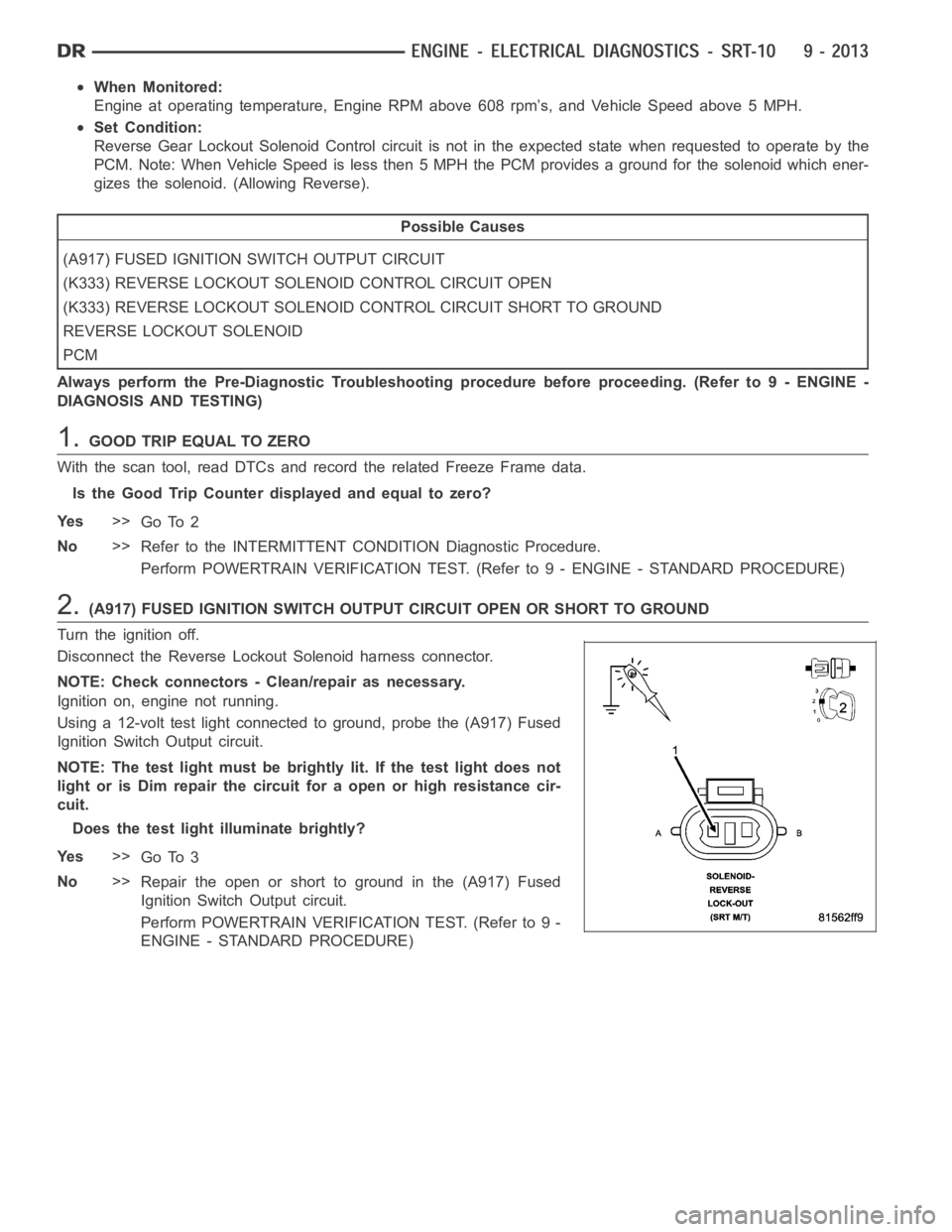
2.(A917) FUSED IGNITION SWITCH OUTPUT CIRCUIT OPEN OR SHORT TO GROUND
Turn the ignition off.
Disconnect the Reverse Lockout Solenoid harness connector.
NOTE: Check connectors - Clean/repair as necessary.
Ignition on, engine not running.
Using a 12-volt test light connected to ground, probe the (A917) Fused
Ignition Switch Output circuit.
NOTE: The test light must be brightly lit. If the test light does not
light or is Dim repair the circuit for a open or high resistance cir-
cuit.
Does the test light illuminate brightly?
Ye s>>
Go To 3
No>>
Repair the open or short to ground in the (A917) Fused
Ignition Switch Output circuit.
Perform POWERTRAIN VERIFICATION TEST. (Refer to 9 -
ENGINE - STANDARD PROCEDURE)
Page 1349 of 5267
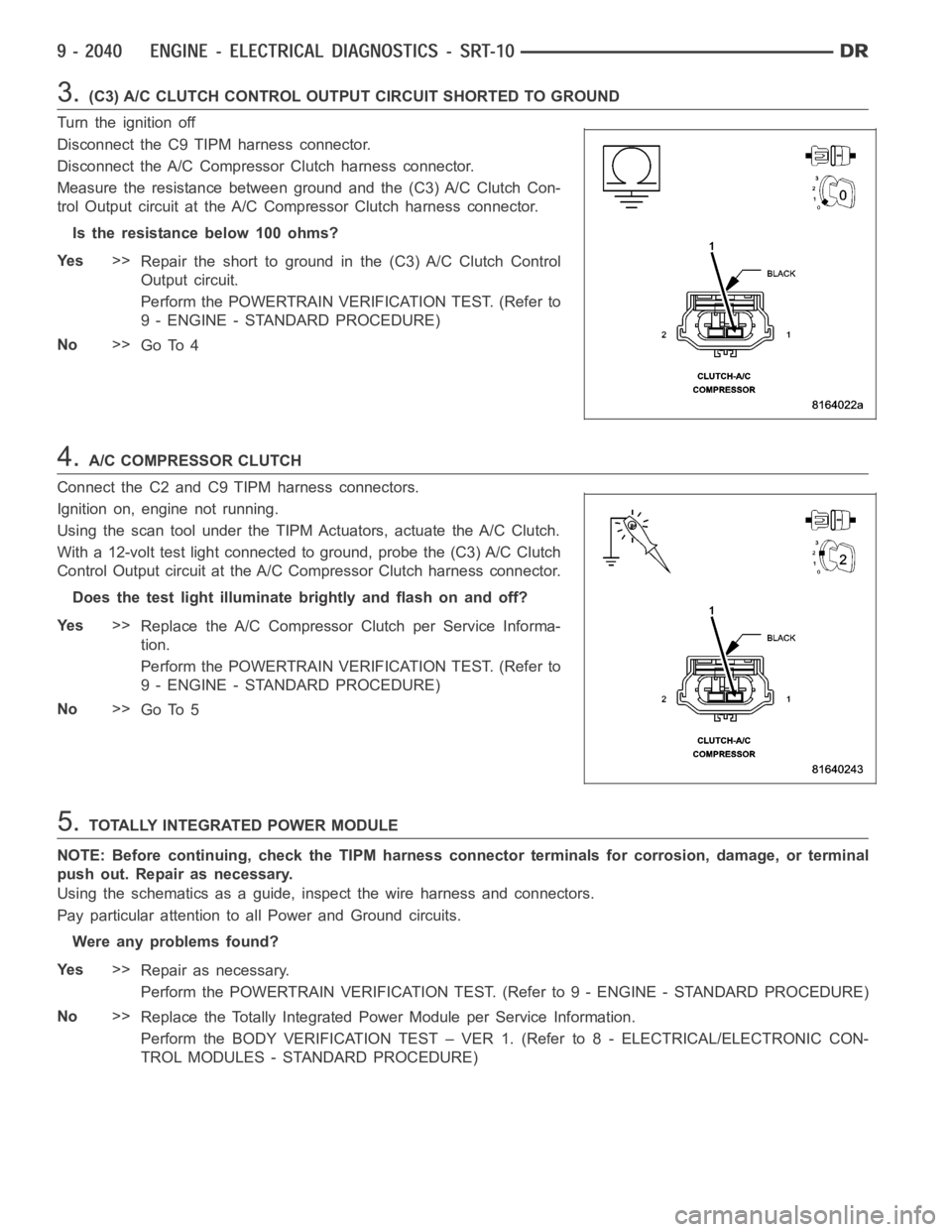
3.(C3) A/C CLUTCH CONTROL OUTPUT CIRCUIT SHORTED TO GROUND
Turn the ignition off
Disconnect the C9 TIPM harness connector.
Disconnect the A/C Compressor Clutch harness connector.
Measure the resistance between ground and the (C3) A/C Clutch Con-
trol Output circuit at the A/C Compressor Clutch harness connector.
Istheresistancebelow100ohms?
Ye s>>
Repair the short to ground in the (C3) A/C Clutch Control
Output circuit.
Perform the POWERTRAIN VERIFICATION TEST. (Refer to
9 - ENGINE - STANDARD PROCEDURE)
No>>
Go To 4
4.A/C COMPRESSOR CLUTCH
Connect the C2 and C9 TIPM harness connectors.
Ignition on, engine not running.
Using the scan tool under the TIPM Actuators, actuate the A/C Clutch.
With a 12-volt test light connected to ground, probe the (C3) A/C Clutch
Control Output circuit at the A/C Compressor Clutch harness connector.
Does the test light illuminate brightly and flash on and off?
Ye s>>
Replace the A/C Compressor Clutch per Service Informa-
tion.
Perform the POWERTRAIN VERIFICATION TEST. (Refer to
9 - ENGINE - STANDARD PROCEDURE)
No>>
Go To 5
5.TOTALLY INTEGRATED POWER MODULE
NOTE: Before continuing, check the TIPM harness connector terminals for corrosion, damage, or terminal
push out. Repair as necessary.
Using the schematics as a guide, inspect the wire harness and connectors.
Pay particular attention to all Power and Ground circuits.
Were any problems found?
Ye s>>
Repair as necessary.
Perform the POWERTRAIN VERIFICATION TEST. (Refer to 9 - ENGINE - STANDARD PROCEDURE)
No>>
Replace the Totally Integrated Power Module per Service Information.
Perform the BODY VERIFICATION TEST – VER 1. (Refer to 8 - ELECTRICAL/ELECTRONIC CON-
TROL MODULES - STANDARD PROCEDURE)