2005 NISSAN NAVARA ESP
[x] Cancel search: ESPPage 1078 of 3171
EC-98
DTC P0112, P0113 IAT SENSOR
DTC P0112, P0113 IAT SENSOR
PFP:22630
Component DescriptionEBS01KE4
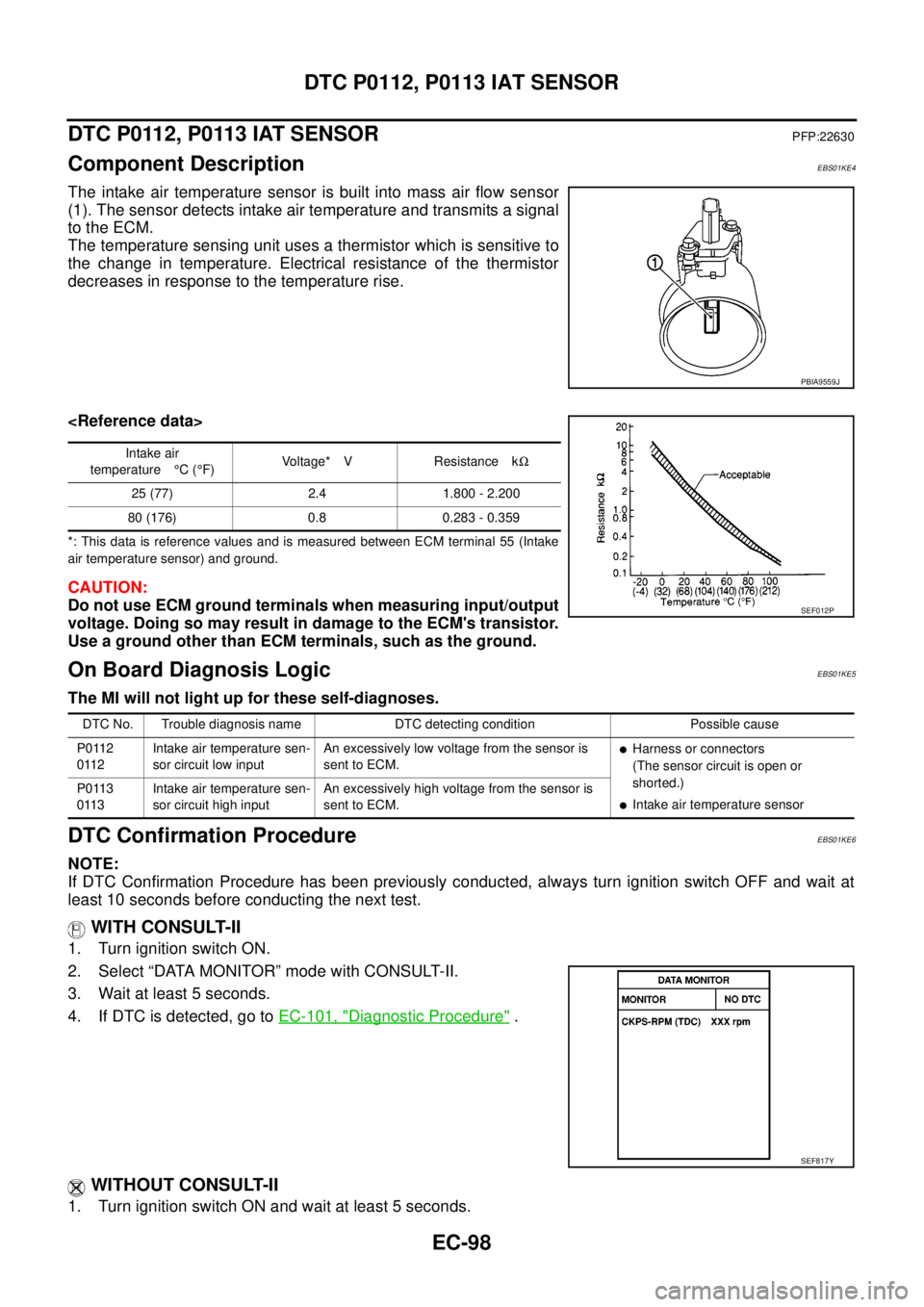
The intake air temperature sensor is built into mass air flow sensor
(1). The sensor detects intake air temperature and transmits a signal
to the ECM.
The temperature sensing unit uses a thermistor which is sensitive to
the change in temperature. Electrical resistance of the thermistor
decreases in response to the temperature rise.
*: This data is reference values and is measured between ECM terminal 55 (Intake
air temperature sensor) and ground.
CAUTION:
Do not use ECM ground terminals when measuring input/output
voltage. Doing so may result in damage to the ECM's transistor.
Use a ground other than ECM terminals, such as the ground.
On Board Diagnosis LogicEBS01KE5
The MI will not light up for these self-diagnoses.
DTC Confirmation ProcedureEBS01KE6
NOTE:
If DTC Confirmation Procedure has been previously conducted, always turn ignition switch OFF and wait at
least 10 seconds before conducting the next test.
WITH CONSULT-II
1. Turn ignition switch ON.
2. Select “DATA MONITOR” mode with CONSULT-II.
3. Wait at least 5 seconds.
4. If DTC is detected, go toEC-101, "
Diagnostic Procedure".
WITHOUT CONSULT-II
1. Turn ignition switch ON and wait at least 5 seconds.
PBIA9559J
Intake air
temperature°C(°F)Voltage* V Resistance kW
25 (77) 2.4 1.800 - 2.200
80 (176) 0.8 0.283 - 0.359
SEF012P
DTC No. Trouble diagnosis name DTC detecting condition Possible cause
P0112
0112Intake air temperature sen-
sor circuit low inputAn excessively low voltage from the sensor is
sent to ECM.
lHarness or connectors
(The sensor circuit is open or
shorted.)
lIntake air temperature sensor P0113
0113Intake air temperature sen-
sor circuit high inputAn excessively high voltage from the sensor is
sent to ECM.
SEF817Y
Page 1109 of 3171
DTC P0201 - P0204 FUEL INJECTOR
EC-129
C
D
E
F
G
H
I
J
K
L
MA
EC
Diagnostic ProcedureEBS01KFH
1.CHECK FUEL INJECTOR POWER SUPPLY FOR OPEN AND SHORT CIRCUIT
1. Turn ignition switch OFF.
2. Disconnect ECM harness connector.
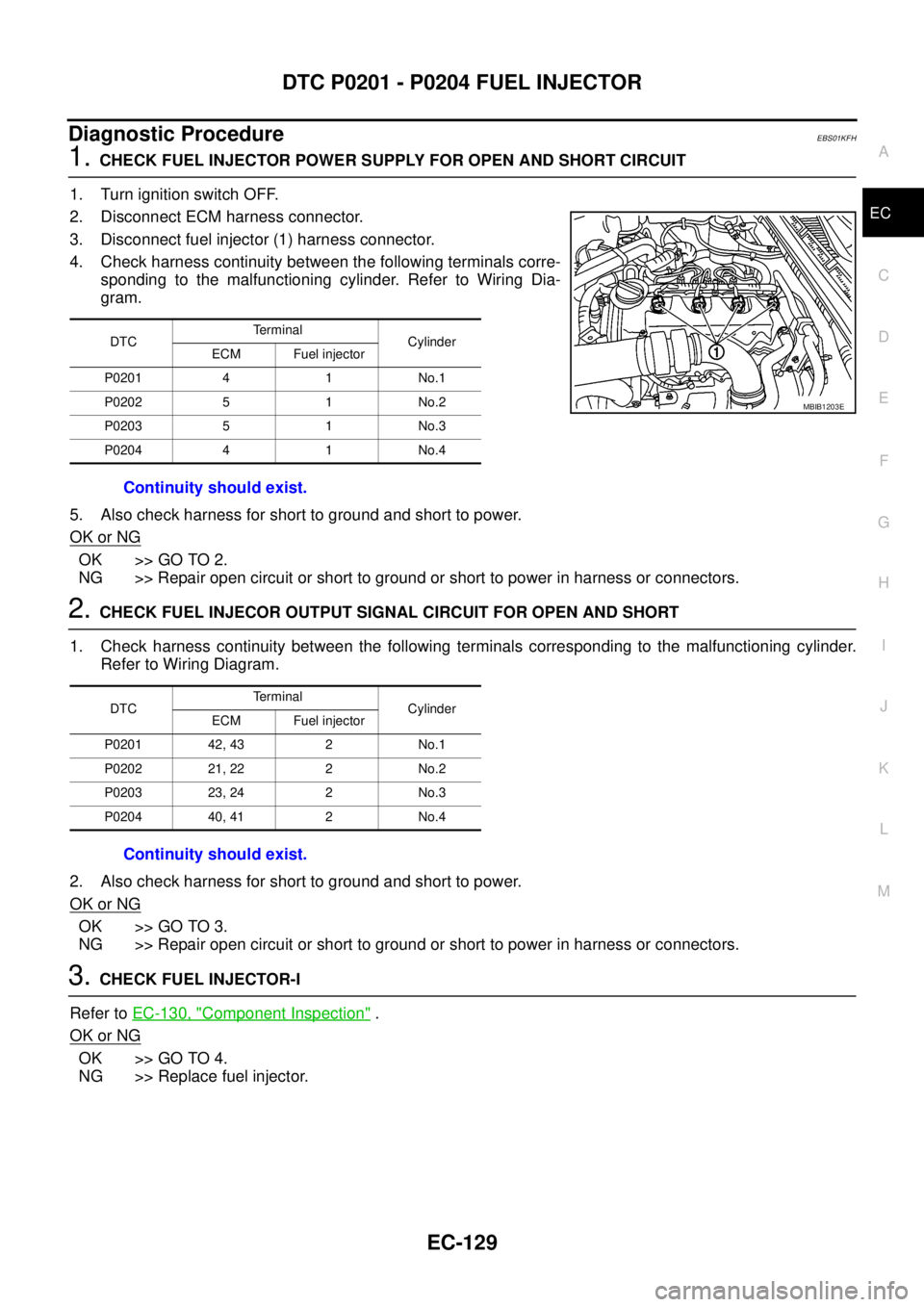
3. Disconnect fuel injector (1) harness connector.
4. Check harness continuity between the following terminals corre-
sponding to the malfunctioning cylinder. Refer to Wiring Dia-
gram.
5. Also check harness for short to ground and short to power.
OK or NG
OK >> GO TO 2.
NG >> Repair open circuit or short to ground or short to power in harness or connectors.
2.CHECK FUEL INJECOR OUTPUT SIGNAL CIRCUIT FOR OPEN AND SHORT
1. Check harness continuity between the following terminals corresponding to the malfunctioning cylinder.
Refer to Wiring Diagram.
2. Also check harness for short to ground and short to power.
OK or NG
OK >> GO TO 3.
NG >> Repair open circuit or short to ground or short to power in harness or connectors.
3.CHECK FUEL INJECTOR-I
Refer toEC-130, "
Component Inspection".
OK or NG
OK >> GO TO 4.
NG >> Replace fuel injector.
DTCTe r m i n a l
Cylinder
ECM Fuel injector
P0201 4 1 No.1
P0202 5 1 No.2
P0203 5 1 No.3
P0204 4 1 No.4
Continuity should exist.
MBIB1203E
DTCTe r m i n a l
Cylinder
ECM Fuel injector
P0201 42, 43 2 No.1
P0202 21, 22 2 No.2
P0203 23, 24 2 No.3
P0204 40, 41 2 No.4
Continuity should exist.
Page 1112 of 3171
EC-132
DTC P0217 ENGINE OVER TEMPERATURE
DTC P0217 ENGINE OVER TEMPERATURE
PFP:21481
DescriptionEBS01KFK
SYSTEM DESCRIPTION
NOTE:
If DTC P0217 is displayed with DTC U1000, first perform the trouble diagnosis for DTC U1000. Refer to
EC-79, "
DTC U1000 CAN COMMUNICATION LINE".
Cooling Fan Control
*: This signal is sent to ECM through CAN communication line.
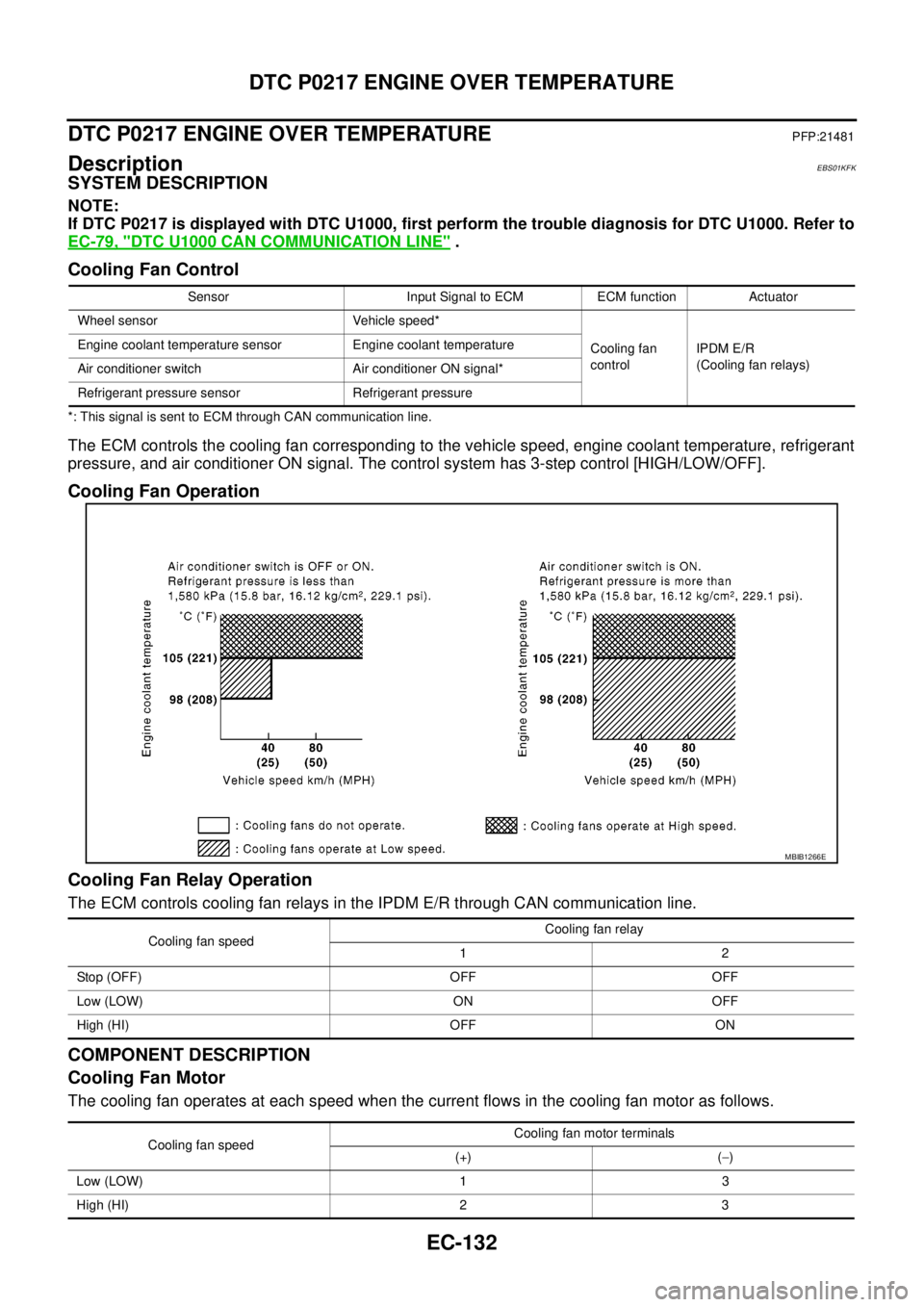
The ECM controls the cooling fan corresponding to the vehicle speed, engine coolant temperature, refrigerant
pressure, and air conditioner ON signal. The control system has 3-step control [HIGH/LOW/OFF].
Cooling Fan Operation
Cooling Fan Relay Operation
The ECM controls cooling fan relays in the IPDM E/R through CAN communication line.
COMPONENT DESCRIPTION
Cooling Fan Motor
The cooling fan operates at each speed when the current flows in the cooling fan motor as follows.
Sensor Input Signal to ECM ECM function Actuator
Wheel sensor Vehicle speed*
Cooling fan
controlIPDM E/R
(Cooling fan relays) Engine coolant temperature sensor Engine coolant temperature
Air conditioner switch Air conditioner ON signal*
Refrigerant pressure sensor Refrigerant pressure
MBIB1266E
Cooling fan speedCooling fan relay
12
Stop (OFF) OFF OFF
Low (LOW) ON OFF
High (HI) OFF ON
Cooling fan speedCooling fan motor terminals
(+) (-)
Low (LOW) 1 3
High (HI) 2 3
Page 1171 of 3171
DTC P0504 ASCD BRAKE SWITCH
EC-191
C
D
E
F
G
H
I
J
K
L
MA
EC
WITHOUT CONSULT-II
1. Start engine.
2. Press MAIN switch and make sure that CRUISE indicator lights up.
3. Drive the vehicle for at least 5 consecutive seconds under the following condition.
4. Turn ignition switch OFF, wait at least 10 seconds and then turn ON.
5. Perform Diagnostic Test Mode II (Self-diagnostic results) with ECM.
If DTC is detected, go toEC-193, "
Diagnostic Procedure".
If DTC is not detected, go to the following step.
6. Start engine.
7. Drive the vehicle for at least 5 consecutive seconds under the following condition.
8. If DTC is detected, go toEC-193, "
Diagnostic Procedure".
Vehiclespeed Morethan5km/h(3MPH)
Selector lever Suitable position
Vehiclespeed Morethan5km/h(3MPH)
Selector lever Suitable position
Driving locationDepress the brake pedal for more than
five seconds so as not to come off from
the above-mentioned condition.
Page 1222 of 3171
EC-242
DTC P1268 - P1271 FUEL INJECTOR
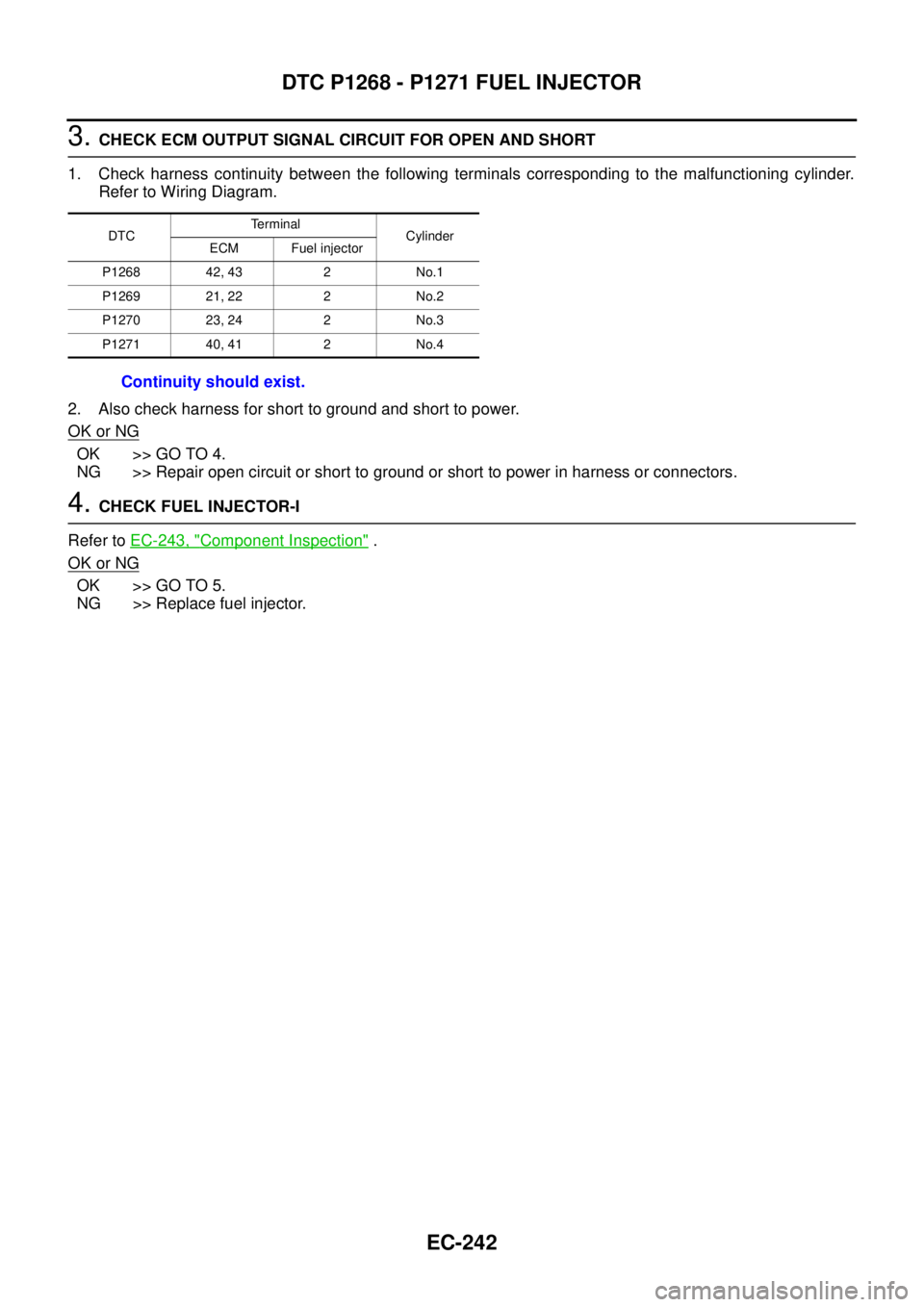
3.CHECK ECM OUTPUT SIGNAL CIRCUIT FOR OPEN AND SHORT
1. Check harness continuity between the following terminals corresponding to the malfunctioning cylinder.
Refer to Wiring Diagram.
2. Also check harness for short to ground and short to power.
OK or NG
OK >> GO TO 4.
NG >> Repair open circuit or short to ground or short to power in harness or connectors.
4.CHECK FUEL INJECTOR-I
Refer toEC-243, "
Component Inspection".
OK or NG
OK >> GO TO 5.
NG >> Replace fuel injector.
DTCTerminal
Cylinder
ECM Fuel injector
P1268 42, 43 2 No.1
P1269 21, 22 2 No.2
P1270 23, 24 2 No.3
P1271 40, 41 2 No.4
Continuity should exist.
Page 1275 of 3171
GLOW CONTROL SYSTEM
EC-295
C
D
E
F
G
H
I
J
K
L
MA
EC
GLOW CONTROL SYSTEMPFP:25230
DescriptionEBS01KLM
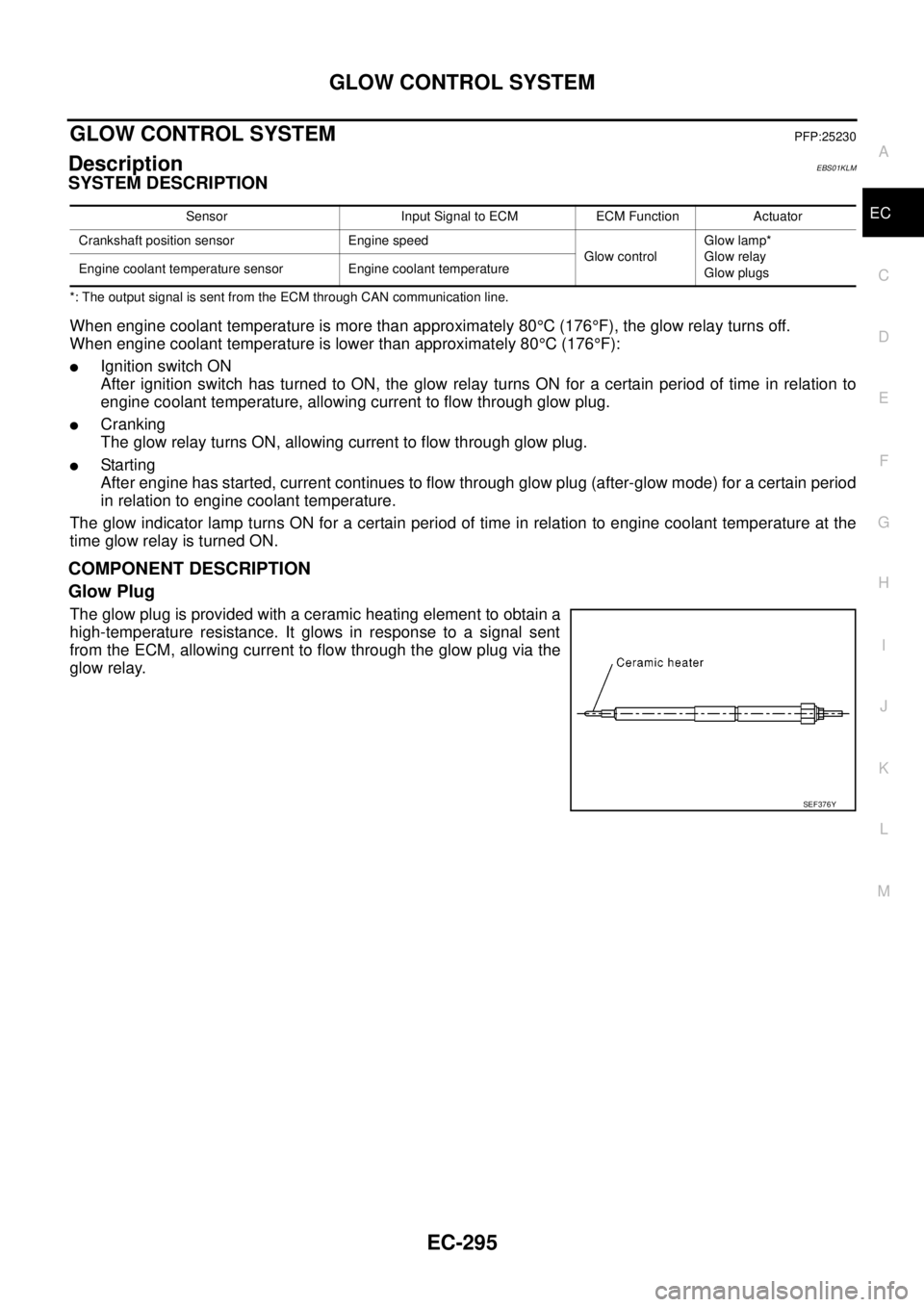
SYSTEM DESCRIPTION
*: The output signal is sent from the ECM through CAN communication line.
When engine coolant temperature is more than approximately 80°C(176°F), the glow relay turns off.
When engine coolant temperature is lower than approximately 80°C(176°F):
lIgnition switch ON
After ignition switch has turned to ON, the glow relay turns ON for a certain period of time in relation to
engine coolant temperature, allowing current to flow through glow plug.
lCranking
The glow relay turns ON, allowing current to flow through glow plug.
lSta rti ng
After engine has started, current continues to flow through glow plug (after-glow mode) for a certain period
in relation to engine coolant temperature.
The glow indicator lamp turns ON for a certain period of time in relation to engine coolant temperature at the
time glow relay is turned ON.
COMPONENT DESCRIPTION
Glow Plug
The glow plug is provided with a ceramic heating element to obtain a
high-temperature resistance. It glows in response to a signal sent
from the ECM, allowing current to flow through the glow plug via the
glow relay.
Sensor Input Signal to ECM ECM Function Actuator
Crankshaft position sensor Engine speed
Glow controlGlow lamp*
Glow relay
Glow plugs Engine coolant temperature sensor Engine coolant temperature
SEF376Y
Page 1282 of 3171
EC-302
EGR VOLUME CONTROL SYSTEM
EGR VOLUME CONTROL SYSTEM
PFP:14710
DescriptionEBS01KLR
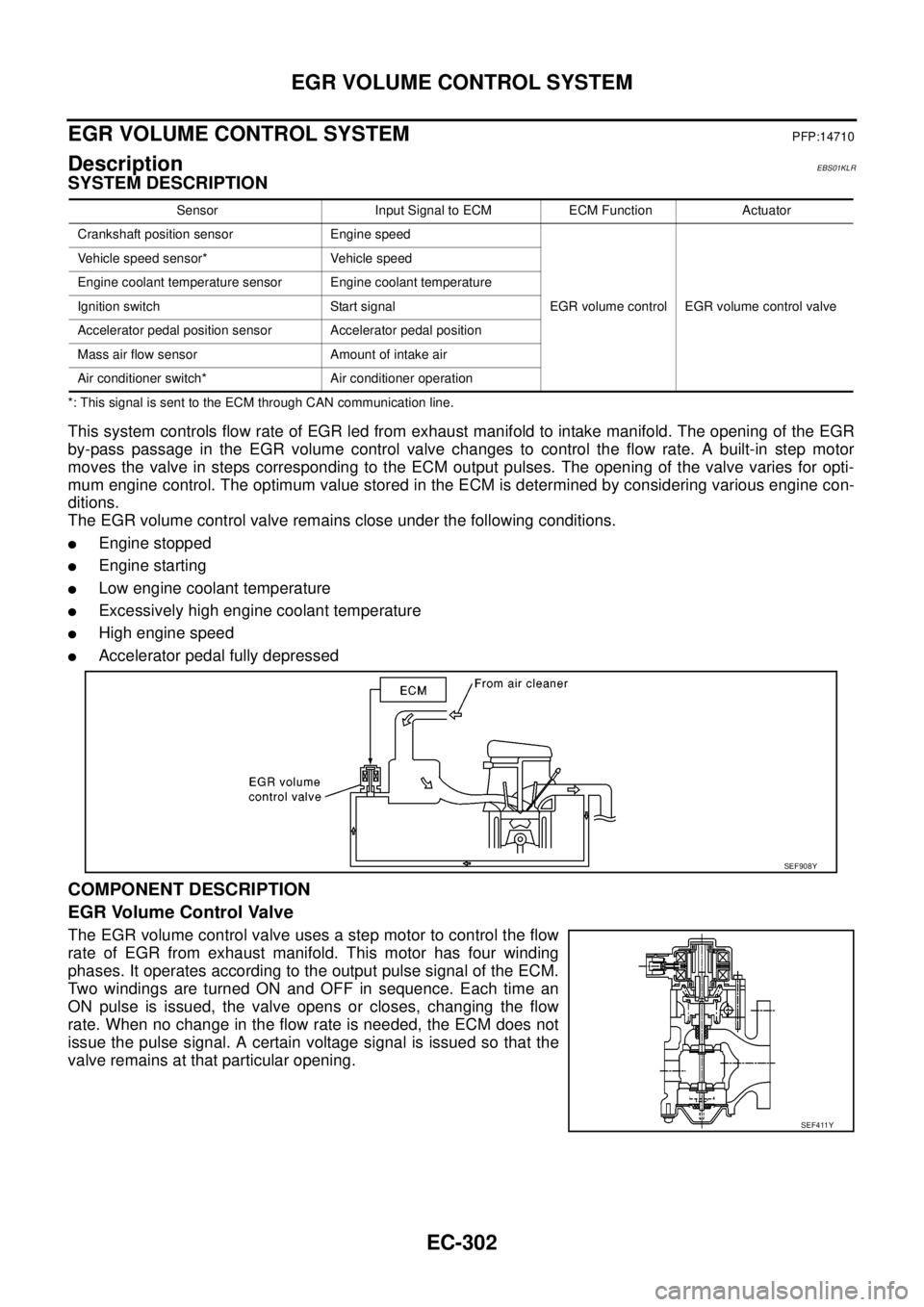
SYSTEM DESCRIPTION
*: This signal is sent to the ECM through CAN communication line.
This system controls flow rate of EGR led from exhaust manifold to intake manifold. The opening of the EGR
by-pass passage in the EGR volume control valve changes to control the flow rate. A built-in step motor
moves the valve in steps corresponding to the ECM output pulses. The opening of the valve varies for opti-
mum engine control. The optimum value stored in the ECM is determined by considering various engine con-
ditions.
The EGR volume control valve remains close under the following conditions.
lEngine stopped
lEngine starting
lLow engine coolant temperature
lExcessively high engine coolant temperature
lHigh engine speed
lAccelerator pedal fully depressed
COMPONENT DESCRIPTION
EGR Volume Control Valve
The EGR volume control valve uses a step motor to control the flow
rate of EGR from exhaust manifold. This motor has four winding
phases. It operates according to the output pulse signal of the ECM.
Two windings are turned ON and OFF in sequence. Each time an
ON pulse is issued, the valve opens or closes, changing the flow
rate. When no change in the flow rate is needed, the ECM does not
issue the pulse signal. A certain voltage signal is issued so that the
valve remains at that particular opening.
Sensor Input Signal to ECM ECM Function Actuator
Crankshaft position sensor Engine speed
EGR volume control EGR volume control valve Vehicle speed sensor* Vehicle speed
Engine coolant temperature sensor Engine coolant temperature
Ignition switch Start signal
Accelerator pedal position sensor Accelerator pedal position
Mass air flow sensor Amount of intake air
Air conditioner switch* Air conditioner operation
SEF908Y
SEF411Y
Page 1344 of 3171
EI-6
SQUEAK AND RATTLE TROUBLE DIAGNOSES
SQUEAK AND RATTLE TROUBLE DIAGNOSES
PFP:00000
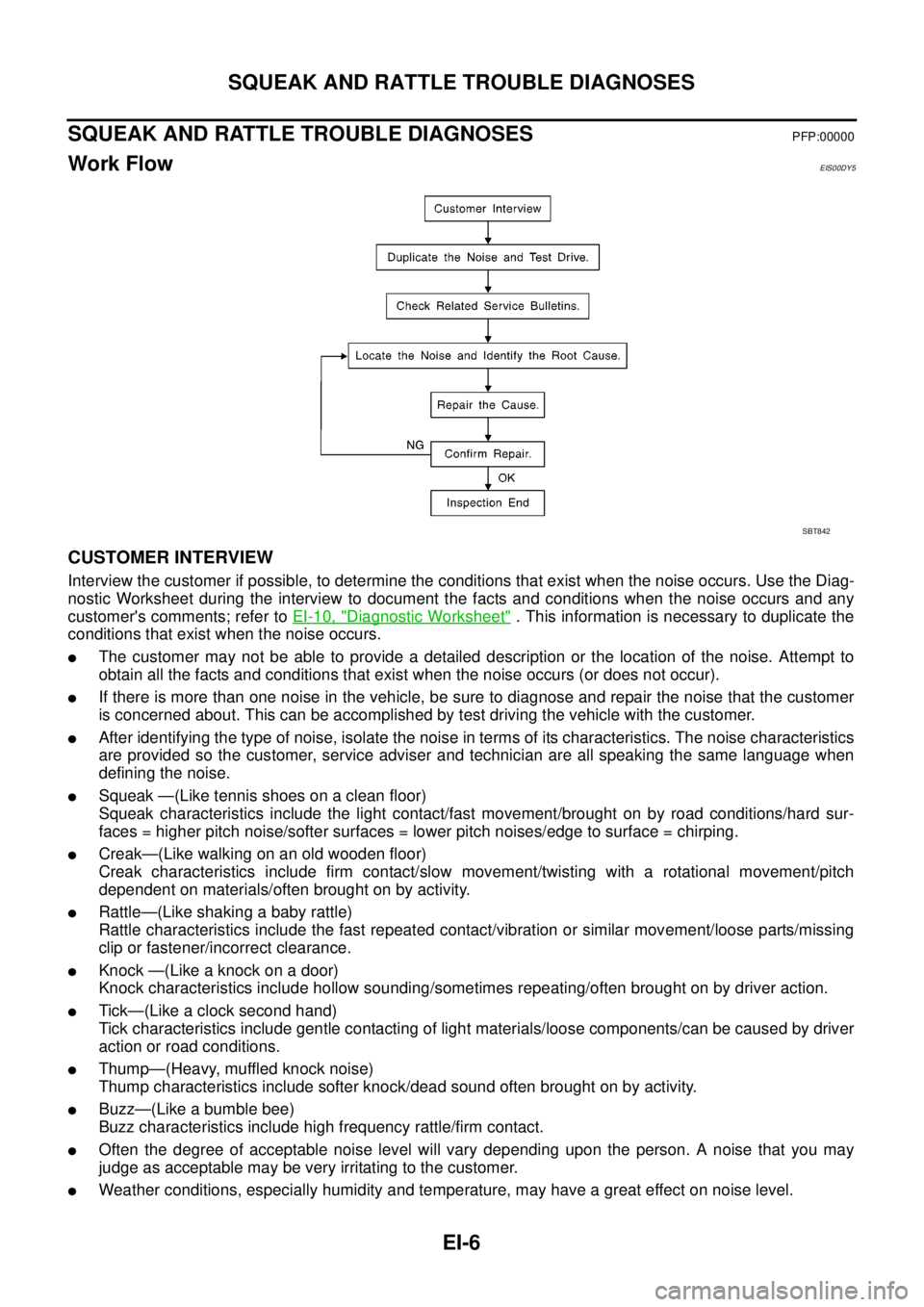
Work FlowEIS00DY5
CUSTOMER INTERVIEW
Interview the customer if possible, to determine the conditions that exist when the noise occurs. Use the Diag-
nostic Worksheet during the interview to document the facts and conditions when the noise occurs and any
customer's comments; refer toEI-10, "
Diagnostic Worksheet". This information is necessary to duplicate the
conditions that exist when the noise occurs.
lThe customer may not be able to provide a detailed description or the location of the noise. Attempt to
obtain all the facts and conditions that exist when the noise occurs (or does not occur).
lIf there is more than one noise in the vehicle, be sure to diagnose and repair the noise that the customer
is concerned about. This can be accomplished by test driving the vehicle with the customer.
lAfter identifying the type of noise, isolate the noise in terms of its characteristics. The noise characteristics
are provided so the customer, service adviser and technician are all speaking the same language when
defining the noise.
lSqueak —(Like tennis shoes on a clean floor)
Squeak characteristics include the light contact/fast movement/brought on by road conditions/hard sur-
faces = higher pitch noise/softer surfaces = lower pitch noises/edge to surface = chirping.
lCreak—(Like walking on an old wooden floor)
Creak characteristics include firm contact/slow movement/twisting with a rotational movement/pitch
dependent on materials/often brought on by activity.
lRattle—(Like shaking a baby rattle)
Rattle characteristics include the fast repeated contact/vibration or similar movement/loose parts/missing
clip or fastener/incorrect clearance.
lKnock —(Like a knock on a door)
Knock characteristics include hollow sounding/sometimes repeating/often brought on by driver action.
lTick—(Like a clock second hand)
Tick characteristics include gentle contacting of light materials/loose components/can be caused by driver
action or road conditions.
lThump—(Heavy, muffled knock noise)
Thump characteristics include softer knock/dead sound often brought on by activity.
lBuzz—(Like a bumble bee)
Buzz characteristics include high frequency rattle/firm contact.
lOften the degree of acceptable noise level will vary depending upon the person. A noise that you may
judge as acceptable may be very irritating to the customer.
lWeather conditions, especially humidity and temperature, may have a great effect on noise level.
SBT842