2005 NISSAN NAVARA ESP
[x] Cancel search: ESPPage 1018 of 3171
EC-38
TROUBLE DIAGNOSIS
Basic Inspection
EBS01KCV
Precaution:
Perform Basic Inspection without electrical or mechanical loads applied;
lHeadlamp switch is OFF.
lOn vehicles equipped with daytime light systems, set lighting switch to the 1st position to light
only small lamps.
lAir conditioner switch is OFF.
lHeater fan switch is OFF.
lRear defogger switch is OFF.
lHeat up switch is OFF.
lSteering wheel is in the straight-ahead position, etc.
1.INSPECTION START
1. Check service records for any recent repairs that may indicate a related incident.
2. Check the current need for scheduled maintenance, especially for fuel filter and air cleaner filter. Refer to
MA-8, "
PERIODIC MAINTENANCE".
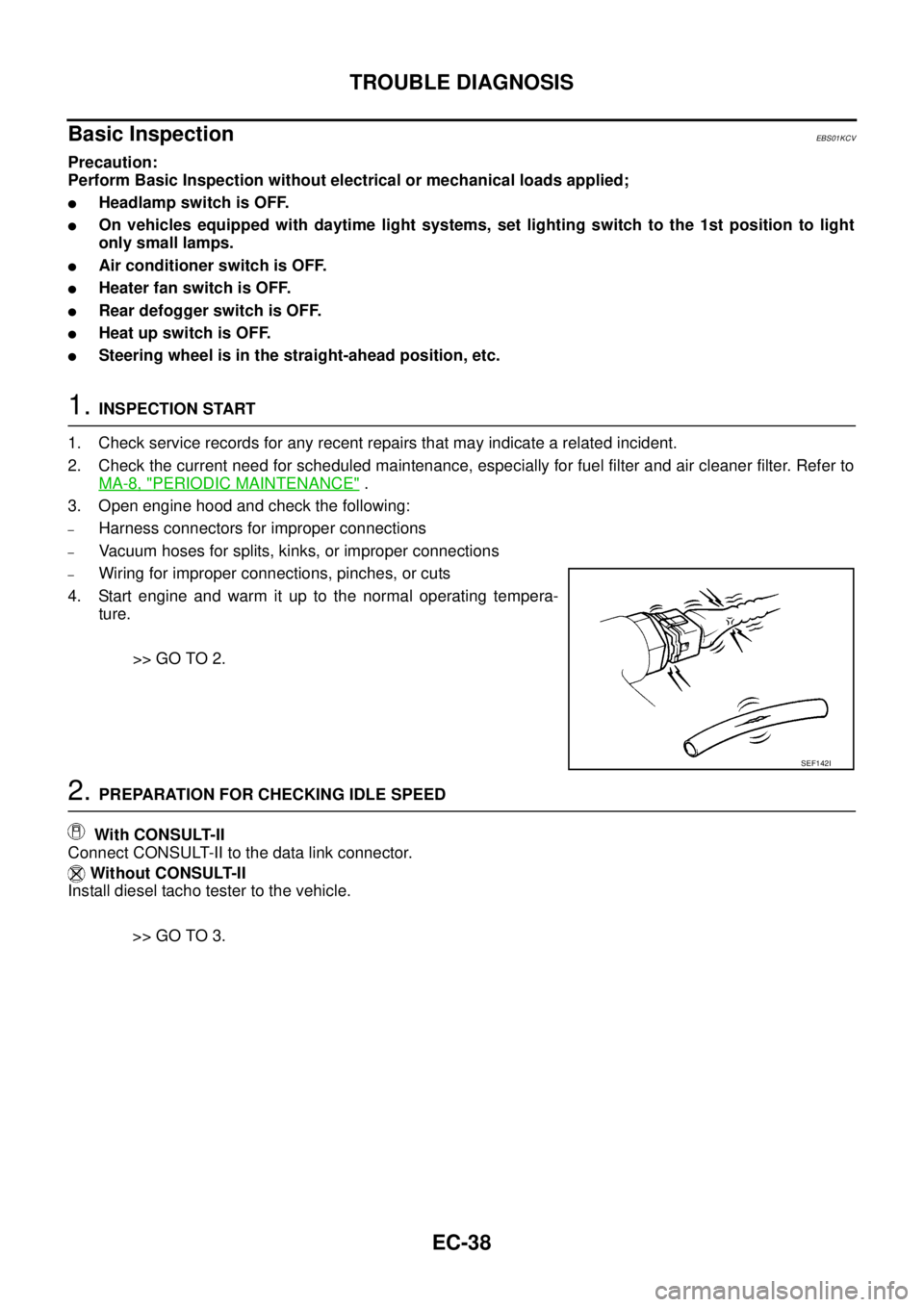
3. Open engine hood and check the following:
–Harness connectors for improper connections
–Vacuum hoses for splits, kinks, or improper connections
–Wiring for improper connections, pinches, or cuts
4. Start engine and warm it up to the normal operating tempera-
ture.
>> GO TO 2.
2.PREPARATION FOR CHECKING IDLE SPEED
With CONSULT-II
Connect CONSULT-II to the data link connector.
Without CONSULT-II
Install diesel tacho tester to the vehicle.
>> GO TO 3.
SEF142I
Page 1036 of 3171
![NISSAN NAVARA 2005 Repair Workshop Manual EC-56
TROUBLE DIAGNOSIS
48
49L
BFuel rail pressure sensor[Engine is running]
lWarm-up condition
lIdle speed1.7 - 2.0V
[Engine is running]
lWarm-up condition
lEngine speed: 2,000 rpm2.0 - 2.3V
50 YFuel](/manual-img/5/57362/w960_57362-1035.png "NISSAN NAVARA 2005 Repair Workshop Manual EC-56
TROUBLE DIAGNOSIS
48
49L
BFuel rail pressure sensor[Engine is running]
lWarm-up condition
lIdle speed1.7 - 2.0V
[Engine is running]
lWarm-up condition
lEngine speed: 2,000 rpm2.0 - 2.3V
50 YFuel")
EC-56
TROUBLE DIAGNOSIS
48
49L
BFuel rail pressure sensor[Engine is running]
lWarm-up condition
lIdle speed1.7 - 2.0V
[Engine is running]
lWarm-up condition
lEngine speed: 2,000 rpm2.0 - 2.3V
50 YFuel pump temperature sen-
sor[Engine is running]
lWarm-up conditionApproximately 0.3 - 5.3V
Output voltage varies with fuel
pump temperature
51 SBEngine coolant temperature
sensor[Engine is running]
lWarm-up conditionApproximately 0.3 - 5.3V
Output voltage varies with engine
coolant temperature
52 BR Turbocharger boost sensor[Engine is running]
lWarm-up condition
lIdle speed2.1 - 2.4V
[Engine is running]
lWarm-up condition
lEngine speed: 2,000 rpm2.3 - 2.6V
53 W Refrigerant pressure sensor[Engine is running]
lWarm-up condition
lBoth A/C switch and blower switch: ON
(Compressor operates)1.0 - 4.0V
54 G Mass air flow sensor[Ignition switch: ON]Approximately 0.7V
[Engine is running]
lWarm-up condition
lIdle speed1.6 - 2.0V
[Engine is running]
lWarm-up condition
lEngine is revving from idle to about 4,000
rpm.1.6 - 2.0V to Approximately 4.3V
(Check for liner voltage rise in
response to engine being
increased to about 4,000 rpm)
55 WIntake air temperature sen-
sor[Engine is running]
lWarm-up conditionApproximately 0.3 - 5.2V
Output voltage varies with intake
air temperature
63 RFuel rail pressure sensor
power supply[Ignition switch ON]Approximately 5.3V
64 VSensor power supply
(Turbocharger boost sensor /
Refrigerant pressure sensor)[Ignition switch ON]Approximately 5.3V
65 BCrankshaft position sensor
ground[Ignition switch ON]Approximately 0.3V
66 BCamshaft position sensor
ground[Ignition switch ON]Approximately 0.3V
67 —Sensor ground
(Sensor shield circuit)[Ignition switch ON]Approximately 0.3V
68 WFuel rail pressure sensor
ground[Ignition switch ON]Approximately 0.3V
69 BFuel pump temperature sen-
sor ground[Ignition switch ON]Approximately 0.3V
70 LGEngine coolant temperature
sensor ground[Ignition switch ON]Approximately 0.3V TERMI-
NAL
NO.WIRE
COLORITEM CONDITIONDATA
(DC Voltage and Pulse Signal)
Page 1044 of 3171
![NISSAN NAVARA 2005 Repair Workshop Manual EC-64
TROUBLE DIAGNOSIS
NOTE:
Any monitored item that does not match the vehicle being diagnosed is deleted from the display automatically.
ACTIVE TEST MODE
INT/M PRES SE [kPa]
lTurbocharger boost (de](/manual-img/5/57362/w960_57362-1043.png "NISSAN NAVARA 2005 Repair Workshop Manual EC-64
TROUBLE DIAGNOSIS
NOTE:
Any monitored item that does not match the vehicle being diagnosed is deleted from the display automatically.
ACTIVE TEST MODE
INT/M PRES SE [kPa]
lTurbocharger boost (de")
EC-64
TROUBLE DIAGNOSIS
NOTE:
Any monitored item that does not match the vehicle being diagnosed is deleted from the display automatically.
ACTIVE TEST MODE
INT/M PRES SE [kPa]
lTurbocharger boost (determined by
the signal voltage from the turbo-
charger boost sensor) is displayed.
CYL COUNT [1/2/3/4]
lThe cylinder being injected is dis-
played.
1 ... Cylinder No.1 is injected.
2 ... Cylinder No.2 is injected.
3 ... Cylinder No.3 is injected.
4 ... Cylinder No.4 is injected.
SET SW
[ON/OFF]´
lIndicates [ON/OFF] condition from
SET/COAST switch signal.
RESUME/ACC SW
[ON/OFF]´
lIndicates [ON/OFF] condition from
RESUME/ACCEL switch signal.
CANCEL SW
[ON/OFF]´
lIndicates [ON/OFF] condition from
CANCEL switch signal.
MAIN SW
[ON/OFF]´
lIndicates [ON/OFF] condition from
MAIN switch signal.
ASCD APPLY [YES/NO]
lDisplaying ASCD application status
stored in ECM.
VDC APPLY [YES/NO]
lDisplaying ESP application status
stored in ECM.
AC PRESS SEN [V]
lThe signal voltage from the refrigerant
pressure sensor is displayed.
Voltage [V]
Voltage, frequency, duty cycle or pulse
width measured by the probe.Only “#” is displayed if item is unable to
be measured.
Figures with “#”s are temporary ones.
They are the same figures as an actual
piece of data which was just previously
measured. [Hz] or [%] Frequency
[msec],[Hz]or[%]
DUTY-HI
DUTY-LOW
PLS WIDTH-HI
PLS WIDTH-LOWMONITOR ITEMECM
INPUT
SIG-
NALMAIN
SIG-
NALSCONDITION SPECIFICATION
TEST ITEM CONDITION JUDGEMENT CHECK ITEM (REMEDY)
POWER BAL-
ANCE
lEngine: After warming up, idle the
engine.
lA/C switch: OFF
lShift lever: P or N (A/T), Neutral
(M/T)
lCut off each injector signal one at
a time using CONSULT-IIEngine runs rough or dies.
lHarness and connectors
lCompression
lFuel injector
COOLING FAN *
lIgnition switch: ON
lOperate the cooling fan at LOW,
HI speed and turn OFF using
CONSULT-II.Cooling fan moves at LOW, HI
speed and stops.lHarness and connector
lCooling fan motor
lCooling fan relay
ENG COOLANT
TEMP
lEngine: Return to the original
trouble condition
lChange the engine coolant tem-
perature using CONSULT-II.If trouble symptom disappears, see
CHECK ITEM.
lHarness and connectors
lEngine coolant temperature sen-
sor
lFuel injector
Page 1045 of 3171
TROUBLE DIAGNOSIS
EC-65
C
D
E
F
G
H
I
J
K
L
MA
EC
*: Leaving cooling fan OFF with CONSULT-II while engine is running may cause the engine to overheat.
REAL TIME DIAGNOSIS IN DATA MONITOR MODE
CONSULT-II has two kinds of triggers and they can be selected by touching “SETTING” in “DATA MONITOR”
mode.
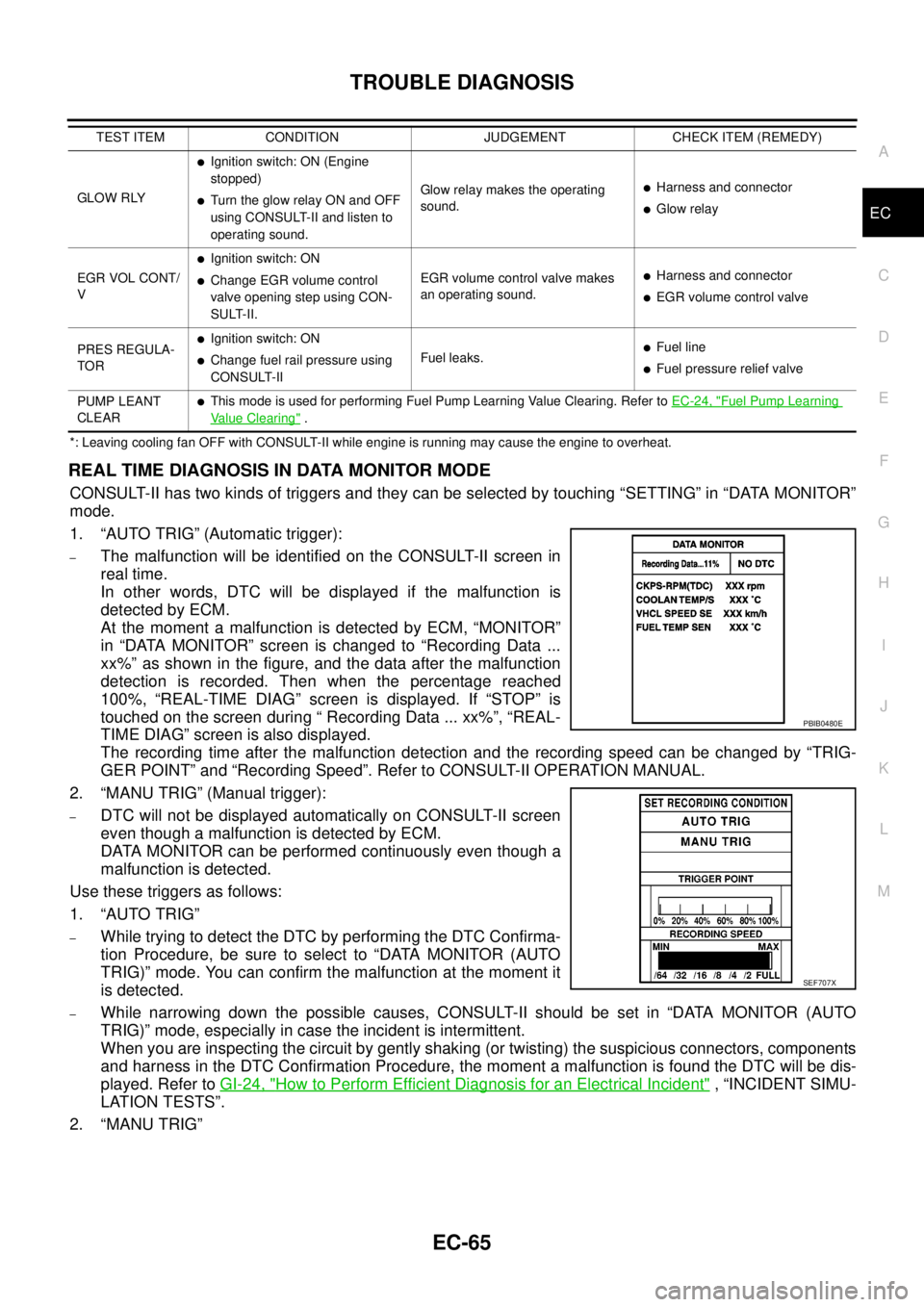
1. “AUTO TRIG” (Automatic trigger):
–The malfunction will be identified on the CONSULT-II screen in
real time.
In other words, DTC will be displayed if the malfunction is
detected by ECM.
At the moment a malfunction is detected by ECM, “MONITOR”
in “DATA MONITOR” screen is changed to “Recording Data ...
xx%” as shown in the figure, and the data after the malfunction
detection is recorded. Then when the percentage reached
100%, “REAL-TIME DIAG” screen is displayed. If “STOP” is
touched on the screen during “ Recording Data ... xx%”, “REAL-
TIME DIAG” screen is also displayed.
The recording time after the malfunction detection and the recording speed can be changed by “TRIG-
GER POINT” and “Recording Speed”. Refer to CONSULT-II OPERATION MANUAL.
2. “MANU TRIG” (Manual trigger):
–DTC will not be displayed automatically on CONSULT-II screen
even though a malfunction is detected by ECM.
DATA MONITOR can be performed continuously even though a
malfunction is detected.
Use these triggers as follows:
1. “AUTO TRIG”
–While trying to detect the DTC by performing the DTC Confirma-
tion Procedure, be sure to select to “DATA MONITOR (AUTO
TRIG)” mode. You can confirm the malfunction at the moment it
is detected.
–While narrowing down the possible causes, CONSULT-II should be set in “DATA MONITOR (AUTO
TRIG)” mode, especially in case the incident is intermittent.
When you are inspecting the circuit by gently shaking (or twisting) the suspicious connectors, components
and harness in the DTC Confirmation Procedure, the moment a malfunction is found the DTC will be dis-
played. Refer toGI-24, "
How to Perform Efficient Diagnosis for an Electrical Incident", “INCIDENT SIMU-
LATION TESTS”.
2. “MANU TRIG”
GLOW RLY
lIgnition switch: ON (Engine
stopped)
lTurn the glow relay ON and OFF
using CONSULT-II and listen to
operating sound.Glow relay makes the operating
sound.lHarness and connector
lGlow relay
EGR VOL CONT/
V
lIgnition switch: ON
lChange EGR volume control
valve opening step using CON-
SULT-II.EGR volume control valve makes
an operating sound.lHarness and connector
lEGR volume control valve
PRES REGULA-
TOR
lIgnition switch: ON
lChange fuel rail pressure using
CONSULT-IIFuel leaks.lFuel line
lFuel pressure relief valve
PUMP LEANT
CLEAR
lThis mode is used for performing Fuel Pump Learning Value Clearing. Refer toEC-24, "Fuel Pump Learning
Value Clearing". TEST ITEM CONDITION JUDGEMENT CHECK ITEM (REMEDY)
PBIB0480E
SEF707X
Page 1047 of 3171
TROUBLE DIAGNOSIS
EC-67
C
D
E
F
G
H
I
J
K
L
MA
EC
P/N POSI SWlIgnition switch: ONShift lever:
P or N (A/T), Neutral (M/T)ON
Except above OFF
START SIGNAL
lIgnition switch: ON®START®ON OFF®ON®OFF
AIRCONDSIG
lEngine: After warming up, idle
the engineAir conditioner switch: OFF OFF
Air conditioner switch: ON
(Compressor operates.)ON
BRAKE SW
lIgnition switch: ONBrake pedal: Fully released OFF
Brake pedal: Slightly depressed ON
BRAKE SW2
lIgnition switch: ON
lBrake pedal: Fully released (A/T)
lClutch pedal and brake pedal:
Fully released (M/T)OFF
lBrake pedal: Slightly depressed
(A/T)
lClutch pedal and/or brake pedal:
Slightly depressed (M/T)ON
IGN SW
lIgnition switch: ON®OFF ON®OFF
WARM UP SW
lIgnition switch: ONHeat up switch: OFF OFF
Heat up switch: ON ON
MAS AIR/FL SE*
lEngine: After warming up
lAir conditioner switch: OFF
lShift lever:
P or N (A/T), Neutral (M/T)
lNo loadIgnition switch: ON
(Engine stopped)Approximately 0.4V
Idle 1.3 - 1.7V
Engine is revving from idle to about
4,000 rpm.1.3 - 1.7V to Approximately 4.0V
(Check for liner voltage rise in
response to engine being
increased to about 4,000 rpm)
MAIN INJ WID
lEngine: After warming up
lShift lever:
P or N (A/T), Neutral (M/T)
lIdle speedNo load 0.50 - 0.70 msec
Blower fan switch: ON
Rear window defogger switch: ON0.50 - 0.80 msec
PUMP CURRENT
lEngine: After warming up
lAir conditioner switch: OFF
lShift lever:
P or N (A/T), Neutral (M/T)
lNo loadIdle 1,600 - 2,000 mA
2,000 rpm 1,500 - 1,900 mA
GLOW RLY Refer toEC-295, "
GLOW CONTROL SYSTEM".
COOLING FAN
lEngine: After warming up, idle
the engine
lAir conditioner switch: OFFEngine coolant temperature:
97°C (207°F) or lessOFF
Engine coolant temperature:
Between 98°C(208°F) and 104°C
(219°F)LOW
Engine coolant temperature:
105°C(221°F) or moreHI
EGR VOL CON/V
lEngine: After warming up
lAir conditioner switch: OFF
lShift lever:
P or N (A/T), Neutral (M/T)
lNo loadAfter 1 minute at idle More than 10 steps
Revving engine from idle to 3,200
rpm0step
INT/A VOLUME
lEngine: After warming up, idle the engine 150 - 450 mg/ MONITOR ITEM CONDITION SPECIFICATION
Page 1070 of 3171
EC-90
DTC P0093 FUEL SYSTEM
5.REPLACE FUEL PUMP
1. Replace fuel pump.
2. Perform Fuel Pump Learning Value Clearing. Refer toEC-24, "
Fuel Pump Learning Value Clearing".
>>INSPECTION END
Component InspectionEBS01KDT
FUEL RAIL PRESSURE RELIEF VALVE
With CONSULT-II
WARNING:
lConfirm that the engine is cooled down and there are no fire hazards near the vehicle.
lPrepare pans or saucers under the disconnected fuel line because the fuel may spill out.
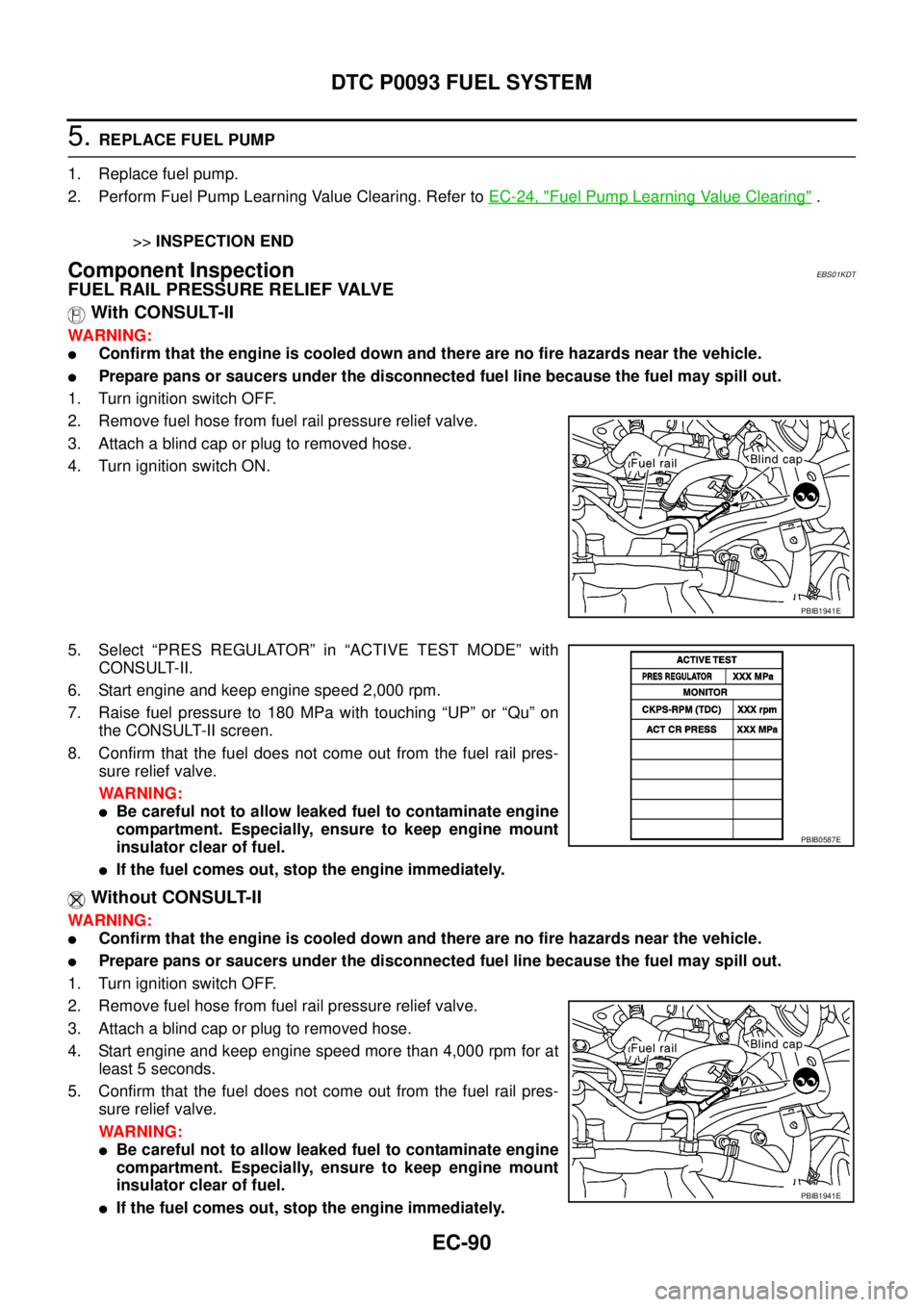
1. Turn ignition switch OFF.
2. Remove fuel hose from fuel rail pressure relief valve.
3. Attach a blind cap or plug to removed hose.
4. Turn ignition switch ON.
5. Select “PRES REGULATOR” in “ACTIVE TEST MODE” with
CONSULT-II.
6. Start engine and keep engine speed 2,000 rpm.
7. Raisefuelpressureto180MPawithtouching“UP”or“Qu”on
the CONSULT-II screen.
8. Confirm that the fuel does not come out from the fuel rail pres-
sure relief valve.
WARNING:
lBe careful not to allow leaked fuel to contaminate engine
compartment. Especially, ensure to keep engine mount
insulator clear of fuel.
lIf the fuel comes out, stop the engine immediately.
Without CONSULT-II
WARNING:
lConfirm that the engine is cooled down and there are no fire hazards near the vehicle.
lPrepare pans or saucers under the disconnected fuel line because the fuel may spill out.
1. Turn ignition switch OFF.
2. Remove fuel hose from fuel rail pressure relief valve.
3. Attach a blind cap or plug to removed hose.
4. Start engine and keep engine speed more than 4,000 rpm for at
least 5 seconds.
5. Confirm that the fuel does not come out from the fuel rail pres-
sure relief valve.
WARNING:
lBe careful not to allow leaked fuel to contaminate engine
compartment. Especially, ensure to keep engine mount
insulator clear of fuel.
lIf the fuel comes out, stop the engine immediately.
PBIB1941E
PBIB0587E
PBIB1941E
Page 1072 of 3171
EC-92
DTC P0102, P0103 MAF SENSOR
DTC P0102, P0103 MAF SENSOR
PFP:22680
Component DescriptionEBS01KDV
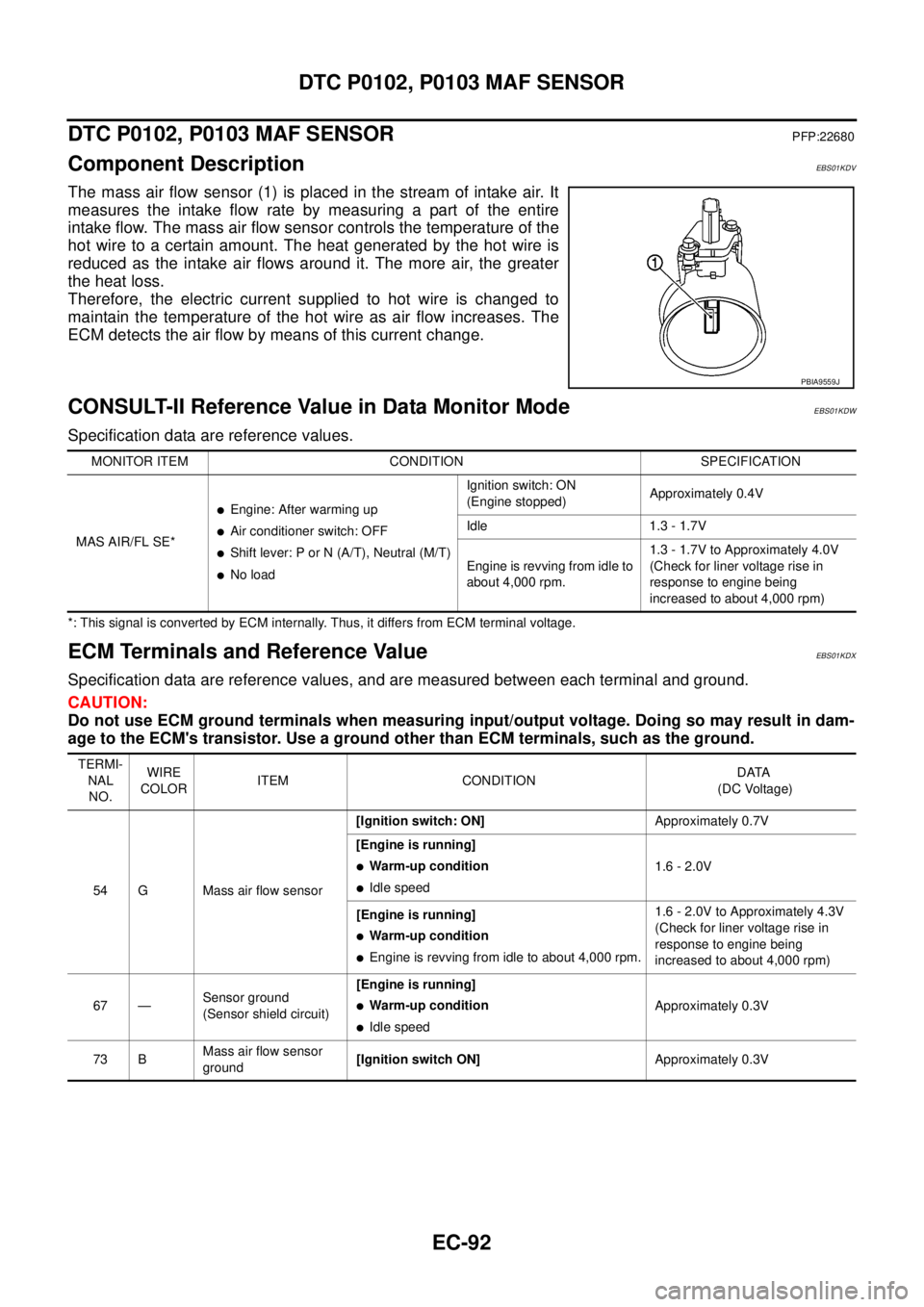
The mass air flow sensor (1) is placed in the stream of intake air. It
measures the intake flow rate by measuring a part of the entire
intake flow. The mass air flow sensor controls the temperature of the
hot wire to a certain amount. The heat generated by the hot wire is
reduced as the intake air flows around it. The more air, the greater
the heat loss.
Therefore, the electric current supplied to hot wire is changed to
maintain the temperature of the hot wire as air flow increases. The
ECM detects the air flow by means of this current change.
CONSULT-II Reference Value in Data Monitor ModeEBS01KDW
Specification data are reference values.
*: This signal is converted by ECM internally. Thus, it differs from ECM terminal voltage.
ECM Terminals and Reference ValueEBS01KDX
Specification data are reference values, and are measured between each terminal and ground.
CAUTION:
Do not use ECM ground terminals when measuring input/output voltage. Doing so may result in dam-
age to the ECM's transistor. Use a ground other than ECM terminals, such as the ground.
PBIA9559J
MONITOR ITEM CONDITION SPECIFICATION
MAS AIR/FL SE*
lEngine: After warming up
lAir conditioner switch: OFF
lShift lever: P or N (A/T), Neutral (M/T)
lNo loadIgnition switch: ON
(Engine stopped)Approximately 0.4V
Idle 1.3 - 1.7V
Engine is revving from idle to
about 4,000 rpm.1.3 - 1.7V to Approximately 4.0V
(Check for liner voltage rise in
response to engine being
increased to about 4,000 rpm)
TERMI-
NAL
NO.WIRE
COLORITEM CONDITIONDATA
(DC Voltage)
54 G Mass air flow sensor[Ignition switch: ON]Approximately 0.7V
[Engine is running]
lWarm-up condition
lIdle speed1.6 - 2.0V
[Engine is running]
lWarm-up condition
lEngine is revving from idle to about 4,000 rpm.1.6 - 2.0V to Approximately 4.3V
(Check for liner voltage rise in
response to engine being
increased to about 4,000 rpm)
67 —Sensor ground
(Sensor shield circuit)[Engine is running]
lWarm-up condition
lIdle speedApproximately 0.3V
73 BMass air flow sensor
ground[Ignition switch ON]Approximately 0.3V
Page 1077 of 3171
DTC P0102, P0103 MAF SENSOR
EC-97
C
D
E
F
G
H
I
J
K
L
MA
EC
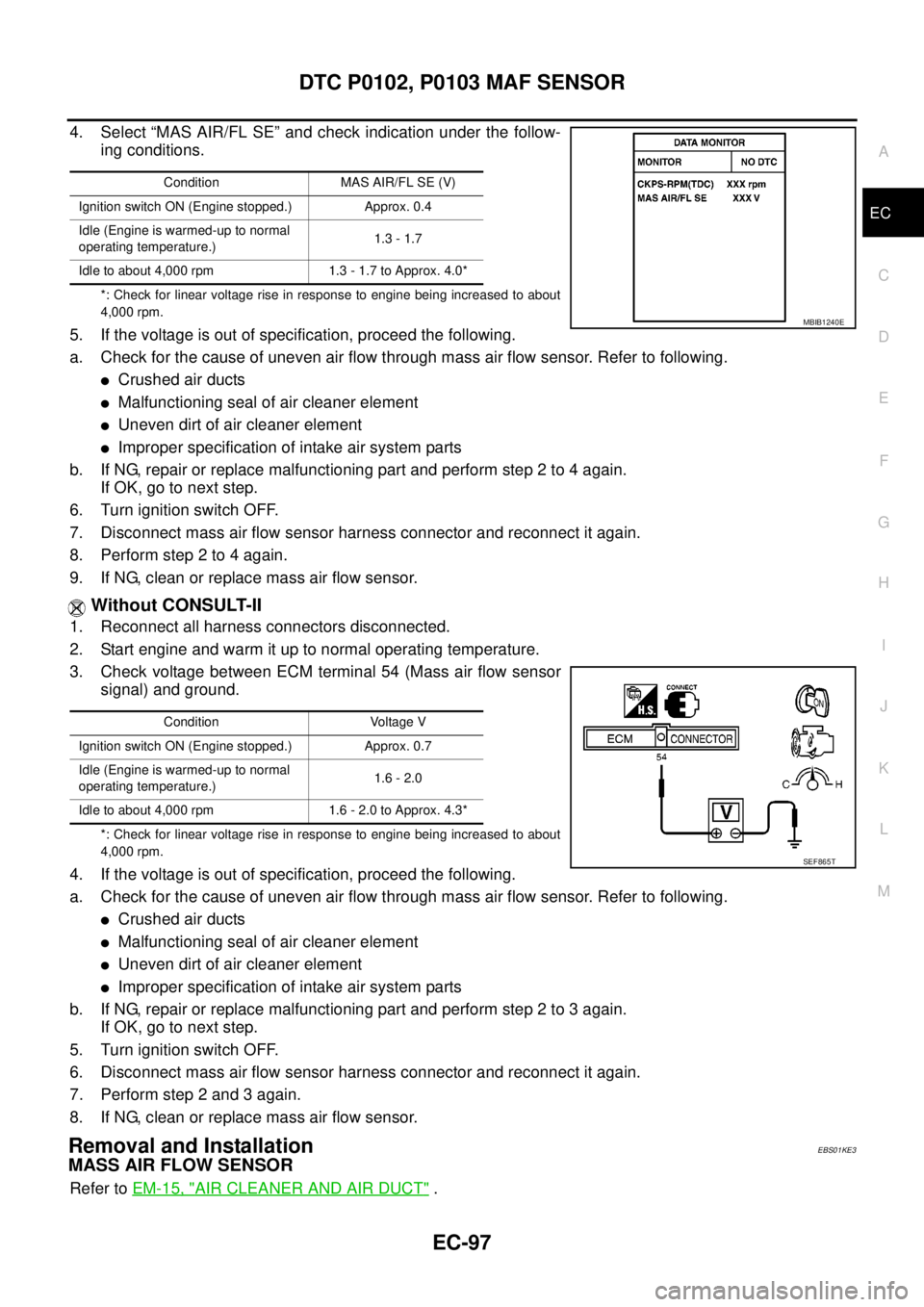
4. Select “MAS AIR/FL SE” and check indication under the follow-
ing conditions.
*: Check for linear voltage rise in response to engine being increased to about
4,000 rpm.
5. If the voltage is out of specification, proceed the following.
a. Check for the cause of uneven air flow through mass air flow sensor. Refer to following.
lCrushed air ducts
lMalfunctioning seal of air cleaner element
lUneven dirt of air cleaner element
lImproper specification of intake air system parts
b. If NG, repair or replace malfunctioning part and perform step 2 to 4 again.
IfOK,gotonextstep.
6. Turn ignition switch OFF.
7. Disconnect mass air flow sensor harness connector and reconnect it again.
8. Performstep2to4again.
9. If NG, clean or replace mass air flow sensor.
Without CONSULT-II
1. Reconnect all harness connectors disconnected.
2. Start engine and warm it up to normal operating temperature.
3. Check voltage between ECM terminal 54 (Mass air flow sensor
signal) and ground.
*: Check for linear voltage rise in response to engine being increased to about
4,000 rpm.
4. If the voltage is out of specification, proceed the following.
a. Check for the cause of uneven air flow through mass air flow sensor. Refer to following.
lCrushed air ducts
lMalfunctioning seal of air cleaner element
lUneven dirt of air cleaner element
lImproper specification of intake air system parts
b. If NG, repair or replace malfunctioning part and perform step 2 to 3 again.
IfOK,gotonextstep.
5. Turn ignition switch OFF.
6. Disconnect mass air flow sensor harness connector and reconnect it again.
7. Perform step 2 and 3 again.
8. If NG, clean or replace mass air flow sensor.
Removal and InstallationEBS01KE3
MASS AIR FLOW SENSOR
Refer toEM-15, "AIR CLEANER AND AIR DUCT".
Condition MAS AIR/FL SE (V)
Ignition switch ON (Engine stopped.) Approx. 0.4
Idle (Engine is warmed-up to normal
operating temperature.)1.3 - 1.7
Idle to about 4,000 rpm 1.3 - 1.7 to Approx. 4.0*
MBIB1240E
Condition Voltage V
Ignition switch ON (Engine stopped.) Approx. 0.7
Idle (Engine is warmed-up to normal
operating temperature.)1.6 - 2.0
Idle to about 4,000 rpm 1.6 - 2.0 to Approx. 4.3*
SEF865T