2005 NISSAN NAVARA ESP
[x] Cancel search: ESPPage 220 of 3171

AT-212
A/T SHIFT LOCK SYSTEM
A/T SHIFT LOCK SYSTEM
PFP:34950
DescriptionECS00G2Z
lThe mechanical key interlock mechanism also operates as a shift lock:
With the ignition switch turned to ON, selector lever cannot be shifted from “P” position to any other posi-
tion unless brake pedal is depressed.
With the key removed, selector lever cannot be shifted from “P” position to any other position.
The key cannot be removed unless selector lever is placed in “P” position.
lThe shift lock and key interlock mechanisms are controlled by ON-OFF operation of the shift lock solenoid
and by the operation of the rotator and slider located inside the key cylinder, respectively.
Shift Lock System Electrical Parts LocationECS00G30
SCIA7299E
Page 332 of 3171

AT-324
SERVICE DATA AND SPECIFICATIONS (SDS)
Vehicle Speed at Which Gear Shifting Occurs
ECS00H8W
2WD MODELS
lAt half throttle, the accelerator opening is 4/8 of the full opening.
4WD MODELS
lAt half throttle, the accelerator opening is 4/8 of the full opening.
Vehicle Speed at Which Lock-Up Occurs/ReleasesECS00H8X
2WD MODELS
lAt closed throttle, the accelerator opening is less than 1/8 condition. (Closed throttle position signal: OFF)
lAt half throttle, the accelerator opening is 4/8 of the full opening.
4WD MODELS
lAt closed throttle, the accelerator opening is less than 1/8 condition. (Closed throttle position signal: OFF)
lAt half throttle, the accelerator opening is 4/8 of the full opening.
A/T Fluid Temperature SensorECS00G3T
Tire sizeThrottle
positionVehicle speed [km/h (MPH)]
D1®D2D2®D3D3®D4D4®D5D5®D4D4®D3D3®D2D2®D1
255/65 R17
255/70 R16Full
throttle41 - 45
(25 - 28)66 - 72
(41 - 45)103 - 113
(64 - 70)148 - 164
(92 - 102)144 - 160
(89 - 99)92 - 102
(57 - 63)53 - 59
(33 - 37)23 - 24
(14 - 15)
Half
throttle34 - 38
(21 - 24)55 - 61
(34 - 38)86 - 96
(53 - 60)118 - 130
(73 - 81)88 - 98
(55 - 61)60 - 66
(37 - 41)39 - 43
(24 - 27)10 - 11
(6 - 7)
Tire sizeThrottle
positionVehiclespeed [km/h(MPH)]
D1®D2D2®D3D3®D4D4®D5D5®D4D4®D3D3®D2D2®D1
255/65 R17
255/70 R16Full
throttle38 - 42
(24 - 26)62 - 68
(39 - 42)97 - 107
(60 - 66)141 - 155
(88 - 96)137 - 151
(85 - 94)87 - 97
(54 - 60)50 - 56
(31 - 35)22 - 24
(14 - 15)
Half
throttle32 - 36
(20 - 22)52 - 58
(32 - 36)82 - 90
(51 - 56)117 - 129
(73 - 80)83 - 91
(52 - 57)57 - 63
(35 - 39)37 - 41
(23 - 25)10 - 11
(6 - 7)
265/70 R16LTFull
throttle40 - 44
(25 - 27)65 - 71
(40 - 44)101 - 111
(63 - 69)145 - 161
(90 - 100)142 - 156
(88 - 97)90 - 100
(56 - 62)52 - 58
(32 - 36)23 - 25
(14 - 16)
Half
throttle33 - 37
(21 - 23)54 - 60
(34 - 37)85 - 93
(53 - 58)121 - 133
(75 - 83)85 - 95
(53 - 59)59 - 65
(37 - 40)38 - 42
(24 - 26)10 - 11
(6 - 7)
Tire size Throttle positionVehicle speed [km/h (MPH)]
Lock-up ON Lock-up OFF
255/65 R17
255/70 R16Closed throttle 73 - 81 (45 - 50) 70 - 78 (44 - 48)
Half throttle 141 - 155 (88 - 96) 130 - 144 (81 - 89)
Tire size Throttle positionVehicle speed [km/h (MPH)]
Lock-up ON Lock-up OFF
255/65 R17
255/70 R16Closed throttle 69 - 77 (43 - 48) 66 - 74 (41 - 46)
Half throttle 134 - 148 (83 - 92) 123 - 137 (76 - 85)
265/70 R16LTClosed throttle 72 - 80 (45 - 50) 69 - 77 (43 - 48)
Half throttle 139 - 153 (86 - 95) 128 - 142 (80 - 88)
Name Condition CONSULT-II “DATA MONITOR” (Approx.) Resistance (Approx.)
ATFTEMPSE10°C(32°F) 3.3 V 15 kW
20°C(68°F) 2.7 V 6.5 kW
80°C(176°F) 0.9 V 0.9 kW
ATFTEMPSE20°C(32°F) 3.3 V 10 kW
20°C(68°F) 2.5V 4kW
80°C(176°F) 0.7 V 0.5 kW
Page 351 of 3171
PREPARATION
ATC-17
C
D
E
F
G
H
I
K
L
MA
B
AT C
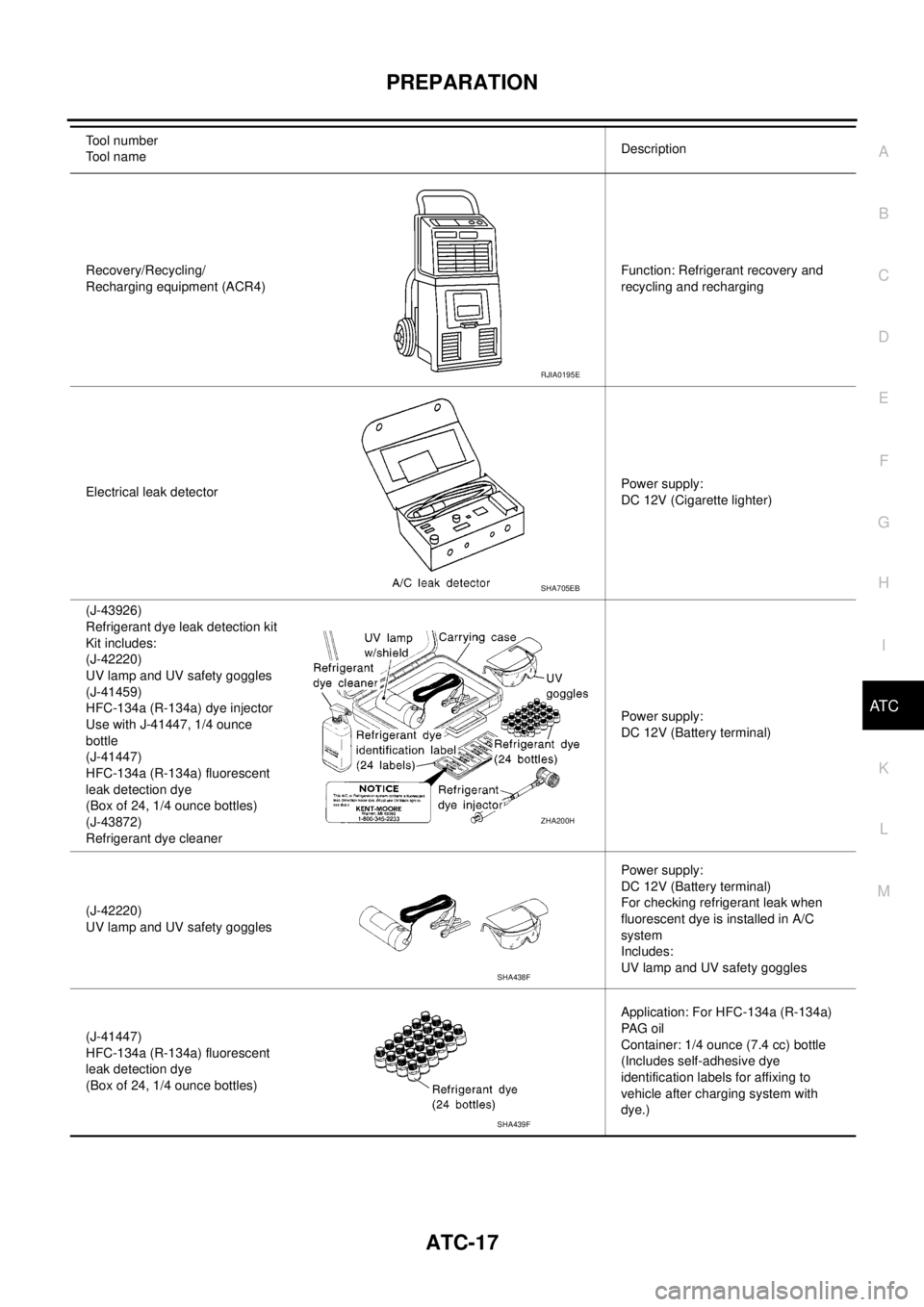
Recovery/Recycling/
Recharging equipment (ACR4)Function: Refrigerant recovery and
recycling and recharging
Electrical leak detectorPower supply:
DC 12V (Cigarette lighter)
(J-43926)
Refrigerant dye leak detection kit
Kit includes:
(J-42220)
UV lamp and UV safety goggles
(J-41459)
HFC-134a (R-134a) dye injector
Use with J-41447, 1/4 ounce
bottle
(J-41447)
HFC-134a (R-134a) fluorescent
leak detection dye
(Box of 24, 1/4 ounce bottles)
(J-43872)
Refrigerant dye cleanerPower supply:
DC 12V (Battery terminal)
(J-42220)
UV lamp and UV safety gogglesPower supply:
DC 12V (Battery terminal)
For checking refrigerant leak when
fluorescent dye is installed in A/C
system
Includes:
UV lamp and UV safety goggles
(J-41447)
HFC-134a (R-134a) fluorescent
leak detection dye
(Box of 24, 1/4 ounce bottles)Application: For HFC-134a (R-134a)
PA G o i l
Container: 1/4 ounce (7.4 cc) bottle
(Includes self-adhesive dye
identification labels for affixing to
vehicle after charging system with
dye.) Tool number
Tool nameDescription
RJIA0195E
SHA705EB
ZHA200H
SHA438F
SHA439F
Page 390 of 3171
ATC-56
TROUBLE DIAGNOSIS
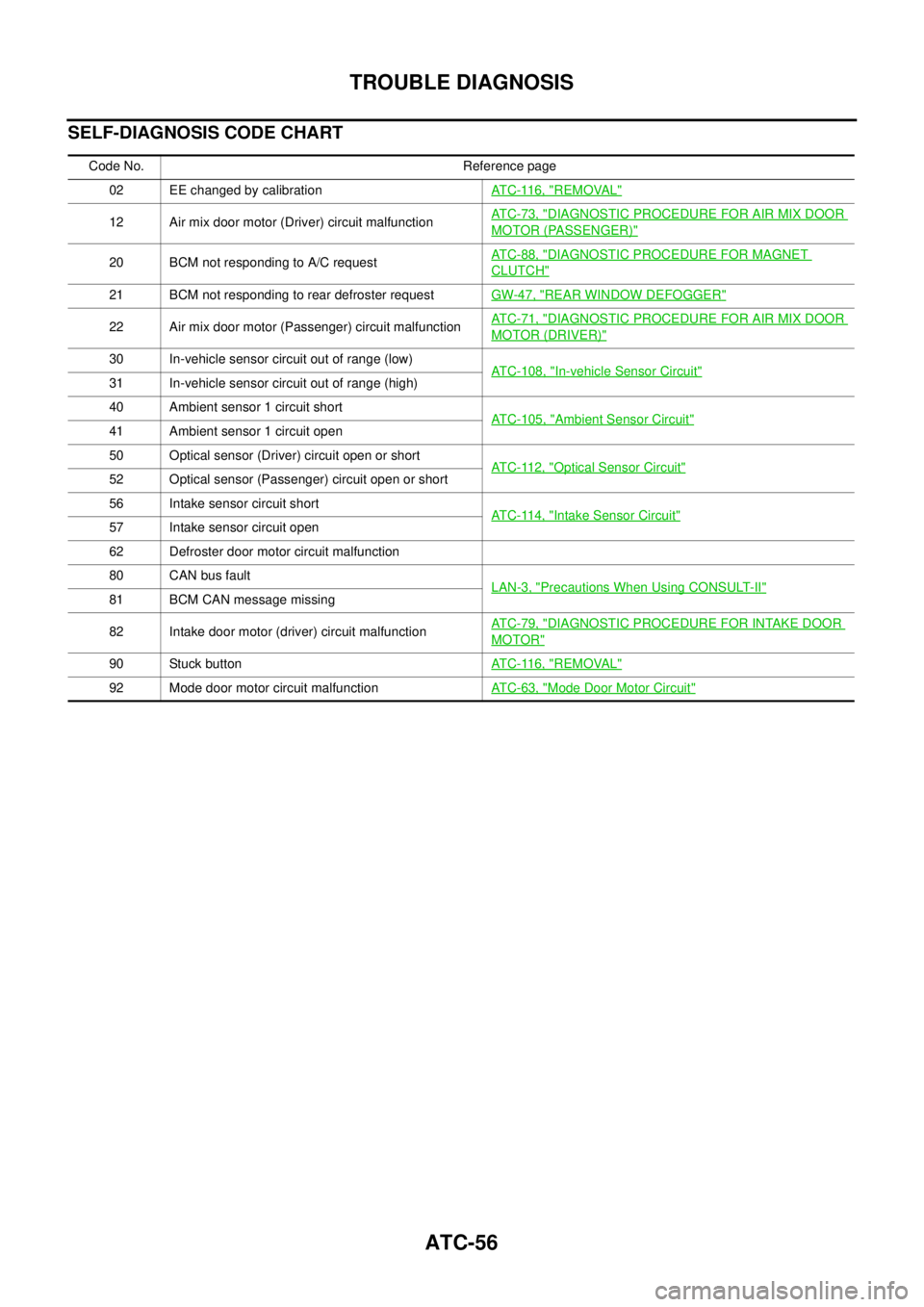
SELF-DIAGNOSIS CODE CHART
Code No. Reference page
02 EE changed by calibrationATC-116, "
REMOVAL"
12 Air mix door motor (Driver) circuit malfunctionATC-73, "DIAGNOSTIC PROCEDURE FOR AIR MIX DOOR
MOTOR (PASSENGER)"
20 BCM not responding to A/C requestATC-88, "DIAGNOSTIC PROCEDURE FOR MAGNET
CLUTCH"
21 BCM not responding to rear defroster requestGW-47, "REAR WINDOW DEFOGGER"
22 Air mix door motor (Passenger) circuit malfunctionATC-71, "DIAGNOSTIC PROCEDURE FOR AIR MIX DOOR
MOTOR (DRIVER)"
30 In-vehicle sensor circuit out of range (low)
ATC-108, "In-vehicle Sensor Circuit"31 In-vehicle sensor circuit out of range (high)
40 Ambient sensor 1 circuit short
ATC-105, "
Ambient Sensor Circuit"41 Ambient sensor 1 circuit open
50 Optical sensor (Driver) circuit open or short
ATC-112, "
Optical Sensor Circuit"52 Optical sensor (Passenger) circuit open or short
56 Intake sensor circuit short
ATC-114, "
Intake Sensor Circuit"57 Intake sensor circuit open
62 Defroster door motor circuit malfunction
80 CAN bus fault
LAN-3, "
Precautions When Using CONSULT-II"81 BCM CAN message missing
82 Intake door motor (driver) circuit malfunctionATC-79, "
DIAGNOSTIC PROCEDURE FOR INTAKE DOOR
MOTOR"
90 Stuck buttonATC-116, "REMOVAL"
92 Mode door motor circuit malfunctionATC-63, "Mode Door Motor Circuit"
Page 555 of 3171

TROUBLE DIAGNOSIS
AV-67
C
D
E
F
G
H
I
J
L
MA
B
AV
VOICE GUIDANCE
VOICE RECOGNITION
An indirect route is suggested.If there are restrictions (such as one way streets)
on roads close to the starting point or destination,
the system may suggest an indirect route.Adjust the location of the starting point or
destination.
The system may suggest an indirect route because
route calculation does not take into consideration
some areas such as narrow streets (gray roads).Reset the destination to a main or ordinary
road, and recalculate the route.
The landmark information does not
correspond to the actual informa-
tion.This may caused by insufficient or incorrect data on
the DVD-ROM.This is not a malfunction.
The suggested route does not
exactly connect to the starting
point, waypoints, or destination.There is no data for route calculation closer to
these locations.Set the starting point, waypoints and desti-
nation on main road, and perform route cal-
culation. Symptom Possible cause Possible solution
Symptom Possible cause Possible solution
The voice guidance is not avail-
able.Voice guidance is only available at certain intersec-
tions. In some cases, voice guidance is not avail-
able even when the vehicle should make a turn.This is not a malfunction.
The vehicle has deviated from the suggested
route.Go back to the suggested route or request
route calculation again.
Voice guidance is set to off. Turn on the voice guidance.
Route guidance is set to off. Turn on the voice guidance.
The guidance content does not
correspond to the actual condition.The content of the voice guidance may vary,
depending on the types of intersections at which
turns are made.Follow all traffic rules and regulations.
Symptom Possible cause Possible solution
The system does not recognize
the command.
The system recognizes the com-
mand incorrectly.The interior of the vehicle is too noisy.Close the windows or have other occu-
pants be quiet.
The volume of the voice is too low. Speak louder.
Pronounceation is unclear. Speak clearly.
Voice recognition mode is not yet ready to speak.Push the release “PPT” on the steering
switch, and speak a command after the
tone sounds.
5 seconds or more have passed after pushed and
released “PTT” on the steering switch.Make sure to speak a command within 5
seconds after push and release “PTT” on
the steering switch.
Only a limited range of voice commands is usable
for each screen.Use a correct voice command appropriate
for the current screen.
Page 569 of 3171
BCM (BODY CONTROL MODULE)
BCS-3
C
D
E
F
G
H
I
J
L
MA
B
BCS
BCM (BODY CONTROL MODULE)PFP:284B2
System DescriptionEKS00PA1
lBCM (Body Control Module) controls the operation of various electrical units installed on the vehicle.
BCM FUNCTION
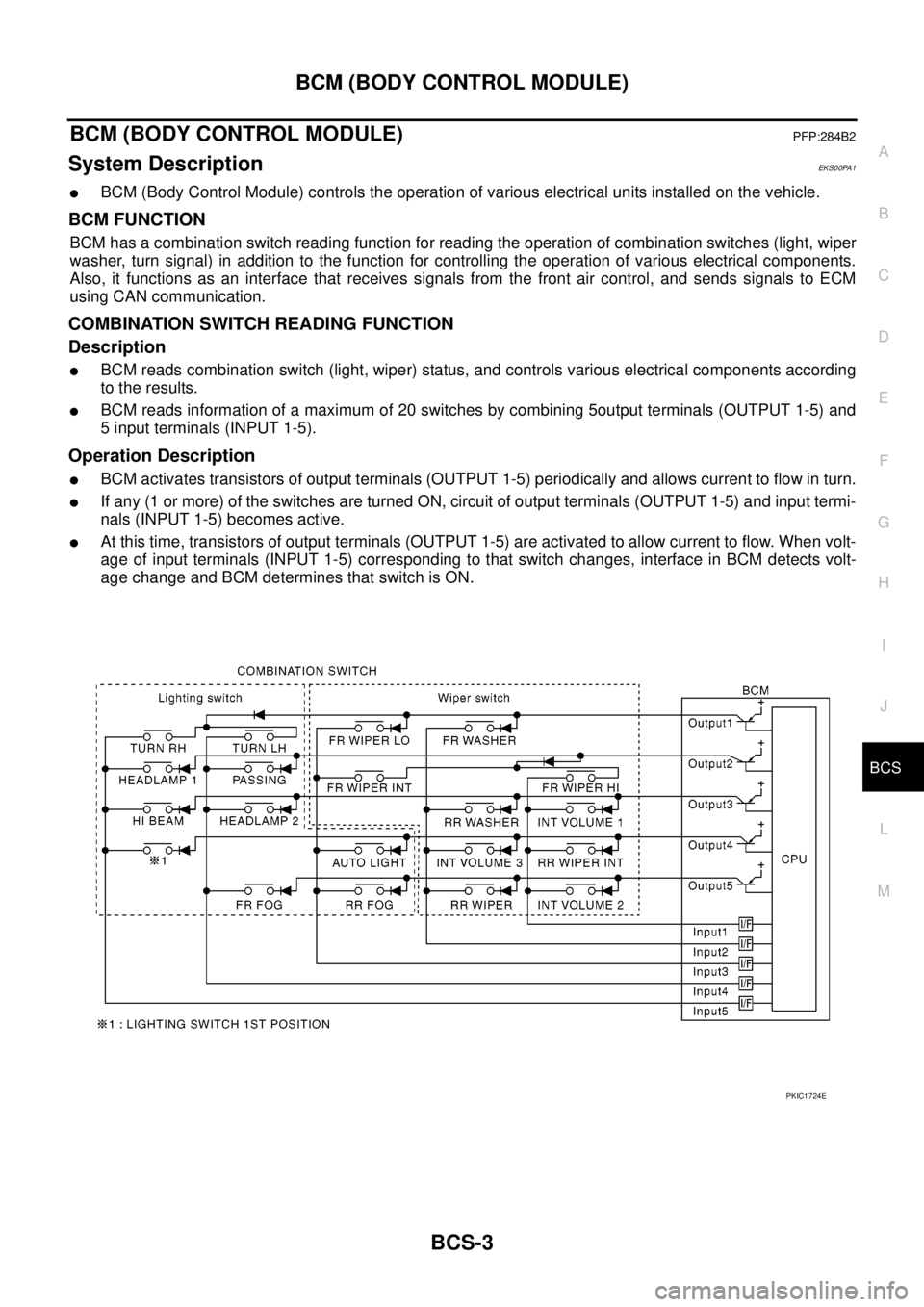
BCM has a combination switch reading function for reading the operation of combination switches (light, wiper
washer, turn signal) in addition to the function for controlling the operation of various electrical components.
Also, it functions as an interface that receives signals from the front air control, and sends signals to ECM
using CAN communication.
COMBINATION SWITCH READING FUNCTION
Description
lBCM reads combination switch (light, wiper) status, and controls various electrical components according
to the results.
lBCM reads information of a maximum of 20 switches by combining 5output terminals (OUTPUT 1-5) and
5 input terminals (INPUT 1-5).
Operation Description
lBCM activates transistors of output terminals (OUTPUT 1-5) periodically and allows current to flow in turn.
lIf any (1 or more) of the switches are turned ON, circuit of output terminals (OUTPUT 1-5) and input termi-
nals (INPUT 1-5) becomes active.
lAt this time, transistors of output terminals (OUTPUT 1-5) are activated to allow current to flow. When volt-
age of input terminals (INPUT 1-5) corresponding to that switch changes, interface in BCM detects volt-
age change and BCM determines that switch is ON.
PKIC1724E
Page 590 of 3171

BL-6
SQUEAK AND RATTLE TROUBLE DIAGNOSES
SQUEAK AND RATTLE TROUBLE DIAGNOSES
PFP:00000
Work FlowEIS00DI2
CUSTOMER INTERVIEW
Interview the customer if possible, to determine the conditions that exist when the noise occurs. Use the Diag-
nostic Worksheet during the interview to document the facts and conditions when the noise occurs and any
customer's comments; refer toBL-10, "
Diagnostic Worksheet". This information is necessary to duplicate the
conditions that exist when the noise occurs.
lThe customer may not be able to provide a detailed description or the location of the noise. Attempt to
obtain all the facts and conditions that exist when the noise occurs (or does not occur).
lIf there is more than one noise in the vehicle, be sure to diagnose and repair the noise that the customer
is concerned about. This can be accomplished by test driving the vehicle with the customer.
lAfter identifying the type of noise, isolate the noise in terms of its characteristics. The noise characteristics
are provided so the customer, service adviser and technician are all speaking the same language when
defining the noise.
lSqueak —(Like tennis shoes on a clean floor)
Squeak characteristics include the light contact/fast movement/brought on by road conditions/hard sur-
faces=higher pitch noise/softer surfaces=lower pitch noises/edge to surface=chirping
lCreak—(Like walking on an old wooden floor)
Creak characteristics include firm contact/slow movement/twisting with a rotational movement/pitch
dependent on materials/often brought on by activity.
lRattle—(Like shaking a baby rattle)
Rattle characteristics include the fast repeated contact/vibration or similar movement/loose parts/missing
clip or fastener/incorrect clearance.
lKnock —(Like a knock on a door)
Knock characteristics include hollow sounding/sometimes repeating/often brought on by driver action.
lTick—(Like a clock second hand)
Tick characteristics include gentle contacting of light materials/loose components/can be caused by driver
action or road conditions.
lThump—(Heavy, muffled knock noise)
Thump characteristics include softer knock/dead sound often brought on by activity.
lBuzz—(Like a bumble bee)
Buzz characteristics include high frequency rattle/firm contact.
lOften the degree of acceptable noise level will vary depending upon the person. A noise that you may
judge as acceptable may be very irritating to the customer.
lWeather conditions, especially humidity and temperature, may have a great effect on noise level.
SBT842
Page 608 of 3171

BL-24
POWER DOOR LOCK SYSTEM
lto BCM terminal 34
lthrough door lock /unlock switch terminals 1 and 3
lthrough body grounds M21, M80 and M83.
then all doors are locked.
When door lock/unlock switch is locked, ground is supplied
lthrough BCM terminal 56
lthrough all door actuators terminal 3
lthrough all door lock actuators terminal 2
lthrough back door lock actuator terminals 1 and 3
lto BCM terminals 54 and 60.
then all doors actuators are locked
Power door unlock operation with door lock/unlock switch
When doors are unlock by door lock/unlock switch, ground is supplied
lto BCM terminal 32
lthrough door lock/unlock switch terminals 2 and 3
lthrough body grounds M21, M80 and M83.
then all doors are locked.
When door lock/unlock switch is unlocked, ground is supplied
lthrough BCM terminals 54 and 60
lthrough all door lock actuators terminal 2
lthrough all door lock actuators terminal 3
lthen all door actuators are unlock
lto BCM terminal 56.
Door lock/unlock switch indicator operation
When door lock/unlock switch is locked, all doors are locked, door lock/unlock switch indicator is on, and
ground is supplied
lto BCM terminal 17
lthrough door lock/unlock switch terminals 5 and 3
lthrough body grounds M21, M80 and M83.
OUTLINE
Function Available by Operating the Door Lock/Unlock Switch
lOperating the door lock/unlock switch to “LOCK” will lock all doors.
lOperating the door lock/unlock switch to “UNLOCK” will unlock all doors.
NOTE:
Unlock via the interior door handles and door lock/unlock switch is always possible.
Door Lock Warning Function
Under following conditions lock actuators will not respond and buzzer warning will beeps while pressing door
lock/unlock switch in LOCK direction.
lIgnition switch is turned OFF
lMechanical key is out of ignition key cylinder
lDoor is opened (except driver side door)
Key Reminder Function
Under following conditions lock actuators will lock the door once, but then immediately unlock all doors and
buzzer warning will beeps while pressing door lock/unlock switch in LOCK direction.
lIgnition switch is turned OFF
lMechanical key is inserted in ignition key cylinder
lDriver side door is opened
Door Lock/Unlock Switch Indicator
The Door lock/unlock switch indicates door lock status. The indicator will illuminates when a lock operation is
accomplish, during this state, if any door is open, the indicator will turn OFF.