Page 3179 of 3502
SUNROOF
RF-15
C
D
E
F
G
H
J
K
L
MA
B
RF
Work FlowBIS0010W
1. Check the symptom and customer's requests.
2. Understand the outline of system. Refer to RF-11, "
System Description" .
3. According to the trouble diagnosis chart, repair or replace the cause of the malfunction. Refer to RF-15,
"Trouble Diagnosis Chart by Symptom" .
4. Does sunroof system operate normally? If Yes, GO TO 5. If No, GO TO 3.
5. INSPECTION END.
Trouble Diagnosis Chart by SymptomBIS0010X
Check BCM Power Supply and Ground CircuitBIS0010Y
1. CHECK FUSE
�Check 10A fuse [No.1, located in fuse block (J/B)]
�Check 15A fuse [No.17, located in fuse block (J/B)]
�Check 50A fusible link (letter M located in the fuse and fusible link box).
NOTE:
Refer to RF-10, "
Component Parts and Harness Connector Location" .
OK or NG
OK >> GO TO 2.
NG >> If fuse is blown out, be sure to eliminate cause of malfunction before installing new fuse. Refer to
PG-3, "
POWER SUPPLY ROUTING CIRCUIT" .
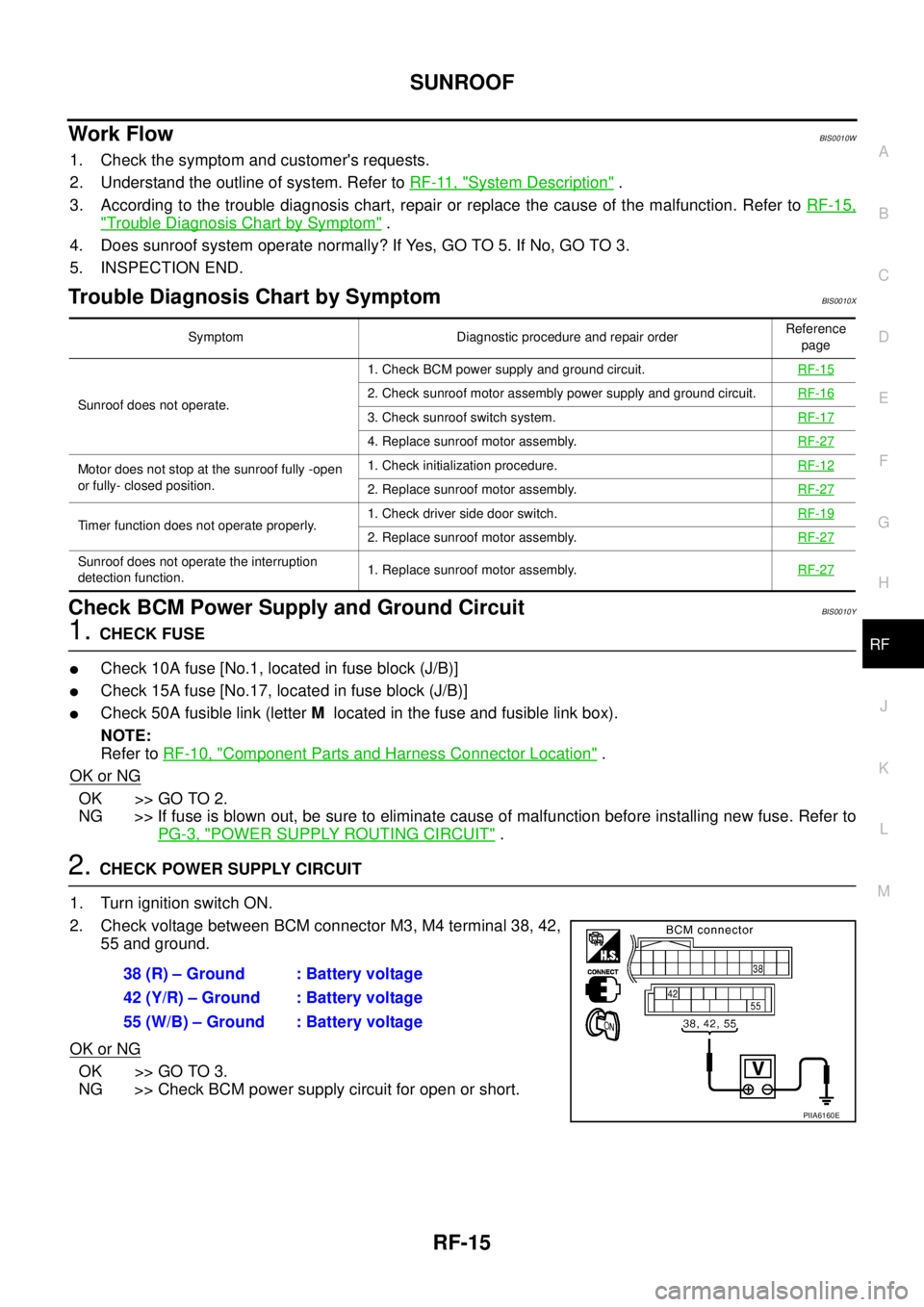
2. CHECK POWER SUPPLY CIRCUIT
1. Turn ignition switch ON.
2. Check voltage between BCM connector M3, M4 terminal 38, 42,
55 and ground.
OK or NG
OK >> GO TO 3.
NG >> Check BCM power supply circuit for open or short.
Symptom Diagnostic procedure and repair orderReference
page
Sunroof does not operate.1. Check BCM power supply and ground circuit.RF-15
2. Check sunroof motor assembly power supply and ground circuit.RF-16
3. Check sunroof switch system.RF-17
4. Replace sunroof motor assembly.RF-27
Motor does not stop at the sunroof fully -open
or fully- closed position.1. Check initialization procedure.RF-12
2. Replace sunroof motor assembly.RF-27
Timer function does not operate properly.1. Check driver side door switch.RF-192. Replace sunroof motor assembly.RF-27
Sunroof does not operate the interruption
detection function.1. Replace sunroof motor assembly.RF-27
38 (R) – Ground : Battery voltage
42 (Y/R) – Ground : Battery voltage
55 (W/B) – Ground : Battery voltage
PIIA6160E
Page 3180 of 3502
RF-16
SUNROOF
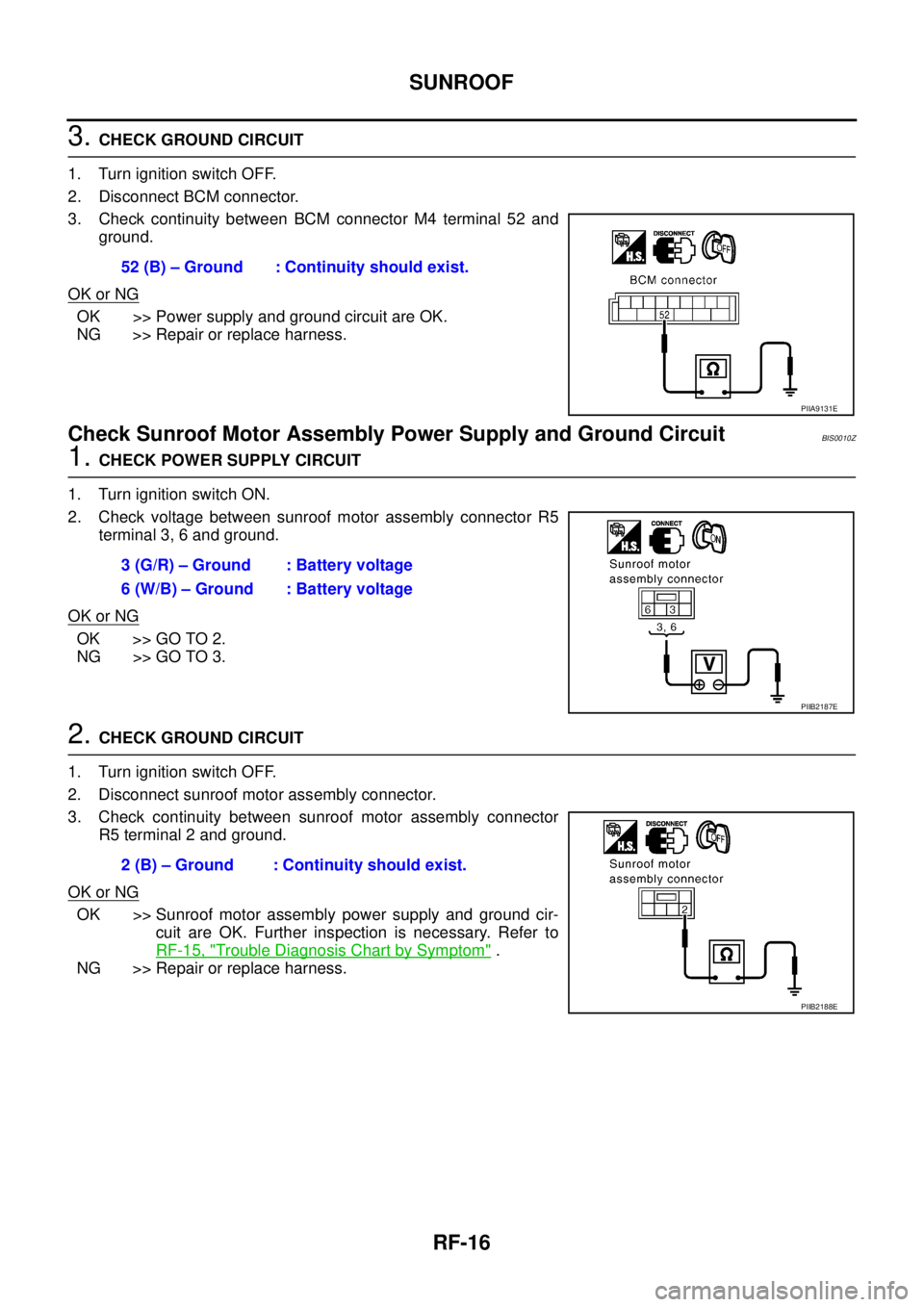
3. CHECK GROUND CIRCUIT
1. Turn ignition switch OFF.
2. Disconnect BCM connector.
3. Check continuity between BCM connector M4 terminal 52 and
ground.
OK or NG
OK >> Power supply and ground circuit are OK.
NG >> Repair or replace harness.
Check Sunroof Motor Assembly Power Supply and Ground CircuitBIS0010Z
1. CHECK POWER SUPPLY CIRCUIT
1. Turn ignition switch ON.
2. Check voltage between sunroof motor assembly connector R5
terminal 3, 6 and ground.
OK or NG
OK >> GO TO 2.
NG >> GO TO 3.
2. CHECK GROUND CIRCUIT
1. Turn ignition switch OFF.
2. Disconnect sunroof motor assembly connector.
3. Check continuity between sunroof motor assembly connector
R5 terminal 2 and ground.
OK or NG
OK >> Sunroof motor assembly power supply and ground cir-
cuit are OK. Further inspection is necessary. Refer to
RF-15, "
Trouble Diagnosis Chart by Symptom" .
NG >> Repair or replace harness.52 (B) – Ground : Continuity should exist.
PIIA9131E
3 (G/R) – Ground : Battery voltage
6 (W/B) – Ground : Battery voltage
PIIB2187E
2 (B) – Ground : Continuity should exist.
PIIB2188E
Page 3221 of 3502
PREPARATION
SC-3
C
D
E
F
G
H
I
J
L
MA
B
SC
PREPARATIONPFP:00002
Commercial Service ToolsBKS001MA
Tool number
Tool nameDescription
Power toolLoosening nuts and bolts
PBIC0190E
Page 3232 of 3502

SC-14
STARTING SYSTEM
STARTING SYSTEMPFP:23300
System Description BKS001ME
Power is supplied at all times:
�through 40A fusible link (letter F , located in the fuse and fusible link block)
�to ignition switch terminal 1,
�through 15A fuse (No. 71, located in the IPDM E/R)
�to CPU of IPDM E/R,
�through 15A fuse (No. 78, located in the IPDM E/R)
�to CPU of IPDM E/R.
With the ignition switch in the ON or START position, power is supplied:
[A/T models]
�from ignition relay
�through 10A fuse (No. 83, located in the IPDM E/R)
�through IPDM E/R terminal 26
�to park/neutral position switch terminal 1.
[CVT models]
�through ignition relay ( within the IPDM E/R )
�to CPU of IPDM E/R.
When the selector lever in the “P” or “N” position, power is supplied:
[A/T models]
�through park/neutral position switch terminal 2
�to IPDM E/R terminal 53.
[CVT models]
�from TCM terminal 24
�to IPDM E/R terminal 53.
Ground is supplied:
�to IPDM E/R terminals 38, 50 and 60
�from grounds E1 and E31.
Then starter relay is turn ON.
With the ignition switch in the START position, IPDM E/R is energized and power is supplied:
�from ignition switch terminal 5
�to IPDM E/R terminal 4 and
�through IPDM E/R terminal 3
�to starter motor terminal 1.
The starter motor plunger closes and provides a closed circuit between the battery and starter motor. The
starter motor is grounded to the engine block. With power and ground supplied, cranking occurs and the
engine starts.
Page 3236 of 3502
SC-18
STARTING SYSTEM
Removal and Installation BKS001MH
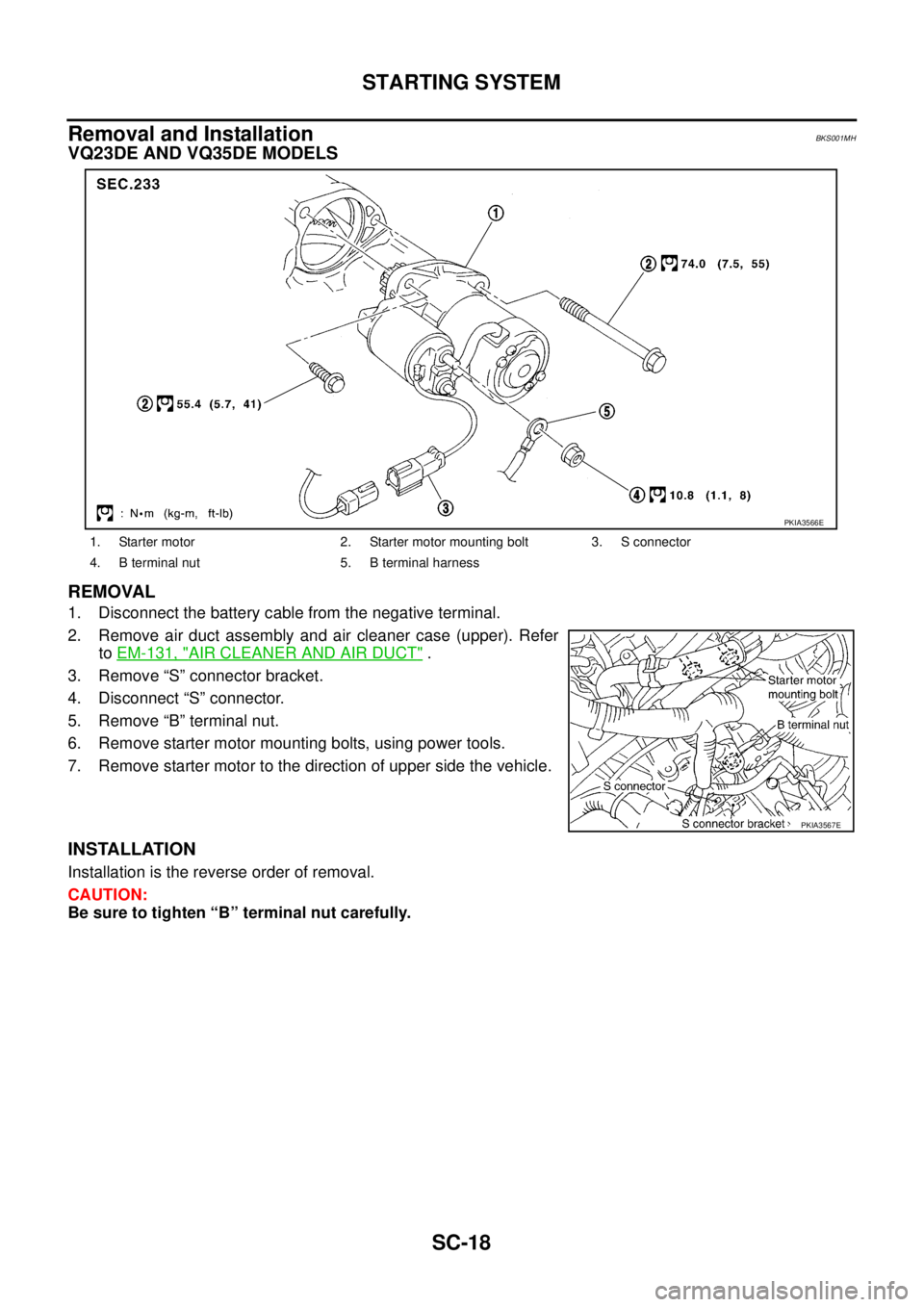
VQ23DE AND VQ35DE MODELS
REMOVAL
1. Disconnect the battery cable from the negative terminal.
2. Remove air duct assembly and air cleaner case (upper). Refer
to EM-131, "
AIR CLEANER AND AIR DUCT" .
3. Remove “S” connector bracket.
4. Disconnect “S” connector.
5. Remove “B” terminal nut.
6. Remove starter motor mounting bolts, using power tools.
7. Remove starter motor to the direction of upper side the vehicle.
INSTALLATION
Installation is the reverse order of removal.
CAUTION:
Be sure to tighten “B” terminal nut carefully.
1. Starter motor 2. Starter motor mounting bolt 3. S connector
4. B terminal nut 5. B terminal harness
PKIA3566E
PKIA3567E
Page 3237 of 3502
STARTING SYSTEM
SC-19
C
D
E
F
G
H
I
J
L
MA
B
SC
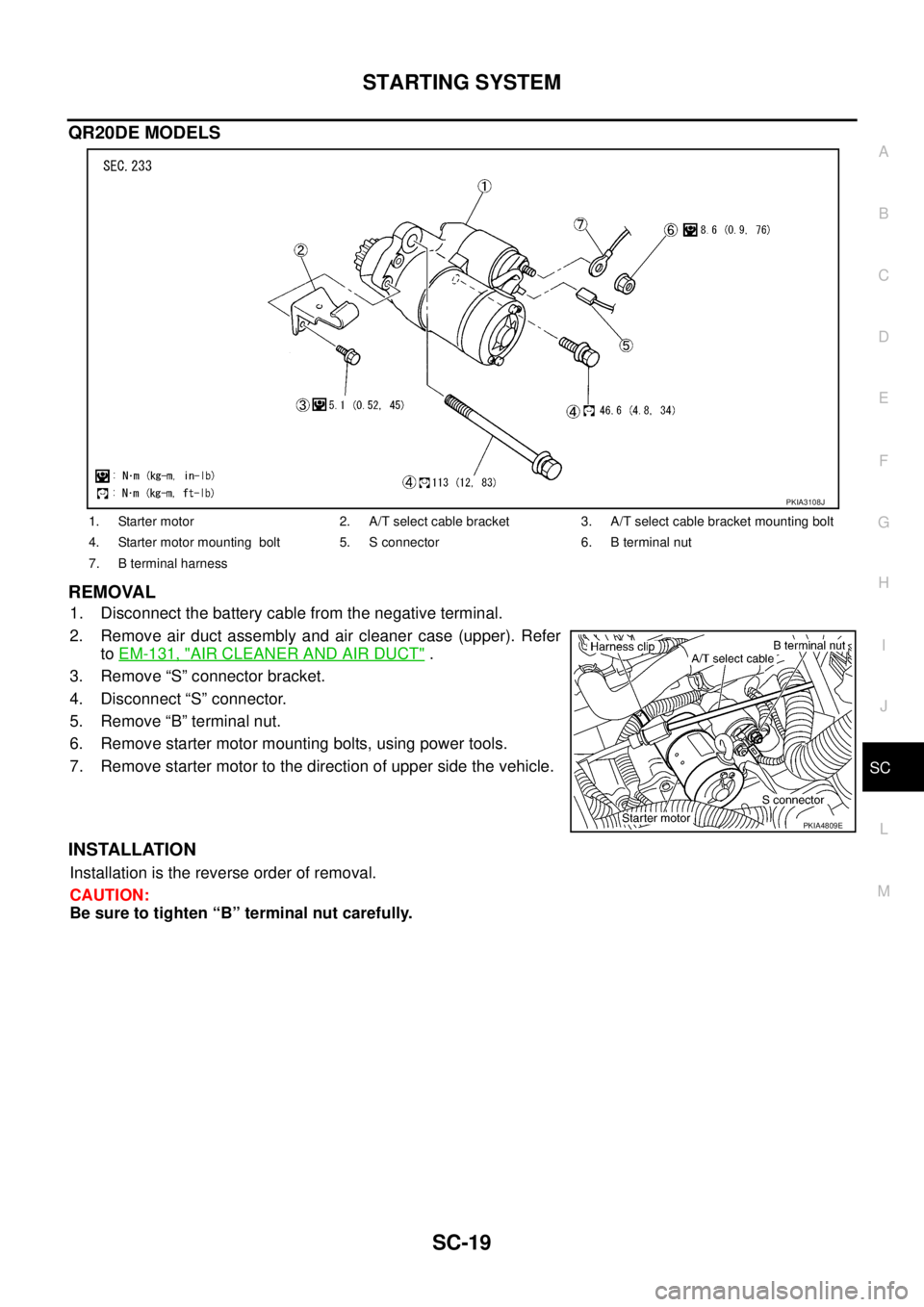
QR20DE MODELS
REMOVAL
1. Disconnect the battery cable from the negative terminal.
2. Remove air duct assembly and air cleaner case (upper). Refer
to EM-131, "
AIR CLEANER AND AIR DUCT" .
3. Remove “S” connector bracket.
4. Disconnect “S” connector.
5. Remove “B” terminal nut.
6. Remove starter motor mounting bolts, using power tools.
7. Remove starter motor to the direction of upper side the vehicle.
INSTALLATION
Installation is the reverse order of removal.
CAUTION:
Be sure to tighten “B” terminal nut carefully.
1. Starter motor 2. A/T select cable bracket 3. A/T select cable bracket mounting bolt
4. Starter motor mounting bolt 5. S connector 6. B terminal nut
7. B terminal harness
PKIA3108J
PKIA4809E
Page 3245 of 3502

CHARGING SYSTEM
SC-27
C
D
E
F
G
H
I
J
L
MA
B
SC
CHARGING SYSTEMPFP:23100
System DescriptionBKS001MJ
The alternator provides DC voltage to operate the vehicle's electrical system and to keep the battery charged.
The voltage output is controlled by the IC regulator.
Power is supplied at all times:
�through 10A fuse (No. 36, located in the fuse and fusible link block)
�to alternator terminal 4 (“S” terminal).
“B” terminal supplies power to charge the battery and operate the vehicle's electrical system. Output voltage is
controlled by the IC regulator at terminal 4 (“S” terminal) detecting the input voltage.
The charging circuit is protected by the 120A fusible link (letter A, located in the fusible link holder).
The alternator is grounded to the engine block.
With the ignition switch in the ON or START position, power is supplied:
�through 10A fuse [No. 14, located in the fuse block (J/B)]
�to combination meter terminal 8 for the charge warning lamp.
Ground is supplied:
�to combination meter terminal 22
�through alternator terminal 3 (“L” terminal)
�to alternator terminal “E”
�through ground E2.
The charge warning lamp will illuminate. When the alternator is providing sufficient voltage with the engine
running, the ground is opened and the charge warning lamp will go off.
If the charge warning lamp illuminates with the engine running, a malfunction is indicated.
MALFUNCTION INDICATOR
The IC regulator warning function activates to illuminate charge warning lamp, if any of the following symp-
toms occur while alternator is operating:
�Excessive voltage is produced.
�No voltage is produced.
Page 3248 of 3502
SC-30
CHARGING SYSTEM
Removal and InstallationBKS0027E
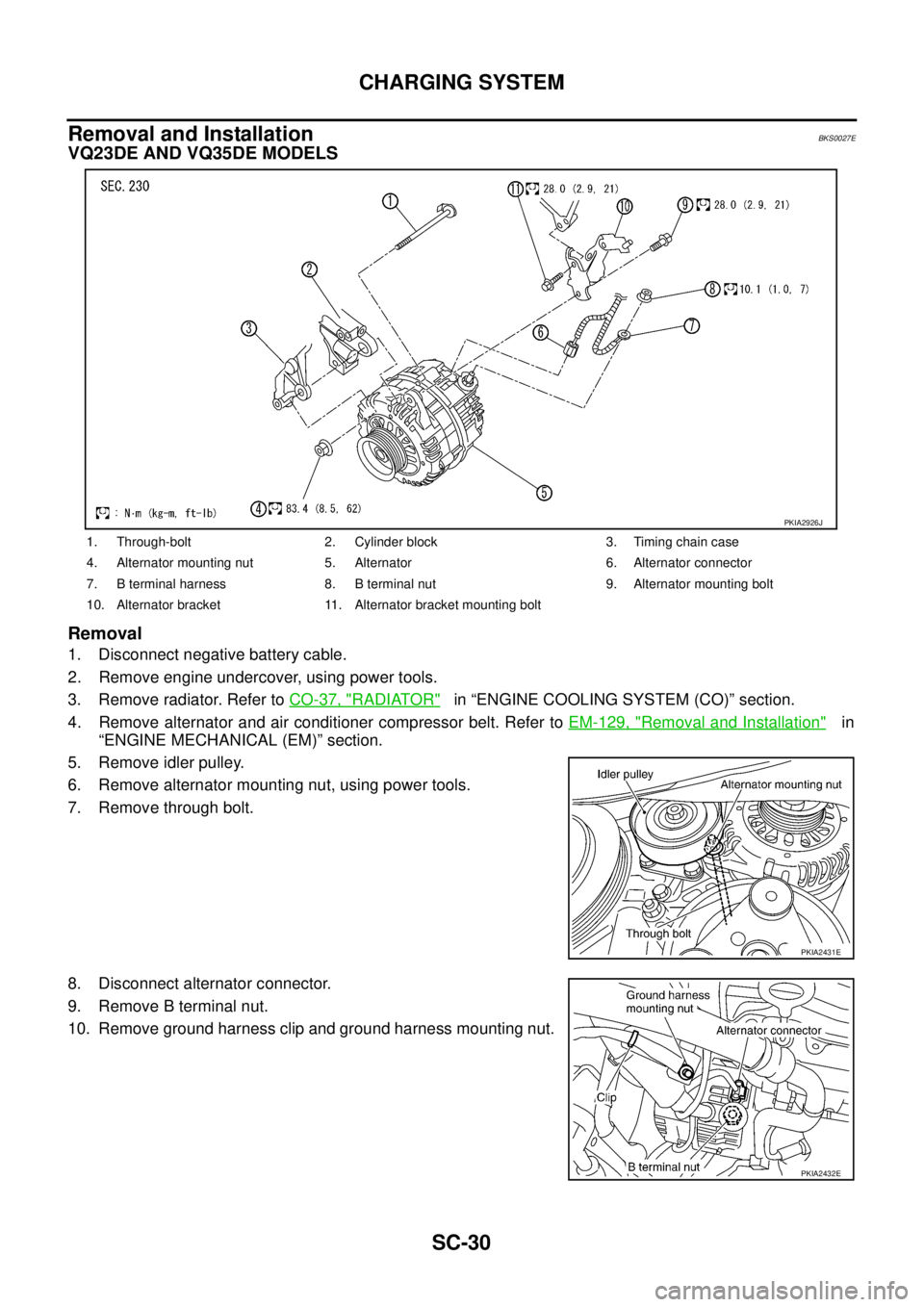
VQ23DE AND VQ35DE MODELS
Removal
1. Disconnect negative battery cable.
2. Remove engine undercover, using power tools.
3. Remove radiator. Refer to CO-37, "
RADIATOR" in “ENGINE COOLING SYSTEM (CO)” section.
4. Remove alternator and air conditioner compressor belt. Refer to EM-129, "
Removal and Installation" in
“ENGINE MECHANICAL (EM)” section.
5. Remove idler pulley.
6. Remove alternator mounting nut, using power tools.
7. Remove through bolt.
8. Disconnect alternator connector.
9. Remove B terminal nut.
10. Remove ground harness clip and ground harness mounting nut.
1. Through-bolt 2. Cylinder block 3. Timing chain case
4. Alternator mounting nut 5. Alternator 6. Alternator connector
7. B terminal harness 8. B terminal nut 9. Alternator mounting bolt
10. Alternator bracket 11. Alternator bracket mounting bolt
PKIA2926J
PKIA2431E
PKIA2432E