Page 346 of 4323

DI±152
± DIAGNOSTICSENGINE
346 Author�: Date�:
2005 SEQUOIA (RM1146U) A/F sensor status
Activated
Fuel±cutOFF
Engine load10 to 70%
Shift position4th±
Heated oxygen sensor impedance (Low):
Battery voltage11 V±
Estimated sensor temperature±700°C (1,292°F)
ECM monitorCompleted
P0606Not set
Heated oxygen sensor impedance (High):
Battery voltage11 V±
Estimated sensor temperature450°C (842°F)±
ECM monitorCompleted
P0606Not set
Heated oxygen sensor output voltage (Extremely high):
Battery voltage11 V±
Time after engine start2 sec.±
TYPICAL MALFUNCTION THRESHOLDS
Detection CriteriaThreshold
Heated oxygen sensor output voltage (Output voltage):
Either of the following conditions is met:Condition 1 or 2
1. All of the following conditions are met:Condition (a), (b) and (c)
(a) Commanded air±fuel ratio14.3 or less
(b) Rear HO2S voltage0.21 to 0.59 V
(c) OSC (Oxygen Storage Capacity of catalyst)3 g or more
2. All of the following conditions are met:Condition (a), (b) and (c)
(a) Commanded air±fuel ratio14.9 or more
(b) Rear HO2S voltage0.21 to 0.59 V
(c) OSC (Oxygen Storage Capacity of catalyst)3 g or more
Heated oxygen sensor output voltage (Low voltage):
All of the following conditions are met:Condition 1, 2 and 3
1. Commanded air±fuel ratio14.3 or less
2. Rear HO2S voltageLess than 0.21 V
3. OSC (Oxygen Storage Capacity of catalyst)3 g or more
Heated oxygen sensor output voltage (High voltage):
All of the following conditions are met:Condition 1, 2 and 3
1. Commanded air±fuel ratio14.9 or more
2. Rear HO2S voltageMore than 0.59 V
3. OSC (Oxygen Storage Capacity of catalyst)3 g or more
Heated oxygen sensor impedance (Low):
Duration of following condition30 sec. or more
Heated oxygen sensor impedanceLess than 5 W
Heated oxygen sensor impedance (High):
Duration of following condition90 sec. or more
Page 358 of 4323
A23543
+B
OXR2
OXL2E1 HTR2
HTL2
H2
H4
Wire Harness Side:
Bank 1 Sensor 2, Bank 2 Sensor 2
B17416HT1BECM Connector E7OX1B E8
HT2B
OX2B
A21040
Reference (Bank 1 Sensor 1 System Drawing)
From
BatteryEFI No. 1 FuseEFI Relay
EFI No. 2 FuseHeater Oxygen
Sensor
Heater
SensorHT1A
OX1A
E2
MRELECM
DI±164
± DIAGNOSTICSENGINE
358 Author�: Date�:
2005 SEQUOIA (RM1146U)
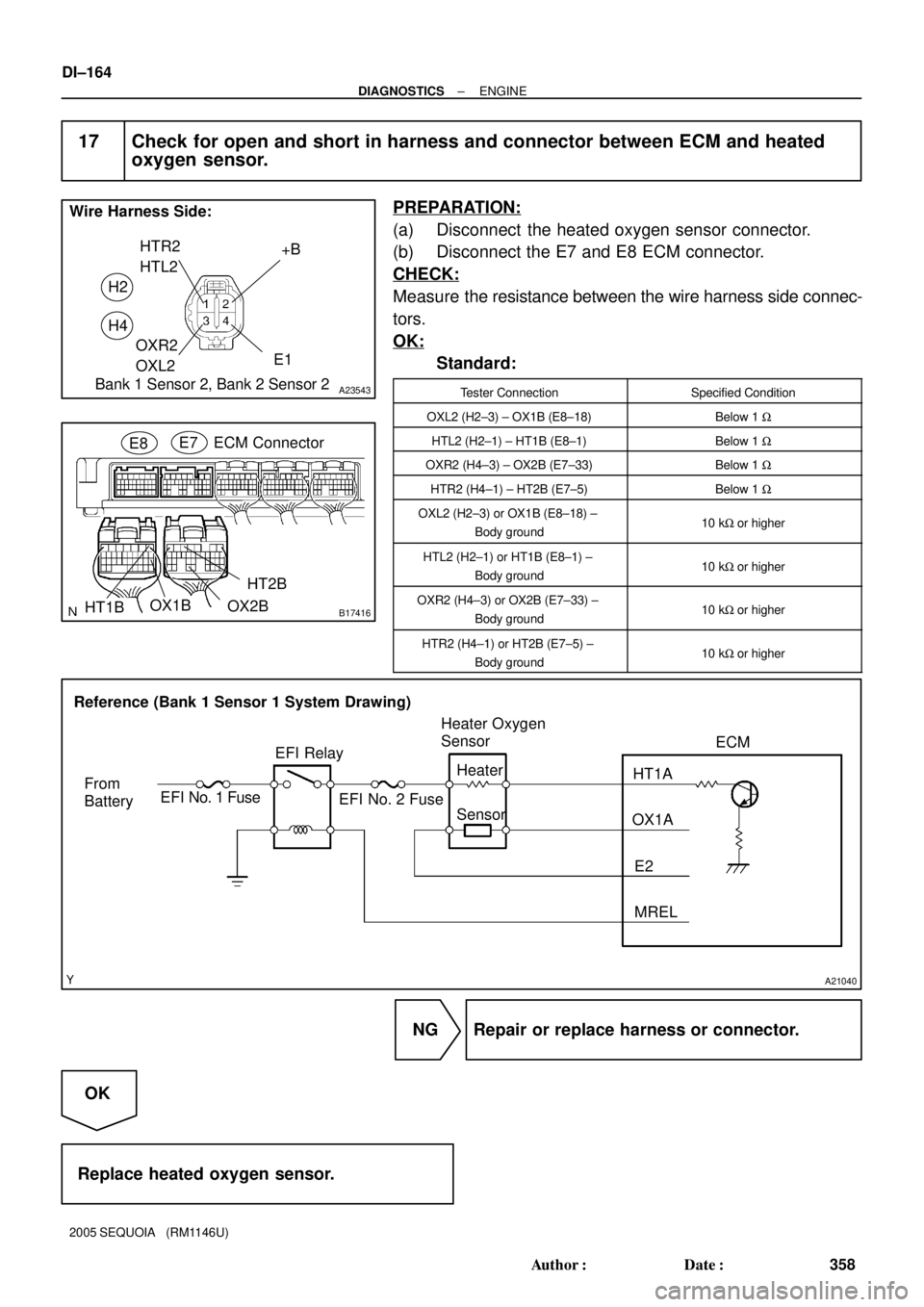
17 Check for open and short in harness and connector between ECM and heated
oxygen sensor.
PREPARATION:
(a) Disconnect the heated oxygen sensor connector.
(b) Disconnect the E7 and E8 ECM connector.
CHECK:
Measure the resistance between the wire harness side connec-
tors.
OK:
Standard:
Tester ConnectionSpecified Condition
OXL2 (H2±3) ± OX1B (E8±18)Below 1 W
HTL2 (H2±1) ± HT1B (E8±1)Below 1 W
OXR2 (H4±3) ± OX2B (E7±33)Below 1 W
HTR2 (H4±1) ± HT2B (E7±5)Below 1 W
OXL2 (H2±3) or OX1B (E8±18) ±
Body ground10 kW or higher
HTL2 (H2±1) or HT1B (E8±1) ±
Body ground10 kW or higher
OXR2 (H4±3) or OX2B (E7±33) ±
Body ground10 kW or higher
HTR2 (H4±1) or HT2B (E7±5) ±
Body ground10 kW or higher
NG Repair or replace harness or connector.
OK
Replace heated oxygen sensor.
Page 362 of 4323

DI±168
± DIAGNOSTICSENGINE
362 Author�: Date�:
2005 SEQUOIA (RM1146U)
TYPICAL ENABLING CONDITIONS
ItSpecificationItemMinimumMaximum
The monitor will run whenever these
DTCs are not presentSee page DI±18
Battery voltage11 V±
Fuel system statusClosed±loop
Throttle position learningCompleted
Either of the following conditions is met:Condition 1 or 2
1. Engine RPM±1,000 rpm
2. Intake air amount per revolution0.26 g/sec.±
Catalyst monitorNo executed
TYPICAL MALFUNCTION THRESHOLDS
Detection CriteriaThreshold
Purge±cutExecuting
Either of the following conditions is metCondition 1 or 2
1. Average between short±term fuel trim and long±term fuel
trim35% or more (varies with ECT)
2. Average between short±term fuel trim and long±term fuel
trim±35% or less (varies with ECT)
WIRING DIAGRAM
Refer to DTC P2195 on page DI±383.
INSPECTION PROCEDURE
HINT:
Hand±held tester only:
Malfunctioning areas can be identified by performing the A/F CONTROL function provided in the ACTIVE
TEST. The A/F CONTROL function can help to determine whether the Air±Fuel Ratio (A/F) sensor, Heated
Oxygen (HO2) sensor and other potential trouble areas are malfunctioning.
The following instructions describe how to conduct the A/F CONTROL operation using a hand±held tester.
(1) Connect a hand±held tester to the DLC3.
(2) Start the engine and turn the tester ON.
(3) Warm up the engine at an engine speed of 2,500 rpm for approximately 90 seconds.
(4) On the tester, select the following menu items: DIAGNOSIS / ENHANCED OBD II / ACTIVE
TEST / A/F CONTROL.
(5) Perform the A/F CONTROL operation with the engine in an idling condition (press the RIGHT
or LEFT button to change the fuel injection volume).
(6) Monitor the voltage outputs of the A/F and HO2 sensors (AFS B1S1 (AFS B2S1) and OS2 B1S2
(O2S B2S2)) displayed on the tester.
HINT:
�The A/F CONTROL operation lowers the fuel injection volume by 12.5 % or increases the injection
volume by 25 %.
�Each sensor reacts in accordance with increases and decreases in the fuel injection volume.
Page 370 of 4323
A23512
Reference (Bank 1 Sensor 1 System Drawing):
A/F Sensor A/F Relay
Heater
Sensor
A1A+ HA1A
Duty
Control ECM
From
Battery
A/F Heater
Fuse
A1A±
To EFI Relay
DI±176
± DIAGNOSTICSENGINE
370 Author�: Date�:
2005 SEQUOIA (RM1146U)
Standard (Check for short):
Tester ConnectionsSpecified Conditions
HT (A38±1) or HA1A (E7±2) ± Body ground
HT (A39±1) or HA2A (E7±1) ± Body ground10 kW or higher
AF+ (A38±3) or A1A+ (E7±22) ± Body ground
AF+ (A39±3) or A2A+ (E7±23) ± Body ground10 kW or higher
AF± (A38±4) or A1A± (E7±30) ± Body ground
AF± (A39±4) or A2A± (E7±31) ± Body ground10 kW or higher
NG Replace or replace harness or connector.
OK
14 Replace air fuel ratio sensor.
NEXT
Page 373 of 4323

A21043
Starter Relay EFI Relay
Circuit Opening
Relay
Fuel Pump RelayMREL
FPRTr2
Tr1 EFI No.1
IGNECM
FC
NE Fuel Pump
Battery
StarterFuel Pump Resistor
AM2Ignition Switch
STA
Crankshaft Position
Sensor (NE Signal)
± DIAGNOSTICSENGINE
DI±179
373 Author�: Date�:
2005 SEQUOIA (RM1146U)
DTC P0230 Fuel Pump Primary Circuit
CIRCUIT DESCRIPTION
In the diagram below, when the engine is cranked, current flows from terminal STAR of the ECM to the starter
relay coil and also current flows to terminal STA of the ECM (STA signal).
When the STA signal and NE signal are input to the ECM, the Tr1 is turned ON, current flows to the coil of
the circuit opening relay, the relay switches on, power is supplied to the fuel pump, and the fuel pump oper-
ates.
While the NE signal is generated (engine running), the ECM keeps the Tr1 ON (circuit opening relay ON)
and the fuel pump also keeps operating.
The fuel pump speed is controlled at two levels (high speed or low speed) by the condition of the engine
(starting, light load, heavy load). When the engine starts (STA ON), the Tr2 in the ECM is OFF, so the fuel
pump relay closes and battery positive voltage is applied directly to the fuel pump. The fuel pump operates
at high speed.
After the engine starts while idling or light loads, since the Tr2 goes ON, power is supplied to the fuel pump
via the fuel pump resistor. The fuel pump operates at low speed.
DICEW±02
Page 375 of 4323
A23553
G±R
1 28
A 6
BECM
AM2
W±B6
32
15 3
2 121
3 2B IA1
J5
J/CL±O
I18
Ignition SW
3
7
F10
Fusible Link BlockB±R
BI530
10 26 4
12
2
114
68
1 41
5 3L±B
AM2
52HE6
2D
2F 1J1C2F
IA4
E4
E4 IG4
IA4 2H
2H 2C 1C
1JFPR
FC
MREL B±O5
J44
J45J/C E
L
BB1G±RG±REngine Room J/B
4
2F
5V V V
IL2
25
G±O G±O
B
IG2
W±B
W±BA
ED 5 4G±RIG1
B±WB±W
Instrument Panel J/B
F9
Fuel Pump
Resister
Battery2C
W±R W±R5
6
EFI No.15
C/OPN Relay Fuel Pump
Relay
EFI Relay F19
Fuel Pump
± DIAGNOSTICSENGINE
DI±181
375 Author�: Date�:
2005 SEQUOIA (RM1146U)
WIRING DIAGRAM
HINT:
This diagnostic chart is based on premise that engine is started. If the engine is not started, proceed to prob-
lem symptoms table on DI±33.
Page 381 of 4323

± DIAGNOSTICSENGINE
DI±187
381 Author�: Date�:
2005 SEQUOIA (RM1146U)
TYPICAL ENABLING CONDITIONS
ItSpecificationItemMinimumMaximum
The monitor will run whenever these
DTCs are not presentSee page DI±18
Battery voltage8 V±
Throttle position learningCompleted
VVT systemNormal operate by scan±tool
Engine RPM400 to 5,700rpm
All of the following conditions are met:Condition 1 and 2
1. Engine coolant temperature±10�C (14�F)±
2. Either of the following conditions is met:Condition (a) or (b)
(a) Engine coolant temperature at engine
start±7�C (19�F)±
(b) Engine coolant temperature20�C (68�F)±
Fuel±cutOFF
Emission±related±misfire:
First 1,000 revolutions after engine start,
or check modeCrankshaft 1,000 revolutions
Except aboveCrankshaft 1,000 revolutions x 4
Catalyst±damage±misfire (MIL blinks):
All of the following conditions 1, 2 and 3
are metCrankshaft 200 revolutions
1. Driving cycle1st
2. Check modeOFF
3. Engine RPM±2,800 rpm
Except aboveCrankshaft 200 revolutions x 3
TYPICAL MALFUNCTION THRESHOLDS
Detection CriteriaThreshold
Emission±related±misfire:
Misfire rate:1.2 % or more
Catalyst±damage±misfire (MIL blinks):
Number of misfire per 200 revolutions93 or more
(varies with intake air amount and RPM)
Multiple cylinders misfireDetected
MONITOR RESULT
Refer to page DI±26 for detailed information.
The test value and test limit information are described as shown in the following table. Check the monitor
result and test values after performing the monitor drive pattern (refer to ºConfirmation Monitorº).
�MID (Monitor Identification Data) is assigned to each emissions±related component.
�TID (Test Identification Data) is assigned to each test value.
�Scaling is used to calculate the test value indicated on generic OBD ll scan tools.
Page 384 of 4323

A15466A19380
Battery I18
Ignition SW
1
#80 #60 #40#20
#70#50ECM
#30 #10
6
2
I10 Injector No.2
I12 Injector No.4
I13 Injector No.5
I14 Injector No.6
I15 Injector No.7
I16 Injector No.8
7
1
2
12
1
2 1
2
1
2
2
2
2 3 2
5
7 4
I9 Injector No.1
1C
2D1
B
F10
Fusible Link BlockIGN2
Engine Room J/B
54
B2C1 1C
1J 1D 2
3
W±R6
AM2Instrument Panel J/B
W±R3
B±R
1
1
1
I11 Injector No.3
IG413
E8 E6
E6
E8 E6 E6
E6 E6
R±W B±R
B±R
B±R
B±R
B±R
B±R
B±RY R±B
L±R W
L G R
B±R B±R B±R
5
IG2
AM2
B±R
B±R
B±R
B±R
B±R
DI±190
± DIAGNOSTICSENGINE
384 Author�: Date�:
2005 SEQUOIA (RM1146U)
WIRING DIAGRAM
Refer to DTC P0351 on page DI±221 for the wiring diagram of the ignition system.
CONFIRMATION DRIVING PATTERN
(a) Connect the hand±held tester to the DLC3.
(b) Record DTC and the freeze frame data.
(c) Use the hand±held tester to set the check mode (See page DI±44).
(d) Read the value on the misfire counter for each cylinder when idling. If the value is displayed on the
misfire counter, skip the following procedure of confirmation driving.
(e) Drive the vehicle several times with the engine speed, load and surrounding range shown as ENGINE
SPD, CALC LOAD in the freeze frame data or MISFIRE RPM, MISFIRE LOAD in the DATA LIST.
If you have no hand±held tester, turn the ignition switch OFF after the symptom is simulated once. Then re-
peat the simulation process again.