2001 CHRYSLER VOYAGER ECU
[x] Cancel search: ECUPage 956 of 4284

Symptom:
INTERNAL EEPROM WRITE ERROR
When Monitored and Set Condition:
INTERNAL EEPROM WRITE ERROR
When Monitored: During a EEPROM write event.
Set Condition: If the EEPROM write time exceeds 16ms.
POSSIBLE CAUSES
INTERMITTENT CONDITION
RKE/THATCHAM ALARM MODULE - INTERNAL MALFUNCTION
TEST ACTION APPLICABILITY
1 Turn the ignition on.
With the DRBIIIt, erase the current RKE/Thatcham Alarm Module DTC's.
Turn the ignition off, wait 10 seconds then turn the ignition on.
With the DRBIIIt, read the current RKE/Thatcham Alarm Module DTC's.
Does the DRBIIItdisplay: INTERNAL EEPROM WRITE ERROR?All
Ye s®Replace the RKE/Thatcham Alarm Module.
Perform VTSS VERIFICATION TEST - 1A.
No®The condition that caused this symptom is currently not present.
Inspect the related wiring harness for a possible intermittent
condition.
Perform VTSS VERIFICATION TEST - 1A.
927
VEHICLE THEFT/SECURITY
Page 957 of 4284
Symptom:
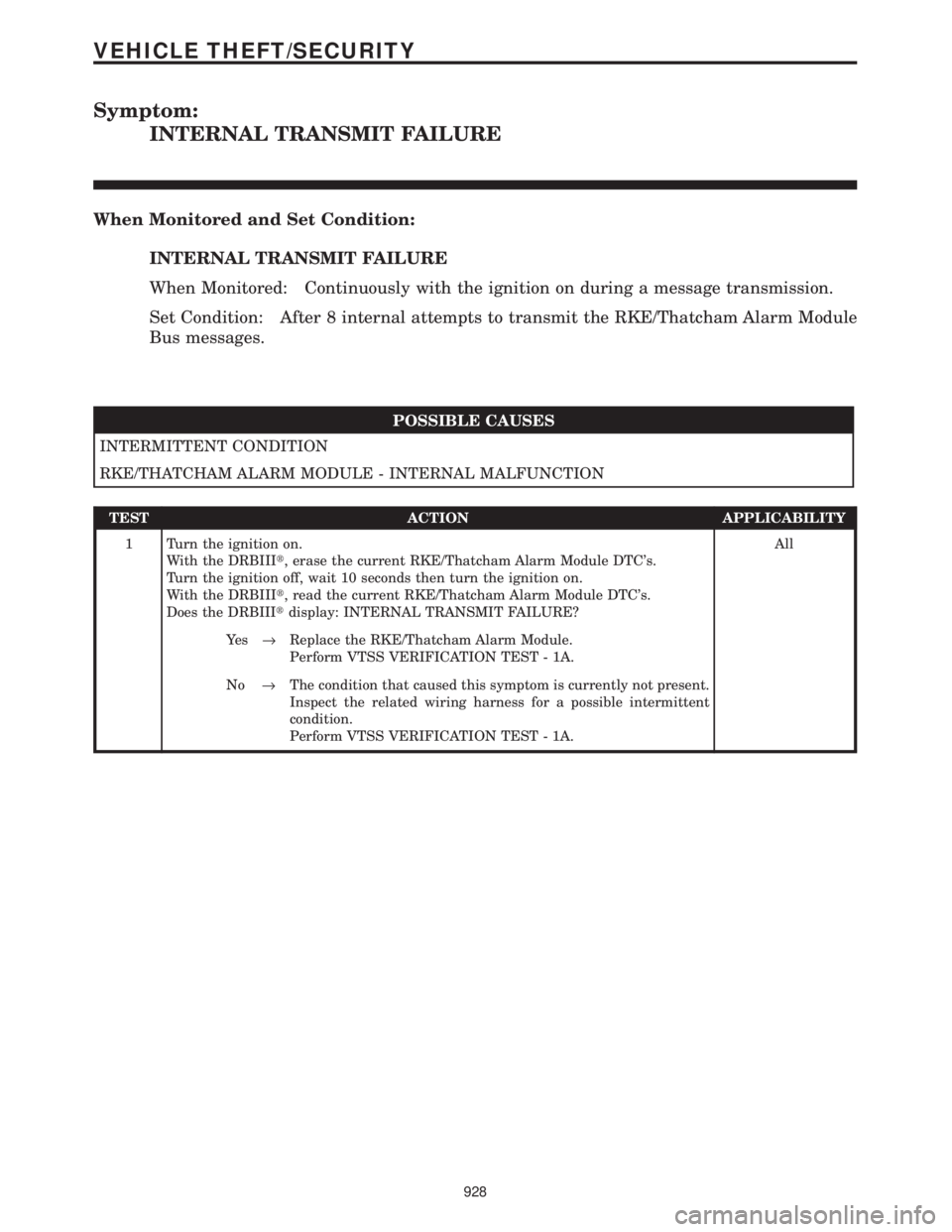
INTERNAL TRANSMIT FAILURE
When Monitored and Set Condition:
INTERNAL TRANSMIT FAILURE
When Monitored: Continuously with the ignition on during a message transmission.
Set Condition: After 8 internal attempts to transmit the RKE/Thatcham Alarm Module
Bus messages.
POSSIBLE CAUSES
INTERMITTENT CONDITION
RKE/THATCHAM ALARM MODULE - INTERNAL MALFUNCTION
TEST ACTION APPLICABILITY
1 Turn the ignition on.
With the DRBIIIt, erase the current RKE/Thatcham Alarm Module DTC's.
Turn the ignition off, wait 10 seconds then turn the ignition on.
With the DRBIIIt, read the current RKE/Thatcham Alarm Module DTC's.
Does the DRBIIItdisplay: INTERNAL TRANSMIT FAILURE?All
Ye s®Replace the RKE/Thatcham Alarm Module.
Perform VTSS VERIFICATION TEST - 1A.
No®The condition that caused this symptom is currently not present.
Inspect the related wiring harness for a possible intermittent
condition.
Perform VTSS VERIFICATION TEST - 1A.
928
VEHICLE THEFT/SECURITY
Page 958 of 4284

Symptom:
INTERNAL ULTRASONIC FAULT
When Monitored and Set Condition:
INTERNAL ULTRASONIC FAULT
When Monitored: During the initial 6 seconds of an ignition on cycle.
Set Condition: After 5 consecutive ignition cycles without detecting any ultrasonic
movement.
POSSIBLE CAUSES
FRONT INTRUSION SENSOR
FRONT INTRUSION SENSOR
FRONT INTRUSION SENSOR SIGNAL CIRCUIT OPEN
FRONT INTRUSION SENSOR SIGNAL CIRCUIT OPEN
FRONT SENSOR GROUND CIRCUIT OPEN
FRONT SENSOR GROUND CIRCUIT OPEN
INTRUSION SENSOR DETECTION
REAR INTRUSION SENSOR
REAR INTRUSION SENSOR
REAR INTRUSION SENSOR SIGNAL CIRCUIT OPEN
REAR INTRUSION SENSOR SIGNAL CIRCUIT OPEN
REAR SENSOR GROUND CIRCUIT OPEN
REAR SENSOR GROUND CIRCUIT OPEN
RKE/THATCHAM ALARM MODULE - INTERNAL MALFUNCTION
RKE/THATCHAM ALARM MODULE - INTERNAL MALFUNCTION
RKE/THATCHAM ALARM MODULE - INTERNAL MALFUNCTION
RKE/THATCHAM ALARM MODULE - INTERNAL MALFUNCTION
RKE/THATCHAM ALARM MODULE - INTERNAL MALFUNCTION
RKE/THATCHAM ALARM MODULE - INTERNAL MALFUNCTION
RKE/THATCHAM ALARM MODULE - INTERNAL MALFUNCTION
RKE/THATCHAM ALARM MODULE - INTERNAL MALFUNCTION
RKE/THATCHAM ALARM MODULE - INTERNAL MALFUNCTION
RKE/THATCHAM ALARM MODULE - INTERNAL MALFUNCTION
929
VEHICLE THEFT/SECURITY
Page 959 of 4284

TEST ACTION APPLICABILITY
1 Turn the ignition on.
With the DRBIIIt, erase the current RKE/Thatcham Alarm Module DTC's.
Turn the ignition off, wait 10 seconds then turn the ignition on.
Cycle the ignition on and off 5 times.
With the DRBIIIt, read the current RKE/Thatcham Alarm Module DTC's.
Does the DRBIIItdisplay: INTERNAL ULTRASONIC FAULT?All
Ye s®Go To 2
No®Go To 12
2 Turn the ignition off.
Disconnect the Front Intrusion Sensor connector.
Connect a voltmeter to the Front Intrusion Sensor Signal circuit at the Intrusion
Sensor connector.
Turn the ignition on while observing the voltmeter.
NOTE: Voltage will only be present during the first 6 seconds when the
ignition is turned on.
Is the voltage above 10.0 volts when the ignition is initially turned on?All
Ye s®Go To 3
No®Go To 11
3 Turn the ignition off.
Measure the resistance of the Sensor Ground circuit at the Front Intrusion Sensor
connector.
Is the resistance below 5.0 ohms?All
Ye s®Go To 4
No®Go To 10
4 Replace the Front Intrusion Sensor with a known good sensor.
Turn the ignition on.
With the DRBIIIt, monitor the Intrusion Sensor.
Does the DRBIIItshow: INTRUSION DETECTED?All
Ye s®Replace the Front Intrusion Sensor.
Perform VTSS VERIFICATION TEST - 1A.
No®Go To 5
5 Turn the ignition off.
Disconnect the Rear Intrusion Sensor connector.
Connect a voltmeter to the Rear Intrusion Sensor Signal circuit at the Intrusion
Sensor connector.
Turn the ignition on while observing the voltmeter.
NOTE: Voltage will only be present during the first 6 seconds when the
ignition is turned on.
Is the voltage above 10.0 volts when the ignition is initially turned on?All
Ye s®Go To 6
No®Go To 9
930
VEHICLE THEFT/SECURITY
INTERNAL ULTRASONIC FAULT ÐContinued
Page 960 of 4284

TEST ACTION APPLICABILITY
6 Turn the ignition off.
Measure the resistance of the Sensor Ground circuit at the Rear Intrusion Sensor
connector.
Is the resistance below 5.0 ohms?All
Ye s®Go To 7
No®Go To 8
7 Replace the Rear Intrusion Sensor with a known good sensor.
Turn the ignition on.
With the DRBIIIt, monitor the Intrusion Sensor.
Does the DRBIIItshow INTRUSION DETECTED?All
Ye s®Replace the Rear Intrusion Sensor.
Perform VTSS VERIFICATION TEST - 1A.
No®Replace the RKE/Thatcham Alarm Module.
Perform VTSS VERIFICATION TEST - 1A.
8 Gain access to the RKE/Thatcham Alarm Module.
Disconnect the RKE/Thatcham Alarm Module C1 connector.
Measure the resistance of the Sensor Ground circuit between the RKE/Thatcham
Alarm Module C1 connector and the Intrusion Sensor connector.
Is the resistance below 5.0 ohms?All
Ye s®Replace the RKE/Thatcham Alarm Module.
Perform VTSS VERIFICATION TEST - 1A.
No®Repair the Rear Sensor Ground circuit for an open.
Perform VTSS VERIFICATION TEST - 1A.
9 Turn the ignition off.
Gain access to the RKE/Thatcham Alarm Module C1 connector.
While back probing, measure the voltage of the Rear Intrusion Sensor Signal circuit.
Turn the ignition on while observing the voltmeter.
NOTE: Voltage will only be present during the first 6 seconds when the
ignition is turned on.
Is the voltage above 10.0 volts when the ignition is initially turned on?All
Ye s®Repair the Rear Intrusion Sensor Signal circuit for an open.
Perform VTSS VERIFICATION TEST - 1A.
No®Replace the RKE/Thatcham Alarm Module.
Perform VTSS VERIFICATION TEST - 1A.
10 Gain access to the RKE/Thatcham Alarm Module.
Disconnect the RKE/Thatcham Alarm Module C1 connector.
Measure the resistance of the Sensor Ground circuit between the RKE/Thatcham
Alarm Module C1 connector and the Intrusion Sensor connector.
Is the resistance below 5.0 ohms?All
Ye s®Replace the RKE/Thatcham Alarm Module.
Perform VTSS VERIFICATION TEST - 1A.
No®Repair the Front Sensor Ground circuit for an open.
Perform VTSS VERIFICATION TEST - 1A.
931
VEHICLE THEFT/SECURITY
INTERNAL ULTRASONIC FAULT ÐContinued
Page 961 of 4284

TEST ACTION APPLICABILITY
11 Turn the ignition off.
Gain access to the RKE/Thatcham Alarm Module C1 connector.
While back probing, measure the voltage of the Front Intrusion Sensor Signal circuit.
Turn the ignition on while observing the voltmeter.
NOTE: Voltage will only be present during the first 6 seconds when the
ignition is turned on.
Is the voltage above 10.0 volts when the ignition is initially turned on?All
Ye s®Repair the Front Intrusion Sensor Signal circuit for an open.
Perform VTSS VERIFICATION TEST - 1A.
No®Replace the RKE/Thatcham Alarm Module.
Perform VTSS VERIFICATION TEST - 1A.
12 Turn the ignition off.
With the DRBIIIt, monitor the Intrusion Sensor.
Turn the ignition on.
NOTE: The Intrusion Sensors will only detect movement during initial
ignition on.
Does the DRBIIItshow INTRUSION DETECTED when the ignition is initially
turned on?All
Ye s®The condition that caused this symptom is currently not present.
Inspect the related wiring harness for a possible intermittent
condition.
Perform VTSS VERIFICATION TEST - 1A.
No®Go To 13
13 Turn the ignition off.
Disconnect the Front Intrusion Sensor connector.
Connect a voltmeter to the Front Intrusion Sensor Signal circuit at the Intrusion
Sensor connector.
Turn the ignition on while observing the voltmeter.
NOTE: Voltage will only be present during the first 6 seconds when the
ignition is turned on.
Is the voltage above 10.0 volts when the ignition is initially turned on?All
Ye s®Go To 14
No®Go To 22
14 Turn the ignition off.
Measure the resistance of the Sensor Ground circuit at the Front Intrusion Sensor
connector.
Is the resistance below 5.0 ohms?All
Ye s®Go To 15
No®Go To 21
15 Replace the Intrusion Sensor with a known good sensor.
Turn the ignition on.
With the DRBIIIt, monitor the Intrusion Sensor.
Does the DRBIIItshow INTRUSION DETECTED?All
Ye s®Replace the Front Intrusion Sensor.
Perform VTSS VERIFICATION TEST - 1A.
No®Go To 16
932
VEHICLE THEFT/SECURITY
INTERNAL ULTRASONIC FAULT ÐContinued
Page 962 of 4284

TEST ACTION APPLICABILITY
16 Turn the ignition off.
Disconnect the Rear Intrusion Sensor connector.
Connect a voltmeter to the Rear Intrusion Sensor Signal circuit at the Intrusion
Sensor connector.
Turn the ignition on while observing the voltmeter.
NOTE: Voltage will only be present during the first 6 seconds when the
ignition is turned on.
Is the voltage above 10.0 volts when the ignition is initially turned on?All
Ye s®Go To 17
No®Go To 20
17 Turn the ignition off.
Measure the resistance of the Sensor Ground circuit at the Rear Intrusion Sensor
connector.
Is the resistance below 5.0 ohms?All
Ye s®Go To 18
No®Go To 19
18 Replace the Rear Intrusion Sensor with a known good sensor.
Turn the ignition on.
With the DRBIIIt, monitor the Intrusion Sensor.
Does the DRBIIItshow INTRUSION DETECTED?All
Ye s®Replace the Rear Intrusion Sensor.
Perform VTSS VERIFICATION TEST - 1A.
No®Replace the RKE/Thatcham Alarm Module.
Perform VTSS VERIFICATION TEST - 1A.
19 Gain access to the RKE/Thatcham Alarm Module.
Disconnect the RKE/Thatcham Alarm Module C1 connector.
Measure the resistance of the Sensor Ground circuit between the RKE/Thatcham
Alarm Module C1 connector and the Intrusion Sensor connector.
Is the resistance below 5.0 ohms?All
Ye s®Replace the RKE/Thatcham Alarm Module.
Perform VTSS VERIFICATION TEST - 1A.
No®Repair the Rear Sensor Ground circuit for an open.
Perform VTSS VERIFICATION TEST - 1A.
20 Turn the ignition off.
Gain access to the RKE/Thatcham Alarm Module C1 connector.
While back probing, measure the voltage of the Rear Intrusion Sensor Signal circuit.
Turn the ignition on while observing the voltmeter.
NOTE: Voltage will only be present during the first 6 seconds when the
ignition is turned on.
Is the voltage above 10.0 volts when the ignition is initially turned on?All
Ye s®Repair the Rear Intrusion Sensor Signal circuit for an open.
Perform VTSS VERIFICATION TEST - 1A.
No®Replace the RKE/Thatcham Alarm Module.
Perform VTSS VERIFICATION TEST - 1A.
933
VEHICLE THEFT/SECURITY
INTERNAL ULTRASONIC FAULT ÐContinued
Page 963 of 4284

TEST ACTION APPLICABILITY
21 Gain access to the RKE/Thatcham Alarm Module.
Disconnect the RKE/Thatcham Alarm Module C1 connector.
Measure the resistance of the Sensor Ground circuit between the RKE/Thatcham
Alarm Module C1 connector and the Intrusion Sensor connector.
Is the resistance below 5.0 ohms?All
Ye s®Replace the RKE/Thatcham Alarm Module.
Perform VTSS VERIFICATION TEST - 1A.
No®Repair the Front Sensor Ground circuit for an open.
Perform VTSS VERIFICATION TEST - 1A.
22 Turn the ignition off.
Gain access to the RKE/Thatcham Alarm Module C1 connector.
While back probing, measure the voltage of the Front Intrusion Sensor Signal circuit.
Turn the ignition on while observing the voltmeter.
NOTE: Voltage will only be present during the first 6 seconds when the
ignition is turned on.
Is the voltage above 10.0 volts when the ignition is initially turned on?All
Ye s®Repair the Front Intrusion Sensor Signal circuit for an open.
Perform VTSS VERIFICATION TEST - 1A.
No®Replace the RKE/Thatcham Alarm Module.
Perform VTSS VERIFICATION TEST - 1A.
934
VEHICLE THEFT/SECURITY
INTERNAL ULTRASONIC FAULT ÐContinued