2001 CHRYSLER VOYAGER heating
[x] Cancel search: heatingPage 4 of 4284
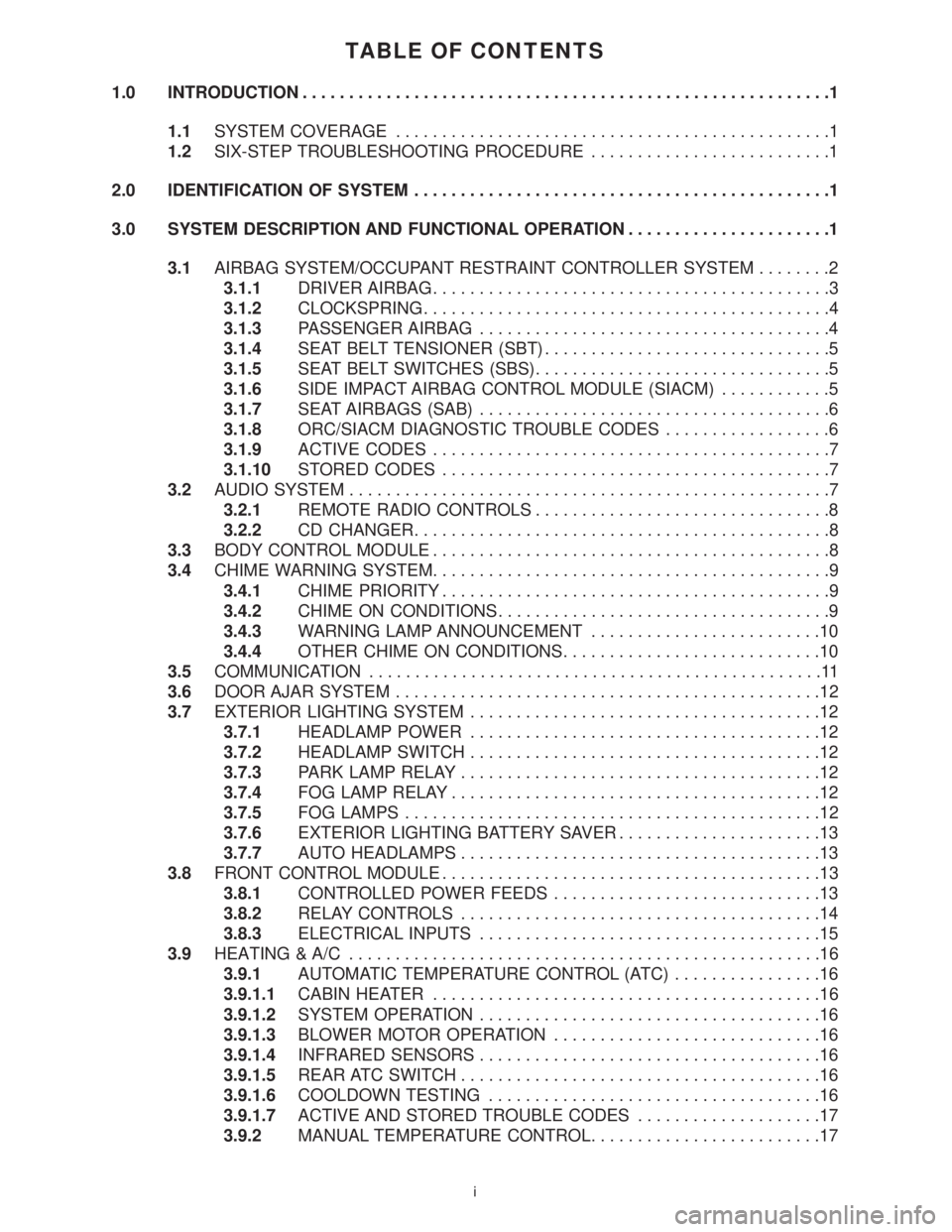
TABLE OF CONTENTS
1.0 INTRODUCTION.........................................................1
1.1SYSTEM COVERAGE...............................................1
1.2SIX-STEP TROUBLESHOOTING PROCEDURE..........................1
2.0 IDENTIFICATION OF SYSTEM.............................................1
3.0 SYSTEM DESCRIPTION AND FUNCTIONAL OPERATION......................1
3.1AIRBAG SYSTEM/OCCUPANT RESTRAINT CONTROLLER SYSTEM........2
3.1.1DRIVER AIRBAG...........................................3
3.1.2CLOCKSPRING............................................4
3.1.3PASSENGER AIRBAG......................................4
3.1.4SEAT BELT TENSIONER (SBT)...............................5
3.1.5SEAT BELT SWITCHES (SBS)................................5
3.1.6SIDE IMPACT AIRBAG CONTROL MODULE (SIACM)............5
3.1.7SEAT AIRBAGS (SAB)......................................6
3.1.8ORC/SIACM DIAGNOSTIC TROUBLE CODES..................6
3.1.9ACTIVE CODES...........................................7
3.1.10STORED CODES..........................................7
3.2AUDIO SYSTEM....................................................7
3.2.1REMOTE RADIO CONTROLS................................8
3.2.2CD CHANGER.............................................8
3.3BODY CONTROL MODULE...........................................8
3.4CHIME WARNING SYSTEM...........................................9
3.4.1CHIME PRIORITY..........................................9
3.4.2CHIME ON CONDITIONS....................................9
3.4.3WARNING LAMP ANNOUNCEMENT.........................10
3.4.4OTHER CHIME ON CONDITIONS............................10
3.5COMMUNICATION.................................................11
3.6DOOR AJAR SYSTEM..............................................12
3.7EXTERIOR LIGHTING SYSTEM......................................12
3.7.1HEADLAMP POWER......................................12
3.7.2HEADLAMP SWITCH......................................12
3.7.3PARK LAMP RELAY.......................................12
3.7.4FOG LAMP RELAY........................................12
3.7.5FOG LAMPS.............................................12
3.7.6EXTERIOR LIGHTING BATTERY SAVER......................13
3.7.7AUTO HEADLAMPS.......................................13
3.8FRONT CONTROL MODULE.........................................13
3.8.1CONTROLLED POWER FEEDS.............................13
3.8.2RELAY CONTROLS.......................................14
3.8.3ELECTRICAL INPUTS.....................................15
3.9HEATING & A/C...................................................16
3.9.1AUTOMATIC TEMPERATURE CONTROL (ATC)................16
3.9.1.1CABIN HEATER..........................................16
3.9.1.2SYSTEM OPERATION.....................................16
3.9.1.3BLOWER MOTOR OPERATION.............................16
3.9.1.4INFRARED SENSORS.....................................16
3.9.1.5REAR ATC SWITCH.......................................16
3.9.1.6COOLDOWN TESTING....................................16
3.9.1.7ACTIVE AND STORED TROUBLE CODES....................17
3.9.2MANUAL TEMPERATURE CONTROL.........................17
i
Page 5 of 4284
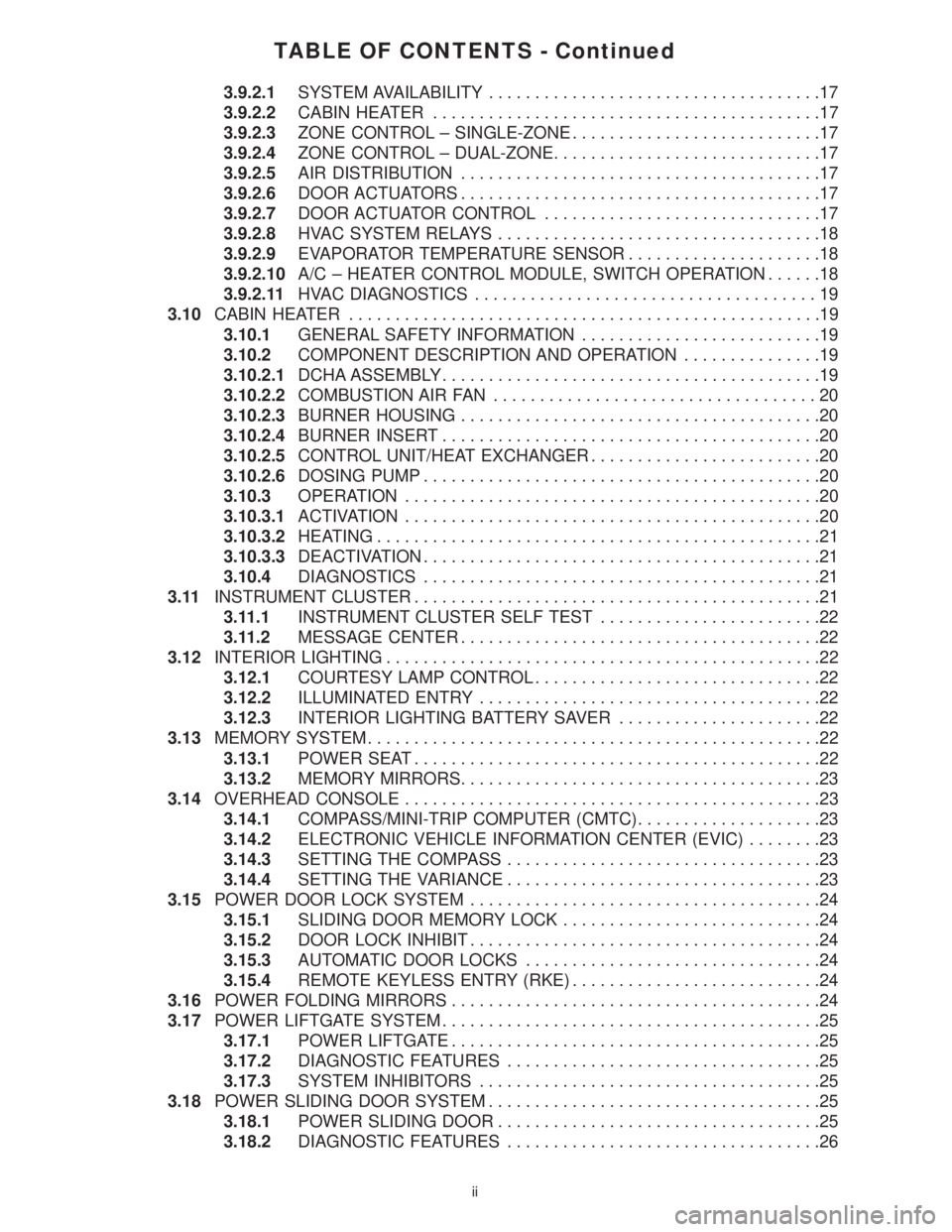
TABLE OF CONTENTS - Continued
3.9.2.1SYSTEM AVAILABILITY....................................17
3.9.2.2CABIN HEATER..........................................17
3.9.2.3ZONE CONTROL ± SINGLE-ZONE...........................17
3.9.2.4ZONE CONTROL ± DUAL-ZONE.............................17
3.9.2.5AIR DISTRIBUTION.......................................17
3.9.2.6DOOR ACTUATORS.......................................17
3.9.2.7DOOR ACTUATOR CONTROL..............................17
3.9.2.8HVAC SYSTEM RELAYS...................................18
3.9.2.9EVAPORATOR TEMPERATURE SENSOR.....................18
3.9.2.10A/C ± HEATER CONTROL MODULE, SWITCH OPERATION......18
3.9.2.11HVAC DIAGNOSTICS.....................................19
3.10CABIN HEATER...................................................19
3.10.1GENERAL SAFETY INFORMATION..........................19
3.10.2COMPONENT DESCRIPTION AND OPERATION...............19
3.10.2.1DCHA ASSEMBLY.........................................19
3.10.2.2COMBUSTION AIR FAN...................................20
3.10.2.3BURNER HOUSING.......................................20
3.10.2.4BURNER INSERT.........................................20
3.10.2.5CONTROL UNIT/HEAT EXCHANGER.........................20
3.10.2.6DOSING PUMP...........................................20
3.10.3OPERATION.............................................20
3.10.3.1ACTIVATION.............................................20
3.10.3.2HEATING................................................21
3.10.3.3DEACTIVATION...........................................21
3.10.4DIAGNOSTICS...........................................21
3.11INSTRUMENT CLUSTER............................................21
3.11.1INSTRUMENT CLUSTER SELF TEST........................22
3.11.2MESSAGE CENTER.......................................22
3.12INTERIOR LIGHTING...............................................22
3.12.1COURTESY LAMP CONTROL...............................22
3.12.2ILLUMINATED ENTRY.....................................22
3.12.3INTERIOR LIGHTING BATTERY SAVER......................22
3.13MEMORY SYSTEM.................................................22
3.13.1POWER SEAT............................................22
3.13.2MEMORY MIRRORS.......................................23
3.14OVERHEAD CONSOLE.............................................23
3.14.1COMPASS/MINI-TRIP COMPUTER (CMTC)....................23
3.14.2ELECTRONIC VEHICLE INFORMATION CENTER (EVIC)........23
3.14.3SETTING THE COMPASS..................................23
3.14.4SETTING THE VARIANCE..................................23
3.15POWER DOOR LOCK SYSTEM......................................24
3.15.1SLIDING DOOR MEMORY LOCK............................24
3.15.2DOOR LOCK INHIBIT......................................24
3.15.3AUTOMATIC DOOR LOCKS................................24
3.15.4REMOTE KEYLESS ENTRY (RKE)...........................24
3.16POWER FOLDING MIRRORS........................................24
3.17POWER LIFTGATE SYSTEM.........................................25
3.17.1POWER LIFTGATE........................................25
3.17.2DIAGNOSTIC FEATURES..................................25
3.17.3SYSTEM INHIBITORS.....................................25
3.18POWER SLIDING DOOR SYSTEM....................................25
3.18.1POWER SLIDING DOOR...................................25
3.18.2DIAGNOSTIC FEATURES..................................26
ii
Page 12 of 4284
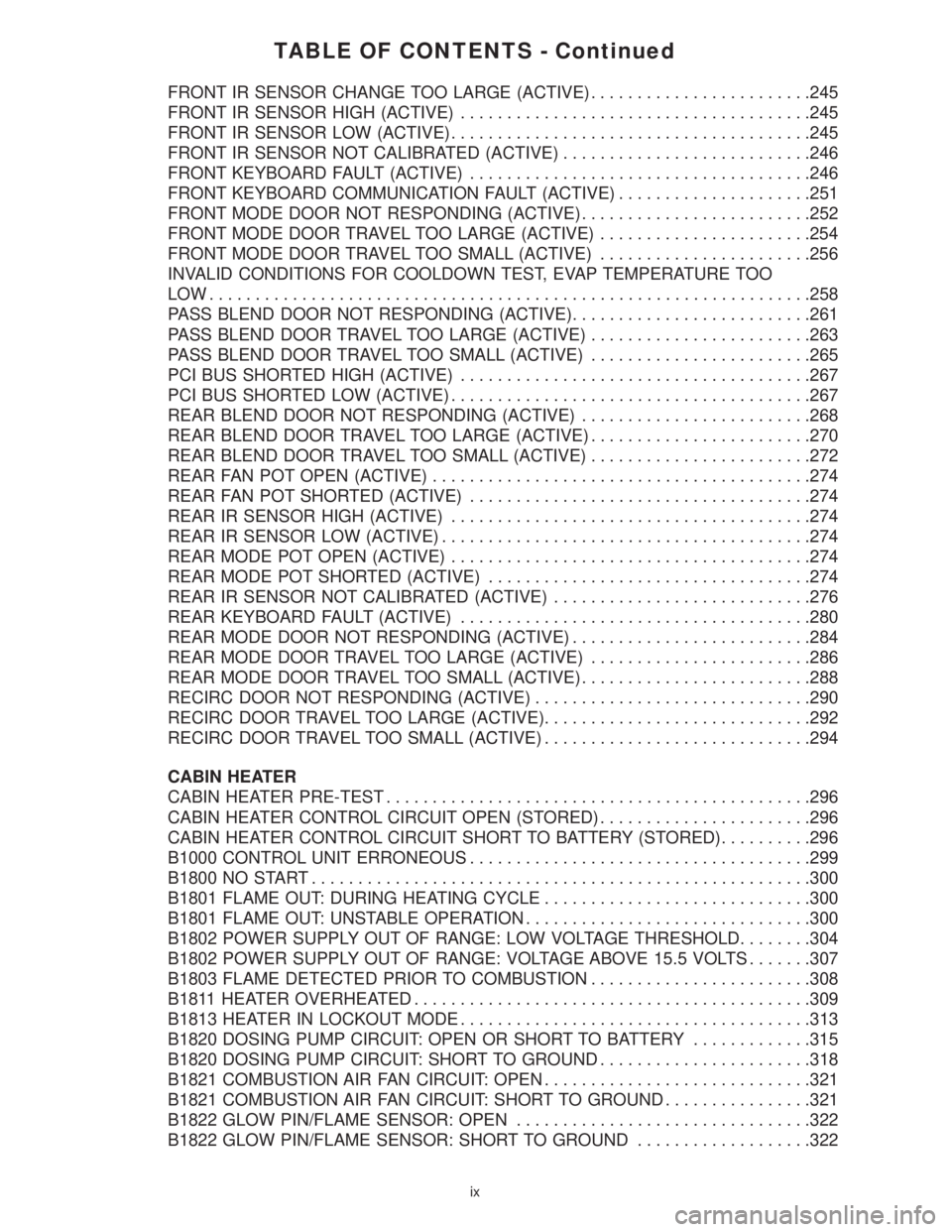
TABLE OF CONTENTS - Continued
FRONT IR SENSOR CHANGE TOO LARGE (ACTIVE)........................245
FRONT IR SENSOR HIGH (ACTIVE)......................................245
FRONT IR SENSOR LOW (ACTIVE).......................................245
FRONT IR SENSOR NOT CALIBRATED (ACTIVE)...........................246
FRONT KEYBOARD FAULT (ACTIVE).....................................246
FRONT KEYBOARD COMMUNICATION FAULT (ACTIVE).....................251
FRONT MODE DOOR NOT RESPONDING (ACTIVE).........................252
FRONT MODE DOOR TRAVEL TOO LARGE (ACTIVE).......................254
FRONT MODE DOOR TRAVEL TOO SMALL (ACTIVE).......................256
INVALID CONDITIONS FOR COOLDOWN TEST, EVAP TEMPERATURE TOO
LOW.................................................................258
PASS BLEND DOOR NOT RESPONDING (ACTIVE)..........................261
PASS BLEND DOOR TRAVEL TOO LARGE (ACTIVE)........................263
PASS BLEND DOOR TRAVEL TOO SMALL (ACTIVE)........................265
PCI BUS SHORTED HIGH (ACTIVE)......................................267
PCI BUS SHORTED LOW (ACTIVE).......................................267
REAR BLEND DOOR NOT RESPONDING (ACTIVE).........................268
REAR BLEND DOOR TRAVEL TOO LARGE (ACTIVE)........................270
REAR BLEND DOOR TRAVEL TOO SMALL (ACTIVE)........................272
REAR FAN POT OPEN (ACTIVE).........................................274
REAR FAN POT SHORTED (ACTIVE).....................................274
REAR IR SENSOR HIGH (ACTIVE).......................................274
REAR IR SENSOR LOW (ACTIVE)........................................274
REAR MODE POT OPEN (ACTIVE).......................................274
REAR MODE POT SHORTED (ACTIVE)...................................274
REAR IR SENSOR NOT CALIBRATED (ACTIVE)............................276
REAR KEYBOARD FAULT (ACTIVE)......................................280
REAR MODE DOOR NOT RESPONDING (ACTIVE)..........................284
REAR MODE DOOR TRAVEL TOO LARGE (ACTIVE)........................286
REAR MODE DOOR TRAVEL TOO SMALL (ACTIVE).........................288
RECIRC DOOR NOT RESPONDING (ACTIVE)..............................290
RECIRC DOOR TRAVEL TOO LARGE (ACTIVE).............................292
RECIRC DOOR TRAVEL TOO SMALL (ACTIVE).............................294
CABIN HEATER
CABIN HEATER PRE-TEST..............................................296
CABIN HEATER CONTROL CIRCUIT OPEN (STORED).......................296
CABIN HEATER CONTROL CIRCUIT SHORT TO BATTERY (STORED)..........296
B1000 CONTROL UNIT ERRONEOUS.....................................299
B1800 NO START......................................................300
B1801 FLAME OUT: DURING HEATING CYCLE.............................300
B1801 FLAME OUT: UNSTABLE OPERATION...............................300
B1802 POWER SUPPLY OUT OF RANGE: LOW VOLTAGE THRESHOLD........304
B1802 POWER SUPPLY OUT OF RANGE: VOLTAGE ABOVE 15.5 VOLTS.......307
B1803 FLAME DETECTED PRIOR TO COMBUSTION........................308
B1811 HEATER OVERHEATED...........................................309
B1813 HEATER IN LOCKOUT MODE......................................313
B1820 DOSING PUMP CIRCUIT: OPEN OR SHORT TO BATTERY.............315
B1820 DOSING PUMP CIRCUIT: SHORT TO GROUND.......................318
B1821 COMBUSTION AIR FAN CIRCUIT: OPEN.............................321
B1821 COMBUSTION AIR FAN CIRCUIT: SHORT TO GROUND................321
B1822 GLOW PIN/FLAME SENSOR: OPEN................................322
B1822 GLOW PIN/FLAME SENSOR: SHORT TO GROUND...................322
ix
Page 15 of 4284
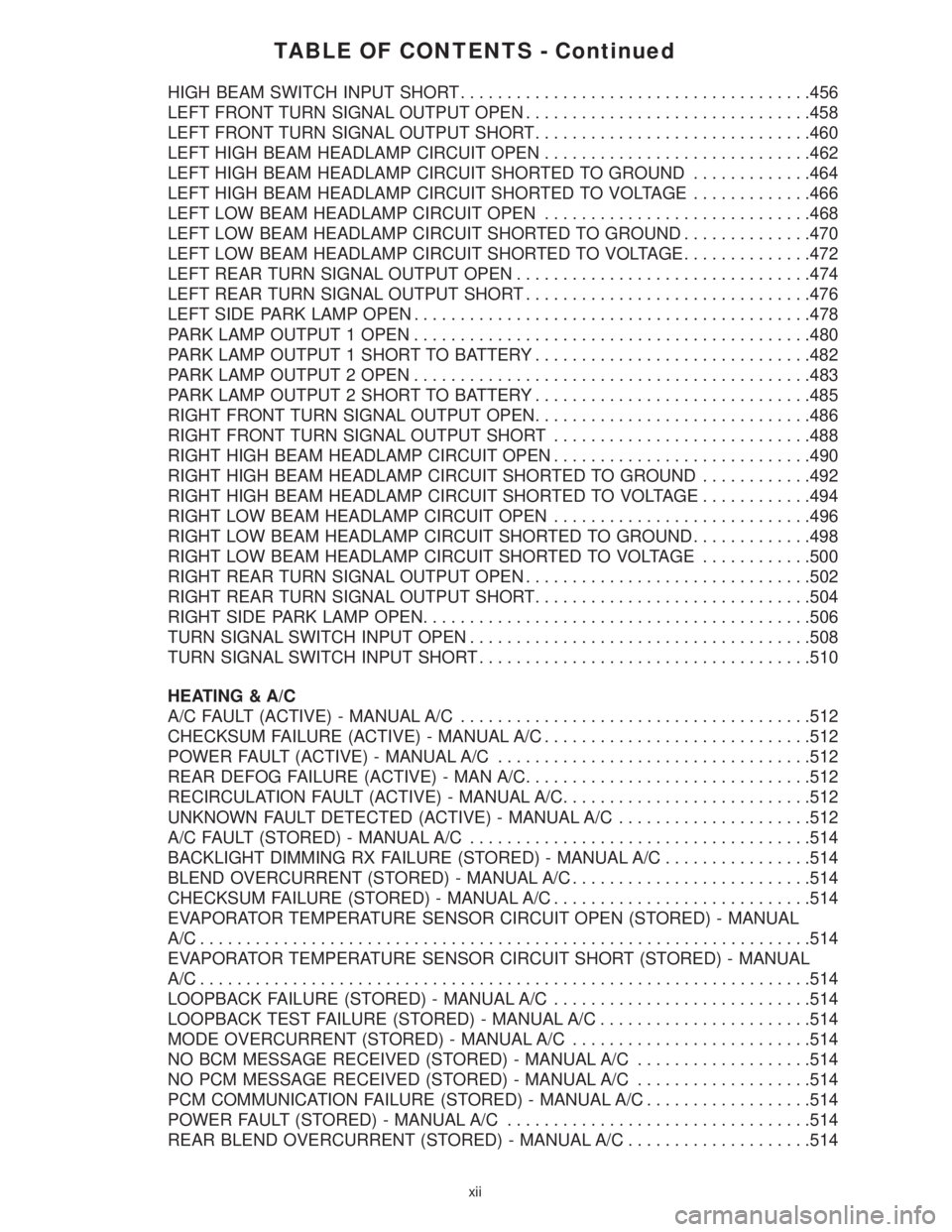
TABLE OF CONTENTS - Continued
HIGH BEAM SWITCH INPUT SHORT......................................456
LEFT FRONT TURN SIGNAL OUTPUT OPEN...............................458
LEFT FRONT TURN SIGNAL OUTPUT SHORT..............................460
LEFT HIGH BEAM HEADLAMP CIRCUIT OPEN.............................462
LEFT HIGH BEAM HEADLAMP CIRCUIT SHORTED TO GROUND.............464
LEFT HIGH BEAM HEADLAMP CIRCUIT SHORTED TO VOLTAGE.............466
LEFT LOW BEAM HEADLAMP CIRCUIT OPEN.............................468
LEFT LOW BEAM HEADLAMP CIRCUIT SHORTED TO GROUND..............470
LEFT LOW BEAM HEADLAMP CIRCUIT SHORTED TO VOLTAGE..............472
LEFT REAR TURN SIGNAL OUTPUT OPEN................................474
LEFT REAR TURN SIGNAL OUTPUT SHORT...............................476
LEFT SIDE PARK LAMP OPEN...........................................478
PARK LAMP OUTPUT 1 OPEN...........................................480
PARK LAMP OUTPUT 1 SHORT TO BATTERY..............................482
PARK LAMP OUTPUT 2 OPEN...........................................483
PARK LAMP OUTPUT 2 SHORT TO BATTERY..............................485
RIGHT FRONT TURN SIGNAL OUTPUT OPEN..............................486
RIGHT FRONT TURN SIGNAL OUTPUT SHORT............................488
RIGHT HIGH BEAM HEADLAMP CIRCUIT OPEN............................490
RIGHT HIGH BEAM HEADLAMP CIRCUIT SHORTED TO GROUND............492
RIGHT HIGH BEAM HEADLAMP CIRCUIT SHORTED TO VOLTAGE............494
RIGHT LOW BEAM HEADLAMP CIRCUIT OPEN............................496
RIGHT LOW BEAM HEADLAMP CIRCUIT SHORTED TO GROUND.............498
RIGHT LOW BEAM HEADLAMP CIRCUIT SHORTED TO VOLTAGE............500
RIGHT REAR TURN SIGNAL OUTPUT OPEN...............................502
RIGHT REAR TURN SIGNAL OUTPUT SHORT..............................504
RIGHT SIDE PARK LAMP OPEN..........................................506
TURN SIGNAL SWITCH INPUT OPEN.....................................508
TURN SIGNAL SWITCH INPUT SHORT....................................510
HEATING & A/C
A/C FAULT (ACTIVE) - MANUAL A/C......................................512
CHECKSUM FAILURE (ACTIVE) - MANUAL A/C.............................512
POWER FAULT (ACTIVE) - MANUAL A/C..................................512
REAR DEFOG FAILURE (ACTIVE) - MAN A/C...............................512
RECIRCULATION FAULT (ACTIVE) - MANUAL A/C...........................512
UNKNOWN FAULT DETECTED (ACTIVE) - MANUAL A/C.....................512
A/C FAULT (STORED) - MANUAL A/C.....................................514
BACKLIGHT DIMMING RX FAILURE (STORED) - MANUAL A/C................514
BLEND OVERCURRENT (STORED) - MANUAL A/C..........................514
CHECKSUM FAILURE (STORED) - MANUAL A/C............................514
EVAPORATOR TEMPERATURE SENSOR CIRCUIT OPEN (STORED) - MANUAL
A/C..................................................................514
EVAPORATOR TEMPERATURE SENSOR CIRCUIT SHORT (STORED) - MANUAL
A/C..................................................................514
LOOPBACK FAILURE (STORED) - MANUAL A/C............................514
LOOPBACK TEST FAILURE (STORED) - MANUAL A/C.......................514
MODE OVERCURRENT (STORED) - MANUAL A/C..........................514
NO BCM MESSAGE RECEIVED (STORED) - MANUAL A/C...................514
NO PCM MESSAGE RECEIVED (STORED) - MANUAL A/C...................514
PCM COMMUNICATION FAILURE (STORED) - MANUAL A/C..................514
POWER FAULT (STORED) - MANUAL A/C.................................514
REAR BLEND OVERCURRENT (STORED) - MANUAL A/C....................514
xii
Page 21 of 4284
TABLE OF CONTENTS - Continued
INTERNAL EEPROM WRITE ERROR......................................927
INTERNAL TRANSMIT FAILURE..........................................928
INTERNAL ULTRASONIC FAULT.........................................929
LOOPBACK ERROR....................................................935
NO VALID MESSAGES RECEIVED........................................936
PCI BUS SHORTED TO BATTERY........................................937
PCI BUS SHORTED TO GROUND........................................938
PCM MESSAGES NOT RECEIVED........................................939
VEHICLE THEFT ALARM INDICATOR OUTPUT OPEN.......................940
VEHICLE THEFT ALARM INDICATOR OUTPUT SHORT......................941
*ALARM TRIPS ON ITS OWN............................................942
*HOOD DOES NOT TRIP VTSS..........................................943
*LEFT FRONT DOOR DOES NOT TRIP VTSS..............................944
*LEFT SLIDING DOOR DOES NOT TRIP VTSS.............................945
*LIFTGATE DOES NOT TRIP VTSS.......................................946
*REPEATER LAMPS INOPERATIVE WITH ALARM...........................947
*RIGHT FRONT DOOR DOES NOT TRIP VTSS.............................948
*RIGHT SLIDING DOOR DOES NOT TRIP VTSS............................949
*VTSS INDICATOR INOPERATIVE........................................950
*VTSS INDICATOR LAMP INOPERATIVE...................................951
*VTSS SIREN INOP....................................................952
*VTSS WILL NOT ARM..................................................955
WINDSHIELD WIPER & WASHER
FR WIPER HI-LO RELAY OPEN..........................................956
FR WIPER HI-LO RELAY SHORT TO BATT.................................958
FRONT WASH SWITCH INPUT STUCK....................................959
FRONT WASHER OUTPUT OPEN........................................961
FRONT WIPER NOT PARKED............................................963
FRONT WIPER ON RELAY OPEN........................................965
FRONT WIPER ON RELAY SHORT TO BATT...............................966
FRONT WIPER PARK SWITCH SHORT TO GND............................967
FRONT WIPER SWITCH MUX INPUT OPEN................................969
FRONT WIPER SWITCH MUX INPUT SHORT TO GROUND...................971
HEADLAMP WASHER RELAY OPEN......................................973
HEADLAMP WASHER RELAY SHORT TO BATT.............................975
REAR WASH SWITCH INPUT STUCK.....................................976
REAR WASHER OUTPUT OPEN.........................................978
REAR WIPER OUTPUT OPEN...........................................980
REAR WIPER OUTPUT SHORT TO GROUND..............................982
REAR WIPER SWITCH MUX INPUT OPEN.................................984
REAR WIPER SWITCH MUX INPUT SHORT TO GROUND....................986
VERIFICATION TESTS
VERIFICATION TESTS..................................................988
8.0 COMPONENT LOCATIONS..............................................995
8.1AIRBAG SYSTEM.................................................995
8.2BODY CONTROL MODULE.........................................996
8.3ENGINE CONTROL MODULE.......................................996
8.4HEATING & A/C...................................................996
8.4.1ACTUATORS ± FRONT LHD...............................996
xviii
Page 30 of 4284
1.0 INTRODUCTION
The procedures contained in this manual include
all the specifications, instructions and graphics
needed to diagnose 2001 body system problems. The
diagnostics in this manual are based on the failure
condition or symptom being present at the time of
diagnosis.
Please follow the recommendations below when
choosing your diagnostic path.
1. First make sure the DRBIIItis communicating
with the appropriate modules; i.e., if the
DRBIIItdisplays a ªNo Responseº or a ªBus6
Signals Openº condition, you must diagnose that
first.
2. Read DTC's (diagnostic trouble codes) with the
DRBIIIt.
3. If no DTC's are present, identify the customer
complaint.
4. Once the DTC or customer complaint is identi-
fied, locate the matching test in the Table of
Contents and begin to diagnose the symptom.
All component location views are in Section 8.0. All
connector pinouts are in Section 9.0. All schematics
are in Section 10.0. All Charts and Graphs are in
Section 11.0.
An * placed before the symptom description indi-
cated a customer complaint.
When repairs are required, refer to the appropri-
ate service information for the proper removal and
repair procedure.
Diagnostic procedures change every year. New
diagnostic systems may be added: carryover systems
may be enhanced. READ THIS MANUAL BEFORE
TRYING TO DIAGNOSE A VEHICLE DIAGNOS-
TIC TROUBLE CODE. It is recommended that you
review the entire manual to become familiar with all
the new and changed diagnostic procedures.
This book reflects many suggested changes from
readers of past issues. After using this book, if you
have any comments or suggestions, please fill out
the form in the back of this book and mail it back to
us.
1.1 SYSTEM COVERAGE
This diagnostic procedures manual covers all
2001 Chrysler Voyager and Caravan vehicles. This
diagnostic procedures manual also covers both left
hand drive (LHD) and right hand drive (RHD)
vehicles. There may be some slight differences in
the location views of components. If the location
views shown are on a LHD vehicle, a RHD vehicle
will be symmetrically opposite.
1.2 SIX-STEP TROUBLESHOOTING
PROCEDURE
Diagnosis of the body system is done in six basic
steps:
²verification of complaint
²verification of any related symptoms
²symptom analysis
²problem isolation
²repair of isolated problem
²verification of proper operation
2.0 IDENTIFICATION OF
SYSTEM
The vehicle systems that are part of the ªbodyº
system are:
²Airbag
²Audio
²Cabin Heater
²Chime
²Communication
²Door Ajar System
²Electrically heated system
²Exterior lighting
²Heating and A/C
²Instrument Cluster
²Interior Lighting
²Manual Temperature Control
²Memory Seat
²Overhead Console
²Power Door Lock/RKE
²Power Folding Mirrors
²Power Sliding Doors
²Power Liftgate
²Power windows
²Vehicle Theft Security System (VTSS)
²Windshield Wiper and Washer
3.0 SYSTEM DESCRIPTION AND
FUNCTIONAL OPERATION
The body system on the 2001 RG consists of a
combination of modules that communicate over the
PCI bus (Programmable Communication Interface
multiplex system). Through the PCI bus, informa-
tion about the operation of vehicle components and
circuits is relayed quickly to the appropriate mod-
ule(s). All modules receive all the information trans-
1
GENERAL INFORMATION
Page 45 of 4284
the CPA is not properly engaged, a voltage on pin 38
will be interpreted as an unseated connector and a
fault will set.
Flash programming voltage Ð20 volt input on
pin 42. When a DRBIIItis connected and the
proper flash reprogramming sequence is selected,
the 20 volt signal will be applied through pin 42.
3.9 HEATING & A/C
3.9.1 AUTOMATIC TEMPERATURE
CONTROL (ATC)
3.9.1.1 CABIN HEATER
For vehicles equipped with a diesel engine, a
Cabin Heater is used in conjunction with the HVAC
system. The Cabin Heater is designed to supply the
vehicle's occupants with heat prior to the engine
reaching operating temperature. For additional in-
formation on this system, refer to Cabin Heater
under General Information and Diagnostic Proce-
dures in this manual.
3.9.1.2 SYSTEM OPERATION
The Automatic Temperature Control (ATC) sys-
tem provides fully adjustable three zone climate
control; Driver front zone, Passenger Front zone
and Rear zone. The following is a list of ATC
controls and features:
± a POWER button which allows the operator to
turn the system completely off.
± AUTO HIGH/LOW switch allows the operator
to select what rate (fan speed) the system will
provide the selected comfort level.
± DRIVER, REAR and PASSENGER rocker
switches to select desired temperature for each
zone.
± Recirculation button allows cooling air to be
recirculated which maximizes cooling ability.
± A/C select button allows the operator to turn
the A/C compressor off.
± Defroster button allows the operator to turn on
the defroster independently during automatic
control.
± Fan control rotary switch for selecting fan
speed.
± Mode rotary switch for selecting heating/
cooling direction.
± REAR SYSTEM rotary switch for activating
the Rear ATC Switch allowing intermediate
passenger control over rear climate control.
3.9.1.3 BLOWER MOTOR OPERATION
The Automatic Temperature Control (ATC) front
and rear blower control provides continuously vari-
able control of air flow rate to meet occupant
comfort requirements. Pulse width modulation of
the blower motor power allows the front and rear
blower to operate at any speed from off to full speed.
When front or rear blower operation is required, the
ATC sends a PCI Bus message to the Front Control
Module (FCM) requesting blower relay ON. The
FCM provides a ground for the front and rear
blower motor relay coils, activating both relays. The
front and rear blower relays provide 12 volts to
their respective blower motor power modules. Each
module provides a 12 volt blower motor control
signal to the ATC. The ATC provides a pulse width
modulated (duty-cycle) ground signal to this circuit
based on climate requirements. The higher voltage
on the signal circuit (less duty-cycle ground) the
lower the blower speed request. The lower voltage
on the signal circuit (more duty-cycle ground) the
higher the blower speed request.
3.9.1.4 INFRARED SENSORS
The ATC system uses infrared (I/R) sensors to
monitor and control oocupant comfort levels. This
sensing system replaces interior air temperature
and solar sensors which required complex control
programs to maintain occupant comfort levels. The
front I/R sensor is located in the instrument panel
center bezel outlet. The rear I/R sensor is located in
the rear overhead mounted ATC switch.
3.9.1.5 REAR ATC SWITCH
The rear ATC switch is mounted in the headliner.
The switch contains a rotary adjustment for fan
speed, a rotary adjustment for mode selection, a
push button switch for temperature selection and a
digital display of the selected temperature.
3.9.1.6 COOLDOWN TESTING
The ATC provides a feature referred to as a
Cooldown Test. This test is initiated using the
DRBIIItand is designed to check the performance
of the air conditioning system. The ATC will not
perform this test if the ambient air temperature is
below 12ÉC (53ÉF). During the test, the ATC com-
pares the ambient air temperature to the evapora-
tor temperature sensor. To pass the cooldown test,
the evap temperature sensor must drop -6ÉC (20ÉF)
below ambient temperature within 2 minutes of
start of test. At the completion of the cooldown test
the DRBIIItwill display one of the following mes-
sages indicating test outcome:
± Cooldown Test Passed
± Cooldown Test Failed
16
GENERAL INFORMATION
Page 50 of 4284

ating and the combustion air fan operation is sus-
pended for 3 seconds. Subsequently, the combustion
air fan speed is increased in two ramps within 56
seconds to nearly full load operation. After a stabi-
lization phase of 15 seconds, the combustion air fan
speed is again increased in a ramp within 50
seconds to nearly full load. After reaching full load
fuel delivery, the glow plug is deactivated and the
combustion air fan operation is increased to full
load. During the subsequent 45 seconds, as well as
in normal operation, the glow plug functions as a
flame sensor to monitor the flame condition. After
all these events, the automatically controlled heat-
ing operation starts.
In case of a no flame or a flame out condition, a
restart is automatically initiated. If the no flame
condition persists, fuel delivery is stopped and the
heater enters an error lockout mode with a run-
down of the combustion air fan. This will set one or
more DTCs in the DCHA Control's memory. If six
continuous attempts to start the heater fail due to
one or more faults in the DCHA system, the heater
enters a heater lockout mode. This will set DTC
B1813 along with any other fault(s) that the DCHA
Control identified.
3.10.3.2 HEATING
During the automatically controlled heating op-
eration, when the coolant temperature reaches
72ÉC (162ÉF), the heater will switch to a part load
operation. When the coolant temperature reaches
75ÉC (167ÉF) or if the heater runs for longer than 76
minutes the heater will switch to a control idle
period. If the coolant temperature drops to 71ÉC
(160ÉF) during a control idle period, the heater will
perform a regular starting sequence into full load
operation. A drop in coolant temperature to 65ÉC
(149ÉF) during part load operation will cause the
heater to switch to a full load operation.
3.10.3.3 DEACTIVATION
The DCHA will deactivate if the:
²engine is turned off.
²coolant temperature reaches 75ÉC (167ÉF).
²heater runs longer than 76 minutes.
²fuel tank has less than 1/8 of a tank of fuel.
²Power switch on the A/C ± Heater Control Module
is off.
²Blend Control on the A/C ± Heater Control Mod-
ule is set below 75% reheat.
When the heater is deactivated, the combustion
stops and a run-down sequence begins. During the
run-down sequence, the combustion air fan contin-
ues operation to cool down the heater. The fan is
automatically switched off after the run-down se-
quence is complete. The run-down time and thecombustion air fan speed depend on the heater
operating condition at the time of deactivation.
Run-down time is approximately 175 seconds when
deactivated in full load operation and approxi-
mately 100 seconds when deactivated in part load
operation.
3.10.4 DIAGNOSTICS
The DCHA is fully addressable with the DRBIIIt.
System tests include a Field Mode Test to activate
the DCHA for diagnostic testing purposes. The
DCHA Control will store up to three DTCs in its
memory. If the Controller detects a new fault in the
DCHA system, one that is not already stored in its
memory, it will clear the oldest of the three stored
DTCs, and it will store the new fault's DTC. If the
Controller detects a reoccurrence of a stored fault, it
will overwrite that fault's DTC with the most recent
occurrence.
3.11 INSTRUMENT CLUSTER
The Instrument Cluster receives and sends mes-
sages to other modules via the PCI bus circuit. The
indicator lamps will illuminate briefly for a bulb
check when the ignition is turned from off to run.
All of the gauges receive their information via the
PCI bus from the powertrain control module and
body control module.
The gauges and the LEDs are not individually
replaceable thereby requiring complete replace-
ment of the Instrument Cluster if a repair is neces-
sary. In the event that the Instrument Cluster loses
communication with other modules on the PCI bus,
the cluster will display ªno busº in the VF display.
The Trip/Reset button is used to switch the dis-
play from trip to total mileage. Holding the button
when the display is in the trip mode will reset the
trip mileage. This button is also used to put the
cluster in self-diagnostic mode. The odometer dis-
play uses blue-green vacuum fluorescent digital
characters.
On base vehicles, the Instrument Cluster has
three gauges: Speedometer, Fuel and Engine Cool-
ant Temperature. A red dot moves transversely
through openings in the Instrument Cluster face
(P-R-N-D-2-1) to indicate the gear selected.
With all other models, the Instrument Cluster
also includes a Tachometer and uses a vacuum-
fluorescent shift indicator.
The odometer display and door/liftgate ajar indi-
cators turn on when a door is opened to assist both
the customer and service technician to view the
odometer without turning the ignition on.
21
GENERAL INFORMATION