2001 CHRYSLER VOYAGER service
[x] Cancel search: servicePage 1008 of 4284
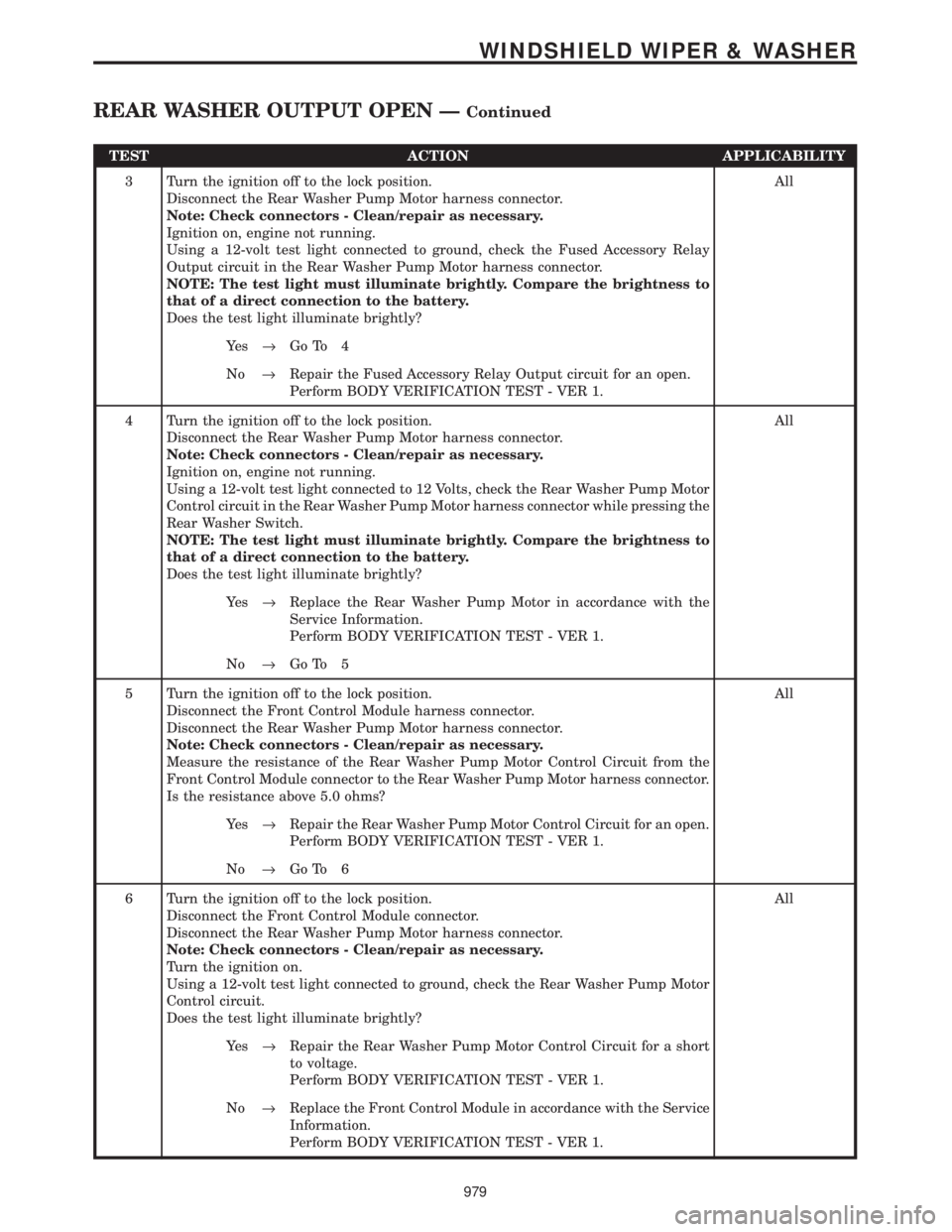
TEST ACTION APPLICABILITY
3 Turn the ignition off to the lock position.
Disconnect the Rear Washer Pump Motor harness connector.
Note: Check connectors - Clean/repair as necessary.
Ignition on, engine not running.
Using a 12-volt test light connected to ground, check the Fused Accessory Relay
Output circuit in the Rear Washer Pump Motor harness connector.
NOTE: The test light must illuminate brightly. Compare the brightness to
that of a direct connection to the battery.
Does the test light illuminate brightly?All
Ye s®Go To 4
No®Repair the Fused Accessory Relay Output circuit for an open.
Perform BODY VERIFICATION TEST - VER 1.
4 Turn the ignition off to the lock position.
Disconnect the Rear Washer Pump Motor harness connector.
Note: Check connectors - Clean/repair as necessary.
Ignition on, engine not running.
Using a 12-volt test light connected to 12 Volts, check the Rear Washer Pump Motor
Control circuit in the Rear Washer Pump Motor harness connector while pressing the
Rear Washer Switch.
NOTE: The test light must illuminate brightly. Compare the brightness to
that of a direct connection to the battery.
Does the test light illuminate brightly?All
Ye s®Replace the Rear Washer Pump Motor in accordance with the
Service Information.
Perform BODY VERIFICATION TEST - VER 1.
No®Go To 5
5 Turn the ignition off to the lock position.
Disconnect the Front Control Module harness connector.
Disconnect the Rear Washer Pump Motor harness connector.
Note: Check connectors - Clean/repair as necessary.
Measure the resistance of the Rear Washer Pump Motor Control Circuit from the
Front Control Module connector to the Rear Washer Pump Motor harness connector.
Is the resistance above 5.0 ohms?All
Ye s®Repair the Rear Washer Pump Motor Control Circuit for an open.
Perform BODY VERIFICATION TEST - VER 1.
No®Go To 6
6 Turn the ignition off to the lock position.
Disconnect the Front Control Module connector.
Disconnect the Rear Washer Pump Motor harness connector.
Note: Check connectors - Clean/repair as necessary.
Turn the ignition on.
Using a 12-volt test light connected to ground, check the Rear Washer Pump Motor
Control circuit.
Does the test light illuminate brightly?All
Ye s®Repair the Rear Washer Pump Motor Control Circuit for a short
to voltage.
Perform BODY VERIFICATION TEST - VER 1.
No®Replace the Front Control Module in accordance with the Service
Information.
Perform BODY VERIFICATION TEST - VER 1.
979
WINDSHIELD WIPER & WASHER
REAR WASHER OUTPUT OPEN ÐContinued
Page 1010 of 4284
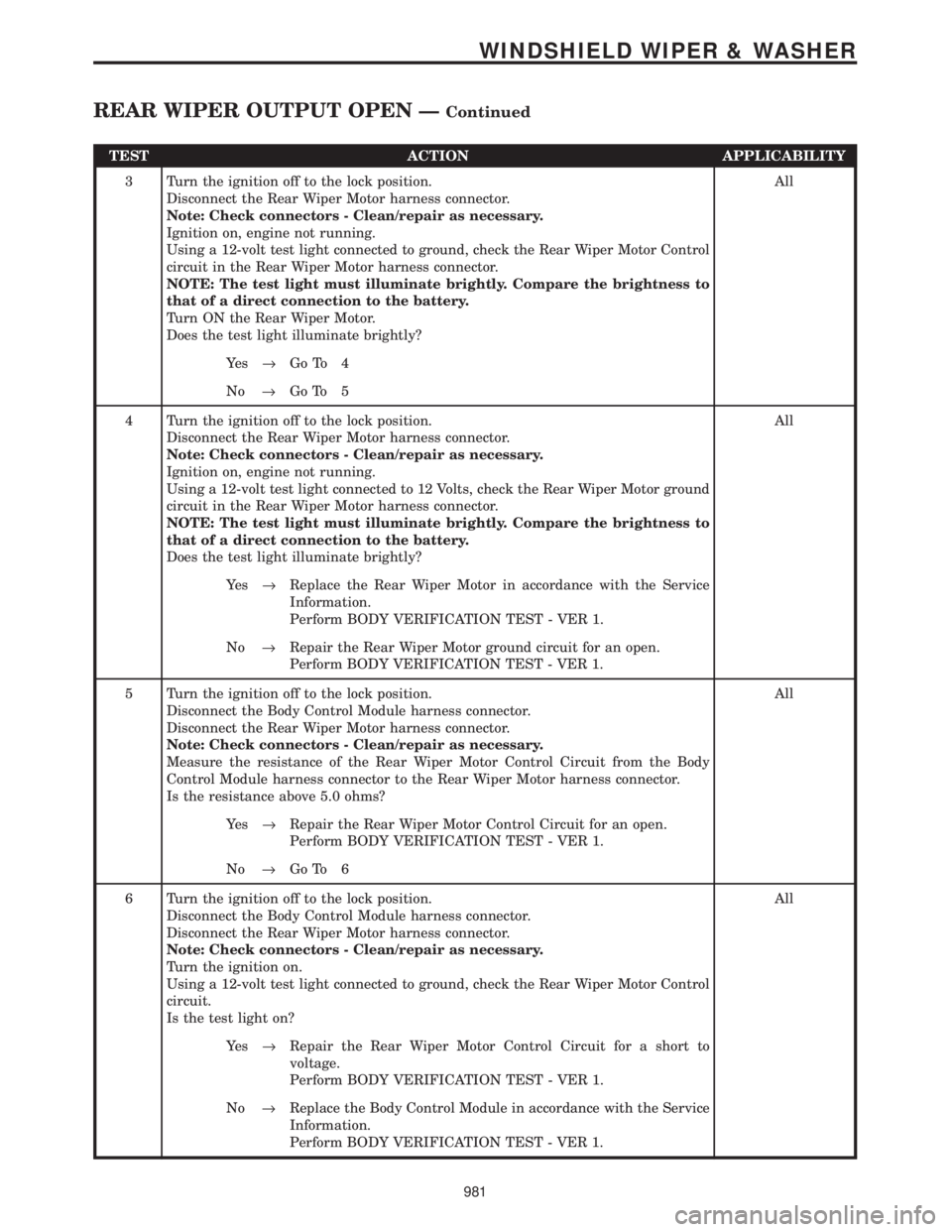
TEST ACTION APPLICABILITY
3 Turn the ignition off to the lock position.
Disconnect the Rear Wiper Motor harness connector.
Note: Check connectors - Clean/repair as necessary.
Ignition on, engine not running.
Using a 12-volt test light connected to ground, check the Rear Wiper Motor Control
circuit in the Rear Wiper Motor harness connector.
NOTE: The test light must illuminate brightly. Compare the brightness to
that of a direct connection to the battery.
Turn ON the Rear Wiper Motor.
Does the test light illuminate brightly?All
Ye s®Go To 4
No®Go To 5
4 Turn the ignition off to the lock position.
Disconnect the Rear Wiper Motor harness connector.
Note: Check connectors - Clean/repair as necessary.
Ignition on, engine not running.
Using a 12-volt test light connected to 12 Volts, check the Rear Wiper Motor ground
circuit in the Rear Wiper Motor harness connector.
NOTE: The test light must illuminate brightly. Compare the brightness to
that of a direct connection to the battery.
Does the test light illuminate brightly?All
Ye s®Replace the Rear Wiper Motor in accordance with the Service
Information.
Perform BODY VERIFICATION TEST - VER 1.
No®Repair the Rear Wiper Motor ground circuit for an open.
Perform BODY VERIFICATION TEST - VER 1.
5 Turn the ignition off to the lock position.
Disconnect the Body Control Module harness connector.
Disconnect the Rear Wiper Motor harness connector.
Note: Check connectors - Clean/repair as necessary.
Measure the resistance of the Rear Wiper Motor Control Circuit from the Body
Control Module harness connector to the Rear Wiper Motor harness connector.
Is the resistance above 5.0 ohms?All
Ye s®Repair the Rear Wiper Motor Control Circuit for an open.
Perform BODY VERIFICATION TEST - VER 1.
No®Go To 6
6 Turn the ignition off to the lock position.
Disconnect the Body Control Module harness connector.
Disconnect the Rear Wiper Motor harness connector.
Note: Check connectors - Clean/repair as necessary.
Turn the ignition on.
Using a 12-volt test light connected to ground, check the Rear Wiper Motor Control
circuit.
Is the test light on?All
Ye s®Repair the Rear Wiper Motor Control Circuit for a short to
voltage.
Perform BODY VERIFICATION TEST - VER 1.
No®Replace the Body Control Module in accordance with the Service
Information.
Perform BODY VERIFICATION TEST - VER 1.
981
WINDSHIELD WIPER & WASHER
REAR WIPER OUTPUT OPEN ÐContinued
Page 1012 of 4284
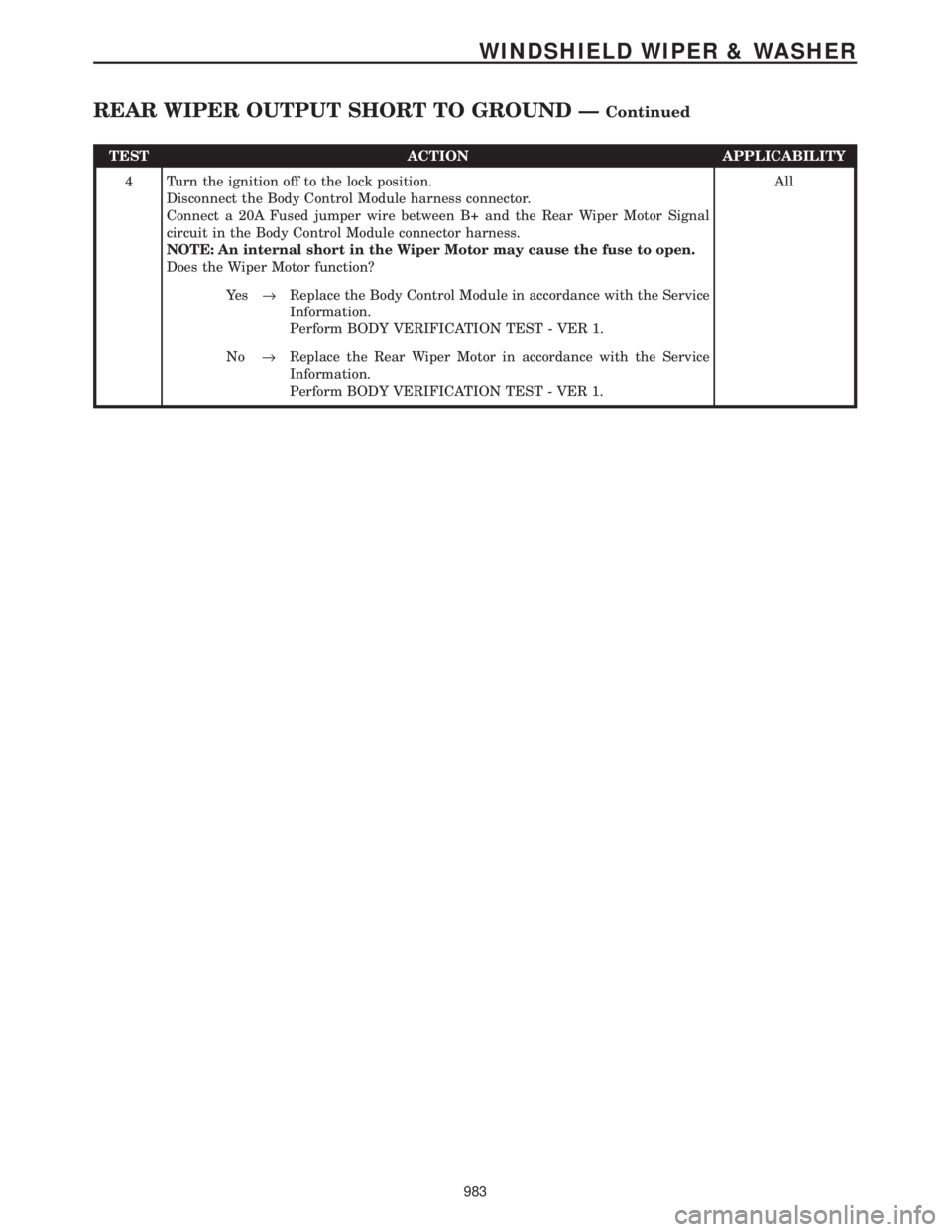
TEST ACTION APPLICABILITY
4 Turn the ignition off to the lock position.
Disconnect the Body Control Module harness connector.
Connect a 20A Fused jumper wire between B+ and the Rear Wiper Motor Signal
circuit in the Body Control Module connector harness.
NOTE: An internal short in the Wiper Motor may cause the fuse to open.
Does the Wiper Motor function?All
Ye s®Replace the Body Control Module in accordance with the Service
Information.
Perform BODY VERIFICATION TEST - VER 1.
No®Replace the Rear Wiper Motor in accordance with the Service
Information.
Perform BODY VERIFICATION TEST - VER 1.
983
WINDSHIELD WIPER & WASHER
REAR WIPER OUTPUT SHORT TO GROUND ÐContinued
Page 1013 of 4284
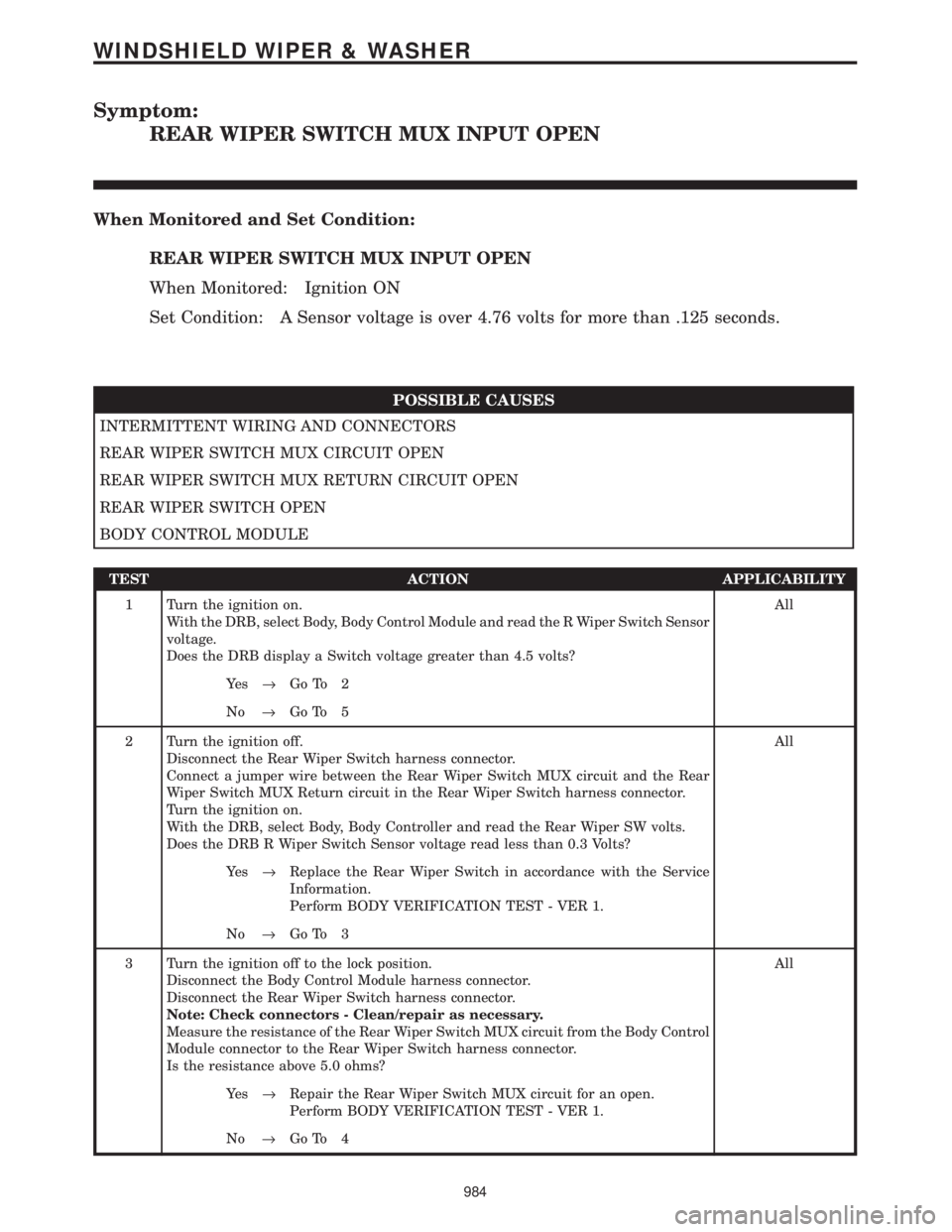
Symptom:
REAR WIPER SWITCH MUX INPUT OPEN
When Monitored and Set Condition:
REAR WIPER SWITCH MUX INPUT OPEN
When Monitored: Ignition ON
Set Condition: A Sensor voltage is over 4.76 volts for more than .125 seconds.
POSSIBLE CAUSES
INTERMITTENT WIRING AND CONNECTORS
REAR WIPER SWITCH MUX CIRCUIT OPEN
REAR WIPER SWITCH MUX RETURN CIRCUIT OPEN
REAR WIPER SWITCH OPEN
BODY CONTROL MODULE
TEST ACTION APPLICABILITY
1 Turn the ignition on.
With the DRB, select Body, Body Control Module and read the R Wiper Switch Sensor
voltage.
Does the DRB display a Switch voltage greater than 4.5 volts?All
Ye s®Go To 2
No®Go To 5
2 Turn the ignition off.
Disconnect the Rear Wiper Switch harness connector.
Connect a jumper wire between the Rear Wiper Switch MUX circuit and the Rear
Wiper Switch MUX Return circuit in the Rear Wiper Switch harness connector.
Turn the ignition on.
With the DRB, select Body, Body Controller and read the Rear Wiper SW volts.
Does the DRB R Wiper Switch Sensor voltage read less than 0.3 Volts?All
Ye s®Replace the Rear Wiper Switch in accordance with the Service
Information.
Perform BODY VERIFICATION TEST - VER 1.
No®Go To 3
3 Turn the ignition off to the lock position.
Disconnect the Body Control Module harness connector.
Disconnect the Rear Wiper Switch harness connector.
Note: Check connectors - Clean/repair as necessary.
Measure the resistance of the Rear Wiper Switch MUX circuit from the Body Control
Module connector to the Rear Wiper Switch harness connector.
Is the resistance above 5.0 ohms?All
Ye s®Repair the Rear Wiper Switch MUX circuit for an open.
Perform BODY VERIFICATION TEST - VER 1.
No®Go To 4
984
WINDSHIELD WIPER & WASHER
Page 1014 of 4284
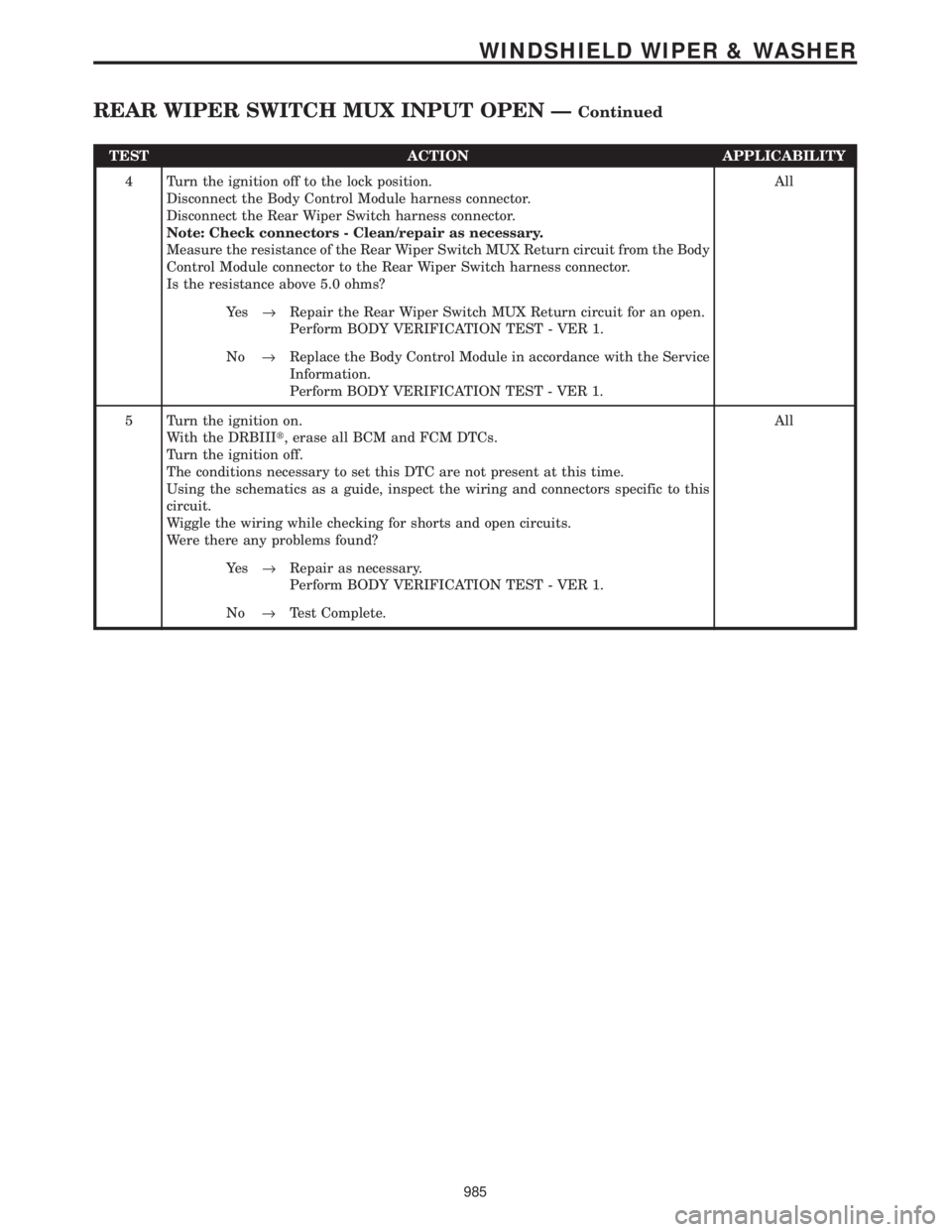
TEST ACTION APPLICABILITY
4 Turn the ignition off to the lock position.
Disconnect the Body Control Module harness connector.
Disconnect the Rear Wiper Switch harness connector.
Note: Check connectors - Clean/repair as necessary.
Measure the resistance of the Rear Wiper Switch MUX Return circuit from the Body
Control Module connector to the Rear Wiper Switch harness connector.
Is the resistance above 5.0 ohms?All
Ye s®Repair the Rear Wiper Switch MUX Return circuit for an open.
Perform BODY VERIFICATION TEST - VER 1.
No®Replace the Body Control Module in accordance with the Service
Information.
Perform BODY VERIFICATION TEST - VER 1.
5 Turn the ignition on.
With the DRBIIIt, erase all BCM and FCM DTCs.
Turn the ignition off.
The conditions necessary to set this DTC are not present at this time.
Using the schematics as a guide, inspect the wiring and connectors specific to this
circuit.
Wiggle the wiring while checking for shorts and open circuits.
Were there any problems found?All
Ye s®Repair as necessary.
Perform BODY VERIFICATION TEST - VER 1.
No®Test Complete.
985
WINDSHIELD WIPER & WASHER
REAR WIPER SWITCH MUX INPUT OPEN ÐContinued
Page 1015 of 4284
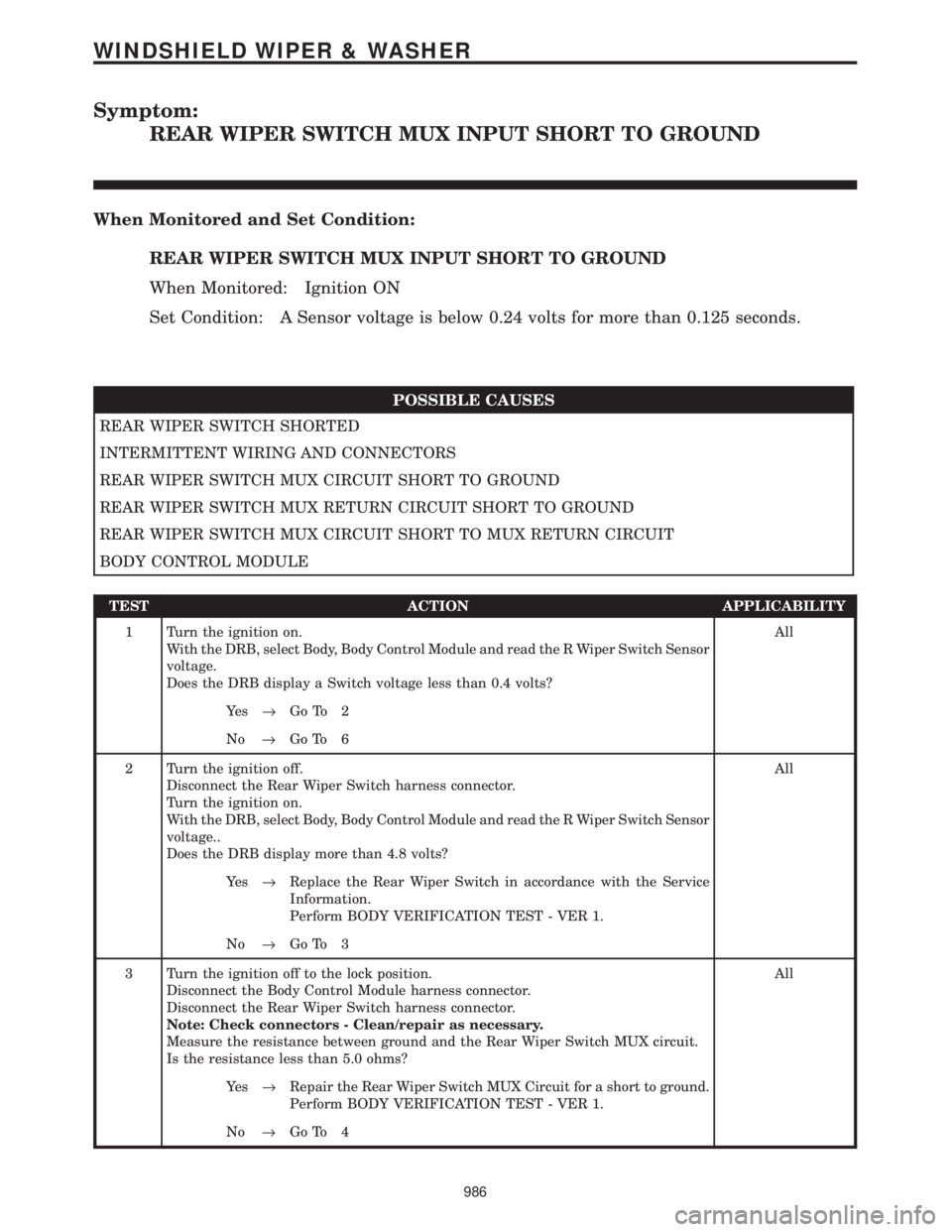
Symptom:
REAR WIPER SWITCH MUX INPUT SHORT TO GROUND
When Monitored and Set Condition:
REAR WIPER SWITCH MUX INPUT SHORT TO GROUND
When Monitored: Ignition ON
Set Condition: A Sensor voltage is below 0.24 volts for more than 0.125 seconds.
POSSIBLE CAUSES
REAR WIPER SWITCH SHORTED
INTERMITTENT WIRING AND CONNECTORS
REAR WIPER SWITCH MUX CIRCUIT SHORT TO GROUND
REAR WIPER SWITCH MUX RETURN CIRCUIT SHORT TO GROUND
REAR WIPER SWITCH MUX CIRCUIT SHORT TO MUX RETURN CIRCUIT
BODY CONTROL MODULE
TEST ACTION APPLICABILITY
1 Turn the ignition on.
With the DRB, select Body, Body Control Module and read the R Wiper Switch Sensor
voltage.
Does the DRB display a Switch voltage less than 0.4 volts?All
Ye s®Go To 2
No®Go To 6
2 Turn the ignition off.
Disconnect the Rear Wiper Switch harness connector.
Turn the ignition on.
With the DRB, select Body, Body Control Module and read the R Wiper Switch Sensor
voltage..
Does the DRB display more than 4.8 volts?All
Ye s®Replace the Rear Wiper Switch in accordance with the Service
Information.
Perform BODY VERIFICATION TEST - VER 1.
No®Go To 3
3 Turn the ignition off to the lock position.
Disconnect the Body Control Module harness connector.
Disconnect the Rear Wiper Switch harness connector.
Note: Check connectors - Clean/repair as necessary.
Measure the resistance between ground and the Rear Wiper Switch MUX circuit.
Is the resistance less than 5.0 ohms?All
Ye s®Repair the Rear Wiper Switch MUX Circuit for a short to ground.
Perform BODY VERIFICATION TEST - VER 1.
No®Go To 4
986
WINDSHIELD WIPER & WASHER
Page 1016 of 4284
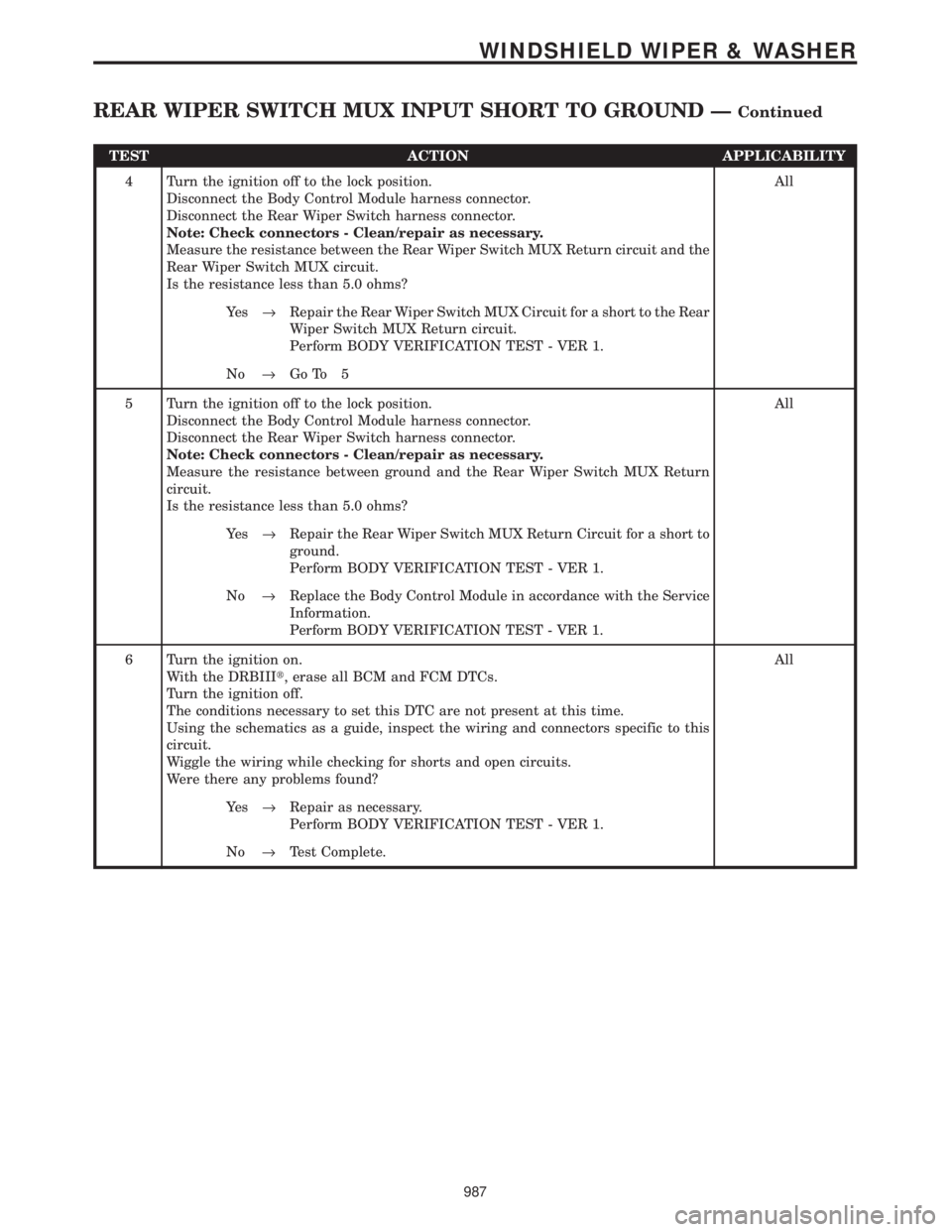
TEST ACTION APPLICABILITY
4 Turn the ignition off to the lock position.
Disconnect the Body Control Module harness connector.
Disconnect the Rear Wiper Switch harness connector.
Note: Check connectors - Clean/repair as necessary.
Measure the resistance between the Rear Wiper Switch MUX Return circuit and the
Rear Wiper Switch MUX circuit.
Is the resistance less than 5.0 ohms?All
Ye s®Repair the Rear Wiper Switch MUX Circuit for a short to the Rear
Wiper Switch MUX Return circuit.
Perform BODY VERIFICATION TEST - VER 1.
No®Go To 5
5 Turn the ignition off to the lock position.
Disconnect the Body Control Module harness connector.
Disconnect the Rear Wiper Switch harness connector.
Note: Check connectors - Clean/repair as necessary.
Measure the resistance between ground and the Rear Wiper Switch MUX Return
circuit.
Is the resistance less than 5.0 ohms?All
Ye s®Repair the Rear Wiper Switch MUX Return Circuit for a short to
ground.
Perform BODY VERIFICATION TEST - VER 1.
No®Replace the Body Control Module in accordance with the Service
Information.
Perform BODY VERIFICATION TEST - VER 1.
6 Turn the ignition on.
With the DRBIIIt, erase all BCM and FCM DTCs.
Turn the ignition off.
The conditions necessary to set this DTC are not present at this time.
Using the schematics as a guide, inspect the wiring and connectors specific to this
circuit.
Wiggle the wiring while checking for shorts and open circuits.
Were there any problems found?All
Ye s®Repair as necessary.
Perform BODY VERIFICATION TEST - VER 1.
No®Test Complete.
987
WINDSHIELD WIPER & WASHER
REAR WIPER SWITCH MUX INPUT SHORT TO GROUND ÐContinued
Page 1017 of 4284
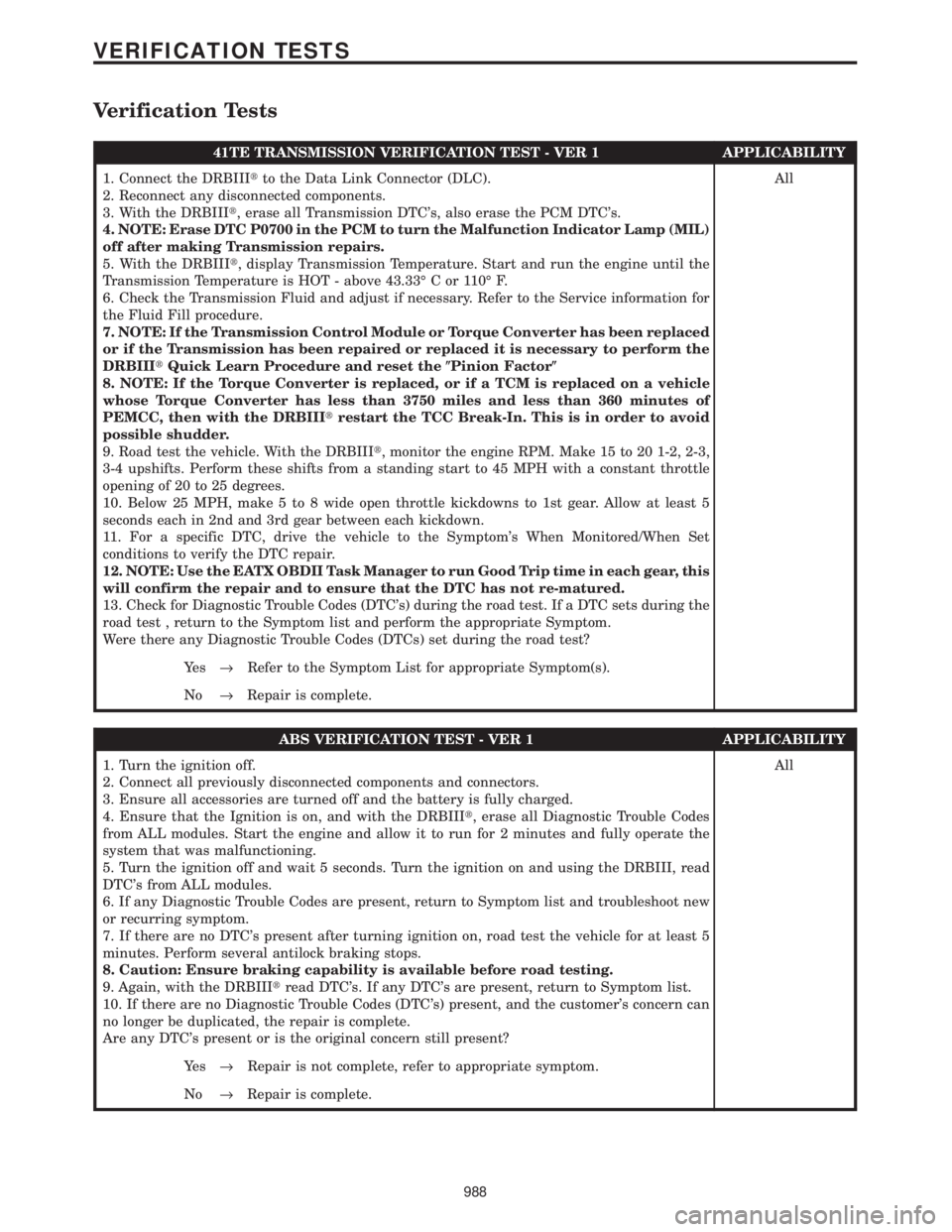
Verification Tests
41TE TRANSMISSION VERIFICATION TEST - VER 1 APPLICABILITY
1. Connect the DRBIIItto the Data Link Connector (DLC).
2. Reconnect any disconnected components.
3. With the DRBIIIt, erase all Transmission DTC's, also erase the PCM DTC's.
4. NOTE: Erase DTC P0700 in the PCM to turn the Malfunction Indicator Lamp (MIL)
off after making Transmission repairs.
5. With the DRBIIIt, display Transmission Temperature. Start and run the engine until the
Transmission Temperature is HOT - above 43.33É C or 110É F.
6. Check the Transmission Fluid and adjust if necessary. Refer to the Service information for
the Fluid Fill procedure.
7. NOTE: If the Transmission Control Module or Torque Converter has been replaced
or if the Transmission has been repaired or replaced it is necessary to perform the
DRBIIItQuick Learn Procedure and reset the(Pinion Factor(
8. NOTE: If the Torque Converter is replaced, or if a TCM is replaced on a vehicle
whose Torque Converter has less than 3750 miles and less than 360 minutes of
PEMCC, then with the DRBIIItrestart the TCC Break-In. This is in order to avoid
possible shudder.
9. Road test the vehicle. With the DRBIIIt, monitor the engine RPM. Make 15 to 20 1-2, 2-3,
3-4 upshifts. Perform these shifts from a standing start to 45 MPH with a constant throttle
opening of 20 to 25 degrees.
10. Below 25 MPH, make 5 to 8 wide open throttle kickdowns to 1st gear. Allow at least 5
seconds each in 2nd and 3rd gear between each kickdown.
11. For a specific DTC, drive the vehicle to the Symptom's When Monitored/When Set
conditions to verify the DTC repair.
12. NOTE: Use the EATX OBDII Task Manager to run Good Trip time in each gear, this
will confirm the repair and to ensure that the DTC has not re-matured.
13. Check for Diagnostic Trouble Codes (DTC's) during the road test. If a DTC sets during the
road test , return to the Symptom list and perform the appropriate Symptom.
Were there any Diagnostic Trouble Codes (DTCs) set during the road test?All
Ye s®Refer to the Symptom List for appropriate Symptom(s).
No®Repair is complete.
ABS VERIFICATION TEST - VER 1 APPLICABILITY
1. Turn the ignition off.
2. Connect all previously disconnected components and connectors.
3. Ensure all accessories are turned off and the battery is fully charged.
4. Ensure that the Ignition is on, and with the DRBIIIt, erase all Diagnostic Trouble Codes
from ALL modules. Start the engine and allow it to run for 2 minutes and fully operate the
system that was malfunctioning.
5. Turn the ignition off and wait 5 seconds. Turn the ignition on and using the DRBIII, read
DTC's from ALL modules.
6. If any Diagnostic Trouble Codes are present, return to Symptom list and troubleshoot new
or recurring symptom.
7. If there are no DTC's present after turning ignition on, road test the vehicle for at least 5
minutes. Perform several antilock braking stops.
8. Caution: Ensure braking capability is available before road testing.
9. Again, with the DRBIIItread DTC's. If any DTC's are present, return to Symptom list.
10. If there are no Diagnostic Trouble Codes (DTC's) present, and the customer's concern can
no longer be duplicated, the repair is complete.
Are any DTC's present or is the original concern still present?All
Ye s®Repair is not complete, refer to appropriate symptom.
No®Repair is complete.
988
VERIFICATION TESTS