Page 789 of 4770

'99camry U
23
TESTING THE SYSTEM
1. Open all the windows.
2. Set the system as described above.
The doors should be locked with the
key or wireless remote control transmit-
ter. Be sure to wait until the indicator
light goes off or starts flashing.
3. Unlock any door from the inside. The
system should activate the alarm.
4. Stopping the alarm as described above.
5. Repeat this operation for the other
doors, trunk and hood. When testing on
the hood, also check that the system
is activated when the battery terminal
is disconnected and then reconnected.
If the system does not work properly,
have it checked by your Toyota dealer.
Fuel tank cap
1. To open the fuel filler door, pull the
lever up.
When refueling, turn off the engine.
CAUTION
�Do not smoke, cause sparks or al-
low open flames when refueling.
The fumes are flammable.
�When opening the cap, do not re-
move the cap quickly. In hot weath-
er, fuel under pressure could cause
injury by spraying out of the filler
neck if the cap is suddenly re-
moved.
2. To remove the fuel tank cap, turn
the cap slowly counterclockwise,
then pause slightly before removing
it. After removing the cap, hang it
on the cap hanger.
It is not unusual to hear a slight swoosh
when the cap is opened. When installing,
turn the cap clockwise till you hear a
click.
If the cap is not tightened securely, the
malfunction indicator lamp comes on.
Make sure the cap is tightened securely.
Page 821 of 4770

'99camry U
55
�After installing the child restraint
system, make sure it is secured in
place following the manufacturer 's
instructions. If it is not restrained
securely, it may cause death or se-
rious injury to the child in the
event of a sudden stop or accident.
When not using the child restraint system,
keep it secured with the seat belt or place
it in the trunk or somewhere other than
the passenger compartment. This will pre-
vent it from injuring passengers in the
event of a sudden stop or accident.
Your vehicle has anchors for securing the
top strap of a child restraint system. The
anchor nuts are welded beneath the sheet
metal to permit installation of an anchor
bracket for a child restraint system.
To install an anchor bracket, use an 8 mm
� 30 mm � 1.25 mm coarse thread met-
ric bolt and 15 mm (0.6 in.) spacer. Note
that the bolts accompanying many child
restraint systems are not metric. You can
damage the anchor nuts on your vehicle
if you force bolts with different thread into
the anchor nuts.For instructions about how to install the
anchor bracket, see ºTop strap anchors
and locationsº.
If your child restraint system does not
provide any of the necessary parts, you
can purchase the following items from
your Toyota dealer.
� CRS installation kit
(Part No. 04731±22012)Ðcontains 1
bolt, 3 types of spacers and 1 lock-
ing clip.
� Bolt (Part No. 91511±60830)
Page 832 of 4770
'99camry U
66
4. To remove the infant seat, press the
buckle±release button and allow the
belt to retract completely. The belt will
move freely again and be ready to
work for an adult or older child passen-
ger.(B) CONVERTIBLE SEAT INSTALLATION
A convertible seat is used in forward±
facing and rear±facing position depend-
ing on the child's age and size. When
installing, follow the manufacturer's in-
structions about the applicable child's
age and size as well as directions for
installing a child restraint system.CAUTION
�Never put a rear±facing child re-
straint system on the front seat be-
cause the force of the rapid infla-
tion of the passenger airbag can
cause death or serious injury to the
child.
Page 918 of 4770
'99camry U
152
CAUTION
�To reduce the chance of injury in
case of an accident or a sudden
stop, always keep the garage door
opener box closed while driving.
�Keep the remained spacers away
from children.
The miscellaneous box and garage door
opener box (stored in the glove box)
are interchangeable.
Removing the coverÐ
Half open the cover. Pinch each hinge and
pull it out of its pivot one by one as
shown above.
Do not remove the cover forcibly.Installing the coverÐ
Align the hinges to the pivots, and press
each hinge with a thumb until you hear a
click.
Make sure that the cover opens and
closes smoothly.
Page 931 of 4770
'99camry U
217
Part 7
DO±IT±YOURSELF
MAINTENANCEÐ
Chapter 7±2
Engine and Chassis
�Checking the engine oil level
�Checking the engine coolant
level
�Checking brake fluid
�Checking power steering fluid
�Checking tire pressure
�Checking and replacing tires
�Rotating tires
�Installing snow tires and chains
�Replacing wheels
�Aluminum wheel precautions
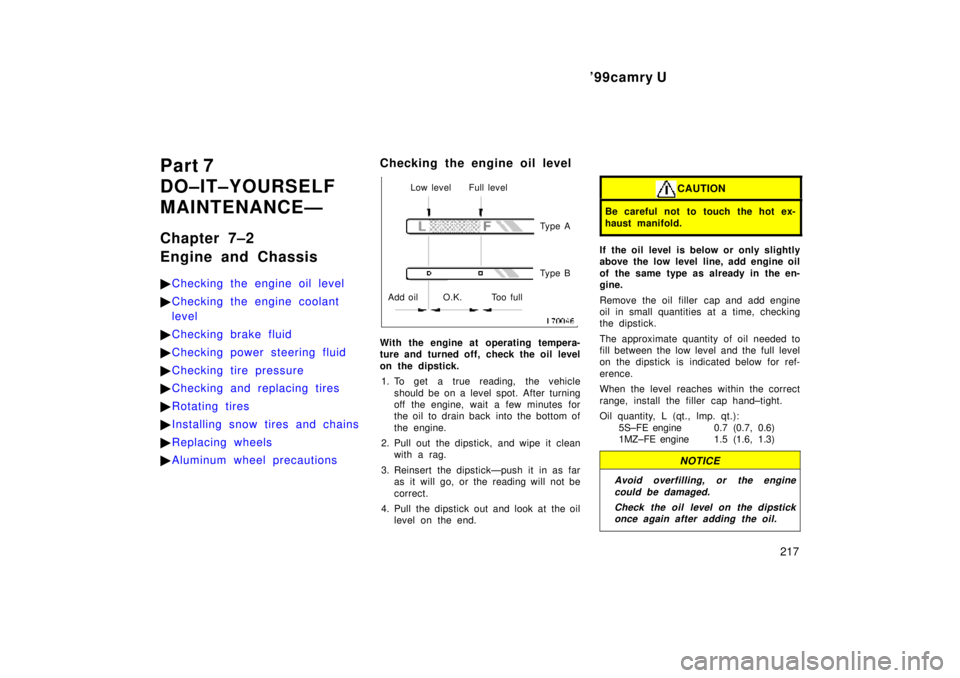
Checking the engine oil level
Low level Full level
Add oil O.K. Too fullTy p e A
Ty p e B
With the engine at operating tempera-
ture and turned off, check the oil level
on the dipstick.
1. To get a true reading, the vehicle
should be on a level spot. After turning
off the engine, wait a few minutes for
the oil to drain back into the bottom of
the engine.
2. Pull out the dipstick, and wipe it clean
with a rag.
3. Reinsert the dipstickÐpush it in as far
as it will go, or the reading will not be
correct.
4. Pull the dipstick out and look at the oil
level on the end.
CAUTION
Be careful not to touch the hot ex-
haust manifold.
If the oil level is below or only slightly
above the low level line, add engine oil
of the same type as already in the en-
gine.
Remove the oil filler cap and add engine
oil in small quantities at a time, checking
the dipstick.
The approximate quantity of oil needed to
fill between the low level and the full level
on the dipstick is indicated below for ref-
erence.
When the level reaches within the correct
range, install the filler cap hand±tight.
Oil quantity, L (qt., lmp. qt.):
5S±FE engine 0.7 (0.7, 0.6)
1MZ±FE engine 1.5 (1.6, 1.3)
NOTICE
�Avoid overfilling, or the engine
could be damaged.
�Check the oil level on the dipstick
once again after adding the oil.
Page 937 of 4770

'99camry U
223
CAUTION
�Do not mix radial, bias belted, or
bias±ply tires on your vehicle. It
can cause dangerous handling char-
acteristics, resulting in loss of con-
trol.
�Do not use tires or wheels other
than the manufacturer 's recom-
mended size.
Toyota recommends all four tires, or at
least both of the front or rear tires be
replaced at a time as a set.
See ºIf you have a flat tireº in Part 4 for
tire change procedure.
When a tire is replaced, the wheel
should always be balanced.
An unbalanced wheel may affect vehicle
handling and tire life. Wheels can get out
of balance with regular use and should
therefore be balanced occasionally.
When replacing a tubeless tire, the air
valve should also be replaced with a
new one.
Rotating tires
To equalize the wear and help extend
tire life, Toyota recommends that you
rotate your tires approximately every
12000 km (7500 miles). However, the
most appropriate timing for tire rotation
may vary according to your driving hab-
its and road surface conditions.
See ºIf you have a flat tireº in Part 4 for
tire change procedure.
When rotating tires, check for uneven
wear and damage. Abnormal wear is usu-
ally caused by incorrect tire pressure, im-
proper wheel alignment, out±of±balance
wheels, or severe braking.WHEN TO USE SNOW TIRES OR
CHAINS
Snow tires or chains are recommended
when driving on snow or ice.
On wet or dry roads, conventional tires
provide better traction than snow tires.
SNOW TIRE SELECTION
If you need snow tires, select the same
size, construction and load capacity as
the original tires on your Toyota.
Do not use tires other than those men-
tioned above. Do not install studded tires
without first checking local regulations for
possible restrictions.
SNOW TIRE INSTALLATION
Snow tires should be installed on all
wheels.
Installing snow tires on the front wheels
only can lead to an excessive difference
in road grip capability between the front
and rear tires which could cause loss of
vehicle control.
When storing removed tires you should
store them in a cool dry place. Mark the
direction of rotation and be sure to install
them in the same direction when replac-
ing.
Installing snow tires and
chains
Page 938 of 4770

'99camry U
224
CAUTION
�Do not drive with the snow tires
incorrectly inflated.
�Never drive over 120 km/h (75 mph)
with any type of snow tires.
TIRE CHAIN SELECTION
Use the tire chains of correct size and
type.
Use SAE Class ºSº type radial tire chains
except radial cable chains or V±bar type
chains.
Regulations regarding the use of tire
chains vary according to location or
type of road, so always check them
before installing chains.
CHAIN INSTALLATION
Install the chains on the front tires as
tightly as possible. Do not use tire
chains on the rear tires. Retighten
chains after driving 0.5Ð1.0 km
(1/4Ð1/2 mile).
When installing chains on your tires, care-
fully follow the instructions of the chain
manufacturer.If wheel covers are used, they will be
scratched by the chain band,so remove
the covers before putting on the chains.
CAUTION
�Do not exceed 50 km/h (30 mph) or
the chain manufacturer 's recom-
mended speed limit, whichever is
lower.
�Drive carefully avoiding bumps,
holes, and sharp turns, which may
cause the vehicle to bounce.
�Avoid sharp turns or locked±wheel
braking, as use of chains may ad-
versely affect vehicle handling.
Replacing wheels
WHEN TO REPLACE YOUR WHEELS
If you have wheel damage such as
bending, cracks or heavy corrosion, the
wheel should be replaced.
If you fail to replace damaged wheels, the
tire may slip off the wheel or they may
cause loss of handling control.
WHEEL SELECTION
When replacing wheels, care should be
taken to ensure that the wheels are re-
placed by ones with the same load ca-
pacity, diameter, rim width, and offset.
This must be observed on compact spare
tires, too.
Correct replacement wheels are available
at your Toyota dealer.
A wheel of a different size or type may
adversely affect handling, wheel and bear-
ing life, brake cooling, speedometer/odom-
eter calibration, stopping ability, headlight
aim, bumper height, vehicle ground clear-
ance, and tire or snow chain clearance to
the body and chassis.
Page 947 of 4770
'99camry U
233
Use a flat±bladed screwdriver. Remove
and install the cover clips as shown in
the following illustrations.Removing cover clips
Installing cover clips
Use a flat±bladed screw driver. To protect
the surface, place several sheets of paper
over the surface.
ÐParking, front side marker
and front turn signal lights