Page 60 of 4770

3. Delco Battery:
CHECK HYDROMETER
Green Dot visible:
Battery is adequately charged
Dark (Green Dot not visible):
Battery must be charged
Clear or Light Yellow:
Replace battery
HINT: There is no need to add water during the entire
service life of the battery.
AIR FILTER INSPECTION
1. INSPECT AIR FILTER
Visually check that the element is not excessively
dirty, damaged or oily.
2. CLEAN AIR FILTER
Clean the element with compressed air.
First blow air from the inside thoroughly. Then blow
off the outside of the element.B. Except Maintenance Free Battery
Check the specific gravity of each cell.
Standard specific gravity:
55D23L battery for GNB Incorporated
1.25 ± 1.27 at 205C (685F)
55D23L battery for JOHNSON CONTROLS
1.26 ± 1.28 at 275C (815F)
80D26L battery for GNB Incorporated
1.27 ± 1.29 at 205C (685F)
80D26L battery for JOHNSON CONTROLS
1.28 ± 1.30 at 27�C (81�F)
If the gravity is less than specification, charge the
battery.
HINT: Check the indicator as shown in the illustration.
HIGH±TENSION CORDS INSPECTION
1. DISCONNECT HIGH±TENSION CORDS FROM
SPARK PLUGS
Disconnect the high ± tension cords at the rubber
boot. Do not pull on the high±tension cords.
NOTICE: Pulling on or bending the cords may damage the
conductor inside.
± 5S±FE ENGINEENGINE MECHANICALEG1±10
Page 62 of 4770
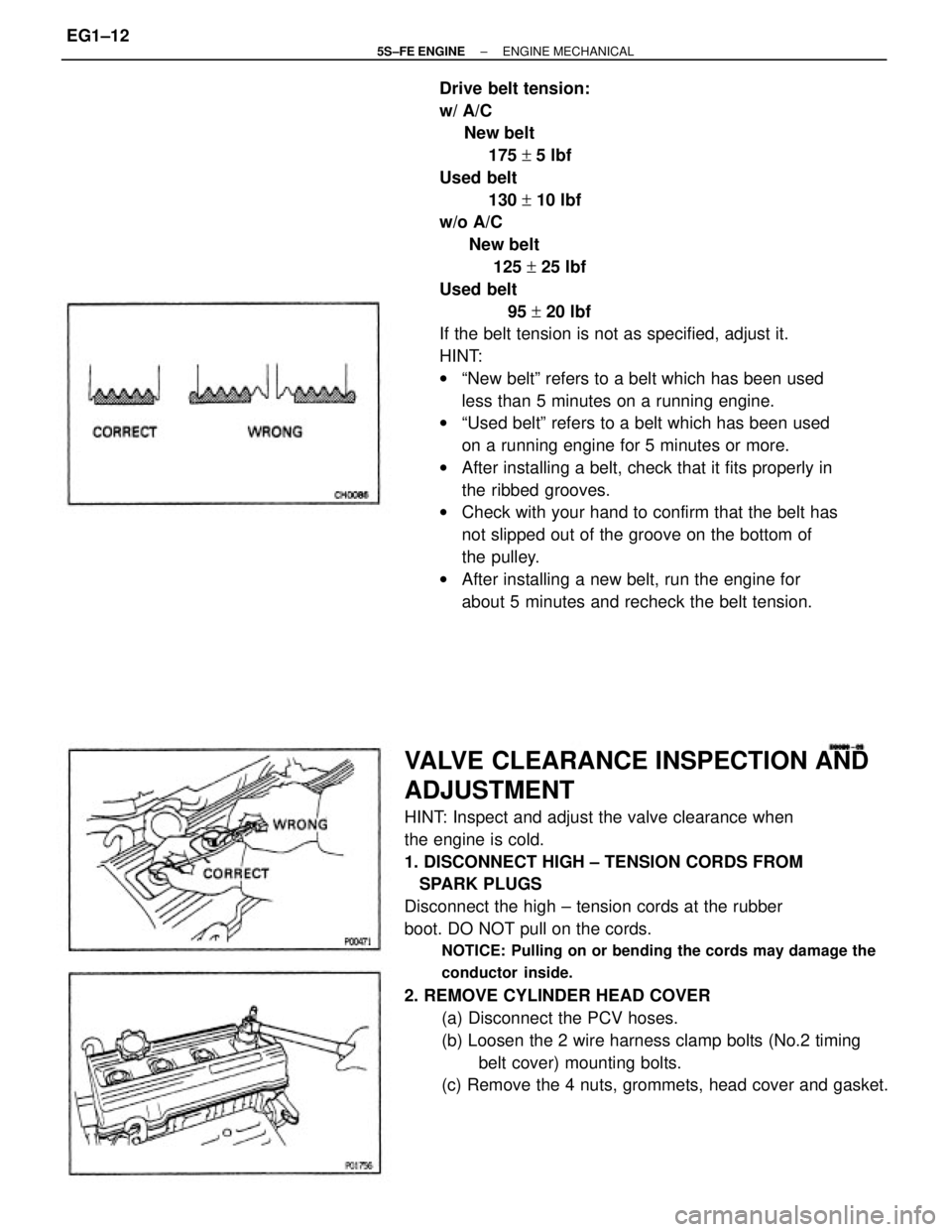
Drive belt tension:
w/ A/C
New belt
175 + 5 lbf
Used belt
130 + 10 lbf
w/o A/C
New belt
125 + 25 lbf
Used belt
95 + 20 lbf
If the belt tension is not as specified, adjust it.
HINT:
wªNew beltº refers to a belt which has been used
less than 5 minutes on a running engine.
wªUsed beltº refers to a belt which has been used
on a running engine for 5 minutes or more.
wAfter installing a belt, check that it fits properly in
the ribbed grooves.
wCheck with your hand to confirm that the belt has
not slipped out of the groove on the bottom of
the pulley.
wAfter installing a new belt, run the engine for
about 5 minutes and recheck the belt tension.
VALVE CLEARANCE INSPECTION AND
ADJUSTMENT
HINT: Inspect and adjust the valve clearance when
the engine is cold.
1. DISCONNECT HIGH ± TENSION CORDS FROM
SPARK PLUGS
Disconnect the high ± tension cords at the rubber
boot. DO NOT pull on the cords.
NOTICE: Pulling on or bending the cords may damage the
conductor inside.
2. REMOVE CYLINDER HEAD COVER
(a) Disconnect the PCV hoses.
(b) Loosen the 2 wire harness clamp bolts (No.2 timing
belt cover) mounting bolts.
(c) Remove the 4 nuts, grommets, head cover and gasket.
± 5S±FE ENGINEENGINE MECHANICALEG1±12
Page 73 of 4770
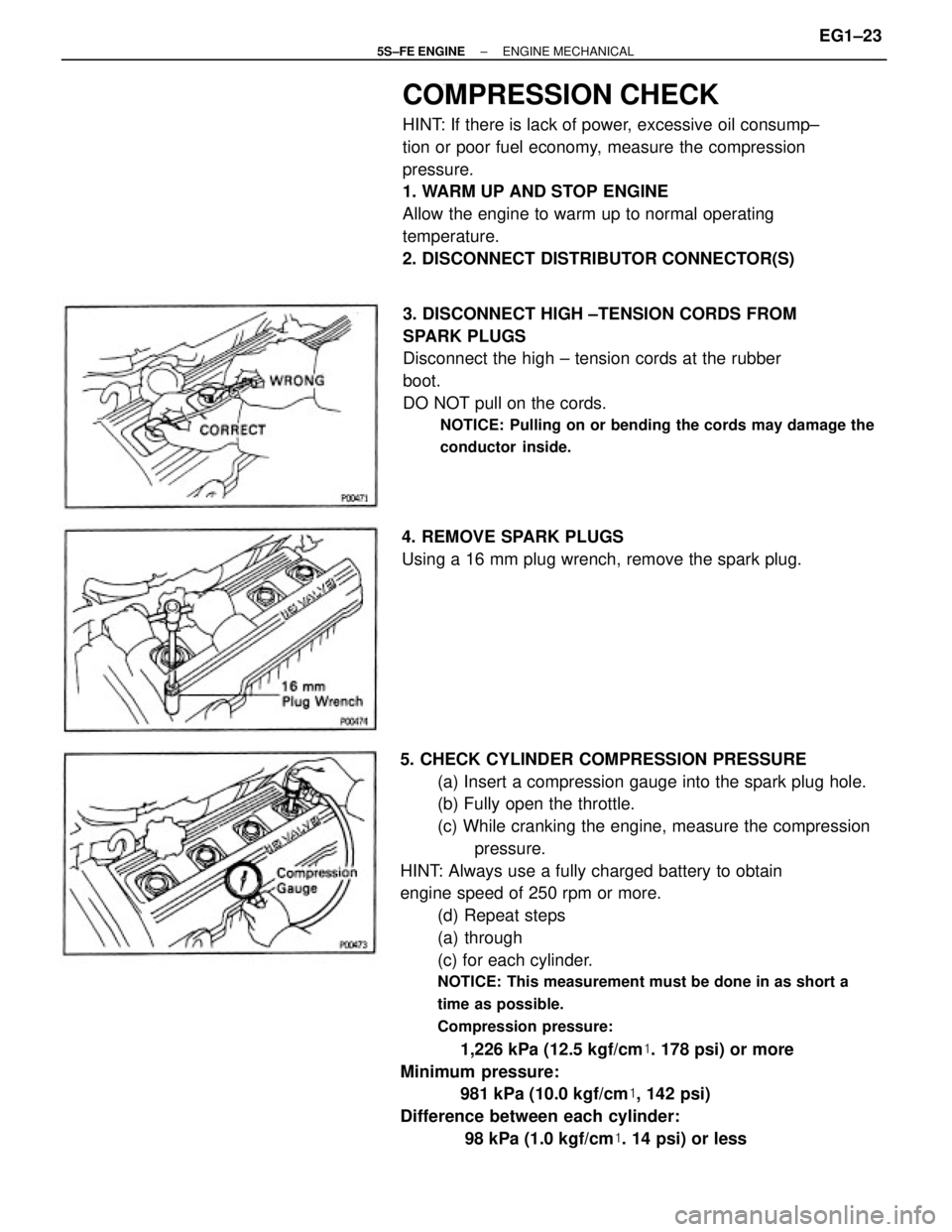
5. CHECK CYLINDER COMPRESSION PRESSURE
(a) Insert a compression gauge into the spark plug hole.
(b) Fully open the throttle.
(c) While cranking the engine, measure the compression
pressure.
HINT: Always use a fully charged battery to obtain
engine speed of 250 rpm or more.
(d) Repeat steps
(a) through
(c) for each cylinder.
NOTICE: This measurement must be done in as short a
time as possible.
Compression pressure:
1,226 kPa (12.5 kgf/cm�. 178 psi) or more
Minimum pressure:
981 kPa (10.0 kgf/cm�, 142 psi)
Difference between each cylinder:
98 kPa (1.0 kgf/cm�. 14 psi) or less
COMPRESSION CHECK
HINT: If there is lack of power, excessive oil consump±
tion or poor fuel economy, measure the compression
pressure.
1. WARM UP AND STOP ENGINE
Allow the engine to warm up to normal operating
temperature.
2. DISCONNECT DISTRIBUTOR CONNECTOR(S)
3. DISCONNECT HIGH ±TENSION CORDS FROM
SPARK PLUGS
Disconnect the high ± tension cords at the rubber
boot.
DO NOT pull on the cords.
NOTICE: Pulling on or bending the cords may damage the
conductor inside.
4. REMOVE SPARK PLUGS
Using a 16 mm plug wrench, remove the spark plug.
± 5S±FE ENGINEENGINE MECHANICALEG1±23
Page 77 of 4770
11. REMOVE SPARK PLUGS
(a) Disconnect the high ± tension cords at the rubber
boot.
DO NOT pull on the cords.
NOTICE: Pulling on or bending the cords may damage the
conductor inside.
13. SET NO.1 CYLINDER TO TDC/COMPRESSION
(a) Turn the crankshaft pulley and align its groove with
timing mark ª0º of the No.1 timing belt cover. 12. REMOVE NO.2 TIMING BELT COVER
Remove the 5 bolts, timing belt cover and 2 gaskets.10. REMOVE No.2 ENGINE MOUNTING BRACKET
Remove the 3 bolts and mounting bracket.
(b) Using a 16 mm plug wrench, remove the spark plug.
± 5S±FE ENGINEENGINE MECHANICALEG1±27
Page 537 of 4770
58CHASSISÐDRIVE SHAFT
DRIVE SHAFT
� DESCRIPTION
�The 5S±FE engine model continues to use the same drive shaft used on the previous model.
�Previously, the inboard joint of the drive shaft on the 1MZ±FE engine model was the bolt±mounted type. However,
on the new model, the inboard joint is the friction±welded integrated type.
�On the new model with 1MZ±FE engine, the boot of the outboard joint are made of thermoplastic elastomer, which
has superior durability.
�5S±FE Engine Model�
�1MZ±FE Engine Model�
Page 927 of 4770
'99camry U
213
If you perform maintenance by yourself,
be sure to follow the correct procedure
given in this part.
You should be aware that improper or in-
complete servicing may result in operating
problems.
Performing do±it±yourself maintenance
during the warranty period may affect your
warranty coverage. Read the separate
Toyota Warranty statement for details and
suggestions.
This part gives instructions only for those
items that are relatively easy for an owner
to perform. As explained in Part 6, there
are still a number of items that must be
done by a qualified technician with special
tools.
For information on tools and parts for do±
it±yourself maintenance, see ºParts and
toolsº.
Utmost care should be taken when work-
ing on your vehicle to prevent accidental
injury. Here are a few precautions that
you should be especially careful to ob-
serve:CAUTION
�When the engine is running, keep
hands, clothing, and tools away
from the moving fan and engine
drive belts. (Removing rings,
watches, and ties is advisable.)
�Right after driving, the engine
compartmentÐthe engine, radiator,
exhaust manifold and spark plug
boots, etc.Ðwill be hot. So be care-
ful not to touch them. Oil, fluids
and spark plugs may also be hot.
�If the engine is hot, do not remove
the radiator cap or loosen the drain
plugs to prevent burning yourself.
�Do not smoke, cause sparks or al-
low open flames around fuel or the
battery. Their fumes are flammable.
�Be extremely cautious when work-
ing on the battery. It contains poi-
sonous and corrosive sulfuric acid.
�Do not get under your vehicle with
just the body jack supporting it. Al-
ways use automotive jack stands or
other solid supports.
Do±it±yourself service
precautions
Page 995 of 4770

'99camry U
199
1. Rinse off loose dirt with a hose. Re-
move any mud or road salt from the
underside of the vehicle or in the
wheel wells.
2. Wash with a mild car±wash soap,
mixed according to the manufacturer 's
instructions. Use a soft cotton mitt and
keep it wet by dipping it frequently into
the wash water. Do not rub hardÐlet
the soap and water remove the dirt.
Aluminum wheels: Use only a mild soap
or neutral detergent.
Plastic bumpers: Wash carefully. Do not
scrub with abrasive cleaners. The bumper
faces are soft.
Road tar: Remove with turpentine or
cleaners that are marked safe for painted
surfaces.
NOTICE
Do not use gasoline or strong sol-
vents, which may be toxic or cause
damage.
3. Rinse thoroughlyÐdried soap can
cause streaking. In hot weather you
may need to rinse each section right
after you wash it.4. To prevent water spots, dry the vehicle
using a clean soft cotton towel. Do not
rub or press hardÐyou might scratch
the paint.
Automatic car wash
Your vehicle may be washed in an auto-
matic car wash, but remember that the
paint can be scratched by some type of
brushes, unfiltered washing water, or the
washing process itself. Scratching reduces
paint durability and gloss, especially on
darker colors. The manager of the car
wash should be able to advise you wheth-
er the process is safe for the paint on
your vehicle.
Waxing your Toyota
Polishing and waxing is recommended
to maintain the original beauty of your
Toyota's finish.
Once a month or if the vehicle does not
repel water well, apply wax.1. Always wash and dry the vehicle be-
fore you begin waxing, even if you are
using a combined cleaner and wax.
2. Use a good quality polish and wax. If
the finish has become extremely weath-
ered, use a car±cleaning polish, fol-
lowed by a separate wax. Carefully fol-
low the manufacturer 's instructions and
precautions. Be sure to polish and wax
the chrome trim as well as the paint.
3. Wax the vehicle again when water
does not bead but remains on the sur-
face in large patches.
NOTICE
Always remove the plastic bumpers if
your vehicle is re±painted and placed
in a high heat paint waxing booth.
High temperatures could damage the
bumpers.
Page 1110 of 4770
SCHEDULED MAINTENANCE LOGS18
Determining Your Vehicle’s Maintenance Needs
Special Operating Conditions
In addition to standard maintenance items, the Scheduled
Maintenance Log indicates services that should be performed
on vehicles that are driven under especially demanding condi-
tions. Specific conditions require specific services, as indicated
below. The Scheduled Maintenance Log indicates at which
mileage/time intervals each service should be performed.
You should perform these additional maintenance services if
you drive
primarilyunder any of the conditions noted. If you
drive only occasionally under these conditions, it is not neces-
sary to perform the additional services.
Driving on Rough, Muddy or Snow-Melted Roads
•Rotate tires
•Inspect ball joints and dust cover
•Inspect brake linings/drums and brake pads/discs
•Inspect drive shaft boots
•Inspect nuts and bolts on chassis and body
•Inspect steering linkage
•Re- torque drive shaft flange bolts*
•Lubricate propeller shaft and re- torque bolts*
Driving on Salt-Covered Roads
•Lubricate propeller shaft and re- torque bolts*
Driving on Unpaved or Dusty Roads
•Inspect brake linings/drums and brake pads/discs
•Inspect or change engine air filter
•Lubricate propeller shaft and re- torque bolts *
Extensive Idling or Low-Speed Driving
for Long Distances
•Inspect brake linings/drums and brake pads/discs
* Applies to selected models. See the Scheduled Maintenance Log for details.