Page 794 of 4770
'99camry U
28
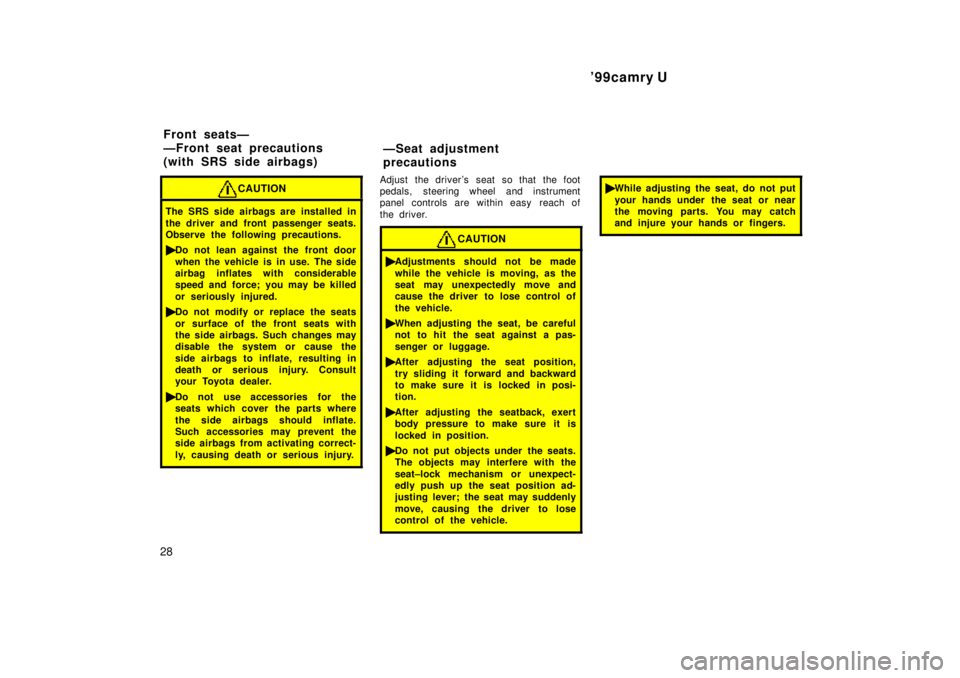
CAUTION
The SRS side airbags are installed in
the driver and front passenger seats.
Observe the following precautions.
�Do not lean against the front door
when the vehicle is in use. The side
airbag inflates with considerable
speed and force; you may be killed
or seriously injured.
�Do not modify or replace the seats
or surface of the front seats with
the side airbags. Such changes may
disable the system or cause the
side airbags to inflate, resulting in
death or serious injury. Consult
your Toyota dealer.
�Do not use accessories for the
seats which cover the parts where
the side airbags should inflate.
Such accessories may prevent the
side airbags from activating correct-
ly, causing death or serious injury.
Adjust the driver's seat so that the foot
pedals, steering wheel and instrument
panel controls are within easy reach of
the driver.
CAUTION
�Adjustments should not be made
while the vehicle is moving, as the
seat may unexpectedly move and
cause the driver to lose control of
the vehicle.
�When adjusting the seat, be careful
not to hit the seat against a pas-
senger or luggage.
�After adjusting the seat position,
try sliding it forward and backward
to make sure it is locked in posi-
tion.
�After adjusting the seatback, exert
body pressure to make sure it is
locked in position.
�Do not put objects under the seats.
The objects may interfere with the
seat±lock mechanism or unexpect-
edly push up the seat position ad-
justing lever; the seat may suddenly
move, causing the driver to lose
control of the vehicle.
�While adjusting the seat, do not put
your hands under the seat or near
the moving parts. You may catch
and injure your hands or fingers.
Front seatsÐ
ÐFront seat precautions
(with SRS side airbags)ÐSeat adjustment
precautions
Page 1008 of 4770
'99camry U
242
5S±FE engine
Automatic transmission
Fluid capacity (drain and refill),
L (qt., Imp. qt.):
Up to 2.5 (2.6, 2.2)
Fluid type:
Automatic transmission fluid D±ll or
DEXRON�IIl (DEXRON�II)
Differential
Fluid capacity L (qt., Imp. qt.):
1.6 (1.7, 1.4)
Fluid type:
Automatic transmission fluid D±II or
DEXRON�III (DEXRON�II)
BRAKES
Minimum pedal clearance when depressed
with the pressure of 490 N (50 kgf, 110 lbf)
with the engine running, mm (in.):
70 (2.8)
Pedal freeplay, mm (in.):
1Ð6 (0.04Ð0.24)
Pad wear limit, mm (in.):
1.0 (0.04)
Lining wear limit, mm (in.):
1.0 (0.04)
Parking brake adjustment when pulled with
the force of 196 N (20 kgf, 44 lbf):
5Ð8 clicksFluid type:
SAE J1703 or FMVSS No.116 DOT 3
STEERING
Wheel freeplay:
Less than 30 mm (1.2 in.)
Power steering fluid type:
Automatic transmission fluid DEXRON�II
or III
Page 4341 of 4770
SA077±01
± SUSPENSION AND AXLETROUBLESHOOTING
SA±1
1952 Author�: Date�:
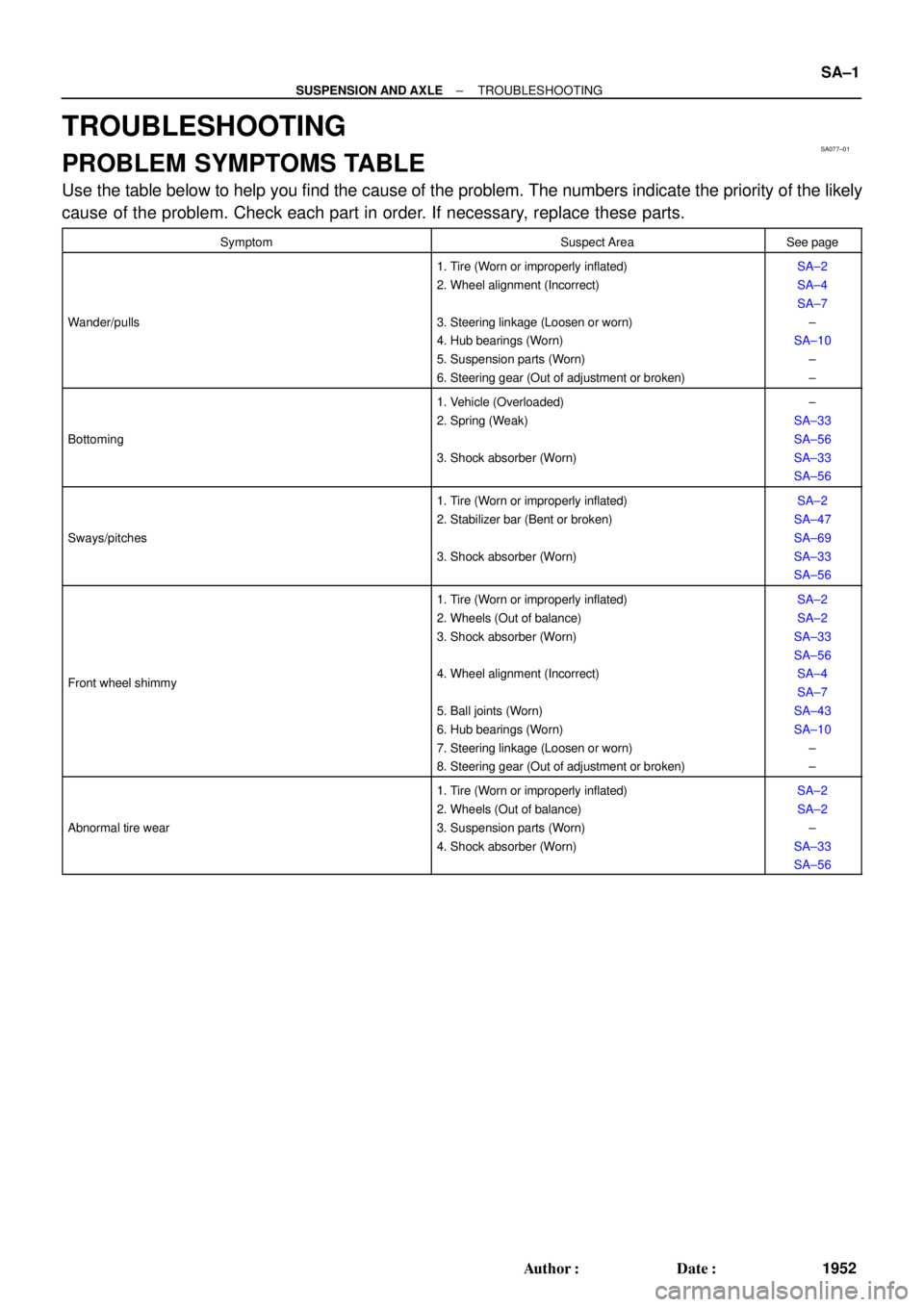
TROUBLESHOOTING
PROBLEM SYMPTOMS TABLE
Use the table below to help you find the cause of the problem. The numbers indicate the priority of the likely
cause of the problem. Check each part in order. If necessary, replace these parts.
SymptomSuspect AreaSee page
Wander/pulls
1. Tire (Worn or improperly inflated)
2. Wheel alignment (Incorrect)
3. Steering linkage (Loosen or worn)
4. Hub bearings (Worn)
5. Suspension parts (Worn)
6. Steering gear (Out of adjustment or broken)SA±2
SA±4
SA±7
±
SA±10
±
±
Bottoming
1. Vehicle (Overloaded)
2. Spring (Weak)
3. Shock absorber (Worn)±
SA±33
SA±56
SA±33
SA±56
Sways/pitches
1. Tire (Worn or improperly inflated)
2. Stabilizer bar (Bent or broken)
3. Shock absorber (Worn)SA±2
SA±47
SA±69
SA±33
SA±56
Front wheel shimmy
1. Tire (Worn or improperly inflated)
2. Wheels (Out of balance)
3. Shock absorber (Worn)
4. Wheel alignment (Incorrect)
5. Ball joints (Worn)
6. Hub bearings (Worn)
7. Steering linkage (Loosen or worn)
8. Steering gear (Out of adjustment or broken)SA±2
SA±2
SA±33
SA±56
SA±4
SA±7
SA±43
SA±10
±
±
Abnormal tire wear
1. Tire (Worn or improperly inflated)
2. Wheels (Out of balance)
3. Suspension parts (Worn)
4. Shock absorber (Worn)SA±2
SA±2
±
SA±33
SA±56