Page 225 of 4770
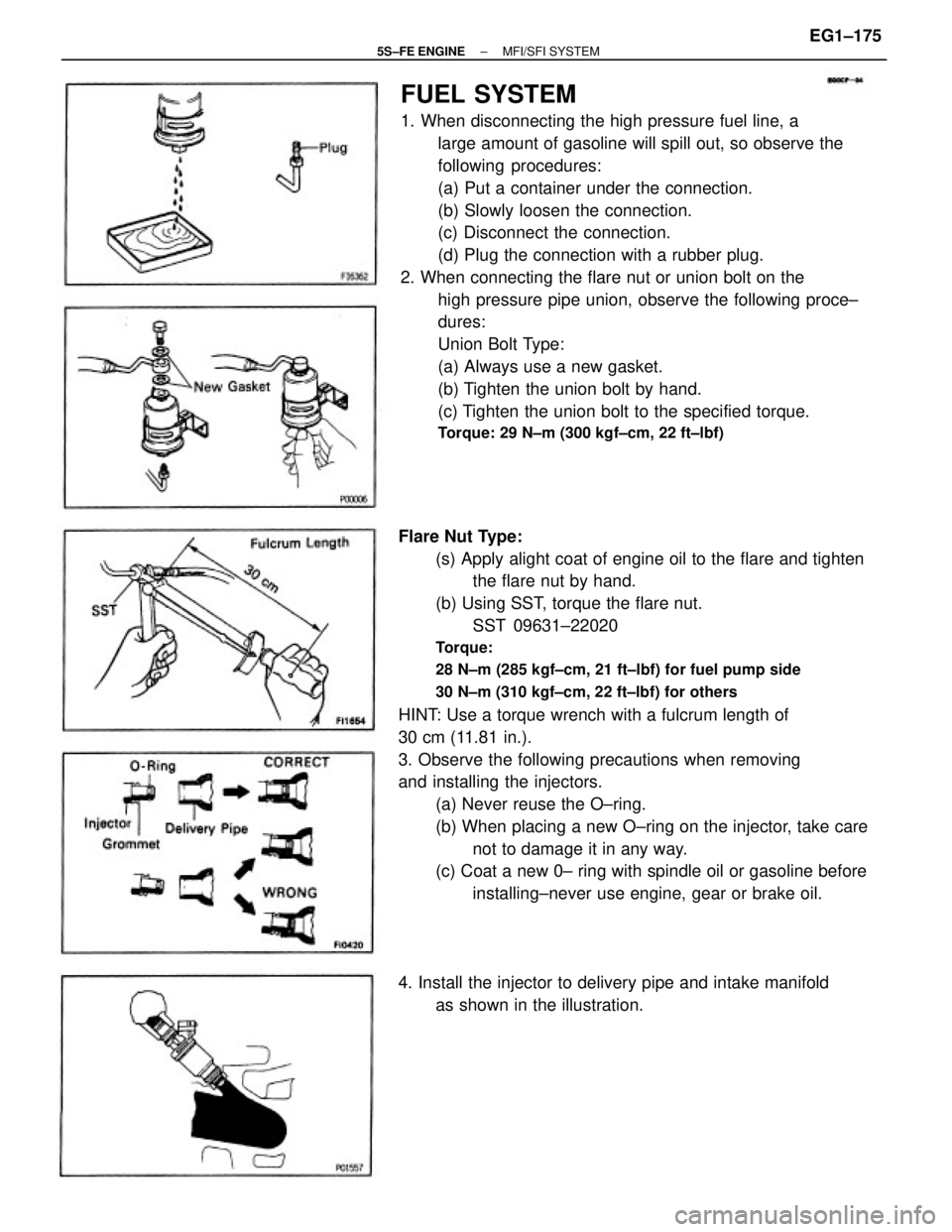
FUEL SYSTEM
1. When disconnecting the high pressure fuel line, a
large amount of gasoline will spill out, so observe the
following procedures:
(a) Put a container under the connection.
(b) Slowly loosen the connection.
(c) Disconnect the connection.
(d) Plug the connection with a rubber plug.
2. When connecting the flare nut or union bolt on the
high pressure pipe union, observe the following proce±
dures:
Union Bolt Type:
(a) Always use a new gasket.
(b) Tighten the union bolt by hand.
(c) Tighten the union bolt to the specified torque.
Torque: 29 N±m (300 kgf±cm, 22 ft±lbf)
Flare Nut Type:
(s) Apply alight coat of engine oil to the flare and tighten
the flare nut by hand.
(b) Using SST, torque the flare nut.
SST 09631±22020
Torque:
28 N±m (285 kgf±cm, 21 ft±lbf) for fuel pump side
30 N±m (310 kgf±cm, 22 ft±lbf) for others
HINT: Use a torque wrench with a fulcrum length of
30 cm (11.81 in.).
3. Observe the following precautions when removing
and installing the injectors.
(a) Never reuse the O±ring.
(b) When placing a new O±ring on the injector, take care
not to damage it in any way.
(c) Coat a new 0± ring with spindle oil or gasoline before
installing±never use engine, gear or brake oil.
4. Install the injector to delivery pipe and intake manifold
as shown in the illustration.
± 5S±FE ENGINEMFI/SFI SYSTEMEG1±175
Page 600 of 4770
mm in.
5
0.20
1. Before temporarily installing the new parts, apply
body sealer to the wheel arch.
HINT:
1) Apply body sealer about 5 mm (0.20 in.) from the
flange, avoiding any oozing.
2) Apply sealer evenly, about 3 ± 4 mm (0.12 ± 0.16
in.) in diameter.
3) For other sealing points, refer to section AR.
BODY PANEL REPLACEMENT RE±40
INSTALLATION
[Foamed Material
Application Areas]
Body Sealer
Butt Weld
[Foamed Material
Application Areas]about 5 mm
Body Sealer
Braze
2. Temporarily install the new parts and check the fit
of the rear door, luggage compartment door and
rear combination light.
INSTALLATION DIAGRAM
Describes in detail installation of the new parts involving repair by welding and/or cutting, but
excluding painting.
INSTALLATION GUIDE
Provides additional information to more efficiently help you perform the installation.
SYMBOLS
See page IN±4.
ILLUSTRATION OF WELD POINTS
Weld method and panel position symbols.
See page IN±5.
INTRODUCTIONIN-3
Page 604 of 4770

Component to be alignedSection of repair manual
for relevant model year
Front Wheels
Suspension and Axle (SA) section
Rear Wheels
Suspension and Axle (SA) section
�Before repairing the body, remove the SRS parts if, during repair, shocks are likely to be applied to
the sensors due to vibrations of the body or direct tapping with tools or other parts.
�Do not expose the SRS parts directly to hot air or flames
NOTICE:
1) The maximum ambient temperature tolerance is 120
°C (248°F) for the front airbag sensor,
105
°C (221°F) for the center airbag sensor assembly and 93°C (200°F) for the steering wheel
pad, and front passenger airbag assembly. If it is possible that the ambient temperature may
reach or exceed the temperature limit, remove the sensors and the steering wheel pad from the
vehicle or protect them with a hot insulation material before staring work.
2) Prior to welding, remove adjacent, SRS parts form tire vehicle or protect them with fire±proof
covers.
�If the vehicle is damaged, visually inspect for damage to the steering wheel pad using the inspection
procedures described in section RS of the repair manual for the relevant model year.
�When removing or handling the steering wheel pad, and front passenger airbag assembly keep the
pad upper surface facing upward. Also, lock the lock lever of the twin lock type connector at the rear
of the pad and take care not to damage the connector.
(Storing the pad or front passenger airbag assembly with its metallic surface up may lead to a seri-
ous accident if the airbag inflates for some reason.)
�Store the steering wheel pad and the front passenger airbag assembly where the ambient tempera-
ture remains below 93°C (200°F), without high humidity and away from electrical noise.
�Be careful not to let painting materials contact the SRS parts.
�Information labels are attached to the periphery of the SRS components. Follow the NOTICES.
�Store the airbag assembly where the ambient temperature remains below 93°C (200°F), without
high humidity and away from electrical noise.
2. BRAKE SYSTEM
The brake system is one of the most important safety components. Always follow the directions and
notes given in section BR of the repair manual for the relevant model year when handling brake sys-
tem parts.
NOTICE: When repairing the brake master cylinder or TRAC system, bleed the air out of the TRAC
system.
3. DRIVE TRAIN AND CHASSIS
The drive train and chassis are components that can have great effects on the running performance
and vibration resistance of the vehicle. After installing components in the sections listed in the table
below, perform alignments to ensure correct mounting angles and dimensions. Particularly accurate
repair of the body must also be done to ensure correct alignment.
HINT: Correct procedures and special tools are required for alignment. Always follow the directions
given in the repair manual for the relevant model year during alignment and section DI of this manual.
INTRODUCTIONIN-7
Page 609 of 4770
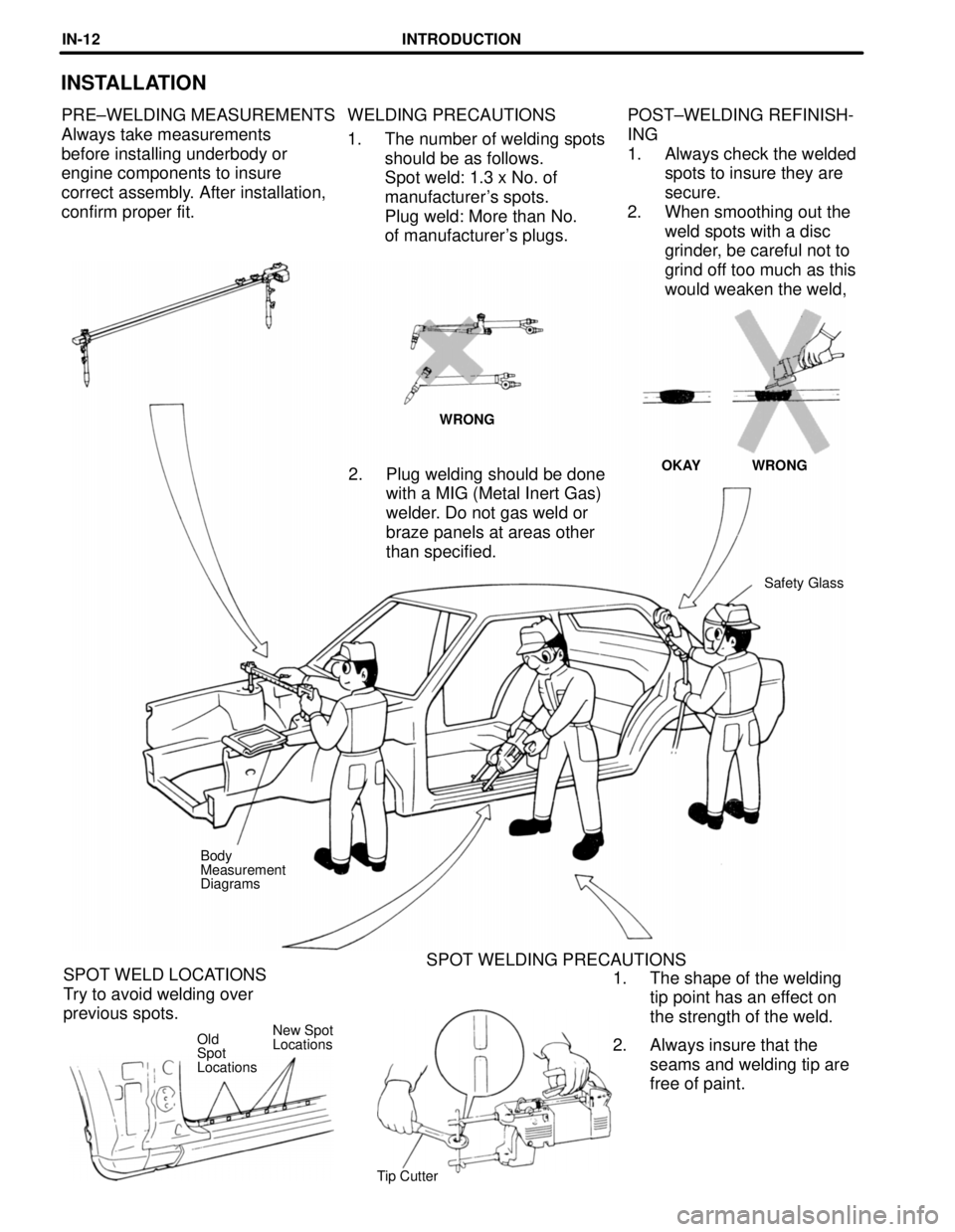
POST±WELDING REFINISH-
ING
1. Always check the welded
spots to insure they are
secure.
2. When smoothing out the
weld spots with a disc
grinder, be careful not to
grind off too much as this
would weaken the weld,
INSTALLATION
WELDING PRECAUTIONS
1. The number of welding spots
should be as follows.
Spot weld: 1.3 x No. of
manufacturer's spots.
Plug weld: More than No.
of manufacturer's plugs. PRE±WELDING MEASUREMENTS
Always take measurements
before installing underbody or
engine components to insure
correct assembly. After installation,
confirm proper fit.
WRONG
OKAYWRONG
2. Plug welding should be done
with a MIG (Metal Inert Gas)
welder. Do not gas weld or
braze panels at areas other
than specified.
Safety Glass
Body
Measurement
Diagrams
SPOT WELDING PRECAUTIONS
SPOT WELD LOCATIONS
Try to avoid welding over
previous spots.
Old
Spot
LocationsNew Spot
Locations
1. The shape of the welding
tip point has an effect on
the strength of the weld.
2. Always insure that the
seams and welding tip are
free of paint.
Tip Cutter
INTRODUCTIONIN-12
Page 637 of 4770
INSTALLATION
Assembly Mark
1. When temporarily installing the new parts,
determine the installation position by the as-
sembly mark. Then measure each part in ac-
cordance with the body dimension diagram.2. Temporarily install the front fender and hood,
and check the fit.
BODY PANEL REPLACEMENTRE-15
Page 639 of 4770
INSTALLATION
Assembly Mark
1. When temporarily installing the new parts,
determine the installation position by the as-
sembly mark.
2. Measurements must be accurate with the
body dimension diagram, as this affects the
front wheel alignment.3. Temporarily install the front fender and hood,
and check the fit.
BODY PANEL REPLACEMENTRE-17
Page 648 of 4770
mm in.
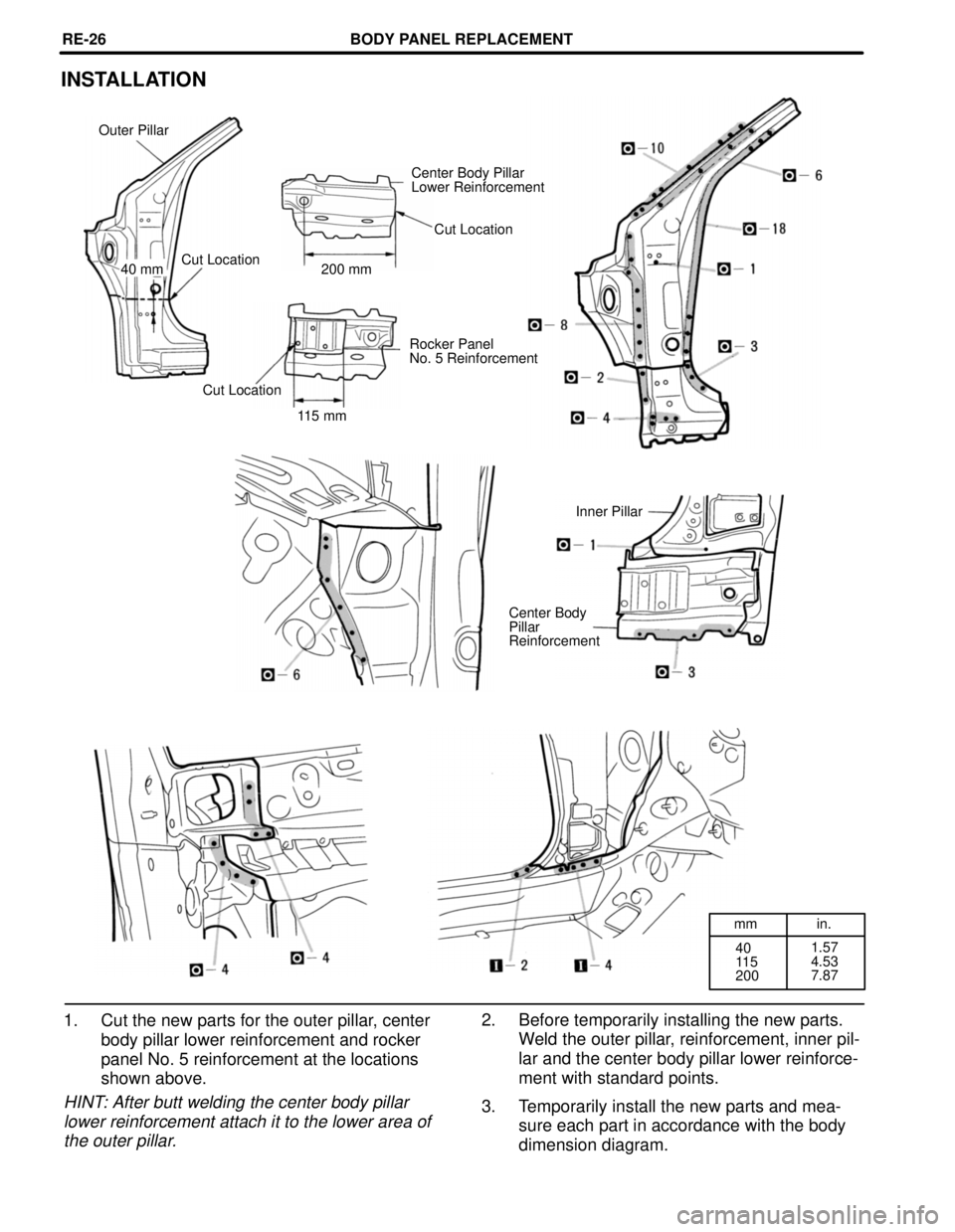
40
11 5
2001.57
4.53
7.87
INSTALLATION
Outer Pillar
Center Body Pillar
Lower Reinforcement
Cut Location
Cut Location
40 mm 200 mm
Rocker Panel
No. 5 Reinforcement
Cut Location
115 mm
Inner Pillar
Center Body
Pillar
Reinforcement
2. Before temporarily installing the new parts.
Weld the outer pillar, reinforcement, inner pil-
lar and the center body pillar lower reinforce-
ment with standard points.
3. Temporarily install the new parts and mea-
sure each part in accordance with the body
dimension diagram. 1. Cut the new parts for the outer pillar, center
body pillar lower reinforcement and rocker
panel No. 5 reinforcement at the locations
shown above.
HINT: After butt welding the center body pillar
lower reinforcement attach it to the lower area of
the outer pillar.
BODY PANEL REPLACEMENTRE-26
Page 652 of 4770
mm in.
60
702.36
2.76
INSTALLATION
Center Body Pillar Reinforcement
Center Pillar
Reinforcement
60 mm
70 mm
Cut Location
Butt Weld
Center Body Pillar
Reinforcement
Butt Weld
Butt Weld
Inner Pillar
1. Cut the new parts for the center body pillar re-
inforcement at the locations shown above.
2. Before temporarily installing the new parts,
weld the inner pillar, center pillar reinforcement
and center body pillar reinforcement with stan-
dard points.3. Temporarily install the new parts and mea-
sure each part in accordance with the body
dimension diagram.
4. Before welding the new parts, check the fit of
the front door and rear door.
BODY PANEL REPLACEMENTRE-30