Page 1107 of 4770
If you’ ll be doing some of your own maintenance and repair work
on your vehicle, a Toyota service manual will be one of your most
valuable tools. Toyota offers three types of manuals to assist
do- it- yourselfers. To order any of the following manuals, call
Toyota’s service publications department at (800) 622- 2033.
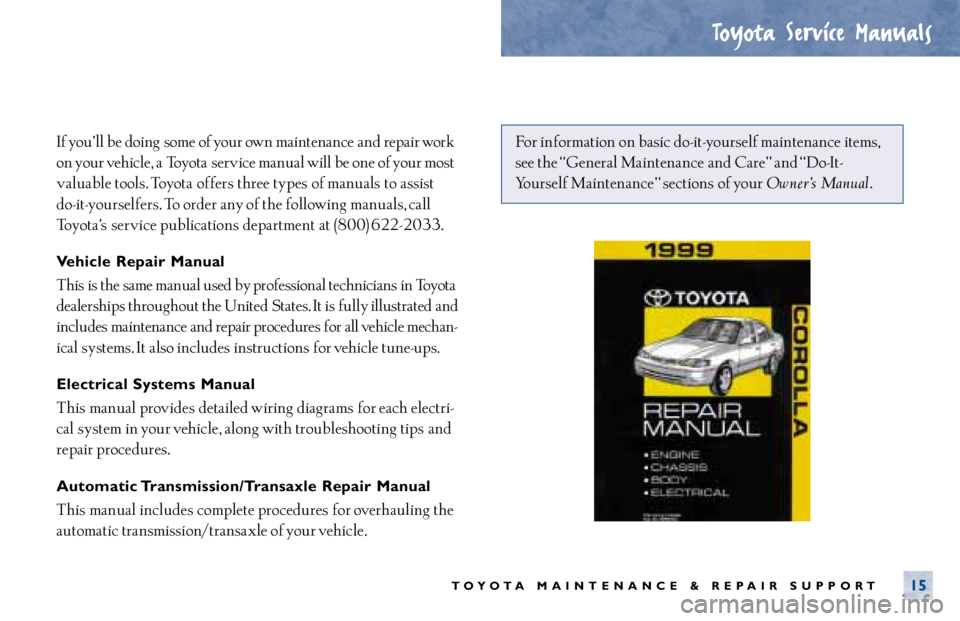
Vehicle Repair Manual
This is the same manual used by professional technicians in Toyota
dealerships throughout the United States. It is fully illustrated and
includes maintenance and repair procedures for all vehicle mechan-
ical systems. It also includes instructions for vehicle tune- ups.
Electrical Systems Manual
This manual provides detailed wiring diagrams for each electri-
cal system in your vehicle, along with troubleshooting tips and
repair procedures.
Automatic Transmission/Transaxle Repair Manual
This manual includes complete procedures for overhauling the
automatic transmission/transaxle of your vehicle.For information on basic do- it- yourself maintenance items,
see the “General Maintenance and Care” and “Do- It-
Yourself Maintenance” sections of your
Owner’s Manual.
Toyota Service Manuals
TOYOTA MAINTENANCE & REPAIR SUPPORT15
Page 1151 of 4770

A INTRODUCTION
This manual consists of the following 12 sections:
No.
SectionDescription
A
INDEXIndex of the contents of this manual.
A
INTRODUCTIONBrief explanation of each section.
BHOW TO USE THIS
MANUALInstructions on how to use this manual.
CTROUBLE±
SHOOTINGDescribes the basic inspection procedures for electrical circuits.
DABBREVIATIONSDefines the abbreviations used in this manual.
E
GLOSSARY OF
TERMS AND
SYMBOLS
Defines the symbols and functions of major parts.
FRELAY LOCATIONSShows position of the Electronic Control Unit, Relays, Relay Block, etc.
This section is closely related to the system circuit.
GELECTRICAL
WIRING ROUTINGDescribes position of Parts Connectors, Splice points, Ground points, etc.
This section is closely related to the system circuit.
INDEXIndex of the system circuits.
H
SYSTEM CIRCUITS
Electrical circuits of each system are shown from the power supply through ground
points. Wiring connections and their positions are shown and classified by code
according to the connection method. (Refer to the section, ºHow to use this manualº).
The ºSystem Outlineº and ºService Hintsº useful for troubleshooting are also contained
in this section.
IGROUND POINTSShows ground positions of all parts described in this manual.
J
OVERALL
ELECTRICAL
WIRING DIAGRAM
Provides circuit diagrams showing the circuit connections.
KPOWER SOURCE
(Current Flow Chart)Describes power distribution from the power supply to various electrical loads.
LPART NUMBER OF
CONNECTORSIndicates the part number of the connectors used in this manual.
Page 1152 of 4770

HOW TO USE THIS MANUAL B
This manual provides information on the electrical circuits installed on vehicles by
dividing them into a circuit for each system.
The actual wiring of each system circuit is shown from the point where the power
source is received from the battery as far as each ground point. (All circuit
diagrams are shown with the switches in the OFF position.)
When troubleshooting any problem, first understand the operation of the circuit
where the problem was detected (see System Circuit section), the power source
supplying power to that circuit (see Power Source section), and the ground points
(see Ground Points section). See the System Outline to understand the circuit
operation.
When the circuit operation is understood, begin troubleshooting of the problem
circuit to isolate the cause. Use Relay Location and Electrical Wiring Routing
sections to find each part, junction block and wiring harness connectors, wiring
harness and wiring harness connectors, splice points, and ground points of each
system circuit. Internal wiring for each junction block is also provided for better
understanding of connection within a junction block.
Wiring related to each system is indicated in each system circuit by arrows
(from__, to__). When overall connections are required, see the Overall Electrical
Wiring Diagram at the end of this manual.
Page 1166 of 4770
E
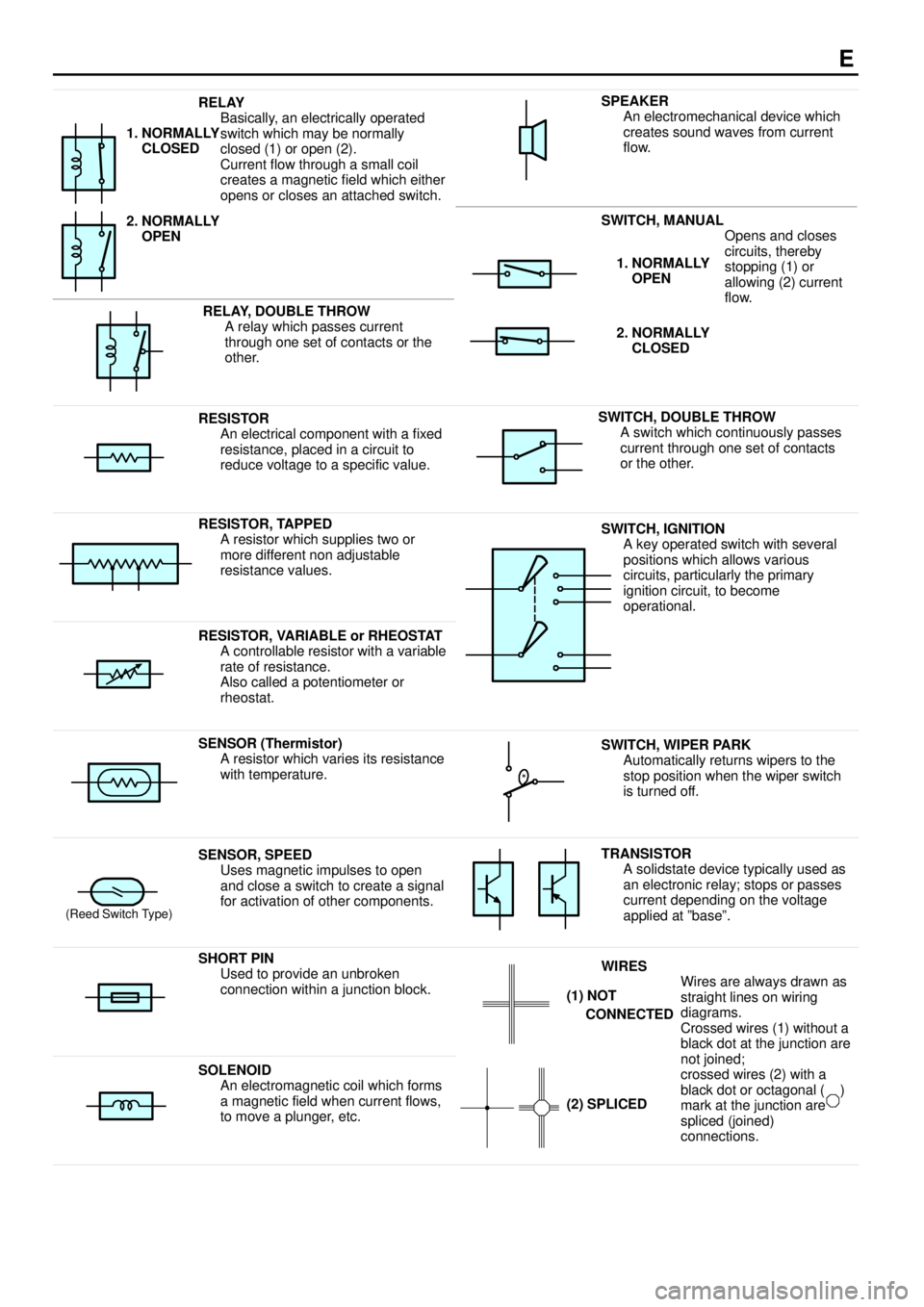
RELAY
Basically, an electrically operated
switch which may be normally
closed (1) or open (2).
Current flow through a small coil
creates a magnetic field which either
opens or closes an attached switch.
1. NORMALLY
CLOSED
2. NORMALLY
OPEN
SWITCH, MANUAL
Opens and closes
iitth b
SPEAKER
An electromechanical device which
creates sound waves from current
flow.
RELAY, DOUBLE THROW
A relay which passes current
through one set of contacts or the
other.
circuits, thereby
stopping (1) or
allowing (2) current
flow.1. NORMALLY
OPEN
2. NORMALLY
CLOSED
RESISTOR
An electrical component with a fixed
resistance, placed in a circuit to
reduce voltage to a specific value.SWITCH, DOUBLE THROW
A switch which continuously passes
current through one set of contacts
or the other.
RESISTOR, TAPPED
A resistor which supplies two or
more different non adjustable
resistance values.SWITCH, IGNITION
A key operated switch with several
positions which allows various
circuits, particularly the primary
ignition circuit, to become
operational.
RESISTOR, VARIABLE or RHEOSTAT
A controllable resistor with a variable
rate of resistance.
Also called a potentiometer or
rheostat.
SENSOR (Thermistor)
A resistor which varies its resistance
with temperature.SWITCH, WIPER PARK
Automatically returns wipers to the
stop position when the wiper switch
is turned off.
(Reed Switch Type)
SENSOR, SPEED
Uses magnetic impulses to open
and close a switch to create a signal
for activation of other components.TRANSISTOR
A solidstate device typically used as
an electronic relay; stops or passes
current depending on the voltage
applied at ºbaseº.
SHORT PIN
Used to provide an unbroken
connection within a junction block.WIRES
Wires are always drawn as
straight lines on wiring
diagrams.
Crossed wires (1) without a
black dot at the junction are
tj i d
(1) NOT
CONNECTED
SOLENOID
An electromagnetic coil which forms
a magnetic field when current flows,
to move a plunger, etc.
j
not joined;
crossed wires (2) with a
black dot or octagonal ( )
mark at the junction are
spliced (joined)
connections.
(2) SPLICED