2000 DODGE NEON torque
[x] Cancel search: torquePage 869 of 1285
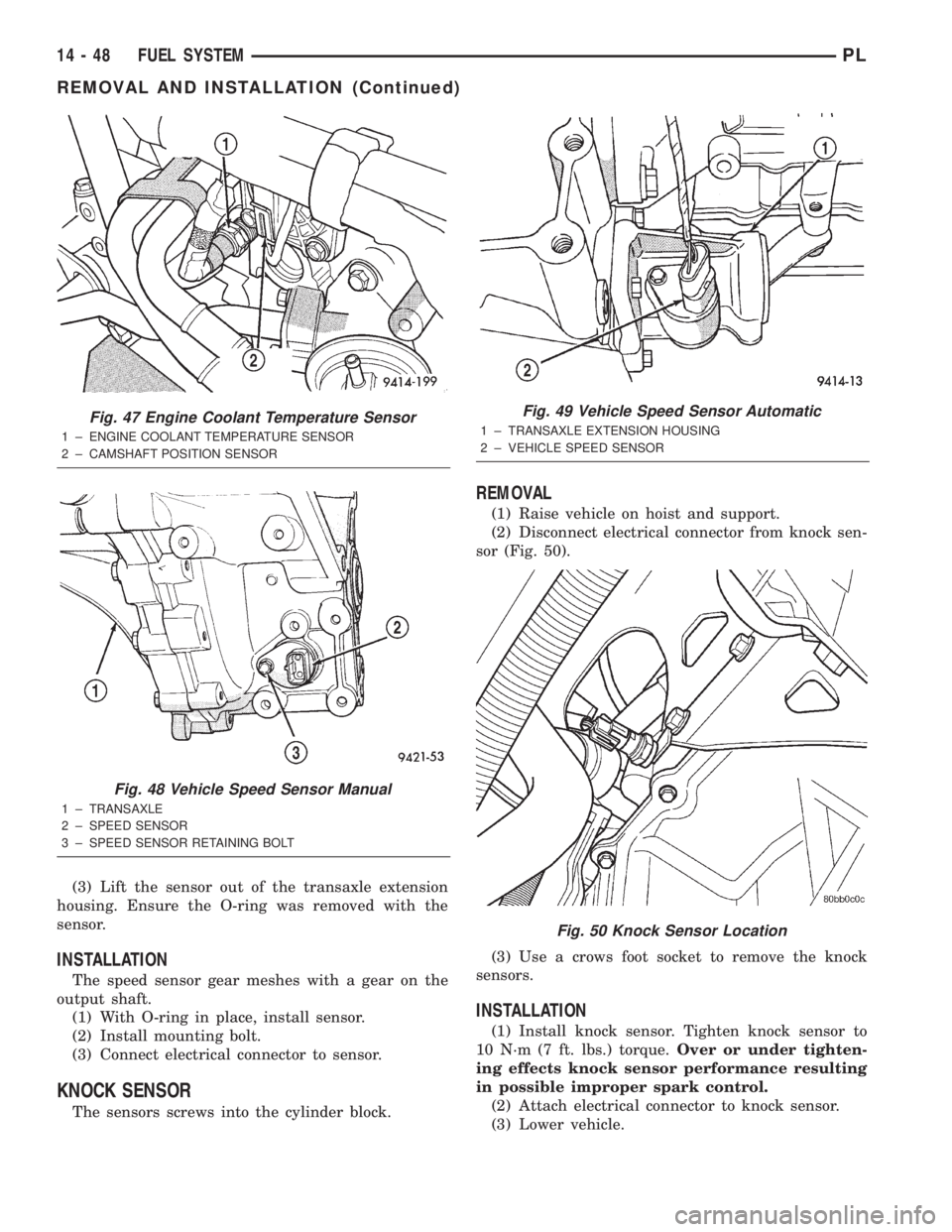
(3) Lift the sensor out of the transaxle extension
housing. Ensure the O-ring was removed with the
sensor.
INSTALLATION
The speed sensor gear meshes with a gear on the
output shaft.
(1) With O-ring in place, install sensor.
(2) Install mounting bolt.
(3) Connect electrical connector to sensor.
KNOCK SENSOR
The sensors screws into the cylinder block.
REMOVAL
(1) Raise vehicle on hoist and support.
(2) Disconnect electrical connector from knock sen-
sor (Fig. 50).
(3) Use a crows foot socket to remove the knock
sensors.
INSTALLATION
(1) Install knock sensor. Tighten knock sensor to
10 N´m (7 ft. lbs.) torque.Over or under tighten-
ing effects knock sensor performance resulting
in possible improper spark control.
(2) Attach electrical connector to knock sensor.
(3) Lower vehicle.
Fig. 47 Engine Coolant Temperature Sensor
1 ± ENGINE COOLANT TEMPERATURE SENSOR
2 ± CAMSHAFT POSITION SENSOR
Fig. 48 Vehicle Speed Sensor Manual
1 ± TRANSAXLE
2 ± SPEED SENSOR
3 ± SPEED SENSOR RETAINING BOLT
Fig. 49 Vehicle Speed Sensor Automatic
1 ± TRANSAXLE EXTENSION HOUSING
2 ± VEHICLE SPEED SENSOR
Fig. 50 Knock Sensor Location
14 - 48 FUEL SYSTEMPL
REMOVAL AND INSTALLATION (Continued)
Page 870 of 1285
SPECIFICATIONS
VECI LABEL
Always use the information found on the Vehicle
Emission Control Information (VECI) label. The
VECI label is located in the engine compartment.
TORQUE
DESCRIPTION TORQUE
Air Cleaner Lid Screws...... 3.9N´m(35in.lbs.)
Crankshaft Position Sensor Mounting Bolts . . 8 N´m
(70 in. lbs.)
Engine Coolant Temperature Sensor...... 18N´m
(165 in. lbs.)
IAC Motor-To-Throttle Body Bolts....... 4.5N´m
(40 in. lbs.)
MAP Sensor............... 4.5N´m(40in.lbs.)
Oxygen Sensor............. 28N´m(20ft.lbs.)
Powertrain Control Module (PCM) Mounting
Screws.................. 4N´m(35in.lbs.)
Throttle Body Mounting Bolts........... 23N´m
(200 in. lbs.)
Throttle Position Sensor Mounting Screws . . 2 N´m
(20 in. lbs.)
Vehicle Speed Sensor Mounting Bolt..... 2.2N´m
(20 in. lbs.)
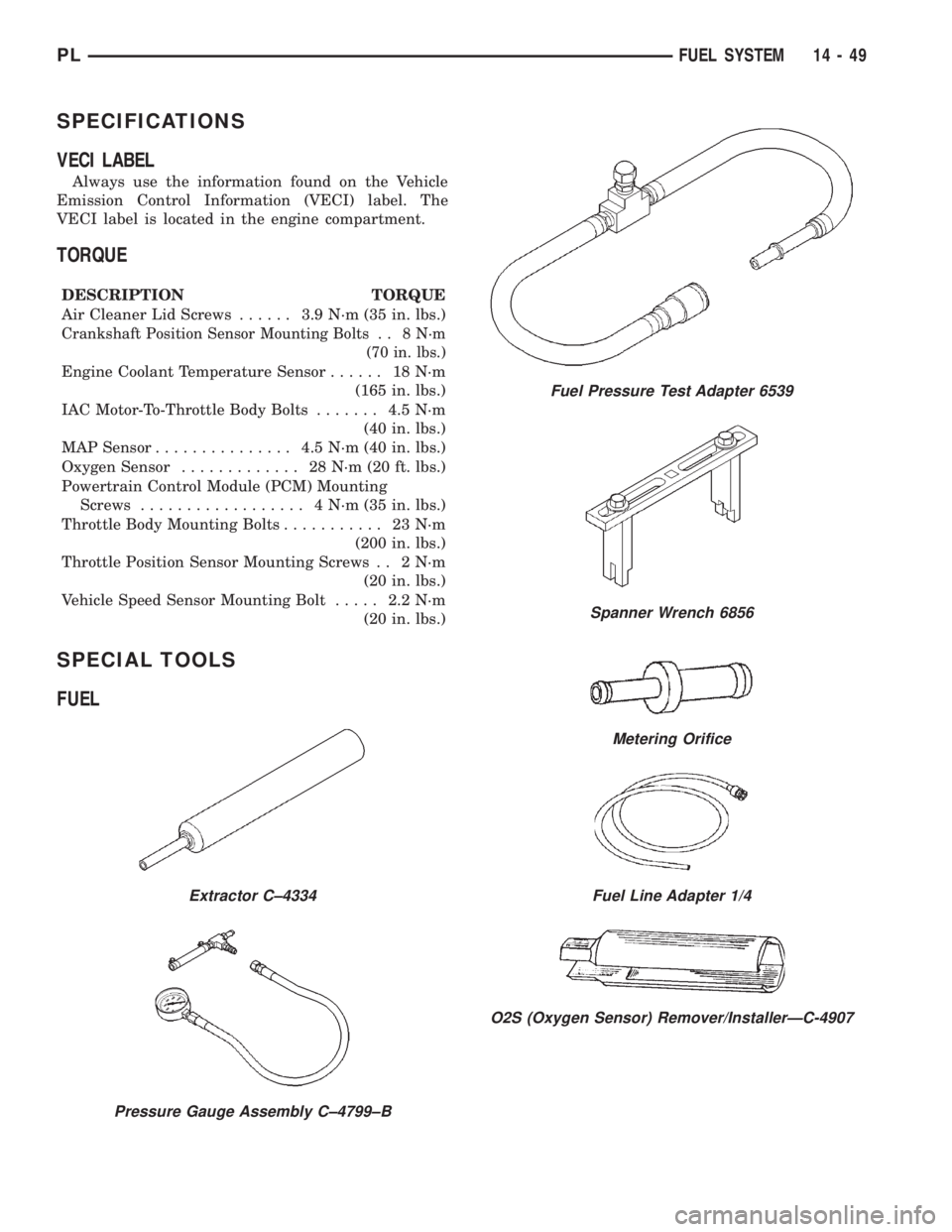
SPECIAL TOOLS
FUEL
Extractor C±4334
Pressure Gauge Assembly C±4799±B
Fuel Pressure Test Adapter 6539
Spanner Wrench 6856
Metering Orifice
Fuel Line Adapter 1/4
O2S (Oxygen Sensor) Remover/InstallerÐC-4907
PLFUEL SYSTEM 14 - 49
Page 872 of 1285
STEERING
TABLE OF CONTENTS
page page
POWER STEERING......................... 1
POWER STEERING PUMP.................. 16STEERING GEAR.......................... 21
STEERING COLUMN....................... 29
POWER STEERING
TABLE OF CONTENTS
page page
DESCRIPTION AND OPERATION
POWER STEERING SYSTEM................1
POWER STEERING FLUID HOSES............2
POWER STEERING FLUID COOLER...........2
POWER STEERING FLUID PRESSURE
SWITCH...............................3
DIAGNOSIS AND TESTING
STEERING SYSTEM DIAGNOSIS CHARTS......4
POWER STEERING SYSTEM FLOW AND
PRESSURE TEST........................9
SERVICE PROCEDURES
POWER STEERING SYSTEM FLUID LEVEL
CHECK...............................11REMOVAL AND INSTALLATION
SERVICE WARNINGS AND CAUTIONS........11
POWER STEERING FLUID PRESSURE HOSE . . . 11
POWER STEERING FLUID RETURN HOSE.....12
POWER STEERING FLUID COOLER..........13
POWER STEERING FLUID PRESSURE
SWITCH..............................14
SPECIFICATIONS
POWER STEERING FASTENER TORQUE
SPECIFICATIONS.......................15
SPECIAL TOOLS
POWER STEERING.......................15
DESCRIPTION AND OPERATION
POWER STEERING SYSTEM
Turning of the steering wheel is converted into lin-
ear travel through the meshing of the helical pinion
teeth with the rack teeth within the steering gear.
Power assist steering is provided by an open-cen-
ter, rotary-type control valve. It is used to direct
power steering fluid from the power steering pump to
either side of the integral steering rack piston. Road
feel is controlled by the diameter of a torsion bar
which initially steers the vehicle. As steering effort
increases as in a turn, the torsion bar twists, causing
relative rotary motion between the rotary valve body
and valve spool. This movement directs fluid behind
the integral rack piston, which in turn builds up
hydraulic pressure and assists in the turning effort.
This vehicle comes with power steering as stan-
dard equipment and it is the only steering systemavailable. The power steering system consists of
these major components:
²POWER STEERING PUMP
²POWER STEERING GEAR
²POWER STEERING FLUID RESERVOIR
(mounted on the pump)
²POWER STEERING FLUID PRESSURE HOSE
²POWER STEERING FLUID RETURN HOSE
²POWER STEERING FLUID COOLER (on some
models)
For information on the first two components, refer
to their respective sections within this service man-
ual group. Information on the third component can
be found in POWER STEERING PUMP. Information
on all other components can be found in this section
of this service manual group.
PLSTEERING 19 - 1
Page 875 of 1285
DIAGNOSIS AND TESTING
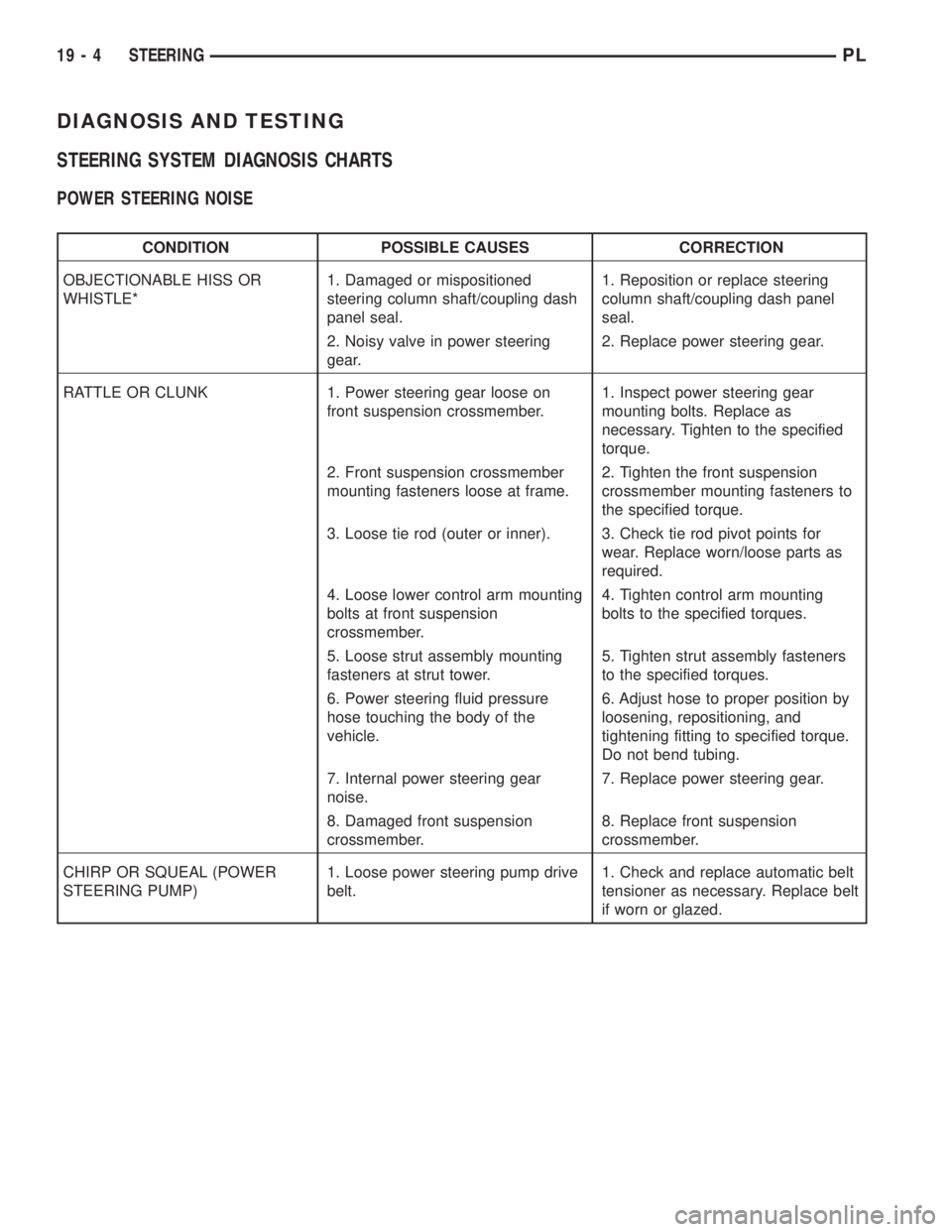
STEERING SYSTEM DIAGNOSIS CHARTS
POWER STEERING NOISE
CONDITION POSSIBLE CAUSES CORRECTION
OBJECTIONABLE HISS OR
WHISTLE*1. Damaged or mispositioned
steering column shaft/coupling dash
panel seal.1. Reposition or replace steering
column shaft/coupling dash panel
seal.
2. Noisy valve in power steering
gear.2. Replace power steering gear.
RATTLE OR CLUNK 1. Power steering gear loose on
front suspension crossmember.1. Inspect power steering gear
mounting bolts. Replace as
necessary. Tighten to the specified
torque.
2. Front suspension crossmember
mounting fasteners loose at frame.2. Tighten the front suspension
crossmember mounting fasteners to
the specified torque.
3. Loose tie rod (outer or inner). 3. Check tie rod pivot points for
wear. Replace worn/loose parts as
required.
4. Loose lower control arm mounting
bolts at front suspension
crossmember.4. Tighten control arm mounting
bolts to the specified torques.
5. Loose strut assembly mounting
fasteners at strut tower.5. Tighten strut assembly fasteners
to the specified torques.
6. Power steering fluid pressure
hose touching the body of the
vehicle.6. Adjust hose to proper position by
loosening, repositioning, and
tightening fitting to specified torque.
Do not bend tubing.
7. Internal power steering gear
noise.7. Replace power steering gear.
8. Damaged front suspension
crossmember.8. Replace front suspension
crossmember.
CHIRP OR SQUEAL (POWER
STEERING PUMP)1. Loose power steering pump drive
belt.1. Check and replace automatic belt
tensioner as necessary. Replace belt
if worn or glazed.
19 - 4 STEERINGPL
Page 876 of 1285
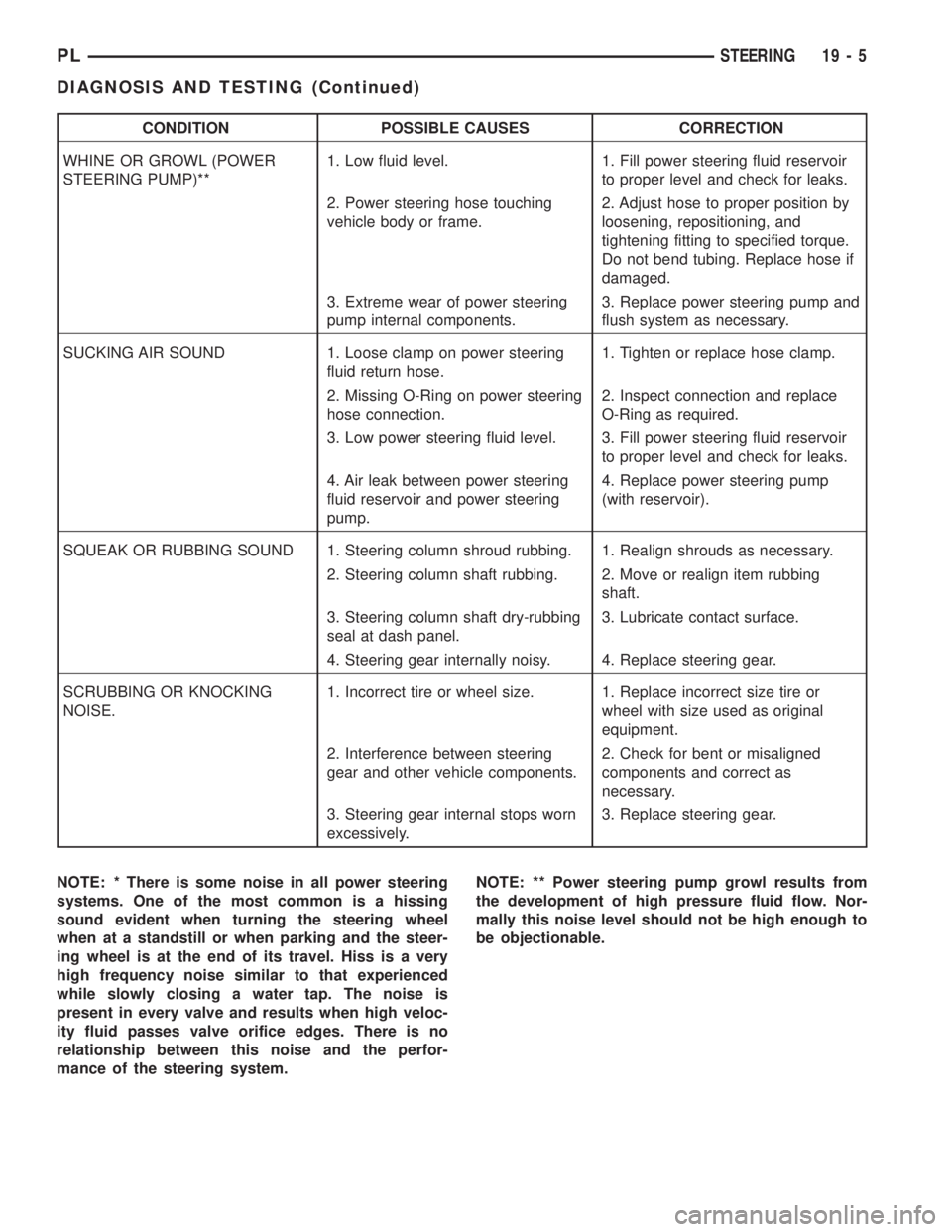
CONDITION POSSIBLE CAUSES CORRECTION
WHINE OR GROWL (POWER
STEERING PUMP)**1. Low fluid level. 1. Fill power steering fluid reservoir
to proper level and check for leaks.
2. Power steering hose touching
vehicle body or frame.2. Adjust hose to proper position by
loosening, repositioning, and
tightening fitting to specified torque.
Do not bend tubing. Replace hose if
damaged.
3. Extreme wear of power steering
pump internal components.3. Replace power steering pump and
flush system as necessary.
SUCKING AIR SOUND 1. Loose clamp on power steering
fluid return hose.1. Tighten or replace hose clamp.
2. Missing O-Ring on power steering
hose connection.2. Inspect connection and replace
O-Ring as required.
3. Low power steering fluid level. 3. Fill power steering fluid reservoir
to proper level and check for leaks.
4. Air leak between power steering
fluid reservoir and power steering
pump.4. Replace power steering pump
(with reservoir).
SQUEAK OR RUBBING SOUND 1. Steering column shroud rubbing. 1. Realign shrouds as necessary.
2. Steering column shaft rubbing. 2. Move or realign item rubbing
shaft.
3. Steering column shaft dry-rubbing
seal at dash panel.3. Lubricate contact surface.
4. Steering gear internally noisy. 4. Replace steering gear.
SCRUBBING OR KNOCKING
NOISE.1. Incorrect tire or wheel size. 1. Replace incorrect size tire or
wheel with size used as original
equipment.
2. Interference between steering
gear and other vehicle components.2. Check for bent or misaligned
components and correct as
necessary.
3. Steering gear internal stops worn
excessively.3. Replace steering gear.
NOTE: * There is some noise in all power steering
systems. One of the most common is a hissing
sound evident when turning the steering wheel
when at a standstill or when parking and the steer-
ing wheel is at the end of its travel. Hiss is a very
high frequency noise similar to that experienced
while slowly closing a water tap. The noise is
present in every valve and results when high veloc-
ity fluid passes valve orifice edges. There is no
relationship between this noise and the perfor-
mance of the steering system.NOTE: ** Power steering pump growl results from
the development of high pressure fluid flow. Nor-
mally this noise level should not be high enough to
be objectionable.
PLSTEERING 19 - 5
DIAGNOSIS AND TESTING (Continued)
Page 877 of 1285
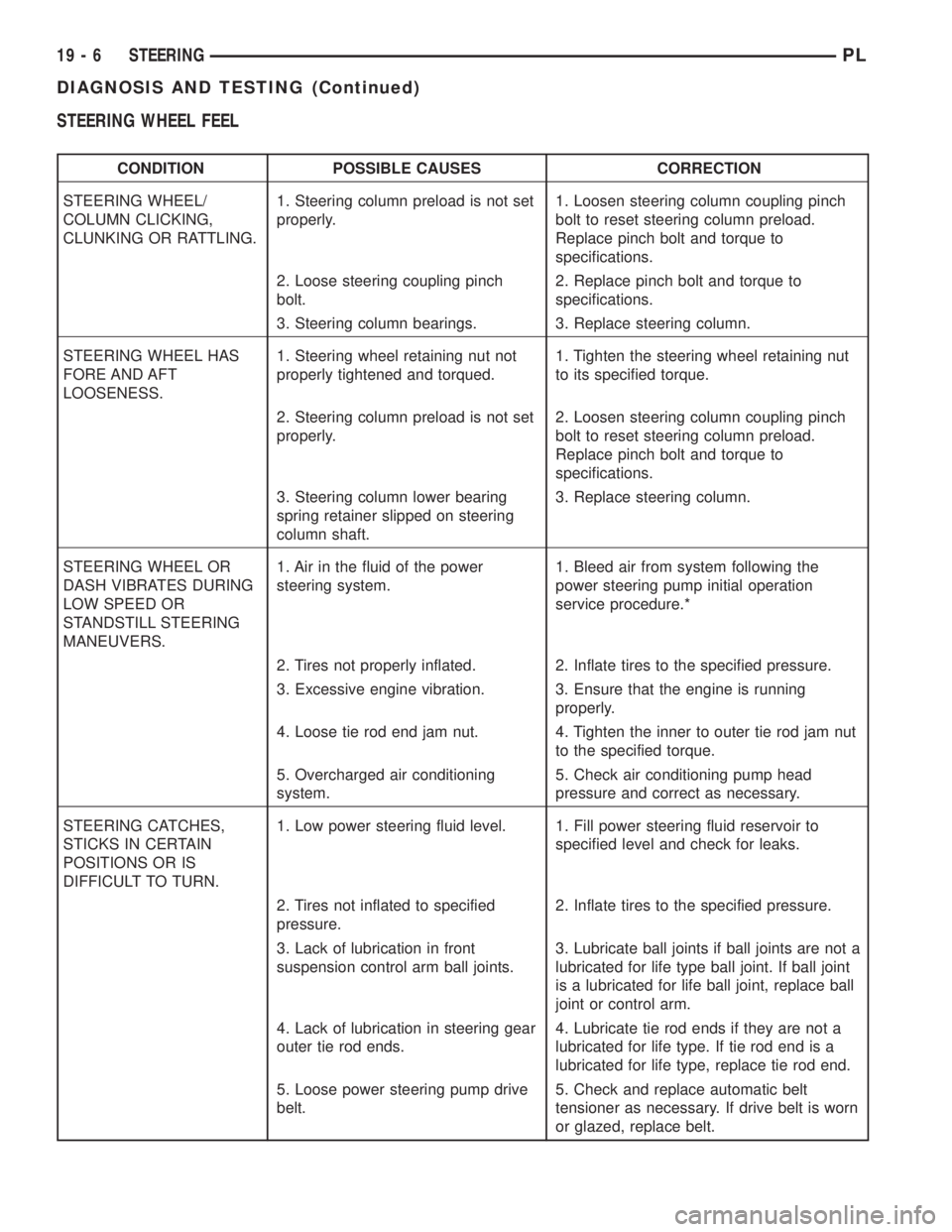
STEERING WHEEL FEEL
CONDITION POSSIBLE CAUSES CORRECTION
STEERING WHEEL/
COLUMN CLICKING,
CLUNKING OR RATTLING.1. Steering column preload is not set
properly.1. Loosen steering column coupling pinch
bolt to reset steering column preload.
Replace pinch bolt and torque to
specifications.
2. Loose steering coupling pinch
bolt.2. Replace pinch bolt and torque to
specifications.
3. Steering column bearings. 3. Replace steering column.
STEERING WHEEL HAS
FORE AND AFT
LOOSENESS.1. Steering wheel retaining nut not
properly tightened and torqued.1. Tighten the steering wheel retaining nut
to its specified torque.
2. Steering column preload is not set
properly.2. Loosen steering column coupling pinch
bolt to reset steering column preload.
Replace pinch bolt and torque to
specifications.
3. Steering column lower bearing
spring retainer slipped on steering
column shaft.3. Replace steering column.
STEERING WHEEL OR
DASH VIBRATES DURING
LOW SPEED OR
STANDSTILL STEERING
MANEUVERS.1. Air in the fluid of the power
steering system.1. Bleed air from system following the
power steering pump initial operation
service procedure.*
2. Tires not properly inflated. 2. Inflate tires to the specified pressure.
3. Excessive engine vibration. 3. Ensure that the engine is running
properly.
4. Loose tie rod end jam nut. 4. Tighten the inner to outer tie rod jam nut
to the specified torque.
5. Overcharged air conditioning
system.5. Check air conditioning pump head
pressure and correct as necessary.
STEERING CATCHES,
STICKS IN CERTAIN
POSITIONS OR IS
DIFFICULT TO TURN.1. Low power steering fluid level. 1. Fill power steering fluid reservoir to
specified level and check for leaks.
2. Tires not inflated to specified
pressure.2. Inflate tires to the specified pressure.
3. Lack of lubrication in front
suspension control arm ball joints.3. Lubricate ball joints if ball joints are not a
lubricated for life type ball joint. If ball joint
is a lubricated for life ball joint, replace ball
joint or control arm.
4. Lack of lubrication in steering gear
outer tie rod ends.4. Lubricate tie rod ends if they are not a
lubricated for life type. If tie rod end is a
lubricated for life type, replace tie rod end.
5. Loose power steering pump drive
belt.5. Check and replace automatic belt
tensioner as necessary. If drive belt is worn
or glazed, replace belt.
19 - 6 STEERINGPL
DIAGNOSIS AND TESTING (Continued)
Page 879 of 1285
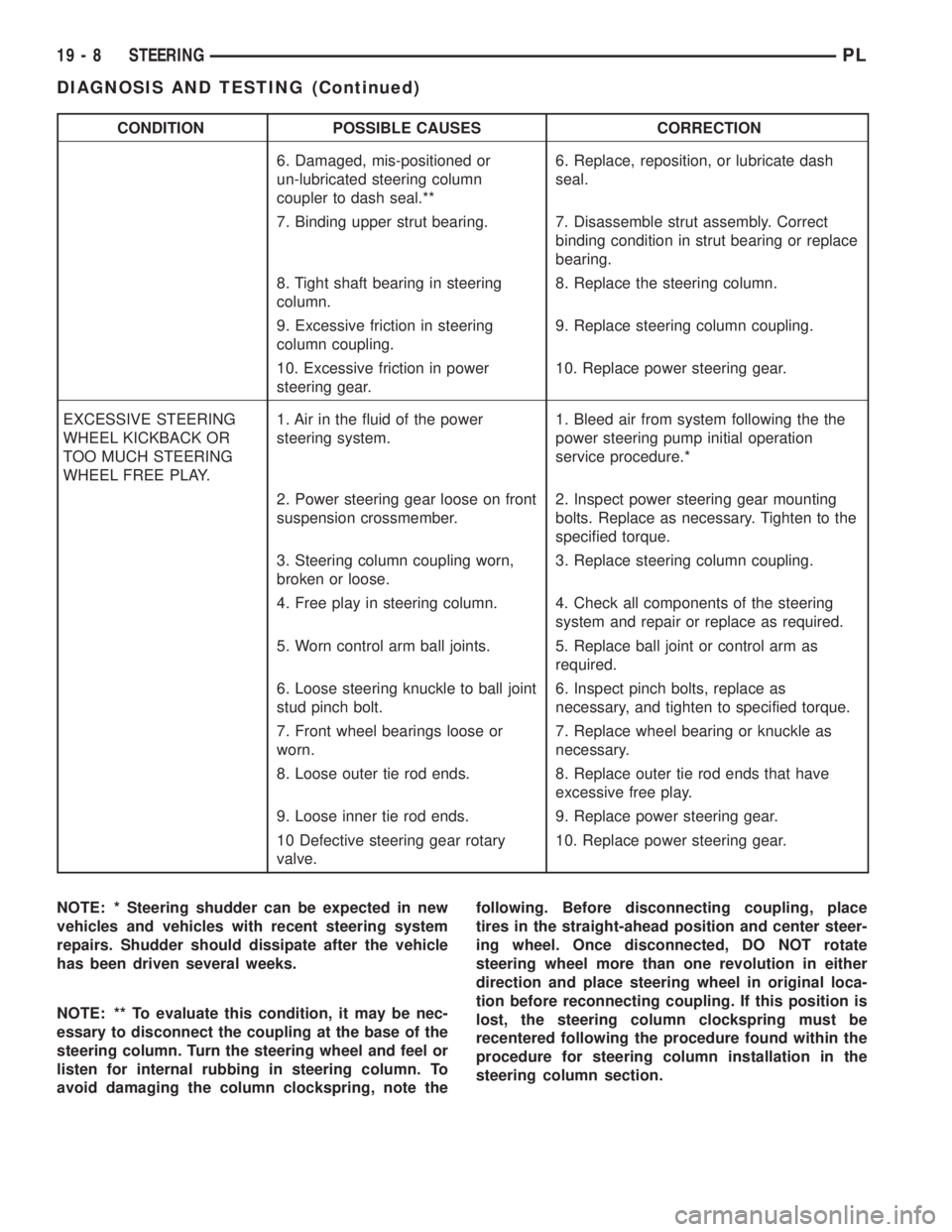
CONDITION POSSIBLE CAUSES CORRECTION
6. Damaged, mis-positioned or
un-lubricated steering column
coupler to dash seal.**6. Replace, reposition, or lubricate dash
seal.
7. Binding upper strut bearing. 7. Disassemble strut assembly. Correct
binding condition in strut bearing or replace
bearing.
8. Tight shaft bearing in steering
column.8. Replace the steering column.
9. Excessive friction in steering
column coupling.9. Replace steering column coupling.
10. Excessive friction in power
steering gear.10. Replace power steering gear.
EXCESSIVE STEERING
WHEEL KICKBACK OR
TOO MUCH STEERING
WHEEL FREE PLAY.1. Air in the fluid of the power
steering system.1. Bleed air from system following the the
power steering pump initial operation
service procedure.*
2. Power steering gear loose on front
suspension crossmember.2. Inspect power steering gear mounting
bolts. Replace as necessary. Tighten to the
specified torque.
3. Steering column coupling worn,
broken or loose.3. Replace steering column coupling.
4. Free play in steering column. 4. Check all components of the steering
system and repair or replace as required.
5. Worn control arm ball joints. 5. Replace ball joint or control arm as
required.
6. Loose steering knuckle to ball joint
stud pinch bolt.6. Inspect pinch bolts, replace as
necessary, and tighten to specified torque.
7. Front wheel bearings loose or
worn.7. Replace wheel bearing or knuckle as
necessary.
8. Loose outer tie rod ends. 8. Replace outer tie rod ends that have
excessive free play.
9. Loose inner tie rod ends. 9. Replace power steering gear.
10 Defective steering gear rotary
valve.10. Replace power steering gear.
NOTE: * Steering shudder can be expected in new
vehicles and vehicles with recent steering system
repairs. Shudder should dissipate after the vehicle
has been driven several weeks.
NOTE: ** To evaluate this condition, it may be nec-
essary to disconnect the coupling at the base of the
steering column. Turn the steering wheel and feel or
listen for internal rubbing in steering column. To
avoid damaging the column clockspring, note thefollowing. Before disconnecting coupling, place
tires in the straight-ahead position and center steer-
ing wheel. Once disconnected, DO NOT rotate
steering wheel more than one revolution in either
direction and place steering wheel in original loca-
tion before reconnecting coupling. If this position is
lost, the steering column clockspring must be
recentered following the procedure found within the
procedure for steering column installation in the
steering column section.
19 - 8 STEERINGPL
DIAGNOSIS AND TESTING (Continued)
Page 880 of 1285
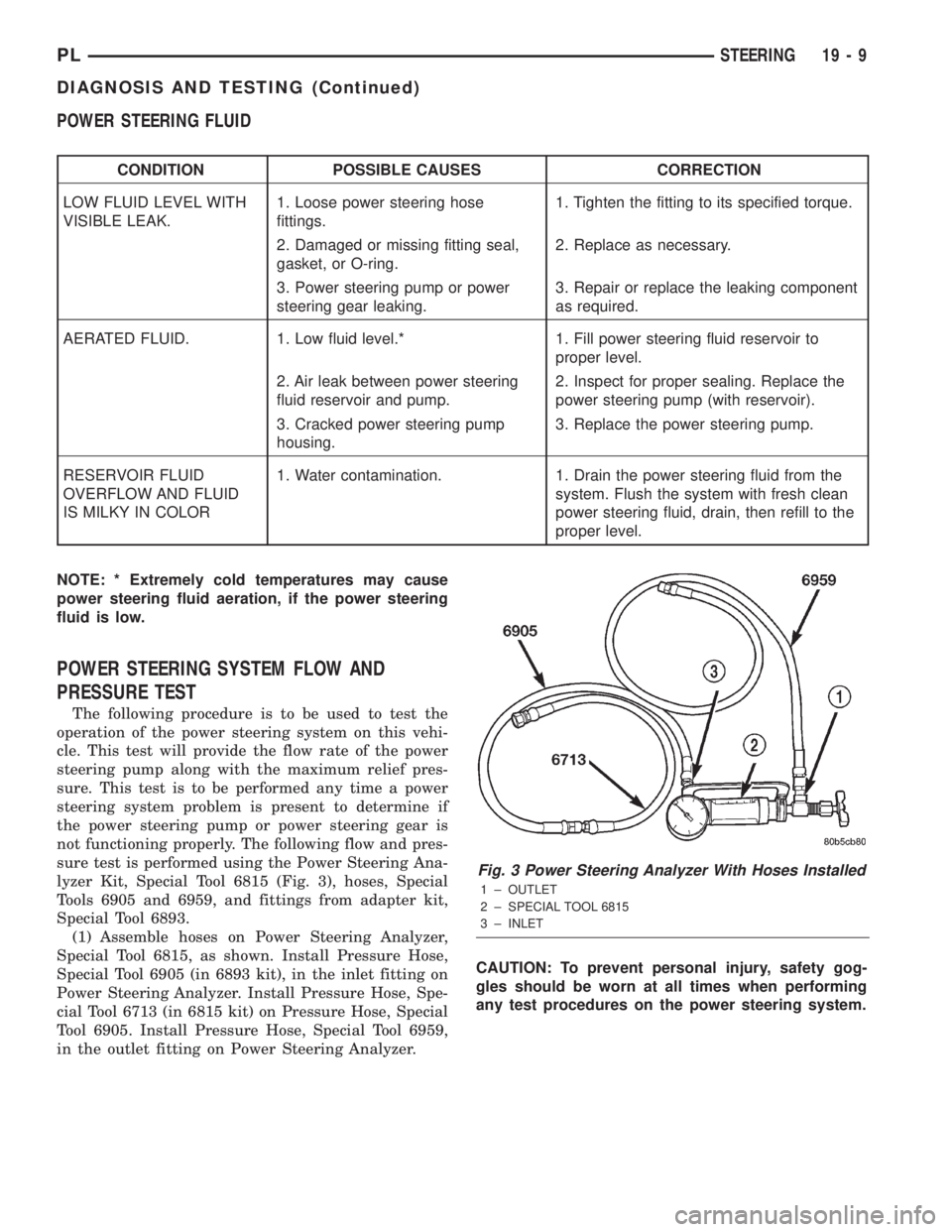
POWER STEERING FLUID
CONDITION POSSIBLE CAUSES CORRECTION
LOW FLUID LEVEL WITH
VISIBLE LEAK.1. Loose power steering hose
fittings.1. Tighten the fitting to its specified torque.
2. Damaged or missing fitting seal,
gasket, or O-ring.2. Replace as necessary.
3. Power steering pump or power
steering gear leaking.3. Repair or replace the leaking component
as required.
AERATED FLUID. 1. Low fluid level.* 1. Fill power steering fluid reservoir to
proper level.
2. Air leak between power steering
fluid reservoir and pump.2. Inspect for proper sealing. Replace the
power steering pump (with reservoir).
3. Cracked power steering pump
housing.3. Replace the power steering pump.
RESERVOIR FLUID
OVERFLOW AND FLUID
IS MILKY IN COLOR1. Water contamination. 1. Drain the power steering fluid from the
system. Flush the system with fresh clean
power steering fluid, drain, then refill to the
proper level.
NOTE: * Extremely cold temperatures may cause
power steering fluid aeration, if the power steering
fluid is low.
POWER STEERING SYSTEM FLOW AND
PRESSURE TEST
The following procedure is to be used to test the
operation of the power steering system on this vehi-
cle. This test will provide the flow rate of the power
steering pump along with the maximum relief pres-
sure. This test is to be performed any time a power
steering system problem is present to determine if
the power steering pump or power steering gear is
not functioning properly. The following flow and pres-
sure test is performed using the Power Steering Ana-
lyzer Kit, Special Tool 6815 (Fig. 3), hoses, Special
Tools 6905 and 6959, and fittings from adapter kit,
Special Tool 6893.
(1) Assemble hoses on Power Steering Analyzer,
Special Tool 6815, as shown. Install Pressure Hose,
Special Tool 6905 (in 6893 kit), in the inlet fitting on
Power Steering Analyzer. Install Pressure Hose, Spe-
cial Tool 6713 (in 6815 kit) on Pressure Hose, Special
Tool 6905. Install Pressure Hose, Special Tool 6959,
in the outlet fitting on Power Steering Analyzer.CAUTION: To prevent personal injury, safety gog-
gles should be worn at all times when performing
any test procedures on the power steering system.
Fig. 3 Power Steering Analyzer With Hoses Installed
1 ± OUTLET
2 ± SPECIAL TOOL 6815
3 ± INLET
PLSTEERING 19 - 9
DIAGNOSIS AND TESTING (Continued)