1993 DODGE TRUCK codes
[x] Cancel search: codesPage 915 of 1502
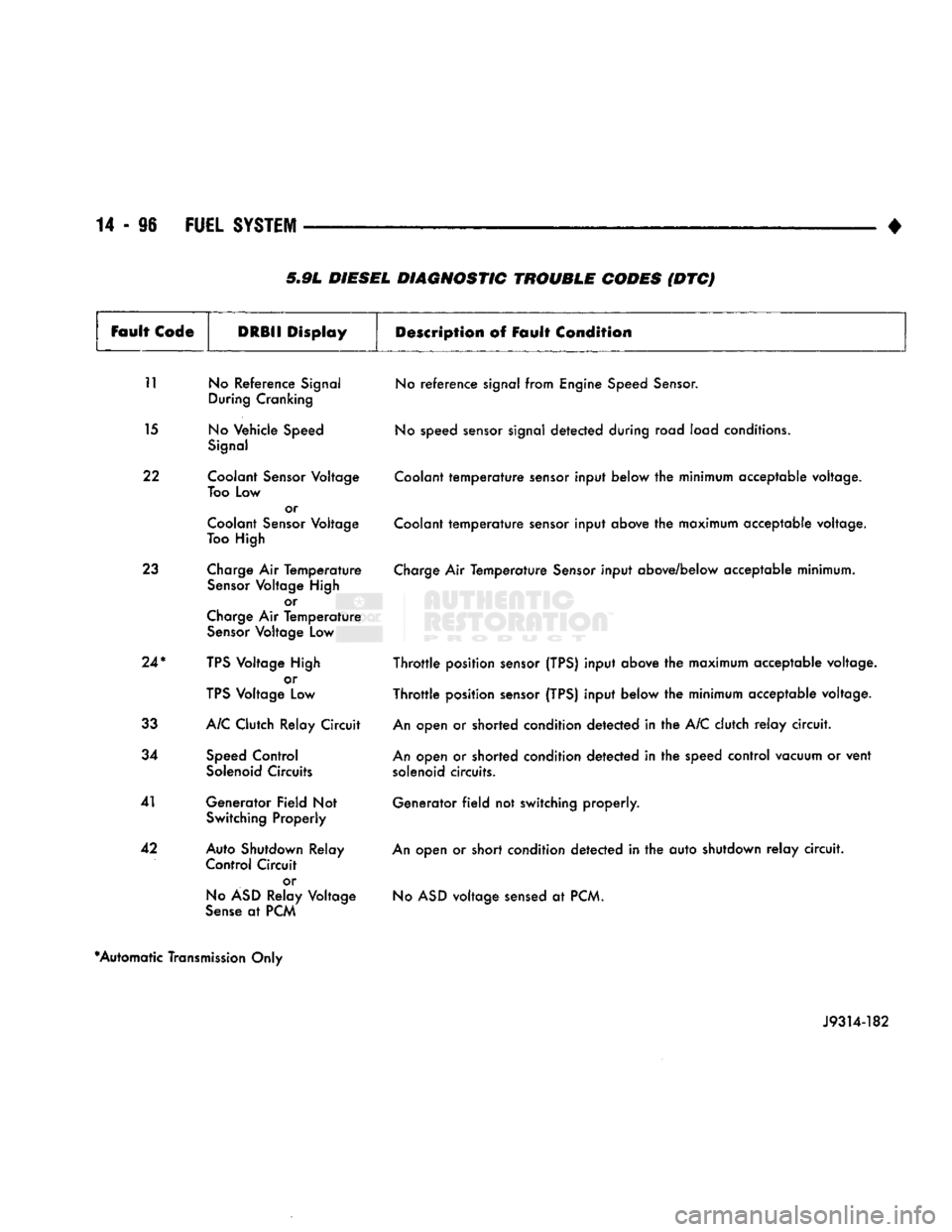
5.9L DIESEL DIAGNOSTIC TROUBLE CODES (DTC)
Fault
Code
DRBII
Display
Description
of Fault
Condition
11 No Reference Signal During Cranking
15 No Vehicle Speed Signal
22 Coolant Sensor Voltage Too Low or
Coolant Sensor Voltage
Too High
23 Charge Air Temperature Sensor Voltage High or
Charge Air Temperature Sensor Voltage Low
24*
TPS Voltage High or
TPS Voltage Low
33 A/C Clutch Relay Circuit
34 Speed Control Solenoid Circuits
41 Generator Field Not Switching Properly
42 Auto Shutdown Relay Control Circuit
or
No ASD Relay Voltage
Sense at PCM No reference signal from Engine Speed Sensor.
No speed sensor signal detected during road load conditions.
Coolant temperature sensor input below the minimum acceptable voltage.
Coolant temperature sensor input above the maximum acceptable voltage.
Charge Air Temperature Sensor input above/below acceptable minimum.
Throttle position sensor (TPS) input above the maximum acceptable voltage.
Throttle position sensor (TPS) input below the minimum acceptable voltage.
An open or shorted condition detected in the A/C clutch relay circuit.
An open or shorted condition detected in the speed control vacuum or vent solenoid circuits.
Generator field not switching properly.
An open or short condition detected in the auto shutdown relay circuit. No ASD voltage sensed at PCM.
*Automatic Transmission Only
J9314-182
Page 916 of 1502
FUEL
SYSTEM
14 - 97
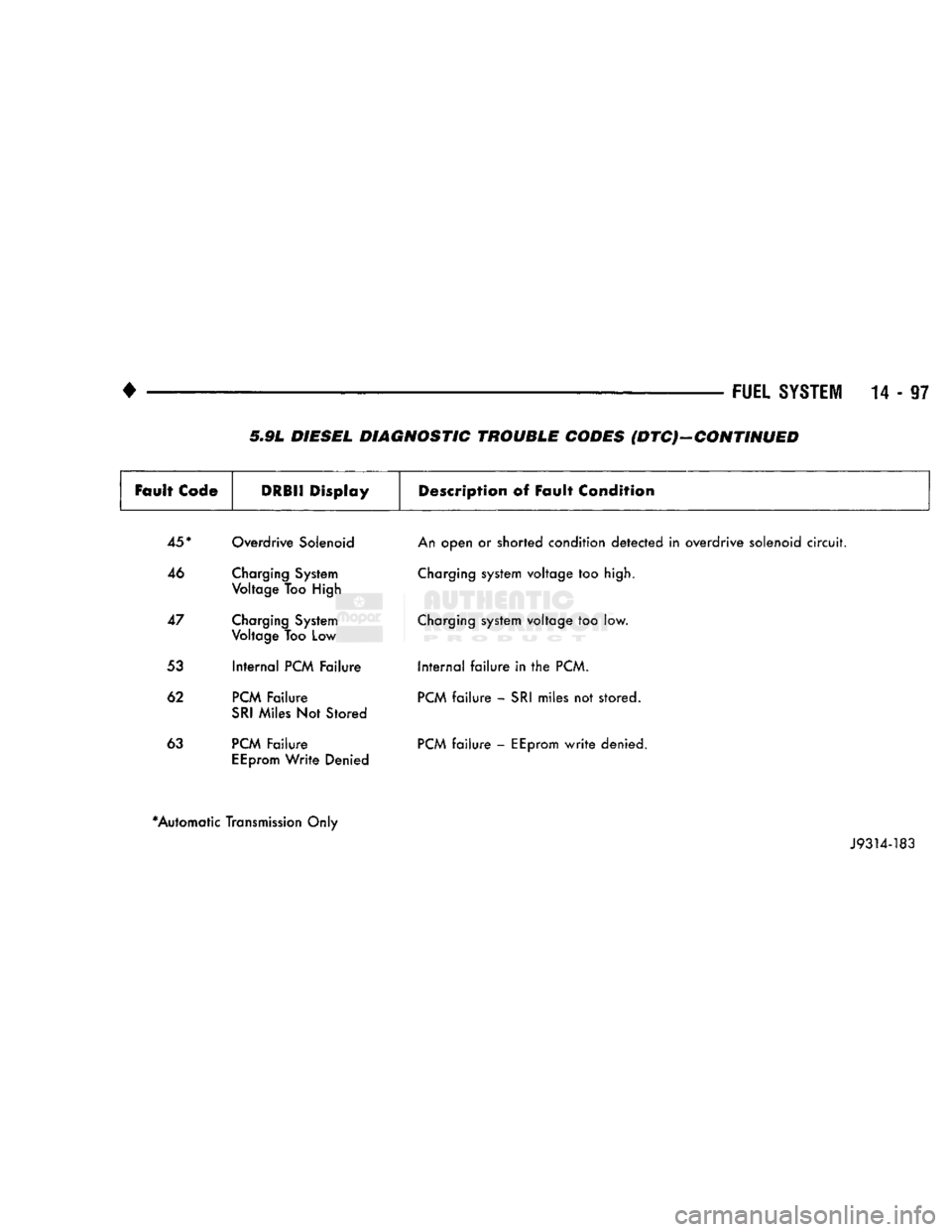
5„9L DIESEL DIAGNOSTIC TROUBLE CODES {DTC}-CONTINUED
Fault
Code
DRBII Display
Description
of Fault Condition
45*
Overdrive Solenoid
46 Charging System Voltage Too High
47 Charging System Voltage Too Low
53 Internal PCM Failure
62 PCM Failure SRI Miles Not Stored
63 PCM Failure EEprom Write Denied An open or shorted condition detected in overdrive solenoid circuit.
Charging system voltage too high.
Charging system voltage too low. Internal failure in the PCM.
PCM failure - SRI miles not stored.
PCM failure - EEprom write denied.
*Automatic Transmission Only J9314-183
Page 918 of 1502
CAV
WIRE
COLOR DESCRIPTION
CAV
WIRE
COLOR DESCRIPTION
1 WT/BK
WATER-IN-FUEL SENSOR 37 OVERDRIVE LAMP SIGNAL
2 TN/BK
COOLANT SENSOR (AUTOMATIC TRANSMISSION ONLY) 38
3 RD BATTERY
39
4
BK/LB*
SENSOR RETURN 40
5 BK/WT
SIGNAL GROUND 41
6 VT/WT*
5 VOLT SUPPLY 42
7 TN/YL 8 VOLT INPUT 43 GR/LB TACHOMETER
8 44
9 DB
IGNITION SENSE 45 LG DATA LINK RECIEVE
10 RD/WT*
OVERDRIVE OVERRIDE 46
11 BK/TN POWER GROUND
47 WT/OR* VEHICLE SENSOR
12 BK/TN
POWER GROUND 48 BR/RD* SPEED CONTROL COAST/SET SWITCH
13 49 YL/RD* SPEED CONTROL ON/OFF SWITCH
14 50 WT/LG* SPEED CONTROL RESUME/ACCEL SWITCH
15 OR/BK* HEATER
#2
RELAY 51 DB/YL ASD RELAY
16 YL/BK HEATER #1 RELAY 52
17 53 LG/RD* SPEED CONTROL VENT SOLENOID
18 54 BK/PK* WATER-IN-FUEL LAMP
19 55 OR/LG* OVERDRIVE SOLENOID
20 DG GENERATOR FIELD 56 DG/WT WAIT-TO-START LAMP
21 BK/RD
CHARGE (INTAKE) AIR TEMPERATURE SENSOR 57 DG/OR ASD SENSE
22
OR/DB*
THROTTLE POSITION SENSOR 58
23 59
24 GY/BK
REFERENCE PICKUP 60
25 PK
DATA LINK TRANSMIT WIRE COLOR CODES LB
LIGHT BLUE VT VIOLET
26 BK BLACK LG LIGHT GREEN WT
WHITE
27 BR
A/C CLUTCH REQUEST BR BROWN OR ORANGE
YL YELLOW
28 LG/RD THERMO SWITCH DB DARK BLUE PK PINK *
WITH TRACER
29 WT/PK* BRAKE SWITCH DG DARK GREEN
RD RED
30 BR/YL*
PARK/NEUTRAL SWITCH GY GRAY TN TAN
31 ruin
32 BK/PK*
MALFUNCTION INDICATOR LAMP
n
33 TN/RD*
SPEED CONTROL VACUUM SOLENOID CONNECTOR
J//000OOOOOOO
1 1
HI
173456789
10 J/^"*\
Hi
oooooooooo (1 Oj]
VlX
21
22
23
24
25
26
27
28
29
30
\V~V//
oooooooooo
\
II
12 13
14 15
16 17 18
19 20
\
34 DB/OR
WIDE OPEN THROTTLE (A/C) TERMINAL
J//000OOOOOOO
1 1
HI
173456789
10 J/^"*\
Hi
oooooooooo (1 Oj]
VlX
21
22
23
24
25
26
27
28
29
30
\V~V//
oooooooooo)}
31
32 33 34 35 36 37 38 39 40
1JU
35 SHOWN \\\
41 42 43 44 45 46 47 48 49
SO
1
^m^^
|
oooooooooo
1
1
oooooooooo
J//
36
Li
J9314-185
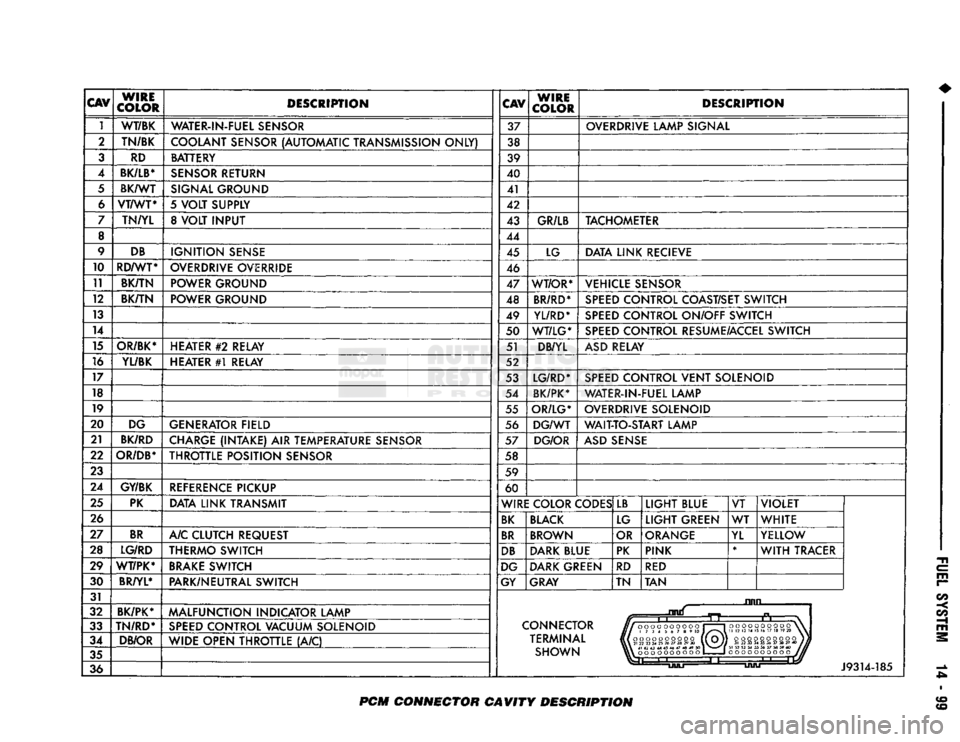
PCM
CONNECTOR CAVITY DESCRIPTION
Page 1077 of 1502
21 - 76
AUTOMATIC
TRANSMISSION—32RH/36RH/37RH/42RH/46RH
•
TORQUE
CONVERTER
A three element torque converter is used. The con
verter used with 32RH and some 36RH transmis sions has a modulated converter clutch. The
converter used with 37RH transmissions is not
equipped with a modulated clutch. The converter used with 1993, 32RH transmissions
is new. The converter hub was changed to accept the
new style drive flats on the oil pump inner gear. The
new style converter is not interchangeable with pre
vious designs. A 241 or 273 mm (9.5 or 10.75 in.) converter is
used for 3.9L, 5.2L and 5.9L gas engine applications.
A 310 mm (12.2 in.) converter is used for diesel en
gine applications. The converter impeller is connected to the engine
crankshaft through the front cover which is welded
to the impeller. The turbine is splined to the trans
mission input shaft and the stator is splined to the transmission reaction shaft. The converter is a welded assembly. It is not a re
pairable component and is serviced as an assembly.
RECOMMENDED
FLUID
The recommended and preferred fluid for Chrysler
automatic transmissions is Mopar ATF Plus, Type
7176.
Use Mopar Dexron II only when ATF Plus is
not readily available.
TRANSMISSION
IDENTIFICATION
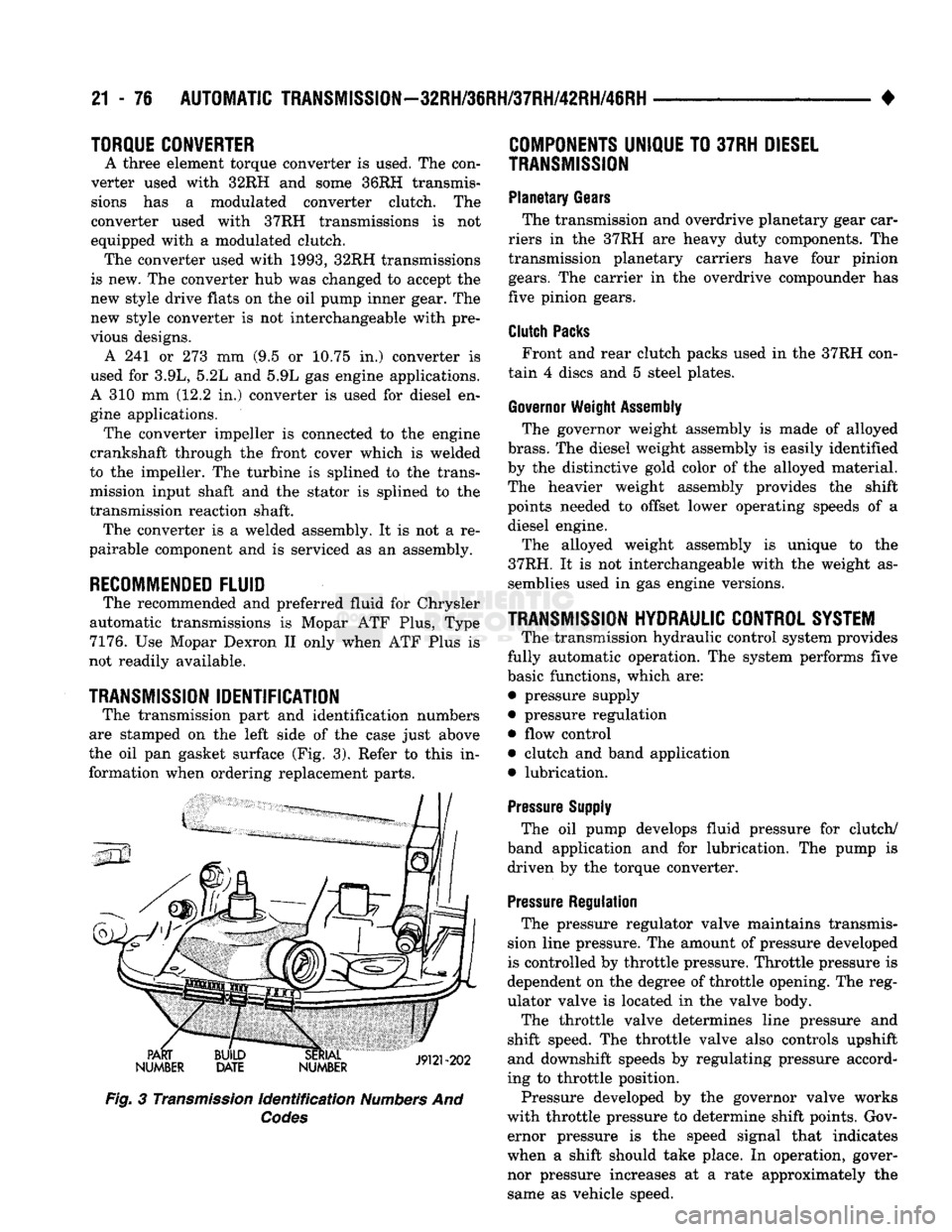
The transmission part and identification numbers
are stamped on the left side of the case just above
the oil pan gasket surface (Fig. 3). Refer to this in formation when ordering replacement parts.
PART
NUMBER BUILD
DATE SERIAL
19191-909
NUMBER JVUI zuz
Fig.
3
Transmission
Identification
Numbers
And
Codes
COMPONENTS
UNIQUE
TO
37RH
DIESEL
TRANSMISSION
Planetary
Gears
The transmission and overdrive planetary gear car
riers in the 37RH are heavy duty components. The
transmission planetary carriers have four pinion
gears.
The carrier in the overdrive compounder has
five pinion gears.
Clutch
Packs
Front and rear clutch packs used in the 37RH con
tain 4 discs and 5 steel plates.
Governor
Weight
Assembly
The governor weight assembly is made of alloyed
brass.
The diesel weight assembly is easily identified
by the distinctive gold color of the alloyed material.
The heavier weight assembly provides the shift
points needed to offset lower operating speeds of a diesel engine.
The alloyed weight assembly is unique to the
37RH. It is not interchangeable with the weight as semblies used in gas engine versions.
TRANSMISSION
HYDRAULIC
CONTROL
SYSTEM
The transmission hydraulic control system provides
fully automatic operation. The system performs five
basic functions, which are: • pressure supply
• pressure regulation • flow control
• clutch and band application
• lubrication.
Pressure
Supply
The oil pump develops fluid pressure for clutch/
band application and for lubrication. The pump is driven by the torque converter.
Pressure
Regulation
The pressure regulator valve maintains transmis
sion line pressure. The amount of pressure developed
is controlled by throttle pressure. Throttle pressure is
dependent on the degree of throttle opening. The reg
ulator valve is located in the valve body.
The throttle valve determines line pressure and
shift speed. The throttle valve also controls upshift
and downshift speeds by regulating pressure accord
ing to throttle position.
Pressure developed by the governor valve works
with throttle pressure to determine shift points. Gov ernor pressure is the speed signal that indicates
when a shift should take place. In operation, gover
nor pressure increases at a rate approximately the same as vehicle speed.
Page 1082 of 1502
•
AUTOMATIC
TRANSMISSION—32RH/36RH/37RH/42RH/46RH
21 - 81
TORQUE
CONVERTER
A three element torque converter
is
used
for all ap
plications.
The
converter consists
of the
impeller,
sta-
tor
and
turbine.
The
converter also contains
an
overrunning clutch
and a
modulated converter clutch
mechanism.
The converter used with
1993,
42RH transmissions
is
new. The
converter
hub was
changed
to
accept
the
new style drive flats
on the oil
pump inner gear.
The
new style converter
is not
interchangeable with pre
vious designs.
The converter modulated clutch consists
of a
slid
ing clutch piston, clutch springs
and the
clutch disc
friction material.
The
clutch provides optimum
torque transfer
and
economy when engaged.
The clutch disc
is
attached
to the
converter front
cover.
The
clutch piston
and
clutch springs
are at
tached
to the
turbine
hub. The
springs dampen
en
gine firing impulses
and
loads during
the
initial
phase
of
converter clutch engagement.
Clutch engagement
is
controlled
by the
converter
clutch valve
and
solenoid. Both
are
located
on the
transmission valve body. Clutch engagement occurs in drive range
at
speeds above approximately 30-35
mph.
The clutch provides reduced engine speed
and
greater fuel economy when engaged. Clutch engage
ment also provides reduced transmission fluid tem
peratures.
COMPONENTS
UNIQUE
TO
DIESEL VERSION
OF
46RH
Planetary
Gears
The transmission
and
overdrive planetary gear car
riers
in the
diesel version
of the
46RH
are
heavy duty components.
The
transmission planetary carriers have four pinion gears.
The
carrier
in the
over
drive compounder
has
five pinion gears.
The
heavy
duty planetary units
are
unique
to the
diesel 46RH.
Clutch
Packs
Clutch packs used
in the
diesel version
of the
46RH contain
the
following number
of
discs
and
plates:
• transmission front/rear clutch
has 4
discs
and 5
steel plates
• overdrive clutch
has 5
discs
and 6
steel plates
• overdrive direct clutch
has 8
discs
and 9
steel
plates
Governor
Weight
Assembly
The governor weight assembly
in the
diesel 46RH
is made
of
alloyed brass.
The
diesel weight assembly
is easily identified
by the
distinctive gold color
of the
alloyed material.
The
heavier weight assembly pro
vides
the
shift points needed
to
offset lower operating speeds
of a
diesel engine. The alloyed weight assembly
is
unique
to the
diesel
46RH.
It is not
interchangeable with
the
weight
as
semblies used
in gas
engine versions.
Diesel
Thermo
Switch
Fourth gear operation
in the
diesel 46RH
is
also
controlled
by two
temperature sensitive thermo- switches.
The first thermo-switch
is the
engine coolant tem
perature switch. This switch prevents overdrive fourth gear operation when engine coolant tempera
ture
is
below approximately
65° F.
The second thermo-switch directly monitors trans
mission fluid temperature.
The
switch will either
downshift
the
transmission
to
third gear,
or
prevent a
3-4
upshift when fluid temperature exceeds
270-275°
F.
The fluid temperature switch
is
located
in a
boss
built into
the
cooler outlet line.
The
boss
and
switch are located approximately
2-3
inches from
the
outlet
line fitting
in the
transmission case.
The engine coolant
and
fluid temperature switches
are
in
circuit with
the
overdrive control switch
in the
instrument panel.
GEAR RATIOS
42RH forward gear ratios
are:
First gear
=
2.74:1
Second gear
= 1.54:1
Third gear
= 1.00:1
Fourth gear
=
0.69:1.
46RH forward gear ratios
are:
First gear
=
2.45:1 Second gear
= 1.45:1
Third gear
= 1.00:1
Fourth gear
=
0.69:1.
RECOMMENDED
FLUID
The recommended
and
preferred fluid
for
42RH/
46RH transmissions
is
Mopar
ATF
Plus, type
7176.
Use Mopar Dexron
II
only when
ATF
Plus
is not
readily available.
TRANSMISSION
IDENTIFICATION
The transmission part
and
identification numbers
and codes
are
stamped
on the
left side
of the
case
just above
the oil pan
gasket surface
(Fig. 3).
The first letter/number group
is the
assembly part
number.
The
next number group
the
transmission
build date.
The
last number group
is the
transmis sion serial number. Refer
to
this information when
ordering replacement parts.
FOURTH
GEAR OVERDRIVE COMPONENTS
42RH/46RH models have three transmission shafts.
An intermediate shaft
is
positioned between
the in
put
and
output shafts.
The
output shaft
is in the
Page 1084 of 1502
•
AUTOMATIC TRANSiISSIO|-32RH/8iRH/37RH/42RH/4iRH
21 - 83 plate. The overdrive clutch also disengages the direct
clutch during 3-4 upshifts. As fluid pressure extends
the overdrive piston, the piston contacts the direct clutch hub pressing it rearward. This action com
presses the direct clutch spring relieving spring load on the clutch pack. The clutch is disengaged once
spring load is relieved.
The 3-4 accumulator cushions overdrive clutch en
gagement to smooth the transition into fourth gear.
The accumulator is charged at the same time as ap
ply pressure acts against the overdrive piston.
Converter clutch engagement in overdrive fourth
gear is controlled by sensor inputs to the powertrain
control module. In third gear above 25 mph, sensor inputs to the control module that determine clutch
engagement and shift timing are:
• coolant temperature (verifies minimum of 60° F)
• engine speed • vehicle speed
• throttle position
• manifold vacuum (MAP sensor)
Gearshift
Mechanism
The gear shift mechanism provides the same shift
positions used with 3-speed Chrysler transmissions
(P-R-N-D-2-1).
The shift into overdrive fourth gear range occurs
only after the transmission has completed the shift into D third gear range. No further movement of the
shift mechanism is required to complete the 3-4 shift.
The fourth gear upshift occurs automatically when
the overdrive control switch is in the ON position. Shift timing is determined by sensor inputs to the
engine controller.
Overdrive Control
Switch
The overdrive control switch is located in the in
strument panel. In the On position, automatic shifts
into fourth gear overdrive will occur. In the Off posi
tion, the switch overrides the engine controller pre
venting a shift to overdrive fourth gear range.
The switch has an indicator light that illuminates
when overdrive is turned off. The switch also resets
when the ignition key is turned to the OFF position so that the automatic overdrive feature is restored.
The use of fault codes is employed to help diagnose
the electronic components that operate the overdrive
unit and converter clutch.
HYDRAULIC
CONTROLS
The 42REJ/46RH hydraulic control system provides
fully automatic operation. The system performs five
basic functions which are: pressure supply, pressure regulation, flow control, clutch/band application, and
lubrication. 42RH/46RH system operation is similar to that de
scribed in the 32RH/36RH/37RH General Informa tion section. The main difference being fourth gear
operation which is covered here.
Pressure
Regulation
The pressure regulator valve maintains line pres
sure.
The amount of pressure developed is controlled
by throttle pressure which is dependent on the de gree of throttle opening. The regulator valve is lo
cated in the valve body.
The throttle valve determines line pressure and
shift speed. Governor pressure increases in propor
tion to vehicle speed. The throttle valve controls up shift and downshift speeds by regulating pressure
according to throttle position.
Flow
Control And Lubrication The manual valve is operated by the gearshift link
age and provides the operating range selected by the
driver.
The 1-2 shift valve provides 1-2 or 2-1 shifts and
the 2-3 shift valve provides 2-3 or 3-2 shifts.
The kickdown valve provides forced 3-2 or 3-1
downshifts depending on vehicle speed. Downshifts
occur when the throttle is opened beyond downshift
detent position which is just before wide open throt
tle.
The 2-3 valve throttle pressure plug provides 3-2
downshifts at varying throttle openings depending on
vehicle speed.
The 1-2 shift control valve transmits 1-2 shift pres
sure to the accumulator piston. This controls kick-
down band capacity on 1-2 upshifts and 3-2 downshifts.
The 3-4 shift valve, shuttle valve, timing valve and
accumulator are only actuated when the overdrive
solenoid is energized.
The solenoid contains a check ball that controls a
vent port to the 3-4 valve. The check ball either di
verts line pressure away from or directly to, the 3-4 shift valve. Energizing the solenoid causes the check
ball to close the vent port allowing line pressure to act upon the 3-4 upshift valve.
The limit valve determines maximum speed at
which a 3-2 part throttle kickdown can be made. Some transmissions do not have the limit valve and
maximum speed for a 3-2 kickdown is at the detent
position.
The 2-3 shuttle valve has two functions. First is
fast front band release and smooth engagement dur ing lift-foot 2-3 upshifts. The second is to regulate
front clutch and band application during 3-2 down
shifts.
The 3-4 shuttle valve uses a combination of throt
tle and governor pressure to control the rate of over
drive piston apply and release. This is done to
maintain shift quality at varying throttle openings.
Page 1380 of 1502
•
WHEELS
AND
TIRES
22-11 VEHICLE VIBRATION
Vehicle vibration can
be
caused by:
• Tire/wheel unbalance
or
excessive runout
• Defective tires with extreme tread wear
• Nylon overlay flat spots (performance tires only)
• Incorrect wheel bearing adjustment
(if
applicable)
• Loose
or
worn suspension/steering components
• Certain tire tread patterns
• Incorrect drive shaft angles
or
excessive drive
shaft/yoke runout
• Defective
or
worn U-joints
• Excessive brake rotor
or
drum runout
• Loose engine
or
transmission supports/mounts
• And
by
engine operated accessories Refer
to the
appropriate Groups
in
this man
ual for additional information.
VIBRATION
TYPES
There are two types
of
vehicle vibration:
• Mechanical
• Audible. Mechanical vehicle vibration
can be
felt through
the seats, floor pan and/or steering wheel. Audible vehicle vibration
is
heard above normal
background noise.
The
sound
can be a
droning
or
drumming noise. Vibrations
are
sensitive
to
change
in
engine
torque, vehicle speed
or
engine speed.
ENGINE TORQUE SENSITIVE VIBRATION
This vibration can
be
increased
or
decreased by:
• Accelerating
• Decelerating
• Coasting
• Maintaining
a
constant vehicle speed
VEHICLE SPEED SENSITIVE VIBRATION
This vibration condition always occurs
at
the same
vehicle speed regardless
of
the engine torque
or en
gine speed.
ENGINE SPEED
{RPM}
SENSITIVE VIBRATION
This vibration occurs
at
varying engine speeds.
It
can
be
isolated
by
increasing
or
decreasing
the en
gine speed with the transmission
in
NEUTRAL posi
tion.
VIBRATION
DIAGNOSIS
A vibration diagnosis should always begin with
a
10 mile (16 km) trip (to warm the vehicle and tires).
Then
a
road test
to
identify the vibration. Corrective action should
not be
attempted until
the
vibration
type has been identified
via a
road test. During the road test, drive the vehicle
on a
smooth
surface.
If
vibration exists, note
and
record
the
fol
lowing information: • Identify
the
vehicle speed range when
the
vibra
tion occurs
• Identify the type
of
vibration
• Identify the vibration sensitivity
• Determine
if
the vibration
is
affected
by
changes
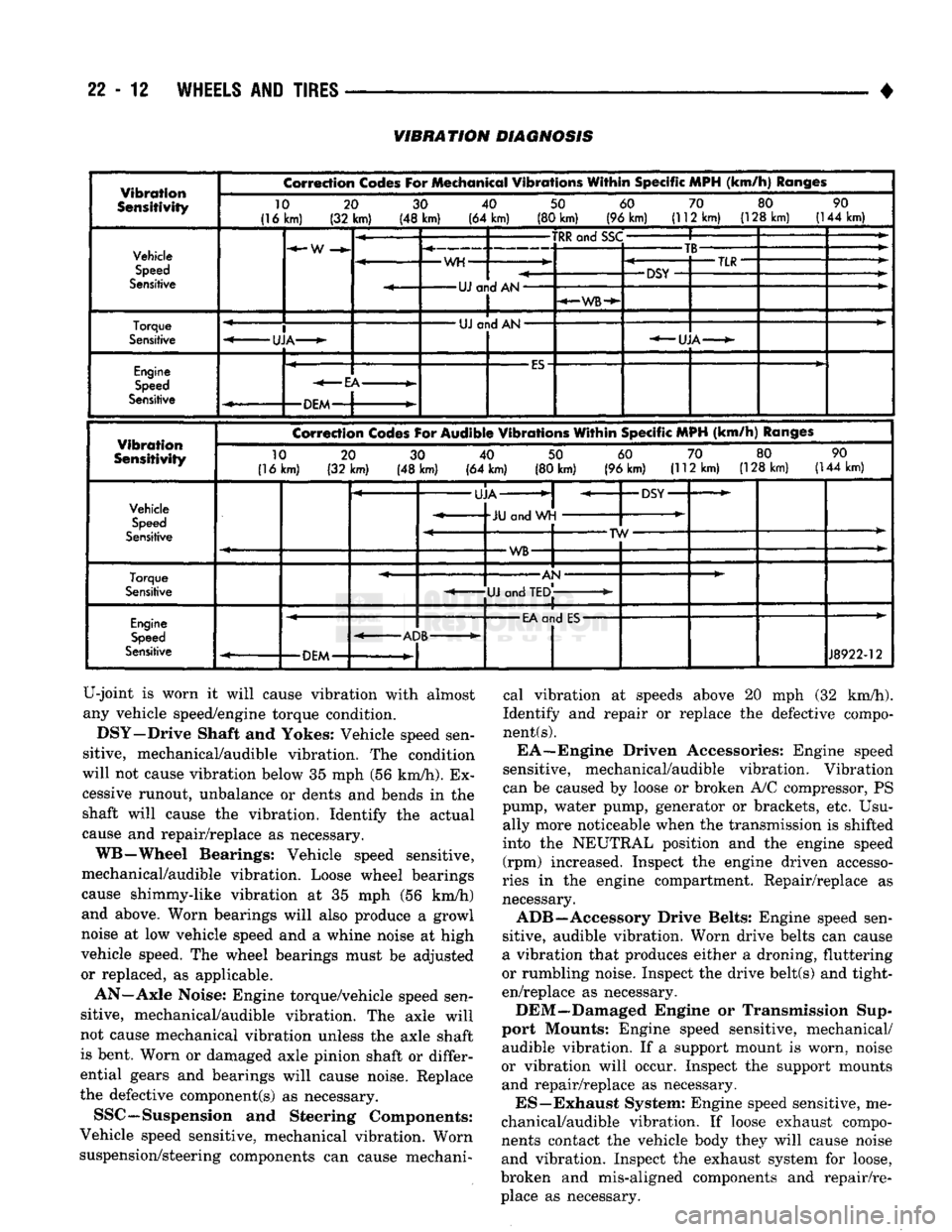
in vehicle speed, engine speed and engine torque. When the vibration has been identified, refer to the
Vibration Diagnosis chart
for
causes. Consider cor
recting only those causes coded
in
the chart that
are
related
to
the vibration condition.
Refer
to
the following cause codes and descriptions
for explanations when referring
to
the chart.
TRR—Tire
and
Wheel Radial Runout: Vehicle
speed sensitive, mechanical vibration.
The
runout
will not cause vibration below
20
mph (32 km/h).
WH—Wheel Hop: Vehicle speed sensitive,
me
chanical vibration.
The
wheel
hop
generates rapid
up-down movement
in
the steering wheel. The vibra
tion
is
most noticeable
in the 20 - 40
mph
(32 - 64
km/h) range. The wheel hop will not cause vibration
below
20
mph (32 km/h). Wheel hop
is
caused
by a
tire/wheel that
has a
radial runout
of
more than 0.045 of-an-inch (1.14 mm).
If
wheel runout
is
accept
able
and
combined runout cannot
be
reduced
by re
positioning the tire
on
wheel, replace tire.
TB—Tire/Wheel Balance: Vehicle speed sensitive,
mechanical vibration. Static tire/wheel unbalance
will not cause vibration below 30 mph (46 km/h). Dy
namic tire/wheel unbalance will
not
cause vibration
below
40
mph (64 km/h). TLR—Tire/Wheel Lateral runout: Vehicle speed
sensitive, mechanical vibration. The runout will
not
cause vibration below
50 - 55 mph (80 - 88
km/h).
Excessive lateral runout will also cause front-end shimmy. TW—Tire Wear: Vehicle speed sensitive, audible
vibration. Abnormal tire wear causes small vibration in
the 30 - 55
mph
(88
km/h) range. This will pro
duce
a
whine noise
at
high speed.
The
whine will
change
to a
growl noise when the speed
is
reduced. W—Tire Waddle: Vehicle speed sensitive, mechan
ical vibration. Irregular tire uniformity
can
cause
side-to-side motion during speeds
up to 15
mph
(24
km/h).
If
the motion
is
excessive, identify
the
defec
tive tire and replace
it.
U A J—Universal Joint (Drive Shaft) Angles:
Torque/vehicle speed sensitive, mechanical/audible
vibration. Incorrect drive shaft angles cause mechan ical vibration below
20
mph (32 km/h) and
in
the
70
mph (112 km/h) range. The incorrect angles can also
produce
an
audible vibration
in
the 20
-
50 mph (32
-
80 km/h) range. Caster adjustment could
be
required
to correct the angles. UJ—Universal Joints: Engine torque/vehicle
speed sensitive, mechanical/audible vibration.
If
the
Page 1381 of 1502
22-12
WHEELS
AND
TIRES
VIBRATION
DIAGNOSIS
Vibration
Sensitivity
Correction
Codes
For
Mechanical
Vibrations
Within
Specific
MPH
(km/h)
Ranges
10
(16km)
20
(32 km) 30
(48 km) 40
(64 km) 50
(80 km) 60
(96 km) 70
(112 km) 80
(128 km) 90
(144 km) Vehicle
Speed
Sensitive
•W
-WH-
-TRR
and
SSC-
-UJ
and AN-
-WB-
-TB-
-DSY
•TLR-
Torque
Sensitive
I
-UJA-
•
UJ
and AN
•
•UJA-
Engine
Speed
Sensitive
•ES
•EA-
•DEM-
Vibration
Sensitivity
Correction
Codes
For
Audible
Vibrations
Within
Specific
MPH
(km/h)
Ranges
10
(16 km) 20
(32 km) 30
(48 km) 40
(64 km) 50
(80 km) 60
(96 km) 70
(112 km) 80
(128 km) 90
(144 km)
Vehicle
Speed
Sensitive
•UJA-
JU
and WH
•DSY"
-TW-
•WB-
Torque
Sensitive
-AN
*
-UJ
and
TED,
Engine
Speed
Sensitive
•
EA
and
ES-
-ADB-
-DEM-
J8922-12
U-joint is worn it will cause vibration with almost
any vehicle speed/engine torque condition. DSY—Drive Shaft and Yokes: Vehicle speed sen
sitive, mechanical/audible vibration. The condition
will not cause vibration below 35 mph (56 km/h). Ex
cessive runout, unbalance or dents and bends in the shaft will cause the vibration. Identify the actual
cause and repair/replace as necessary.
WB—Wheel Bearings: Vehicle speed sensitive,
mechanical/audible vibration. Loose wheel bearings
cause shimmy-like vibration at 35 mph (56 km/h)
and above. Worn bearings will also produce a growl
noise at low vehicle speed and a whine noise at high
vehicle speed. The wheel bearings must be adjusted
or replaced, as applicable.
AN—Axle Noise: Engine torque/vehicle speed sen
sitive, mechanical/audible vibration. The axle will
not cause mechanical vibration unless the axle shaft
is bent. Worn or damaged axle pinion shaft or differ
ential gears and bearings will cause noise. Replace
the defective component(s) as necessary.
SSC—Suspension and Steering Components:
Vehicle speed sensitive, mechanical vibration. Worn
suspension/steering components can cause mechani cal vibration at speeds above 20 mph (32 km/h).
Identify and repair or replace the defective compo
nent
(s).
EA—Engine Driven Accessories: Engine speed
sensitive, mechanical/audible vibration. Vibration
can be caused by loose or broken A/C compressor, PS
pump, water pump, generator or brackets, etc. Usu ally more noticeable when the transmission is shifted
into the NEUTRAL position and the engine speed (rpm) increased. Inspect the engine driven accesso
ries in the engine compartment. Repair/replace as
necessary.
ADB—Accessory Drive Belts: Engine speed sen
sitive, audible vibration. Worn drive belts can cause
a vibration that produces either a droning, fluttering
or rumbling noise. Inspect the drive belt(s) and tight
en/replace as necessary.
DEM—Damaged Engine or Transmission Sup
port Mounts: Engine speed sensitive, mechanical/ audible vibration. If a support mount is worn, noise
or vibration will occur. Inspect the support mounts and repair/replace as necessary.
ES—Exhaust System: Engine speed sensitive, me
chanical/audible vibration. If loose exhaust compo
nents contact the vehicle body they will cause noise
and vibration. Inspect the exhaust system for loose,
broken and mis-aligned components and repair/re place as necessary.