1989 MITSUBISHI GALANT sensor
[x] Cancel search: sensorPage 945 of 1273
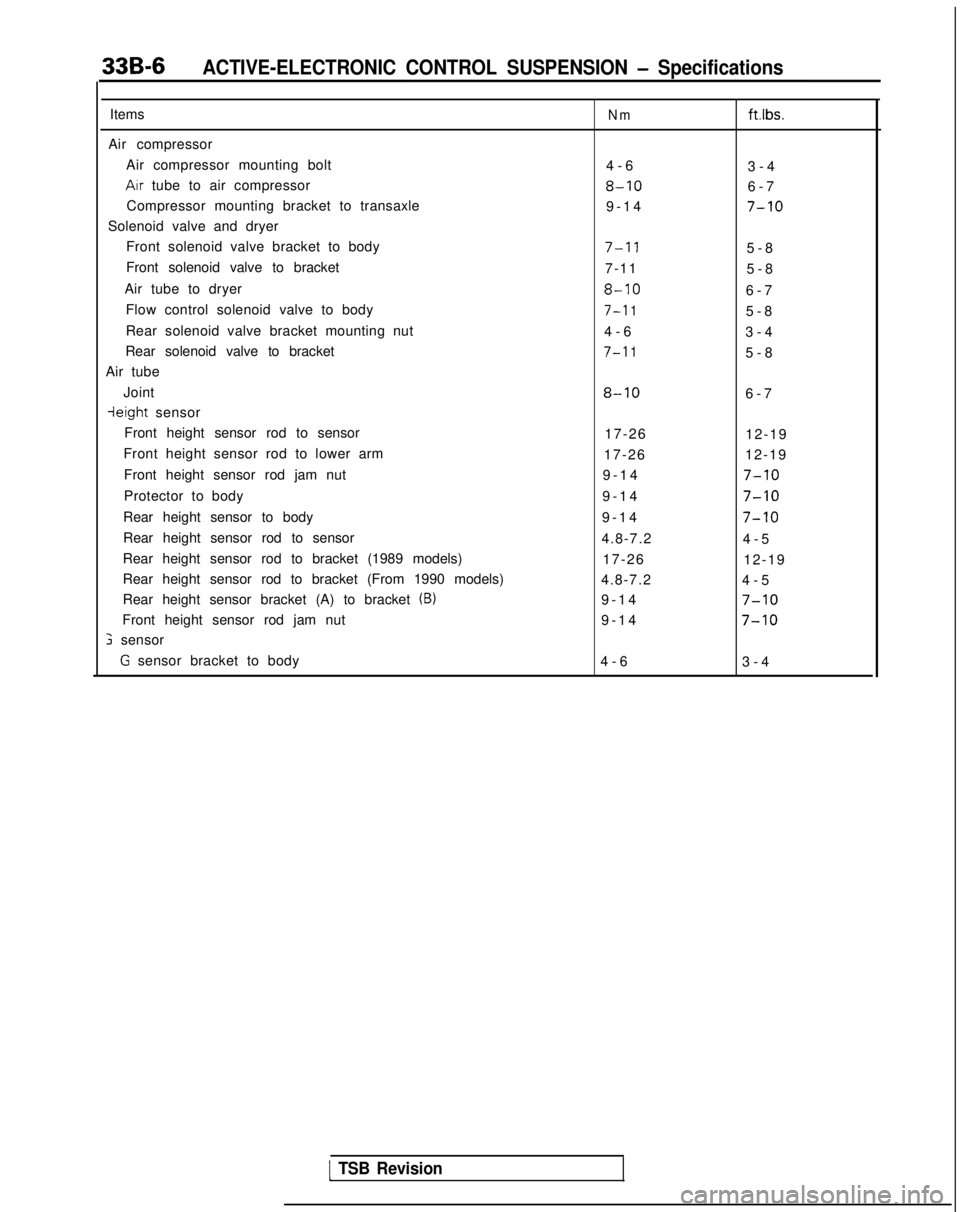
33B-6ACTIVE-ELECTRONIC CONTROL SUSPENSION - Specifications
Items
Air compressor Air compressor mounting bolt
Arr tube to air compressor
Compressor mounting bracket to transaxle
Solenoid valve and dryer Front solenoid valve bracket to body
Front solenoid valve to bracket
Air tube to dryer Flow control solenoid valve to body
Rear solenoid valve bracket mounting nut
Rear solenoid valve to bracket
Air tube
Joint
ieight sensor
Front height sensor rod to sensor
Front height sensor rod to lower arm
Front height sensor rod jam nut
Protector to body
Rear height sensor to body
Rear height sensor rod to sensor
Rear height sensor rod to bracket (1989 models)
Rear height sensor rod to bracket (From 1990 models)
Rear height sensor bracket (A) to bracket
(B)
Front height sensor rod jam nut
; sensor
G sensor bracket to body
Nmftlbs.
4-
6
3-4
8-106-
7
9-14
7-10
7-l 15-
8
7-11 5-8
8-106-
7
7-l 15-
8
4-6 3-4
7-l 15-
8
8-106-
7
17-26 12-19
17-26 12-19
9-14
7-10
9-1
4
7-10
9-1
4
7-10
4.8-7.2
4-
5
17-26 12-19
4.8-7.2 4-5
9-14
7-10
9-1
4
7-10
4-
6
3-4
1 TSB Revision
Page 949 of 1273
33B-10 ACTIVE-ELECTRONIC CONTROL SUSPENSION - Troubleshooting
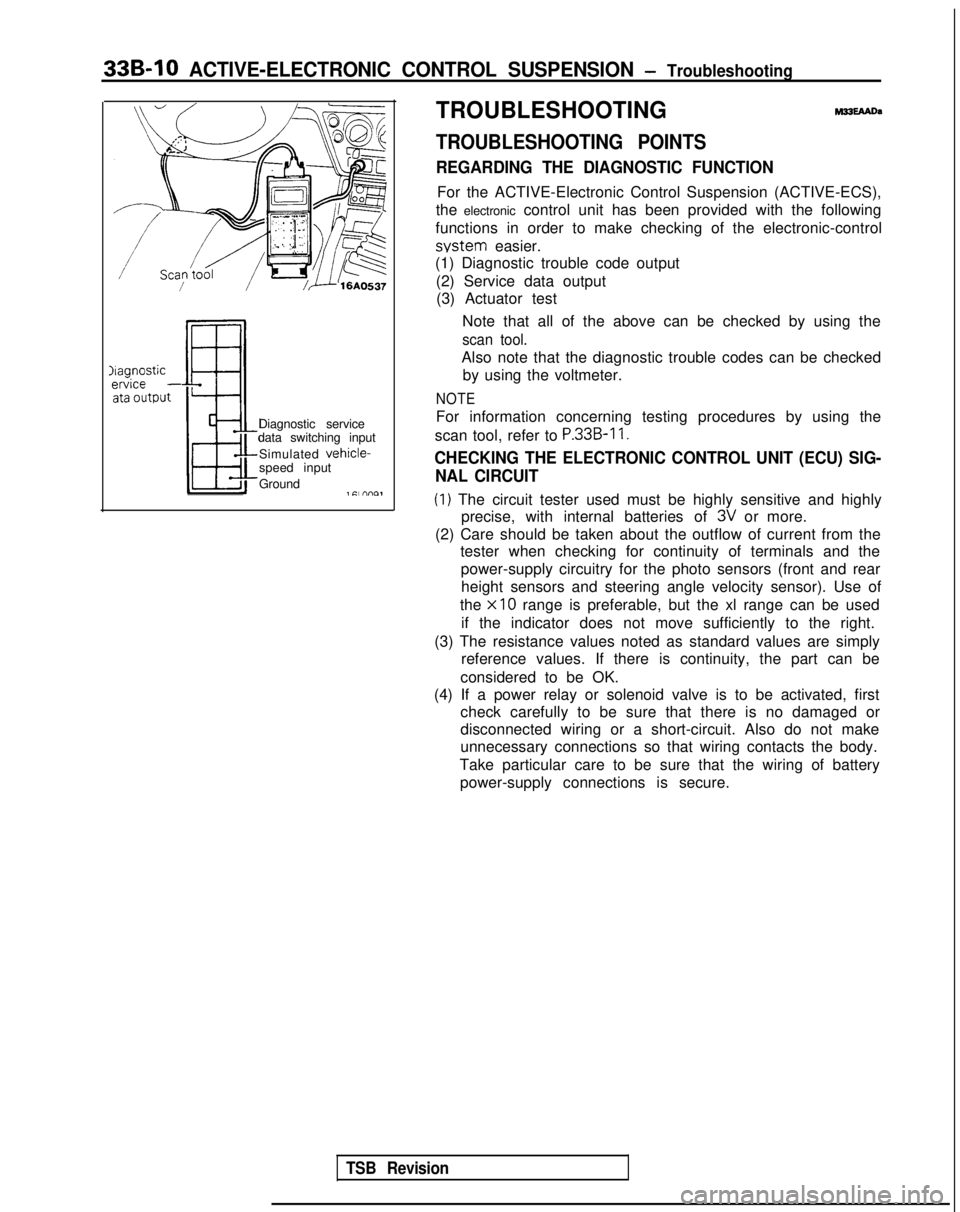
Ifagnosticervice
- ata 0utDut
Diagnostic service
data switching input
Simulated
vehicle-speed input
Ground
1 Cl nno,
TROUBLESHOOTINGhw3EAAtm
TROUBLESHOOTING POINTS
REGARDING THE DIAGNOSTIC FUNCTION
For the ACTIVE-Electronic Control Suspension (ACTIVE-ECS),
the electronic control unit has been provided with the following
functions in order to make checking of the electronic-control system
easier.
(1) Diagnostic trouble code output
(2) Service data output(3) Actuator test
Note that all of the above can be checked by using the
scan tool.
Also note that the diagnostic trouble codes can be checkedby using the voltmeter.
NOTE
For information concerning testing procedures by using the
scan tool, refer to
P.33B-11.
CHECKING THE ELECTRONIC CONTROL UNIT (ECU) SIG- NAL CIRCUIT
(1) The circuit tester used must be highly sensitive and highly precise, with internal batteries of
3V or more.
(2) Care should be taken about the outflow of current from the tester when checking for continuity of terminals and the
power-supply circuitry for the photo sensors (front and rearheight sensors and steering angle velocity sensor). Use of
the
x10 range is preferable, but the xl range can be used
if the indicator does not move sufficiently to the right.
(3) The resistance values noted as standard values are simply reference values. If there is continuity, the part can be
considered to be OK.
(4) If a power relay or solenoid valve is to be activated, first check carefully to be sure that there is no damaged or
disconnected wiring or a short-circuit. Also do not make
unnecessary connections so that wiring contacts the body.
Take particular care to be sure that the wiring of battery power-supply connections is secure.
TSB Revision
Page 950 of 1273
ACTIVE-ELECTRONIC CONTROL SUSPENSION - Troubleshooting 33B-11
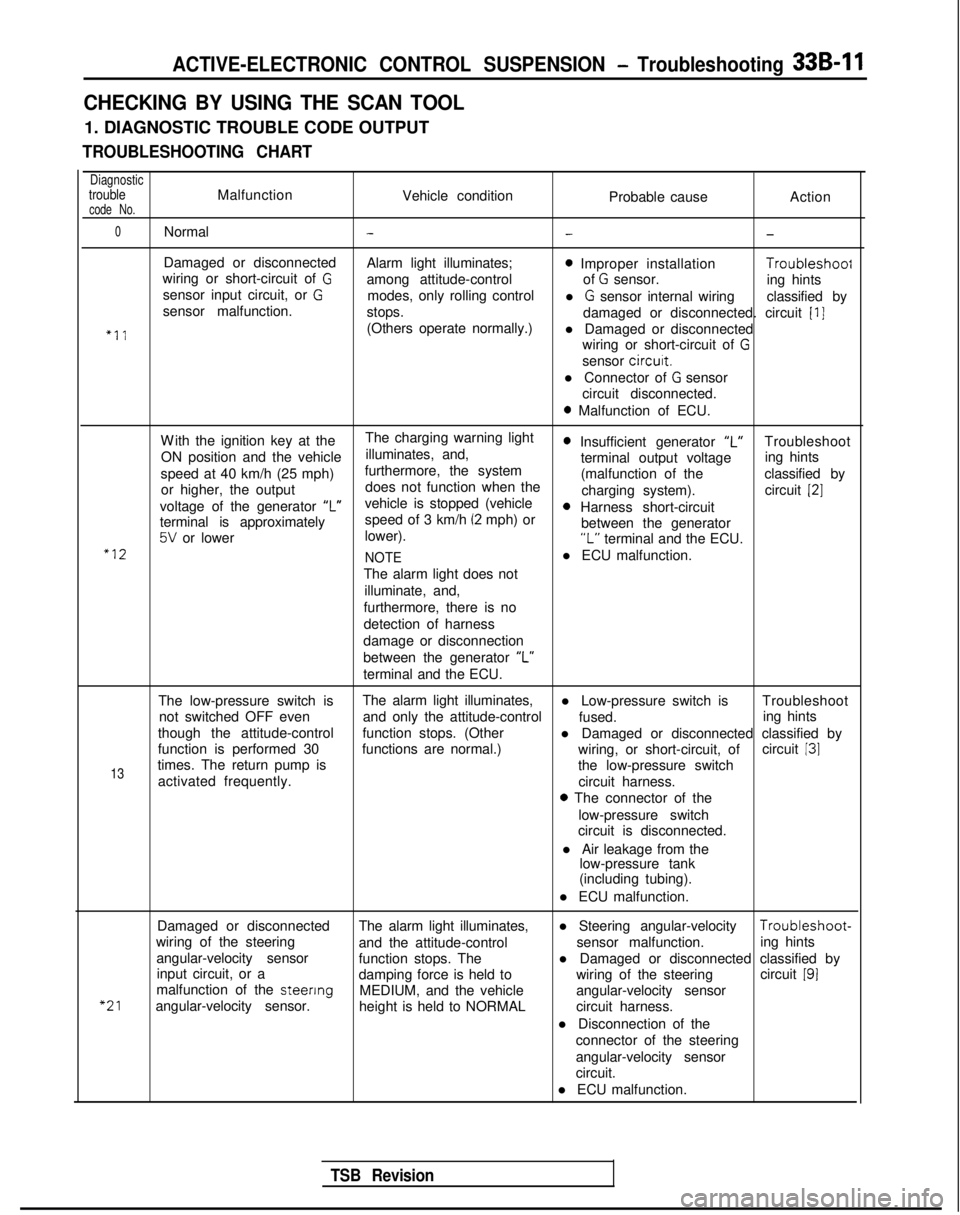
CHECKING BY USING THE SCAN TOOL
1. DIAGNOSTIC TROUBLE CODE OUTPUT
TROUBLESHOOTING CHART
DiagnostictroubleMalfunctionVehicle conditioncode No.Probable causeAction
0Normal---
Damaged or disconnected
Alarm light illuminates;0 Improper installation Troubleshoof
wiring or short-circuit of Gamong attitude-control of G sensor.
sensor input circuit, or Ging hints
modes, only rolling control
sensor malfunction. l
G sensor internal wiring
classified by
stops. damaged or disconnected. circuit
[I]
“11(Others operate normally.)l Damaged or disconnected
wiring or short-circuit of
G
sensor circurt.
l Connector of
G sensor
circuit disconnected.
0 Malfunction of ECU.
W
ith the ignition key at the
The charging warning light
ON position and the vehicle illuminates, and,
0 Insufficient generator “L”Troubleshoot
speed at 40 km/h (25 mph) furthermore, the system terminal output voltage
ing hints
or higher, the output does not function when the (malfunction of the
classified by
charging system). circuit
[2]
voltage of the generator ‘I”vehicle is stopped (vehicle0 Harness short-circuit
terminal is approximately speed of 3 km/h (2 mph) or
5V or lower
lower). between the generator“L” terminal and the ECU.“12
NOTEl ECU malfunction.
The alarm light does not illuminate, and,
furthermore, there is no
detection of harness
damage or disconnection
between the generator “L”
terminal and the ECU.
The low-pressure switch is The alarm light illuminates,
l Low-pressure switch is Troubleshoot
not switched OFF even and only the attitude-control
fused.
though the attitude-control ing hints
function stops. (Other l Damaged or disconnected classified by
function is performed 30 functions are normal.) circuit
131
13times. The return pump is wiring, or short-circuit, of
the low-pressure switch
activated frequently. circuit harness.
0 The connector of the
low-pressure switch
circuit is disconnected.
l Air leakage from the low-pressure tank
(including tubing).
l ECU malfunction.
“21
Damaged or disconnected The alarm light illuminates,l Steering angular-velocity Troubleshoot-
wiring of the steering and the attitude-control sensor malfunction.
angular-velocity sensor ing hints
function stops. The
input circuit, or a l Damaged or disconnected classified by
damping force is held to wiring of the steeringcircuit
191malfunction of the steenng
MEDIUM, and the vehicle
angular-velocity sensor. angular-velocity sensor
height is held to NORMAL circuit harness.
l Disconnection of the connector of the steering
angular-velocity sensor
circuit.
l ECU malfunction.
TSB Revision
Page 951 of 1273
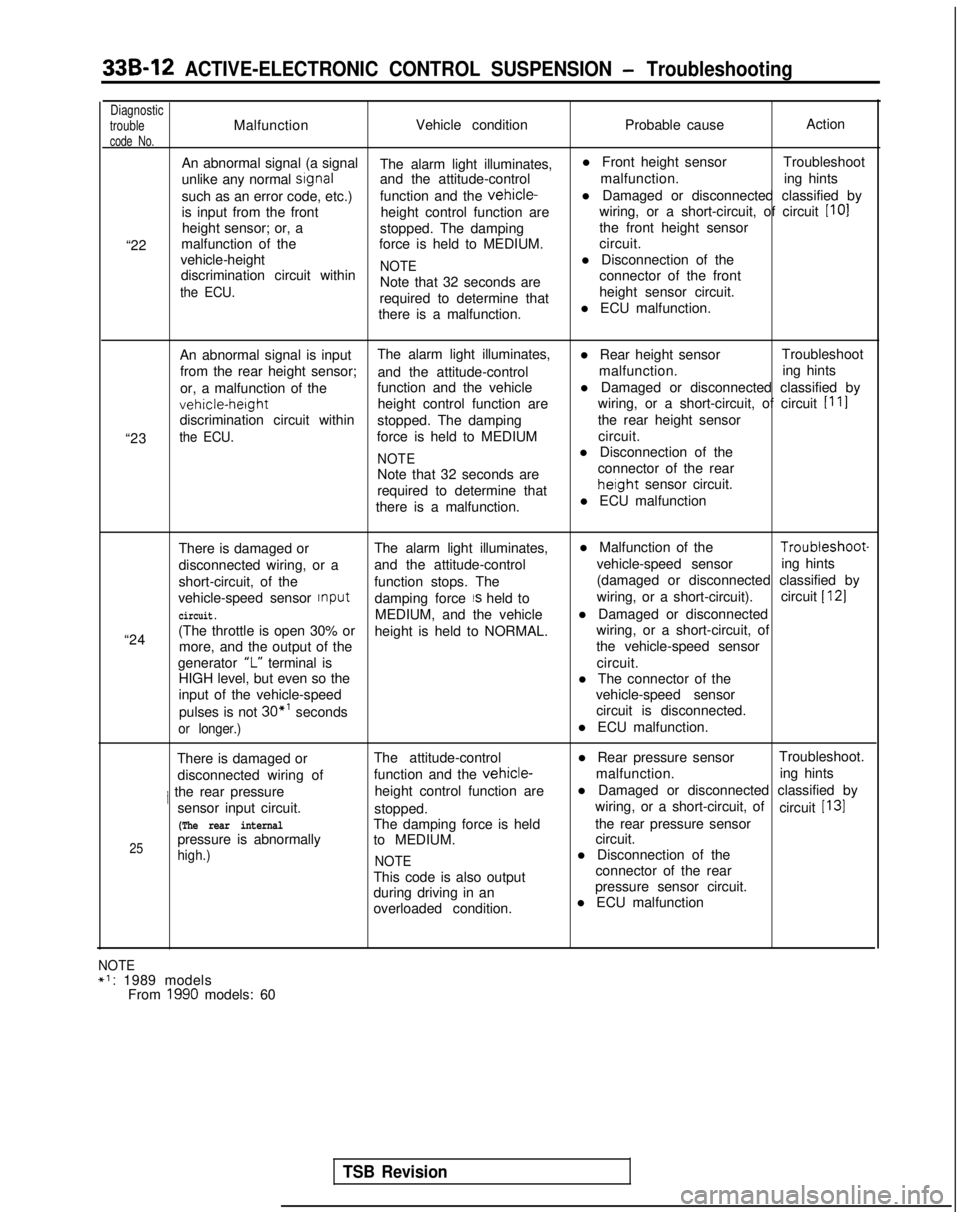
33B-12 ACTIVE-ELECTRONIC CONTROL SUSPENSION - Troubleshooting
Diagnostic
troubleMalfunction Vehicle condition
Probable causeAction
code No.
An abnormal signal (a signal
The alarm light illuminates, l Front height sensor
Troubleshoot
unlike any normal
srgnaland the attitude-control malfunction.
ing hints
such as an error code, etc.) function and the
vehicle-l Damaged or disconnected classified by
is input from the front height control function are wiring, or a short-circuit, of circuit [IO]
height sensor; or, a stopped. The damping the front height sensor
“22 malfunction of the
force is held to MEDIUM. circuit.
vehicle-height
NOTEl Disconnection of the
discrimination circuit within
the ECU.Note that 32 seconds are connector of the front
required to determine that height sensor circuit.
there is a malfunction. l ECU malfunction.
“23 An abnormal signal is input
The alarm light illuminates,
l Rear height sensorTroubleshoot
from the rear height sensor; and the attitude-control malfunction.
ing hints
or, a malfunction of the function and the vehicle
l Damaged or disconnected classified byvehicle-height
height control function are
wiring, or a short-circuit, of circuit
[I 11
discrimination circuit within
stopped. The damping the rear height sensor
the ECU.force is held to MEDIUM circuit.
NOTEl Disconnection of the
Note that 32 seconds are connector of the rear
required to determine that
height sensor circuit.
there is a malfunction. l ECU malfunction
There is damaged or The alarm light illuminates, l Malfunction of the Troubleshoot-
disconnected wiring, or a and the attitude-control vehicle-speed sensor
ing hints
short-circuit, of the function stops. The (damaged or disconnected classified by
vehicle-speed sensor Input
damping force
IS held to wiring, or a short-circuit).
circuit [ 121
circuit.MEDIUM, and the vehicle l Damaged or disconnected
“24 (The throttle is open 30% or
height is held to NORMAL. wiring, or a short-circuit, of
more, and the output of the the vehicle-speed sensor
generator “L”
terminal is circuit.
HIGH level, but even so the l The connector of the
input of the vehicle-speed vehicle-speed sensor
pulses is not
30*’ seconds circuit is disconnected.
or longer.)l ECU malfunction.
There is damaged or The attitude-control
l Rear pressure sensorTroubleshoot.
disconnected wiring of function and the
vehicle-malfunction.
ing hints
/ the rear pressure height control function arel Damaged or disconnected classified by
sensor input circuit. stopped. wiring, or a short-circuit, of
circuit
[I31
(The rear internalThe damping force is held the rear pressure sensor
25pressure is abnormally
to MEDIUM. circuit.
high.)
NOTEl Disconnection of the
This code is also output connector of the rear
during driving in an pressure sensor circuit.
overloaded condition. l ECU malfunction
NOTE+1: 1989 models
From 1990 models: 60
TSB Revision
Page 954 of 1273
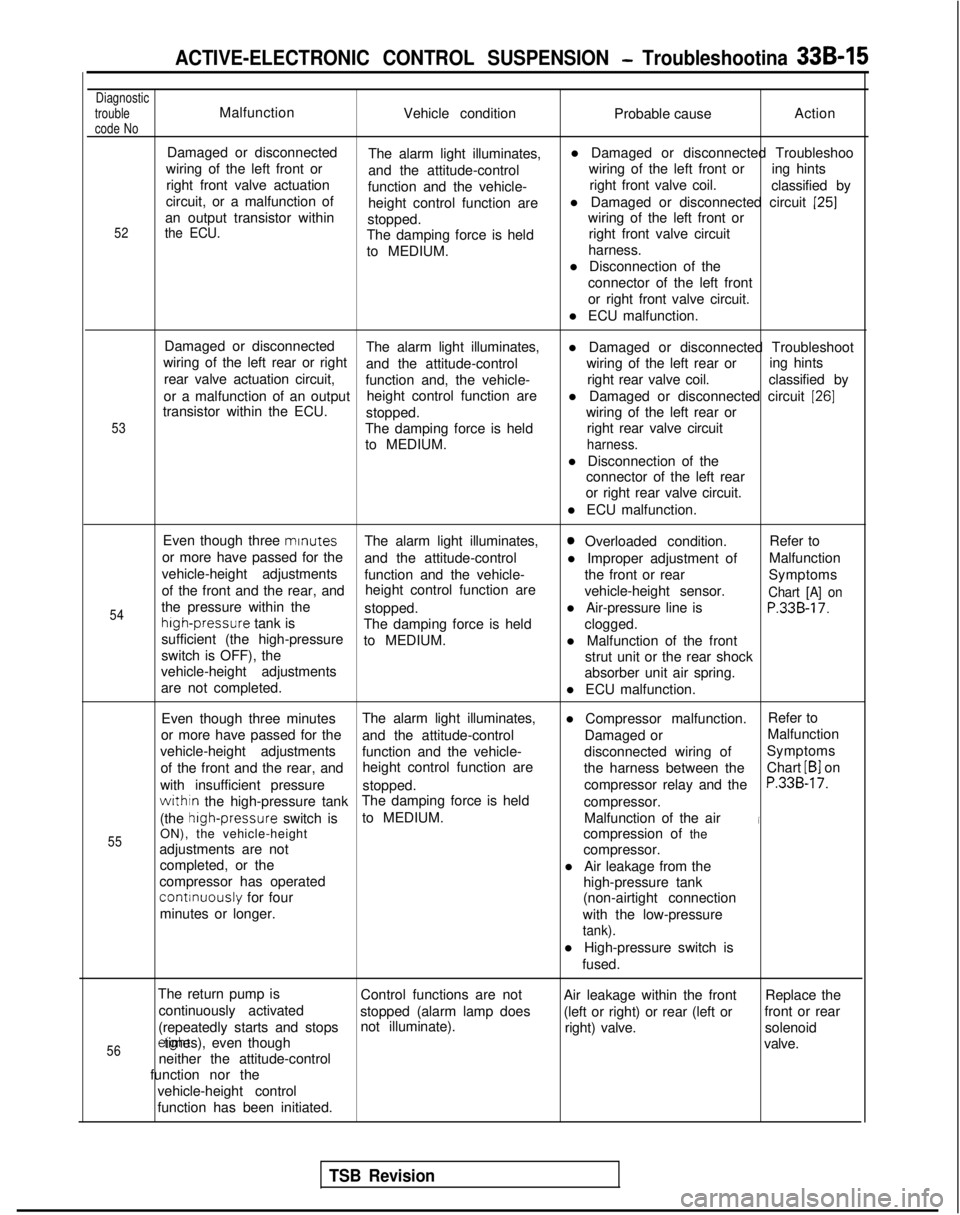
ACTIVE-ELECTRONIC CONTROL SUSPENSION - Troubleshootina 33B-15
Diagnostic
trouble
code NoMalfunction Vehicle condition Probable causeAction
52
Damaged or disconnected
The alarm light illuminates, l Damaged or disconnected Troubleshoo
wiring of the left front or and the attitude-control wiring of the left front or
ing hints
right front valve actuation function and the vehicle- right front valve coil.
classified by
circuit, or a malfunction of height control function arel Damaged or disconnected circuit
[25]an output transistor within
stopped. wiring of the left front orthe ECU.The damping force is held
right front valve circuit
to MEDIUM. harness.
l Disconnection of the connector of the left front
or right front valve circuit.
l ECU malfunction.
53
Damaged or disconnected The alarm light illuminates,
wiring of the left rear or right l Damaged or disconnected Troubleshoot
and the attitude-control wiring of the left rear or
rear valve actuation circuit, ing hints
function and, the vehicle- right rear valve coil.
classified by
or a malfunction of an output height control function are
transistor within the ECU. l Damaged or disconnected circuit
[26]
stopped.
wiring of the left rear or
The damping force is held right rear valve circuit
to MEDIUM.
harness.
l Disconnection of the connector of the left rear
or right rear valve circuit.
l ECU malfunction.
54
55
Even though three mrnutes
The alarm light illuminates,0 Overloaded condition. Refer to
or more have passed for the and the attitude-control l Improper adjustment ofMalfunction
vehicle-height adjustments function and the vehicle- the front or rear
of the front and the rear, and Symptoms
height control function are vehicle-height sensor.
Chart [A] onthe pressure within thestopped.l Air-pressure line isP.33B-17.high-pressure
tank is
The damping force is held
sufficient (the high-pressure clogged.
to MEDIUM. l Malfunction of the front
switch is OFF), the strut unit or the rear shock
vehicle-height adjustments absorber unit air spring.
are not completed. l ECU malfunction.
Even though three minutes The alarm light illuminates,
l Compressor malfunction.Refer to
or more have passed for the and the attitude-control Damaged orMalfunction
vehicle-height adjustments function and the vehicle- disconnected wiring ofSymptoms
of the front and the rear, and height control function are
the harness between theChart
LB1 on
with insufficient pressure stopped. compressor relay and the
P.33B-17.
withtn the high-pressure tankThe damping force is held
compressor.
(the high-pressure
switch isto MEDIUM.
Malfunction of the air
iON), the vehicle-height compression of the
adjustments are not compressor.
completed, or the l Air leakage from the
compressor has operated
continuously for four high-pressure tank
minutes or longer. (non-airtight connection
with the low-pressure
tank).
l High-pressure switch is fused.
The return pump is Control functions are not Air leakage within the frontReplace the
continuously activated stopped (alarm lamp does (left or right) or rear (left orfront or rear
(repeatedly starts and stops not illuminate).
right) valve.solenoid
56erght times), even though
valve.
neither the attitude-control
function nor the
vehicle-height control
function has been initiated.
TSB Revision
Page 956 of 1273
![MITSUBISHI GALANT 1989 Service Repair Manual ACTIVE-ELECTRONIC CONTROL SUSPENSION - Troubleshooting 33B-17
CHECKING ACCORDING TO CHARTS CLASSIFIED BY THE MALFUNCTION SYMPTOM
[A] DIAGNOSTIC TROUBLE CODE NO.54
No
Yes
b Excessive vehicle-height ad-](/manual-img/19/57312/w960_57312-955.png "MITSUBISHI GALANT 1989 Service Repair Manual ACTIVE-ELECTRONIC CONTROL SUSPENSION - Troubleshooting 33B-17
CHECKING ACCORDING TO CHARTS CLASSIFIED BY THE MALFUNCTION SYMPTOM
[A] DIAGNOSTIC TROUBLE CODE NO.54
No
Yes
b Excessive vehicle-height ad-")
ACTIVE-ELECTRONIC CONTROL SUSPENSION - Troubleshooting 33B-17
CHECKING ACCORDING TO CHARTS CLASSIFIED BY THE MALFUNCTION SYMPTOM
[A] DIAGNOSTIC TROUBLE CODE NO.54
No
Yes
b Excessive vehicle-height ad-justment
(overload) overload). time (due to -Unload the vehicle and turn* the ignition key to OFF; then
restart the engine and check
whether or not the system
functions normally.
Is the installation position of Nothe height sensor correct?
Yes Improper setting of the heightc sensor, or malfunction of the
height sensor. l Correct the installationcposition of the height sen-
sor, or adjust the vehicle
-height sensor rod.
l Check the height sensor. Refer to troubleshooting
hints [IO] and
[ll]classified by circuit.
Are the front strut and rear
NoMalfunction of the rolling
shock absorber unit air spr-* diaphragm.
Repair the rolling diaphragm,
or replace the shock absorber
ings in normal condition?Lunit.
(become folded)
Yes
Is the sound of operation
NoThe solenoid valves remain
heard from each solenoid closed, or there is air leakage
valve necessary for th
e
’ due to a malfunction of the
vehicle-height adjustment? valve seat.
Yes
Is the air pressure in the
vehicle-height adjustment
Nopressure line 950 kPa (135
psi) or higher?
I
Yes Damaged or disconnected
wiring of the high-pressure
switch, or incorrect vehicle
-height adjustment pressureline.
l Check the high-pressure switch circuit.
* Refer to troubleshooting hint [5] classified by circuit.
l Correct the clogging pro-
blem, or replace the air
tube.
Control unit malfunction.
[B] DIAGNOSTIC TROUBLE CODE NO.55
- No
Does the compressor func-
tion normally?
Yes Replace the control unit.c l Power is not supplied to
the compressor.Refer to troubleshooting
hint
[18] classified by cir-
cuit.
0 Improper compressor com- pression.
Is the air pressure in the
Novehicle-height adjustment
pressure line 760 kPa (108psi) or lower? High-pressure
switch
isRefer to troubleshooting hint
shorted____* [5] classified by circuit.
Yes Air leakage.
TSB RevisionI
Page 957 of 1273
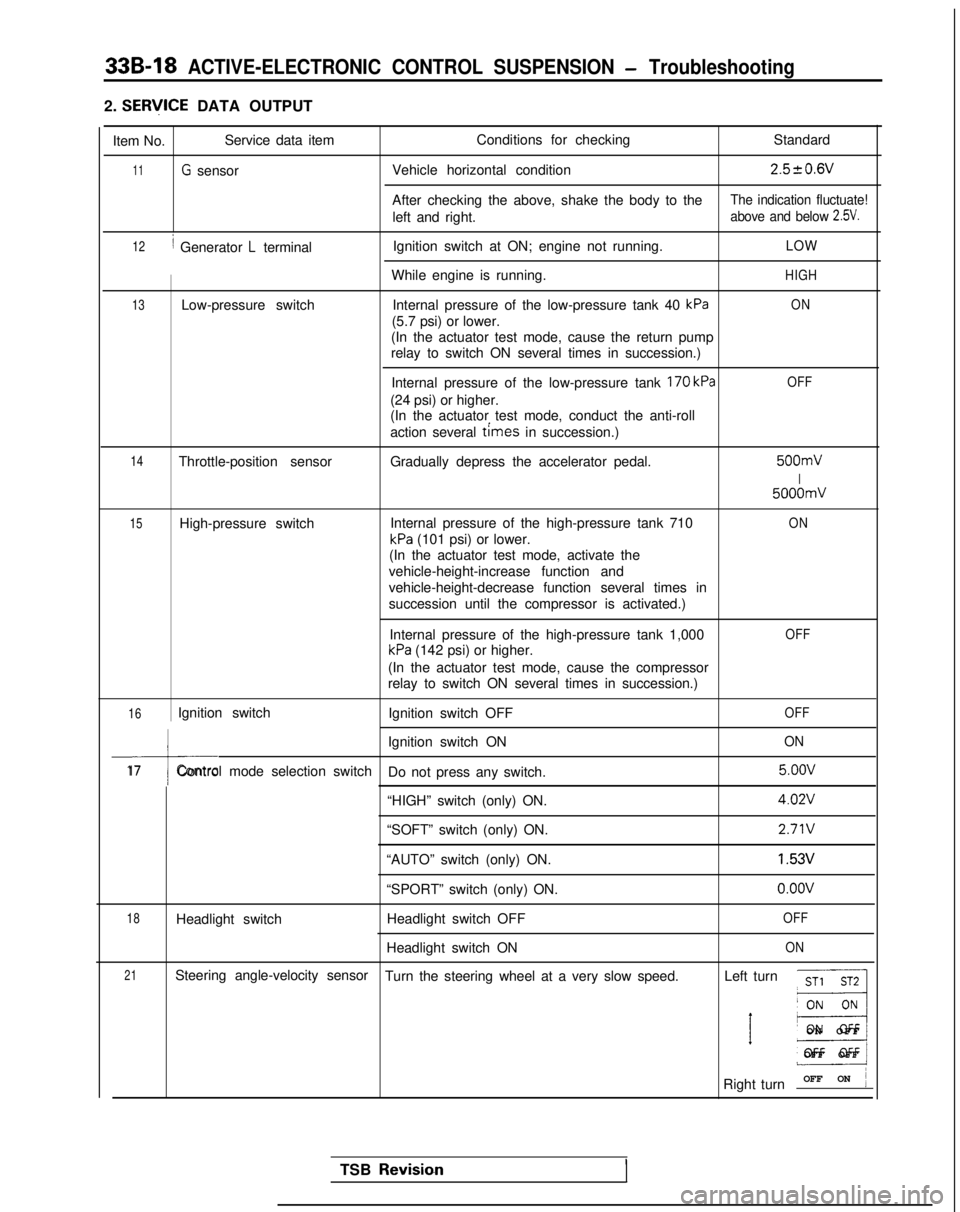
33B-18 ACTIVE-ELECTRONIC CONTROL SUSPENSION - Troubleshooting
2. SERlflCE DATA OUTPUT
Item No. Service data item
Conditions for checking
Standard
11G sensorVehicle horizontal condition2.520.6V
After checking the above, shake the body to theThe indication fluctuate!
left and right.above and below 2.5V.
12/ Generator L terminalIgnition switch at ON; engine not running.LOW
While engine is running.HIGH
13Low-pressure switch
Internal pressure of the low-pressure tank 40 kPaON
(5.7 psi) or lower.
(In the actuator test mode, cause the return pump
relay to switch ON several times in succession.)
Internal pressure of the low-pressure tank
170 kPa
(24 psi) or higher.
(In the actuator test mode, conduct the anti-roll
action several
times in succession.)
OFF
14Throttle-position sensor Gradually depress the accelerator pedal. 500mV
I
5000mV
15High-pressure switch
Internal pressure of the high-pressure tank 710ON
kPa (101 psi) or lower.
(In the actuator test mode, activate the
vehicle-height-increase function and
vehicle-height-decrease function several times in
succession until the compressor is activated.)
Internal pressure of the high-pressure tank 1,000
kPa (142 psi) or higher.
OFF
(In the actuator test mode, cause the compressor
relay to switch ON several times in succession.)
16Ignition switch Ignition switch OFFOFF
I
Ignition switch ONON
17Control mode selection switch
Do not press any switch. 5.oov
“HIGH” switch (only) ON.
4.02V
“SOFT” switch (only) ON.2.71V
“AUTO” switch (only) ON.1.53V
“SPORT” switch (only) ON.o.oov
18Headlight switch Headlight switch OFFOFF
Headlight switch ONON
21Steering angle-velocity sensor
Turn the steering wheel at a very slow speed. Left turnST1 ST2
__I
’ E3
ON OF
F
OFF OFF
Right turn OFF ON
j
TSB Revisio.nI
Page 958 of 1273
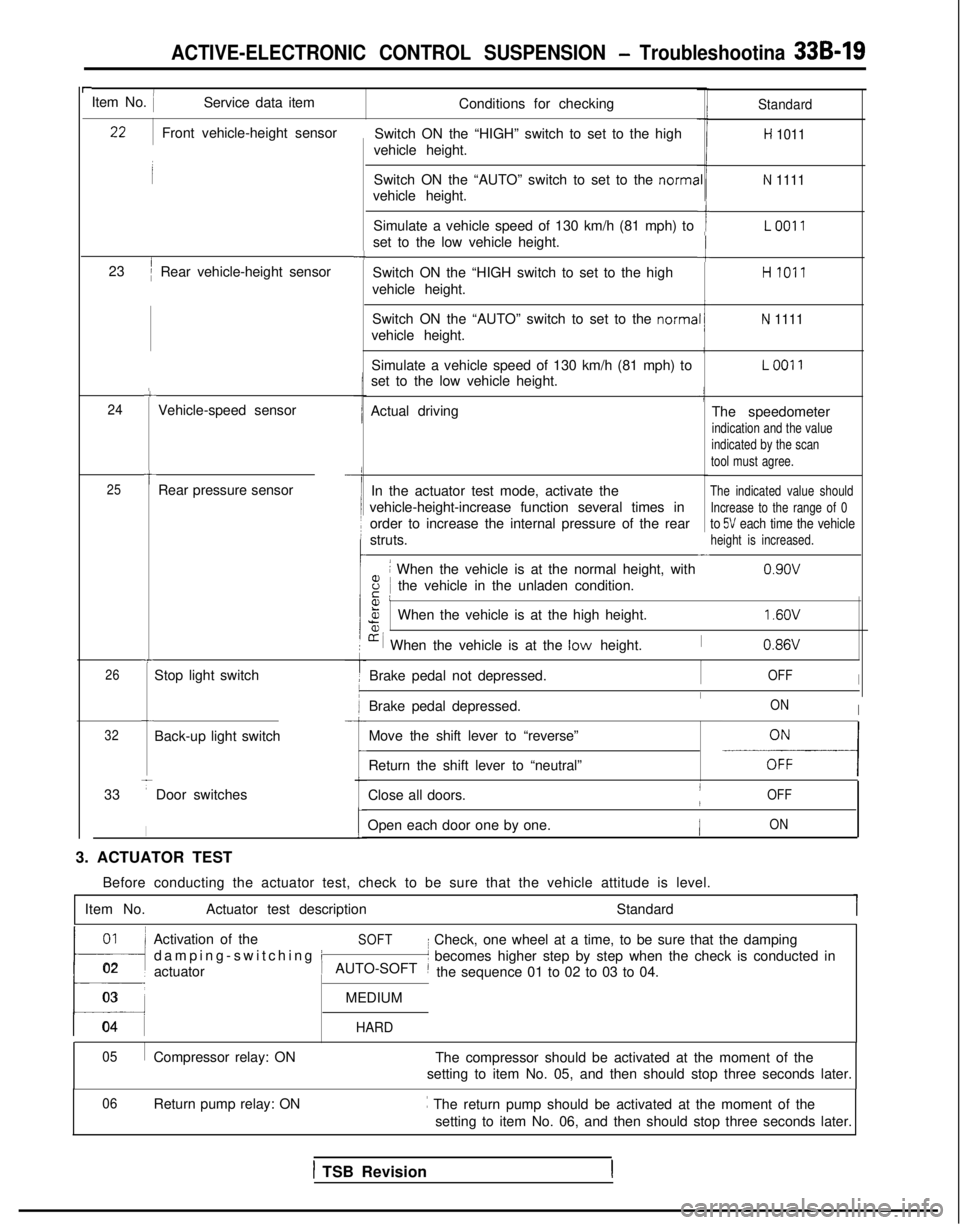
ACTIVE-ELECTRONIC CONTROL SUSPENSION - Troubleshootina 33B-19
rItem No. IService data itemConditions for checking
Switch ON the “HIGH” switch to set to the high
vehicle height.Standard
H 1011
Switch ON the “AUTO” switch to set to the norma
vehicle height.N 1111
Simulate a vehicle speed of 130 km/h (81 mph) to
set to the low vehicle height.ILO011
-cSwitch ON the “HIGH switch to set to the high
vehicle height.HI011
Switch ON the “AUTO” switch to set to the norma
vehicle height.
N 1111
Simulate a vehicle speed of 130 km/h (81 mph) to
set to the low vehicle height.LOO11
Actual driving The speedometer
indication and the value
indicated by the scan
tool must agree.
In the actuator test mode, activate theThe indicated value should
vehicle-height-increase function several times inIncrease to the range of 0
order to increase the internal pressure of the rearto 5V each time the vehicle
struts.height is increased.-
8
i When the vehicle is at the normal height, with
iE Ithe vehicle in the unladen condition. 0.9ov
Front vehicle-height sensor
23
’/Rear vehicle-height sensor
-4
c
24Vehicle-speed sensor
t25Rear pressure sensor
Fa,%When the vehicle is at the high height.
[r i When the vehicle is at the low height.
1.6OV
I0.86VT
26Stop light switch Brake pedal not depressed.IOFFI
Brake pedal depressed.IONIc
32Back-up light switch
33
TDoor switches
I
Move the shift lever to “reverse”
-E-----l
-
Return the shift lever to “neutral”
Close all doors.
IOFF/
Open each door one by one.ION
3. ACTUATOR TEST Before conducting the actuator test, check to be sure that the vehicle a\
ttitude is level.
Item No. Actuator test description Standard
01~
!l
Activation of theSOFT
damping-switching i
I Check, one wheel at a time, to be sure that the damping
02 actuator
t’ becomes higher step by step when the check is conducted in
AUTO-SOFT ~the sequence 01 to 02 to 03 to 04.
03MEDIUM
04 HARD
05
Compressor relay: ON The compressor should be activated at the moment of the
setting to item No. 05, and then should stop three seconds later.
Return pump relay: ON ~
The return pump should be activated at the moment of the
setting to item No. 06, and then should stop three seconds later.
06
1 TSB Revision