1988 PONTIAC FIERO octane
[x] Cancel search: octanePage 551 of 1825
6EZ-B-4 5.OL (VIN E) DRIVEABILITY AND EMISSIONS
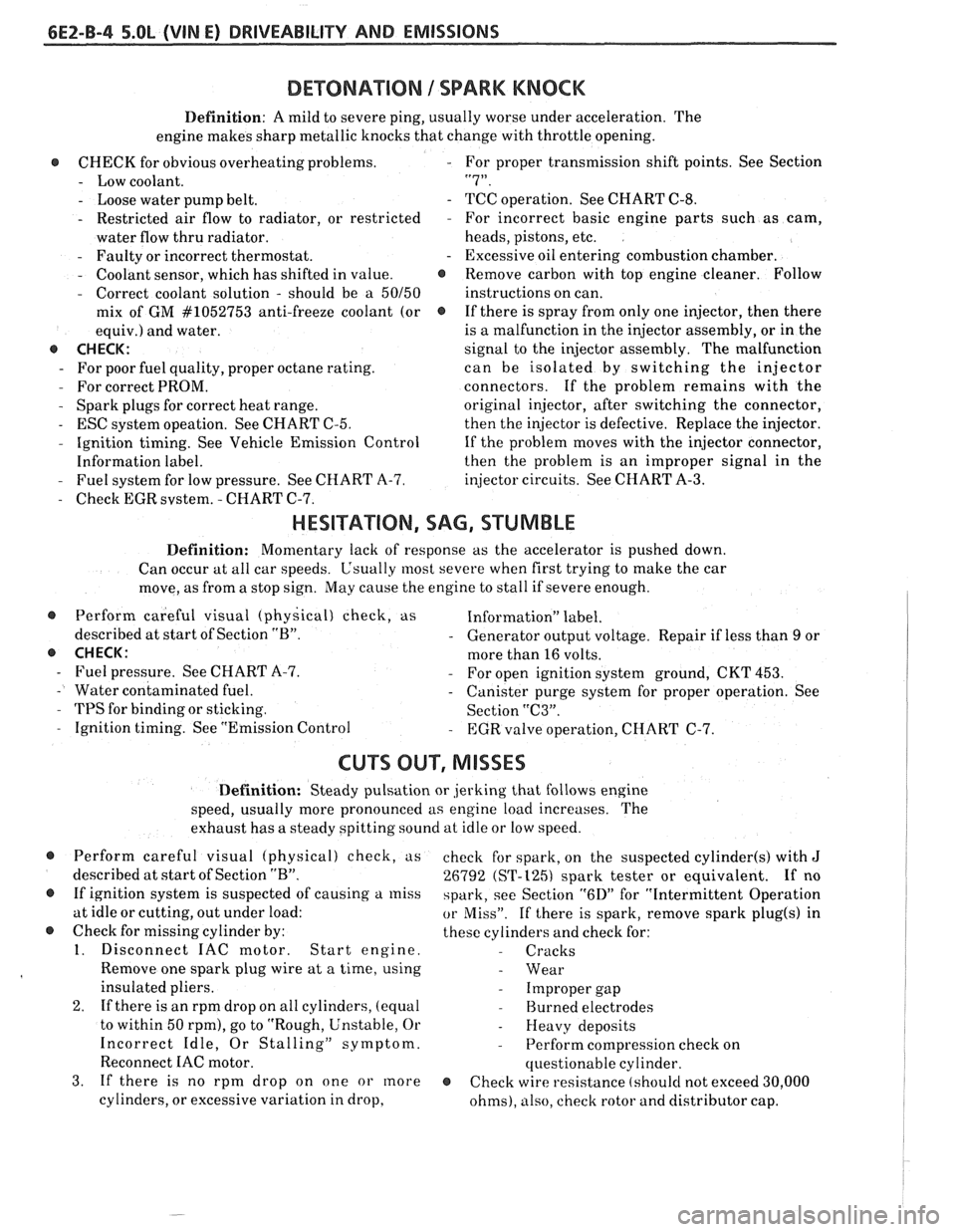
DEWNATION 1 SPARK KNOCK
Definition: A mild to severe ping, usually worse under acceleration. The
engine makes sharp metallic knocks that change with throttle opening.
@ CHECK for obvious overheatingproblems. - For proper transmission shift points. See Section
- Low coolant. "7".
- Loose water pump belt. - TCC operation. See CHART C-8.
- Restricted air flow to radiator, or restricted - For incorrect basic engine parts such as cam,
water flow thru radiator. heads,
pistons, etc.
- Faulty or incorrect thermostat. - Excessive oil entering combustion chamber.
- Coolant sensor, which has shifted in value. @ Remove carbon with top engine cleaner. Follow
- Correct coolant solution - should be a 50150 instructions on can.
mix of GM
#lo52753 anti-freeze coolant (or @ If there is spray from only one injector, then there
equiv.) and water. is
a malfunction in the injector assembly, or in the
@ CHECK: signal to the injector assembly. The malfunction
- For poor fuel quality, proper octane rating. can be isolated by switching the injector
- For correct PROM. connectors. If the problem remains with the
- Spark plugs for correct heat range.
original injector, after switching the connector,
- ESC system opeation. See CHART C-5.
then the injector is defective. Replace the injector.
- Ignition timing. See Vehicle Emission Control
If the problem moves with the injector connector,
Information label. then the
problem is an improper signal in the
- Fuel system for low pressure. See CHART A-7.
injector circuits. See CHART A-3.
- Check EGR svstem. - CHART C-7.
HESITATION, SAG, STUMBLE
Definition: Momentary lack of response as the accelerator is pushed down.
Can occur at all car speeds.
C'sually most severe when first trying to make the car
move, as from a stop sign.
May cause the engine to stall if severe enough.
@ Perform careful visual (physical) check, as Information" label.
described at start of Section
"B". - Generator output voltage. Repair if less than 9 or
@ CHECK: more than 16 volts.
- Fuel pressure. See CHART A-7. - For open ignition system ground, CKT 453.
- Water contaminated fuel. - Canister purge system for proper operation. See
- TPS for binding or sticking.
Section "C3".
- Ignition timing. See "Emission Control - EGR valve operation, CHART C-7.
CU"F OUT, MISSES
Definition: Steady pulsation or jerking that follows engine
speed, usually more pronounced as engine load increases. The
exhaust has a steady spitting sound at idle or low speed.
@ Perform careful visual (physical) check, us
described at start of Section
"B".
@ If ignition system is suspected of causing a miss
at idle or cutting, out under load:
@ Check for missing cylinder by:
1. Disconnect IAC motor. Start engine.
Remove one spark plug wire at a time, using
insulated pliers.
2. If there is an rpm drop on all cylinders, (equal
to within 50
rpm), go to "Rough, Unstable, Or
Incorrect Idle, Or Stalling" symptom.
Reconnect
IAC motor.
3. If there is no rpm drop on one or more
cylinders, or excessive variation in drop, check
for spark, on the suspected
cylinder(s) with J
26792 (ST-1251 spark tester or equivalent. If no
spark, see Section
"6D" for "Intermittent Operation
or Miss". If there is spark, remove spark plug(s) in
these cylinders and check for:
- Cracks
- Wear
- Improper gap
- Burned electrodes
- Heavy deposits
- Perform compression check on
questionable cylinder.
@ Check wire resistance (shoulcl not exceed 30,000
ohms), also, check rotor and distributor cap.
Page 606 of 1825
DRIVEABILITY AND EMISSIONS 5.OL (VIN E) 6E2-C5-1
ELECmONIC SPARK CONTROL (ESC) SYSTEM
CONTENTS
GENERAL DESCRIPTION ................ C5-1 ON-CAR SERVICE ..................... C5-1
PURPOSE
......................... C5-1 ESC KNOCK SENSOR ................ C5-1
OPERATION
....................... C5-1 ESC MODULE ...........e..e.e..... C5-1
DIAGNOSIS
......................... C5-1 PARTS INFORMATION ................. C5-2
RESULTS OF INCORRECT ESC OPERATION
. C5-1
GENERAL DESCRIPTION
PURPOSE
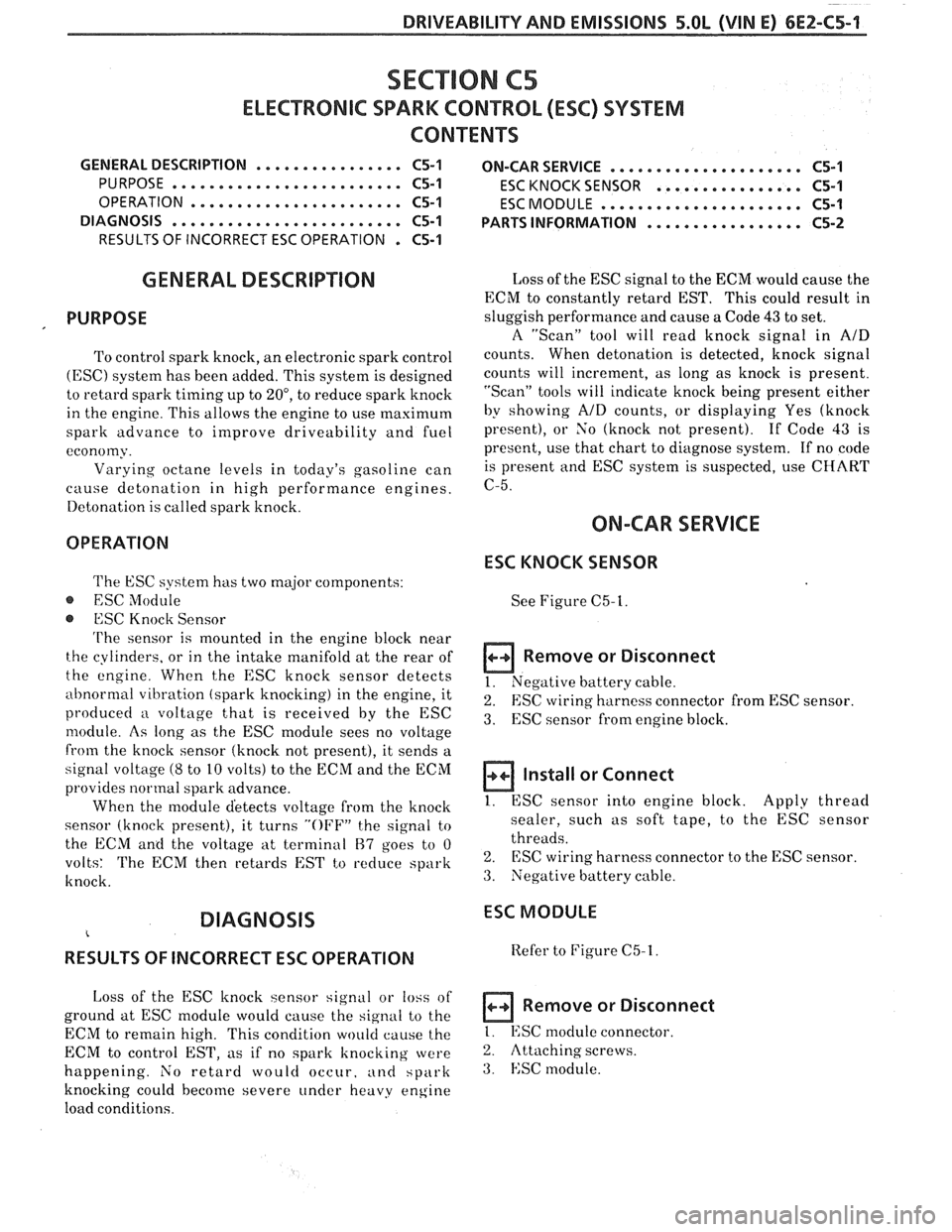
To control spark knock, an electronic spark control
(ESC) system has been added. This system is designed
to retard spark timing up to
20°, to reduce spark knock
in the engine. This allows the engine to use maximum
spark advance to
improve driveability and fuel
economy. Varying octane levels in today's gasoline can
cause detonation in high performance engines.
Detonation is called spark knock. Loss
of the ESC signal to the ECM would cause the
ECM to constantly retard EST. This could result in
sluggish performance and cause a Code
43 to set.
A "Scan" tool will read knock signal in
AID
counts. When detonation is detected, knock signal
counts will increment,
as long as knock is present.
"Scan" tools will indicate knock being present either
by showing
AID counts, or displaying Yes (knock
present), or No (knock not present). If Code
43 is
present, use that chart to diagnose system. If no code
is present and ESC system is suspected, use CHART
C-5.
ON-CAR SERVICE
OPERATION
ESC KNOCK SENSOR
'I'he ESC system has two major components:
e ESC Module
@ ESC Knock Sensor
The sensor is mounted in the engine block near
the cylinders, or in the intake manifold at the rear of
the engine. When the ESC knock sensor detects
abnormal vibration (spark knocking) in the engine, it
produced
a voltage that is received by the ESC
module. As long as the ESC module sees no voltage
from the knock sensor (knock not present), it sends a
signal voltage
(8 to 10 volts) to the ECM and the ECM
provides normal spark advance.
When the module
d'etects voltage from the knock
sensor (knock present), it turns "OFF" the signal to
the ECM and the voltage at terminal
B7 goes to 0
volts: The ECM then retards EST to reduce spark
knock.
DIAGNOSIS
See Figure C5-1.
Remove or Disconnect
1. Negative battery cable.
2. ESC wiring harness connector from ESC sensor.
3. ESC sensor from engine block.
Install or Connect
I. ESC sensor into engine block. Apply thread
sealer, such as soft tape, to the ESC sensor
threads.
2. ESC wiring harness connector to the ESC sensor.
3. Negative battery cable.
ESC MODULE
RESULTS OF INCORRECT ESC OPERATION
Refer to Figure C5- 1
Loss of the ESC knock sensor signal or loss of
ground at ESC module would cause the signal to the a Remove or Disconnect
ECM to remain hiph. This condition would cause the 1. ESC module connector. L. ECM to control EST, as if no spark knocking were 2. Attachingscrews.
happening. No retard would occur, and spark 3. p;SCmodule.
knocking could become severe under heavy engine
load conditions.
Page 922 of 1825
DRIVEABILITY AND EMISSIONS 5.OL (VIN F) & 5.7L (VIN 8) 6E3-C5-1
SECTION C5
ELECTRONIC SPARK CONTROL (ESC) SYSTEM
CONTENTS
GENERAL DESCRIPTION ................ C5-1 ON-CAR SERVICE ..................... C5-1
PURPOSE ......................... C5-1 ESCSENSOR e............e......... C5-1
GENERAL DESCRIPTION .............. C5-1 ESC MODULE AND BRACKET .......... C5-2
DIAGNOSIS
......................... C5-1 PARTS INFORMATION ................. C5-2
GENERAL DESCRIPTION DIAGNOSIS
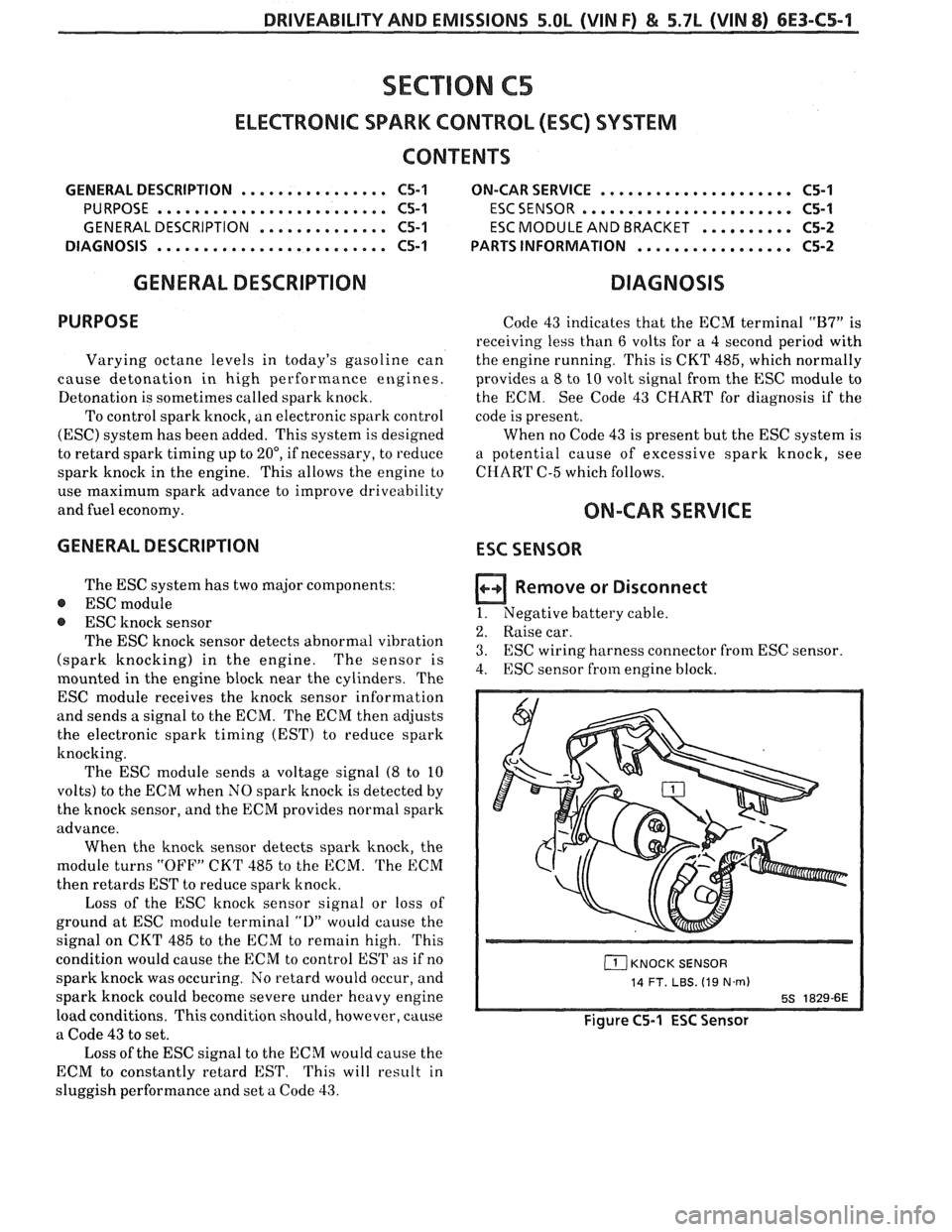
PURPOSE
Varying octane levels in today's gasoline can
cause detonation in high performance engines.
Detonation is sometimes called spark knock.
To control spark knock, an electronic spark control
(ESC) system has been added. This system is designed
to retard spark timing up to
20°, if necessary, to reduce
spark knock in the engine. This allows the engine to
use maximum spark advance to improve driveability
and fuel economy. Code
43 indicates that the ECM terminal
"B7" is
receiving less than
6 volts for a 4 second period with
the engine running. This is CKT 485, which normally
provides
u 8 to 10 volt signal from the ESC module to
the ECM. See Code 43 CHART for diagnosis if the
code is present.
When no Code 43 is present but the ESC system is
a potential cause of excessive spark knock, see
CI-IART C-5 which follows.
ON-CAR SERVICE
GENERAL DESCRIPTION ESC SENSOR
The ESC system has two major components:
@ ESC module
@ ESC knock sensor
The ESC knock sensor detects abnormal vibration
(spark knocking) in the engine. The
sensor is
mounted in the engine block near the cylinders. The
ESC module receives the knock sensor information
and sends a signal to the ECM. The ECM then adjusts
the electronic spark timing (EST) to reduce spark
knocking.
The ESC module sends a voltage signal
(8 to 10
volts) to the ECM when NO spark knock is detected by
the knock sensor, and the ECM provides normal spark
advance. When the knock sensor detects spark knock, the
module turns
"OFF" CKT 485 to the ECM. The ECM
then retards EST to reduce spark knock.
Loss of the ESC knock sensor signal or loss of
ground at ESC module terminal
"1)" would cause the
signal on CKT 485 to the ECM to remain high.
This
condition would cause the ECM to control EST as if no
spark knock was occuring. No retard would occur,
and
spark knock could become severe under heavy engine
load conditions. This condition should, however, cause
a Code
43 to set.
Loss of the ESC signal to the ECM would cause the
ECM to constantly retard EST. This will result in
sluggish performance and set a Code
43.
Remove or Disconnect
I. Negative battery cable.
2. Raise car.
3. ESC wiring harness connector from ESC sensor.
4. ESC sensor
from engine block.
(1 KNOCK SENSOR
14 FT. LBS. (19 N.m)
5s 1829-6E
Figure C5-1 ESC Sensor