Page 46 of 962

ConditionPossible causeCorrection
High fuel consumptionAbnormal condition ignition system
1. Improper ignition timingAdjust
2. Leak or loose connection of high tension cordRepair or replace
3. Defective spark plug (improper gap, heavyClean, adjust or replace
deposits, and burned electrodes, etc..)
4. Cracked distributor cap or rotorReplace
5. Malfunctioning mechanical and vacuumCheck and repair or
advancers in distributorreplace
Abnormal condition in fuel system
1. Improper float levelAdjust
2. Fuel leakage from tank, pipe or carburetorRepair or replace
3. Malfunctioning carburetor choke systemRepair or replace
4. Dirty or clogged carburetor jetsClean
5. Clogged air cleaner elementClean or replace
6. Malfunctioning thermostatically controlledCheck and repair or
air cleanerreplace
Abnormal condition in engine
1. Low compressionPreviously outlined
2. Poor valve seatingRepair or replace
3. Improper valve clearanceAdjust
Emission control
1. Air leaks at exhaust manifoldTighten manifold bolts
and nuts.
Replace gasket.
2. Oxygen sensor out of orderReplace.
3. Water temperature switch out of orderReplace.
4. Malfunctioning throttle position switchReplace
5. Malfunctioning MCS (mixture controlReplace
solenoid) valve in carburetor
6. Malfunctioning EGR valveReplace
Others
1. Dragging brakesRepair or replace
2. Slipping clutchAdjust or replace
3. Improper tire pressureAdjust
Excessive engine oilOil leakage
consumption1. Loose oil drain plugTighten
2. Loose oil pan securing boltsTighten
3. Deteriorated or broken oil pan sealantReplace sealant
4. Leaky oil sealsReplace
5. Blown cylinder head gasketReplace
6. Improper tightening of oil filterTighten
7. Loose oil pressure switchTighten
2-8
Page 47 of 962

Condition
Excessive engine oil
consumption
Possible cause
“Oil pumping” (Oil finding its way into
combustion chambers.)
1. Sticky piston ring
2. Worn piston ring groove and ring
3. Worn pistons or cylinders
Correction
Remove carbon and
replace rings
Replace piston and ring
Replace pistons and
rebore as necessary
Oil leakage along valve stems
1. Defective valve stem oil sealsReplace
2. Badly worn valve stemReplace
2-2. CARBURETOR
ConditionPossible causeICorrection
Fuel overflow from
carburetor
1, Float valve worn or dirty with foreign matterClean or replace
2. Float level set too highAdjust as prescribed
3. Float ruptured and containing some fuelReplace
4. Broken or otherwise defective gasketReplace
5. Loose float chamber securing screwsRetighten
2-3. EXHAUST AND MUFFLER
Condition
Poor muffling per-
formance
Possible cause
1. Loose exhaust pipe connection
2. Broken muffler gasket
3. Broken manifold, pipe or muffler
4. Exhaust manifold loose in place
5. Interference between body and muffler
Correction
Retighten
Replace
Repair or replace
Retighten
Repair, eliminating any
contact
2-4. CLUTCH
ConditionPossible causeICorrection
Slipping clutch Loss of clearance at the tip of release fork
2. Clutch facings dirty with oil
3. Clutch facings excessively worn
4. Weakened diaphragm spring
5. Distorted pressure plate or flywheel surface
6. Improper clutch pedal free travel
Adjust as prescribed
Replace
Replace
Replace
Replace
Adjust and, as necessary,
replace clutch facings
2-9
1.
Page 48 of 962

Condition
Clutch vibration
Noisy clutch
Grabbing clutch
2-5. TRANSMISSION
Condition
Gears slipping out of
mesh
Gears refusing to dis-
engage
Possible cause
1. Improper clutch pedal free travel
2. Weakened diaphragm spring, or worn spring
tip
3. Damaged or worn splines of transmission
input shaft
4. Front input shaft bearing worn or broken
5. Excessively wobbly clutch disc
6. Clutch facings broken or dirty with oil
1. Glazed (glass-like) clutch facings
2. Clutch facings dirty with oil
3. Wobbly clutch disc, or poor facing contact
4. Weakened torsion springs (in clutchdisc)
5. Clutch disc rivets loose
6. Distorted pressure plate or flywheel surface
7. Weakened engine mounting or loosened
mounting bolt or nut
1. Worn or broken release bearing
2. Front input shaft bearing worn down
3. Excessive rattle of clutch disc hub
4. Cracked clutch disc
5. Pressure plate and diaphragm spring rattling
1. Clutch facings soaked with oil
2. Excessively worn clutch facings
3. Rivet heads showing out of the facing
4. Weakened torsion springs
Possible cause
1. Worn shift fork shaft
2. Worn locating steel balls
3. Weakened springs for locating steel balls
4. Worn shift fork
5. Excessive rattle in thrust direction of gears
6. Worn ring or hub in synchronizers
7. Worn bearings of input shaft, main shaft or
countershaft
1. Weakened or broken synchronizer springs
2. Worn inner groove of synchronizer ring
3. Synchronizer ring seized on. the cone
4.Distorted shift fork shaft or shift fork
Correction
Adjust free travel
Replace
Replace
Replace
Replace
Replace
Repair or replace
Replace
Replace
Replace
Replace the disc
Replace
Retighten or replace
Replace
Replace
Replace the disc
Replace
Replace
Replace
Replace
Replace
Replace
Correction
Replace
Replace
Replace
Replace
Replace
Replace
Replace
Replace
Replace
Replace the ring
Replace.
Dragging clutch
2-10
Page 55 of 962
Condition
Starter will not run
at all, or runs but
runs too slow to
crank with full
force
Starter does not
stop running.
2-11. ALTERNATOR
Condition
Battery quickly
becomes over-
discharged.
Charge light does not
light with ignition ON
and engine off
Alternator noise
Possible cause
Magnet switch trouble
1. Lead wire socket loose in place
2. Burnt contact plate, or poor contacting
action
3. Open-circuit in pull-in coil
4. Open-circuit in holding coil
Starter proper trouble
1. Brushes seating poorly or worn down
2. Burnt commutator
3. Open-circuit in armature winding
4. Worn-down starter.
1. Fused contact points of magnet-switch
contact plate
2. Short-circuit between turns of magnet-
switch coil (layer short-circuit)
3. Failure of returning action in ignition
switch
Possible cause
1. Loose or broken “V” belt
2. Battery cables loose, corroded or worn
3. Low level of battery electrolyte
4. Defective battery cell plates
5. Insufficient contact in battery terminal
connection.
6. Excessive electrical load
7. IC regulator or alternator faulty
8. Defective idle up system
1. Fuse blown
2. Light burned out
3. Loose wiring connection
4. IC regulator faulty
1. Worn, loose or otherwise defective bearings
Correction
Retighten
Replace, or repair
Replace
Replace
Repair or replace
Repair or replace
Replace
Replace
Repair or replace
Replace
Replace
Correction
Adjust or replace
Repair or replcae
Replace
Replace the battery
Clean and retighten
Check charging system
Replace
Repair or replace
Check fuse
Replace light
Tighten loose connection!
Replace
i
Replace
2-17
Page 58 of 962
3-1.
3-2.
3-3.
3-5.
3-6.
3-7.
3-8.
3-9.
SECTION 3
ENGINE
CONTENTS
GENERAL DESCRIPTION.................................... 3-2
ENGINE SERVICES NOT REQUIRING ENGINE REMOVAL...... 3-5
ENGINE REMOVAL.......................................3-6
ENGINE DISASSEMBLY.................................. 3-9
INSPECTION OF ENGINE COMPONENTS....................3-17
ENGINE REASSEMBLY...................................3-35
ENGINE INSTALLATION.................................3-53
ENGINE MAINTENANCE SERVICE.........................3-53
RECOMMENDED TORQUE SPECIFICATIONS.................3-58
3-4.
3-1
3
Page 59 of 962
3-1. GENERAL DESCRIPTION
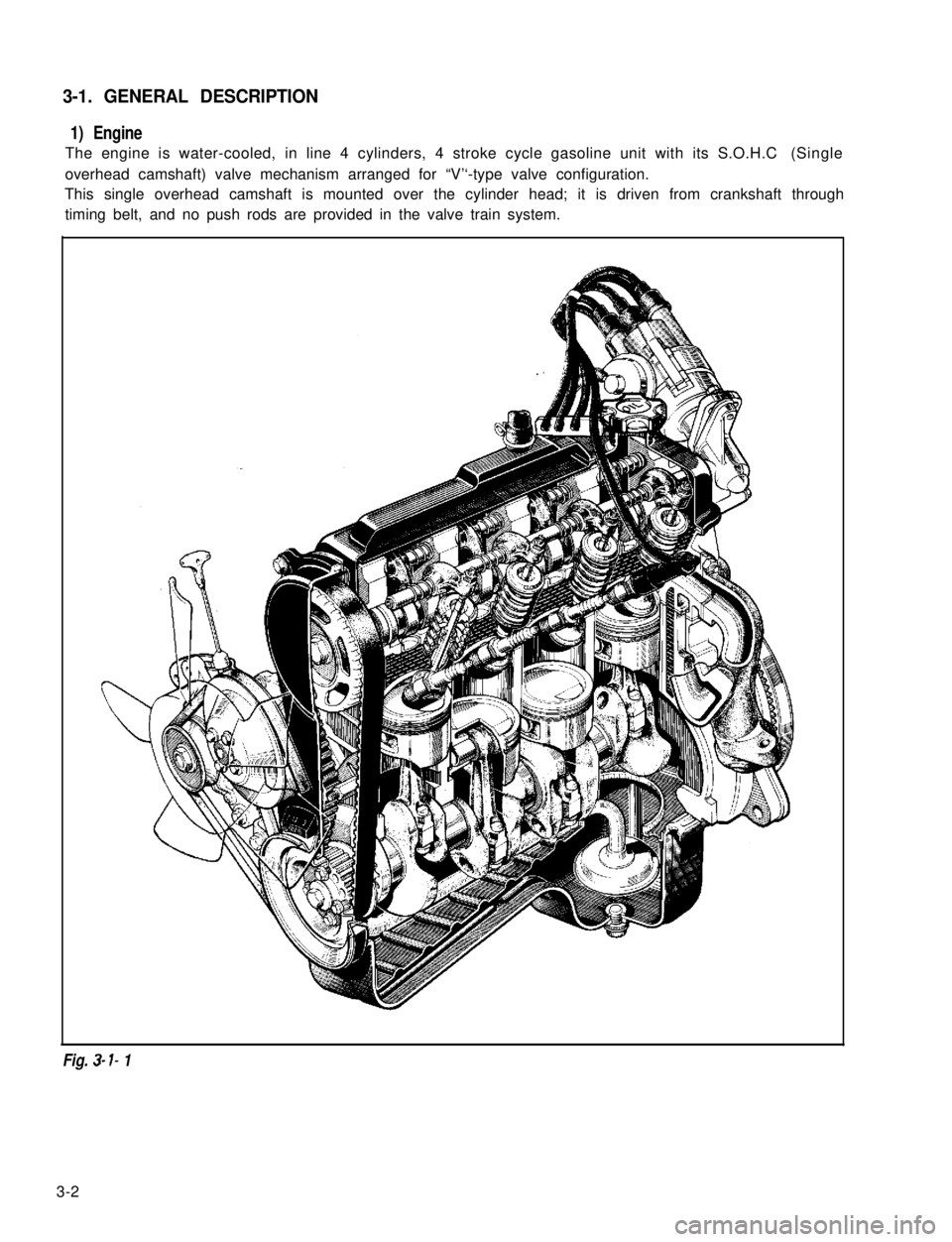
1) Engine
The engine is water-cooled, in line 4 cylinders, 4 stroke cycle gasoline unit with its S.O.H.C (Single
overhead camshaft) valve mechanism arranged for “V’‘-type valve configuration.
This single overhead camshaft is mounted over the cylinder head; it is driven from crankshaft through
timing belt, and no push rods are provided in the valve train system.
Fig. 3- I- 1
3-2
Page 60 of 962
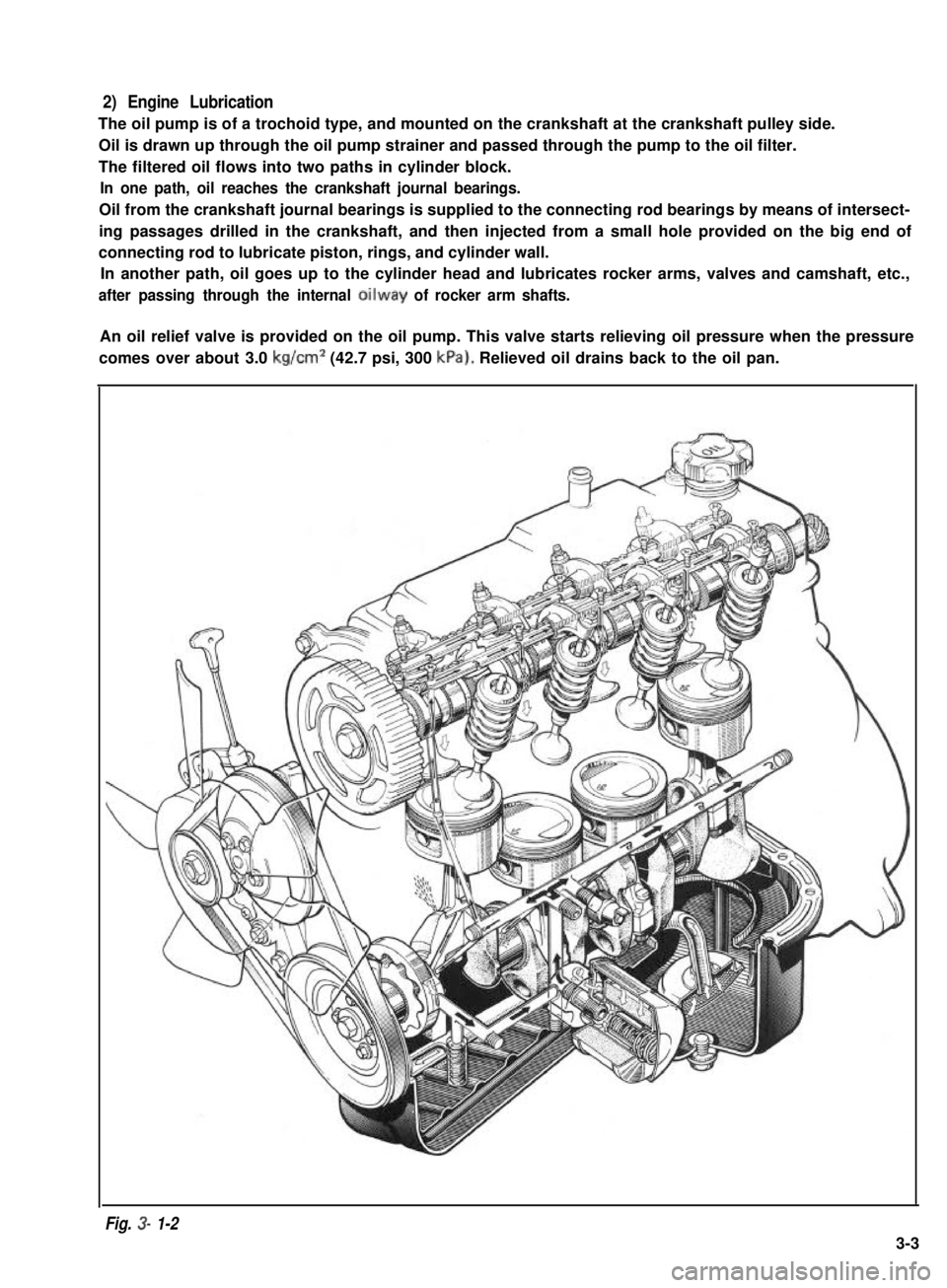
2) Engine Lubrication
The oil pump is of a trochoid type, and mounted on the crankshaft at the crankshaft pulley side.
Oil is drawn up through the oil pump strainer and passed through the pump to the oil filter.
The filtered oil flows into two paths in cylinder block.
In one path, oil reaches the crankshaft journal bearings.
Oil from the crankshaft journal bearings is supplied to the connecting rod bearings by means of intersect-
ing passages drilled in the crankshaft, and then injected from a small hole provided on the big end of
connecting rod to lubricate piston, rings, and cylinder wall.
In another path, oil goes up to the cylinder head and lubricates rocker arms, valves and camshaft, etc.,
after passing through the internal oilway of rocker arm shafts.
An oil relief valve is provided on the oil pump. This valve starts relieving oil pressure when the pressure
comes over about 3.0 kg/cm2 (42.7 psi, 300 kPa). Relieved oil drains back to the oil pan.
Fig. 3- 1-2
3-3
Page 61 of 962
3) Cylinder Head and Valve Train
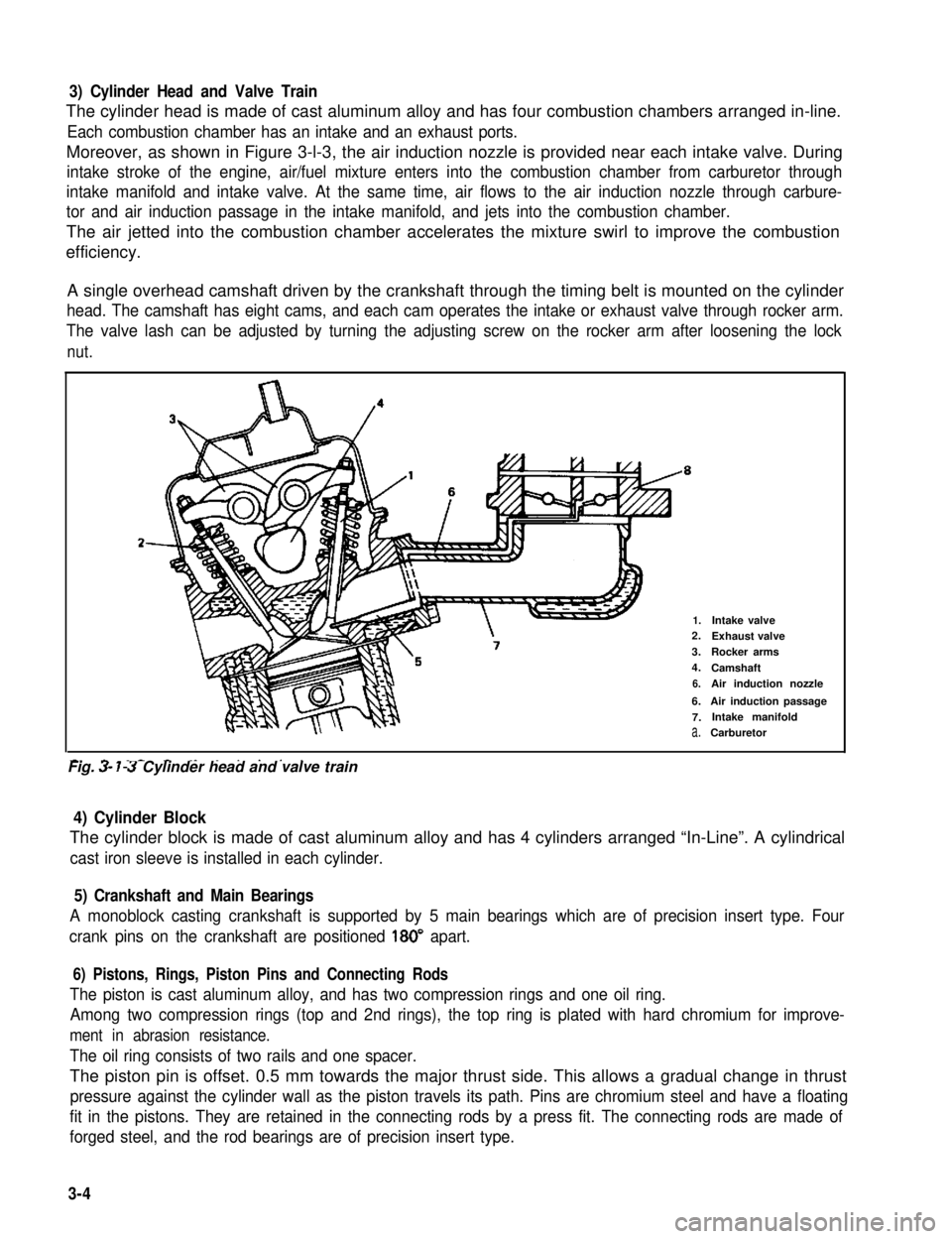
The cylinder head is made of cast aluminum alloy and has four combustion chambers arranged in-line.
Each combustion chamber has an intake and an exhaust ports.
Moreover, as shown in Figure 3-l-3, the air induction nozzle is provided near each intake valve. During
intake stroke of the engine, air/fuel mixture enters into the combustion chamber from carburetor through
intake manifold and intake valve. At the same time, air flows to the air induction nozzle through carbure-
tor and air induction passage in the intake manifold, and jets into the combustion chamber.
The air jetted into the combustion chamber accelerates the mixture swirl to improve the combustion
efficiency.
A single overhead camshaft driven by the crankshaft through the timing belt is mounted on the cylinder
head. The camshaft has eight cams, and each cam operates the intake or exhaust valve through rocker arm.
The valve lash can be adjusted by turning the adjusting screw on the rocker arm after loosening the lock
nut.
2-
1.Intake valve2.Exhaust valve
3.Rocker arms
4.Camshaft
6.Air induction nozzle
6.Air induction passage
7.Intake manifold
a.Carburetor
-. - _- - ._ . . . . .Fig. 3- 7-3 Cylinder head and valve train
4) Cylinder Block
The cylinder block is made of cast aluminum alloy and has 4 cylinders arranged “In-Line”. A cylindrical
cast iron sleeve is installed in each cylinder.
5) Crankshaft and Main Bearings
A monoblock casting crankshaft is supported by 5 main bearings which are of precision insert type. Four
crank pins on the crankshaft are positioned 180” apart.
6) Pistons, Rings, Piston Pins and Connecting Rods
The piston is cast aluminum alloy, and has two compression rings and one oil ring.
Among two compression rings (top and 2nd rings), the top ring is plated with hard chromium for improve-
ment in abrasion resistance.
The oil ring consists of two rails and one spacer.
The piston pin is offset. 0.5 mm towards the major thrust side. This allows a gradual change in thrust
pressure against the cylinder wall as the piston travels its path. Pins are chromium steel and have a floating
fit in the pistons. They are retained in the connecting rods by a press fit. The connecting rods are made of
forged steel, and the rod bearings are of precision insert type.
3-4