Page 253 of 2389
Compressor Control Amplifier
INSPECT AMPLIFIER CIRCUIT
Disconnect the amplifier and inspect the connector on the
wire harness side as shown in the chart below.
VACUUM HOSE CIRCUIT (3S±FE Engine)
Approx. 4.4 k� 25°C(77°F) Turn ignition switch on.
Turn ignition switch off.
Tester
connectionSpecified value
3 ± GroundBattery voltage 6 ± Ground
No voltage ContinuityContinuity
Resistance
Condition
Check for
Constant Constant
Voltage
5±7
± AIR CONDITIONING SYSTEMAmplifiersAC±47
Page 254 of 2389
Compressor Control Amplifier
INSPECT AMPLIFIER CIRCUIT
Disconnect the amplifier and inspect the connector on the
wire harness side as shown in the chart below.
VACUUM HOSE CIRCUIT (3S±FE Engine)
Approx. 4.4 k� 25°C (77°F) Turn ignition switch on.
Turn ignition switch off.
Tester
connectionSpecified value
3 ± GroundBattery voltage 6 ± Ground
No voltage ContinuityContinuity
Resistance
Condition
Check for
Constant Constant
Voltage
5±7
± AIR CONDITIONING SYSTEMVacuum Hose CircuitAC±47
Page 255 of 2389
VACUUM SWITCHING VALVE (VSV)
(See pages AC±4 to AC±7)
INSPECTION OF VSV
1. REMOVE VSV
2. CHECK VACUUM CIRCUIT CONTINUITY IN VSV 8*
BLOWING AIR INTO PIPE
(a) Connect the VSV terminals to the battery terminals
as shown.
(b) Blow into pipe ºAº, and check that air comes out of
pipe ºBº but does not come out of filter ºCº.
4. CHECK FOR OPEN CIRCUIT
Using an ohmmeter, measure the resistance between the
two terminals of the VSV.
Specified resistance: 37 ± 44
� at 20°C (68°F)
If resistance value is not as specified, replace the VSV. 3. CHECK FOR SHORT CIRCUIT
Using an ohmmeter, check that there is no continuity be-
tween each terminal and the VSV body.
If a short circuit is found, repair or replace the VSV.(c) Disconnect the battery.
(d) Blow into pipe ºAº and check that air comes out
of filter ºCº but does not come out of pipe ºBº.
If a problem is found, replace the VSV.
± AIR CONDITIONING SYSTEMVacuum Switching Valve (VSV)AC±48
Page 263 of 2389
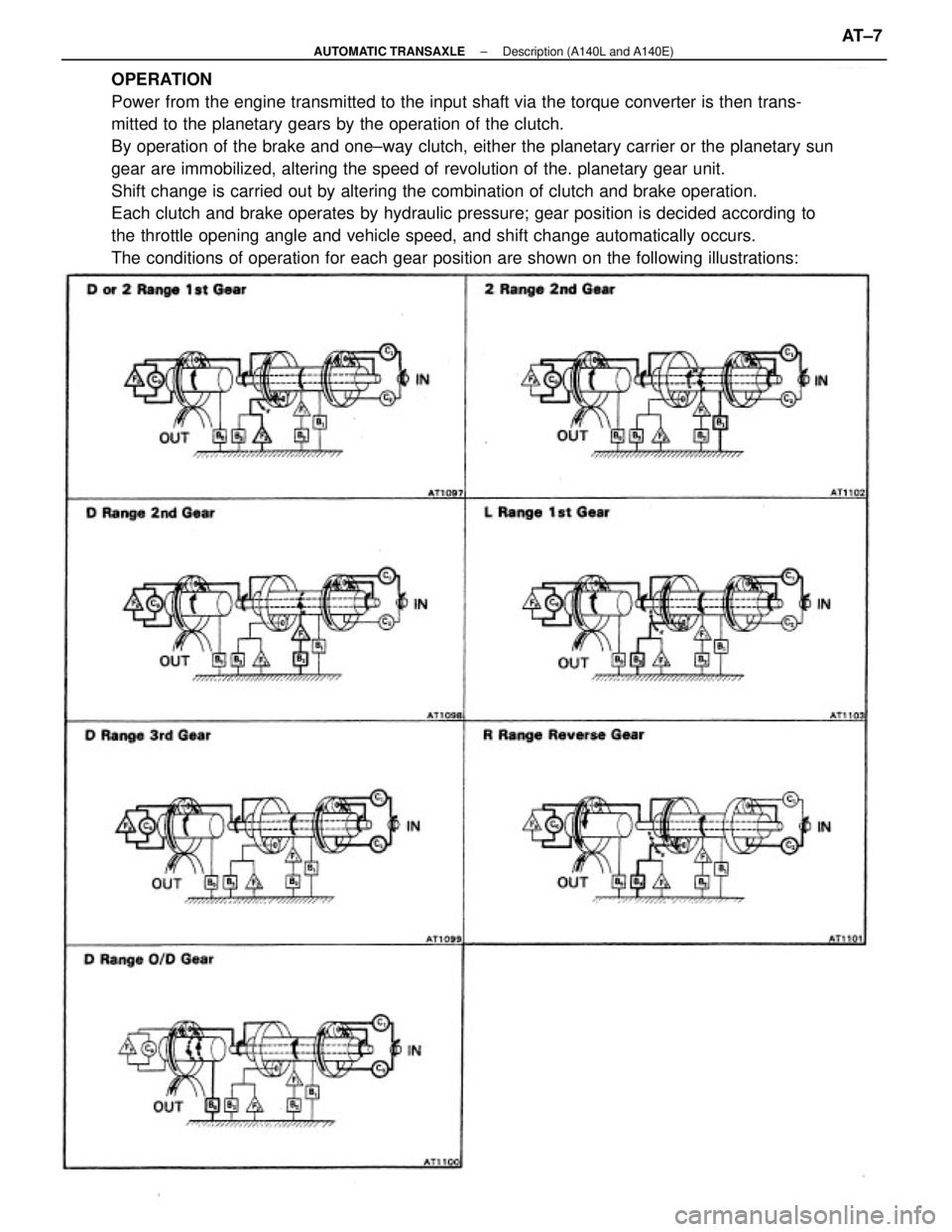
OPERATION
Power from the engine transmitted to the input shaft via the torque converter is then trans-
mitted to the planetary gears by the operation of the clutch.
By operation of the brake and one±way clutch, either the planetary carrier or the planetary sun
gear are immobilized, altering the speed of revolution of the. planetary gear unit.
Shift change is carried out by altering the combination of clutch and brake operation.
Each clutch and brake operates by hydraulic pressure; gear position is decided according to
the throttle opening angle and vehicle speed, and shift change automatically occurs.
The conditions of operation for each gear position are shown on the following illustrations:
± AUTOMATIC TRANSAXLEDescription (A140L and A140E)AT±7
Page 270 of 2389
2. SOLENOID SYSTEM (A140E)
Possible gear positions in accordance with solenoid operating conditions.
A140E
NO. 1 SOLENOID
MALFUNCTIONINGNO. 2 SOLENOID
MALFUNCTIONINGBOTH SOLENOID
MALFUNCTIONING
( ) : No fail safe functionx: Malfunctions
D range
2 rangeNORMAL
L. range Range
± AUTOMATIC TRANSAXLETroubleshooting Operating Mechanism for Each Gear)
(A140L and A140E)AT±15
Page 276 of 2389

Preliminary Check
11. CHECK FLUID LEVEL
HINT: The vehicle must have been driven so that the
engine and transmission are at normal operating tem-
perature. (fluid temperature: 158 ± 176
°F or 70 ±80°C)
(a) Park the vehicle on a level surface, set the parking
brake.
(b) With the engine idling, shift the shift lever into all posi-
tions from P to L position and return to P position.
HINT: Depress the brake pedal.
(a) Pull out the transaxle dipstick and wipe it clean.
(b) Push it back fully into the tube.
(c) Pull it out and check that the fluid level is in the HOT
range. If the level is at the low side of the hot range,
add fluid.
Fluid type: ATF DEXRON) II
NOTICE: Do not overfill.
2. CHECK FLUID CONDITION
If the fluid smells burnt or is black, replace it
3. REPLACE ATF
NOTICE: Do not overfill.
(a) Remove the drain plug and drain the fluid.
(b) Reinstall the drain plug securely.
(c) With the engine OFF, and new fluid through the dip
stick tube.
SST 09043±38100
Fluid: ATF DEXRON) II
Capacity:
Dry fill:
A140E 5.3 liters (5.6 US qts, 4.7 Imp. qts)
A140L 5.7 liters (6.0 U S qts, 5.0 Imp. qts)
Drain and refill (Reference):
140E, A140L 2.5 liters (2.6 US qts, 2.2 Imp. qts)
(d) Start the engine and shift the selector into all positions
from P through L and then shift into P.
(e) With the engine idling, check the fluid level. Add fluid
up to the ºCOOLº level on the dipstick.
(f) Check the fluid level with the normal fluid temperature
(158 ± 176
°F or 70 ± 80°C) and add as necessary.
NOTICE: Do not overfill.
± AUTOMATIC TRANSAXLETroubleshooting (Preliminary Check) (A140L and A140E)AT±21
Page 289 of 2389
INSPECTION ELECTRONIC CONTROL
COMPONENTS
1. INSPECT VOLTAGE OF ECT ECU CONNECTOR
(a) Remove the glove box and instrument panel.
(b) Turn on the ignition switch.
(e) Measure the voltage at each terminal.
Throttle valve fully closed to fully open Throttle valve fully closed to fully open
Throttle valve fully closed to fully open
Vehicle moving (Cruise control OFF)Standing still (Cruise control OFF) Throttle valve opening above 1 .5°
When brake pedal is not depressed When brake pedal is depressed Throttle valve fully closed Throttle valve fully closed
Throttle valve fully closed
Throttle valve fully closed Throttle valve fully open Throttle valve fully open Throttle valve fully openMeasuring condition
Except L range
Except N range Except 2 rangeVoltage (V)
Terminal
N range 2 range
L range
± AUTOMATIC TRANSAXLETroubleshooting (Electronic Control System) (A140E)AT±32
Page 290 of 2389

2. INSPECT SOLENOID
(a) Disconnect the connector from the ECT computer.
(b) Measure the resistance between S1, S2, SL and
ground.
Resistance: 11 ± 15
�
(c) Apply battery voltage to the solenoid. Check that an
operation noise can be heard from the solenoid.
HINT: If there is foreign matter in the solenoid valve,
there will be no fluid control even with solenoid opera-
tion.
3. CHECK SOLENOID SEALS
If there is foreign material in the solenoid valve, there
will be no fluid control even with solenoid operation.
(a) Check No. 1 and No. 2 solenoid valves.
wApplying 5 kg/cm2 (71 psi, 490 kPa) or compressed
air, check that the solenoid valves do not leak the air.
wWhen supply battery voltage to the solenoids,
check that the solenoid valves open.
(b) Check the lock±up solenoid valve.
wApplying 5 kglcm2 (71 psi, 490 kPa) of com-
pressed air, check that the solenoid valve
opens.
wWhen supply battery voltage to the solenoid,
check that the solenoid valve does not leak the
air.
Coolant temp. above 122°F (50°C) Coolant temp. below 122°F (50°C)
O/D main switch turned OFF O/D main switch turned ONMeasuring condition
Ignition switch ON
Vehicle movingStanding still
PWR pattern
NORM patternVoltage (V)
Terminal
± AUTOMATIC TRANSAXLETroubleshooting (Electronic Control System) (A140E)AT±33