Page 291 of 2389
7. INSPECT NO. 1 SPEED SENSOR IN COMBINATION
METER
(a) Remove the combination meter.
(b) Connect an ohmmeter between the terminals.
(c) Revolve the meter shaft and check that the meter
needle repeatedly deflects from 0 to 8
� . 6. INSPECT NO. 2 SPEED SENSOR IN ATM
(a) Jack up a front wheel on one side.
(b) Connect an ohmmeter between the terminals.
(c) Spin the wheel and check that the meter needle de-
flects from 0 to 8 W. 5. INSPECT THROTTLE POSITION SENSOR
Using an ohmmeter, check the resistance between
each terminal. 4. INSPECT NEUTRAL START SWITCH
Inspect that there is continuity between terminal LL±C, 2L±
C and NL±C.
Throttle valve
conditionresistance (W) Shift
Position
TerminalTerminal
N range
2 range
L range
± AUTOMATIC TRANSAXLETroubleshooting (Electronic Control System) (A140E)AT±34
Page 293 of 2389

Mechanical System Tests
STALL TEST
The object of this test is to check the overall performance of the transaxle and engine by measur-
ing the stall speeds in the D and R ranges.
CAUTION:
wPerform the test at normal operation fluid temperature (122 ± 176°F or 50 ± 80°C).
wDo not continuously run this test longer than 5 seconds.
wTo ensure safety, conduct this test in a wide, clear, level area, which provides good traction.
wThe stall test should always be carried out in pairs. One should observe the conditions of wheels
or wheel stoppers outside the vehicle while the other is performing the test.
MEASURE STALL SPEED
(a) Chock the front and rear wheels.
(b) Connect a tachometer to the engine.
(c) Fully apply the parking brake.
(d) Step down strongly on the brake pedal with your left foot.
(e) Start the engine.
(f) Shift into the D range. Step all the way down on the accelerator pedal with your right foot. Quickly
read the stall speed at this time.
Stall speed: 2,200
+150 rpm
(g) Perform the same test in R range.
EVALUATION
(a) If the stall speed is the same for both ranges without the rear wheels rotating but lower than specified
value:
wEngine output may be insufficient
w Stator one±way clutch is not operating properly
(b) If the stall speed in D range is higher than specified:
wLine pressure too low
wForward clutch slipping
wNo. 2 one±way clutch not operating properly
wO/D one±way clutch not operating properly
(c) If the stall speed in R range is higher than specified:
wLine pressure too low
wDirect clutch slipping
wFirst and reverse brake slipping
wO/D one±way clutch not operating properly
(d) If the stall speed in both R and D ranges are higher than specified:
wLine pressure too low
wImproper fluid level
wO/D one±way clutch not operating properly
± AUTOMATIC TRANSAXLETroubleshooting (Mechanical System Tests) (A140L and
A140E)AT±38
Page 294 of 2389

TIME LAG TEST
When the shift lever is shifted while the engine is idling, there will be a certain time elapse or lag
before the shock can be felt. This is used for checking the condition of the O/D direct clutch, for-
ward clutch, direct clutch and first and reverse brake.
NOTICE:
wPerform the test at normal operating fluid temperature (122 ±176°F or 50 ± 80°C).
wBe sure to allow one minute interval between tests.
wMake three measurements and take the average value.
MEASURE TIME LAG
(a) Fully apply the parking brake.
(b) Start the engine and check the idle speed.
Idle speed (N range) : 700 rpm
(c) Shift the shift lever from N to D position. Using a stop watch, measure the time it takes from shifting
the lever until the shock is felt.
Time lag: Less than 1.2 seconds
(d) In the same manner, measure the time lag for N ± R.
Time lag: Less than 1.5 seconds
EVALUATION
(a) If N ± D time lag is longer than specified:
wLine pressure too low
wForward clutch worn
wO/D one±way clutch not operating properly
(b) If N ± R time lag is longer than specified:
wLine pressure too low
wDirect clutch worn
wFirst and reverse brake worn
wO/D one±way clutch not operating properly
± AUTOMATIC TRANSAXLETroubleshooting (Mechanical System Tests) (A140L and
A140E)AT±39
Page 295 of 2389

HYDRAULIC TEST
PREPARATION
(a) Warm up the transaxle fluid.
(b) Remove the transaxle case test plug and connect the hydraulic pressure gauge.
SST 09992±00094 (Oil pressure gauge)
NOTICE:
wPerform the test at normal operating fluid temperature (122 ±176°F or 50 ± 80°C).
wThe line pressure test should always be carried out in pairs. One should observe the conditions
of wheels or wheel stoppers outside the vehicle while the other is performing the test.
MEASURE LINE PRESSURE
(a) Fully apply the parking brake and chock the four wheels.
(b) Start the engine and check idling rpm.
(e) Step down strongly on the brake pedal with your left foot and shift into D range.
(d) Measure the line pressure when the engine is idling.
(e) Press the accelerator pedal all the way down. Quickly read the highest line pressure when engine
speed reaches stall speed.
(f) In the same manner, perform the test in R range.
If the measured pressure are not up to specified values, recheck the throttle cable adjustment and
perform a retest.
kg/cm (psi, kPa)
Line pressure
R range D range
Idling
IdlingStall
Stall
± AUTOMATIC TRANSAXLETroubleshooting (Mechanical System Tests) (A140L and
A140E)AT±40
Page 440 of 2389
(A540H)
The A540H automatic transaxle design is based on the A540E automatic transaxle and equipped with
a center differential and transfer.
This transaxle has the same hydraulic multiplate clutch in the center differential limiting control mecha-
nism as the A241 H automatic transaxle on the Corolla All±TRAC/4WD Station Wagon. The fluid pres-
sure acting on the hydraulic multiplate clutch of the A540H is controlled by the ECT ECU (Electronic
Control Unit according to the vehicle driving conditions. As a result, torque is distributed to the front
and rear wheels appropriately at all times to maximize the overall performance of the 4WD vehicle.
NOTICE: Special handling methods are necessary for full±time 4WD vehicles during inspection and mainte-
nance. Instructions concerning these handling methods are given on page IN±8.
± AUTOMATIC TRANSAXLEDescription (A540E and A540H)AT±185
Page 444 of 2389
( ) 1: No fail±safe function X: Malfunctions
HINT: (A540H) When any one of the speed sensors (front or rear) or center differential control sole-
noid valves (No. 1 or No. 2) malfunction, the ECT ECU stops center differential control and main-
tains the center differential in a free condition.
Operating Mechanism for Each Gear (A540E A540H)
1. CLUTCH BRAKE AND ONE±WAY CLUTCH
A540E, A540H
Down±shift only ± no up±shift
2. SOLENOID SYSTEM
Possible gear positions in accordance with solenoid operating conditions.
A540E, A540H
NO. 2 SOLENOID
MALFUNCTIONING NO. I SOLENOID
MALFUNCTIONINGBOTH SOLENOIDS
MALFUNCTIONING Shift lever
positionGear position
NORMAL
D rangeParking
2 range
L rangeReverse
Neutral
Range
2nd3 rd
O/D
2nd1st
1st 1st2nd
3rd
± AUTOMATIC TRANSAXLETroubleshooting (Operating Mechanism for Each Gear
(A540E and A540H)AT±189
Page 455 of 2389
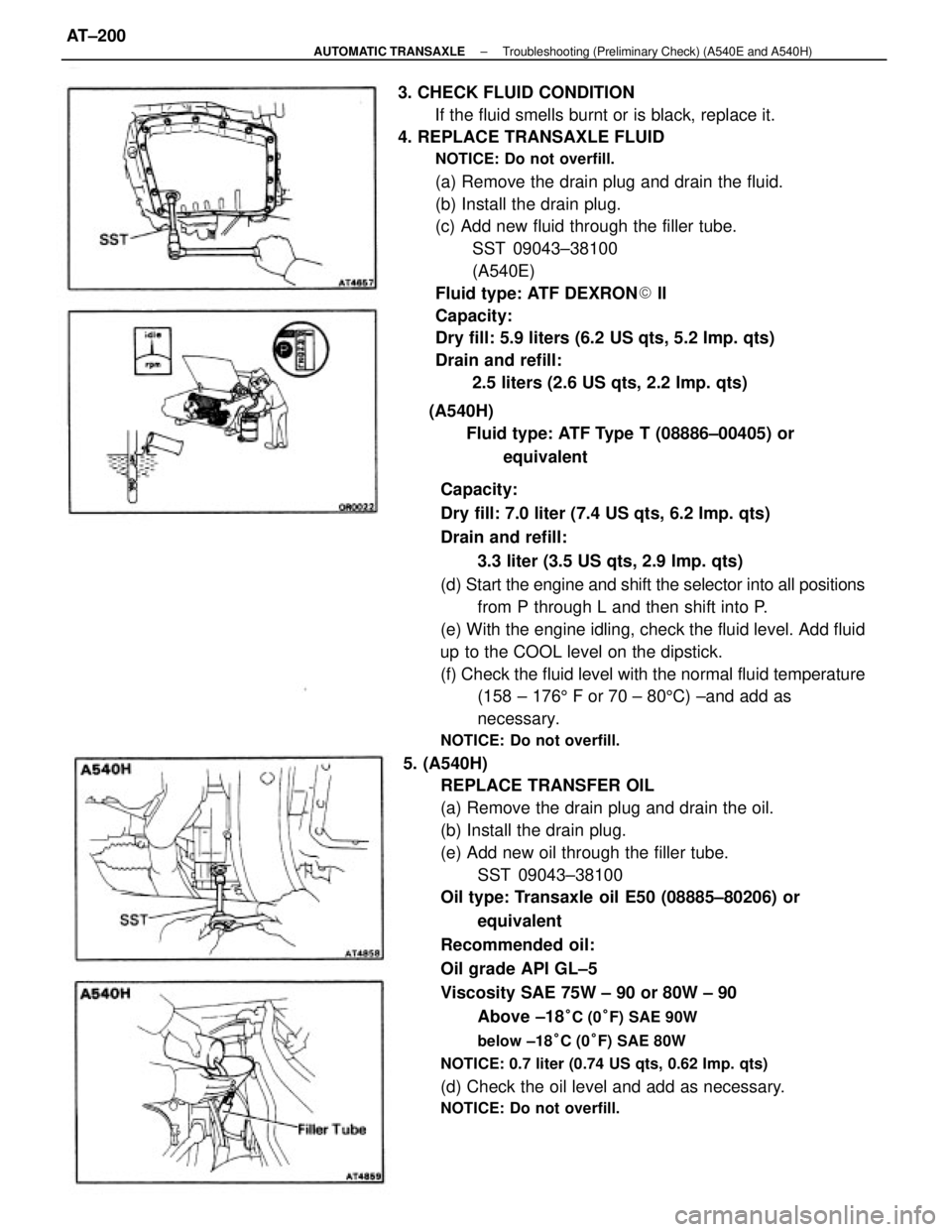
Capacity:
Dry fill: 7.0 liter (7.4 US qts, 6.2 Imp. qts)
Drain and refill:
3.3 liter (3.5 US qts, 2.9 Imp. qts)
(d) Start the engine and shift the selector into all positions
from P through L and then shift into P.
(e) With the engine idling, check the fluid level. Add fluid
up to the COOL level on the dipstick.
(f) Check the fluid level with the normal fluid temperature
(158 ± 1765 F or 70 ± 805C) ±and add as
necessary.
NOTICE: Do not overfill.
5. (A540H)
REPLACE TRANSFER OIL
(a) Remove the drain plug and drain the oil.
(b) Install the drain plug.
(e) Add new oil through the filler tube.
SST 09043±38100
Oil type: Transaxle oil E50 (08885±80206) or
equivalent
Recommended oil:
Oil grade API GL±5
Viscosity SAE 75W ± 90 or 80W ± 90
Above ±18
°C (0°F) SAE 90W
below ±18°C (0°F) SAE 80W
NOTICE: 0.7 liter (0.74 US qts, 0.62 Imp. qts)
(d) Check the oil level and add as necessary.
NOTICE: Do not overfill.
3. CHECK FLUID CONDITION
If the fluid smells burnt or is black, replace it.
4. REPLACE TRANSAXLE FLUID
NOTICE: Do not overfill.
(a) Remove the drain plug and drain the fluid.
(b) Install the drain plug.
(c) Add new fluid through the filler tube.
SST 09043±38100
(A540E)
Fluid type: ATF DEXRON� ll
Capacity:
Dry fill: 5.9 liters (6.2 US qts, 5.2 Imp. qts)
Drain and refill:
2.5 liters (2.6 US qts, 2.2 Imp. qts)
(A540H)
Fluid type: ATF Type T (08886±00405) or
equivalent
± AUTOMATIC TRANSAXLETroubleshooting (Preliminary Check) (A540E and A540H)AT±200
Page 458 of 2389

Mechanical System Tests
STALL TEST
The object of this test is to check the overall performance of the transaxle and engine by measuring
the stall speeds in the D and R ranges.
CAUTION:
wPerform the test at normal operation fluid temperature (122 ± 176°F or 50 ± 80°C).
wDo not continuously run this test longer than 5 seconds.
wTo ensure safety, conduct this test in a wide, clear, level area, which provides good traction.
wThe stall test should always be carried out in pairs. One should observe the conditions of wheels
or wheel stoppers outside the vehicle while the other is performing the test.
MEASURE STALL SPEED
(a) Chock the front and rear wheels.
(b) Connect a tachometer to the engine.
(c) Fully apply the parking brake.
(d) Step down strongly on the brake pedal with your left foot.
(e) Start the engine.
(f) Shift into the D range. Step all the way down on the accelerator pedal with your right foot. Quickly
read the stall speed at this time.
Stall speed: A540E (2VZ±FE) 2,450
+150 rpm
A540H (3S±FE) 2,320
+150 rpm
(g) Perform the same test in R range.
EVALUATION
(a) If the stall speed is the same for both ranges without the rear wheels rotating but lower than specified
value:
wEngine output may be insufficient
wStartor one±way clutch is not operating properly
(b) If the stall speed in D range is higher than specified:
wLine pressure too low
wForward clutch slipping
wNo. 2 one±way clutch not operating properly
wO/D one±way clutch not operating properly
(e) If the stall speed in R range is higher than specified:
wLine pressure too low
wDirect clutch slipping
wFirst and reverse brake slipping
wO/D one±way clutch not operating properly
(d) If the stall speed in both R and D ranges are higher than specified:
wLine pressure too low
wImproper fluid level
wO/D one±way clutch not operating properly
± AUTOMATIC TRANSAXLETroubleshooting (Mechanical System Tests) (A540E and
A540H)AT±222


