Page 1042 of 2389
wA/C switch circuit
wA/C switch
wA/C amplifier
wThrottle position sensor circuit
wThrottle position sensor
wNeutral position sensor
wNeutral start switch circuit
wNeutral start switch
wAccelerator pedal and cable
wECU wEGR valve
wEGR hose
wEGR gas temp. sensor cir-
cuit
wEGR gas temp. sensor
wBVSV for EG R
wBVSV circuit for EGR
wECU No SPI signal for 8 seconds when
engine speed in between 2,500 rpm
and 4,500 rpm and coolant temp.
is below 80°V 07609 except when
racing the engine.wNo. 1 vehicle speed sensor
(Meter side) circuit
wNo. 1 vehicle speed sensor
(Meter side)
wECU
A/C signal, or no IDL signal or no
NSW signal to ECU, with the check
terminals TE1 and
E1 shorted. Open circuit in VC signal or short
circuit between VS and
E2 when idle contacts are closed.
wThrottle position sensor cir-
cuit
wThrottle position sensor
wECU
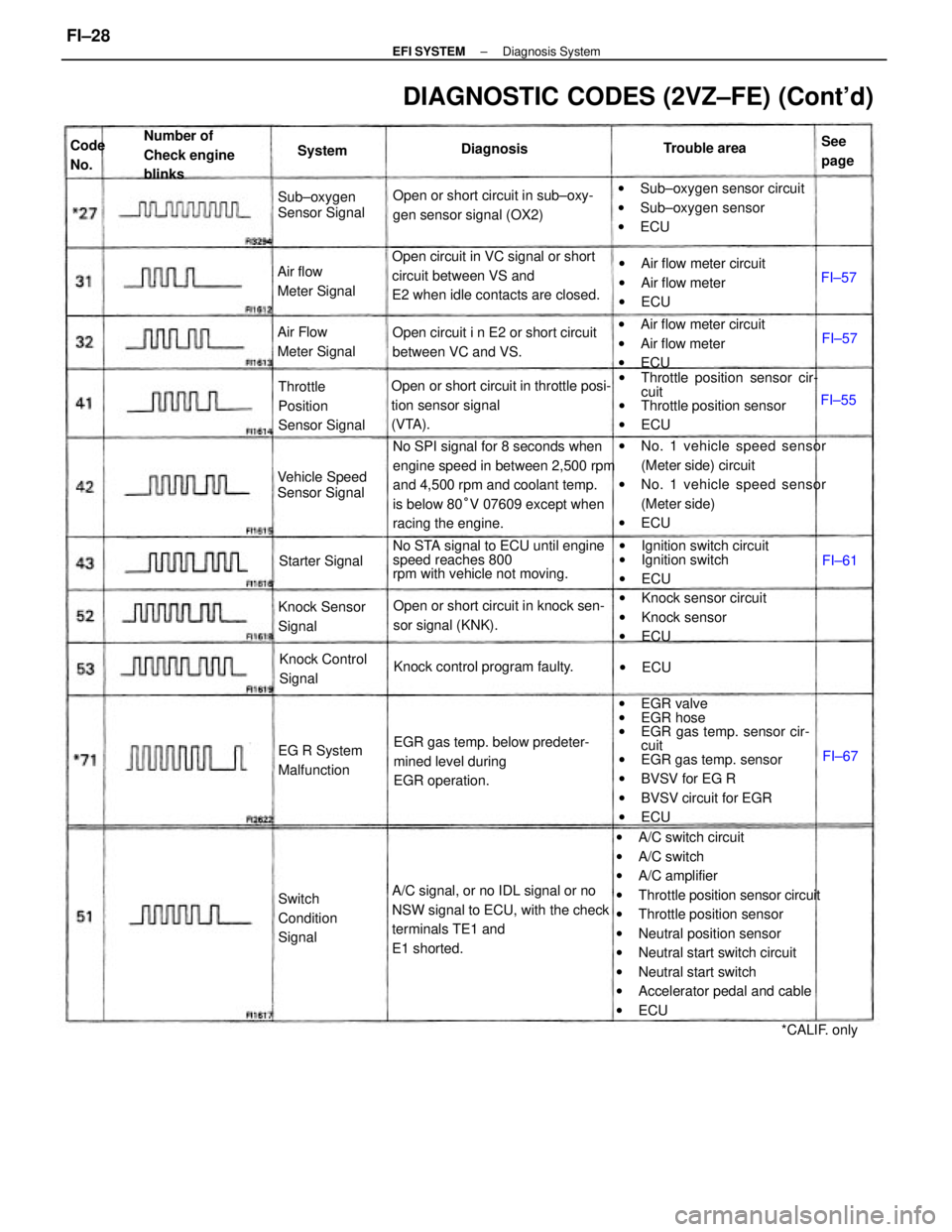
DIAGNOSTIC CODES (2VZ±FE) (Cont'd)
Open or short circuit in throttle posi-
tion sensor signal
(VTA).
No STA signal to ECU until engine
speed reaches 800
rpm with vehicle not moving.
EGR gas temp. below predeter-
mined level during
EGR operation.wSub±oxygen sensor circuit
wSub±oxygen sensor
wECU Open or short circuit in sub±oxy-
gen sensor signal (OX2)
wIgnition switch circuit
wIgnition switch
wECU wAir flow meter circuit
wAir flow meter
wECU wAir flow meter circuit
wAir flow meter
wECU
Open or short circuit in knock sen-
sor signal (KNK).wKnock sensor circuit
wKnock sensor
wECU Open circuit i n E2 or short circuit
between VC and VS.
Knock control program faulty. Throttle
Position
Sensor Signal Number of
Check engine
blinks
Knock Sensor
Signal
Switch
Condition
SignalKnock Control
Signal Air Flow
Meter Signal
Vehicle Speed
Sensor Signal Air flow
Meter SignalSub±oxygen
Sensor Signal
EG R System
MalfunctionStarter Signal
*CALIF. only Trouble area
DiagnosisSee
page System Code
No.
wECUFI±55FI±57
FI±57
FI±67 FI±61
± EFI SYSTEMDiagnosis SystemFI±28
Page 1044 of 2389
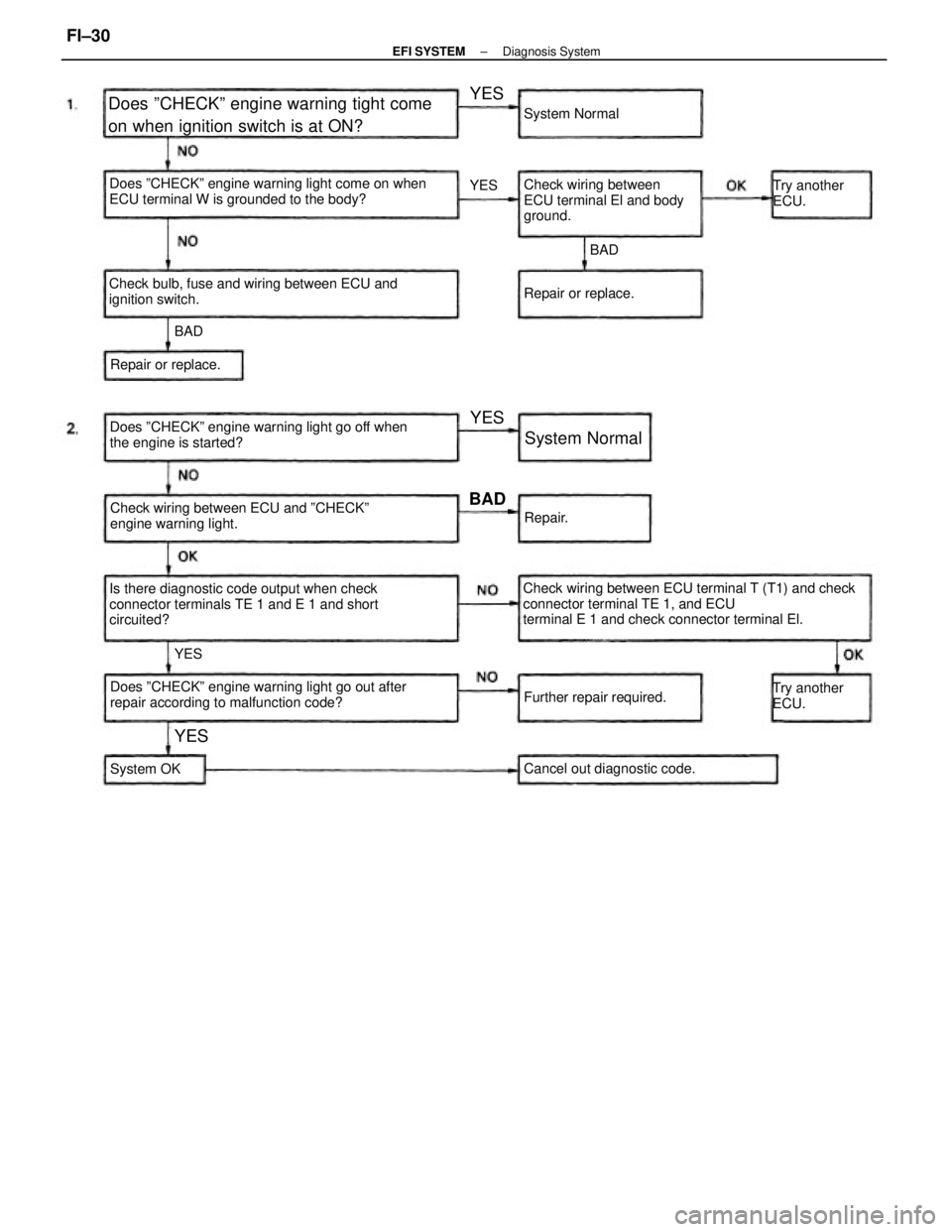
Check wiring between ECU terminal T (T1) and check
connector terminal TE 1, and ECU
terminal E 1 and check connector terminal El. Is there diagnostic code output when check
connector terminals TE 1 and E 1 and short
circuited? Does ºCHECKº engine warning light come on when
ECU terminal W is grounded to the body?
Does ºCHECKº engine warning tight come
on when ignition switch is at ON?
Check bulb, fuse and wiring between ECU and
ignition switch.
Does ºCHECKº engine warning light go out after
repair according to malfunction code? Does ºCHECKº engine warning light go off when
the engine is started?
Check wiring between ECU and ºCHECKº
engine warning light.Check wiring between
ECU terminal El and body
ground.
Cancel out diagnostic code. Further repair required.Try another
ECU.Try another
ECU.
Repair or replace.Repair or replace.
System Normal
System Normal
System OKRepair.
BAD
BAD
BAD
YES YES
YESYES
YES
± EFI SYSTEMDiagnosis SystemFI±30
Page 1047 of 2389
ON±VEHICLE INSPECTION
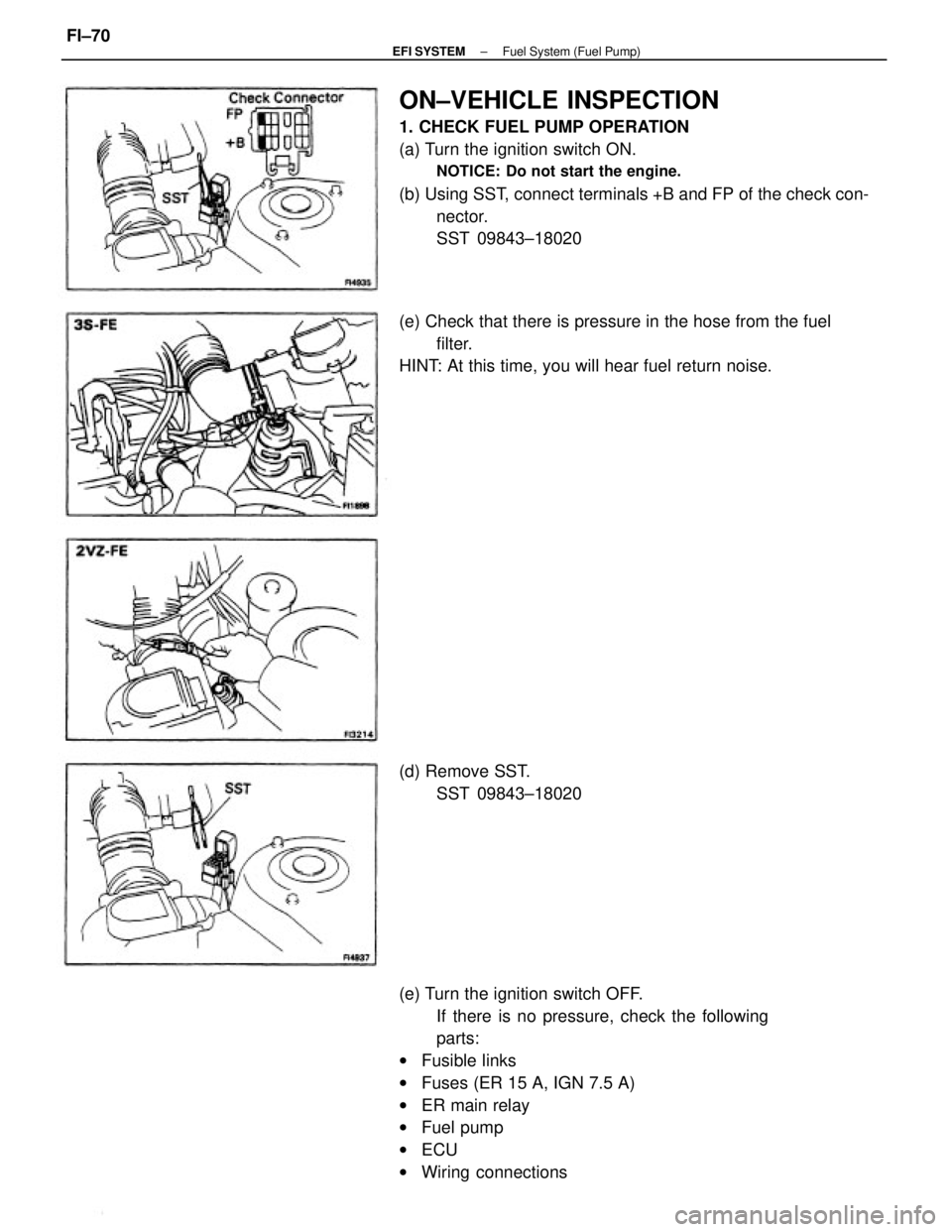
1. CHECK FUEL PUMP OPERATION
(a) Turn the ignition switch ON.
NOTICE: Do not start the engine.
(b) Using SST, connect terminals +B and FP of the check con-
nector.
SST 09843±18020
(e) Turn the ignition switch OFF.
If there is no pressure, check the following
parts:
wFusible links
wFuses (ER 15 A, IGN 7.5 A)
wER main relay
wFuel pump
wECU
wWiring connections (e) Check that there is pressure in the hose from the fuel
filter.
HINT: At this time, you will hear fuel return noise.
(d) Remove SST.
SST 09843±18020
± EFI SYSTEMFuel System (Fuel Pump)FI±70
Page 1049 of 2389
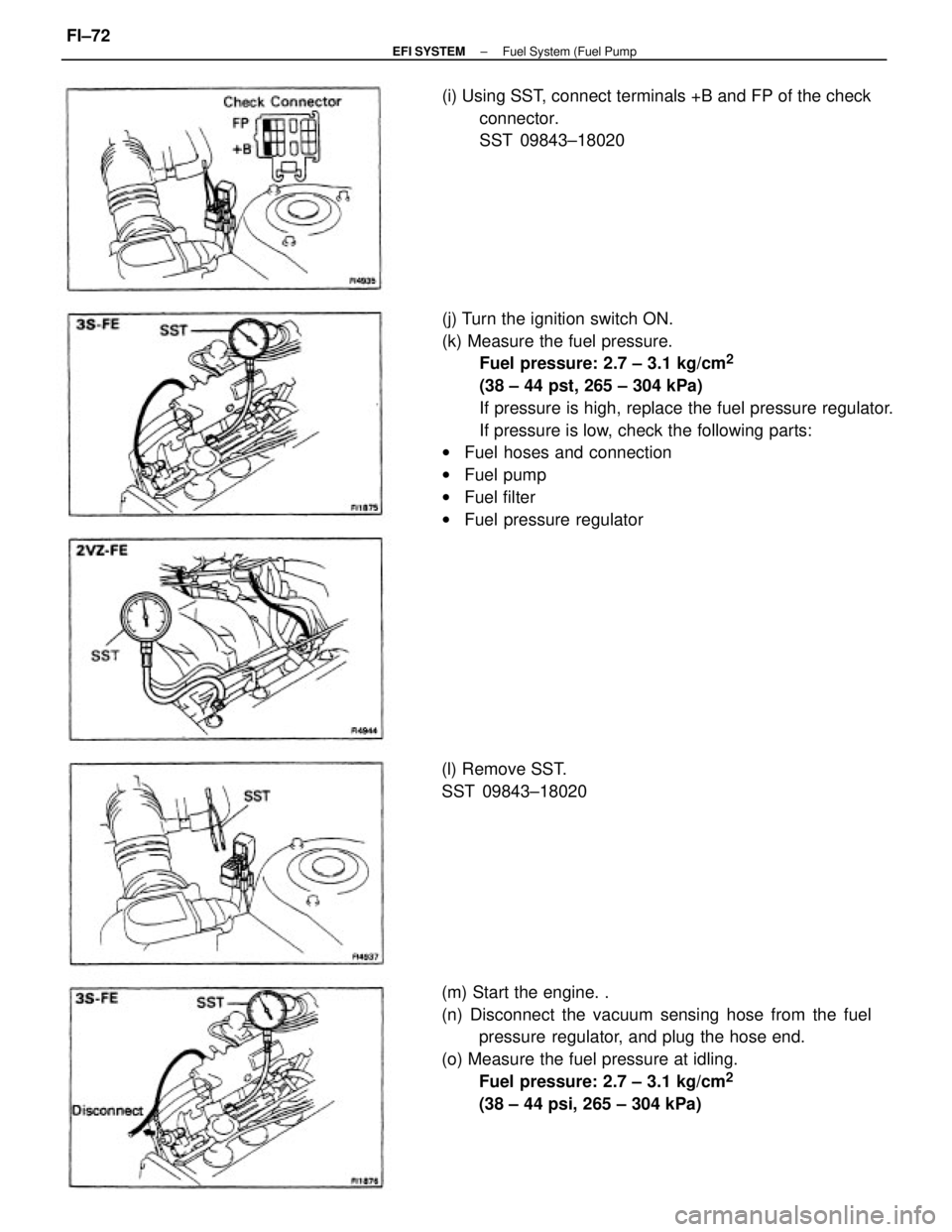
(j) Turn the ignition switch ON.
(k) Measure the fuel pressure.
Fuel pressure: 2.7 ± 3.1 kg/cm
2
(38 ± 44 pst, 265 ± 304 kPa)
If pressure is high, replace the fuel pressure regulator.
If pressure is low, check the following parts:
wFuel hoses and connection
wFuel pump
wFuel filter
wFuel pressure regulator
(m) Start the engine. .
(n) Disconnect the vacuum sensing hose from the fuel
pressure regulator, and plug the hose end.
(o) Measure the fuel pressure at idling.
Fuel pressure: 2.7 ± 3.1 kg/cm
2
(38 ± 44 psi, 265 ± 304 kPa) (i) Using SST, connect terminals +B and FP of the check
connector.
SST 09843±18020
(l) Remove SST.
SST 09843±18020
± EFI SYSTEMFuel System (Fuel PumpFI±72
Page 1050 of 2389
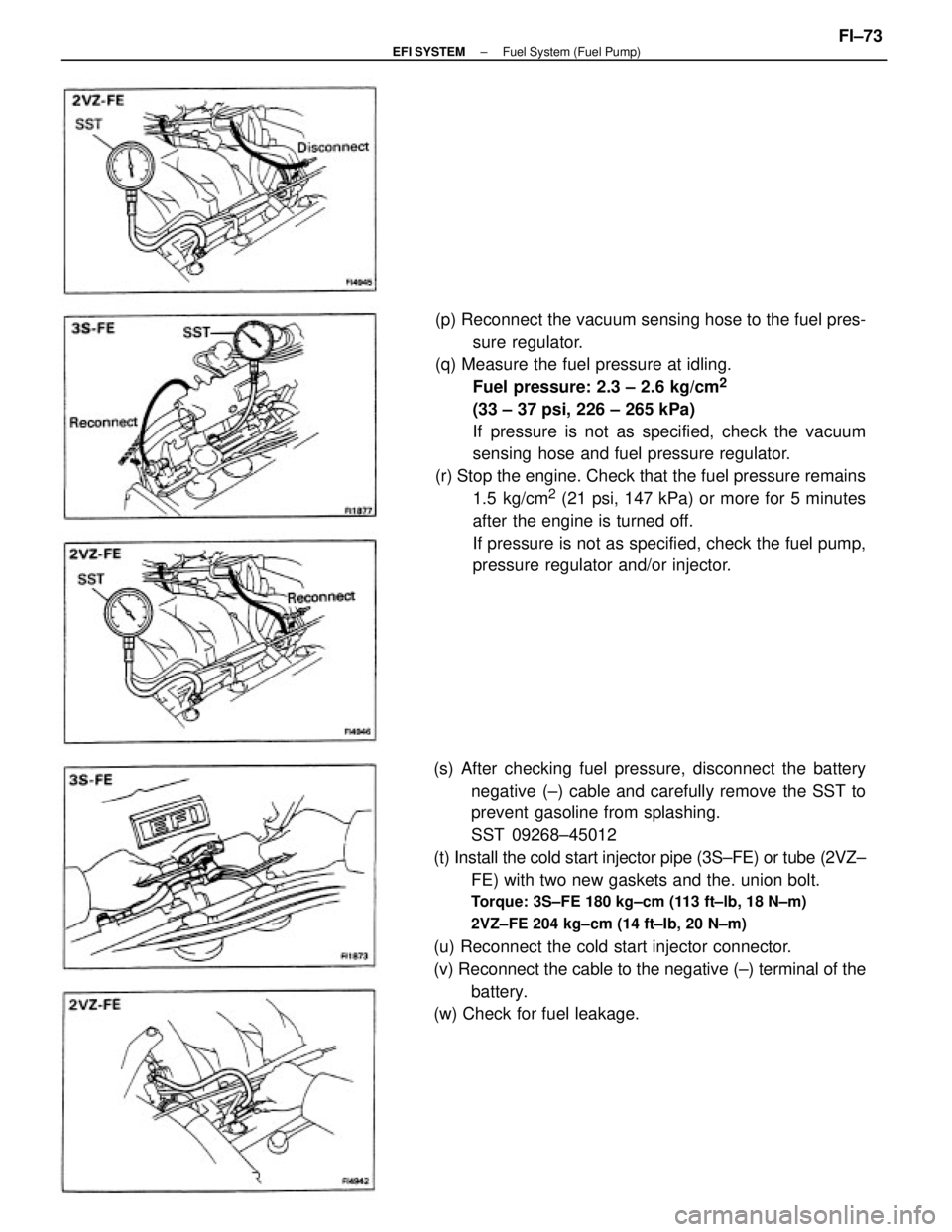
(s) After checking fuel pressure, disconnect the battery
negative (±) cable and carefully remove the SST to
prevent gasoline from splashing.
SST 09268±45012
(t) Install the cold start injector pipe (3S±FE) or tube (2VZ±
FE) with two new gaskets and the. union bolt.
Torque: 3S±FE 180 kg±cm (113 ft±lb, 18 N±m)
2VZ±FE 204 kg±cm (14 ft±Ib, 20 N±m)
(u) Reconnect the cold start injector connector.
(v) Reconnect the cable to the negative (±) terminal of the
battery.
(w) Check for fuel leakage.(p) Reconnect the vacuum sensing hose to the fuel pres-
sure regulator.
(q) Measure the fuel pressure at idling.
Fuel pressure: 2.3 ± 2.6 kg/cm
2
(33 ± 37 psi, 226 ± 265 kPa)
If pressure is not as specified, check the vacuum
sensing hose and fuel pressure regulator.
(r) Stop the engine. Check that the fuel pressure remains
1.5 kg/cm
2 (21 psi, 147 kPa) or more for 5 minutes
after the engine is turned off.
If pressure is not as specified, check the fuel pump,
pressure regulator and/or injector.
± EFI SYSTEMFuel System (Fuel Pump)FI±73
Page 1055 of 2389
HINT:
wThe following troubleshooting procedures are designed for inspection of each separate system, and
therefore
the actual procedure may vary somewhat. However, troubleshooting should be performed while referring
to the inspection methods described in this manual.
wBefore beginning inspection, it is best to first make a simple check of the fuses, fusible links and the condi-
tion of the connectors.
wThe following troubleshooting procedures are based on the supposition that the trouble lies in either a
short or open circuit within the computer.
wIf engine trouble occurs even though proper operating voltage is detected in the computer connector,
then it can be assumed that the ECU is faulty and should be replaced. .
TROUBLESHOOTING WITH
VOLT OHMMETER
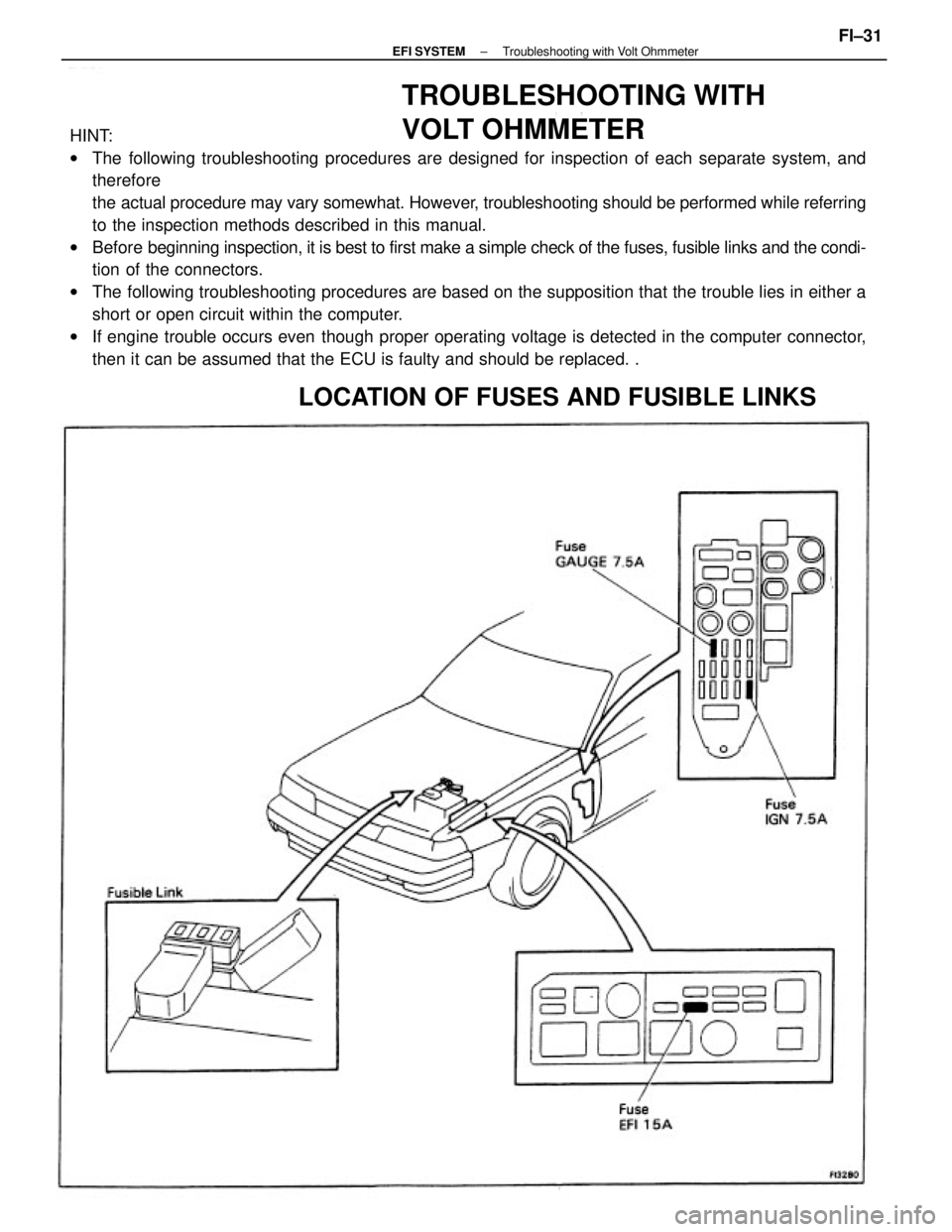
LOCATION OF FUSES AND FUSIBLE LINKS
± EFI SYSTEMTroubleshooting with Volt OhmmeterFI±31
Page 1056 of 2389
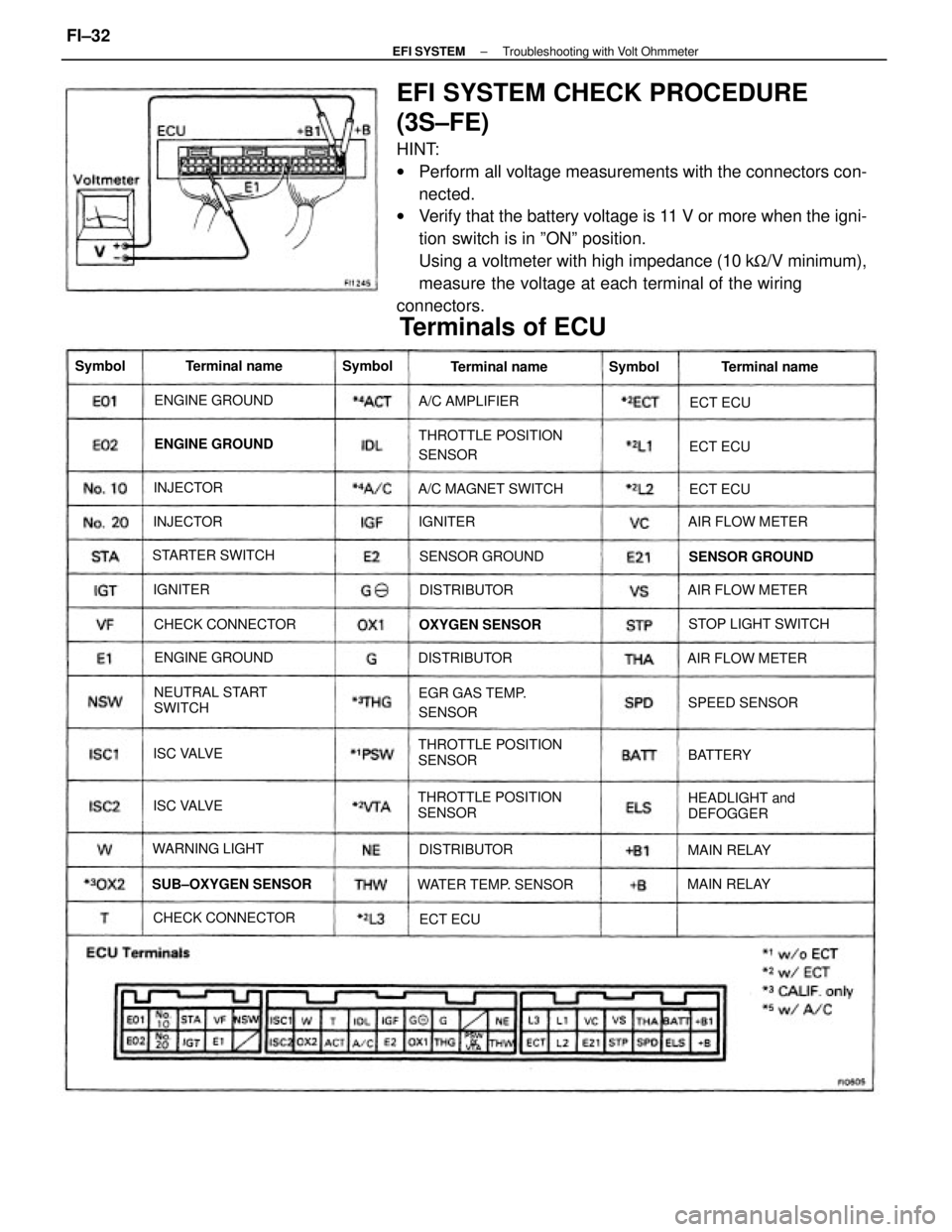
EFI SYSTEM CHECK PROCEDURE
(3S±FE)
HINT:
wPerform all voltage measurements with the connectors con-
nected.
wVerify that the battery voltage is 11 V or more when the igni-
tion switch is in ºONº position.
Using a voltmeter with high impedance (10 kW/V minimum),
measure the voltage at each terminal of the wiring
connectors.
THROTTLE POSITION
SENSORTHROTTLE POSITION
SENSOR
THROTTLE POSITION
SENSOR
Terminals of ECU
NEUTRAL START
SWITCH
HEADLIGHT and
DEFOGGER EGR GAS TEMP.
SENSOR
WATER TEMP. SENSOR SUB±OXYGEN SENSORA/C MAGNET SWITCH
STOP LIGHT SWITCH
CHECK CONNECTORCHECK CONNECTORAIR FLOW METER
AIR FLOW METER
AIR FLOW METER STARTER SWITCH
SENSOR GROUND SENSOR GROUND ENGINE GROUND
ENGINE GROUND ENGINE GROUND
OXYGEN SENSOR
WARNING LIGHTA/C AMPLIFIER
SPEED SENSORTerminal name Terminal name Terminal name
DISTRIBUTORDISTRIBUTOR
DISTRIBUTOR
MAIN RELAYMAIN RELAY ISC VALVE
ISC VALVE INJECTORINJECTOR Symbol
BATTERY Symbol
Symbol
IGNITERECT ECUECT ECU
ECT ECU
IGNITER
ECT ECU
± EFI SYSTEMTroubleshooting with Volt OhmmeterFI±32
Page 1057 of 2389
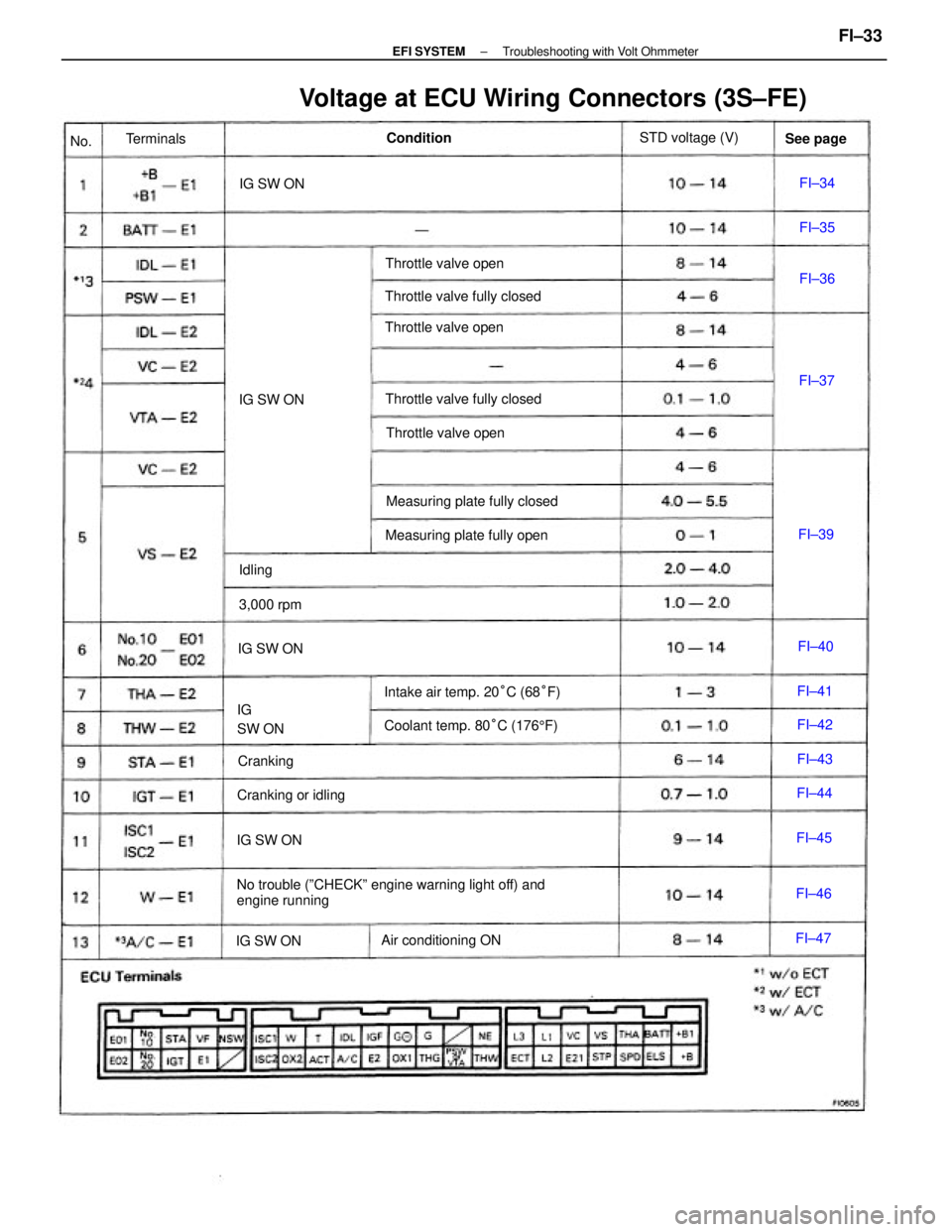
No trouble (ºCHECKº engine warning light off) and
engine running
Voltage at ECU Wiring Connectors (3S±FE)
Measuring plate fully closed
Intake air temp. 20°C (68°F)
Coolant temp. 80°C (1765F) Measuring plate fully open Throttle valve fully closed Throttle valve fully closed
Throttle valve open
Air conditioning ONThrottle valve open Throttle valve open
Cranking or idlingSTD voltage (V)
Terminals
3,000 rpmSee page Condition
IG SW ONIG SW ON
IG SW ON
IG
SW ONIG SW ON
IG SW ONCrankingIdling
FI±40
FI±44
FI±46FI±45FI±34
FI±43 FI±42
FI±47FI±35
FI±36
FI±37
FI±39
FI±41 No.
± EFI SYSTEMTroubleshooting with Volt OhmmeterFI±33