Page 2223 of 2389
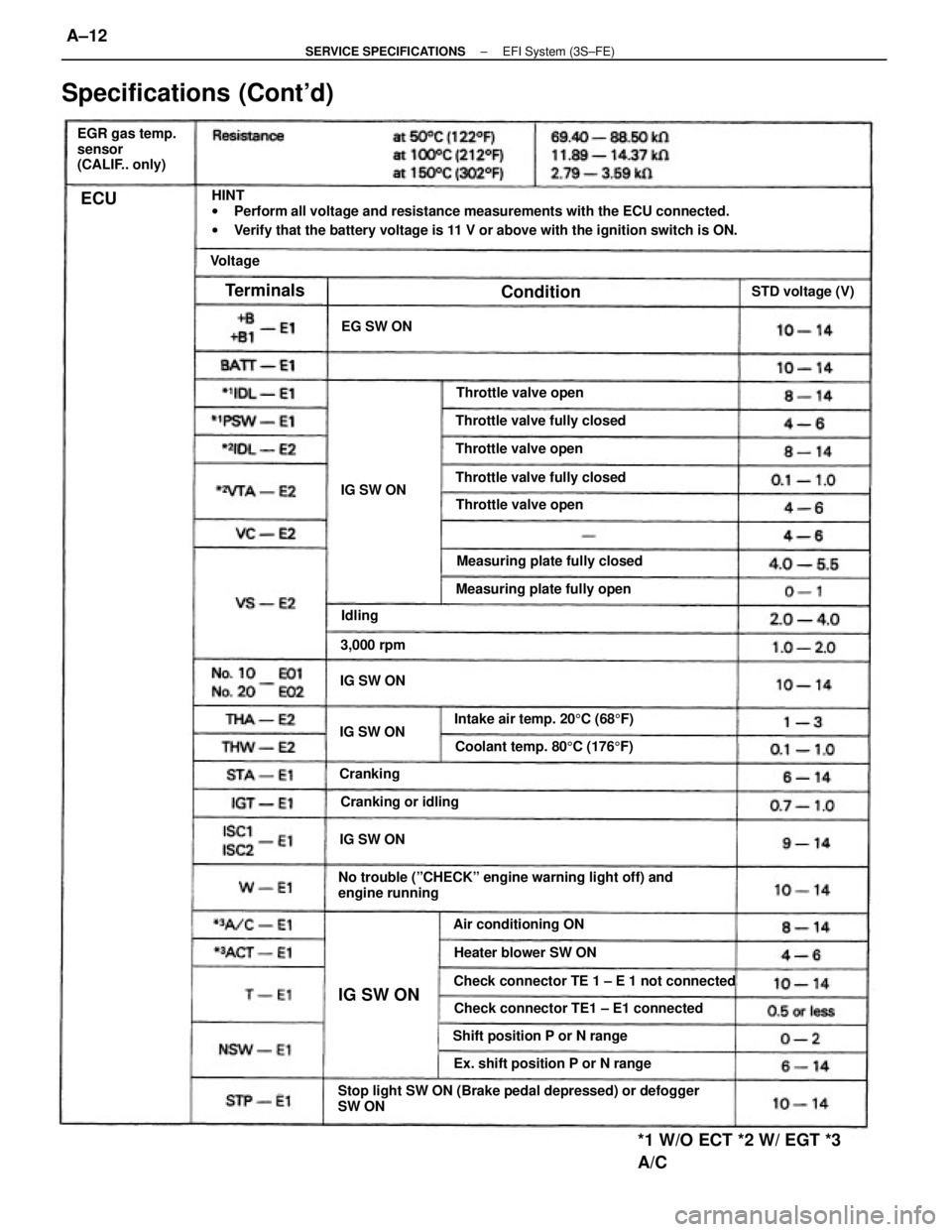
HINT
wPerform all voltage and resistance measurements with the ECU connected.
wVerify that the battery voltage is 11 V or above with the ignition switch is ON.
Stop light SW ON (Brake pedal depressed) or defogger
SW ONNo trouble (ºCHECKº engine warning light off) and
engine running
Check connector TE 1 ± E 1 not connected
Specifications (Cont'd)
Check connector TE1 ± E1 connected
*1 W/O ECT *2 W/ EGT *3
A/C
EGR gas temp.
sensor
(CALIF.. only)
Ex. shift position P or N rangeIntake air temp. 205C (685F) Measuring plate fully closed
Coolant temp. 805C (1765F)
Shift position P or N rangeMeasuring plate fully open Throttle valve fully closed
Throttle valve fully closed
Heater blower SW ON Air conditioning ONThrottle valve open
Throttle valve open
Throttle valve open
Cranking or idlingSTD voltage (V)
3,000 rpmEG SW ON
IG SW ON IG SW ONIG SW ONIG SW ON
IG SW ON
Cranking
Terminals
Condition
Voltage
Idling
ECU
± SERVICE SPECIFICATIONSEFI System (3S±FE)A±12
Page 2227 of 2389
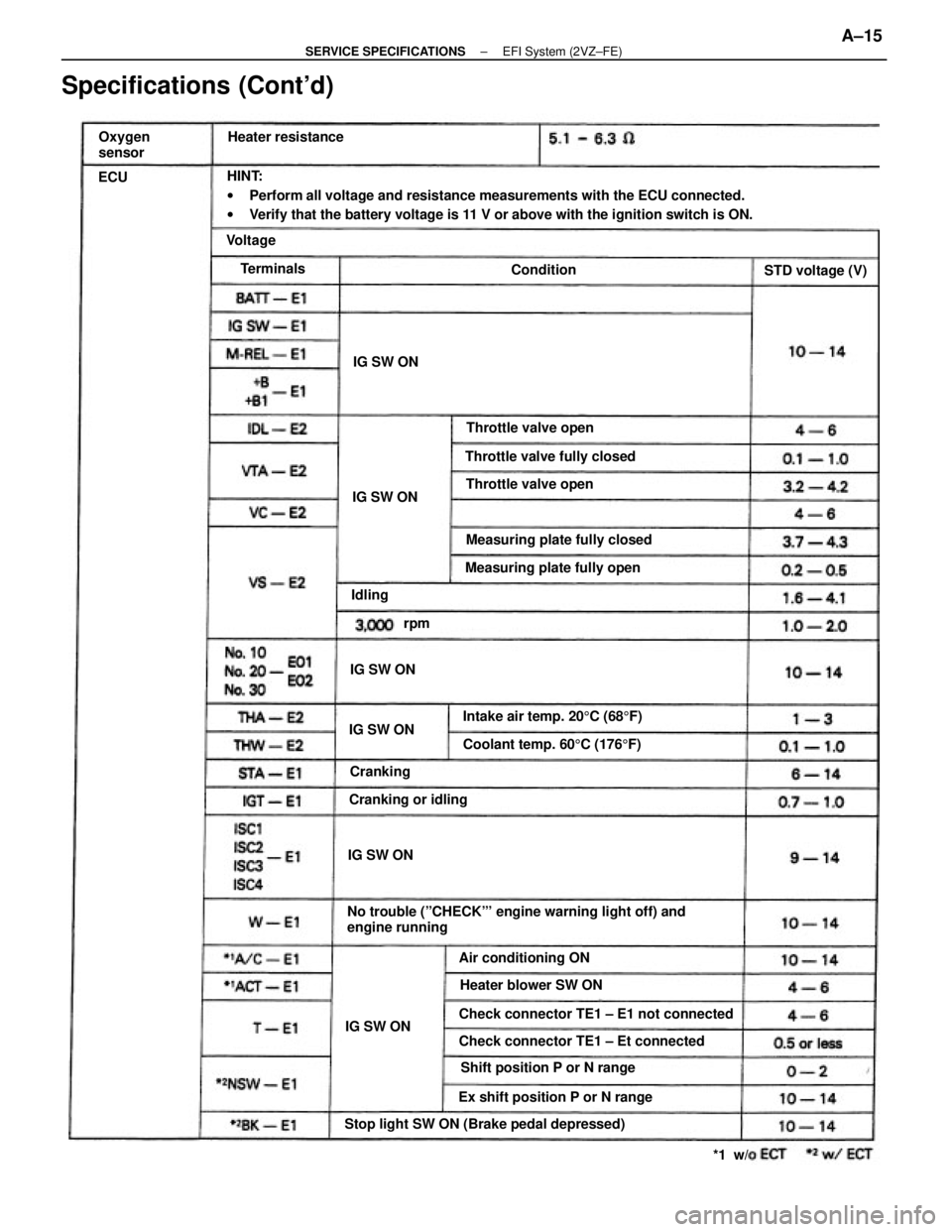
HINT:
wPerform all voltage and resistance measurements with the ECU connected.
wVerify that the battery voltage is 11 V or above with the ignition switch is ON.
No trouble (ºCHECKº' engine warning light off) and
engine running
Specifications (Cont'd)
Stop light SW ON (Brake pedal depressed)Check connector TE1 ± E1 not connected
Check connector TE1 ± Et connected
Shift position P or N range
Ex shift position P or N rangeIntake air temp. 205C (685F) Measuring plate fully closed
Coolant temp. 605C (1765F) Measuring plate fully open Throttle valve fully closed
Heater blower SW ON Air conditioning ONThrottle valve open
Throttle valve open
Cranking or idling Heater resistance
STD voltage (V) Oxygen
sensor
IG SW ON
IG SW ONIG SW ON
IG SW ONIG SW ON
IG SW ONCranking Terminals
Condition Voltage
Idling
*1 w/ rpm ECU
± SERVICE SPECIFICATIONSEFI System (2VZ±FE)A±15
Page 2310 of 2389
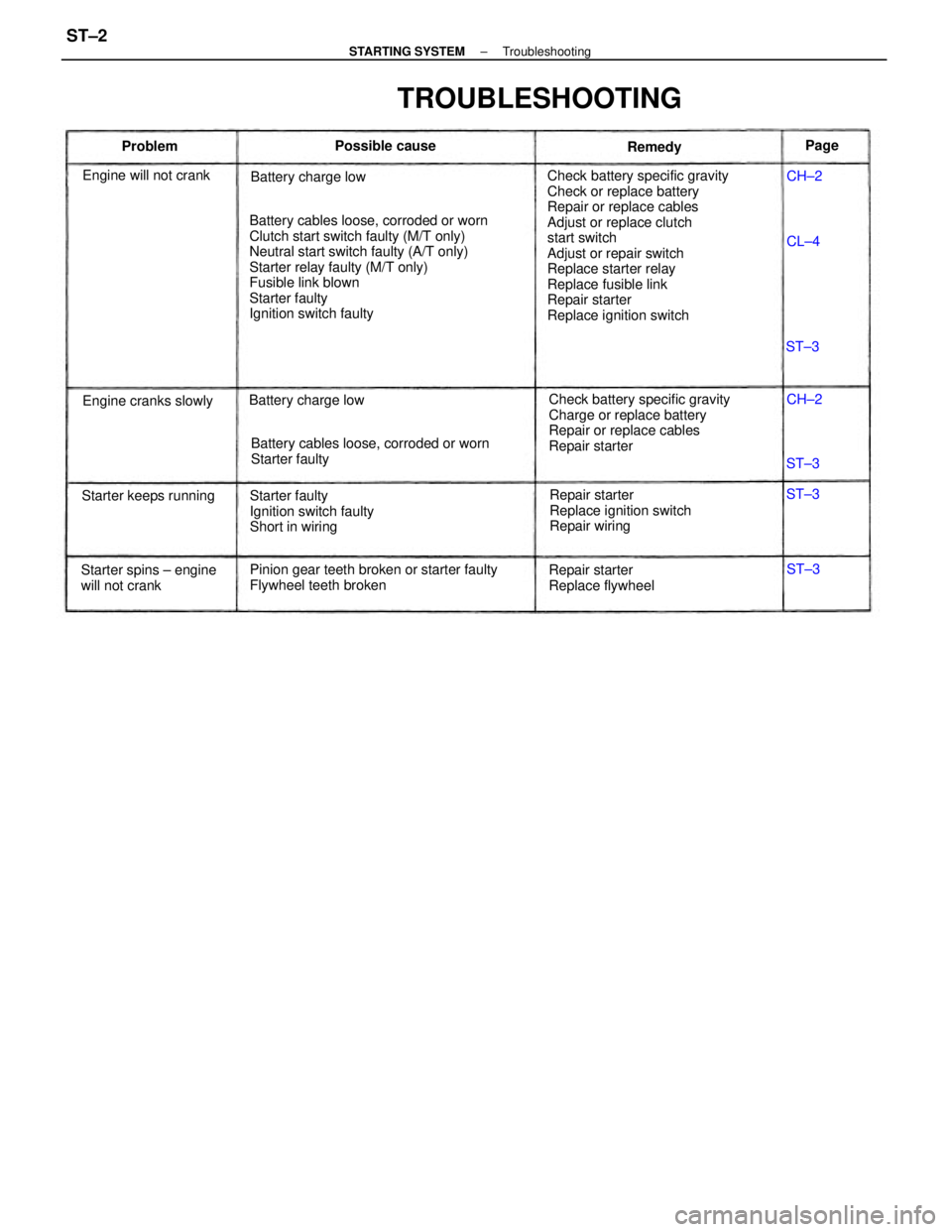
Check battery specific gravity
Check or replace battery
Repair or replace cables
Adjust or replace clutch
start switch
Adjust or repair switch
Replace starter relay
Replace fusible link
Repair starter
Replace ignition switch Battery cables loose, corroded or worn
Clutch start switch faulty (M/T only)
Neutral start switch faulty (A/T only)
Starter relay faulty (M/T only)
Fusible link blown
Starter faulty
Ignition switch faulty
Check battery specific gravity
Charge or replace battery
Repair or replace cables
Repair starter
Pinion gear teeth broken or starter faulty
Flywheel teeth brokenBattery cables loose, corroded or worn
Starter faulty
Repair starter
Replace ignition switch
Repair wiring Starter faulty
Ignition switch faulty
Short in wiring
TROUBLESHOOTING
Starter spins ± engine
will not crankRepair starter
Replace flywheel Engine will not crank
Starter keeps runningBattery charge low
Engine cranks slowlyBattery charge lowPossible cause
Remedy ProblemPage
CH±2
CH±2
ST±3 ST±3
ST±3
ST±3 CL±4
± STARTING SYSTEMTroubleshootingST±2
Page 2323 of 2389
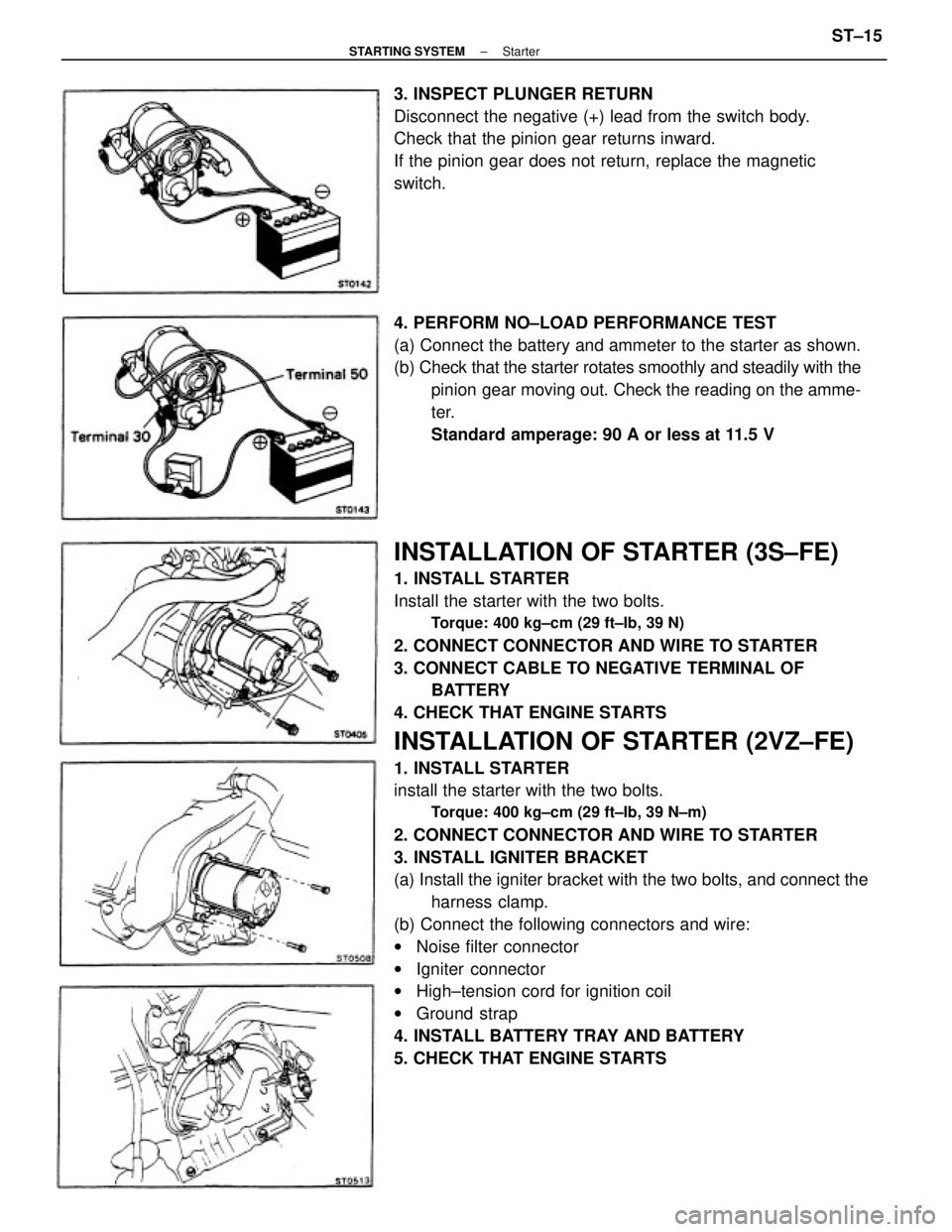
INSTALLATION OF STARTER (3S±FE)
1. INSTALL STARTER
Install the starter with the two bolts.
Torque: 400 kg±cm (29 ft±Ib, 39 N)
2. CONNECT CONNECTOR AND WIRE TO STARTER
3. CONNECT CABLE TO NEGATIVE TERMINAL OF
BATTERY
4. CHECK THAT ENGINE STARTS
INSTALLATION OF STARTER (2VZ±FE)
1. INSTALL STARTER
install the starter with the two bolts.
Torque: 400 kg±cm (29 ft±Ib, 39 N±m)
2. CONNECT CONNECTOR AND WIRE TO STARTER
3. INSTALL IGNITER BRACKET
(a) Install the igniter bracket with the two bolts, and connect the
harness clamp.
(b) Connect the following connectors and wire:
wNoise filter connector
wIgniter connector
wHigh±tension cord for ignition coil
wGround strap
4. INSTALL BATTERY TRAY AND BATTERY
5. CHECK THAT ENGINE STARTS 4. PERFORM NO±LOAD PERFORMANCE TEST
(a) Connect the battery and ammeter to the starter as shown.
(b) Check that the starter rotates smoothly and steadily with the
pinion gear moving out. Check the reading on the amme-
ter.
Standard amperage: 90 A or less at 11.5 V 3. INSPECT PLUNGER RETURN
Disconnect the negative (+) lead from the switch body.
Check that the pinion gear returns inward.
If the pinion gear does not return, replace the magnetic
switch.
± STARTING SYSTEMStarterST±15
Page 2348 of 2389
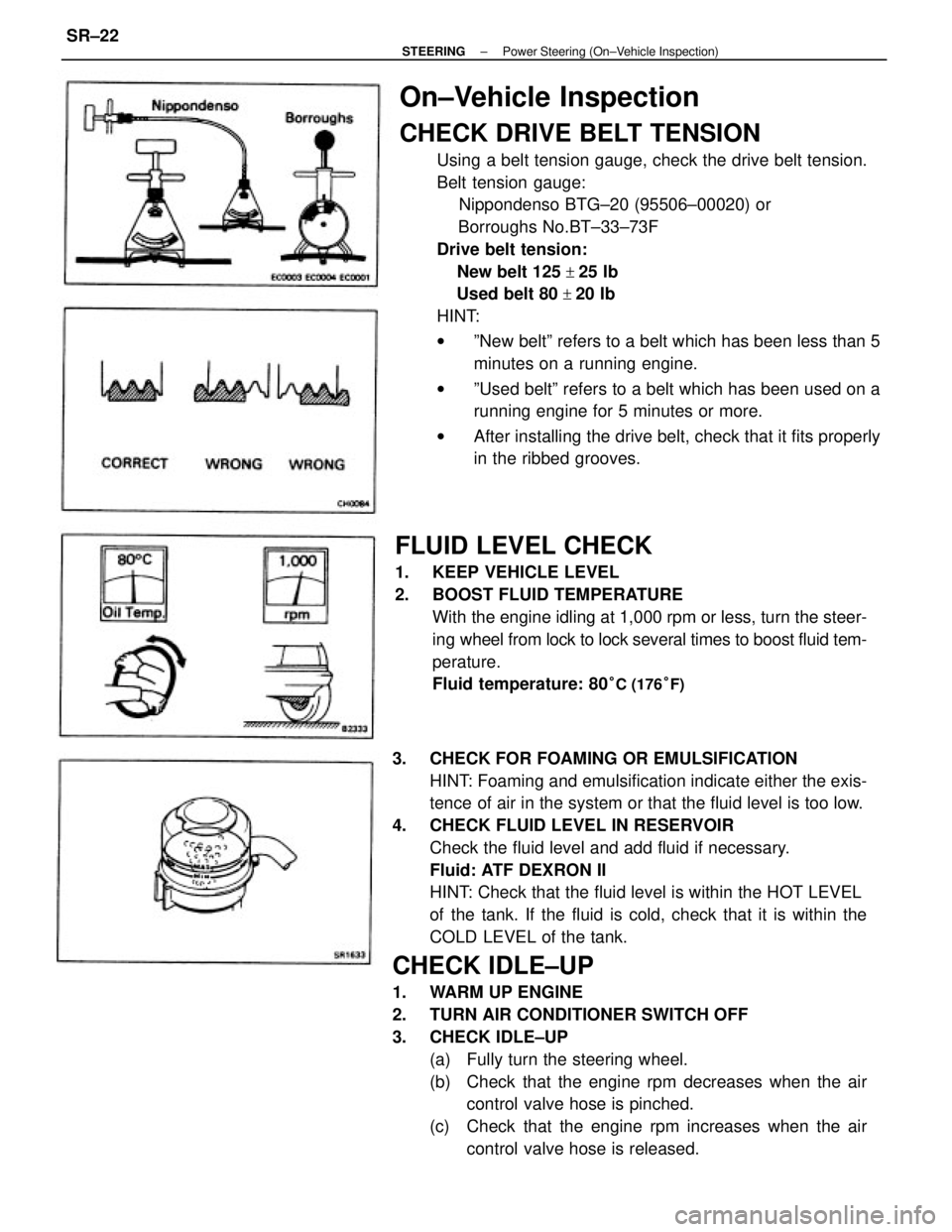
3. CHECK FOR FOAMING OR EMULSIFICATION
HINT: Foaming and emulsification indicate either the exis-
tence of air in the system or that the fluid level is too low.
4. CHECK FLUID LEVEL IN RESERVOIR
Check the fluid level and add fluid if necessary.
Fluid: ATF DEXRON II
HINT: Check that the fluid level is within the HOT LEVEL
of the tank. If the fluid is cold, check that it is within the
COLD LEVEL of the tank.
CHECK IDLE±UP
1. WARM UP ENGINE
2. TURN AIR CONDITIONER SWITCH OFF
3. CHECK IDLE±UP
(a) Fully turn the steering wheel.
(b) Check that the engine rpm decreases when the air
control valve hose is pinched.
(c) Check that the engine rpm increases when the air
control valve hose is released.
On±Vehicle Inspection
CHECK DRIVE BELT TENSION
Using a belt tension gauge, check the drive belt tension.
Belt tension gauge:
Nippondenso BTG±20 (95506±00020) or
Borroughs No.BT±33±73F
Drive belt tension:
New belt 125
+25 Ib
Used belt 80
+20 Ib
HINT:
wºNew beltº refers to a belt which has been less than 5
minutes on a running engine.
wºUsed beltº refers to a belt which has been used on a
running engine for 5 minutes or more.
wAfter installing the drive belt, check that it fits properly
in the ribbed grooves.
FLUID LEVEL CHECK
1. KEEP VEHICLE LEVEL
2. BOOST FLUID TEMPERATURE
With the engine idling at 1,000 rpm or less, turn the steer-
ing wheel from lock to lock several times to boost fluid tem-
perature.
Fluid temperature: 80
°C (176°F)
± STEERINGPower Steering (On±Vehicle Inspection)SR±22
Page 2350 of 2389
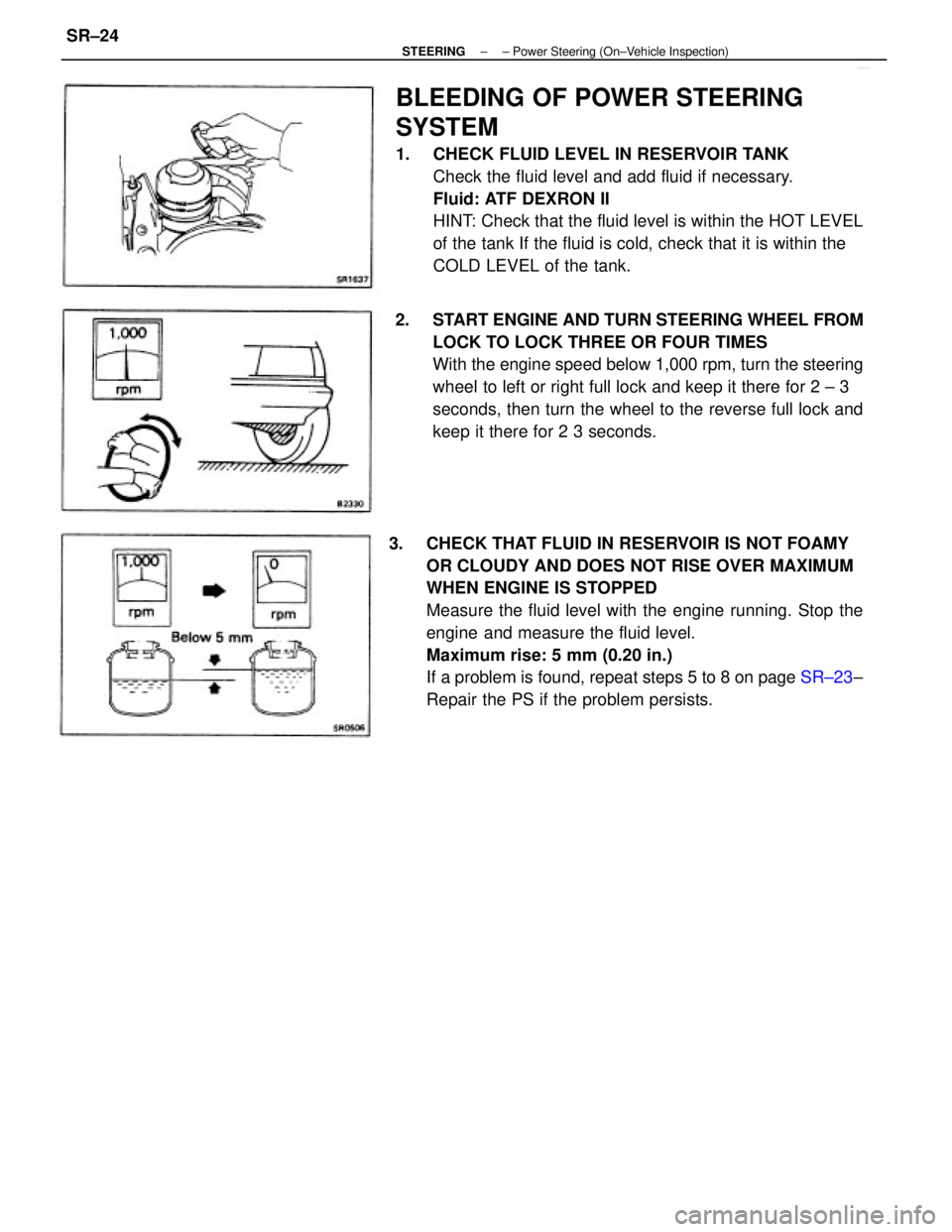
3. CHECK THAT FLUID IN RESERVOIR IS NOT FOAMY
OR CLOUDY AND DOES NOT RISE OVER MAXIMUM
WHEN ENGINE IS STOPPED
Measure the fluid level with the engine running. Stop the
engine and measure the fluid level.
Maximum rise: 5 mm (0.20 in.)
If a problem is found, repeat steps 5 to 8 on page SR±23±
Repair the PS if the problem persists.
BLEEDING OF POWER STEERING
SYSTEM
1. CHECK FLUID LEVEL IN RESERVOIR TANK
Check the fluid level and add fluid if necessary.
Fluid: ATF DEXRON II
HINT: Check that the fluid level is within the HOT LEVEL
of the tank If the fluid is cold, check that it is within the
COLD LEVEL of the tank.
2. START ENGINE AND TURN STEERING WHEEL FROM
LOCK TO LOCK THREE OR FOUR TIMES
With the engine speed below 1,000 rpm, turn the steering
wheel to left or right full lock and keep it there for 2 ± 3
seconds, then turn the wheel to the reverse full lock and
keep it there for 2 3 seconds.
± STEERING± Power Steering (On±Vehicle Inspection)SR±24
Page 2351 of 2389
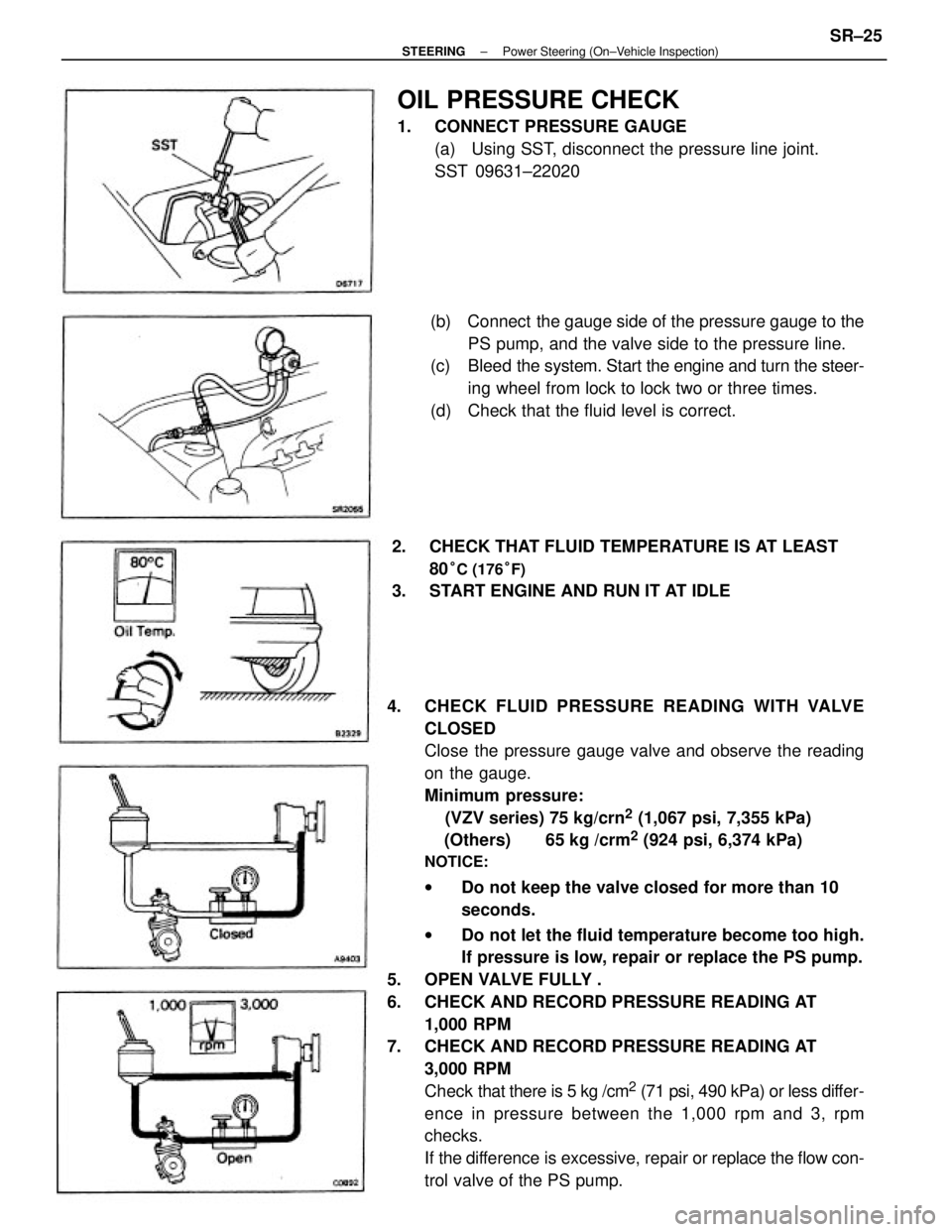
4. CHECK FLUID PRESSURE READING WITH VALVE
CLOSED
Close the pressure gauge valve and observe the reading
on the gauge.
Minimum pressure:
(VZV series) 75 kg/crn
2 (1,067 psi, 7,355 kPa)
(Others) 65 kg /crm
2 (924 psi, 6,374 kPa)
NOTICE:
wDo not keep the valve closed for more than 10
seconds.
wDo not let the fluid temperature become too high.
If pressure is low, repair or replace the PS pump.
5. OPEN VALVE FULLY .
6. CHECK AND RECORD PRESSURE READING AT
1,000 RPM
7. CHECK AND RECORD PRESSURE READING AT
3,000 RPM
Check that there is 5 kg /cm
2 (71 psi, 490 kPa) or less differ-
ence in pressure between the 1,000 rpm and 3, rpm
checks.
If the difference is excessive, repair or replace the flow con-
trol valve of the PS pump.(b) Connect the gauge side of the pressure gauge to the
PS pump, and the valve side to the pressure line.
(c) Bleed the system. Start the engine and turn the steer-
ing wheel from lock to lock two or three times.
(d) Check that the fluid level is correct.
OIL PRESSURE CHECK
1. CONNECT PRESSURE GAUGE
(a) Using SST, disconnect the pressure line joint.
SST 09631±22020
2. CHECK THAT FLUID TEMPERATURE IS AT LEAST
80
°C (176°F)
3. START ENGINE AND RUN IT AT IDLE
± STEERINGPower Steering (On±Vehicle Inspection)SR±25
Page 2352 of 2389
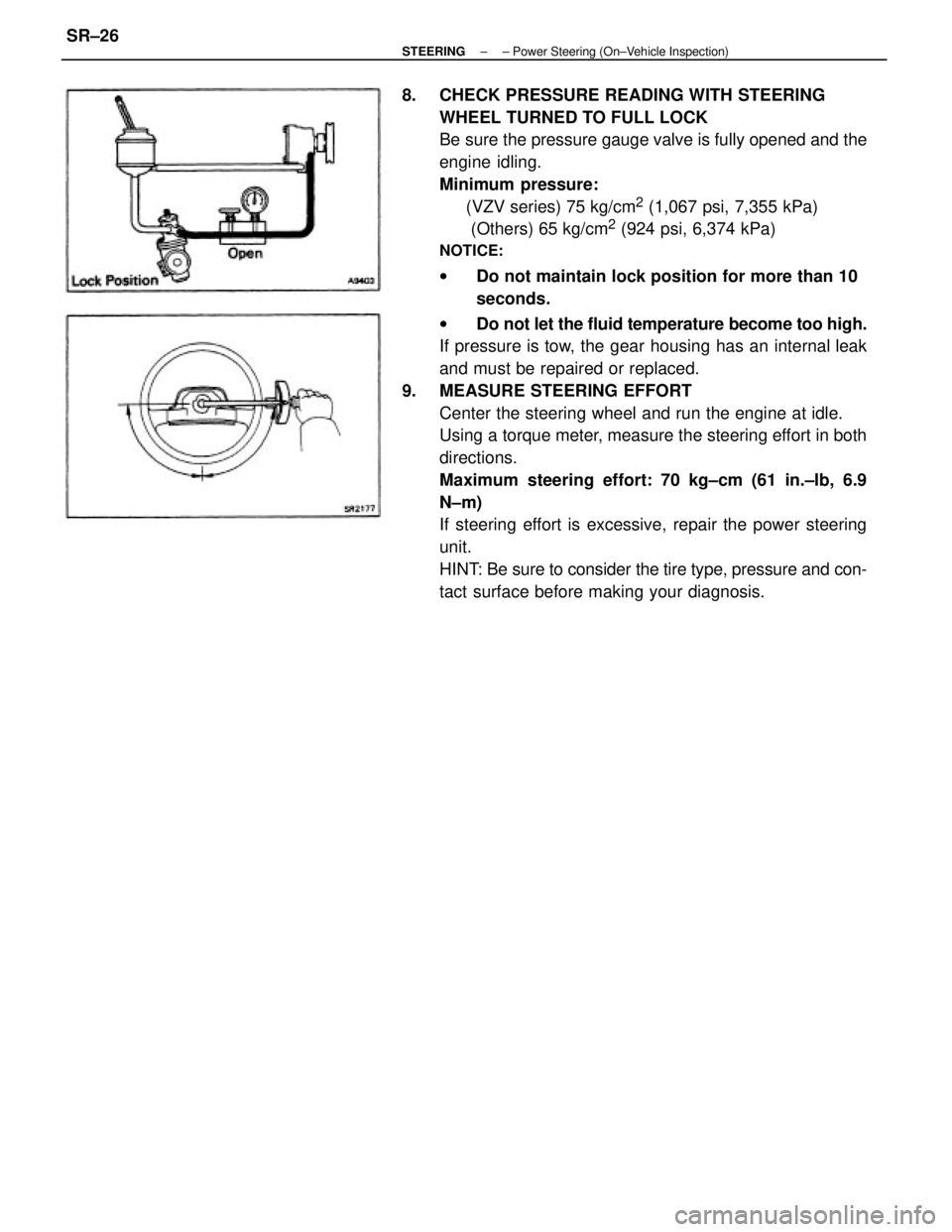
8. CHECK PRESSURE READING WITH STEERING
WHEEL TURNED TO FULL LOCK
Be sure the pressure gauge valve is fully opened and the
engine idling.
Minimum pressure:
(VZV series) 75 kg/cm
2 (1,067 psi, 7,355 kPa)
(Others) 65 kg/cm
2 (924 psi, 6,374 kPa)
NOTICE:
wDo not maintain lock position for more than 10
seconds.
wDo not let the fluid temperature become too high.
If pressure is tow, the gear housing has an internal leak
and must be repaired or replaced.
9. MEASURE STEERING EFFORT
Center the steering wheel and run the engine at idle.
Using a torque meter, measure the steering effort in both
directions.
Maximum steering effort: 70 kg±cm (61 in.±Ib, 6.9
N±m)
If steering effort is excessive, repair the power steering
unit.
HINT: Be sure to consider the tire type, pressure and con-
tact surface before making your diagnosis.
± STEERING± Power Steering (On±Vehicle Inspection)SR±26