Page 1859 of 2389
GENERAL REPAIR INSTRUCTIONS
1. Use fender seat and floor covers to keep the vehicle clean
and prevent damage.
2. During disassembly, keep parts in the appropriate order to
facilitate reassembly.
3. Observe the following:
(a) Before performing electrical work, disconnect the neg-
ative cable from the battery terminal.
(b) If it is necessary to disconnect the battery for inspection
or repair, always disconnect the cable from the nega-
tive H terminal which is grounded to the vehicle body.
(c) To prevent damage to the battery terminal post, loosen
the terminal nut and raise the cable straight up
without twisting or prying it.
(d) Clean the battery terminal posts and cable terminals
with a shop rag.
o not scrape them with a file or other
abrasive objects.
(e) Install the cable terminal to the battery post with
the nut loose, and tighten the nut after installation. Do
not use a hammer to tap the terminal onto the post.
(f) Be sure the cover for the positive (+) terminal is properly
in place.
4. Check hose and wiring connectors to make sure that they are
secure and correct.
5. Non±reusable parts
(a) Always replace cotter pins, gaskets, 0±rings and oil
seals etc. with new ones.
(b) Non±reusable parts are indicated in the component il-
lustrations by the ºrº symbol.
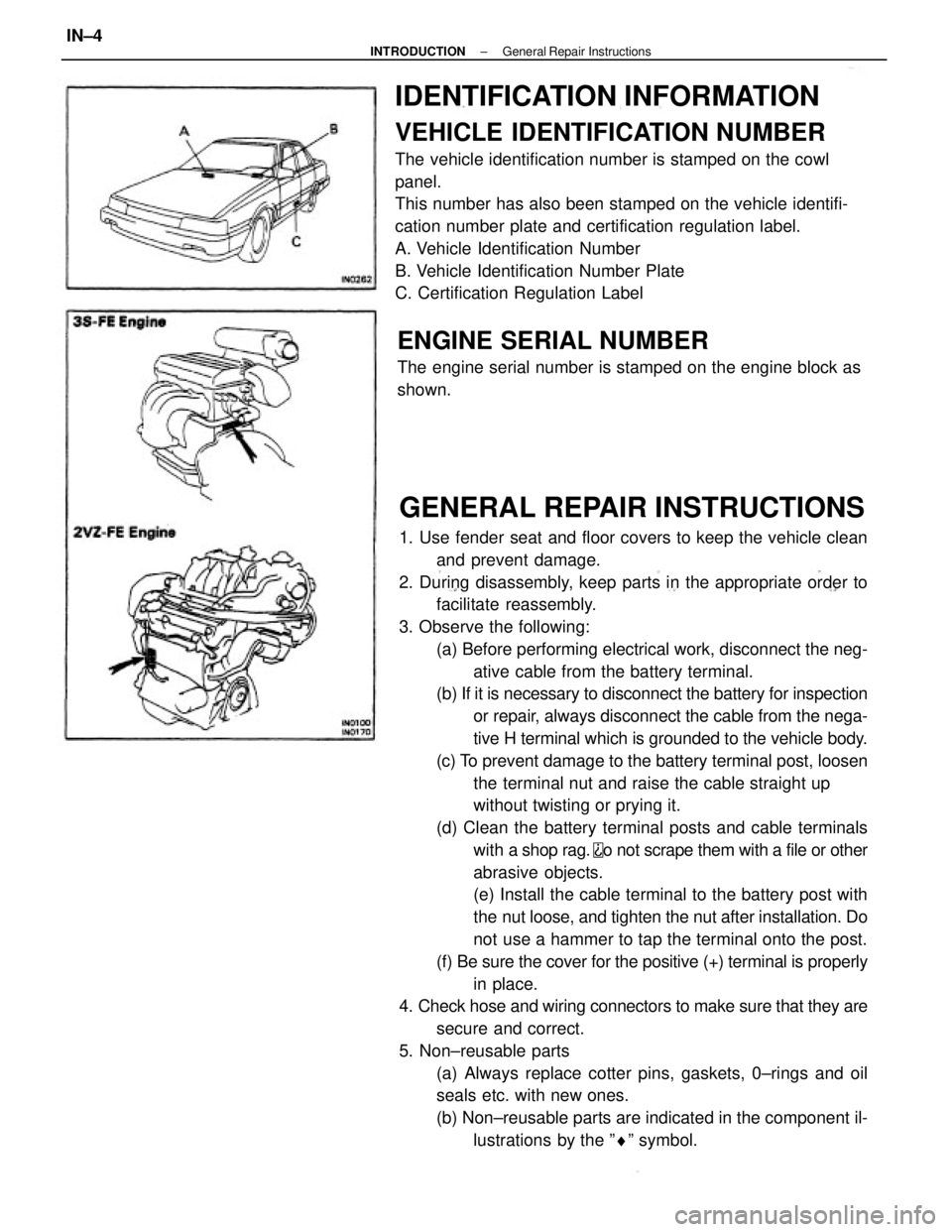
IDENTIFICATION INFORMATION
VEHICLE IDENTIFICATION NUMBER
The vehicle identification number is stamped on the cowl
panel.
This number has also been stamped on the vehicle identifi-
cation number plate and certification regulation label.
A. Vehicle Identification Number
B. Vehicle Identification Number Plate
C. Certification Regulation Label
ENGINE SERIAL NUMBER
The engine serial number is stamped on the engine block as
shown.
± INTRODUCTIONGeneral Repair InstructionsIN±4
Page 1861 of 2389
PRECAUTIONS FOR VEHICLES EQUIPPED WITH A
CATALYTIC CONVERTER
CAUTION: If large amounts of unburned gasoline flow into the converter, it may overheat
and create a fire hazard. To prevent this, observe the following precautions and
explain them to your customer.
1. Use only unleaded gasoline.
2. Avoid prolonged idling.
Avoid running the engine at idle speed for more than 20
minutes.
3. Avoid spark jump test.
(a) Spark jump test only when absolutely necessary. Perform this test as rapidly as pos-
sible.
(b) While testing, never race the engine.
4. Avoid prolonged engine compression measurement.
Engine compression tests must be made as rapidly as possible.
5. Do not run engine when fuel tank is nearly empty.
This may cause the engine to misfire and create an extra
load on the converter.
6. Avoid coasting with ignition turned off and prolonged braking.
7. Do not dispose of used catalyst along with parts contaminated with gasoline or oil.(f) When steam cleaning an engine, protect the distribu-
tor, air filter and VCV from water.
(g) Never use an impact wrench to remove or install tem-
perature switches or temperature sensors.
(h) When checking continuity at the wire connector, insert
the tester probe carefully to prevent terminals from
bending.
(i) When using a vacuum gauge, never force the hose
onto a connector that is too large. Use a step±down
adapter instead. Once the hose has been stretched,
it may leak.
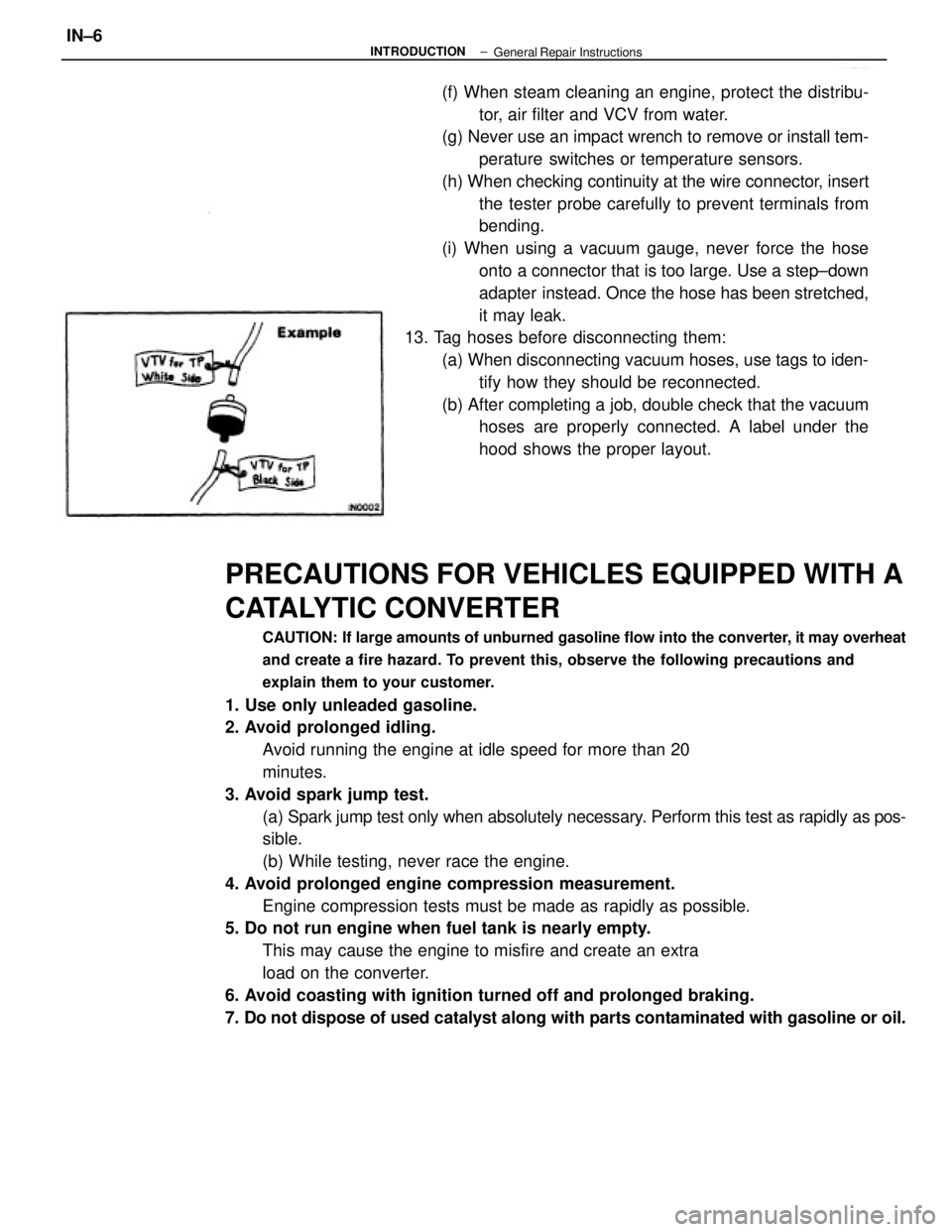
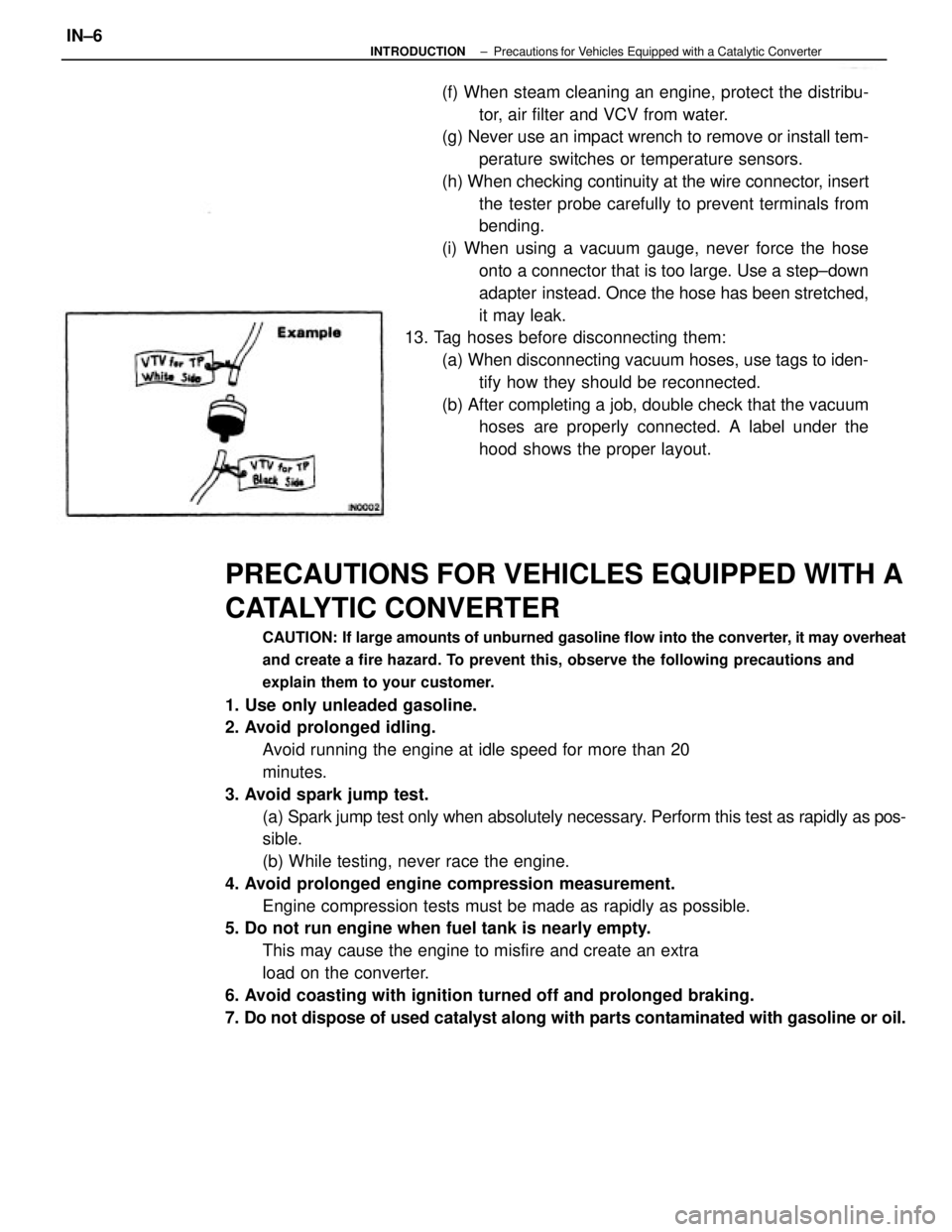
13. Tag hoses before disconnecting them:
(a) When disconnecting vacuum hoses, use tags to iden-
tify how they should be reconnected.
(b) After completing a job, double check that the vacuum
hoses are properly connected. A label under the
hood shows the proper layout.
± INTRODUCTIONIN±6General Repair Instructions
Page 1862 of 2389
PRECAUTIONS FOR VEHICLES EQUIPPED WITH A
CATALYTIC CONVERTER
CAUTION: If large amounts of unburned gasoline flow into the converter, it may overheat
and create a fire hazard. To prevent this, observe the following precautions and
explain them to your customer.
1. Use only unleaded gasoline.
2. Avoid prolonged idling.
Avoid running the engine at idle speed for more than 20
minutes.
3. Avoid spark jump test.
(a) Spark jump test only when absolutely necessary. Perform this test as rapidly as pos-
sible.
(b) While testing, never race the engine.
4. Avoid prolonged engine compression measurement.
Engine compression tests must be made as rapidly as possible.
5. Do not run engine when fuel tank is nearly empty.
This may cause the engine to misfire and create an extra
load on the converter.
6. Avoid coasting with ignition turned off and prolonged braking.
7. Do not dispose of used catalyst along with parts contaminated with gasoline or oil.(f) When steam cleaning an engine, protect the distribu-
tor, air filter and VCV from water.
(g) Never use an impact wrench to remove or install tem-
perature switches or temperature sensors.
(h) When checking continuity at the wire connector, insert
the tester probe carefully to prevent terminals from
bending.
(i) When using a vacuum gauge, never force the hose
onto a connector that is too large. Use a step±down
adapter instead. Once the hose has been stretched,
it may leak.
13. Tag hoses before disconnecting them:
(a) When disconnecting vacuum hoses, use tags to iden-
tify how they should be reconnected.
(b) After completing a job, double check that the vacuum
hoses are properly connected. A label under the
hood shows the proper layout.
± INTRODUCTIONPrecautions for Vehicles Equipped with a Catalytic ConverterIN±6
Page 1869 of 2389
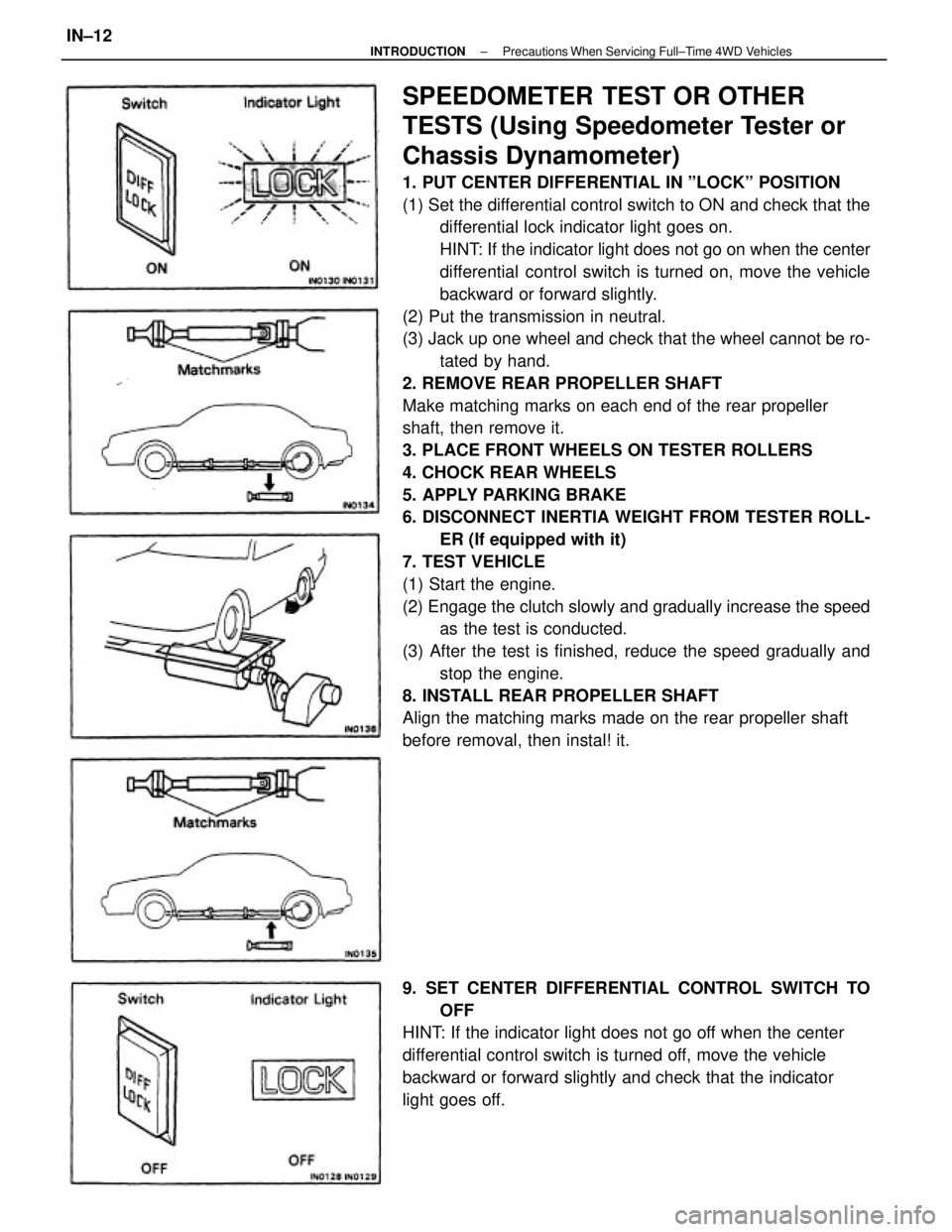
SPEEDOMETER TEST OR OTHER
TESTS (Using Speedometer Tester or
Chassis Dynamometer)
1. PUT CENTER DIFFERENTIAL IN ºLOCKº POSITION
(1) Set the differential control switch to ON and check that the
differential lock indicator light goes on.
HINT: If the indicator light does not go on when the center
differential control switch is turned on, move the vehicle
backward or forward slightly.
(2) Put the transmission in neutral.
(3) Jack up one wheel and check that the wheel cannot be ro-
tated by hand.
2. REMOVE REAR PROPELLER SHAFT
Make matching marks on each end of the rear propeller
shaft, then remove it.
3. PLACE FRONT WHEELS ON TESTER ROLLERS
4. CHOCK REAR WHEELS
5. APPLY PARKING BRAKE
6. DISCONNECT INERTIA WEIGHT FROM TESTER ROLL-
ER (If equipped with it)
7. TEST VEHICLE
(1) Start the engine.
(2) Engage the clutch slowly and gradually increase the speed
as the test is conducted.
(3) After the test is finished, reduce the speed gradually and
stop the engine.
8. INSTALL REAR PROPELLER SHAFT
Align the matching marks made on the rear propeller shaft
before removal, then instal! it.
9. SET CENTER DIFFERENTIAL CONTROL SWITCH TO
OFF
HINT: If the indicator light does not go off when the center
differential control switch is turned off, move the vehicle
backward or forward slightly and check that the indicator
light goes off.
± INTRODUCTIONPrecautions When Servicing Full±Time 4WD VehiclesIN±12
Page 1870 of 2389
ON±VEHICLE WHEEL BALANCING
NOTICE:
1. When doing on±the±car wheel balancing on a fulltime
4WD vehicle, to prevent the wheels from rotating at
different speeds or in different directions from each
other (which could lead to damage to the center differ-
ential or transaxle gears), always be sure to observe
the following precautions:
(1) Aft four wheels should be jacked up, clearing the
ground completely.
(2) The wheels should be driven with both the engine
and the wheel balancer.
(3) The mechanical lock±type center differential
should be in the LOCK position.
(4) The parking brake lever should be fully released.
(5) None of the brakes should be allowed to drag.
2. Avoid sudden acceleration, deceleration and braking.
3. Carry out the wheel balancing with the transmission in
3rd or 4th gear.
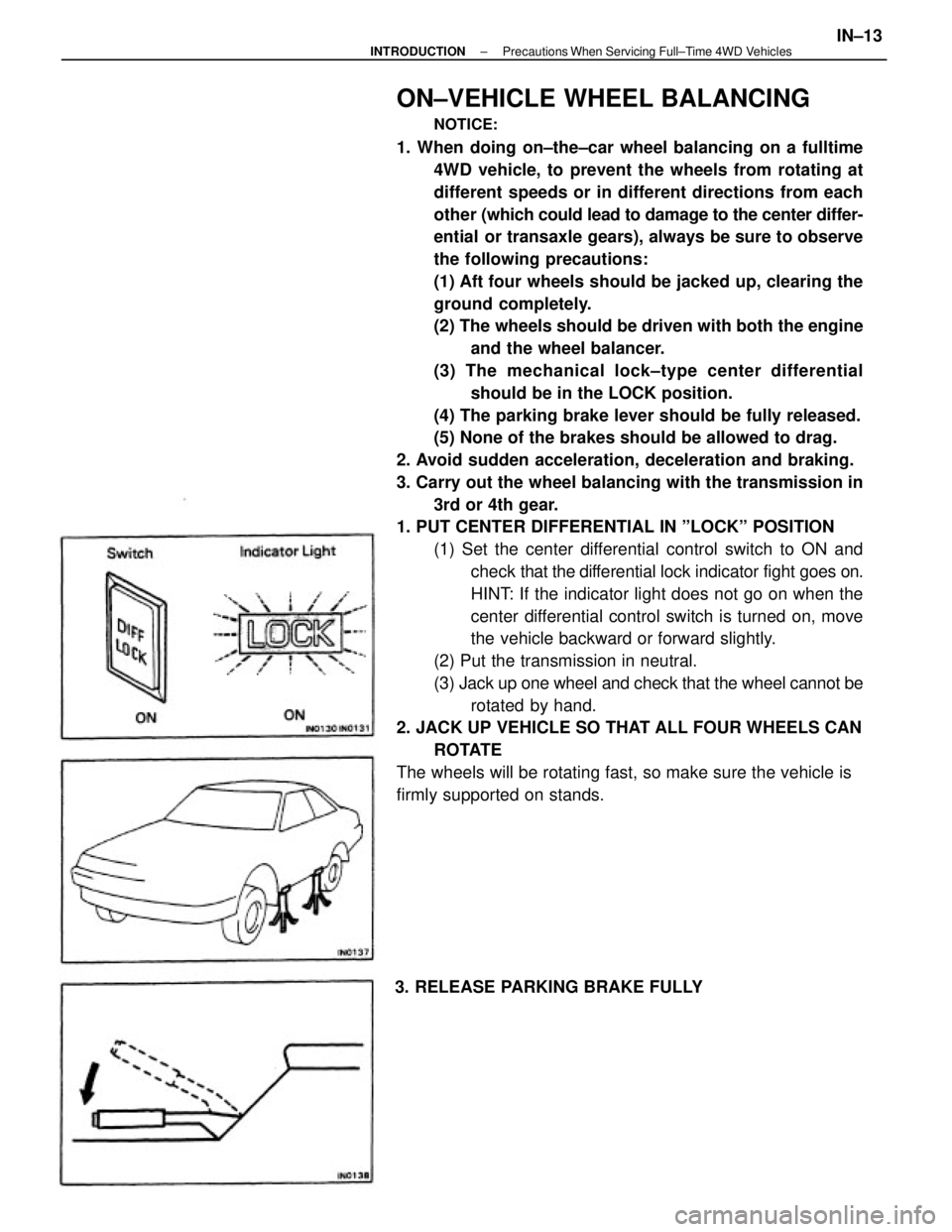
1. PUT CENTER DIFFERENTIAL IN ºLOCKº POSITION
(1) Set the center differential control switch to ON and
check that the differential lock indicator fight goes on.
HINT: If the indicator light does not go on when the
center differential control switch is turned on, move
the vehicle backward or forward slightly.
(2) Put the transmission in neutral.
(3) Jack up one wheel and check that the wheel cannot be
rotated by hand.
2. JACK UP VEHICLE SO THAT ALL FOUR WHEELS CAN
ROTATE
The wheels will be rotating fast, so make sure the vehicle is
firmly supported on stands.
3. RELEASE PARKING BRAKE FULLY
± INTRODUCTIONPrecautions When Servicing Full±Time 4WD VehiclesIN±13
Page 1871 of 2389
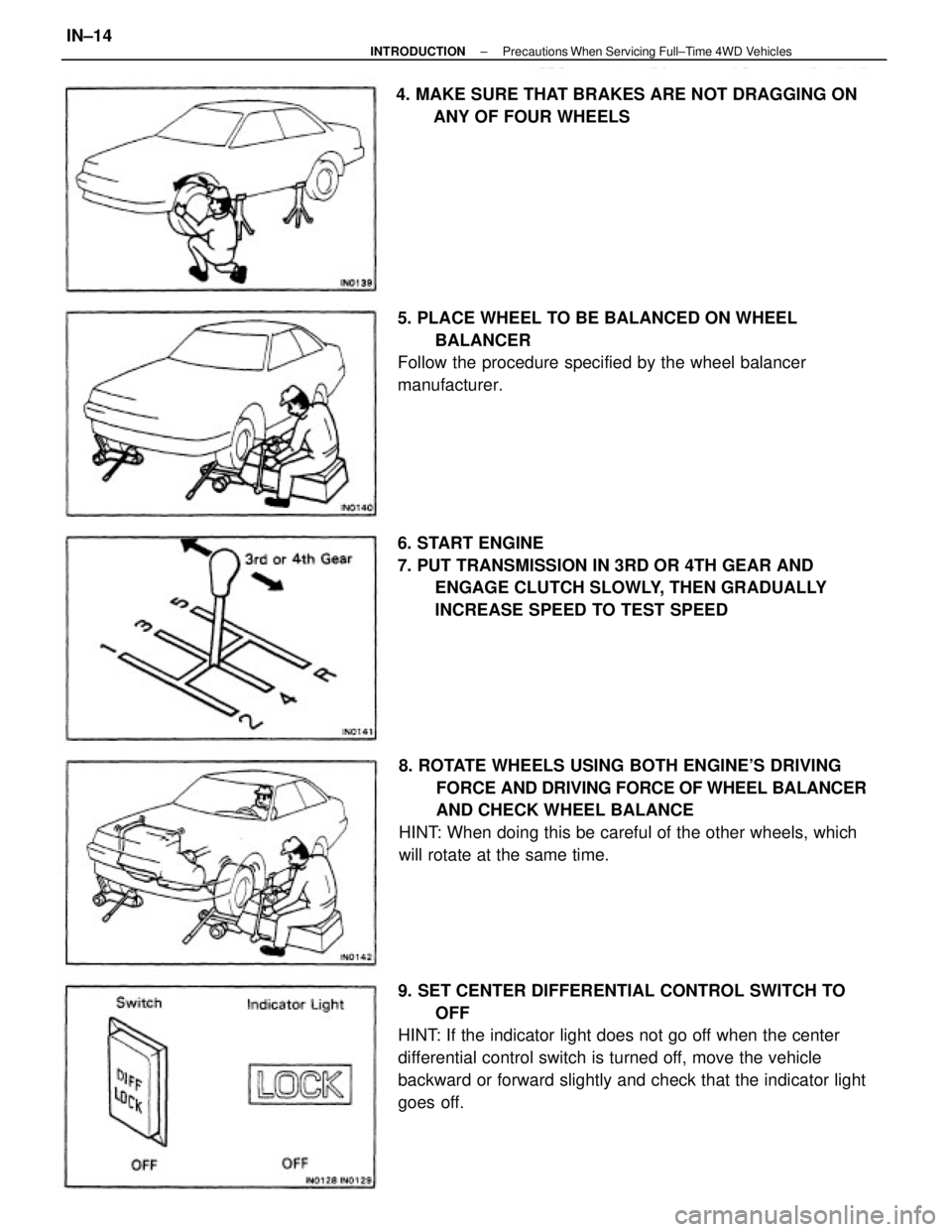
9. SET CENTER DIFFERENTIAL CONTROL SWITCH TO
OFF
HINT: If the indicator light does not go off when the center
differential control switch is turned off, move the vehicle
backward or forward slightly and check that the indicator light
goes off.8. ROTATE WHEELS USING BOTH ENGINE'S DRIVING
FORCE AND DRIVING FORCE OF WHEEL BALANCER
AND CHECK WHEEL BALANCE
HINT: When doing this be careful of the other wheels, which
will rotate at the same time. 6. START ENGINE
7. PUT TRANSMISSION IN 3RD OR 4TH GEAR AND
ENGAGE CLUTCH SLOWLY, THEN GRADUALLY
INCREASE SPEED TO TEST SPEED 5. PLACE WHEEL TO BE BALANCED ON WHEEL
BALANCER
Follow the procedure specified by the wheel balancer
manufacturer. 4. MAKE SURE THAT BRAKES ARE NOT DRAGGING ON
ANY OF FOUR WHEELS
± INTRODUCTIONPrecautions When Servicing Full±Time 4WD VehiclesIN±14
Page 1872 of 2389
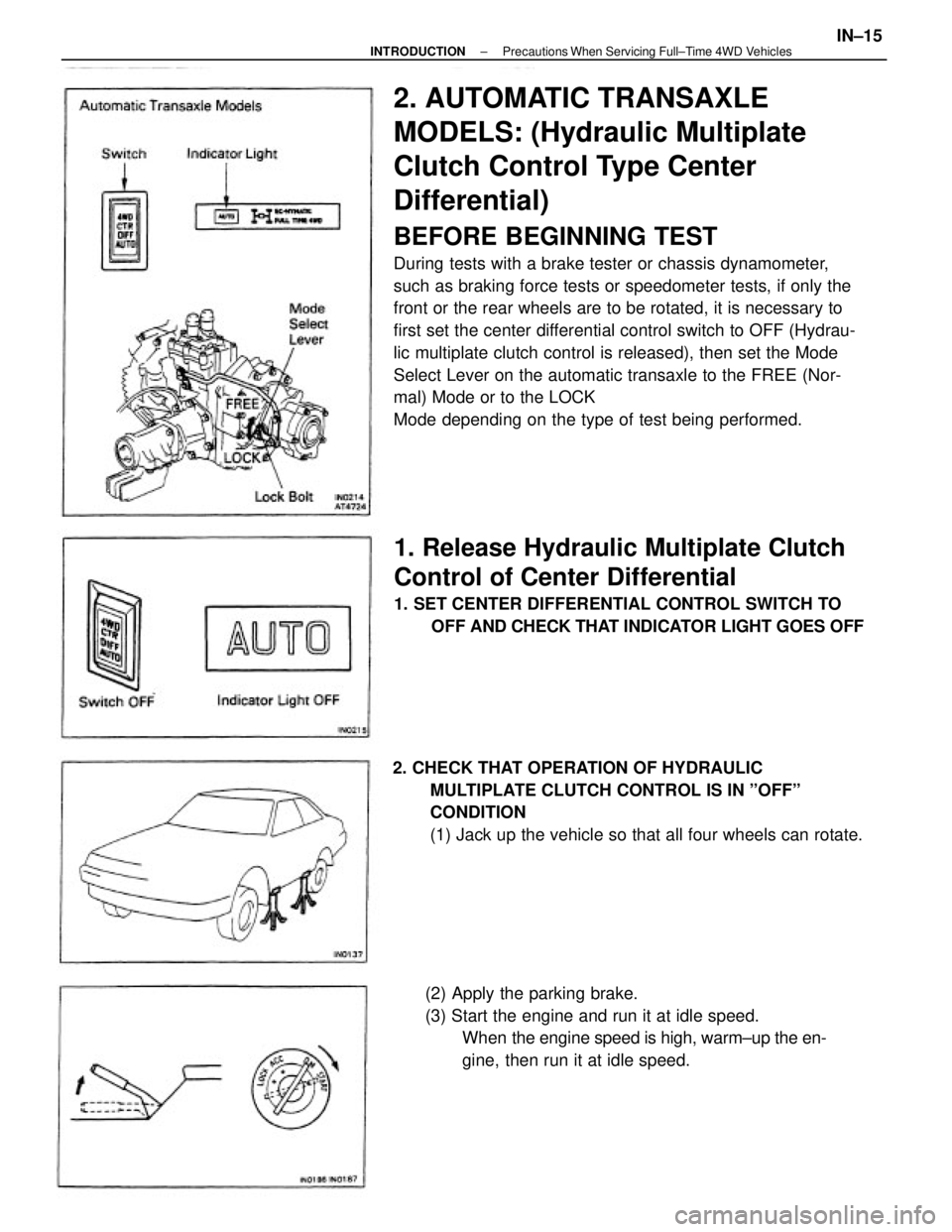
2. AUTOMATIC TRANSAXLE
MODELS: (Hydraulic Multiplate
Clutch Control Type Center
Differential)
BEFORE BEGINNING TEST
During tests with a brake tester or chassis dynamometer,
such as braking force tests or speedometer tests, if only the
front or the rear wheels are to be rotated, it is necessary to
first set the center differential control switch to OFF (Hydrau-
lic multiplate clutch control is released), then set the Mode
Select Lever on the automatic transaxle to the FREE (Nor-
mal) Mode or to the LOCK
Mode depending on the type of test being performed.
1. Release Hydraulic Multiplate Clutch
Control of Center Differential
1. SET CENTER DIFFERENTIAL CONTROL SWITCH TO
OFF AND CHECK THAT INDICATOR LIGHT GOES OFF
2. CHECK THAT OPERATION OF HYDRAULIC
MULTIPLATE CLUTCH CONTROL IS IN ºOFFº
CONDITION
(1) Jack up the vehicle so that all four wheels can rotate.
(2) Apply the parking brake.
(3) Start the engine and run it at idle speed.
When the engine speed is high, warm±up the en-
gine, then run it at idle speed.
± INTRODUCTIONPrecautions When Servicing Full±Time 4WD VehiclesIN±15
Page 1873 of 2389
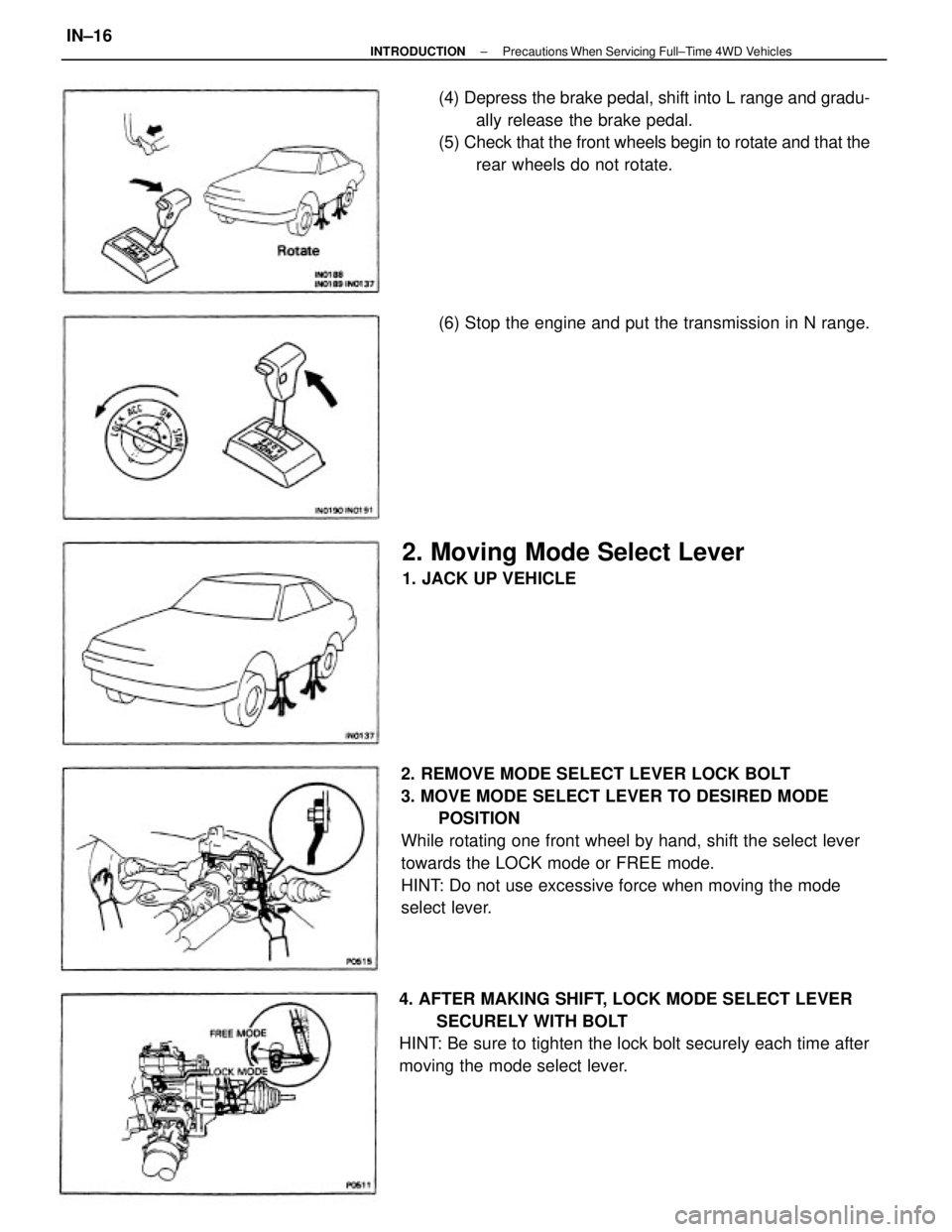
2. REMOVE MODE SELECT LEVER LOCK BOLT
3. MOVE MODE SELECT LEVER TO DESIRED MODE
POSITION
While rotating one front wheel by hand, shift the select lever
towards the LOCK mode or FREE mode.
HINT: Do not use excessive force when moving the mode
select lever.
4. AFTER MAKING SHIFT, LOCK MODE SELECT LEVER
SECURELY WITH BOLT
HINT: Be sure to tighten the lock bolt securely each time after
moving the mode select lever.(4) Depress the brake pedal, shift into L range and gradu-
ally release the brake pedal.
(5) Check that the front wheels begin to rotate and that the
rear wheels do not rotate.
2. Moving Mode Select Lever
1. JACK UP VEHICLE(6) Stop the engine and put the transmission in N range.
± INTRODUCTIONPrecautions When Servicing Full±Time 4WD VehiclesIN±16