Page 1459 of 2389
Sleeve Color MarksCrimping
Tool
ºCLOSE HEREº
Contact
ºINSº Position
10 mm (0.39 in.)
Three or More Times
TERMINAL AND CONNECTOR REPAIR±TERMINAL REPLACEMENT
B±30
40
Wire Harness Repair Manual (RM1022E)
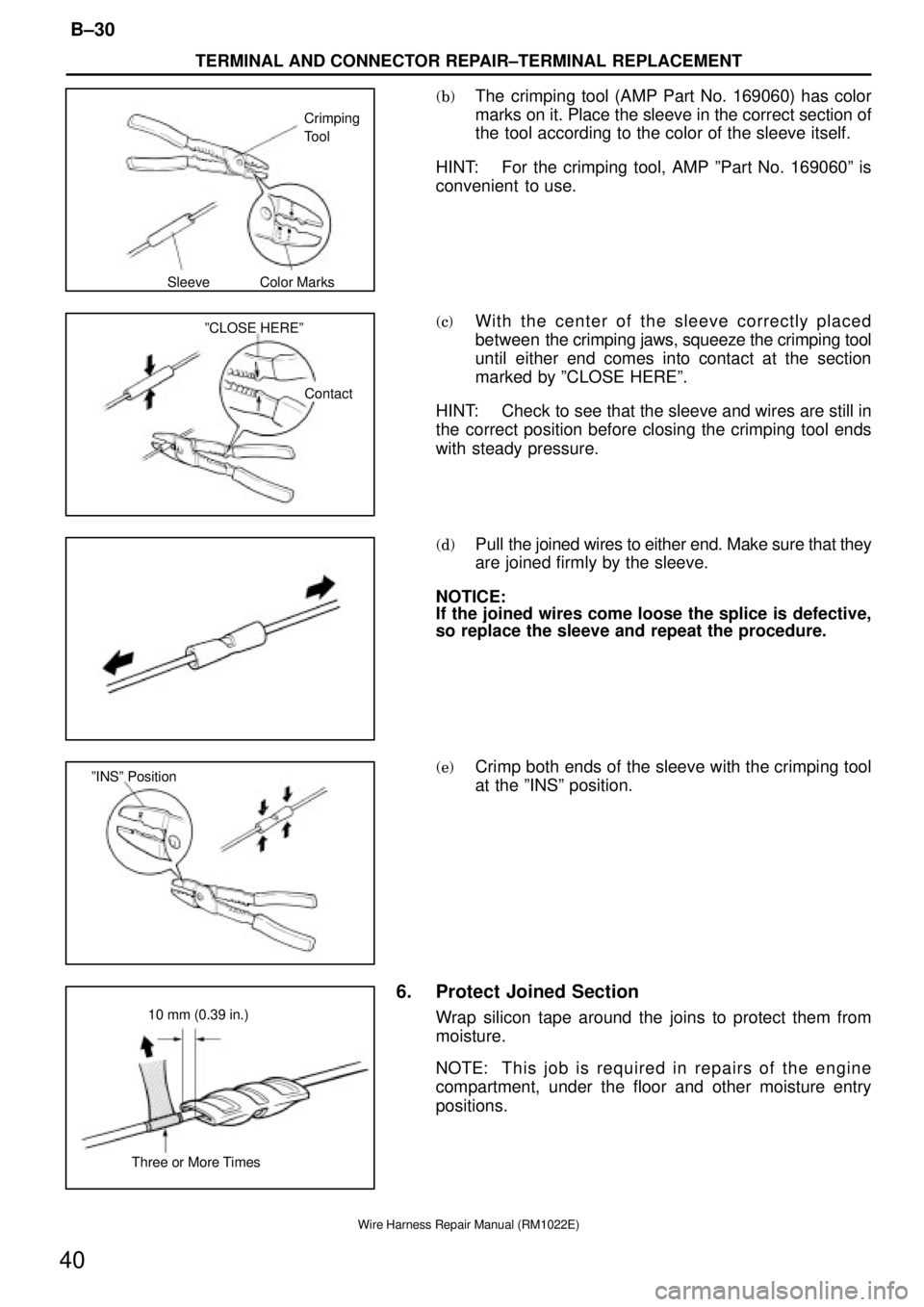
(b)The crimping tool (AMP Part No. 169060) has color
marks on it. Place the sleeve in the correct section of
the tool according to the color of the sleeve itself.
HINT: For the crimping tool, AMP ºPart No. 169060º is
convenient to use.
(c)With the center of the sleeve correctly placed
between the crimping jaws, squeeze the crimping tool
until either end comes into contact at the section
marked by ºCLOSE HEREº.
HINT: Check to see that the sleeve and wires are still in
the correct position before closing the crimping tool ends
with steady pressure.
(d)Pull the joined wires to either end. Make sure that they
are joined firmly by the sleeve.
NOTICE:
If the joined wires come loose the splice is defective,
so replace the sleeve and repeat the procedure.
(e)Crimp both ends of the sleeve with the crimping tool
at the ºINSº position.
6. Protect Joined Section
Wrap silicon tape around the joins to protect them from
moisture.
NOTE: This job is required in repairs of the engine
compartment, under the floor and other moisture entry
positions.
Page 1835 of 2389
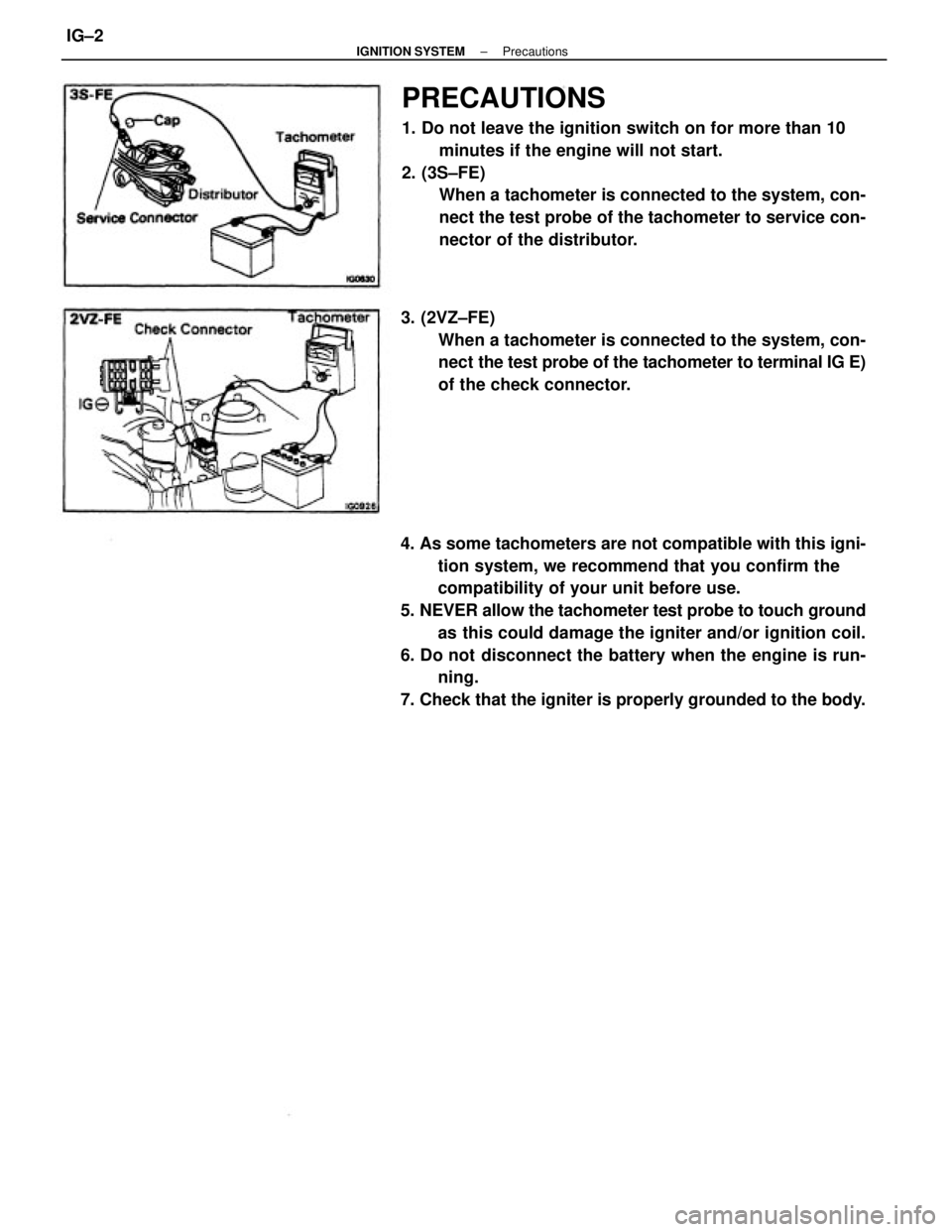
4. As some tachometers are not compatible with this igni-
tion system, we recommend that you confirm the
compatibility of your unit before use.
5. NEVER allow the tachometer test probe to touch ground
as this could damage the igniter and/or ignition coil.
6. Do not disconnect the battery when the engine is run-
ning.
7. Check that the igniter is properly grounded to the body.
PRECAUTIONS
1. Do not leave the ignition switch on for more than 10
minutes if the engine will not start.
2. (3S±FE)
When a tachometer is connected to the system, con-
nect the test probe of the tachometer to service con-
nector of the distributor.
3. (2VZ±FE)
When a tachometer is connected to the system, con-
nect the test probe of the tachometer to terminal IG E)
of the check connector.
± IGNITION SYSTEMPrecautionsIG±2
Page 1838 of 2389
ON±VEHICLE INSPECTION (3S±FE)
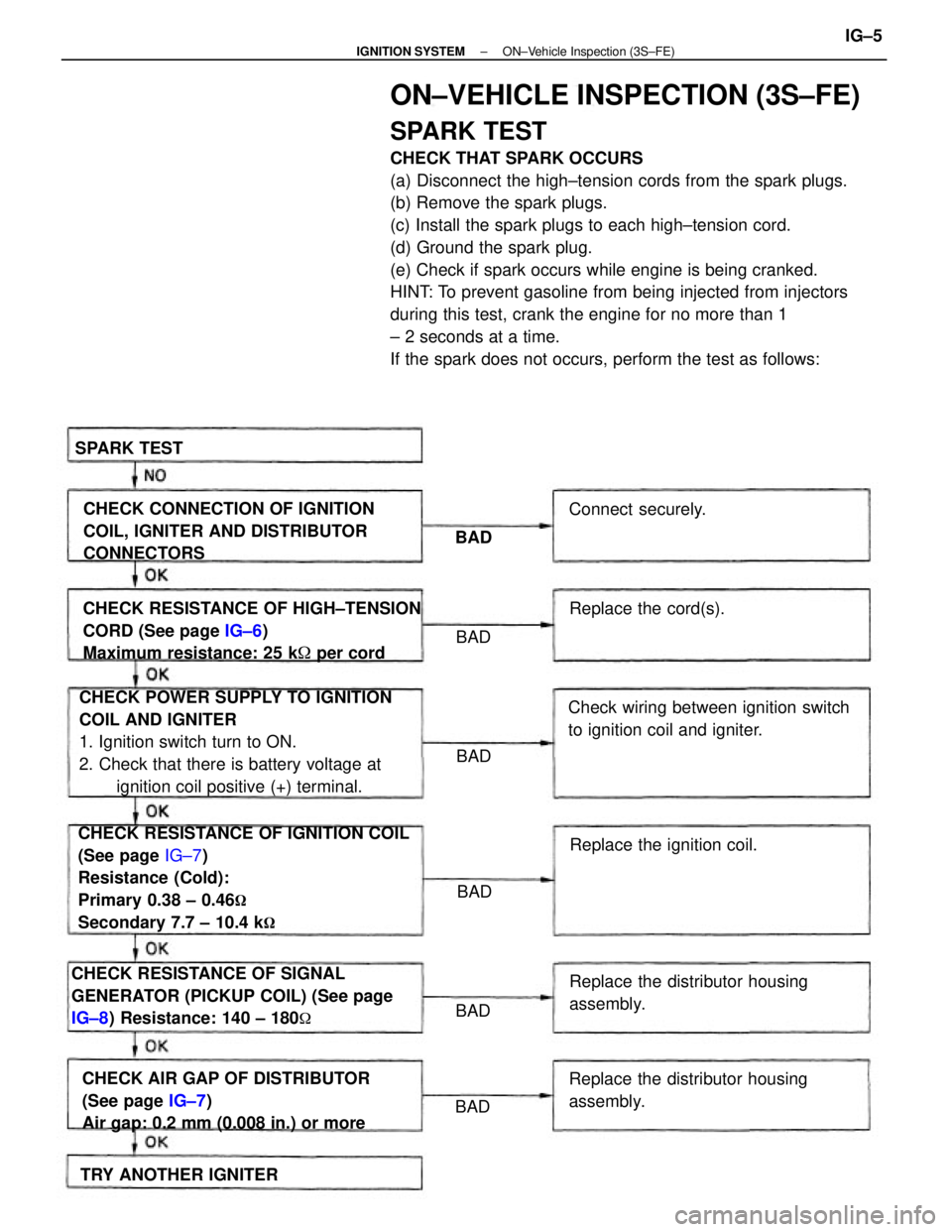
SPARK TEST
CHECK THAT SPARK OCCURS
(a) Disconnect the high±tension cords from the spark plugs.
(b) Remove the spark plugs.
(c) Install the spark plugs to each high±tension cord.
(d) Ground the spark plug.
(e) Check if spark occurs while engine is being cranked.
HINT: To prevent gasoline from being injected from injectors
during this test, crank the engine for no more than 1
± 2 seconds at a time.
If the spark does not occurs, perform the test as follows:
CHECK RESISTANCE OF IGNITION COIL
(See page IG±7)
Resistance (Cold):
Primary 0.38 ± 0.46
�
Secondary 7.7 ± 10.4 k�
CHECK POWER SUPPLY TO IGNITION
COIL AND IGNITER
1. Ignition switch turn to ON.
2. Check that there is battery voltage at
ignition coil positive (+) terminal. CHECK RESISTANCE OF HIGH±TENSION
CORD (See page IG±6)
Maximum resistance: 25 k� per cord
CHECK RESISTANCE OF SIGNAL
GENERATOR (PICKUP COIL) (See page
IG±8) Resistance: 140 ± 180
�
CHECK AIR GAP OF DISTRIBUTOR
(See page IG±7)
Air gap: 0.2 mm (0.008 in.) or moreCHECK CONNECTION OF IGNITION
COIL, IGNITER AND DISTRIBUTOR
CONNECTORS
Check wiring between ignition switch
to ignition coil and igniter.
Replace the distributor housing
assembly.
Replace the distributor housing
assembly.Replace the ignition coil.
TRY ANOTHER IGNITERReplace the cord(s). Connect securely. SPARK TEST
BAD BAD
BAD
BAD BAD
BAD
± IGNITION SYSTEMON±Vehicle Inspection (3S±FE)IG±5
Page 1842 of 2389
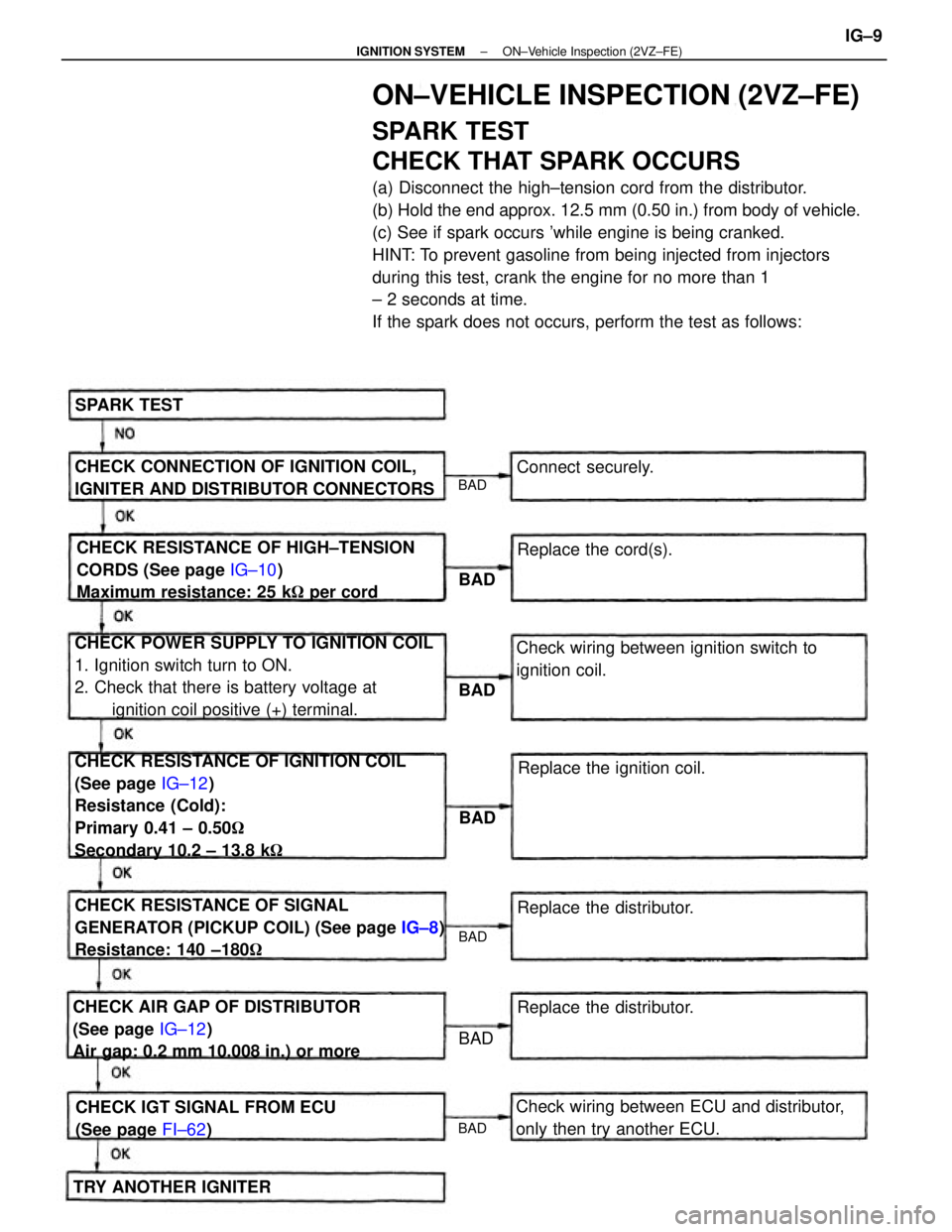
ON±VEHICLE INSPECTION (2VZ±FE)
SPARK TEST
CHECK THAT SPARK OCCURS
(a) Disconnect the high±tension cord from the distributor.
(b) Hold the end approx. 12.5 mm (0.50 in.) from body of vehicle.
(c) See if spark occurs 'while engine is being cranked.
HINT: To prevent gasoline from being injected from injectors
during this test, crank the engine for no more than 1
± 2 seconds at time.
If the spark does not occurs, perform the test as follows:
CHECK RESISTANCE OF IGNITION COIL
(See page IG±12)
Resistance (Cold):
Primary 0.41 ± 0.50�
Secondary 10.2 ± 13.8 k� CHECK POWER SUPPLY TO IGNITION COIL
1. Ignition switch turn to ON.
2. Check that there is battery voltage at
ignition coil positive (+) terminal.
CHECK RESISTANCE OF SIGNAL
GENERATOR (PICKUP COIL) (See page IG±8)
Resistance: 140 ±180� CHECK RESISTANCE OF HIGH±TENSION
CORDS (See page IG±10)
Maximum resistance: 25 k� per cord
CHECK AIR GAP OF DISTRIBUTOR
(See page IG±12)
Air gap: 0.2 mm 10.008 in.) or moreCHECK CONNECTION OF IGNITION COIL,
IGNITER AND DISTRIBUTOR CONNECTORS
Check wiring between ECU and distributor,
only then try another ECU.Check wiring between ignition switch to
ignition coil.
CHECK IGT SIGNAL FROM ECU
(See page FI±62)Replace the ignition coil.
Replace the distributor.
TRY ANOTHER IGNITERReplace the distributor. Replace the cord(s). Connect securely. SPARK TEST
BAD
BAD
BAD
BAD BAD
BAD
BAD
± IGNITION SYSTEMON±Vehicle Inspection (2VZ±FE)IG±9
Page 1843 of 2389
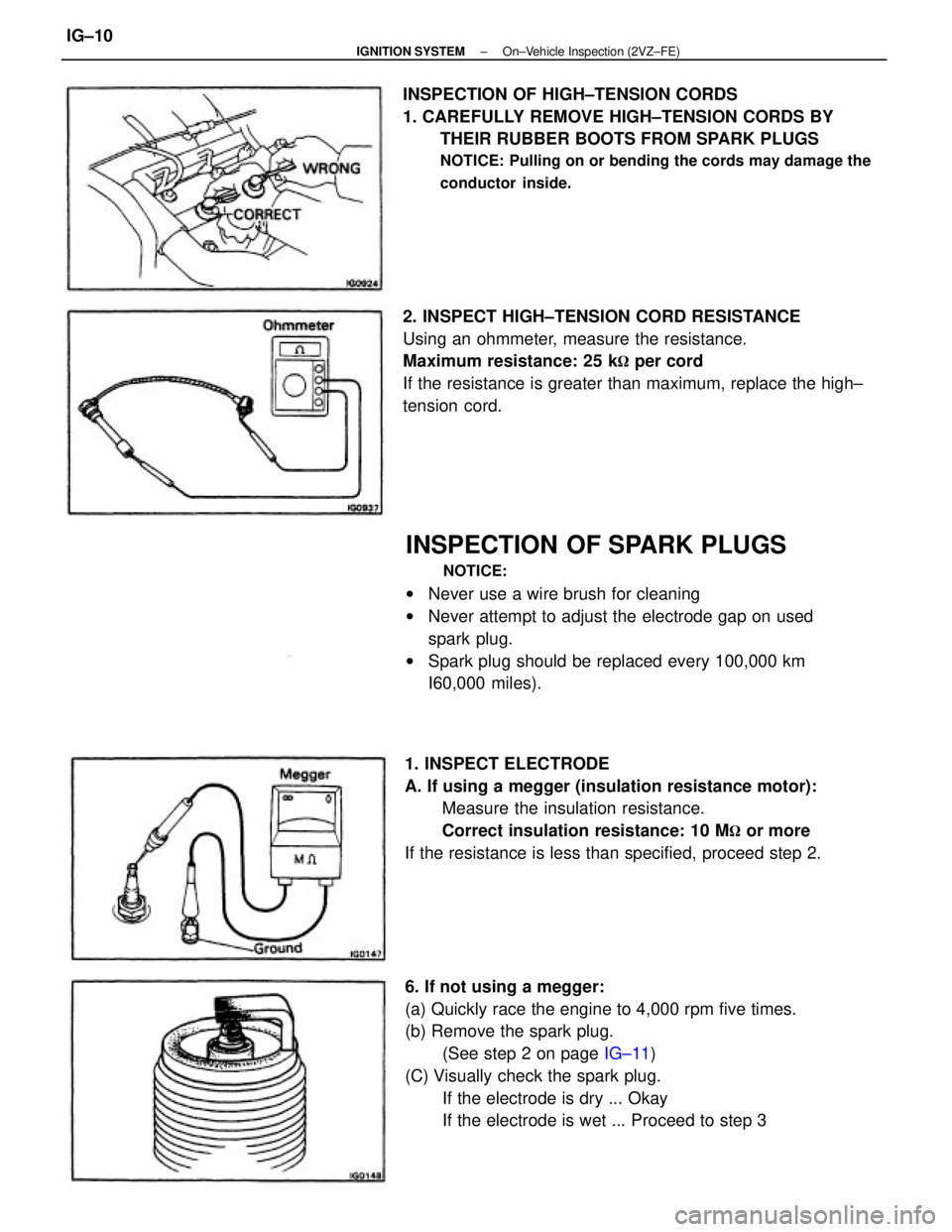
INSPECTION OF SPARK PLUGS
NOTICE:
wNever use a wire brush for cleaning
wNever attempt to adjust the electrode gap on used
spark plug.
wSpark plug should be replaced every 100,000 km
I60,000 miles).
6. If not using a megger:
(a) Quickly race the engine to 4,000 rpm five times.
(b) Remove the spark plug.
(See step 2 on page IG±11)
(C) Visually check the spark plug.
If the electrode is dry ... Okay
If the electrode is wet ... Proceed to step 3 INSPECTION OF HIGH±TENSION CORDS
1. CAREFULLY REMOVE HIGH±TENSION CORDS BY
THEIR RUBBER BOOTS FROM SPARK PLUGS
NOTICE: Pulling on or bending the cords may damage the
conductor inside.
1. INSPECT ELECTRODE
A. If using a megger (insulation resistance motor):
Measure the insulation resistance.
Correct insulation resistance: 10 M
� or more
If the resistance is less than specified, proceed step 2. 2. INSPECT HIGH±TENSION CORD RESISTANCE
Using an ohmmeter, measure the resistance.
Maximum resistance: 25 k
� per cord
If the resistance is greater than maximum, replace the high±
tension cord.
± IGNITION SYSTEMOn±Vehicle Inspection (2VZ±FE)IG±10
Page 1850 of 2389
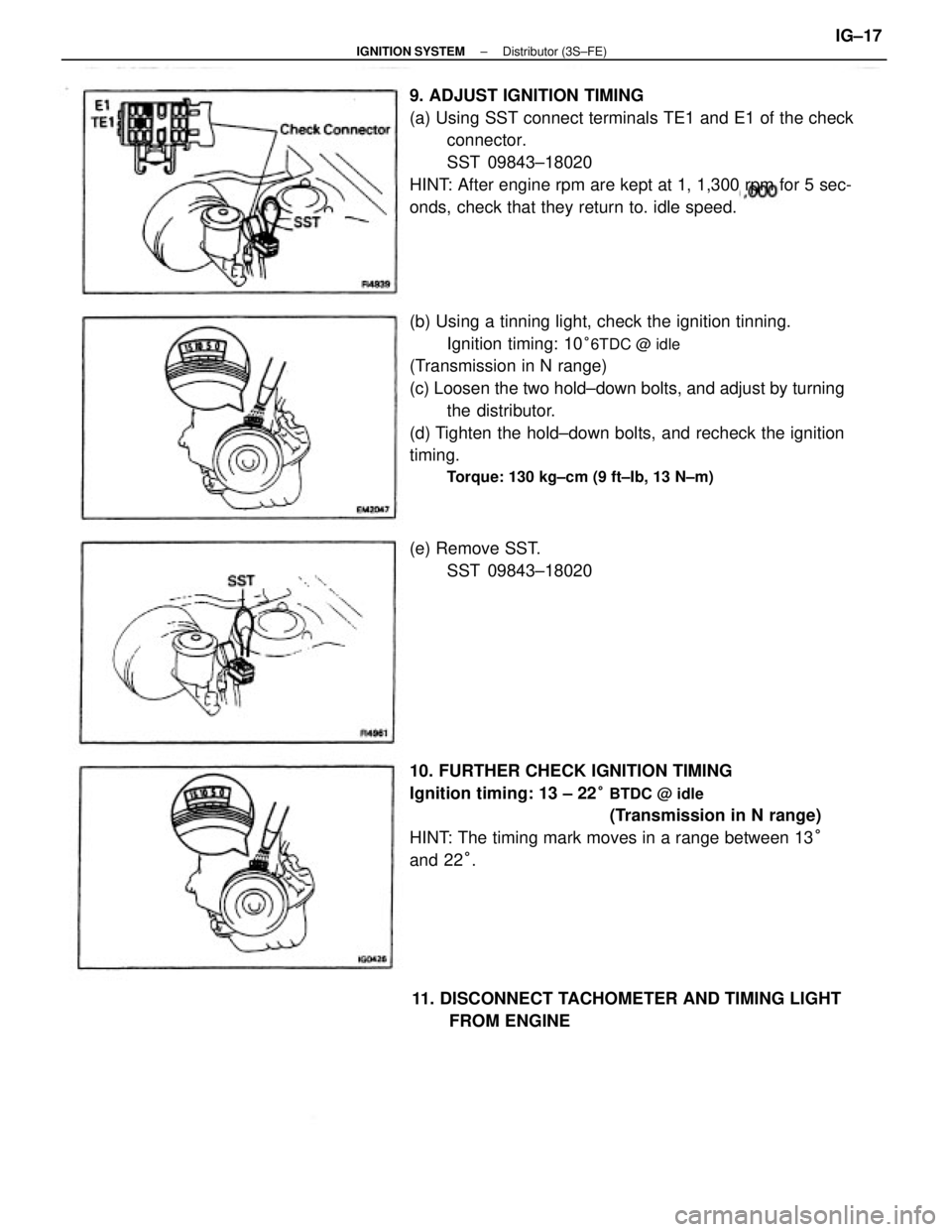
(b) Using a tinning light, check the ignition tinning.
Ignition timing: 10
°6TDC @ idle
(Transmission in N range)
(c) Loosen the two hold±down bolts, and adjust by turning
the distributor.
(d) Tighten the hold±down bolts, and recheck the ignition
timing.
Torque: 130 kg±cm (9 ft±Ib, 13 N±m)
9. ADJUST IGNITION TIMING
(a) Using SST connect terminals TE1 and E1 of the check
connector.
SST 09843±18020
HINT: After engine rpm are kept at 1, 1,300 rpm for 5 sec-
onds, check that they return to. idle speed.
10. FURTHER CHECK IGNITION TIMING
Ignition timing: 13 ± 22
° BTDC @ idle
(Transmission in N range)
HINT: The timing mark moves in a range between 13°
and 22°.
11. DISCONNECT TACHOMETER AND TIMING LIGHT
FROM ENGINE (e) Remove SST.
SST 09843±18020
± IGNITION SYSTEMDistributor (3S±FE)IG±17
Page 1854 of 2389
![TOYOTA CAMRY V20 1986 Service Information 6. WARM UP ENGINE
Allow the engine to normal operating temperature.
7. CONNECT TACHOMETER AND TIMING LIGHT TO
ENGINE
Connect the tachometer test probe to terminal IG [±] of the
check connector.
NOTIC](/manual-img/14/57449/w960_57449-1853.png "TOYOTA CAMRY V20 1986 Service Information 6. WARM UP ENGINE
Allow the engine to normal operating temperature.
7. CONNECT TACHOMETER AND TIMING LIGHT TO
ENGINE
Connect the tachometer test probe to terminal IG [±] of the
check connector.
NOTIC")
6. WARM UP ENGINE
Allow the engine to normal operating temperature.
7. CONNECT TACHOMETER AND TIMING LIGHT TO
ENGINE
Connect the tachometer test probe to terminal IG [±] of the
check connector.
NOTICE:
wNEVER allow the tachometer test probe to touch ground
as it could result in damage to the igniter
and/or ignition coil.
wAs some tachometers are not compatible with this igni-
tion system, we recommended that you confirm the
compatibility of your unit before use.
8. ADJUST IGNITION TIMING
(a) Check the idle speed.
Idle speed: 700
+ 50 rpm
(b) Using SST connect terminals TE1 and E1 of the check con-
nector.
SST 09843±18020
(c) Using a timing light, check the ignition timing.
Ignition timing: 10°6TDC @ idle
(Transmission in N range)
(d) Loosen the two hold±down bolts, and adjust by turning the
distributor.
(e) Tighten the hold±down bolts, and recheck the ignition timing.
Torque: 185 kg±cm (13 ft±Ib, 18 N±m)
9. FURTHER CHECK IGNITION TIMING
Ignition timing: 10°BTDC @ idle
(Transmission in N range)
HINT: The timing mark moves in a range between 13°
and 27°.
10. DISCONNECT TACHOMETER AND TIMING LIGHT
FROM ENGINE (f) Remove SST.
SST 09843±18020
± IGNITION SYSTEMDistributor (2VZ±FE)IG±21
Page 1858 of 2389
GENERAL REPAIR INSTRUCTIONS
1. Use fender seat and floor covers to keep the vehicle clean
and prevent damage.
2. During disassembly, keep parts in the appropriate order to
facilitate reassembly.
3. Observe the following:
(a) Before performing electrical work, disconnect the neg-
ative cable from the battery terminal.
(b) If it is necessary to disconnect the battery for inspection
or repair, always disconnect the cable from the nega-
tive H terminal which is grounded to the vehicle body.
(c) To prevent damage to the battery terminal post, loosen
the terminal nut and raise the cable straight up
without twisting or prying it.
(d) Clean the battery terminal posts and cable terminals
with a shop rag.
o not scrape them with a file or other
abrasive objects.
(e) Install the cable terminal to the battery post with
the nut loose, and tighten the nut after installation. Do
not use a hammer to tap the terminal onto the post.
(f) Be sure the cover for the positive (+) terminal is properly
in place.
4. Check hose and wiring connectors to make sure that they are
secure and correct.
5. Non±reusable parts
(a) Always replace cotter pins, gaskets, 0±rings and oil
seals etc. with new ones.
(b) Non±reusable parts are indicated in the component il-
lustrations by the ºrº symbol.
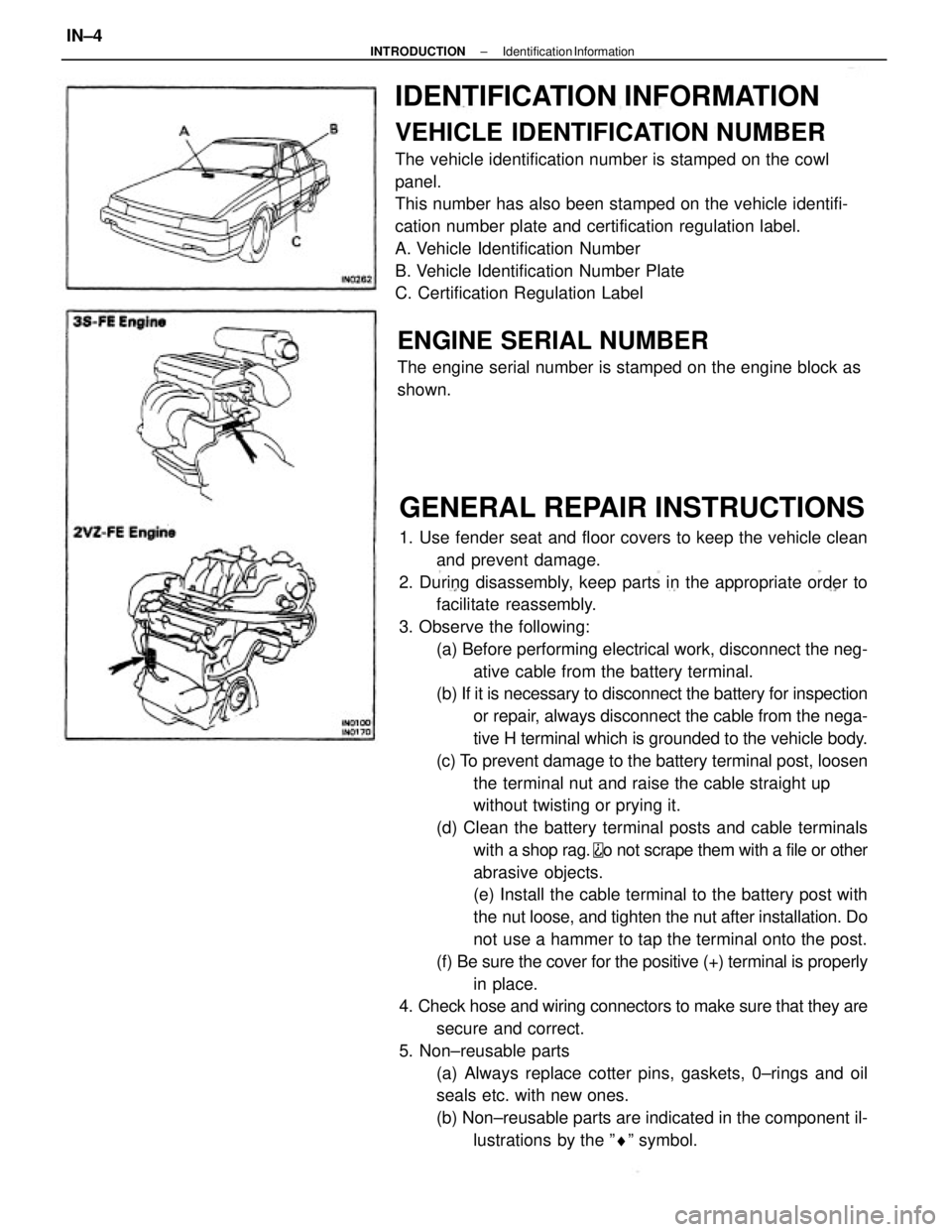
IDENTIFICATION INFORMATION
VEHICLE IDENTIFICATION NUMBER
The vehicle identification number is stamped on the cowl
panel.
This number has also been stamped on the vehicle identifi-
cation number plate and certification regulation label.
A. Vehicle Identification Number
B. Vehicle Identification Number Plate
C. Certification Regulation Label
ENGINE SERIAL NUMBER
The engine serial number is stamped on the engine block as
shown.
± INTRODUCTIONIdentification InformationIN±4