Page 1172 of 2389
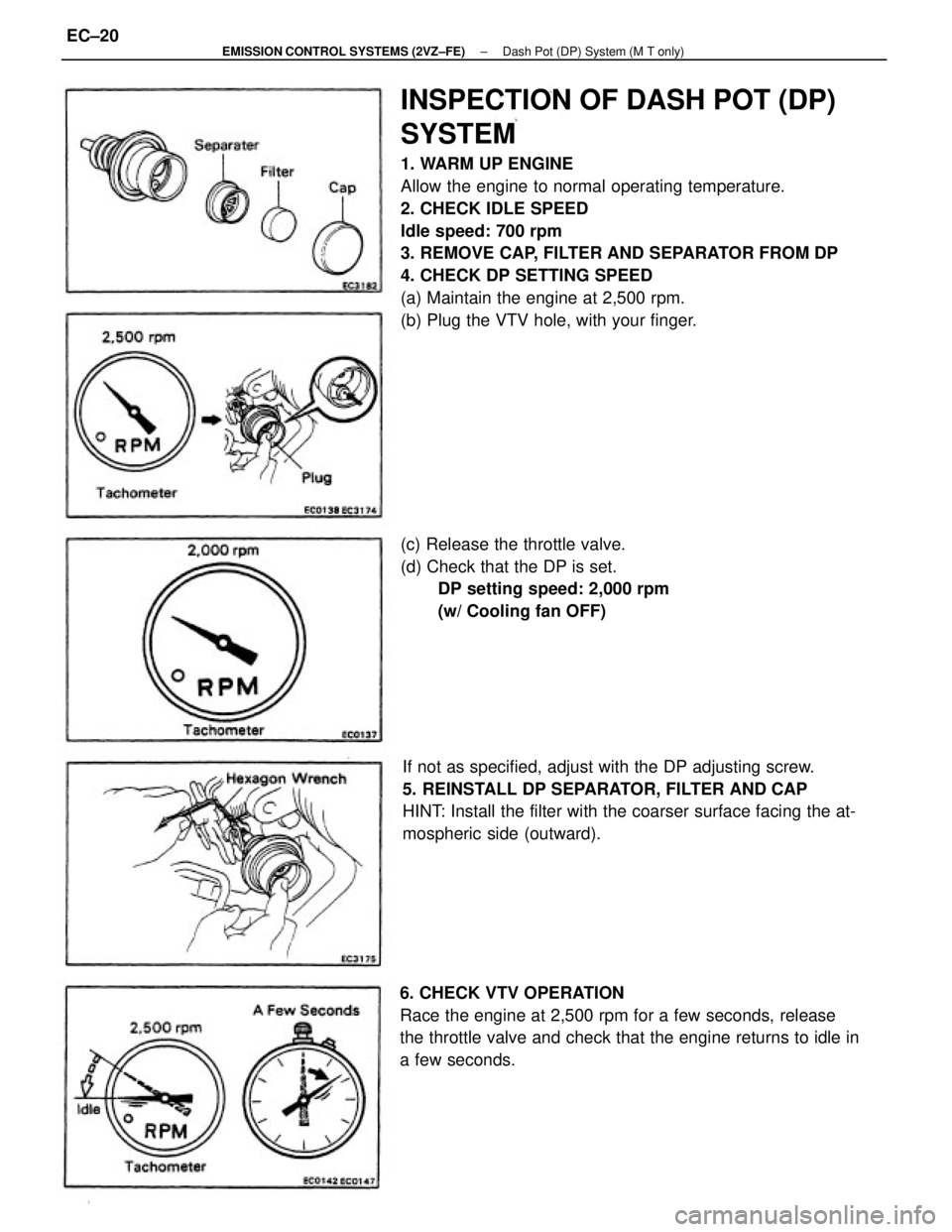
INSPECTION OF DASH POT (DP)
SYSTEM
1. WARM UP ENGINE
Allow the engine to normal operating temperature.
2. CHECK IDLE SPEED
Idle speed: 700 rpm
3. REMOVE CAP, FILTER AND SEPARATOR FROM DP
4. CHECK DP SETTING SPEED
(a) Maintain the engine at 2,500 rpm.
(b) Plug the VTV hole, with your finger.
If not as specified, adjust with the DP adjusting screw.
5. REINSTALL DP SEPARATOR, FILTER AND CAP
HINT: Install the filter with the coarser surface facing the at-
mospheric side (outward).
6. CHECK VTV OPERATION
Race the engine at 2,500 rpm for a few seconds, release
the throttle valve and check that the engine returns to idle in
a few seconds.(c) Release the throttle valve.
(d) Check that the DP is set.
DP setting speed: 2,000 rpm
(w/ Cooling fan OFF)
± EMISSION CONTROL SYSTEMS (2VZ±FE)Dash Pot (DP) System (M T only)EC±20
Page 1174 of 2389
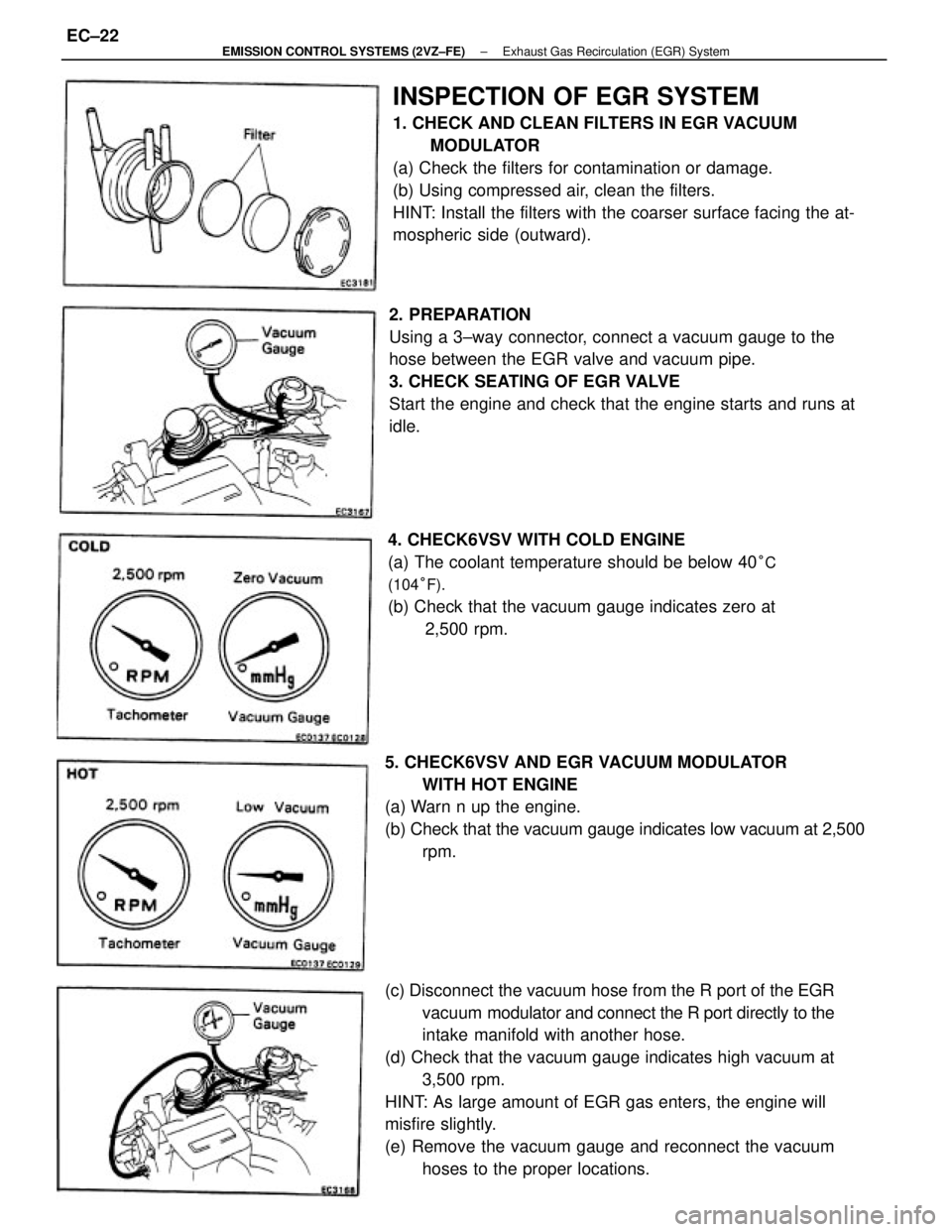
(c) Disconnect the vacuum hose from the R port of the EGR
vacuum modulator and connect the R port directly to the
intake manifold with another hose.
(d) Check that the vacuum gauge indicates high vacuum at
3,500 rpm.
HINT: As large amount of EGR gas enters, the engine will
misfire slightly.
(e) Remove the vacuum gauge and reconnect the vacuum
hoses to the proper locations.
INSPECTION OF EGR SYSTEM
1. CHECK AND CLEAN FILTERS IN EGR VACUUM
MODULATOR
(a) Check the filters for contamination or damage.
(b) Using compressed air, clean the filters.
HINT: Install the filters with the coarser surface facing the at-
mospheric side (outward).
2. PREPARATION
Using a 3±way connector, connect a vacuum gauge to the
hose between the EGR valve and vacuum pipe.
3. CHECK SEATING OF EGR VALVE
Start the engine and check that the engine starts and runs at
idle.
4. CHECK6VSV WITH COLD ENGINE
(a) The coolant temperature should be below 40
°C
(104°F).
(b) Check that the vacuum gauge indicates zero at
2,500 rpm.
5. CHECK6VSV AND EGR VACUUM MODULATOR
WITH HOT ENGINE
(a) Warn n up the engine.
(b) Check that the vacuum gauge indicates low vacuum at 2,500
rpm.
± EMISSION CONTROL SYSTEMS (2VZ±FE)Exhaust Gas Recirculation (EGR) SystemEC±22
Page 1175 of 2389
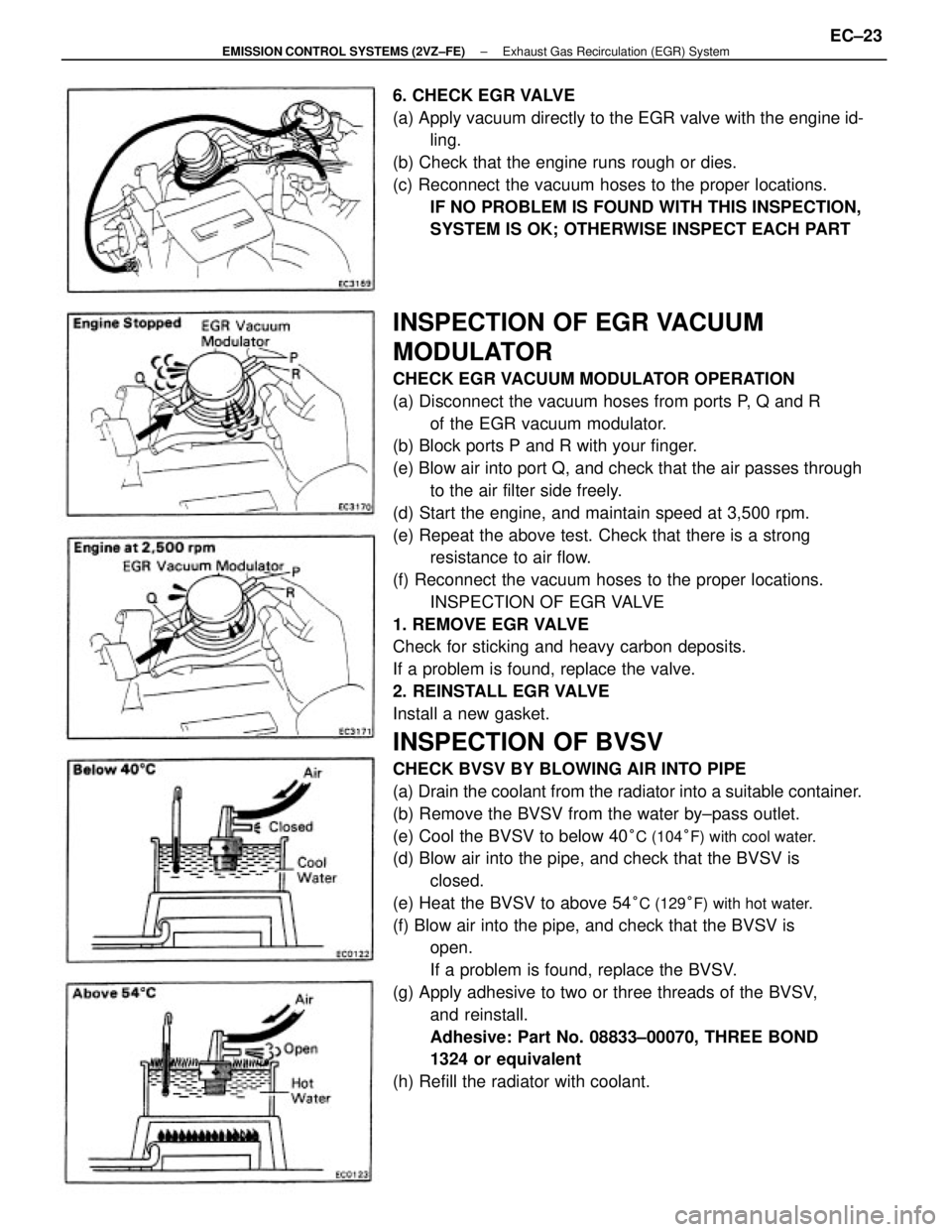
INSPECTION OF EGR VACUUM
MODULATOR
CHECK EGR VACUUM MODULATOR OPERATION
(a) Disconnect the vacuum hoses from ports P, Q and R
of the EGR vacuum modulator.
(b) Block ports P and R with your finger.
(e) Blow air into port Q, and check that the air passes through
to the air filter side freely.
(d) Start the engine, and maintain speed at 3,500 rpm.
(e) Repeat the above test. Check that there is a strong
resistance to air flow.
(f) Reconnect the vacuum hoses to the proper locations.
INSPECTION OF EGR VALVE
1. REMOVE EGR VALVE
Check for sticking and heavy carbon deposits.
If a problem is found, replace the valve.
2. REINSTALL EGR VALVE
Install a new gasket.
INSPECTION OF BVSV
CHECK BVSV BY BLOWING AIR INTO PIPE
(a) Drain the coolant from the radiator into a suitable container.
(b) Remove the BVSV from the water by±pass outlet.
(e) Cool the BVSV to below 40
°C (104°F) with cool water.
(d) Blow air into the pipe, and check that the BVSV is
closed.
(e) Heat the BVSV to above 54
°C (129°F) with hot water.
(f) Blow air into the pipe, and check that the BVSV is
open.
If a problem is found, replace the BVSV.
(g) Apply adhesive to two or three threads of the BVSV,
and reinstall.
Adhesive: Part No. 08833±00070, THREE BOND
1324 or equivalent
(h) Refill the radiator with coolant. 6. CHECK EGR VALVE
(a) Apply vacuum directly to the EGR valve with the engine id-
ling.
(b) Check that the engine runs rough or dies.
(c) Reconnect the vacuum hoses to the proper locations.
IF NO PROBLEM IS FOUND WITH THIS INSPECTION,
SYSTEM IS OK; OTHERWISE INSPECT EACH PART
± EMISSION CONTROL SYSTEMS (2VZ±FE)Exhaust Gas Recirculation (EGR) SystemEC±23
Page 1183 of 2389
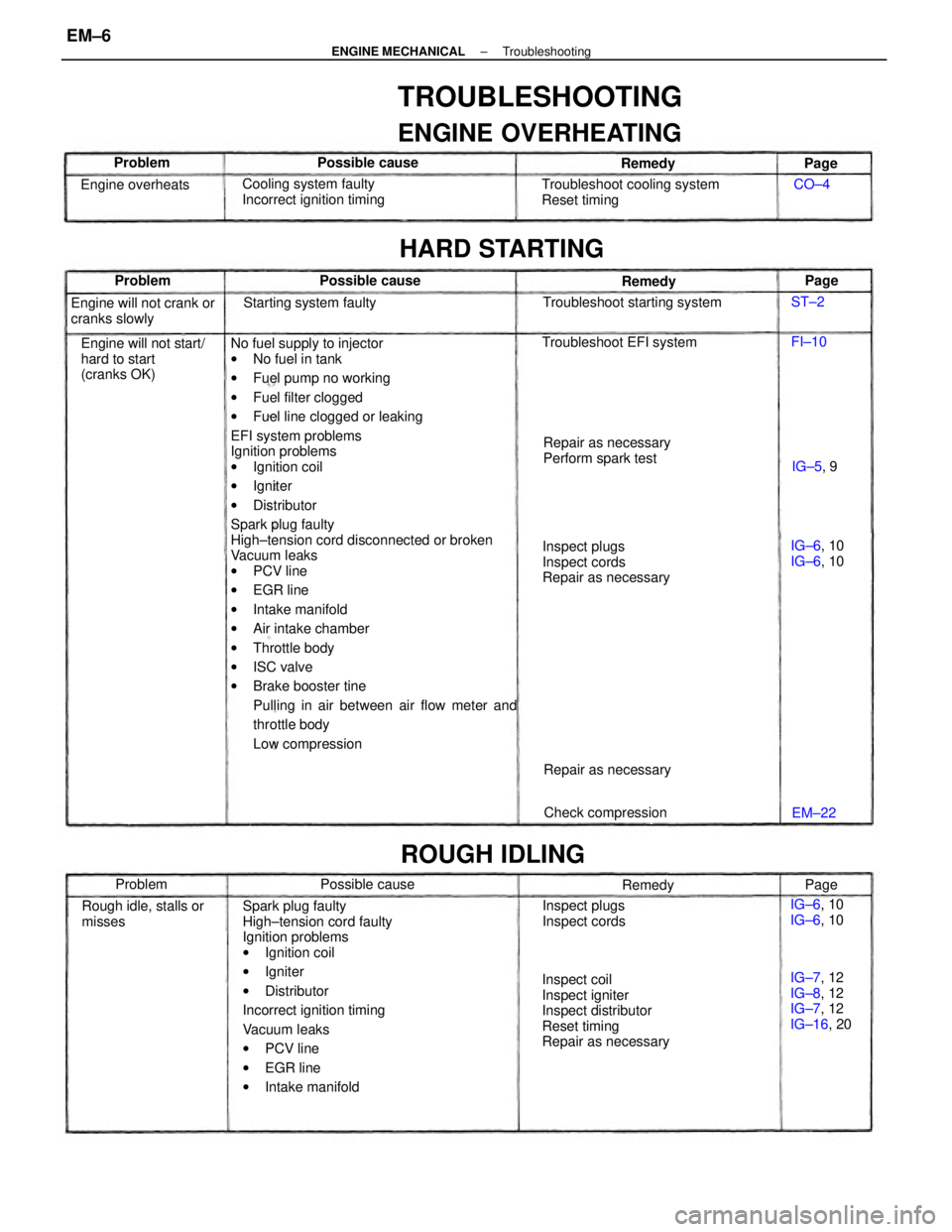
No fuel supply to injector
wNo fuel in tank
wFuel pump no working
wFuel filter clogged
wFuel line clogged or leaking
EFI system problems
Ignition problems
wIgnition coil
wIgniter
wDistributor
Spark plug faulty
High±tension cord disconnected or broken
Vacuum leaks
wPCV line
wEGR line
wIntake manifold
wAir intake chamber
wThrottle body
wISC valve
wBrake booster tine
Pulling in air between air flow meter and
throttle body
Low compression
Spark plug faulty
High±tension cord faulty
Ignition problems
wIgnition coil
wIgniter
wDistributor
Incorrect ignition timing
Vacuum leaks
wPCV line
wEGR line
wIntake manifold
TROUBLESHOOTING
ENGINE OVERHEATING
Inspect coil
Inspect igniter
Inspect distributor
Reset timing
Repair as necessaryInspect plugs
Inspect cords
Repair as necessary Troubleshoot cooling system
Reset timing
Engine will not start/
hard to start
(cranks OK)Cooling system faulty
Incorrect ignition timing
Repair as necessary
Perform spark test Engine will not crank or
cranks slowly
IG±7, 12
IG±8, 12
IG±7, 12
IG±16, 20 Rough idle, stalls or
misses
HARD STARTING
Troubleshoot starting system
Inspect plugs
Inspect cords Troubleshoot EFI system
ROUGH IDLING
Starting system faulty
Check compression Repair as necessary Engine overheats
IG±6, 10
IG±6, 10 IG±6, 10
IG±6, 10 Possible cause
Possible cause Possible cause
Remedy Remedy
Problem
Remedy Problem Problem
IG±5, 9
EM±22Page
Page
Page CO±4
FI±10 ST±2
± ENGINE MECHANICALTroubleshootingEM±6
Page 1184 of 2389
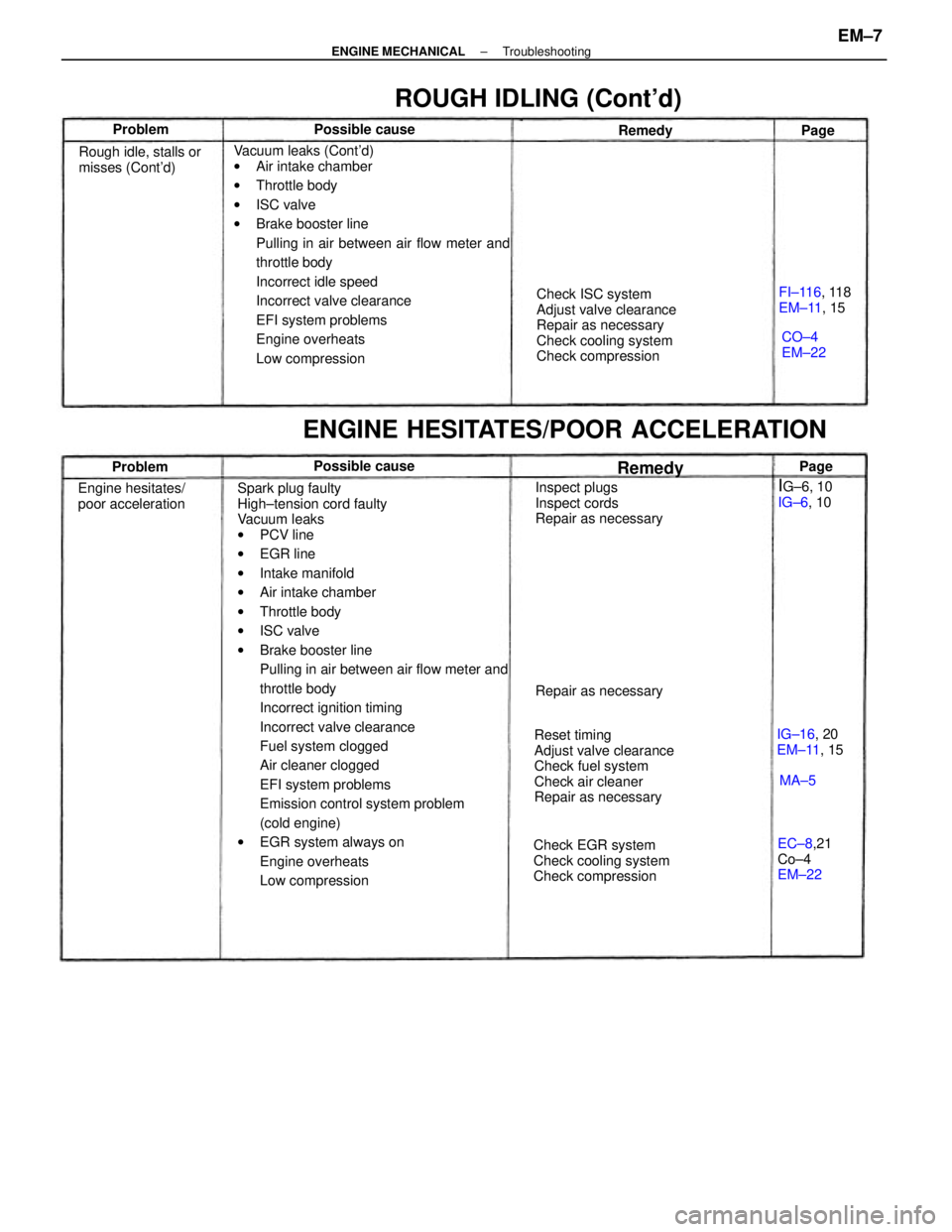
Spark plug faulty
High±tension cord faulty
Vacuum leaks
wPCV line
wEGR line
wIntake manifold
wAir intake chamber
wThrottle body
wISC valve
wBrake booster line
Pulling in air between air flow meter and
throttle body
Incorrect ignition timing
Incorrect valve clearance
Fuel system clogged
Air cleaner clogged
EFI system problems
Emission control system problem
(cold engine)
wEGR system always on
Engine overheats
Low compression Vacuum leaks (Cont'd)
wAir intake chamber
wThrottle body
wISC valve
wBrake booster line
Pulling in air between air flow meter and
throttle body
Incorrect idle speed
Incorrect valve clearance
EFI system problems
Engine overheats
Low compressionCheck ISC system
Adjust valve clearance
Repair as necessary
Check cooling system
Check compression
Reset timing
Adjust valve clearance
Check fuel system
Check air cleaner
Repair as necessary
ENGINE HESITATES/POOR ACCELERATION
Check EGR system
Check cooling system
Check compressionInspect plugs
Inspect cords
Repair as necessary
ROUGH IDLING (Cont'd)
Rough idle, stalls or
misses (Cont'd)
Engine hesitates/
poor acceleration
EC±8,21
Co±4
EM±22FI±116, 118
EM±11, 15
IG±16, 20
EM±11, 15 Repair as necessary
IG±6, 10
IG±6, 10 Possible causePossible cause
CO±4
EM±22 Remedy Problem
RemedyProblemPage
MA±5Page
± ENGINE MECHANICALTroubleshootingEM±7
Page 1185 of 2389
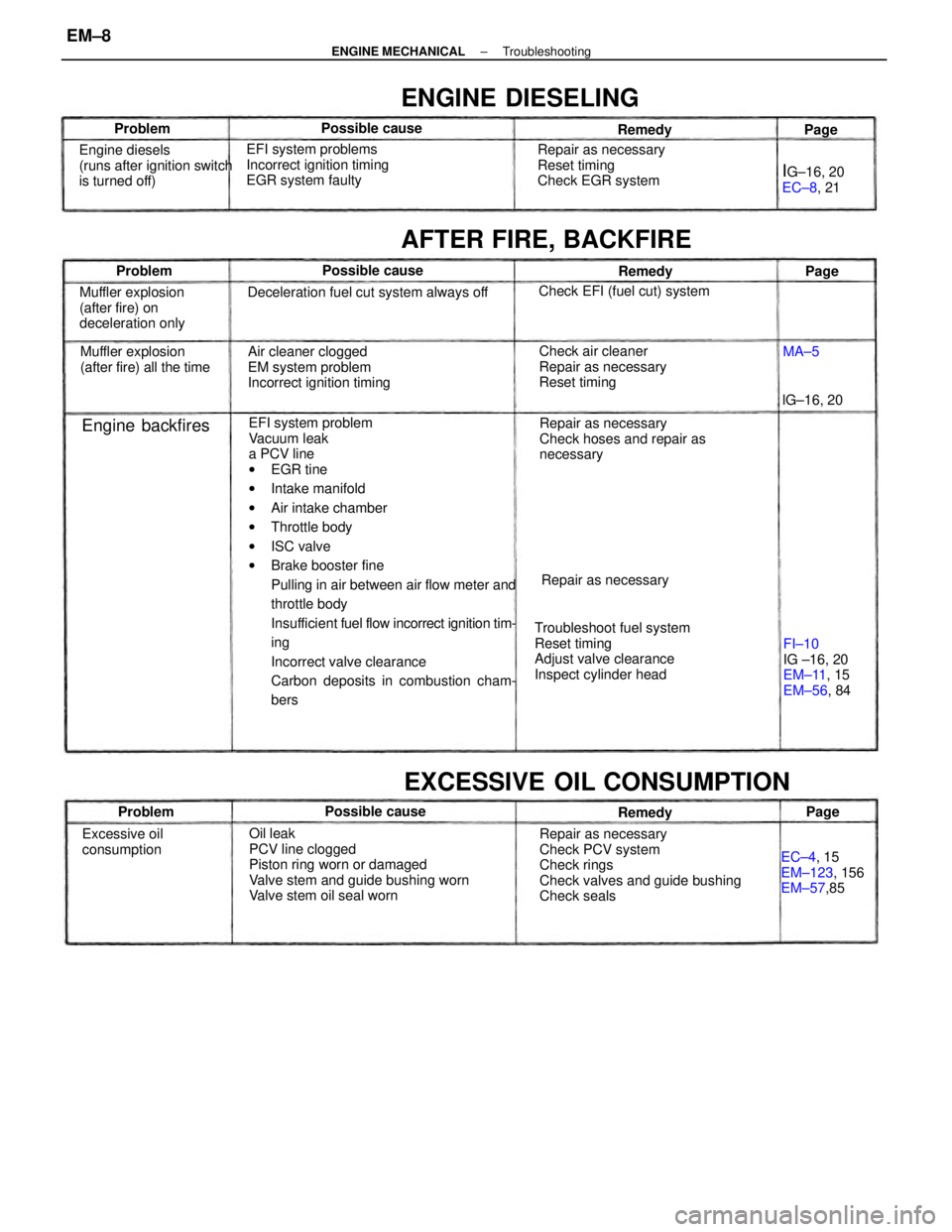
EFI system problem
Vacuum leak
a PCV line
wEGR tine
wIntake manifold
wAir intake chamber
wThrottle body
wISC valve
wBrake booster fine
Pulling in air between air flow meter and
throttle body
Insufficient fuel flow incorrect ignition tim-
ing
Incorrect valve clearance
Carbon deposits in combustion cham-
bers
Oil leak
PCV line clogged
Piston ring worn or damaged
Valve stem and guide bushing worn
Valve stem oil seal wornRepair as necessary
Check PCV system
Check rings
Check valves and guide bushing
Check seals Troubleshoot fuel system
Reset timing
Adjust valve clearance
Inspect cylinder headRepair as necessary
Check hoses and repair as
necessary Air cleaner clogged
EM system problem
Incorrect ignition timing EFI system problems
Incorrect ignition timing
EGR system faulty
Deceleration fuel cut system always off
Check air cleaner
Repair as necessary
Reset timing Repair as necessary
Reset timing
Check EGR system
EXCESSIVE OIL CONSUMPTION
Engine diesels
(runs after ignition switch
is turned off)
Muffler explosion
(after fire) on
deceleration only
FI±10
IG ±16, 20
EM±11, 15
EM±56, 84 Muffler explosion
(after fire) all the time
AFTER FIRE, BACKFIRE
EC±4, 15
EM±123, 156
EM±57,85
ENGINE DIESELING
Check EFI (fuel cut) system
Excessive oil
consumptionRepair as necessary
IG±16, 20
EC±8, 21
Engine backfires
Possible cause Possible cause
Possible causelG±16, 20 Problem
Problem
RemedyRemedy
ProblemRemedy
Page Page
MA±5Page
± ENGINE MECHANICALTroubleshootingEM±8
Page 1186 of 2389
Fuel leak
Air cleaner clogged
Incorrect ignition timing
EFI system problems
wInjector faulty
wDeceleration fuel cut system faulty
Idle speed too high
Spark plug faulty
EGR system always on
Low compression
Tires improperly inflated
Clutch slips
Brakes drag
Incorrect idle speed
Incorrect ignition timing
Vacuum leaks
wPCV line
wEGR line
wIntake manifold
wAir intake chamber
wThrottle body
wISC valve
wBrake booster line
EFI system problemsCheck ISC system
Inspect plugs
Check EGR system
Check compression
Inflate tires to proper pressure
Troubleshoot clutch
Troubleshoot brakesRepair as necessary
Check air cleaner
Reset timing
Repair as necessary
EXCESSIVE FUEL CONSUMPTION
Check ISC system
Reset timing
Repair as necessaryFI±116,118
IG±6, 10
EC±8, 21
EM±22
UNPLEASANT ODOR
Poor gasoline
mileage
FI±116, 118
IG±16, 20
Repair as necessaryMA±5
IG±16, 20
Unpleasant odorPossible cause Possible cause
Problem
ProblemRemedy
RemedyPage Page
± ENGINE MECHANICALTroubleshootingEM±9
Page 1188 of 2389
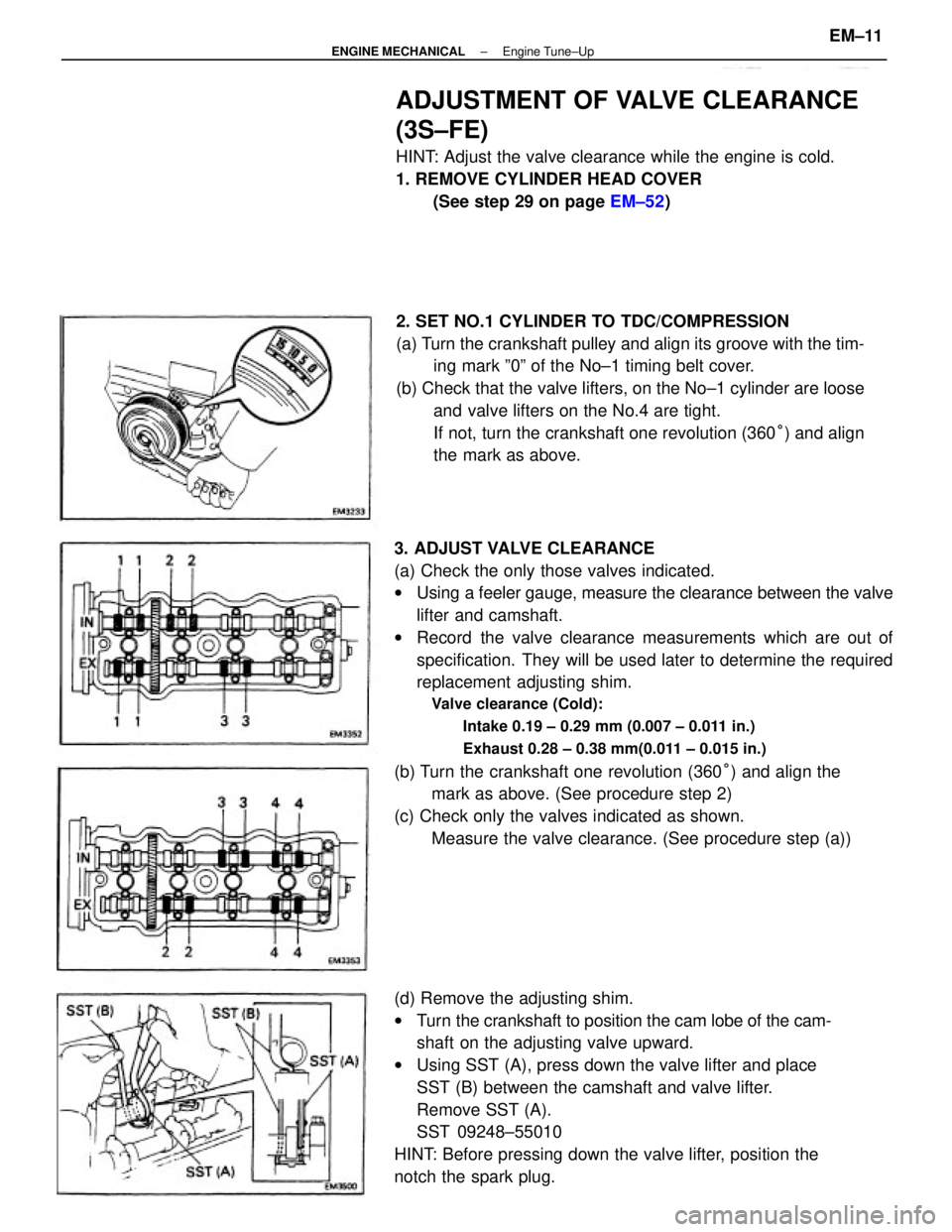
3. ADJUST VALVE CLEARANCE
(a) Check the only those valves indicated.
wUsing a feeler gauge, measure the clearance between the valve
lifter and camshaft.
wRecord the valve clearance measurements which are out of
specification. They will be used later to determine the required
replacement adjusting shim.
Valve clearance (Cold):
Intake 0.19 ± 0.29 mm (0.007 ± 0.011 in.)
Exhaust 0.28 ± 0.38 mm(0.011 ± 0.015 in.)
(b) Turn the crankshaft one revolution (360°) and align the
mark as above. (See procedure step 2)
(c) Check only the valves indicated as shown.
Measure the valve clearance. (See procedure step (a))
(d) Remove the adjusting shim.
wTurn the crankshaft to position the cam lobe of the cam-
shaft on the adjusting valve upward.
wUsing SST (A), press down the valve lifter and place
SST (B) between the camshaft and valve lifter.
Remove SST (A).
SST 09248±55010
HINT: Before pressing down the valve lifter, position the
notch the spark plug.2. SET NO.1 CYLINDER TO TDC/COMPRESSION
(a) Turn the crankshaft pulley and align its groove with the tim-
ing mark º0º of the No±1 timing belt cover.
(b) Check that the valve lifters, on the No±1 cylinder are loose
and valve lifters on the No.4 are tight.
If not, turn the crankshaft one revolution (360°) and align
the mark as above.
ADJUSTMENT OF VALVE CLEARANCE
(3S±FE)
HINT: Adjust the valve clearance while the engine is cold.
1. REMOVE CYLINDER HEAD COVER
(See step 29 on page EM±52)
± ENGINE MECHANICALEngine Tune±UpEM±11