Page 565 of 875

GM – CAMARO 1982-1992 – Repair Guide (Checked by WxMax) 565
3. Reconnect the signal
hose and listen for air flow through the ventilation
tube into the anti-backfire valve. A speed drop should be noticed when
the hose is reconnected.
4. If these conditions are not found, check hoses for restrictions or leaks. If
hoses are OK, replace the anti-backfire valve.
AIR PUMP 1. Check the drive belt tension.
2. Increase the engine speed and observe an increase in air flow. If air flow
does not increase, replace the air pump.
CONTROL VALVE 1. Remove the hoses. Blow through t he valve (toward the cylinder head).
2. Then, suck through the valve (or blow through the other side). If air flows
in one direction, the valve is operative. If not, replace the control valve.
REMOVAL & INSTALLATION
AIR PUMP 1. Remove the AIR control valves and/or adapter at the pump.
2. Loosen the air pump adjustment bolt and remove the drive belt.
3. Unscrew the pump mounting bolts and then remove the pump pulley.
4. Unscrew the pump mounting bol ts and then remove the pump.
To install: 5. Position the pump into place and secure it with the mounting bolts.
6. Install the pump pulley.
7. Install the air pump drive belt and adjust pump belt with the pump
adjustment bolt.
8. Install the AIR contro l valves and/or adapter.
Page 570 of 875

GM – CAMARO 1982-1992 – Repair Guide (Checked by WxMax) 570
Switch (TVS). The electrical type, cons
ists of a ceramic grid located under the
base of the carburetor.
A check of the operation should be made at regular maintenance intervals.
TESTING
VACUUM SERVO TYPE 1. With the engine cold, observe the posit ion of the actuator arm. Start the
engine. The arm should move toward the diaphragm (closing the valve).
2. If the arm does not move, remove the hose and check for vacuum. If still
no vacuum, remove the top hose from the TVS switch and check for
vacuum.
3. If vacuum is present in the top hose, replace the TVS switch.
4. If vacuum is present at the actuator and it does not move, try to free the
valve. If the valve cannot be freed, it must be replaced.
ELECTRICAL TYPE 1. Turn the ignition ON with the engine co ld and probe both terminals of the
heater switch connector with a test light.
• If 1 wire has power, replace the heater switch.
• If neither wire has power, repai r the ignition circuit.
• If both wires have power, probe the pink wire at the heater
connector (if no power, repair the c onnector of the heater switch).
2. If power exists at the pink wire , disconnect the heater connector and
connect a tester across the harness terminal. If no power, repair the
ground wire; if power exists, check the resistance of the heater.
3. If heater is over 3 ohm s, replace the heater. If under 3 ohms, replace the
connector, start the engine (operate to normal temperature) and probe
the pink wire. If no power, the system is OK; if power exists, replace the
heater switch.
REMOVAL & INSTALLATION
VACUUM SERVO TYPE 1. Disconnect the vacuum hose at the EFE.
2. Remove exhaust pipe to manifold nuts.
3. Remove the crossover pipe. Complete removal is not always necessary.
4. Remove the EFE valve.
To install: 5. Position the EFE valve into place.
6. Install the crossover pipe.
7. Install the exhaust pi pe to manifold nuts.
8. Connect the vacuum hose at the EFE.
Page 626 of 875

GM – CAMARO 1982-1992 – Repair Guide (Checked by WxMax) 626
ENGINE PERFORMANCE AND TUNE-UP
TUNE-UP PROCEDURES
In order to extract the full measure of performance and economy from your
engine it is essential that it is properly tuned at regul ar intervals. A regular tune-
up will keep your Camaro's engine running smoothly and will prevent the
annoying breakdowns and poor perform ance associated with an untuned
engine.
A complete tune-up should be performed every 30,000 miles (48,000 km). This
interval should be halved if the car is operated under severe conditions such as
trailer towing, prolonged idling, start-and- stop driving, or if starting or running
problems are noticed. It is assumed that the routine maintenance described in
General Information & Maintenance has been kept up, as this will have a
decided effect on the result s of a tune-up. All of the applicable steps of a tune-
up should be followed in order, as the result is a cumulative one.
If the specifications on the underhoo d tune-up sticker in the engine
compartment of your car disagree with th e "Tune-Up Specifications" chart in this
Section, the figures on the sticker must be used. The sticker often reflects
changes made during t he production run.
SPARK PLUGS
A typical spark plug consists of a metal shell surrounding a ceramic insulator. A
metal electrode extends downward through the center of the insulator and
protrudes a small distance. Located at the end of the plug and attached to the
side of the outer metal shell is the side el ectrode. The side electrode bends in at
a 90 angle so that its tip is just pas t and parallel to the tip of the center
electrode. The distance between these two electrodes (measured in
thousandths of an inch or hundredths of a millimeter) is called the spark plug
gap.
The spark plug does not pr oduce a spark, but instead provides a gap across
which the current can arc. The coil produces anywhere from 20,000 to 50,000
volts (depending on the type and application) which travels through the wires to
the spark plugs. The current passes along the center electrode and jumps the
gap to the side electrode, and in doing so, ignites the air/fuel mixture in the
combustion chamber.
Page 635 of 875
GM – CAMARO 1982-1992 – Repair Guide (Checked by WxMax) 635
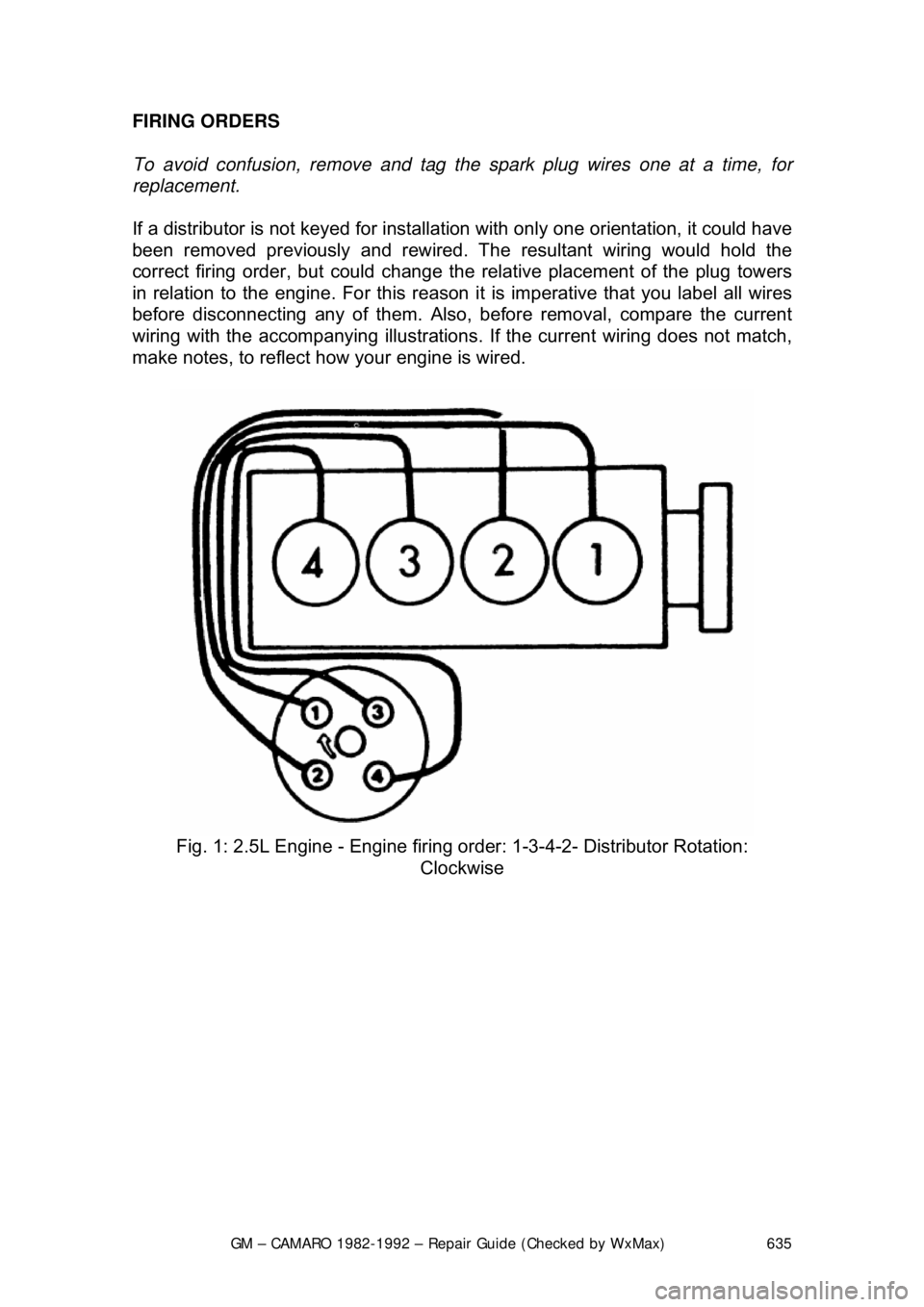
FIRING ORDERS
To avoid confusion, remove and tag th
e spark plug wires one at a time, for
replacement.
If a distributor is not keyed for installati on with only one orientation, it could have
been removed previously and rewired. Th e resultant wiring would hold the
correct firing order, but could change the relative placement of the plug towers
in relation to the engine. Fo r this reason it is imperative that you label all wires
before disconnecting any of them. Also, before removal, compare the current
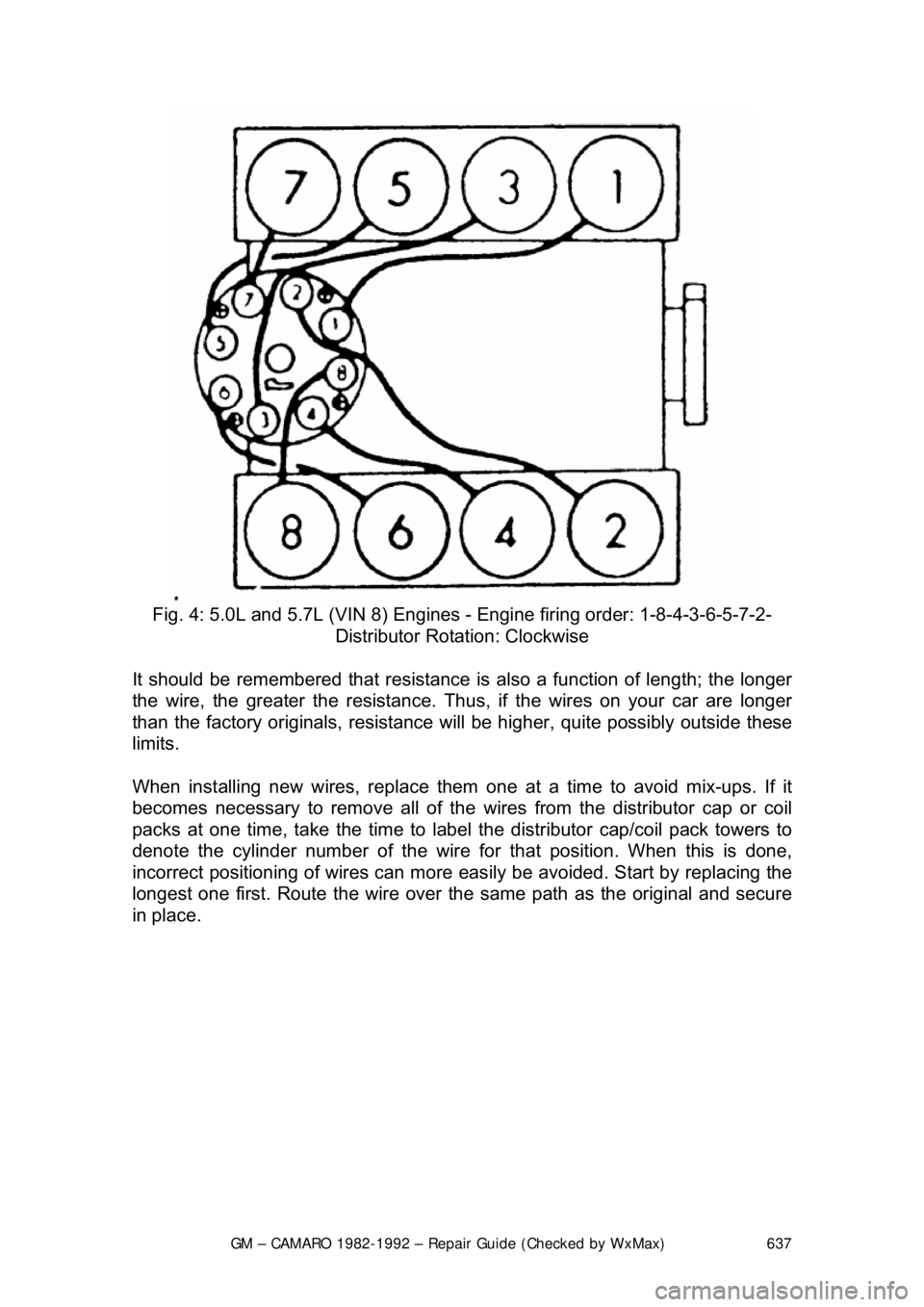
wiring with the accompanying i llustrations. If the current wiring does not match,
make notes, to reflect how your engine is wired.
Fig. 1: 2.5L Engine - Engine firing or der: 1-3-4-2- Distributor Rotation:
Clockwise
Page 637 of 875
GM – CAMARO 1982-1992 – Repair Guide (Checked by WxMax) 637
Fig. 4: 5.0L and 5.7L (VIN 8) Engines - Engine firing order: 1-8-4-3-6-5-7-2-
Distributor Rotation: Clockwise
It should be remembered that resistance is also a function of length; the longer
the wire, the greater the re sistance. Thus, if the wires on your car are longer
than the factory originals, resistance will be higher, qui te possibly outside these
limits.
When installing new wires, r eplace them one at a time to avoid mix-ups. If it
becomes necessary to remove all of the wires from the distributor cap or coil
packs at one time, take the time to label the distributor cap/coil pack towers to
denote the cylinder number of the wire fo r that position. When this is done,
incorrect positioning of wires can more eas ily be avoided. Start by replacing the
longest one first. Route the wire over the same path as the original and secure
in place.
Page 645 of 875

GM – CAMARO 1982-1992 – Repair Guide (Checked by WxMax) 645
3. If no defects have been found at this
time, and you still have a problem,
then the module will have to be che cked. If you do not have access to a
module tester, the only possible alter native is a substitution test. If the
module fails the substitution test, replace it.
COMPONENT REPLACEMENT
CAUTION - When handling secondar y spark plug leads with the engine running
or starting, insulated pliers must be used and care exercised to prevent a
possible electrical shock.
HEI SYSTEM
IGNITION COIL
EXTERNALLY MOUNTED
1. Disconnect the negative battery cable.
2. Disconnect the ignition coil wire from the coil. Do so by pulling on the
boot of the wire while twisting it.
3. Disconnect the harness connecto r from the ignition coil.
4. Remove the coil mounting screws and the ignition coil. If necessary, drill
out and remove the rivets holding the coil to the bracket.
To install: 5. Place the ignition coil in position on the mounting bracket and install the
mounting screws.
6. Reconnect the harness connectors to the ignition coil. Confirm that the
harness connectors are firmly attached to the coil.
7. Install the secondary coil wire to the coil tower.
8. Connect the negative battery cable.
Page 650 of 875
GM – CAMARO 1982-1992 – Repair Guide (Checked by WxMax) 650
DISTRIBUTOR CAP
1. If removing the ignition wires at the cap, take a moment to label the spark
plug wire positioning for each cylinder, at each tower. This will avoid
improper wire placement during assembly.
2. Disconnect the ignition switch wir e from the distributor cap. Also
disconnect the tachometer wire, if so equipped.
3. Release the coil connec tors from the cap.
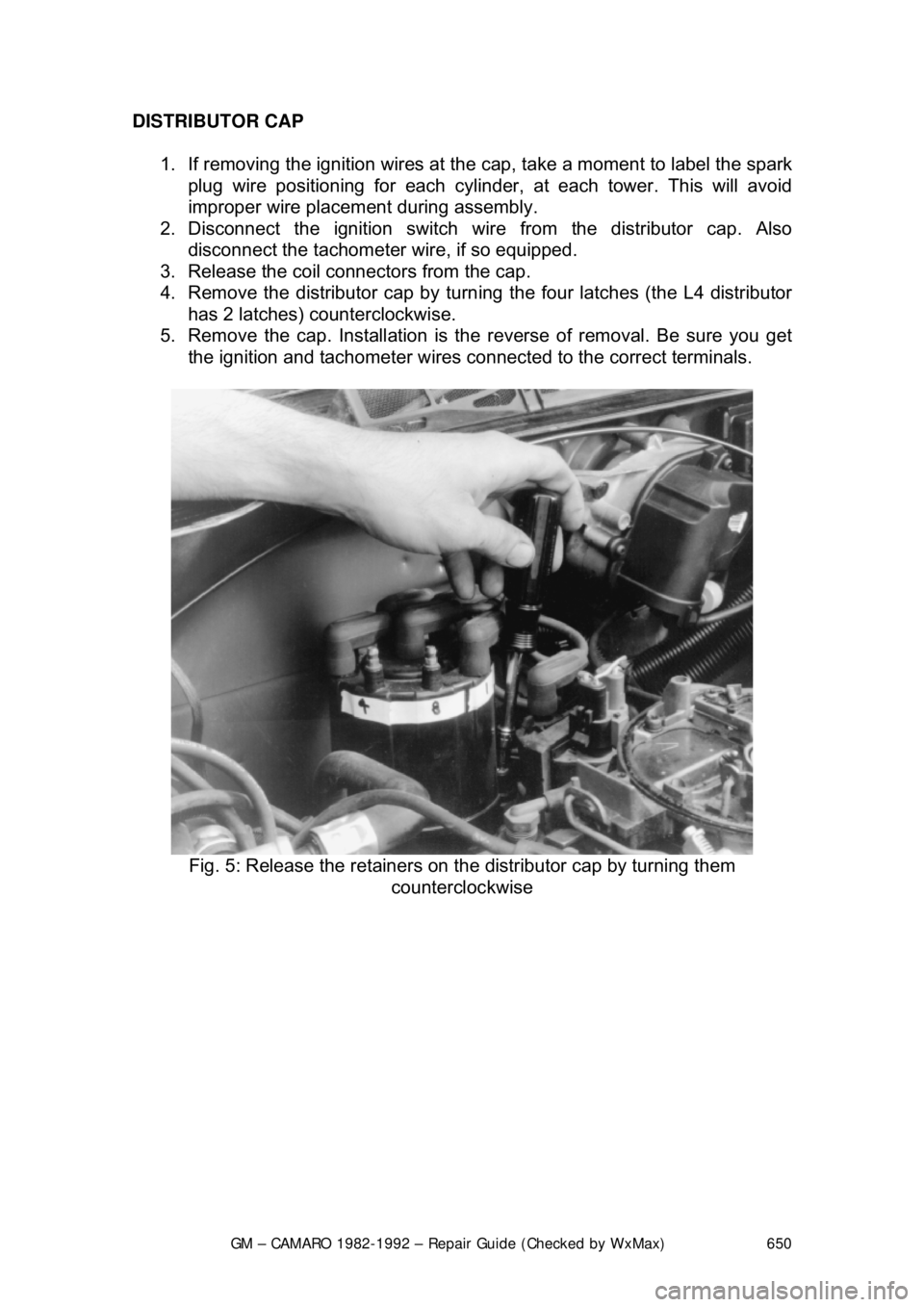
4. Remove the distributor cap by turn ing the four latches (the L4 distributor
has 2 latches) counterclockwise.
5. Remove the cap. Installation is the reverse of removal. Be sure you get
the ignition and tachometer wires c onnected to the correct terminals.
Fig. 5: Release the retainers on t he distributor cap by turning them
counterclockwise
Page 651 of 875

GM – CAMARO 1982-1992 – Repair Guide (Checked by WxMax) 651
Fig. 6: Removing the distri butor cap. Notice that all towers on cap are labeled
with the corresponding engine cylinder number.
ROTOR 1. Disconnect the negative battery cable.
2. Remove the distributor cap.
3. Unscrew the two rotor attaching screws and then lift off the rotor.
4. For installation, make sure the roto r is positioned in the correct direction
and tighten the retaining screws.
CAPACITOR
The capacitor, if equipped, is part of the ignition coil wire harness assembly.
Since the capacitor is used only for radio noise suppres sion, it will seldom need
replacement.
1. Disconnect the negative battery cable.
2. Remove the distributor cap and rotor.
3. Remove the capacitor attaching screws and unplug the connector from
the module. Remove the module.
To install: 4. Plug the connector into the capacitor. Install the capacitor and secure in
place using the mounting screws. Be sure the ground lead is under the
screw.
5. Install the rotor and distributor cap.