1982 CHEVROLET CAMARO tow
[x] Cancel search: towPage 294 of 875

GM – CAMARO 1982-1992 – Repair Guide (Checked by WxMax) 294
25. Connect the negative battery cable at the battery.
CLUTCH
UNDERSTANDING THE CLUTCH
The purpose of the clutch is to disconnect and connect engine power at the
transmission. A vehicle at rest requires a lot of engine torque to get all that
weight moving. An internal combustion engine does not develop a high starting
torque (unlike steam engines) so it must be allowed to operate without any load
until it builds up enough torque to move the vehicle. To a point, torque
increases with engine rpm. The clutch a llows the engine to build up torque by
physically disconnecting t he engine from the transmission, relieving the engine
of any load or resistance.
The transfer of engine power to the tr ansmission (the load) must be smooth and
gradual; if it weren't, driv e line components would wear out or break quickly.
This gradual power transfer is made possi ble by gradually releasing the clutch
pedal. The clutch disc and pressure plat e are the connecting link between the
engine and transmission. When the clutch pedal is released, the disc and plate
contact each other (the clutch is engag ed) physically joining the engine and
transmission. When the pedal is pushed in, the disc and plate separate (the
clutch is disengaged) disconnecting the engine from the transmission.
Most clutch assemblies consists of t he flywheel, the clutch disc, the clutch
pressure plate, the throw out bearing and fork, the actuating linkage and the
pedal. The flywheel and clutch pressure plate (driving members) are connected
to the engine crankshaft and rotate with it. The clutch disc is located between
the flywheel and pressure plate, and is splined to the transmission shaft. A
driving member is one that is attached to the engine and transfers engine power
to a driven member (clutch disc) on t he transmission shaft. A driving member
(pressure plate) rotates (drives) a driv en member (clutch disc) on contact and,
in so doing, turns the transmission shaft.
There is a circular di aphragm spring within th e pressure plate cover
(transmission side). In a relaxed state (w hen the clutch pedal is fully released)
this spring is convex; that is, it is dished outward toward the transmission.
Pushing in the clutch peda l actuates the attached linkage. Connected to the
other end of this is the throw out fork, which hold the throw out bearing. When
the clutch pedal is depre ssed, the clutch linkage pushes the fork and bearing
forward to contact the diaphragm spring of the pressure plate. The outer edges
of the spring are secured to the pressure plate and are pivoted on rings so that
when the center of the spring is compre ssed by the throw out bearing, the outer
edges bow outward and, by so doing, pu ll the pressure plate in the same
direction - away from the clutch disc. This action se parates the disc from the
plate, disengaging the clutch and allowing the transmission to be shifted into
another gear. A coil type clutch return sp ring attached to the clutch pedal arm
permits full release of the pedal. Releasing the pedal pulls the throw out bearing
away from the diaphragm spring resulting in a reversal of spring position. As
bearing pressure is gradually released from the spring center, the outer edges
Page 305 of 875

GM – CAMARO 1982-1992 – Repair Guide (Checked by WxMax) 305
Fig. 1: The torque converter housing is rotated by the engine's crankshaft, and
turns the impeller - The impeller then spin s the turbine, which gives motion to
the turbine shaft, driving the gears
The torus is turning faster than the turbi ne. It picks up fluid at the center of the
converter and, through centrifugal force, slings it outward. Since the outer edge
of the converter moves faster than the portions at the center, the fluid picks up
speed.
The fluid then enters the outer edge of th e turbine blades. It then travels back
toward the center of the converter case along the turbine blades. In impinging
upon the turbine blades, the fluid loses the energy picked up in the torus.
If the fluid was now returned directly into the torus, both halves of the converter
would have to turn at approximately t he same speed at all times, and torque
input and output would both be the same.
In flowing through the torus and turbine, the fluid picks up two types of flow, or
flow in two separate directions. It flow s through the turbine blades, and it spins
with the engine. The stator, whose blades are stationary when the vehicle is
being accelerated at low speeds, converts one type of flow into another. Instead
of allowing the fluid to flow straight back into the torus, the stator's curved
blades turn the fluid almost 90° toward the direction of rotation of the engine.
Thus the fluid does not flow as fast to ward the torus, but is already spinning
when the torus picks it up. This has the effe ct of allowing the torus to turn much
faster than the turbine. This differ ence in speed may be compared to the
difference in speed between the smaller and larger gears in any gear train. The
result is that engine powe r output is higher, and engine torque is multiplied.
Page 316 of 875
GM – CAMARO 1982-1992 – Repair Guide (Checked by WxMax) 316
1984-89 MODELS
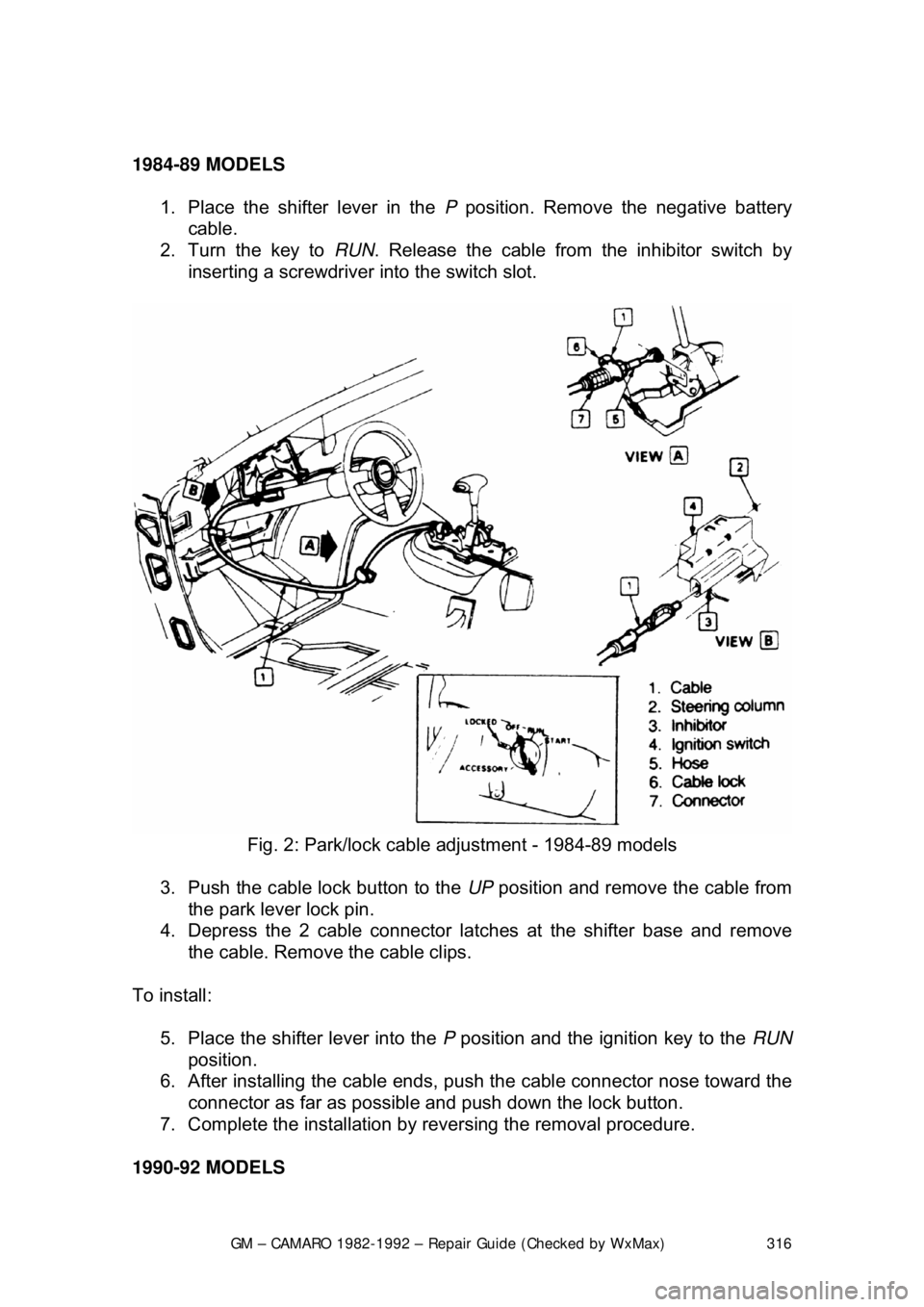
1. Place the shifter lever in the P position. Remove the negative battery
cable.
2. Turn the key to RUN. Release the cable from the inhibitor switch by
inserting a screwdriver into the switch slot.
Fig. 2: Park/lock cable adjustment - 1984-89 models
3. Push the cable lock button to the UP position and remove the cable from
the park lever lock pin.
4. Depress the 2 cable connector latc hes at the shifter base and remove
the cable. Remove the cable clips.
To install: 5. Place the shifter lever into the P position and the ignition key to the RUN
position.
6. After installing the cable ends, push the cable connector nose toward th\
e connector as far as possible and push down the lock button.
7. Complete the installation by reversing the removal procedure.
1990-92 MODELS
Page 317 of 875

GM – CAMARO 1982-1992 – Repair Guide (Checked by WxMax) 317
1. Place the shifter lever in the
P position. Remove the negative battery
cable.
2. Turn the key to RUN.
3. Remove the left side instrument panel sound insulator and kick panels.
4. Remove the floor console.
5. Remove the cable nut and clip. Remove the cable from the bracket, move the button to the UP position and unsnap the cable end from the
lever lock pin.
6. Lower the steering column. Remove the cable clips.
To install: 7. Place the shifter lever into the P position and the ignition key to the RUN
position.
8. After installing the cable ends, push the cable connector nose toward th\
e connector as far as possible and push down the lock button.
9. Complete the installation by reversing the removal procedure.
EXTENSION HOUSING SEAL (IN VEHICLE)
REMOVAL & INSTALLATION
This seal controls transmission oil leakage around the driveshaft. Continued
failure of this seal usually indicates a worn output shaft bushing. If so, there will
be signs of the same wear on the driveshaft where it contacts the seal and
bushing. The seal is available and is fairly simple to install, with the proper tool.
1. Raise and safely support rear of t he vehicle to minimize transmission oil
loss when the driveshaft is removed.
2. Unbolt the driveshaft fr om the differential and center support bearing, if
equipped. Wrap tape around the bearing cu ps to keep them in place on
the universal joint and slide the sh aft out of the transmission.
3. Use a small pry tool to carefully pr y out the old seal. Be careful not to
insert the tool too far into the hous ing or the bushing will be damaged.
4. Use an oil seal installation tool to evenly drive the new seal into the
housing. Make sure the tool only cont acts the outer metal portion of the
seal.
5. Install the driveshaft. Torque the uni versal bearing cup retainer bolts to
15 ft. lbs. (20 Nm). Recheck fluid level.
TRANSMISSION
REMOVAL & INSTALLATION 1. Disconnect the negative batte ry cable at the battery.
2. Remove the air cleaner assembly.
3. Disconnect the throttle valve (TV) control cable at the carburetor.
Page 320 of 875
GM – CAMARO 1982-1992 – Repair Guide (Checked by WxMax) 320
7. Unbolt the universal joint straps fr
om the pinion flange (use care to keep
the universal joint caps in place), lower and remove the driveshaft from
the vehicle. Place a transmission tailshaft plug or rag in place of the \
driveshaft to keep the transmission fluid from draining out.
8. Disconnect the catalytic converter support bracket at the transmission.
9. Disconnect the speedometer cable, electrical connectors and the shift
control cable from the transmission.
CAUTION - During the next step, rear spring force will cause the torque arm to
move toward the floor pan. When disconn ecting the arm from the transmission,
carefully place a piece of wood between the floor pan and the torque arm. This
will prevent possible personal injury and/or floor pan damage
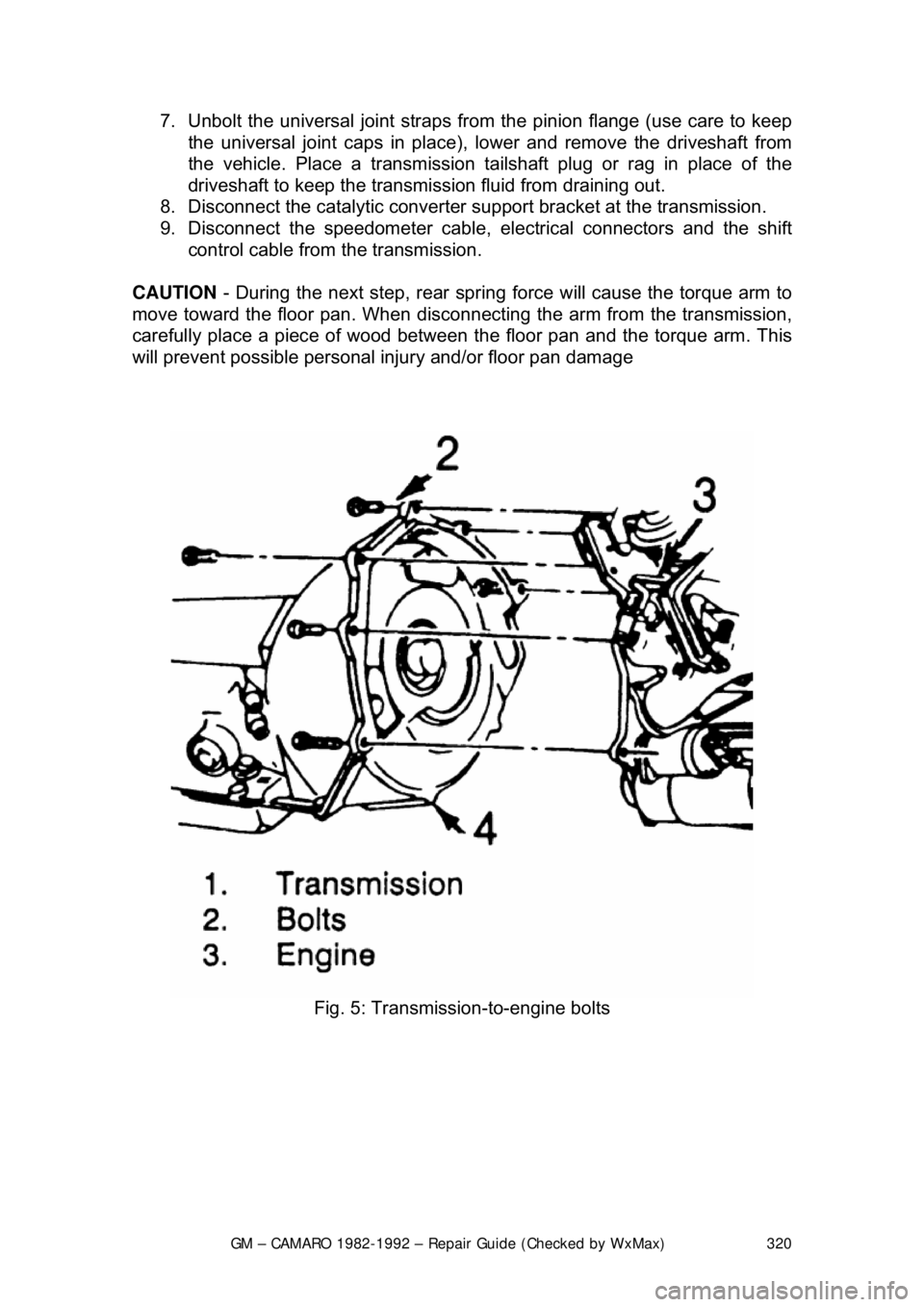
Fig. 5: Transmission-to-engine bolts
Page 345 of 875

GM – CAMARO 1982-1992 – Repair Guide (Checked by WxMax) 345
operation is required of it. Thus, little a
llowance for air circulation is required,
and the windings can be built into a very small space.
The starter solenoid is a magnetic dev ice which employs the small current
supplied by the starting switch circuit of the ignition switch. This magnetic action
moves a plunger which mechanically engages the starter and electrically closes
the heavy switch which connects it to t he battery. The starting switch circuit
consists of the starting switch cont ained within the ignition switch, a
transmission neutral safety switch or clutch pedal switch, and the wiring
necessary to connect these with the starter solenoid or relay.
A pinion, which is a small gear, is m ounted to a one-way drive clutch. This
clutch is splined to the starter armature shaft. When the ignition switch is moved
to the start position, the solenoid plunger slides the pinion toward the flywheel
ring gear via a collar and spring. If t he teeth on the pinion and flywheel match
properly, the pinion will engage the flywheel immediately. If the gear teeth butt
one another, the spring will be compressed and will force the gears to mesh as
soon as the starter turns far enough to a llow them to do so. As the solenoid
plunger reaches the end of it s travel, it closes the contacts that connect the
battery and starter and then the engine is cranked.
As soon as the engine star ts, the flywheel ring gear begins turning fast enough
to drive the pinion at an ex tremely high rate of speed. At this point, the one-way
clutch begins allowing the pi nion to spin faster than the starter shaft so that the
starter will not operate at excessive speed. When the i gnition switch is released
from the starter position, the solenoid is de-energized, and a spring contained
within the solenoid assembly pulls the gear out of mesh and interrupts the
current flow to the starter.
Some starters employ a separate relay, mounted away from the starter, to
switch the motor and solenoid current on and off. The relay thus replaces the
solenoid electrical switch, but does not eliminate the need for a solenoid
mounted on the starter used to mechanica lly engage the starter drive gears.
The relay is used to reduce the amount of current the starting switch must carry.
THE CHARGING SYSTEM
The automobile charging system provides electrical power for operation of the
vehicle's ignition and star ting systems and all the electrical accessories. The
battery serves as an electrical surge or storage tank, storing (in chemical form)
the energy originally pr oduced by the engine driven gen erator. The system also
provides a means of regulating alternat or output to protect the battery from
being overcharged and to avoid excess ive voltage to the accessories.
The storage battery is a chemical device in corporating parallel lead plates in a
tank containing a sulfuric acid-water solution. Adjacent plates are slightly
dissimilar, and the chemical reaction of the two dissimilar plates produces
electrical energy when the battery is connected to a load such as the starter
motor. The chemical reaction is reversible, so that when the generator i\
s
producing a voltage (electrical pressure ) greater than that produced by the
Page 350 of 875

GM – CAMARO 1982-1992 – Repair Guide (Checked by WxMax) 350
4. Remove the distributor cover and wi
re retainer, if equipped. Turn the
retaining screws counterclockwise and remove the cap.
5. Mark the relationship of the roto r to the distributor housing and the
housing relationship to the engine.
6. Remove the distributor reta ining bolt and hold-down clamp.
7. Pull the distri butor up until the rotor just stops turning counterclockwise
and again note the position of the rotor.
8. Remove the distribut or from the engine.
To install: 9. Insert the distributor into the engine, with the rotor aligned to the last
mark made, then slowly install the dist ributor the rest of the way until all
marks previously made are aligned.
10. Install the distributor hold- down clamp and retaining bolt.
11. If removed, install the wiring harness retainer and secondary wires.
12. Install the distributor cap.
13. Engage the wire connections on t he distributor. Make certain the
connectors are fully seated and latched.
14. Reconnect the negative battery cable.
If the engine was accidentally cranked afte r the distributor was removed, the
following procedure can be used during installation.
15. Remove the No. 1 spark plug.
16. Place a finger over the spark pl ug hole. Have a helper turn the engine
slowly using a wrench on the crankshaft bolt until compression is felt. \
17. Align the timing mark on the pulley to 0 on the engine timing indicator.
18. Turn the rotor to point to the No . 1 spark plug tower on the distributor
cap.
19. Install the distributor assembly in the engine and ensure the rotor is
pointing toward the No. 1 spark plug tower.
20. Install the cap and spark plug wires.
21. Check and adjust engine timing.
ALTERNATOR
DESCRIPTION
An alternator differs from a DC shunt generator in that the armature is
stationary, and is called the stator, while the field rotates and is called the rotor.
The higher current values in the alternator's stator are conducted to the external
circuit through fixed leads and connecti ons, rather than through a rotating
commutator and brushes as in a DC generator. This eliminates a major point of
maintenance.
The rotor assembly is supported in the drive end frame by a ball bearing and at
the other end by a roller bearing. These bearings are lubricated during
assembly and require no main tenance. There are six diodes in the end frame
assembly. These diodes are electrical check valves that also change the
Page 378 of 875

GM – CAMARO 1982-1992 – Repair Guide (Checked by WxMax) 378
6. Install the rocker arm, balls and
nut. Tighten the nut until all lash is
eliminated.
7. The engine must be on the No. 1 fi ring position before proceeding. This
may be determined by placing your fi ngers on the No. 1 rocker arms as
the mark crankshaft damper is rotat ed towards the "0" on the timing tab.
If the arms did not move, it is in the No. 1 firing position. If they did move,
turn the crankshaft one full revoluti on to reach the No. 1 position.
Remember, the mark on the crankshaft balancer must be aligned with
the "0" on the timing tab.
8. Adjust the valves as follows:
V6 ENGINES
With the engine on the number 1 firing pos ition, exhaust valves 1, 2 and 3 and
intake valves 1, 5 and 6
may be adjusted. Back out t he adjusting nut until lash is felt at the pushrod.
Tighten the adjusting nut unt il all lash is removed, then tighten the nut an
additional 1
1/2 turns to center the lifter plun ger. Turn the engine one revolution
until the "0" timing mark is once again al igned. Exhaust valves 4, 5 and 6 and
intake valves 2, 3 and 4 may be adjusted.
V8 ENGINES
With the engine on the number 1 firing posit ion, exhaust valves 1, 3, 4 and 8,
intake valves 1, 2, 5 and 7 may be adj usted. Back out the adjusting nut until
lash is felt at the pushrod. Tighten the adjusting nut until all lash is removed,
then tighten an additional 1 turn to center the lifter plunger. Turn the engine one
revolution until the 0 timing mark is once again aligned. Exhaust valves 2, 5, 6
and 7, intake valves 3, 4, 6 and 8 may be adjusted.
9. Install the rocker arm cover.
2.5L ENGINE 1. Disconnect the negative battery cable.
2. Remove the valve cover.
3. Remove the rocker arm bolt, ball and rocker arm.
4. Remove the pushrods, if necessary . Place components in a rack so they
can be reinstalled in the same location.
To install: 5. Coat the bearings surf aces with a thin coating of Molykote® or its
equivalent.
6. Install the pushrod, if removed, through the cylinder head and into the
lifter seat.
7. Install the rocker arm, ball and bol t. Torque to 22 ft lbs. (30 Nm).
8. Install the valve cover.