1982 CHEVROLET CAMARO tow
[x] Cancel search: towPage 441 of 875

GM – CAMARO 1982-1992 – Repair Guide (Checked by WxMax) 441
2. Remove the fan, driv
e belts and water pump pul ley. Remove the valve
cover. Loosen the rocker arms and pivot them, then remove the
pushrods.
3. Remove the oil pump driveshaft and gear assembly. This is located
under a small plate secured by two bol ts near the oil filter. Remove the
spark plugs.
4. Mark the position of the distribut or rotor, housing, and engine block.
Remove the distributor.
5. Remove the valve lifters. They are located behind the pushrod cover.
6. Remove the timing gear cover.
7. Insert a screwdriver through the holes in the ti ming gear and remove the
2 camshaft thrust plate screws.
8. Pull the camshaft and gear assembly out through the front of the engine
block.
When removing the camshaft, be careful not to damage the camshaft bearings.
9. If the camshaft is to be removed from the timing gear, place the assembly in an arbor press and s eparate. CAUTION When removing the
timing gear from the camshaft, the thrust plate must be positioned so that
the woodruff key does not damage it.
To install: 10. To install the timing gear to the camshaft, press the assembly together
and measure the end clearance. T here should be 0.0015-0.0050 in.
(0.038-0.127mm) between the thrust plate and the camshaft.
If the clearance is less than 0.0015 in. (0 .038mm), replace the spacer ring; if
more than 0.0050 in. (0.127mm), replace the thrust ring.
11. Lubricate the camshaft, bearings, and lifters. Slide the camshaft
assembly into the engine and align the timing marks of the camshaft gear
and crankshaft gear.
12. Complete the installation by reversing the removal procedure.
V6 AND V8 ENGINES 1. Remove the engine from the vehicl e or remove all components from the
front of the engine (radi ator, grille, etc.).
2. Remove the timing gear cover and chain.
3. Mark the distributor rotor, housi ng and engine block, then remove the
distributor. Remove the fuel pump and fuel pump pushrod on carbureted
engines.
4. Remove the intake manifold and valve covers. Loosen the rocker arms
and pivot out of way. Remove the pushrods and valve lifters.
5. Remove the oil pump drive.
6. Slide the camshaft toward the front of the engine (be careful not to
damage the camshaft bearings).
Page 442 of 875

GM – CAMARO 1982-1992 – Repair Guide (Checked by WxMax) 442
To install:
7. Lubricate all parts. Slide the ca mshaft onto the camshaft bearings.
8. Install the fuel pump and fuel pump pushrod.
9. Install the distributor and align all matchmarks.
10. Install the oil pump drive.
11. Install the valve lifters, pushrods and rocker arms.
12. Install the intake manifold and valve covers.
13. Install the timing and timing chain cover.
14. Install the radiator.
15. Fill the cooling syst em, start the engine and check for leaks.
BEARING
REMOVAL & INSTALLATION
It is recommended for a machine shop to perform these procedures.
To remove the camshaft bearings, the ca mshaft lifters, flywheel, rear camshaft
expansion plug, and cranks haft must be removed.
Camshaft bearings can be replaced wi th engine completely or partially
disassembled. To replace bearings without complete disassembly remove the
camshaft and crankshaft leaving cylinder heads attached and pistons in place.
Before removing crankshaft, tape threads of connecting rod bolts to prevent
damage to crankshaft. Fasten connecting rods against sides of engine so they
will not be in the way while replacing camshaft bearings.
If excessive wear is indicated, or if the engine is being completely rebuilt,
camshaft bearings should be replaced as follows: Drive the camshaft rear plug
from the block. Assemble the removal puller with its shoulder on the bearing to
be removed. Gradually tighten the puller nut until bearing is removed. Remove
remaining bearings, leaving the front and rear for last. To remove front and rear
bearings, reverse position of the tool, so as to pull the bearings in toward the
center of the block. Leave the tool in th is position, pilot the new front and rear
bearings on the installer, and pull them into position as follows:
• 4 cylinder engines: Ensure oil holes are properly aligned.
• V6 engines: Ensure the rear and intermediate bearing oil holes are
aligned between the 2 and 3 o'clock po sitions and the front bearing oil
holes are at 1:00 and between 2 and 3 o'clock positions.
• V8 engines: Ensure the No. 1 (f ront) camshaft bearing holes are an
equal distance from the 6 o'clock pos ition. The No. 2 through 4 inner
bearing holes must be posit ioned at the 5 o'clock position towards the left
side (drivers) of the engine, even wit h the bottom of the cylinder bore.
The No. 5 bearing oil holes must be positioned at 12 o'clock.
Return the tool to its original position and pull remaining bearings into position.
Page 443 of 875

GM – CAMARO 1982-1992 – Repair Guide (Checked by WxMax) 443
Ensure that oil holes are properly al
igned. Replace camshaft rear plug, and
stake it into position to aid retention.
INSPECTION
CAMSHAFT LOBE LIFT
Check the lift of each lobe in consecutiv e order and make a note of the reading.
1. Remove the fresh air inlet tube a nd the air cleaner. Remove the heater
hose and crankcase ventilation hoses. Remove valve rocker arm
cover(s).
2. Remove the rocker arm stud nut or fulcrum bolts, fulcrum seat and rocker
arm.
3. Make sure the pushrod is in the valve tappet socket. Install a dial indicator so that the actuating poin t of the indicator is in the pushrod
socket (or the indicator ball socket adapter tool is on the end of the
pushrod) and in the same plane as the pushrod movement.
4. Disable the ignition and fuel systems.
5. Install a remote starter switch. Crank the engine with the ignition and fuel
system disabled. Turn the crankshaft ov er until the tappet is on the base
circle of the camshaft lobe. At this position, the pushrod will be in its
lowest position.
6. Zero the dial indicator. Continue to rotate the crankshaft slowly until the
pushrod is in the fully raised position.
7. Compare the total lift recorded on the dial indicator with the specification
shown on the Camshaft Specification chart.
To check the accuracy of the original in dicator reading, continue to rotate the
crankshaft until the indicator reads zero. If the lift on any lobe is below specified
wear limits listed, the ca mshaft and the valve tappet operating on the worn
lobe(s) must be replaced.
8. Install the rocker arm, fulcrum seat and stud nut or fulcrum bolts. Adjust
the valves, if required (r efer to the valves procedure in this section).
9. Install the valve rocker arm cover(s) and the air cleaner.
CAMSHAFT END PLAY
On all gasoline V8 engi nes, prying against the aluminum-nylon camshaft
sprocket, with the valve train load on t he camshaft, can break or damage the
sprocket. Therefore, the rocker arm adj usting nuts must be backed off, or the
rocker arm and shaft assembly must be loosened sufficiently to free the
camshaft. After checking the camshaft e nd play, check the valve clearance.
Adjust if required (refer to procedure in this section).
1. Push the camshaft toward the rear of the engine. Install a dial indicator or
equivalent so that the indicator point is on the camshaft sprocket
attaching screw.
Page 482 of 875

GM – CAMARO 1982-1992 – Repair Guide (Checked by WxMax) 482
If you do not have access to the proper
tools, you may want to bring the
components to a shop that does.
VALVES
The first thing to inspect are the valve heads. Look closely at the head, margin
and face for any cracks, excessive wear or burning. The margin is the best
place to look for burning. It should have a squared edge with an even width all
around the diameter. When a valve burns, the margin will look melted and the
edges rounded. Also inspect the valve head for any signs of tulipping. This will
show as a lifting of the edges or dishi ng in the center of the head and will
usually not occur to all of the valves. All of the heads should look the same, any
that seem dished more t han others are probably bad. Next, inspect the valve
lock grooves and valve tips. Check fo r any burrs around the lock grooves,
especially if you had to file them to remove the valve. Valve tips should appear
flat, although slight rounding with high mile age engines is normal. Slightly worn
valve tips will need to be machined flat. Last, measure the valve stem diameter
with the micrometer. Measure the area that rides within the guide, especially
towards the tip where most of the wear occurs. Take several measurements
along its length and compare them to each other. Wear should be even along
the length with little to no taper. If no minimum diameter is given in the
specifications, then the stem should not read more than 0.001 in. (0.025mm)
below the specification. Any valves that fail these inspections should be
replaced.
Fig. 7: Valve stems may be rolled on a flat surface to check for bends
Page 485 of 875

GM – CAMARO 1982-1992 – Repair Guide (Checked by WxMax) 485
CYLINDER HEAD
There are several things to check on
the cylinder head: valve guides, seats,
cylinder head surface flatness, cracks and physical damage.
VALVE GUIDES
Now that you know the valves are good, you can use them to check the guides,
although a new valve, if available, is preferred. Before you measure anything,
look at the guides carefully and inspect t hem for any cracks, chips or breakage.
Also if the guide is a removable style (a s in most aluminum heads), check them
for any looseness or evidence of movem ent. All of the guides should appear to
be at the same height from the spring s eat. If any seem lower (or higher) from
another, the guide has moved. Mount a dial indicator onto the spring side of the
cylinder head. Lightly oil the valve stem and insert it into the cylinder head.
Position the dial indicator against the valve stem near the tip and zero the
gauge. Grasp the valve stem and wiggle towards and away from the dial
indicator and observe the readings. Mount the dial indicator 90 degrees from
the initial point and zero the gauge and again take a reading. Compare the two
readings for a out of round condition. Check the readings against the
specifications given. An Inside Diamete r (I.D.) gauge designed for valve guides
will give you an accurate valve guide bore measurement. If the I.D. gauge is
used, compare the readings wit h the specifications given. Any guides that fail
these inspections should be replaced or machined.
Fig. 11: A dial gauge may be used to che ck valve stem-to-guide clearance; read
the gauge while moving the valve stem
Page 506 of 875
GM – CAMARO 1982-1992 – Repair Guide (Checked by WxMax) 506
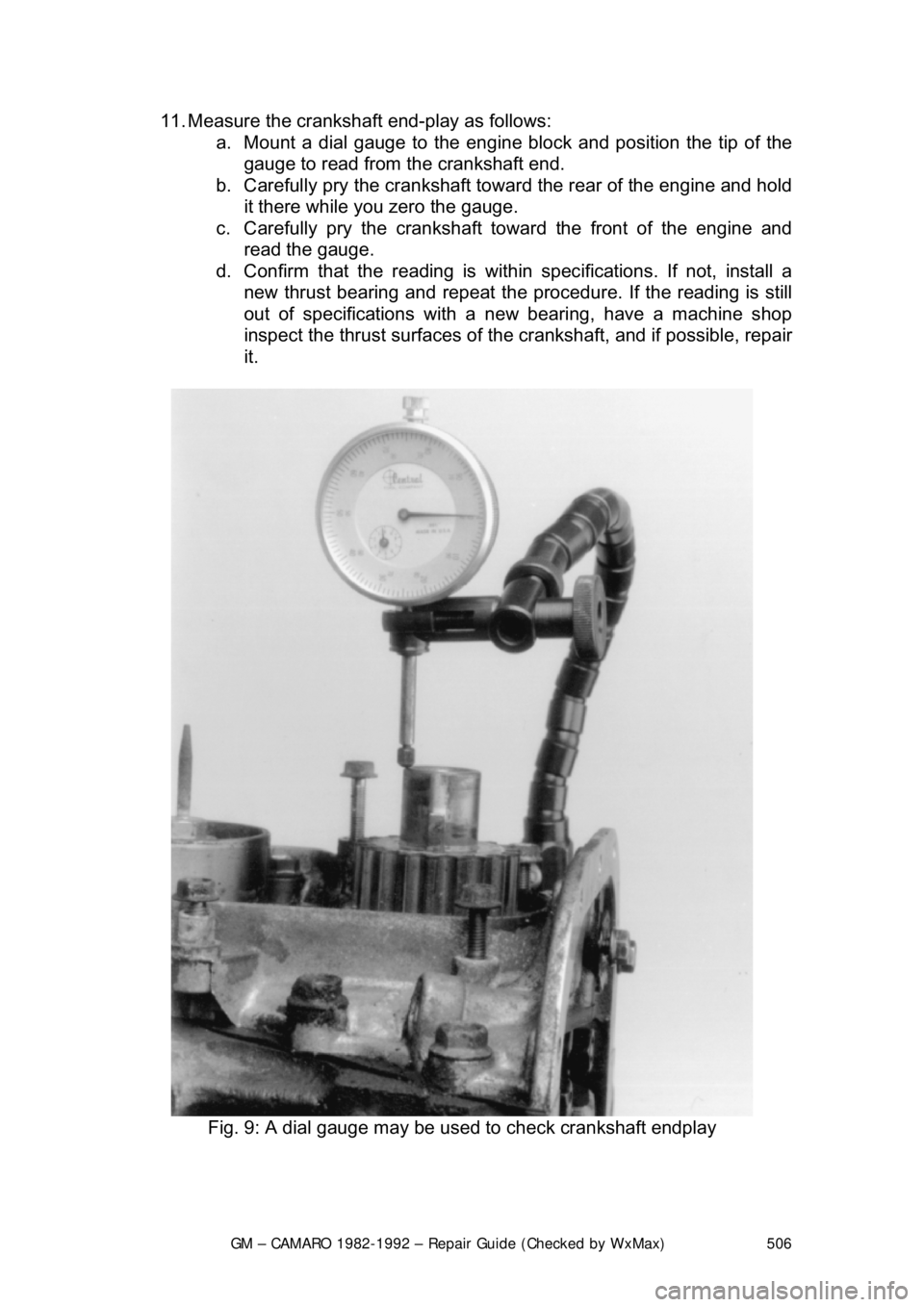
11. Measure the crankshaft end-play as follows:
a. Mount a dial gauge to the engine block and position the tip of the
gauge to read from t he crankshaft end.
b. Carefully pry the crankshaft towa rd the rear of the engine and hold
it there while you zero the gauge.
c. Carefully pry the crankshaft toward the front of the engine and read the gauge.
d. Confirm that the r eading is within specifications. If not, install a
new thrust bearing and repeat the procedure. If the reading is still
out of specifications with a new bearing, have a machine shop
inspect the thrust surfaces of the crankshaft, and if possible, repair
it.
Fig. 9: A dial gauge may be used to check crankshaft endplay
Page 507 of 875
GM – CAMARO 1982-1992 – Repair Guide (Checked by WxMax) 507
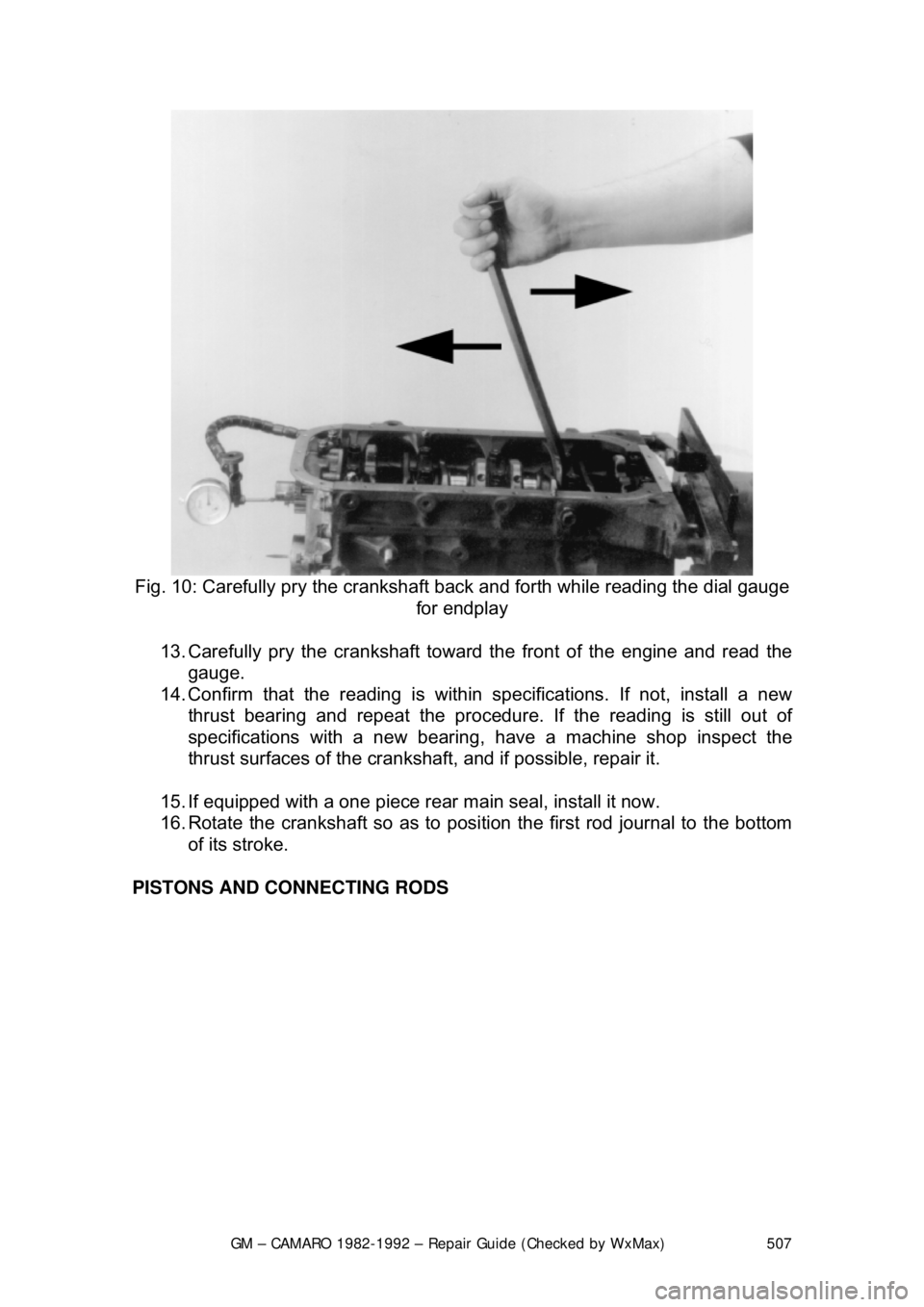
Fig. 10: Carefully pry the crankshaft back and forth while reading the dial gauge
for endplay
13. Carefully pry the crankshaft toward the front of the engine and read the
gauge.
14. Confirm that the reading is within specifications. If not, install a new
thrust bearing and repeat the procedure. If the readi ng is still out of
specifications with a new bearing, have a machine shop inspect the
thrust surfaces of the cranks haft, and if possible, repair it.
15. If equipped with a one piece rear main seal, install it now.
16. Rotate the crankshaft so as to posi tion the first rod journal to the bottom
of its stroke.
PISTONS AND CONNECTING RODS
Page 510 of 875

GM – CAMARO 1982-1992 – Repair Guide (Checked by WxMax) 510
f. Check the ring side clearance of the compression rings with a
feeler gauge inserted between the ring and its lower land
according to specification. The gauge should slide freely around
the entire ring circumference wit hout binding. Any wear that
occurs will form a step at the inne r portion of the lower land. If the
lower lands have high steps, t he piston should be replaced.
Fig. 14: The notch on the side of t he bearing cap matches the tang on the
bearing insert
2. Unless new pistons are installed, be sure to install the pistons in the
cylinders from which they were removed. The numbers on the
connecting rod and bearing cap must be on the same side when installed
in the cylinder bore. If a connecting rod is ever transposed from one
engine or cylinder to another, new bear ings should be fitted and the
connecting rod should be numbered to correspond with the new cylinder
number. The notch on the piston head goes toward the front of the
engine.
3. Install all of the rod bearing inserts into the rods and caps.