1982 CHEVROLET CAMARO hose
[x] Cancel search: hosePage 743 of 875

GM – CAMARO 1982-1992 – Repair Guide (Checked by WxMax) 743
MINIMUM IDLE SPEED
The minimum idle speed should onl
y be adjusted under two conditions:
If the throttle body has been replaced.
After every other possible cause for the in correct idle speed has been explored.
There are many possible causes for incorre ct idle speed, most of which require
a high level of diagnostic skill as well as expensive testing equipment. Check
the vehicle for vacuum leaks, incorrect valve or ignition timing, deposit
accumulation in the throttle bore or valve, sticking throttle linkage or bent throttle
valves. If the vehicle will still not idle pr operly after checking these areas, it
should be diagnosed by a professional.
1. Pierce the idle stop screw with an awl. Apply leverage to remove it.
2. Make sure the IAC valve is connect ed. Short the A and B terminals of the
ALDL connector together with a length of wire.
3. Turn the ignition to the ON positi on, but do not start the engine. Wait at
least 30 seconds before proceeding.
4. With the ignition ON, disconnect the IAC valve connector.
5. Separate the set-timing connector. Th is eliminates the possibility of
changes in engine speed due to variations of engine timing.
6. Start the engine and remove t he wire shorting the A and B terminals
together. It may be necessary to hold the throttle open slightly to prevent
the engine from stalling.
7. Allow the engine to reach no rmal operating temperature.
8. Adjust the idle speed to the following: a. 2.8L Engines - 450-550 rp m A/T or 550-650 rpm M/T
b. 3.1L Engines - Refer to the underhood emissions sticker
c. 5.0L and 5.7L TPI engines - 400-450 rpm.
If these figures differ from t hose on the underhood emissions
sticker, always follow the specifications on the emissions sticker.
9. Turn the ignition OFF and connect the IAC valve harness. On models up
to 1989, adjust the Throttle Position Sensor.
THROTTLE POSITION SENSOR (TPS) 1. Install three jumper wires betw een the TPS and the harness connector.
2. Use a digital voltmeter connected to terminals A and B of the TPS.
3. Turn the ignition switch ON , but do not start the engine.
4. Loosen the TPS attaching screws and adj ust the sensor to the following:
a. 2.8L Engines - 0.50-0.60 volts
b. 5.0L and 5.7L TPI Engines - 0.47-0.61 volts
5. Tighten the attaching screws, then check that the reading has not been
disturbed.
6. With the ignition OFF, remove the jumper wires. Reconnect the TPS
harness.
Page 746 of 875

GM – CAMARO 1982-1992 – Repair Guide (Checked by WxMax) 746
5.0L AND 5.7L TPI ENGINES
1. Disconnect the negative battery cable.
2. Relieve the fuel system pressure.
3. Remove the intake plenum and runners.
4. Remove the fuel rail assembly.
5. Rotate the injector retaining clip to the unlocked position and remove the
injector. Discard the O-rings and the injector retaining clip.
There are two different injector part numbers for the 5.0L and the 5.7L engine.
Do not intermix injectors with different part numbers, as this will result in engine
roughness and excessive emissions. When or dering new injectors, be sure to
order the identical part number that is inscribed on the old injector. However, if a
complete set of injectors is being repl aced, either part number for that engine
application may be used.
To install:
6. Lubricate the new O-ri ng seals with engine oil and install them on the
injector. Assemble a new reta ining clip on the injector.
7. Install the injector into the fuel ra il socket with the electrical connections
facing outward. Rotate the retaini ng clip to the lock position.
8. Install the fuel rail assembly.
9. Install the intake plenum and runners with new gaskets.
10. Tighten the fuel filler cap and connect the negative battery cable.
11. With the engine OFF and the igniti on ON, check for fuel leaks.
FUEL RAIL ASSEMBLY
REMOVAL & INSTALLATION
When servicing the fuel system, be sure to relieve the pressure of the system
and drain the fuel into an approved contai ner. Cap all open fuel lines and plug
any other open passages. DO NO T allow dirt or other contaminants to enter the
system.
2.8L AND 3.1L ENGINES 1. Disconnect the negative battery cable.
2. Relieve the fuel system pressure.
3. Remove the intake plenum.
4. Clean the fuel rail assembly to pr event dirt from entering the system.
5. Remove the cold start tube at th e fuel rail fitting. Use a backup wrench
on the fuel rail fitting to pr event it from turning.
6. Disconnect the fuel feed and return lines at the rail.
7. Disconnect the vacuum hose at the pressure regulator.
8. Unplug the electrical connectors.
9. Loosen and remove the fuel rail attaching bolts.
10. Remove the fuel rail assembly from the intake manifold.
11. Discard all of the O-ring seals t hat are exposed during this procedure.
Page 747 of 875
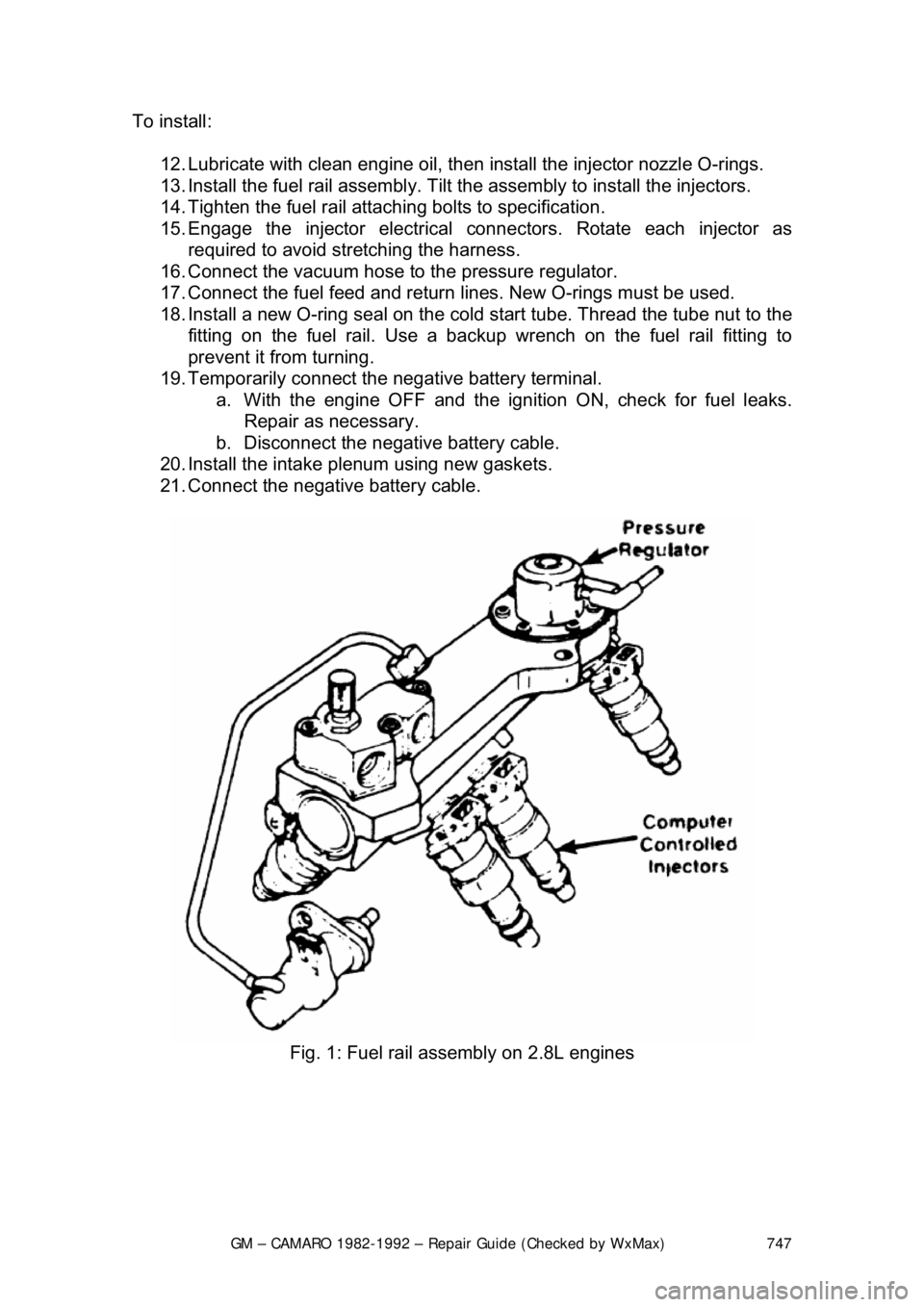
GM – CAMARO 1982-1992 – Repair Guide (Checked by WxMax) 747
To install:
12. Lubricate with clean engine oil, then install the injector nozzle O-rings.
13. Install the fuel rail assembly. Tilt t he assembly to install the injectors.
14. Tighten the fuel rail attachi ng bolts to specification.
15. Engage the injector electrical connectors. Rotate each injector as
required to avoid stretching the harness.
16. Connect the vacuum hose to the pressure regulator.
17. Connect the fuel feed and return lines. New O-rings must be used.
18. Install a new O-ring seal on the cold start tube. Thread the tube nut to the
fitting on the fuel rail. Use a backup wrench on the fuel rail fitting t\
o
prevent it from turning.
19. Temporarily connect the negative battery terminal. a. With the engine OF F and the ignition ON, check for fuel leaks.
Repair as necessary.
b. Disconnect the negative battery cable.
20. Install the intake plenum using new gaskets.
21. Connect the negative battery cable.
Fig. 1: Fuel rail assembly on 2.8L engines
Page 750 of 875

GM – CAMARO 1982-1992 – Repair Guide (Checked by WxMax) 750
6. Disconnect the vacuum hose
at the pressure regulator.
7. Unplug the electrical connectors.
8. Loosen and remove the fuel rail attaching bolts.
9. Remove the fuel rail assembly from the intake manifold.
10. Discard all of the O-ring seals t hat are exposed during this procedure.
To install: 11. Lubricate with clean engine oil, then install the injector nozzle O-rings.
12. Install the fuel rail assembly in the intake manifold.
13. Tighten the fuel rail attachi ng bolts to specification.
14. Engage the injector electrical connectors. Rotate each injector as
required to avoid stretching the harness.
15. Connect the vacuum hose to the pressure regulator.
16. Connect the fuel feed and return lines. New O-rings must be used.
17. Temporarily connect the negative battery terminal. a. With the engine OF F and the ignition ON, check for fuel leaks.
Repair as necessary.
b. Disconnect the negative battery cable.
18. Install the intake plenum and runners. Use new gaskets.
19. Connect the negative battery cable.
FUEL PRESSURE REGULATOR
REMOVAL & INSTALLATION
2.8L AND 3.1L ENGINES
The pressure regulator and the fuel rail are serviced as a complete assembly
only. DO NOT attempt to remove the regulator cove r from the fuel rail.
5.0L AND 5.7L TPI ENGINES 1. Disconnect the negative battery cable.
2. Relieve the fuel system pressure.
3. Remove the intake plenum and runners.
4. Remove the fuel rail assembly.
5. Remove the rear crossover re tainer and base attaching screw.
6. Remove the rear crossover tube and O-ring from the regulator base.
Discard the O-ring.
7. Remove the pressure regulator bracket.
8. Remove the pressure r egulator base-to-rail screw.
9. Separate the regulator base from the fuel rail, then disconnect from the
fuel outlet tube.
10. Remove the fuel outle t tube O-ring and discard.
11. Remove the regulator bas e-to-fuel rail connector.
To install: 12. Lubricate and install new regul ator base-to-fuel rail O-rings.
Page 754 of 875

GM – CAMARO 1982-1992 – Repair Guide (Checked by WxMax) 754
Fig. 1: Cold start valve assembly
FUEL TANK
TANK ASSEMBLY
REMOVAL & INSTALLATION 1. Disconnect the negative battery cable.
2. Relieve the fuel system pressure.
3. Drain the fuel from the tank in to an approved container. Use a hand-
operated pump to drain the fuel through the filler neck.
4. Safely raise and support the vehicle.
5. Remove the fuel filler neck shield.
6. Remove the rear axle assembly.
7. Remove the rear portion of the exhaust system.
8. Remove the exhaust heat shield.
9. Clean all the fuel pipes and hoses in the surrounding areas to prevent
contamination of the fuel system.
10. Disconnect the rear fuel feed, fuel return, vapor, and vent hoses at the
fuel sender assembly.
11. Separate the electrical connection.
12. With the aid of an assist ant, support the fuel tank.
13. Remove the fuel tank strap front attaching bolts. Do not bend the straps
as this will damage them.
14. Remove the tank straps and the fuel tank.
To install: 15. Hook the rear end of the fuel t ank straps into the underbody bracket.
Page 755 of 875

GM – CAMARO 1982-1992 – Repair Guide (Checked by WxMax) 755
16. With the aid of an assistant, posit
ion and support the fuel tank with the
straps. Loosely install the front fuel tank attaching bolts.
17. Engage the electrical connection.
18. Connect the fuel hoses and li nes separated during removal.
19. Install the muffler heat sh ield and the exhaust system.
20. Install the rear axle and the fuel filler neck shield.
21. Lower the vehicle.
22. Add fuel and install the filler cap.
23. Connect the negative battery cable.
24. With the engine OFF, turn the igni tion switch to the ON position for 2
seconds, then turn it to the OFF positi on for 10 seconds. Again turn it to
the ON position and check for fuel leaks.
SENDING UNIT REPLACEMENT 1. Remove the fuel tank.
2. Clean the area surrounding t he sender assembly to prevent
contamination of the fuel system.
3. Using tool J-24187 or equivalent, re move the sending unit retaining cam.
Remove the fuel sender and O-rings fr om the tank. Discard the O-rings.
4. If necessary, separate the fuel pum p from the sending unit assembly.
To install: 5. If removed, install the fuel pump to the sending unit. If the strainer was
removed, it must be re placed with a new one.
6. Inspect and clean the O-ring mating surfaces.
7. Install a new O-ring in the groove around the tank opening. If applicable,
install a new O-ring on t he fuel sender feed tube.
8. Install the fuel sender assembly as follows: a. The fuel pump strainer must be in a horizontal position, and when
installed, must not block the travel of the float arm. Gently fold the
strainer over itself an d slowly position the sending assembly in the
tank so the strainer is not dam aged or trapped by the sump walls.
9. Install the retaining cam us ing tool J-24187 or equivalent.
10. Install the fuel tank assembly.
Page 760 of 875

GM – CAMARO 1982-1992 – Repair Guide (Checked by WxMax) 760
GENERAL INFORMATION & MAINTENANCE
HOW TO USE THIS INFORMATION
The introductory part of this repair gui de is intended to help you learn more
about the inner workings of your Camaro while saving you money on its upkeep
and operation.
The beginning of the repair guide will likely be referred to the most, since that is
where you will find information for maintenance and tune-up. The other
information deals with the more complex systems of your vehicle. Systems
(from engine through brakes) are covered to the extent that the average do-it-
yourselfer can attempt. This repair guide will not explain such things as
rebuilding a differential because the ex pertise required and the special tools
necessary make this uneconomical. It will, however, give you detailed
instructions to help you change your own brake pads and shoes, replace spark
plugs, and perform many more jobs that can save you money and help avoid
expensive problems.
A secondary purpose of this repair guide is a reference for owners who want to
understand their vehicle and/or their mechanics better.
WHERE TO BEGIN
Before removing any bolts, read through t he entire procedure. This will give you
the overall view of what tools and supplies will be required. So read ahead and
plan ahead. Each operation should be approached logically and all procedures
thoroughly understood before attempting any work.
If repair of a component is not considered practical, we tell you how to remove
the part and then how to insta ll the new or rebuilt replacement. In this way, you
at least save labor costs.
AVOIDING TROUBLE
Many procedures in this repair guide r equire you to "label and disconnect ..." a
group of lines, hoses or wires. Don't be think you can remember where
everything goes - you won't. If you hook up va cuum or fuel lines incorrectly, the
vehicle may run poorly, if at all. If you hook up electrical wiring incorrectly, you
may instantly learn a very expensive lesson.
You don't need to know the proper name for each hose or line. A piece of
masking tape on the hose and a piece on its fitting will allow you to assign your
own label. As long as you remember your own code, the lines can be
reconnected by matching your tags. Re member that tape will dissolve in
gasoline or solvents; if a part is to be washed or cleaned, use another method
of identification. A permanent felt-tipped marker or a metal scribe can be very
handy for marking metal parts. Remove any tape or paper labels after
assembly.
Page 762 of 875

GM – CAMARO 1982-1992 – Repair Guide (Checked by WxMax) 762
Loctite). If you're worried about getting so
mething together tight enough to hold,
but loose enough to avoid mechanical damage during assembly, one of these
products might offer substantial insurance. Before choosing a threadlocking
compound, read the label on the pa ckage and make sure the product is
compatible with the materials, fluids, etc. involved.
3. Crossthreading. This occu rs when a part such as a bolt is screwed into a
nut or casting at the wrong angle and forced. Cr ossthreading is more
likely to occur if access is diffic ult. It helps to clean and lubricate
fasteners, then to start threading the bolt, spark pl ug, etc. with your
fingers. If you encounter resistance, unscrew the part and start over
again at a different angle until it can be inserted and turned several t\
imes
without much effort. Keep in mind t hat many parts have tapered threads,
so that gentle turning will automatica lly bring the part you're threading to
the proper angle. Don't put a wrench on the part until it's been tightened
a couple of turns by hand. If you s uddenly encounter resistance, and the
part has not seated fully, don't force it. Pull it back out to make sure it's
clean and threading properly.
Be sure to take your time and be pati ent, and always plan ahead. Allow yourself
ample time to perform r epairs and maintenance.
TOOLS AND EQUIPMENT
Without the proper tools and equipment it is impossible to properly service your
vehicle. It would be virtually impossible to catalog every tool that you would
need to perform all of the oper ations in this repair guide. It would be unwise for
the amateur to rush out and buy an expens ive set of tools on the theory that
he/she may need one or more of them at some time.
The best approach is to proceed slowly, gathering a good quality set of those
tools that are used most frequently. Don't be misled by the low cost of bargain
tools. It is far better to spend a little more for better quality. Forged wrenches, 6
or 12-point sockets and fine tooth ratc hets are by far preferable to their less
expensive counterparts. As any good me chanic can tell you, there are few
worse experiences than trying to work on a vehicle with bad tools. Your
monetary savings will be far outweighed by frustration and mangled knuckles.
Begin accumulating those tools that are used most frequently: those associated
with routine maintenance and tune-up. In addition to the normal assortment of
screwdrivers and pliers, you should have the following tools:
• Wrenches/sockets and combination o pen end/box end wrenches in sizes 1/83/4 in. and/or 3mm-19mm 13/16 in. or 5/8 in. spark plug socket
(depending on plug type).
If possible, buy various length socket drive extensions. Universal-joint\
and
wobble extensions can be extremely usef ul, but be careful when using them, as
they can change the amount of torque applied to the socket.