Page 565 of 875

GM – CAMARO 1982-1992 – Repair Guide (Checked by WxMax) 565
3. Reconnect the signal
hose and listen for air flow through the ventilation
tube into the anti-backfire valve. A speed drop should be noticed when
the hose is reconnected.
4. If these conditions are not found, check hoses for restrictions or leaks. If
hoses are OK, replace the anti-backfire valve.
AIR PUMP 1. Check the drive belt tension.
2. Increase the engine speed and observe an increase in air flow. If air flow
does not increase, replace the air pump.
CONTROL VALVE 1. Remove the hoses. Blow through t he valve (toward the cylinder head).
2. Then, suck through the valve (or blow through the other side). If air flows
in one direction, the valve is operative. If not, replace the control valve.
REMOVAL & INSTALLATION
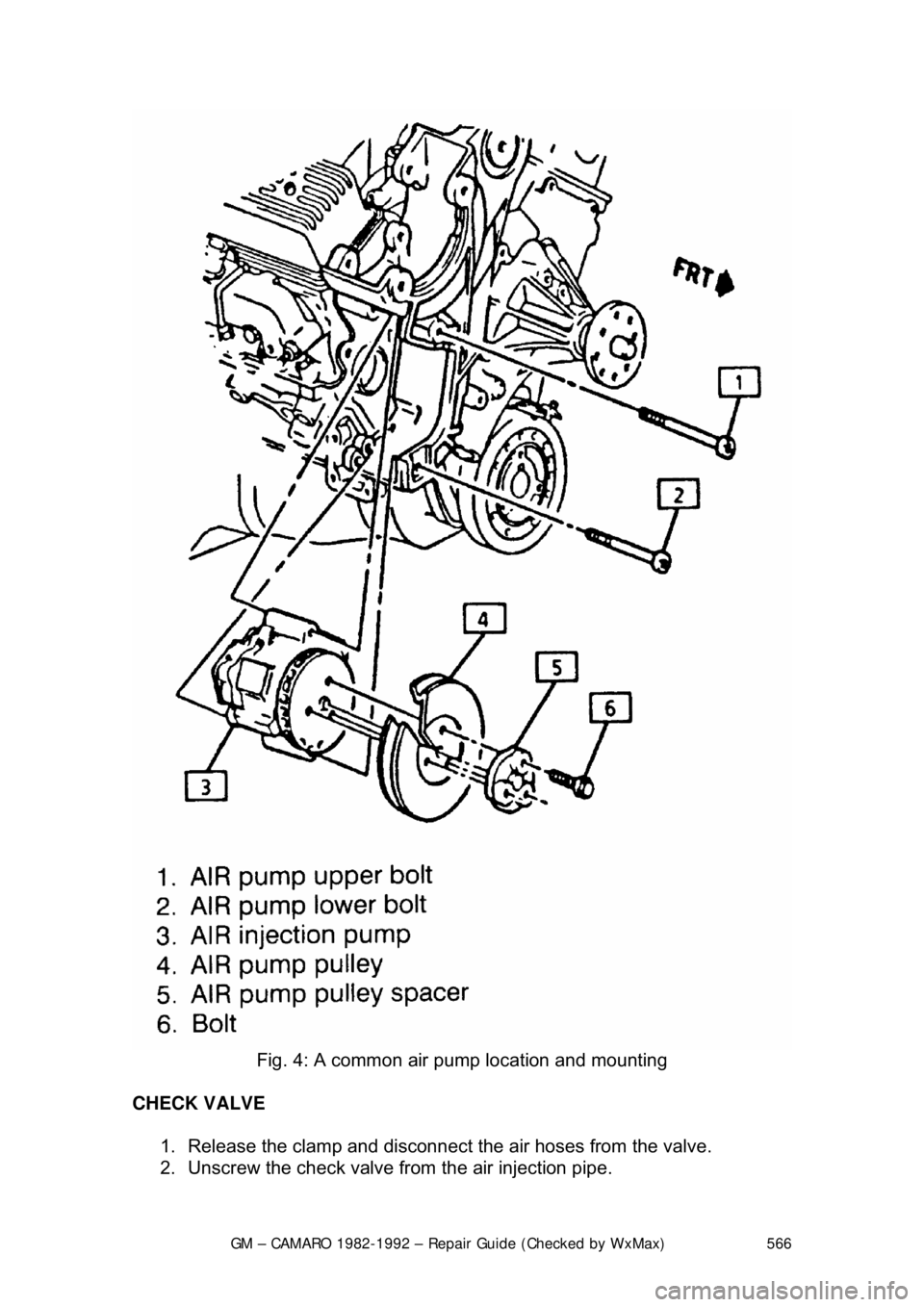
AIR PUMP 1. Remove the AIR control valves and/or adapter at the pump.
2. Loosen the air pump adjustment bolt and remove the drive belt.
3. Unscrew the pump mounting bolts and then remove the pump pulley.
4. Unscrew the pump mounting bol ts and then remove the pump.
To install: 5. Position the pump into place and secure it with the mounting bolts.
6. Install the pump pulley.
7. Install the air pump drive belt and adjust pump belt with the pump
adjustment bolt.
8. Install the AIR contro l valves and/or adapter.
Page 566 of 875
GM – CAMARO 1982-1992 – Repair Guide (Checked by WxMax) 566
Fig. 4: A common air pump location and mounting
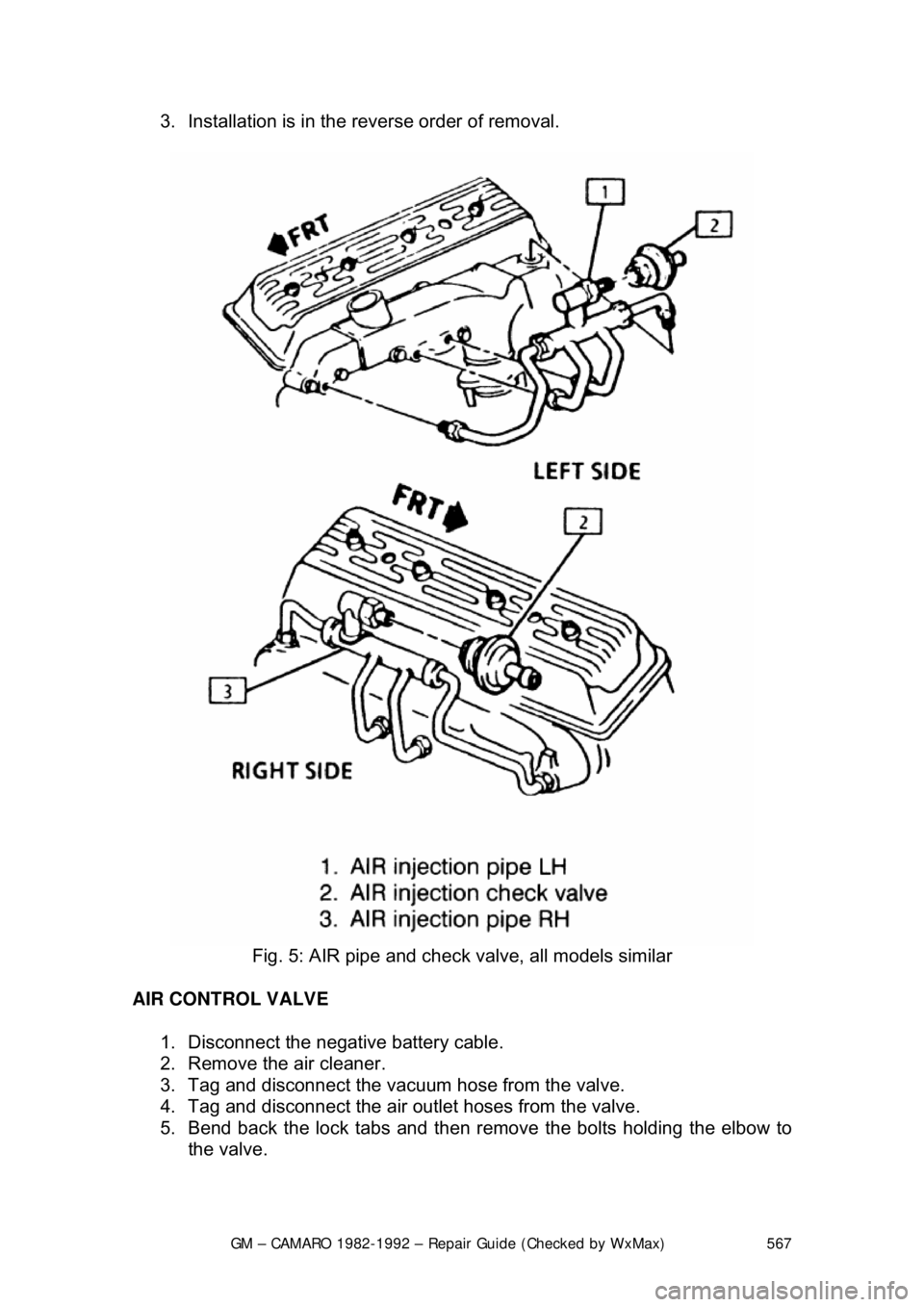
CHECK VALVE 1. Release the clamp and disconnect the air hoses from the valve.
2. Unscrew the check valve from the air injection pipe.
Page 567 of 875
GM – CAMARO 1982-1992 – Repair Guide (Checked by WxMax) 567
3. Installation is in the reverse order of removal.
Fig. 5: AIR pipe and check valve, all models similar
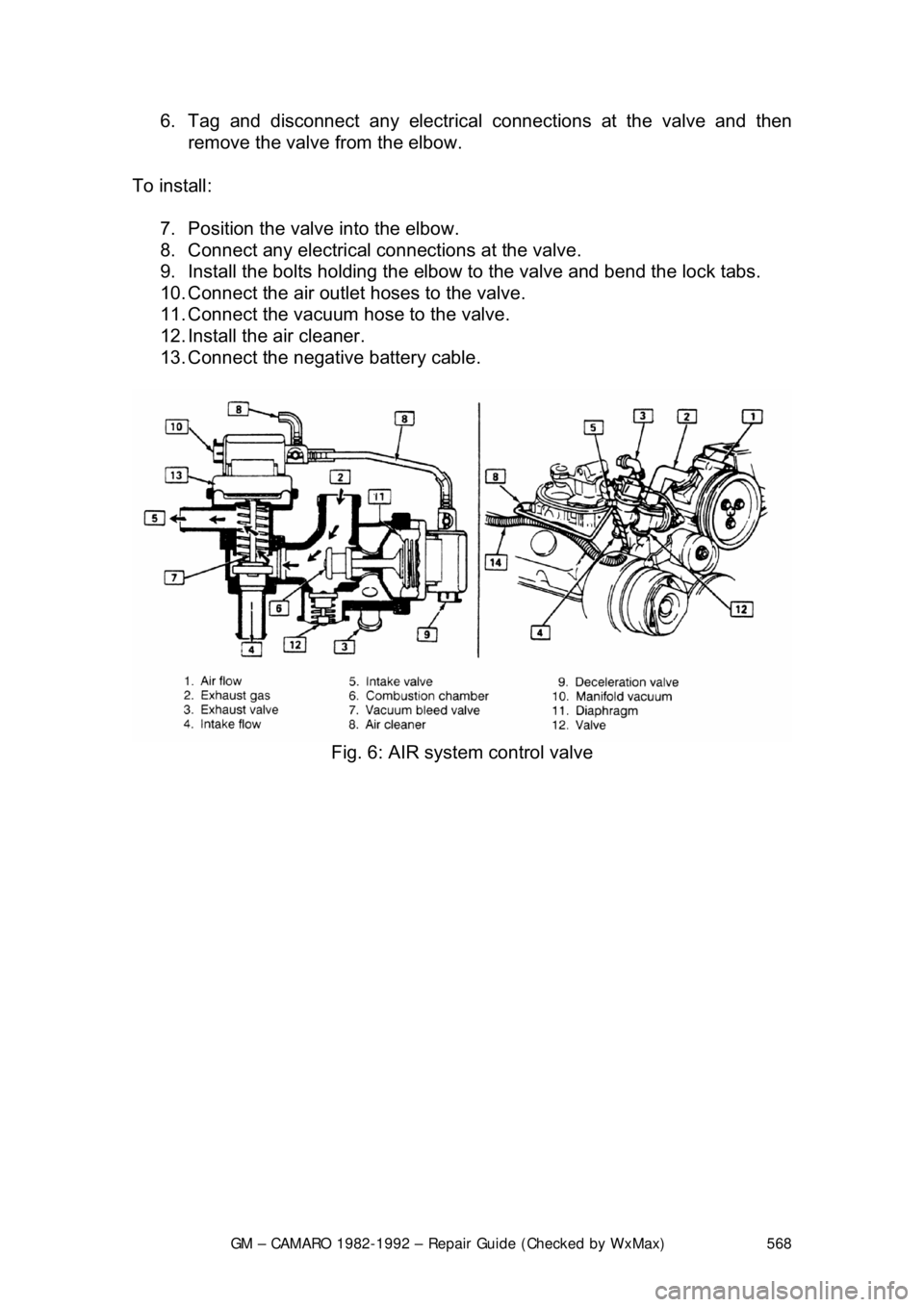
AIR CONTROL VALVE 1. Disconnect the negative battery cable.
2. Remove the air cleaner.
3. Tag and disconnect the vacuum hose from the valve.
4. Tag and disconnect the air outle t hoses from the valve.
5. Bend back the lock tabs and then remo ve the bolts holding the elbow to
the valve.
Page 568 of 875
GM – CAMARO 1982-1992 – Repair Guide (Checked by WxMax) 568
6. Tag and disconnect any electrical
connections at the valve and then
remove the valve from the elbow.
To install: 7. Position the valve into the elbow.
8. Connect any electrical c onnections at the valve.
9. Install the bolts holding the elbow to the valve and bend the lock tabs.
10. Connect the air outlet hoses to the valve.
11. Connect the vacuum hose to the valve.
12. Install the air cleaner.
13. Connect the negative battery cable.
Fig. 6: AIR system control valve
Page 570 of 875

GM – CAMARO 1982-1992 – Repair Guide (Checked by WxMax) 570
Switch (TVS). The electrical type, cons
ists of a ceramic grid located under the
base of the carburetor.
A check of the operation should be made at regular maintenance intervals.
TESTING
VACUUM SERVO TYPE 1. With the engine cold, observe the posit ion of the actuator arm. Start the
engine. The arm should move toward the diaphragm (closing the valve).
2. If the arm does not move, remove the hose and check for vacuum. If still
no vacuum, remove the top hose from the TVS switch and check for
vacuum.
3. If vacuum is present in the top hose, replace the TVS switch.
4. If vacuum is present at the actuator and it does not move, try to free the
valve. If the valve cannot be freed, it must be replaced.
ELECTRICAL TYPE 1. Turn the ignition ON with the engine co ld and probe both terminals of the
heater switch connector with a test light.
• If 1 wire has power, replace the heater switch.
• If neither wire has power, repai r the ignition circuit.
• If both wires have power, probe the pink wire at the heater
connector (if no power, repair the c onnector of the heater switch).
2. If power exists at the pink wire , disconnect the heater connector and
connect a tester across the harness terminal. If no power, repair the
ground wire; if power exists, check the resistance of the heater.
3. If heater is over 3 ohm s, replace the heater. If under 3 ohms, replace the
connector, start the engine (operate to normal temperature) and probe
the pink wire. If no power, the system is OK; if power exists, replace the
heater switch.
REMOVAL & INSTALLATION
VACUUM SERVO TYPE 1. Disconnect the vacuum hose at the EFE.
2. Remove exhaust pipe to manifold nuts.
3. Remove the crossover pipe. Complete removal is not always necessary.
4. Remove the EFE valve.
To install: 5. Position the EFE valve into place.
6. Install the crossover pipe.
7. Install the exhaust pi pe to manifold nuts.
8. Connect the vacuum hose at the EFE.
Page 589 of 875
GM – CAMARO 1982-1992 – Repair Guide (Checked by WxMax) 589
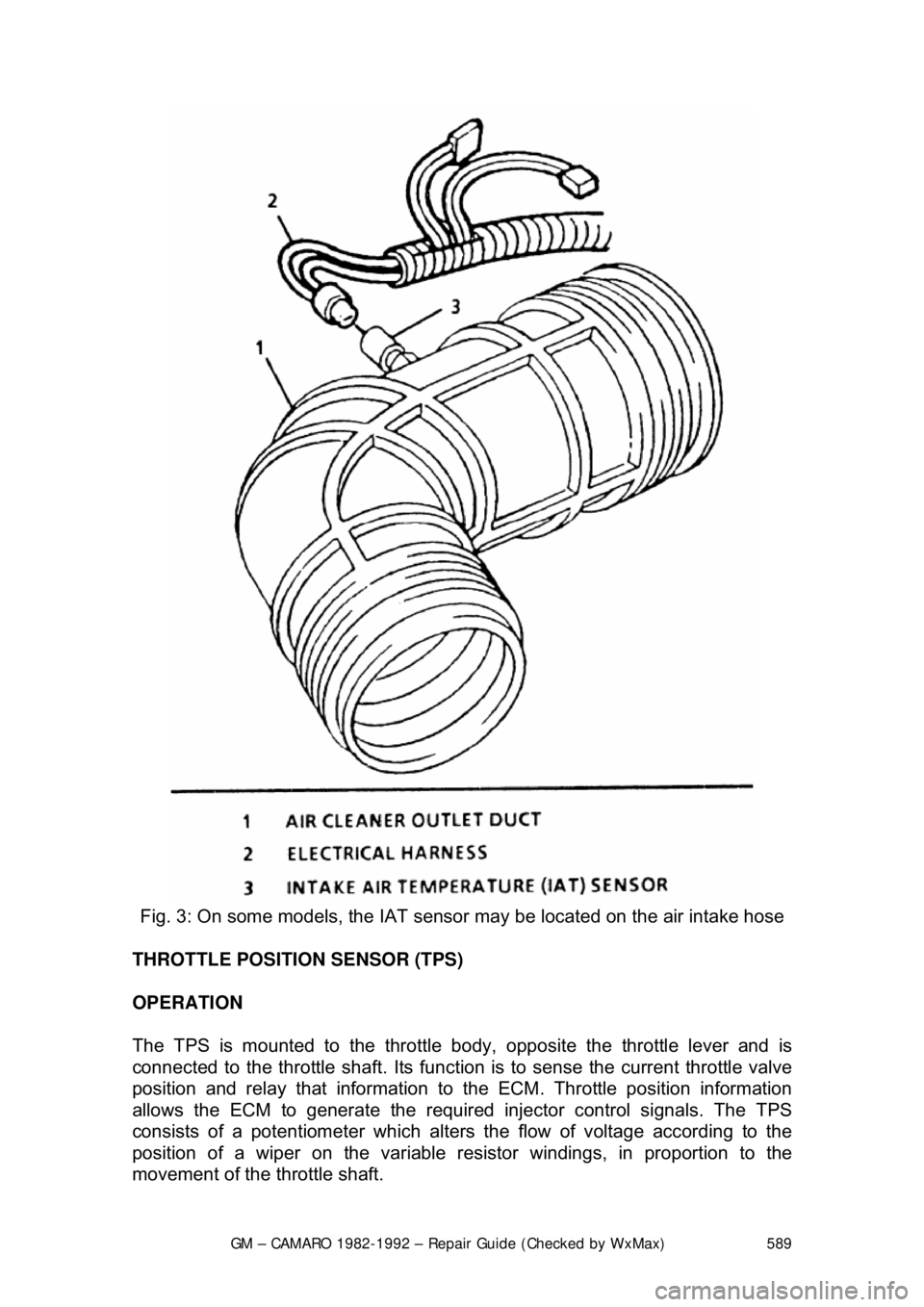
Fig. 3: On some models, the IAT sens or may be located on the air intake hose
THROTTLE POSITION SENSOR (TPS)
OPERATION
The TPS is mounted to the throttle body, opposite the throttle lever and is
connected to the throttle shaft. Its functi on is to sense the current throttle valve
position and relay that information to the ECM. Throttle position information
allows the ECM to generate the required injector control signals. The TPS
consists of a potentiometer which alters the flow of voltage according to the
position of a wiper on the variable resi stor windings, in proportion to the
movement of the throttle shaft.
Page 591 of 875
GM – CAMARO 1982-1992 – Repair Guide (Checked by WxMax) 591
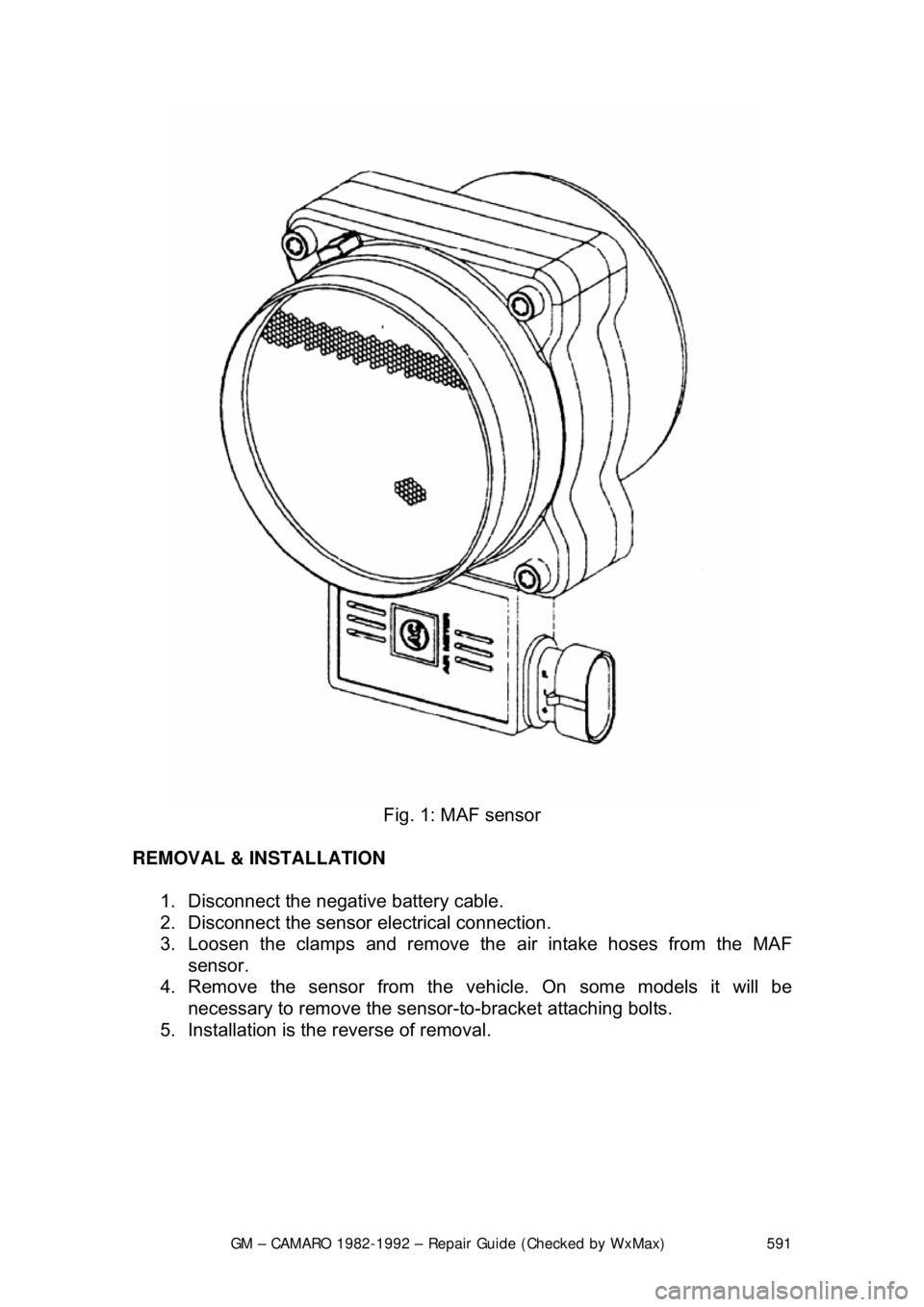
Fig. 1: MAF sensor
REMOVAL & INSTALLATION 1. Disconnect the negative battery cable.
2. Disconnect the sensor electrical connection.
3. Loosen the clamps and remove the air intake hoses from the MAF
sensor.
4. Remove the sensor from the v ehicle. On some models it will be
necessary to remove the senso r-to-bracket attaching bolts.
5. Installation is the reverse of removal.
Page 595 of 875

GM – CAMARO 1982-1992 – Repair Guide (Checked by WxMax) 595
5. If one or more codes are stored,
record them. At the end of the
procedure, perform a visual and physical check of each system.
6. Switch the ignition OFF when finished with code retrieval.
Fig. 1: Diagnostic connector lo cation shown with a 12 pin connector
VISUAL AND PHYSICAL UNDERHOOD INSPECTION
A detailed examinatio n of connectors, wiring and va cuum hoses can often lead
to a repair without further diagnosis. This step relies on the skill of the
technician performing it; a careful inspec tor will check the undersides of hoses
as well as the integrity of hard-to-reac h hoses blocked by the air cleaner or
other component. Wiring should be check ed carefully for any sign of strain,
burning, crimping, or terminal pull-out from a connector. Checking connectors at
components or in harnesses is required; usually, pushing them together will
reveal a loose fit. It is important to note that the fault code indicates a fault or
loss of signal within that system, not necessarily the specific component. Due to
the intricacy of the systems and the spec ial testing equipment required, it is