Page 553 of 875
GM – CAMARO 1982-1992 – Repair Guide (Checked by WxMax) 553
If equipped with the 5.0L (VIN F) and 5.7L
(VIN 8) engines with Tuned Port
Injection (TPI), it will be necessary to remove the intake plenum to gain access
to the EGR valve.
3. Tag and disconnect the necessary hos es and wiring to gain access to
the EGR valve.
4. Remove the EGR valve retaining bolts.
5. Remove the EGR valve. Discard the gasket.
6. Buff the exhaust deposits from the mounting surface and around the
valve using a wire wheel.
7. Remove deposits from the valve outlet.
8. Clean the mounting surfaces of the intake manifold and valve assembly.
To install: 9. Install a new EGR gasket.
10. Install the EGR valve to the manifold.
11. Install the retaining bolts.
12. Connect the wiring and hoses.
13. Install the air cleaner assembly.
14. Connect the negative battery cable.
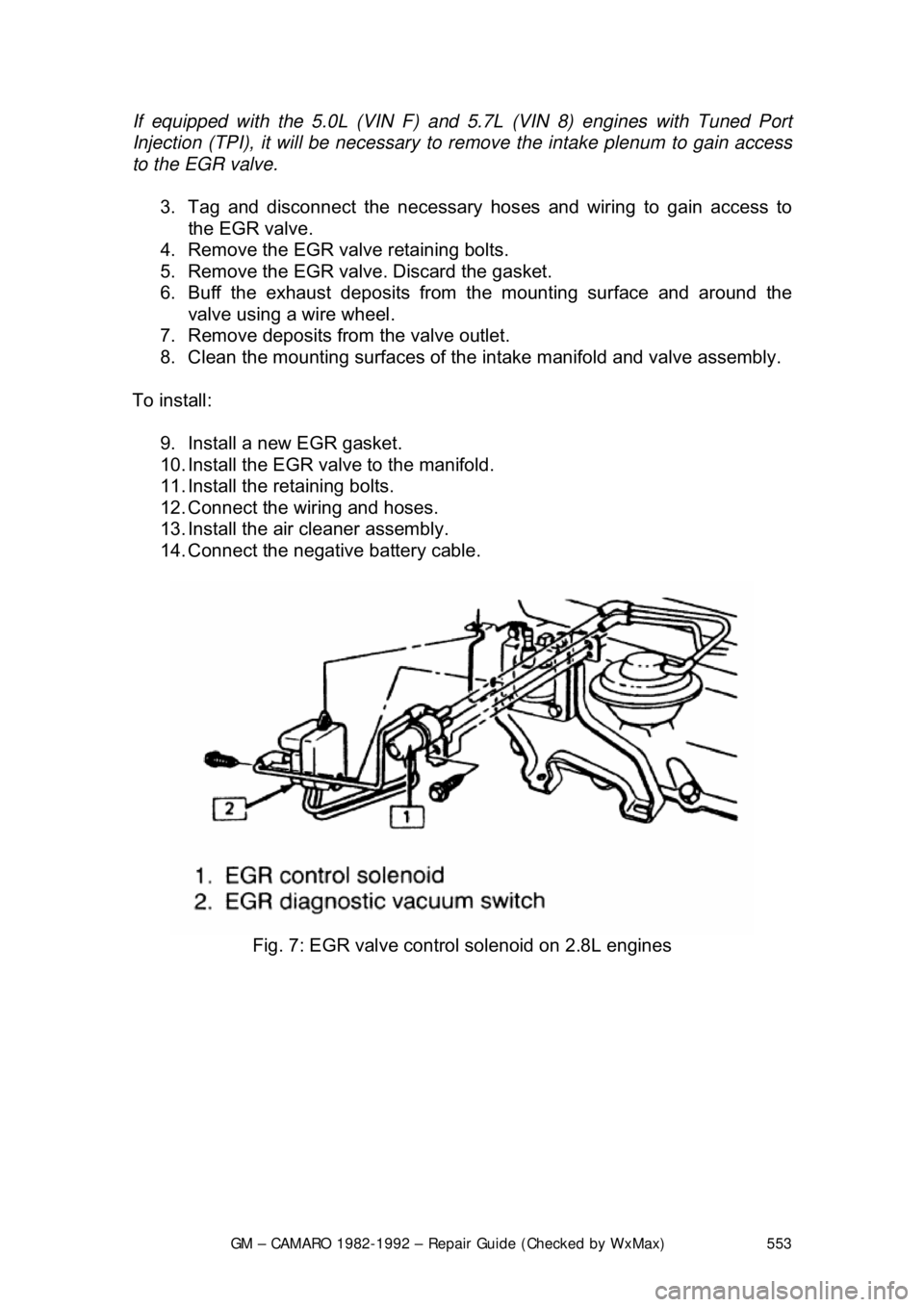
Fig. 7: EGR valve control solenoid on 2.8L engines
Page 557 of 875
GM – CAMARO 1982-1992 – Repair Guide (Checked by WxMax) 557
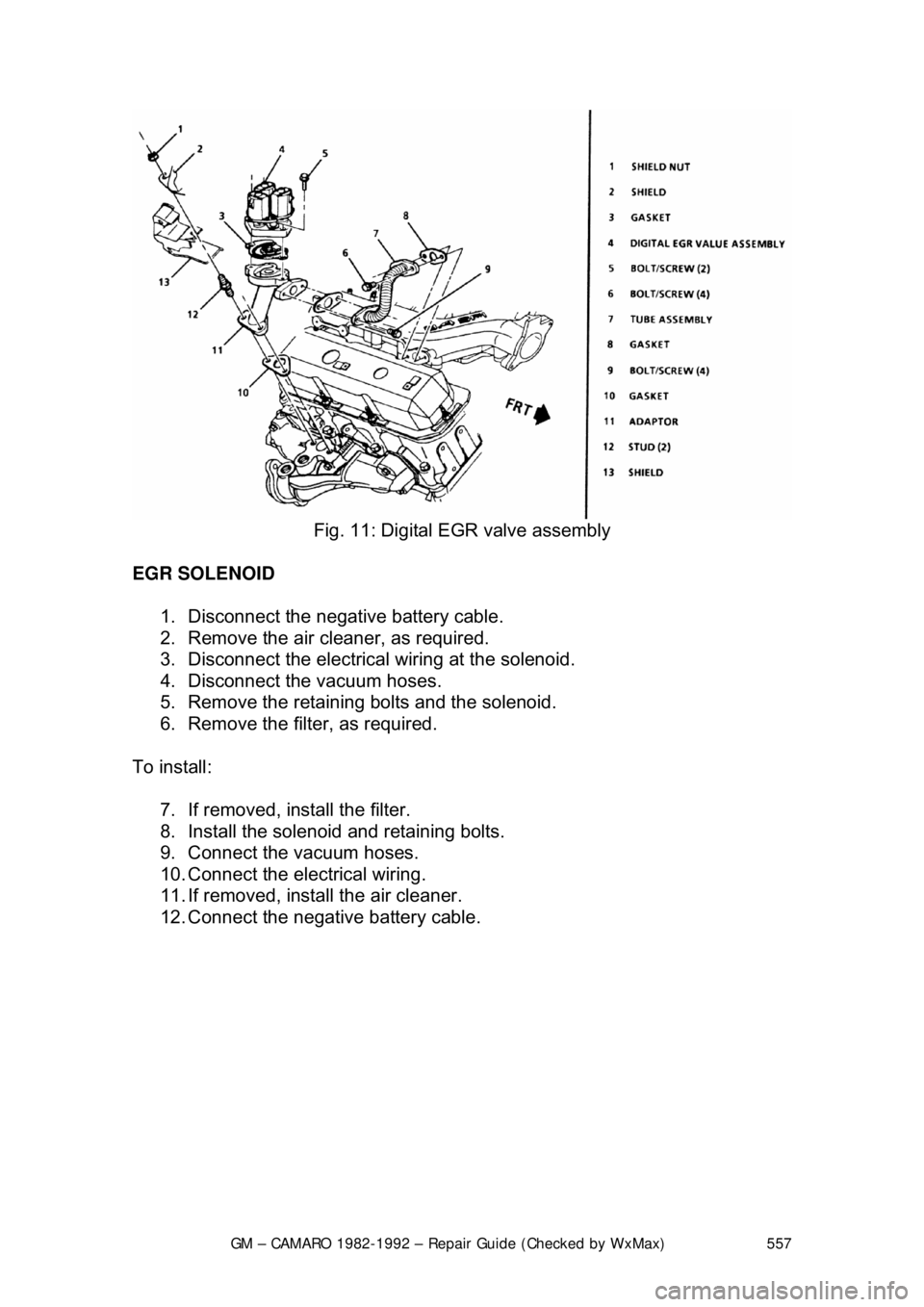
Fig. 11: Digital EGR valve assembly
EGR SOLENOID 1. Disconnect the negative battery cable.
2. Remove the air cl eaner, as required.
3. Disconnect the electrical wiring at the solenoid.
4. Disconnect the vacuum hoses.
5. Remove the retaining bolts and the solenoid.
6. Remove the filt er, as required.
To install: 7. If removed, install the filter.
8. Install the solenoid and retaining bolts.
9. Connect the vacuum hoses.
10. Connect the electrical wiring.
11. If removed, install the air cleaner.
12. Connect the negative battery cable.
Page 558 of 875
GM – CAMARO 1982-1992 – Repair Guide (Checked by WxMax) 558
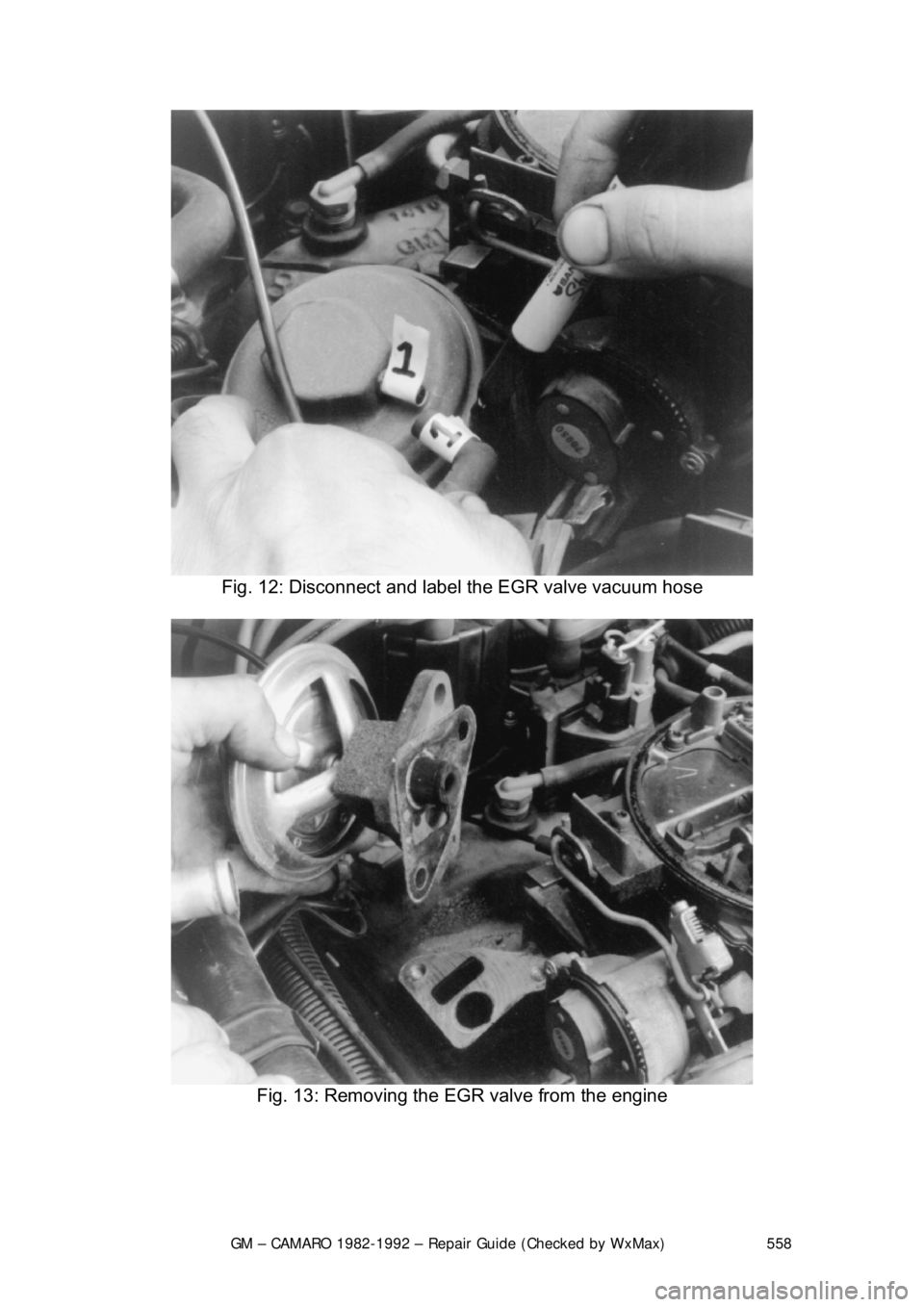
Fig. 12: Disconnect and label the EGR valve vacuum hose
Fig. 13: Removing the EGR valve from the engine
Page 559 of 875

GM – CAMARO 1982-1992 – Repair Guide (Checked by WxMax) 559
Fig. 14: Discard the old gasket. Be sure the remove all carbon deposits from the
ports on the EGR valve and the mounting surface
THERMOSTATIC AIR CLEANER (THERMAC)
OPERATION
This system is designed to warm the air entering the carburetor when
underhood temperatures are low, and to ma intain a controlled air temperature
into the carburetor or throttle body at all times. By allowing preheated air to
enter, the amount of time t he choke is on is reduced, resulting in better fuel
economy and lower emissions. Engine warm-up time is also reduced.
The THERMAC system is composed of th e air cleaner body, a filter, sensor
unit, vacuum diaphragm, damper door, a ssociated hoses and connections. Heat
radiating from the exhaust manifold is tr apped by a heat stove and is ducted to
the air cleaner to supply heated air to t he carburetor or throttle body. A movable
door in the air cleaner case snorkel allows air to be drawn in from the heat stove
(cold operation). The door position is co ntrolled by the vacuum motor, which
receives intake manifold vacuum as modulated by the temperature sensor.
A vacuum door which remain s open can cause carburetor icing or poor cold
driveability. A door which remains clos ed during normal engine operating
temperatures can cause sluggishne ss, engine knocking and overheating.
Page 560 of 875
GM – CAMARO 1982-1992 – Repair Guide (Checked by WxMax) 560
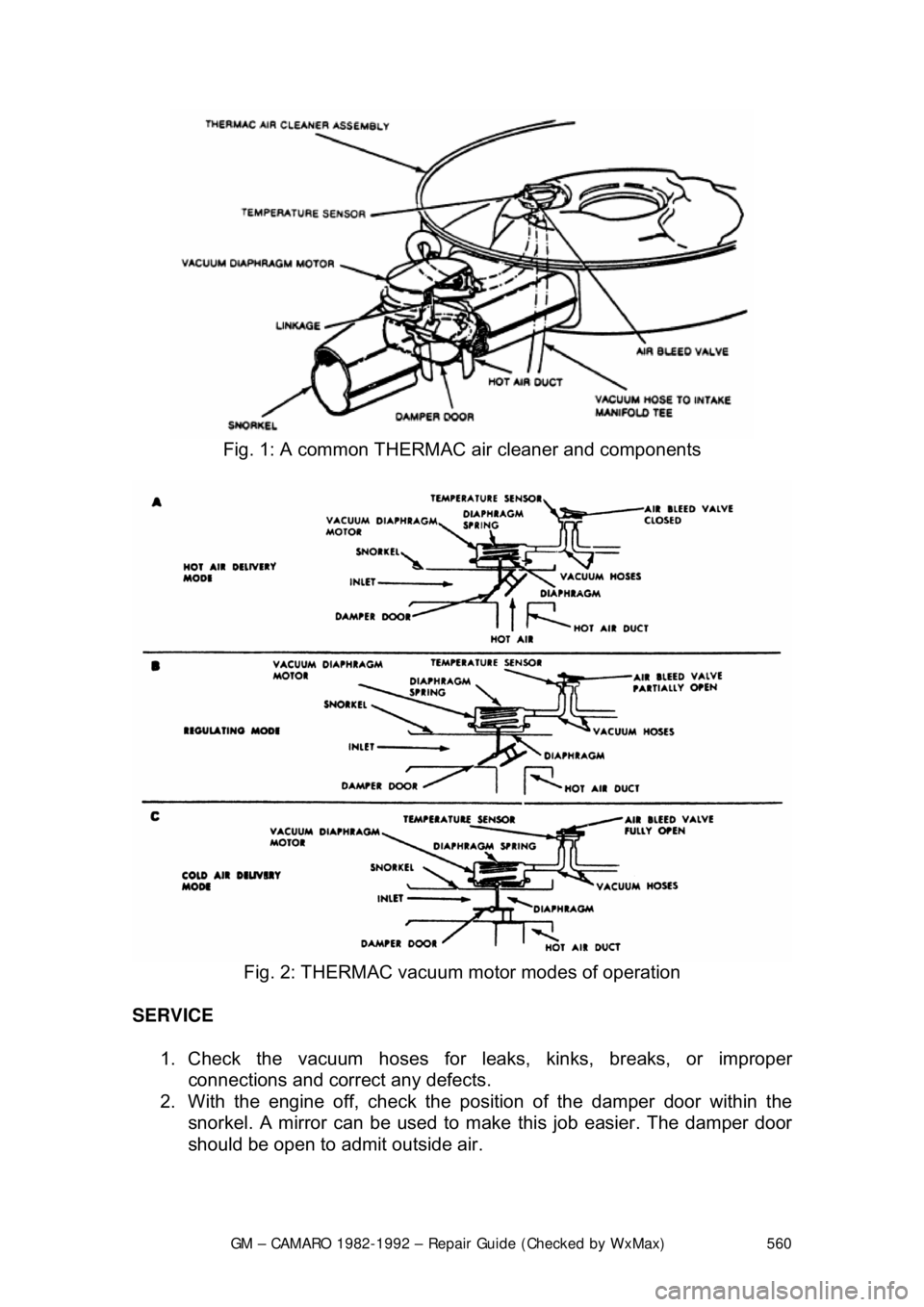
Fig. 1: A common THERMAC air cleaner and components
Fig. 2: THERMAC vacuum motor modes of operation
SERVICE 1. Check the vacuum hoses for leaks, kinks, breaks, or improper connections and correct any defects.
2. With the engine off, check the pos ition of the damper door within the
snorkel. A mirror can be used to make this job easier. The damper door
should be open to admit outside air.
Page 561 of 875

GM – CAMARO 1982-1992 – Repair Guide (Checked by WxMax) 561
3. Apply at least 7 in. Hg of vacuum
to the damper diaphragm unit. The
door should close. If it doesn't, che ck the diaphragm linkage for binding
and correct hookup.
4. With the vacuum still applied and t he door closed, clamp the tube to trap
the vacuum. If the door doesn't remain closed, there is a leak in the
diaphragm assembly.
REMOVAL & INSTALLATION
VACUUM MOTOR 1. Remove the air cleaner.
2. Disconnect the vacuum hose from the motor.
3. Drill out the spot welds with a
1/8 inch (3mm) bit, then enlarge as
necessary to remove the retaining strap.
4. Remove the retaining strap.
5. Lift up the motor and cock it to o ne side to unhook the motor linkage at
the control damper assembly.
To install: 6. In order to install t he new vacuum motor, drill a
7/64 inch (2.8mm) hole in
the snorkel tube as the c enter of the vacuum motor retaining strap.
7. Insert the vacuum motor linkage into the control damper assembly.
8. Use the motor retaining strap and a sheet metal screw to secure the
retaining strap and motor to the snorkel tube.
Make sure the screw does not interf ere with the operation of the damper
assembly. Shorten the screw if necessary.
TEMPERATURE SENSOR 1. Remove the air cleaner.
2. Disconnect the hoses at the air cleaner.
3. Pry up the tabs on the sensor reta ining clip and remove the clip and
sensor from the air cleaner.
To install: 4. Position sensor into air cleaner.
5. Install retaining clip.
6. Connect the hoses to the air cleaner.
7. Install the air cleaner.
AIR INJECTION REACTION (AIR) SYSTEM
OPERATION
The AIR management system is used to prov ide additional oxygen to continue
the combustion process after the exhaus t gases leave the combustion chamber.
Page 562 of 875

GM – CAMARO 1982-1992 – Repair Guide (Checked by WxMax) 562
Air is injected into either the exhaust
port(s), the exhaust manifold(s) or the
catalytic converter by an engine driven ai r pump. The system is in operation at
all times and will bypass air only mom entarily during deceleration and at high
speeds. The bypass function is performed by the air control valve, while the
check valve protects the air pump by pr eventing any backflow of exhaust gases.
The AIR system helps r educe HC and CO content in the exhaust gases by
injecting air into the exhaust ports dur ing cold engine operation. This air
injection also helps the catalytic conv erter to reach the proper temperature
quicker during warmup. When the engine is warm (Closed Loop), the AIR
system injects air into the beds of a th ree-way converter to lower the HC and
the CO content in the exhaust.
The system utilizes the following components:
1. An engine driven AIR pump.
2. AIR Control valves (Air Control, Air Switching).
3. Air flow and control hoses.
4. Check valves.
5. A dual-bed, three-way catalytic converter.
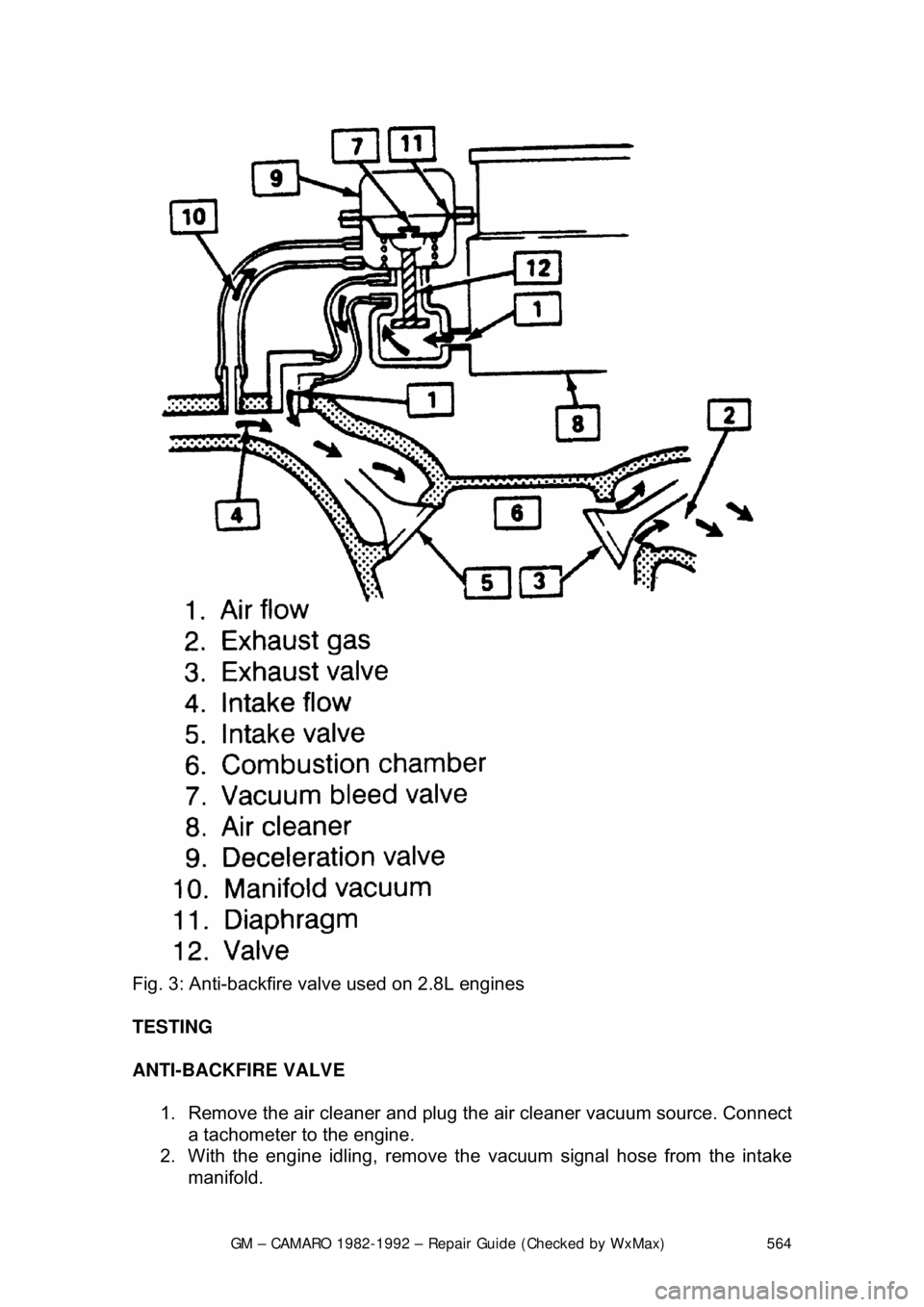
6. A deceleration back-fire control valve - 2.8L engine only.
The belt driven, vane-type air pump is lo cated at the front of the engine and
supplies clean air to the AIR system fo r purposes already stated. When the
engine is cold, the Electronic Control Module (ECM) energizes an AIR control
solenoid. This allows air to flow to the AIR switching valve. The AIR switching
valve is then energized to direct air to the exhaust ports.
When the engine is warm, the ECM de-energ izes the AIR switching valve, thus
directing the air between the beds of the catalytic converter. This provides
additional oxygen for the ox idizing catalyst in the second bed to decrease HC
and CO, while at the same time keeping oxygen levels low in the first bed,
enabling the reducing catalyst to effect ively decrease the levels of NOx.
If the AIR control valve detects a r apid increase in manifold vacuum
(deceleration), certain operat ing modes (wide open throttle, etc.) or if the ECM
self-diagnostic system detects any problem in the system, air is diverted to the
air cleaner or directly into the atmosphere.
The primary purpose of the EC M's divert mode is to prevent backfiring. Throttle
closure at the beginning of deceleration will temporarily create air/fuel mixtures
which are too rich to burn completely . These mixtures become burnable when
they reach the exhaust if combined with the injection ai r. The next firing of the
engine will ignite this mixt ure causing an exhaust backf ire. Momentary diverting
of the injection air from the exhaust prevents this.
The AIR system check valves and hoses should be checked periodically for any
leaks, cracks or deterioration.
Page 564 of 875
GM – CAMARO 1982-1992 – Repair Guide (Checked by WxMax) 564
Fig. 3: Anti-backfire valve used on 2.8L engines
TESTING
ANTI-BACKFIRE VALVE
1. Remove the air cleaner and plug t he air cleaner vacuum source. Connect
a tachometer to the engine.
2. With the engine idling, remove the vacuum signal hose from the intake
manifold.