Page 697 of 875
GM – CAMARO 1982-1992 – Repair Guide (Checked by WxMax) 697
9. Check, and if necessary, adjust fast
idle speed, as described on the
Vehicle Emission Control Information (VECI) label.
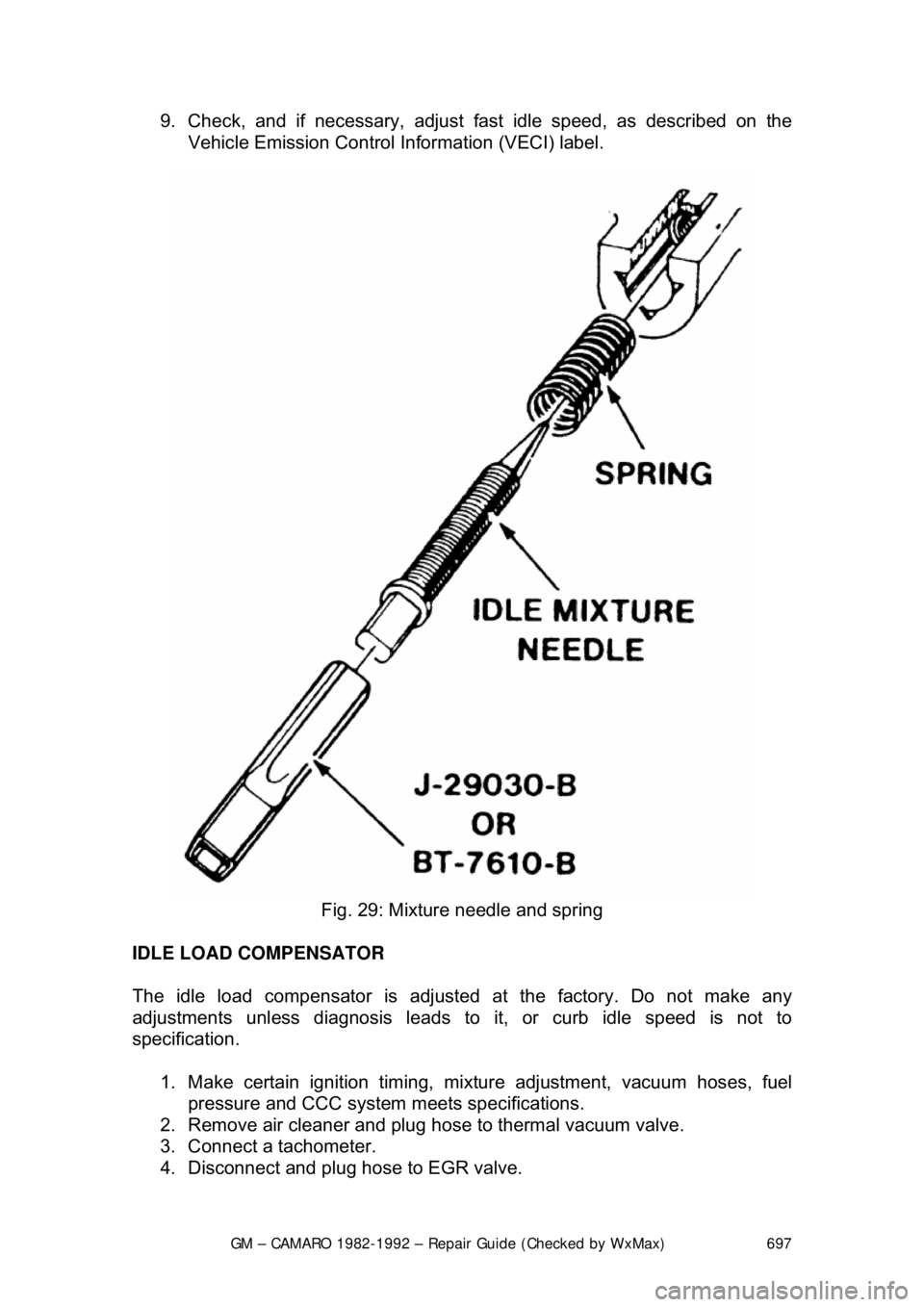
Fig. 29: Mixture needle and spring
IDLE LOAD COMPENSATOR
The idle load compensator is adjusted at the factory. Do not make any
adjustments unless diagnosis leads to i t, or curb idle speed is not to
specification.
1. Make certain ignition timing, mi xture adjustment, vacuum hoses, fuel
pressure and CCC system meets specifications.
2. Remove air cleaner and plug hose to thermal vacuum valve.
3. Connect a tachometer.
4. Disconnect and plug hose to EGR valve.
Page 698 of 875

GM – CAMARO 1982-1992 – Repair Guide (Checked by WxMax) 698
5. Disconnect and plug hose to canister purge port.
6. Disconnect and plug hose to idle load compensator.
7. Back out idle stop screw
on carburetor 3 turns.
8. Turn air conditioning OFF.
9. Block drive wheels, set parki ng brake, place transmission in P, start and
warm engine to normal operating temperature. Make certain choke is
OPEN .
10. With engine RUNNING place transmission in D and idle load
compensator fully extended (no vacuum applied). Using tool J-29607, or
equivalent, adjust plunger to obtain 650-750 rpm. Locknut on plunger
must be held with a wrench to prevent damage to guide tabs.
11. Measure distance from the locknut to tip of the plunger. This distance
must not exceed 1 in. (25mm). If it does check for low idle condition.
12. Reconnect vacuum hose to idle load compensator and observe idle
speed.
13. Idle speed should be between 425-475 rpm in D.
14. If idle speed is correct no further adjustment is necessary, proceed to the
next step. If idle speed is still incorrect continue as follows:
It may be necessary to remove the idle load compensator from the engine
unless a hex key wrench is m odified to clear obstructions.
a. Stop engine, remove rubber cap from the center outlet tube.
b. Using a 0.90 in. (23mm) hex wrench, insert through open center tube to
engage idle speed adjusting screw.
c. If idle speed was low, turn t he adjusting screw counterclockwise
approximately 1 turn for every 85 rpm low. If idle speed was high turn
screw 1 turn for every 85 rpm high.
15. Disconnect and plug vacuum hose to the idle load compensator.
16. Using a hand pump, apply vacuum to the idle load compensator until fully
retracted.
17. Adjust the idle stop screw on carburetor float bowl to obtain 450 rpm in
D .
18. Place transmission in P and stop engine.
19. Reconnect the idle load compensator.
20. Reconnect all vacuum hoses.
21. Install air cleaner and gasket. Remove wheel blocks.
Page 702 of 875
GM – CAMARO 1982-1992 – Repair Guide (Checked by WxMax) 702
16. Connect fuel pipe sand vacuum hoses.
17. Check base (slow) and fast idle.
18. Install the air cleaner.
Fig. 33: Remove the air cleaner for access to the carburetor
Fig. 34: Use a back-up wrench when disconnecting fuel lines
Page 706 of 875
GM – CAMARO 1982-1992 – Repair Guide (Checked by WxMax) 706
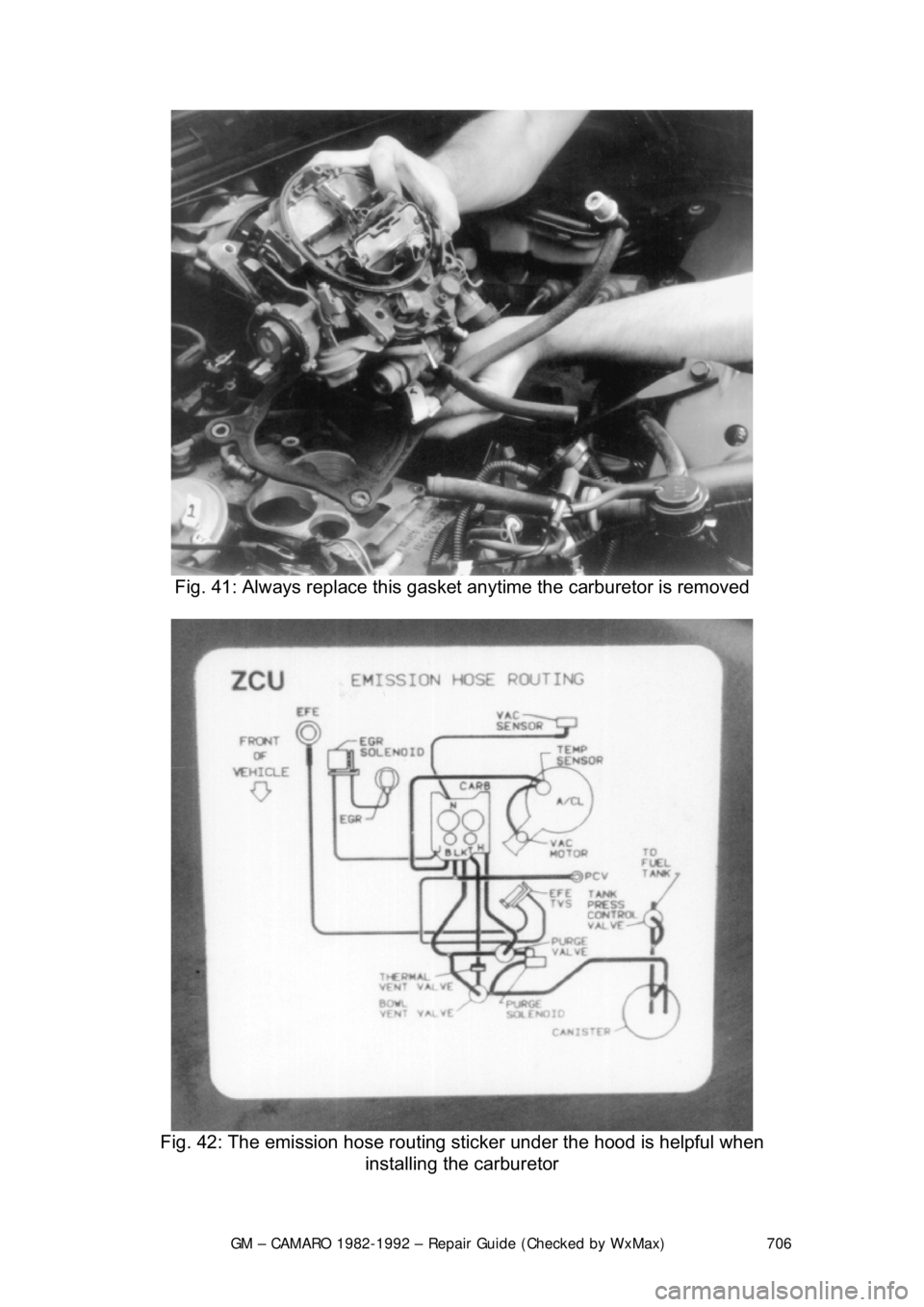
Fig. 41: Always replace this gasket anytime the carburetor is removed
Fig. 42: The emission hose routing sticker under the hood is helpful when
installing the carburetor
Page 707 of 875

GM – CAMARO 1982-1992 – Repair Guide (Checked by WxMax) 707
Fig. 43: The adjustment specifications on the emission control information label
must always be followed
ROCHESTER E4ME AND E4MC 1. Disconnect the battery and remove the air cleaner.
2. Disconnect the accelerator linkage.
3. Disconnect the transmission detent cable.
4. If equipped, remove the cr uise control cable.
5. Tag and detach all of the necessa ry vacuum lines and electrical
connections.
6. Disconnect the fuel line at the carburetor inlet.
7. Remove the attaching bolts and remove the carburetor.
To install: 8. Position the carburetor onto the manifold and install the attaching bolts.
9. Connect the fuel line at the carburetor inlet.
10. Attach all of the vacuum lines and electrical connections, as tagged
during removal.
11. If equipped, install the cruise control.
12. Connect the transmission detent cable.
13. Connect the accelerator linkage.
14. Install the air cleaner and connect the battery.
OVERHAUL
Carburetor overhaul kits are reco mmended for each overhaul. These kits
contain all gaskets and new parts to re place those which deteriorate most
Page 714 of 875

GM – CAMARO 1982-1992 – Repair Guide (Checked by WxMax) 714
4. Start the car and observe the fuel
pressure reading. It should be 9-13 psi
(62-90 kPa).
5. Relieve the fuel pressure.
6. Remove the fuel pressure gauge.
7. Reinstall the fuel line.
8. Start the car and che ck for fuel leaks.
9. Remove plug covering THERMAC va cuum port on the TBI and install the
air cleaner.
THROTTLE BODY
REMOVAL & INSTALLATION 1. Relieve the fuel system pressure.
2. Disconnect the THERMAC hose from the engine fitting and remove the
air cleaner.
3. Detach the electrical connectors at the idle air control, throttle position
sensor, and the injector.
4. Disconnect the throttle linkage, re turn spring, and cruise control (if
equipped).
5. Disconnect the throttle body vacuum hoses, fuel supply and fuel return
lines.
6. Disconnect the 3 bolts securing the throttle body and remove the throttle
body.
7. To install, reverse the removal procedures. Replace the manifold gasket
and O-rings.
8. Perform the minimum idle speed adjustment, if necessary.
Fig. 1: Single injector TBI unit
Page 736 of 875

GM – CAMARO 1982-1992 – Repair Guide (Checked by WxMax) 736
The mass air flow systems measure the
mass of air that is drawn into the
engine cylinders, rather than just the vo lume. The sensor contains a hot-wire
sensing unit, which is made up of an electronic balanced bridge network.
Whenever current is suppli ed to the sensor, the bridge is energized and the
sensing hot-wire is heated. As the air enter s the mass air flow sensor, it passes
over and cools the hot wire. When the hot wire is cooled, it's resistance changes
and additional current is needed to k eep the bridge network balanced. This
increase in current is sent to the computer as a voltage signal and is used to
calculate the mass of the incoming air. The ECM uses this information to\
determine the duration of fuel injection pulse, ignition timing and EGR operation.
The speed density systems calculate the volume of air moving through the
intake. The ECM establishes the speed fact or through a signal from the ignition
module. The Manifold or Intake Air Temperature (MAT/IAT) and the Engine
Coolant Temperature (ECT) sensors work together to assure that proper
temperature information gets to the ECM wh ile the Manifold Absolute Pressure
(MAP) sensor monitors the changes in m anifold pressure which results from
changes in engine loading. These three se nsors contribute to the density factor.
Together, these inputs (engine speed, coolant temperature sensor, etc ...) are
the major determinants of the air/fuel mixture delivered by the fuel injection
system.
The following engines and fuel managem ent systems are covered in this
section:
• 1985-1989 2.8L MPFI - Mass Air Flow
• 1990-1992 3.1L MPFI - Speed Density
• 1985-1989 5.0L and 5.7L TPI - Mass Air Flow
• 1990-1992 5.0L and 5.7L TPI - Speed Density
Relieving Fuel System Pressure
1. Disconnect the negative battery cable to prevent fuel discharge if the key
is accidentally turned to the RUN position.
2. Loosen the fuel filler cap to reliev e the tank pressure and do not tighten
until service has been completed.
3. Connect J-34730-1 fuel pressure gauge or equivalent, to the fuel
pressure test valve. Wrap a shop towel around the fitting while
connecting the gauge to prevent spillage.
4. Place the end of the bleed hose into a suitable container and open the
valve to relieve the fuel system pressure.
ELECTRIC FUEL PUMP
REMOVAL & INSTALLATION
The fuel pump is part of t he fuel sender assembly located inside the fuel tank.
Page 739 of 875

GM – CAMARO 1982-1992 – Repair Guide (Checked by WxMax) 739
3. Make sure the ignition switch has
been in the OFF position for at least 10
seconds and that all accessories are OFF.
4. Turn the ignition switch ON and the pump will run for about 2 seconds.
Note the system pressure with t he pump running, it should be between
40-47 psi.
The ignition switch may have to be cycled to the ON position more than once to
obtain maximum pressure. It is also norma l for the pressure to drop slightly
when the pump first stops, but it should then hold steady.
5. If the pressure is not as specified, verify that fuel pump operation is
heard in the tank.
6. If fuel pump operation is not heard, inspect the fuel pump relay and
wiring.
7. If fuel pump operation is heard, inspect the filter and lines for restriction.
8. Start the engine and make sure the pr essure decreases about 3-10 psi at
idle.
9. If fuel pressure does not decrease, inspect the fuel pressure regulator
and hose.
10. Disconnect the fuel pressure gauge.
THROTTLE BODY
REMOVAL & INSTALLATION 1. Disconnect the negative (-) battery c able and partially drain the radiator.
2. Remove the air inlet duct and unplug the IAC and TPS electrical connectors.
3. Label and disconnect the vacuum and coolant lines.
4. Disconnect the accelerator, thro ttle valve (transmission control) and
cruise control cables, as applicable.
5. Remove the throttle body attaching bolts, then separate the throttle body from the plenum.
6. Discard the gasket.
To install: 7. Install the throttle body to the plenum using a new gasket. Tighten the \
bolts to specification.
8. Engage the accelerator, throttle valve and cruise control cables, as
necessary. Make sure that the link ages do not hold the throttle open.
9. Connect the vacuum and coolant lines.
10. Install the air inlet duct and plug the IAC and TPS electrical connectors
into their sockets.
11. Connect the negative (-) battery cable and refill the radiator.
12. With the engine OFF, check to s ee that the accelerator pedal is free.
Depress the pedal to the floor and release.