1980 CHEVROLET CITATION belt
[x] Cancel search: beltPage 5 of 95
Downloaded from www.Manualslib.com manuals search engine SECTION 1
BEFORE DRIVING YOUR
CHEVROLET
DRIVER DAILY CHECKLIST
Be sure you know your vehicle and its, equipment and how to use it safely.
Before Entering the Vehicle
1. See that windows, mirrors, and lights are clean and unobstructed.
2. Check whether any tire is low or flat. (If any tire looks different from nonnal,
we recommend you check
it with a tire pressure gage.)
3. Check that all lights work.
4. Look for fluid leaks.
5. Be sure everything is properly stowed.
6. Check the area behind the vehicle if you are about to back up.
Before Driving Off
1. Lock all doors.
2. Adjust seat.
3. Adjust inside and outside mirrors.
4. Fasten seat belts.
5. Check that all the warning lights work as the key is turned to "'Start."
6. Check all gages (including the fuel gage).
7. Release the parking brake (and see that the "Brake" light turns om.
Seerelated topics in this manual, or the Maintenance Schedule folder, if problems
are found.
Guard Against Theft
For tips on how to protect your vehicle and its contents, see "Starting and
Operating" in section 2 of this manuaL
KEYS
Two different keys are· provided for the locks on your vehicle. The key code is
stamped on the "knock out" plug in each key head.
• Key with square head (letter "A" or "e") -for ignition lock only.
• Key with oval head (letter "8" or "0") ~ for all other locks.,
For vehicle security:
• Record the key code numbers; then knock the plugs out of the keys.
• Keep the key codes in a safe place (such as your wallet), NOT IN THE
VEHICLE.
If the original keys are lost, duplicates can
be made using the key codes. Contact
any
OM dealer or a locksmith.
If yO~i park in an attended lot, leave only your square-head ignition key.
1-1
Page 7 of 95
Downloaded from www.Manualslib.com manuals search engine CAUTION: For safety's s~ke, always lock the doors and any hatchback when driving. Along with using the seat belts properly, locking the doors, etc. helps prevent occupants from being thrown from the vehicl~ during accidents. It also helps prevent unintended opening of the doors and helps keep out intruders when stopped.
STOWING THINGS IN (OR ON) THE CAR
CAUTION: luggage or other cargo should not be piled higher than the seatbacks. When at all possible. luggage or cargo should be carried in the trunk area. The filler panel or cargo cover, betWeen the rear seatback and the rear window should not be used to carry objects-.even those that are small and light. All items should be secured in place. This will help keep such things from being thrown about and iniurying people in the car during an accident. Cargo weight. whether inside or on the roof, should be positioned as evenly as possible from front to rear.
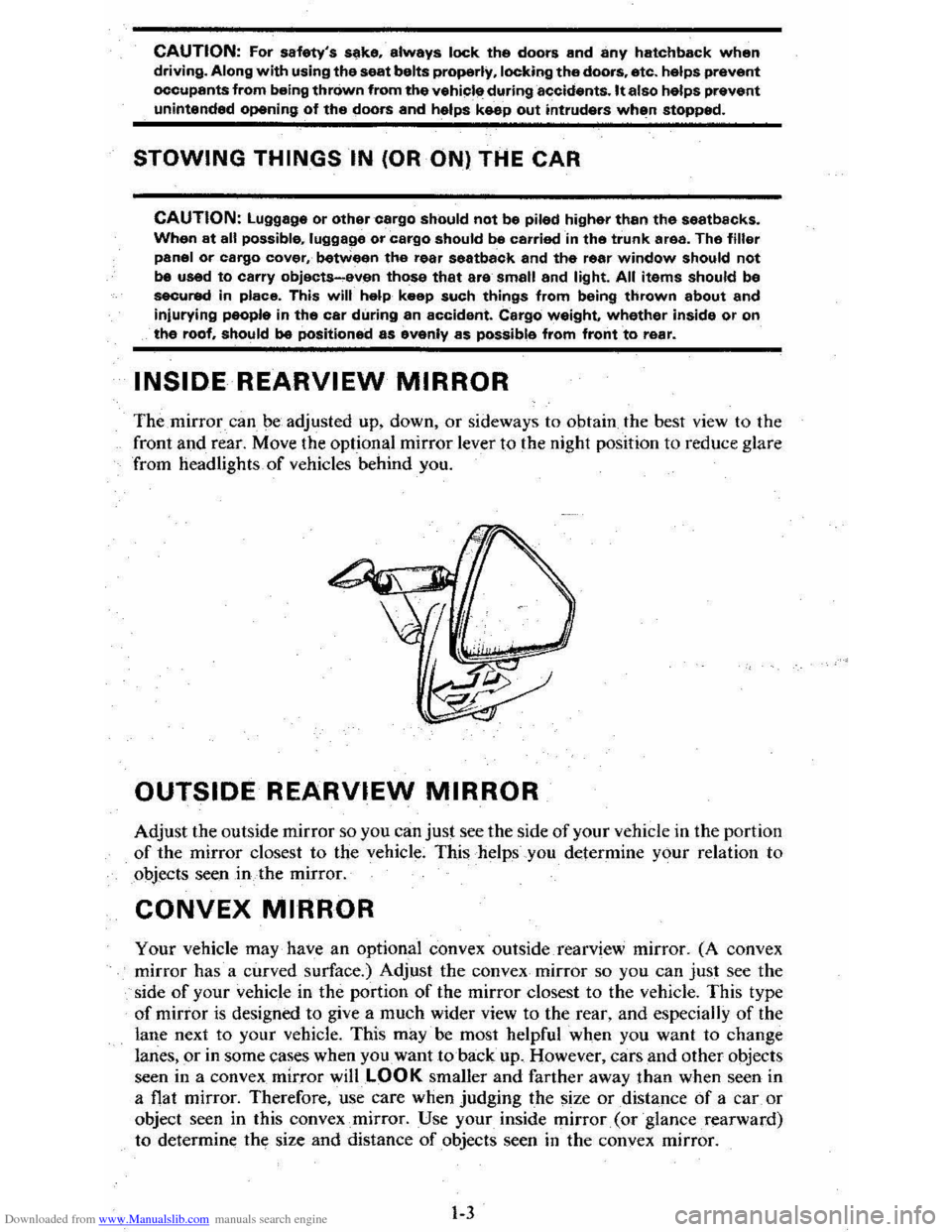
INSIDE REARVIEW MIRROR
The mirror can be adjusted up, down, or sideways to obtain the best view to the
front
and rear. Move the optional mirror lever to the night position to reduce glare
from headlights of vehicles behind you.
OUTSIDE REARVIEW MIRROR
Adjust the outside mirror so you can just see the side of your vehicle in the portion of the mirror closest to the vehicle; This helps you determine your relation to
objects seen
in the mirror.
CONVEX MIRROR
Your vehicle may have an optional convex outside rearview mirror. (A convex
mirror has a curved surface.) Adjust the convex mirror so you can
just see the
side of your vehicle in the portion of the mirror closest to the vehicle. This type
of mirror is designed to give a much wider view to the rear, and especially of the
lane next to your vehicle. This
may· be most helpful when you want to change
lanes, or in some cases when you want to back up. However, cars and other objects
seen in a convex mirror
willLOOK smaller and farther away than when seen in
a flat mirror. Therefore, use care when Judging the size or distance of a car or
object seen in this convex
.. mirror. Use your inside mirror. (or ·glance .rearward)
to determine the size and distance of objects seen in the convex mirror.
1-3
Page 8 of 95
Downloaded from www.Manualslib.com manuals search engine SEAT CONTROLS
ADJUSTMENT OF SEAT POSITION
Manually Operated Front Seats
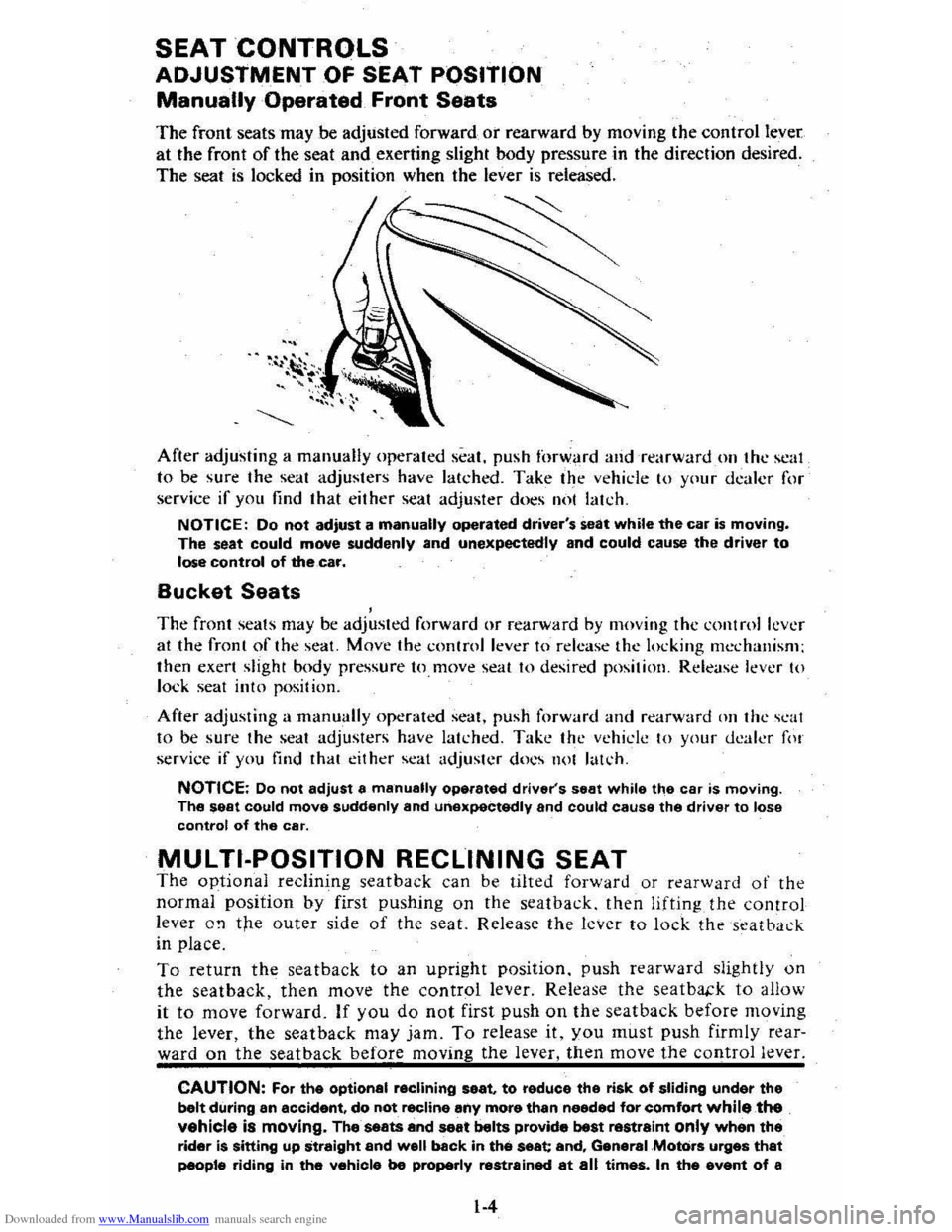
The front seats may be adjusted forward or rearward by moving the control lever
at the front of the seat and exerting slight body pressure in the direction desired.
The seat
is locked in position when the lever is released.
After adjusting a manually operated seat. push forward and rearwardon the scal
to be sure the seat adjusters have latched. Take the vehicle 10 Y(lur dealer for
service if you find that either seat adjuster does IIi)! lakh.
NOTICE: Do not adjust a manually operated driver's seat while the car is moving. The seat could move suddenly and unexpectedly and could cause the driver to lose control of thecaf.
Bucket Seats , The front seats may be adjusted forward or rearward by moving the control lever at the front of the seat. Move the control lever to release the locking mechanism;
then exert slight body pressure to. move seat to desired position. Release lever to lock seat into position.
After adjusting a manually operated seat. push forward and rearward Oil the scat to be sure the seat adjusters have latched. Take the vehicle to your dealer fo!
service if you find that either seat adjuster docs not latch.
NOTICE: Do not adjust a manually operated driver's seat while the car is moving. The seat could move suddenly and unexpectedly and could cause the driver to lose control of the car.
MULTI-POSITION RECLINING SEAT The optional reclining seat back can be tilted forward or rearward of the
normal position by first pushing on the seatback. then lifting the control
lever O!l the outer side of the seat. Release the lever to lock the seat back
in place.
To return the seatback to an upright position. push rearward slightly on
the seatback, then move the control lever. Release the seatba.:k to allow
it to move forward. If you do not first push on the seat back before moving
the lever, the seat back may jam. To release it. you must push firmly rear
ward on the seat back before moving the lever, then move the control lever.
CAUTION: For the optional reclining seat. to reduce the risk of sliding under the belt during an accident, do not recline any more than needed for comfort while the vehicle is moving. The seats and seat belts provide best restraint only when the rider is Sitting up straight and well back in the seat and, General .Motors urges that people riding in the vahicle be properly restrained at all times. In the event of a
1-4
Page 9 of 95
Downloaded from www.Manualslib.com manuals search engine frontal collision, the chance and/or severity of injury may increase with increasing
recline of the saatbeck. The -lap belt is d .. ignad to spread the force of a collision over the strong hlp bone instead of across the abdomen. However, if the hips are
reclined, the lap bett may slide past the hips and ilpply restraint forceS directly to the abdominal region.
Front Seatback Latches
Vehicles with folding front seats have inertial seatback latches. The latches are
designed to prevent forward movement of the front seatback only during a sudden
slowing
of the vehicle. Normally, the seatback can be tilted forward without
unlatching, to get in
or out of the rear seat. But when the vehicle is ""nose down"
such as on a very steep hill, the inertial latch may keep the seat back from being
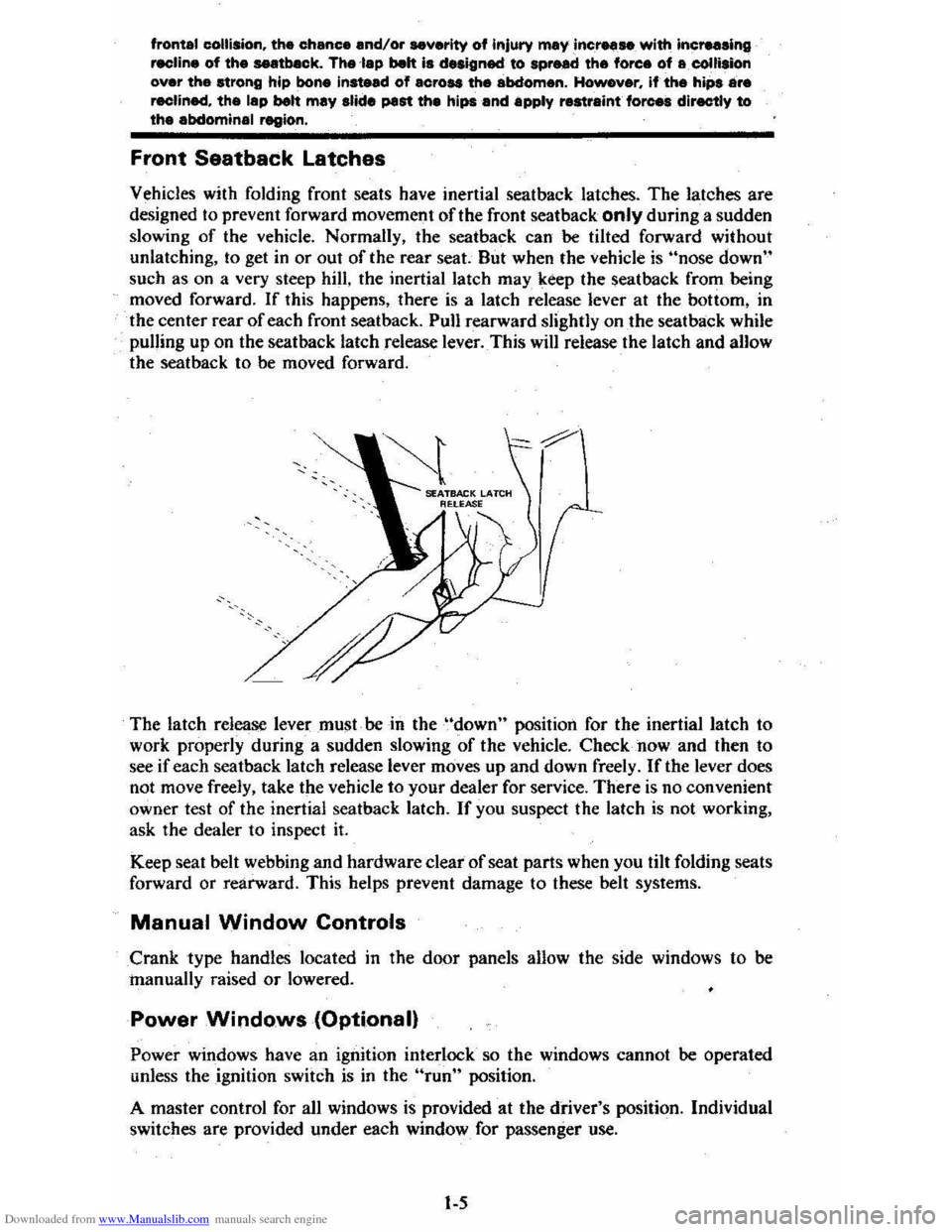
moved forward. If this happens, there is a latch release lever at the bottom, in
the center rear
of each front seatback. pun rearward slightly on the seat back while
pulling up on the seatback latch release lever .. This will release the latch and alJow
the seat back to be moved forward.
The latch release lever must.
be in the "down" position for the inertial latch to
work properly during a sudden slowing of the vehicle. Checkrtow and then to
see
if each seatback latch release lever moves up and down freely. If the lever does
not move freely, take the vehicle to your dealer for service. There is no convenient
owner test of the inertial seatback latch.
If you suspect the latch is not working,
ask the dealer to inspect
it.
Keep seat belt webbing and hardware clear of seat parts when you tilt folding seats
forward or rearward. This helps prevent damage to these belt systems.
Manual Window Controls
Crank type handles located in the door panels anow the side windows to be
manually raised or lowered.
Power Windows (Optional)
Power windows have an ignition interlock so the windows cannot be operated
unless the ignition switch is in the "run" position.
A master control for all windows
is provided at the driver's position. Individual
switches are provided under each window for passenger use.
1-5
Page 10 of 95
Downloaded from www.Manualslib.com manuals search engine SEAT BELTS
1'0 help lessen the chalice of injury and/or the severity of injury in accidents or
sudden,'stops, General Motors urges that people riding in the-car be properly
restrained at aU times" using the seat belts provided. This includes women who
are pregnant, and children of all ages. (See the following pages for· the use of
restraints by children and pregnant women). General Motors provides a seat belt
at each position designed for occupant seating. Thus the front seat of this vehicle
is equipped
with seat belts for two occupants, and the rear seat for three occupants.
Front S",at Lap-Shoulder Belt
• Close the front door fully (this activates the tension reliever).
• Adjust the front seat as needed and sit up straight and well back in the seat.
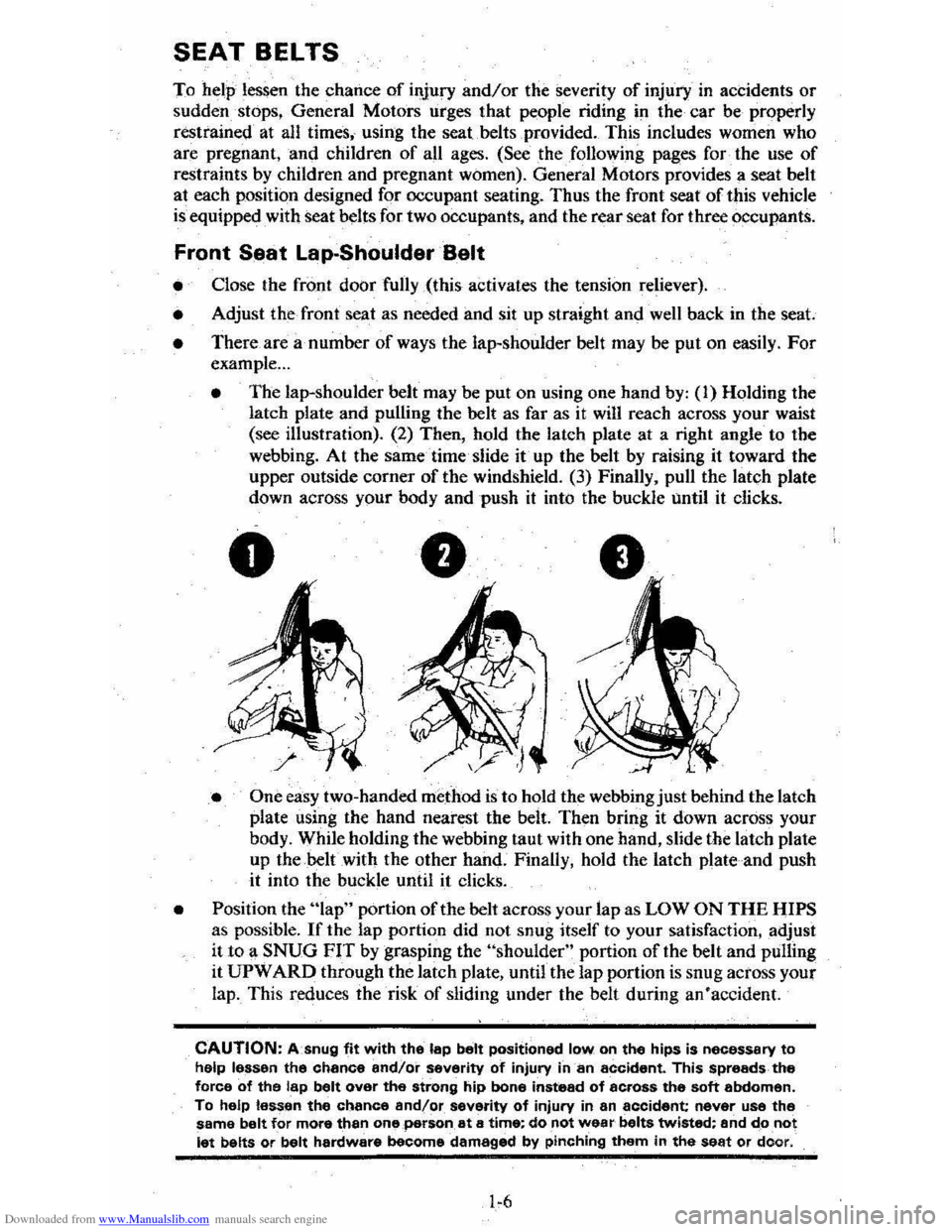
• There are a number of ways the lap-shoulder belt may be put on easily. For example ...
• The lap-shoulder belt may be put on using one hand by: (1) Holding the
latch plate and pulling the belt as far as it will reach across your waist
(see illustration). (2) Then, hold the latch plate
at a right angle to the
webbing.
At the sametimesJide itup the belt by raising it toward the
upper outside corner
of the windshield. (3) Finally, pull the latch plate
down across your body and push it into the buckle until it clicks.
o
• One easy two-handed tm:thod is to hold the webbing just behind the latch
plate using the hand nearest the belt. Then bring it down across your
body. While holding the webbing taut with one hand, slide the latch plate
up the
belt with the other hand. Finally, hold the latch plate and push
it into the buckle until it clicks.
• Position the "lap" portion of the belt across your lap as LOW ON THE HIPS as possible. If the lap portion did not snug itself to your satisfaction, adjust
it
to a SNUG FIT by grasping the "shoulder" portion of the belt and pulling
it UPWARD through the latch plate, until the lap portion is snug across your
lap. This reduces the
risk of sliding under the belt during an·accident.
CAUTION: A snug fit with the lap beilt positioned low on the hips is necessary to help lessen the chance and/or saverity of injury in an accident. This spreads the force of the lap belt over the strong hip bone instead of across the soft: abdomen. To help lessen the chance and/or severity of injury in an accident never use the same belt for more than one person at 8 time; do not wear belts twisted; and do not let belts or belt hardware become damaged by pinching them in the seat or door.
1-6
Page 11 of 95
Downloaded from www.Manualslib.com manuals search engine • The shoulder portion of the front seat belt is design ed to lock only durin g
a sudden stop or impact. At othe r times it is designed to'move freely with
the person,
•
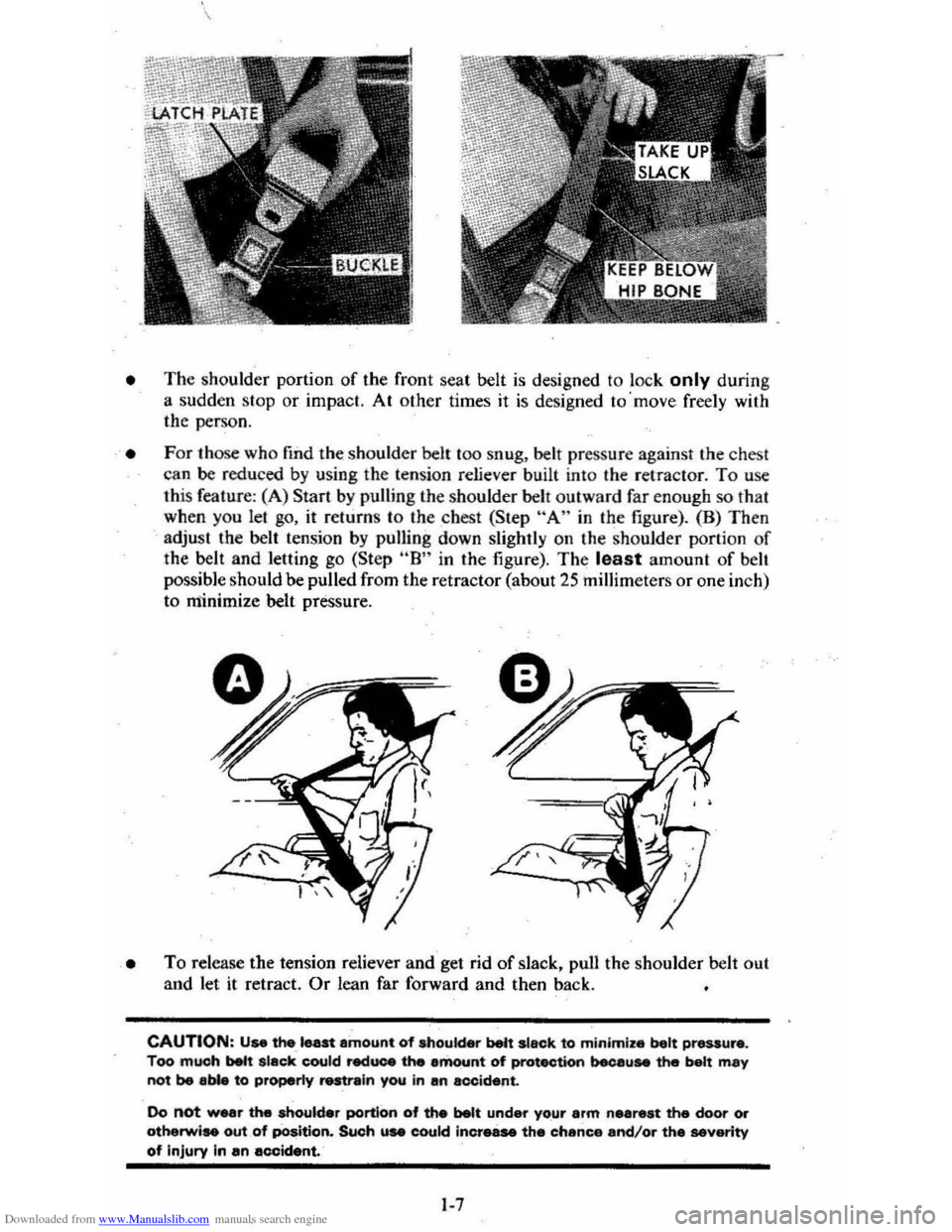
F or those who find the. should er belt too snug, belt pressure against the chest
can be reduced by using the tension reliever built into the ret rac tor , To use
this feature: (A) Start by pulling the s houlder belt outward far enough so that
when you let go, it returns to the chest
(Step "A" in the figure). (B) Then
adj ust the belt tension by pulling down slightly on the shou lder portion of
the belt and letting go (Step "B" in the figure), The least amount of belt
pos
sible should be pulled from the retractor (about 25 millimeters or one inch )
to minimize belt pressure ,
•
To release the tension reliever and get rid of slack, puB the shoulder belt out
and let it retract. Or lean far forward and then back.
CAUTION: Us. the least amount of shoulder belt slack to minimize belt pressure . Too much bett slack could reduce the emount of protection because the bett may not be able to property restnlin you in an accident.
00 not wur the shoulder portion of the Mit under your .rm nurest the door or otherwl .. out,of position. Such u .. could incr .... the chance and/or the severity of injury In an accident.
1-7
Page 12 of 95
Downloaded from www.Manualslib.com manuals search engine • To unfasten the belt,. push in the button in the center of the buckle.
• To stow the belt, pull it out about 150 millimeters (six incbt::s) and let go.
Hold the latch plate as it retracts to keep it from possibly striking people or things nearby. If you forget, the-retractor is designed to rewind the_belt when
the front door
is opened. If needed, slide the latch plate down the webbing
to let the belt retract fully. Be sure that the belt is fully retracted and the
latch plate is out of the way before closing the door to help prevent damage
to interior trim and the seat belt assembly.
Restreint Of Pregnant Women
General Motors urges that-pregnant women lise a lap-shoulder belt whenever one
is present. This will help lessen the chance of a pregnant woman and her unborn
child being injured
and/or will help reduce the severitYClf their injury in an
accident. The lap belt should be used alone if a shoulder belt is not present. In
either case, the lap belt should be worn as low and snug over the hips as possible,
as advised for regular seat belt
·use (see the preceding instructions).
Seat Belt Light/Buzzer Reminder
• When the key is turned to "Run" or "Start," a reminder light is designed
to come on for four to eight seconds.
It is to remind riders to fasten their
seat belts.
• .If the driver's seat belt has not been buckled before turning the key to "Run" or "Start," a buzzer is designed to sound for four to eight seconds (or until
buckled) as a reminder.
If the seat belt or reminder system does not work as de~cribed. see your dealer
for service.
LAP BELTS For Rear Seat Passengers
• To enter the rear seat area in 2-door cars:
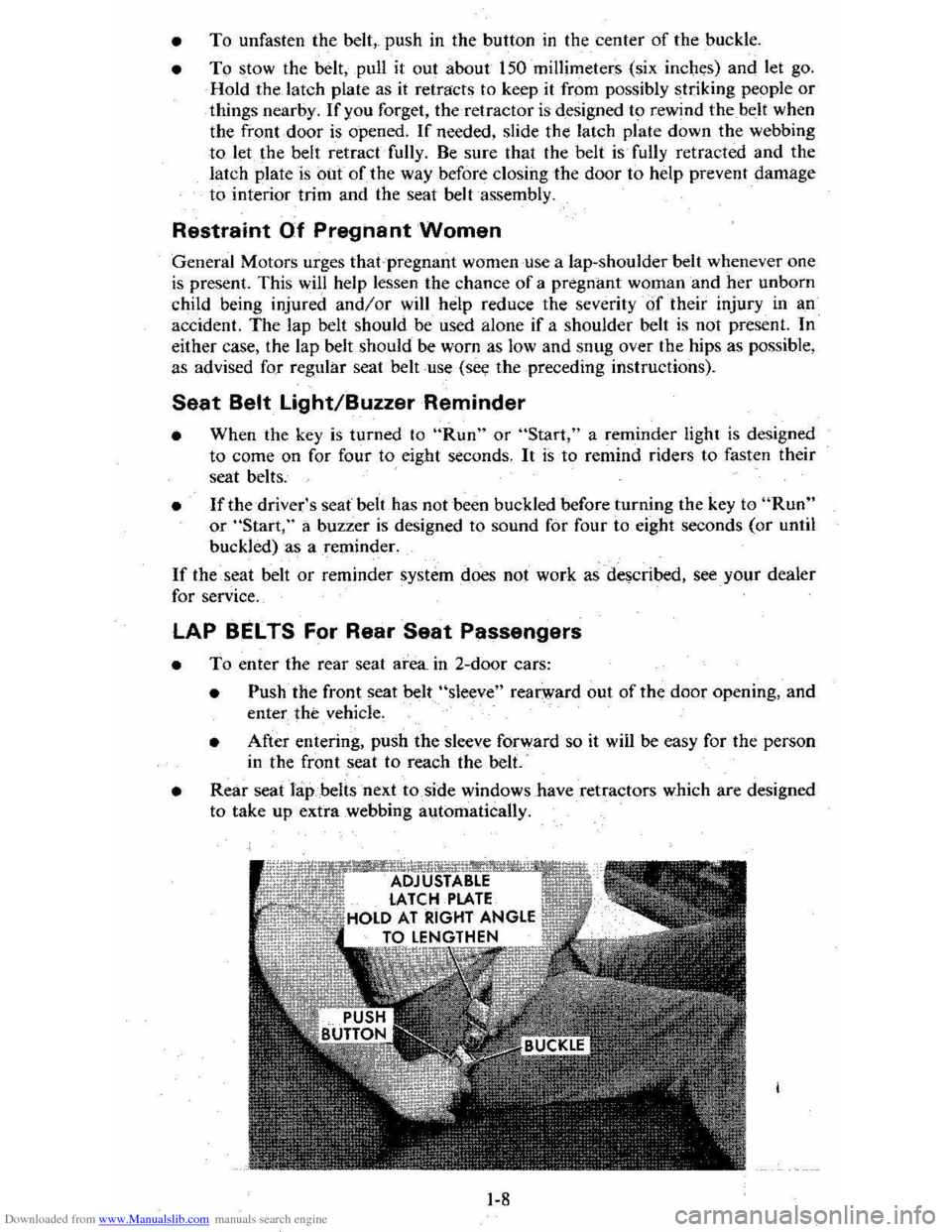
• Pushthe front seat belt "sleeve " rearward out of the door opening, and
enter the vehicle.
• After entering, push the sleeve forward so it wiil be easy for the person
in the front seat to reach the belt.-
• Rear seat lap belts next to side windows have retractors which are designed
to take up extra webbing automatically.
1-8
Page 13 of 95
Downloaded from www.Manualslib.com manuals search engine • In a single motion, pull the rear seat outboard lap belt across your lap far
enough to-push the latch plate into the buckle. un Iii it clicks._ If the belt is
not pulled out far enough to rcadi the-buckle, let the lap bell rewind fully
into its retractor. This unlocks
it so the belt can be puBed .out to the proper length .
• These belts should be positioned, worn, and released as described above under "Front Seat Lap~ShouJder Belt." After fastening, check that the belt is SNUG by pulling the belt firmly across', your lap toward the Jap belt retractor. This
will allow the retractor to take up slack.
• The lap belt at the center seat also should be positioned, worn, and relea sed
as described above-however , it does not have a retractor. It should be
adju sted 10 a SNUG FIT by pulling on the end of the belt coming from the
adju stable latch plate .
• To lengthen the center seat lap belt. place the latch plate at a right angle to
the belt webbing and pull on the latch plate. The belt should then slide easily.
Additional Rear Seat Shoulder Belts-Offerad as an
Accessory by Your Dealer
• When properly worn with a lap beh,--a -shoulder belt can give riders added
protection . II can prevent or reduce impact with the insides of the vehicle
'by restraining the upper body in a collision. This is especially true in a frontal
impact.
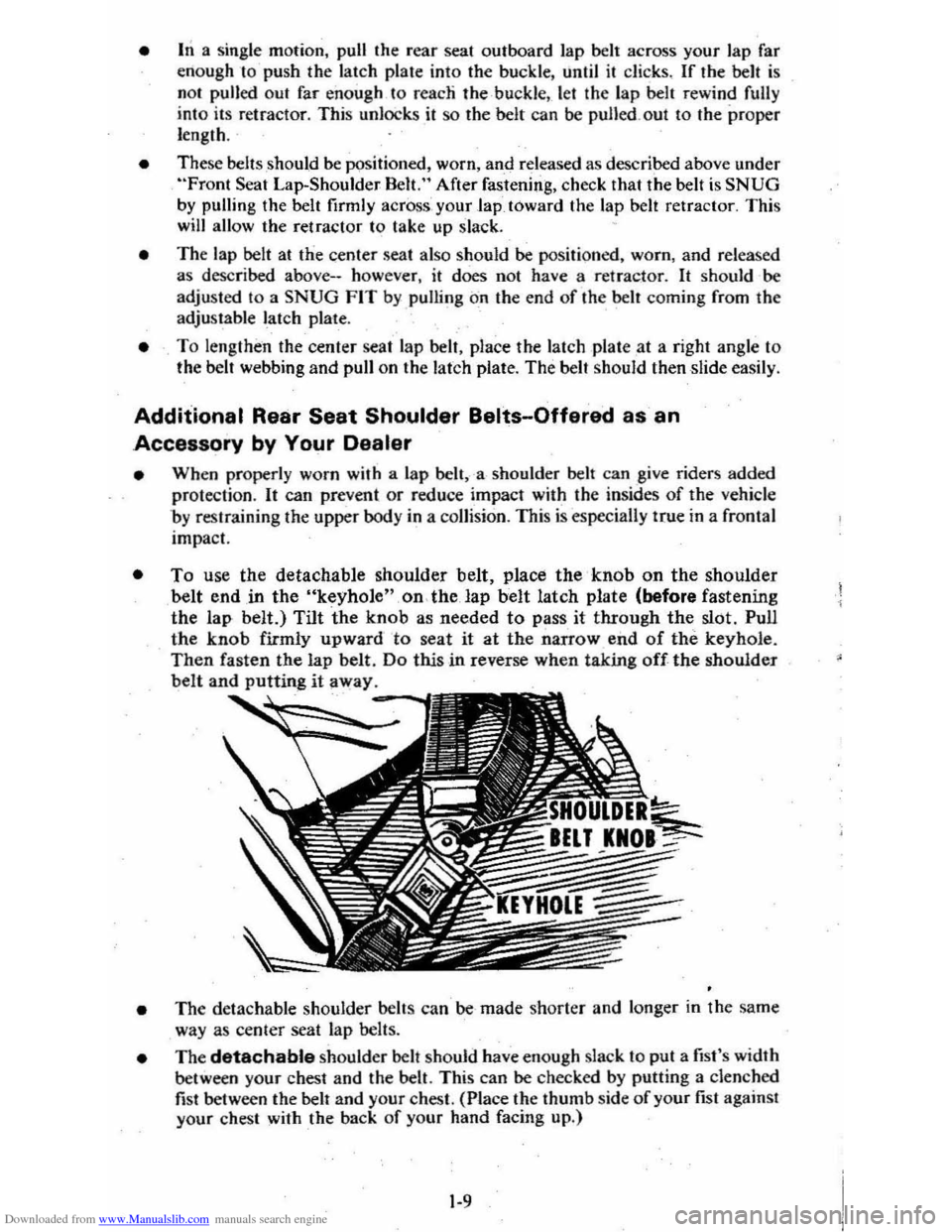
• To use the detachable shoulder belt. place the' knob on the shoulder belt end.in the "keyhole"on.the lap belt latch plate (before fastening
the lap belt.) Tilt the knob as needed
to pass it through the slot. Pull
the knob firmly upward to seat it at the narrow end of the keyhole. Then fasten the lap belt. Do this in reverse when taking off-the shoulder
belt and putting it away.
• The detachable shoulder belts can be made shorter and longer in the same
way as center seat lap belts .
• The detachable shoulder belt should have enough slack to put a fist's width
between your chest and the belt. This can be checked by putting a clenched
fist between the belt and your chest. (Place the thumb side of your fist against
your chest with the back of your hand facing up.)
1-9