1973 DATSUN B110 light
[x] Cancel search: lightPage 116 of 513
REAR
AXLE
REAR
SUSPENSION
REAR
AXLE
CONTENTS
DESCRIPTION
REAR
AXLE
SHAFTS
Removal
RA
1
RA
l
RA
l
8
Inspection
Assembly
RA
3
RA
3
1
Axle
shaft
2
Spacer
3
Wheel
bearing
4
Wheel
bearing
collar
5
Oil
seal
6
Bearing
adjust
shim
7
Axle
case
8
Brake
drum
DESCRIPTION
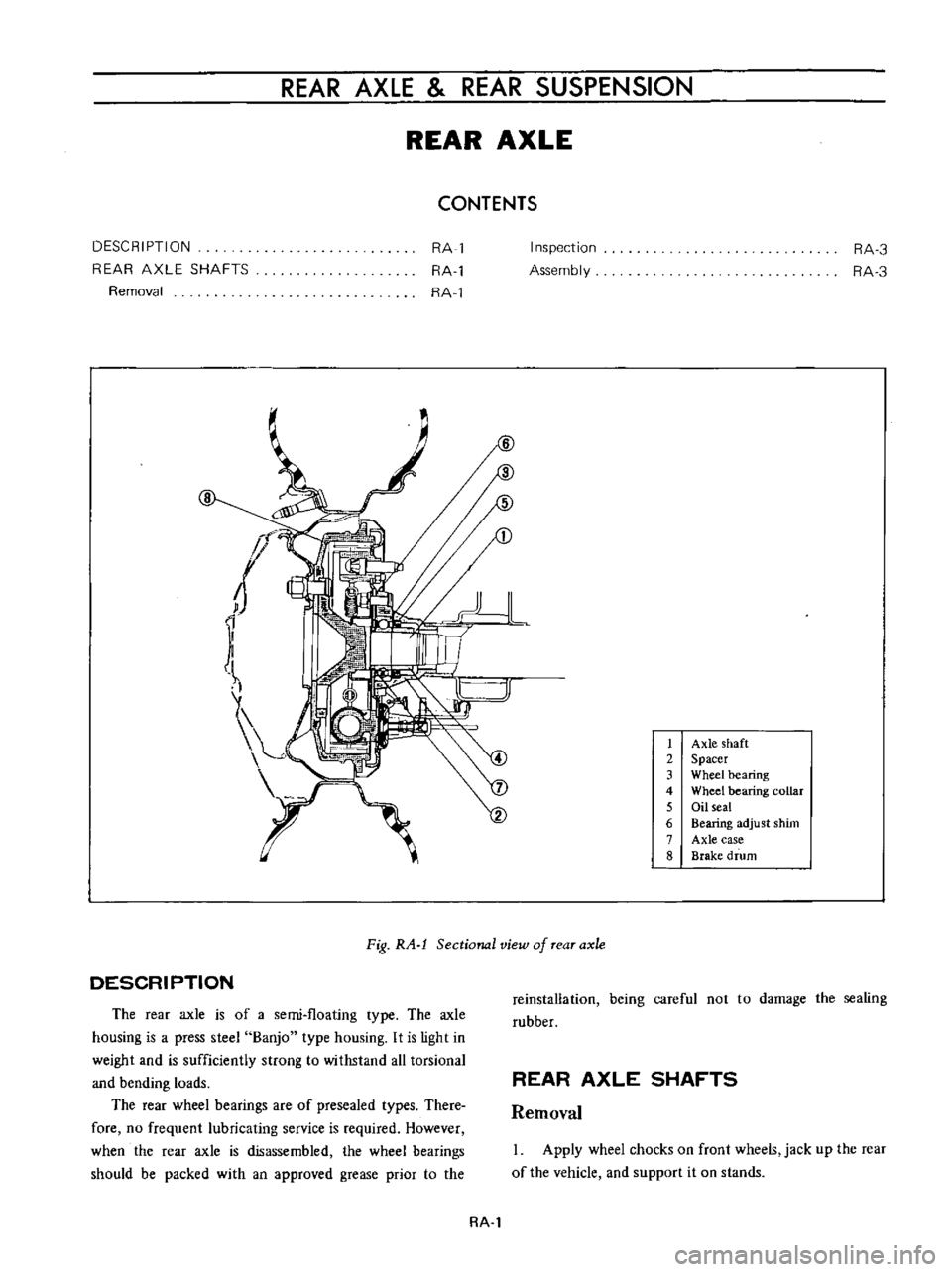
Fig
RA
l
Sectional
view
of
rear
axle
The
rear
axle
is
of
a
semi
floating
type
The
axle
housing
is
a
press
steel
Banjo
type
housing
It
is
light
in
weight
and
is
sufficiently
strong
to
withstand
all
torsional
and
bending
loads
The
rear
wheel
bearings
are
of
presea1ed
types
There
fore
no
frequent
lubricating
service
is
required
However
when
the
rear
axle
is
disassembled
the
wheel
bearings
should
be
packed
with
an
approved
grease
prior
io
the
reinstallation
being
careful
not
to
damage
the
sealing
rubber
REAR
AXLE
SHAFTS
Removal
Apply
wheel
chocks
on
front
wheels
jack
up
the
rear
of
the
vehicle
and
support
it
on
stands
RA
l
Page 125 of 513
DESCRIPTION
BRAKE
PEDAL
Removal
Inspection
Reinstallation
TANDEM
MASTER
CYLINDER
Removal
Disassembly
Inspection
Reassembly
Reinstallation
SINGLE
MASTER
CYLINDER
Removal
and
disassembly
Inspection
Reassembly
and
reinstallation
BRAKE
LINE
Removal
Inspection
Reinstallation
Brake
line
pressure
differential
warning
light
switch
FRONT
DRUM
BRAKE
cr
I
1
0
I
I
CD
BRAKE
BRAKE
CONTENTS
BR
2
BR
2
BR
2
BR
2
BR
2
BR
3
BR
3
BR
3
BR
3
BR
4
BR
4
BR
4
BR
5
BR
5
BR
5
BR
5
BR
5
BR
6
BR
6
BR
7
BR
8
Removal
and
disassembly
Inspection
Reassembly
and
reinstallation
FRONT
DISC
BRAKE
Brake
pad
Caliper
assembly
Reassembly
Reinstallation
REAR
BRAKE
Removal
and
disassembly
Inspection
Reassembly
and
reinstallation
HAND
8RAKE
Removal
Inspection
Reinstallation
ADJUSTMENT
Brake
shoe
clearance
Brake
pedal
height
Hand
brake
Bleeding
hydraulic
system
@
7
o
i
1
Brake
hose
2
Brake
master
cylinder
3
3
way
connector
4
Hand
brake
lever
5
Brake
hose
6
3
way
connector
7
Hanger
strap
8
Turn
buckle
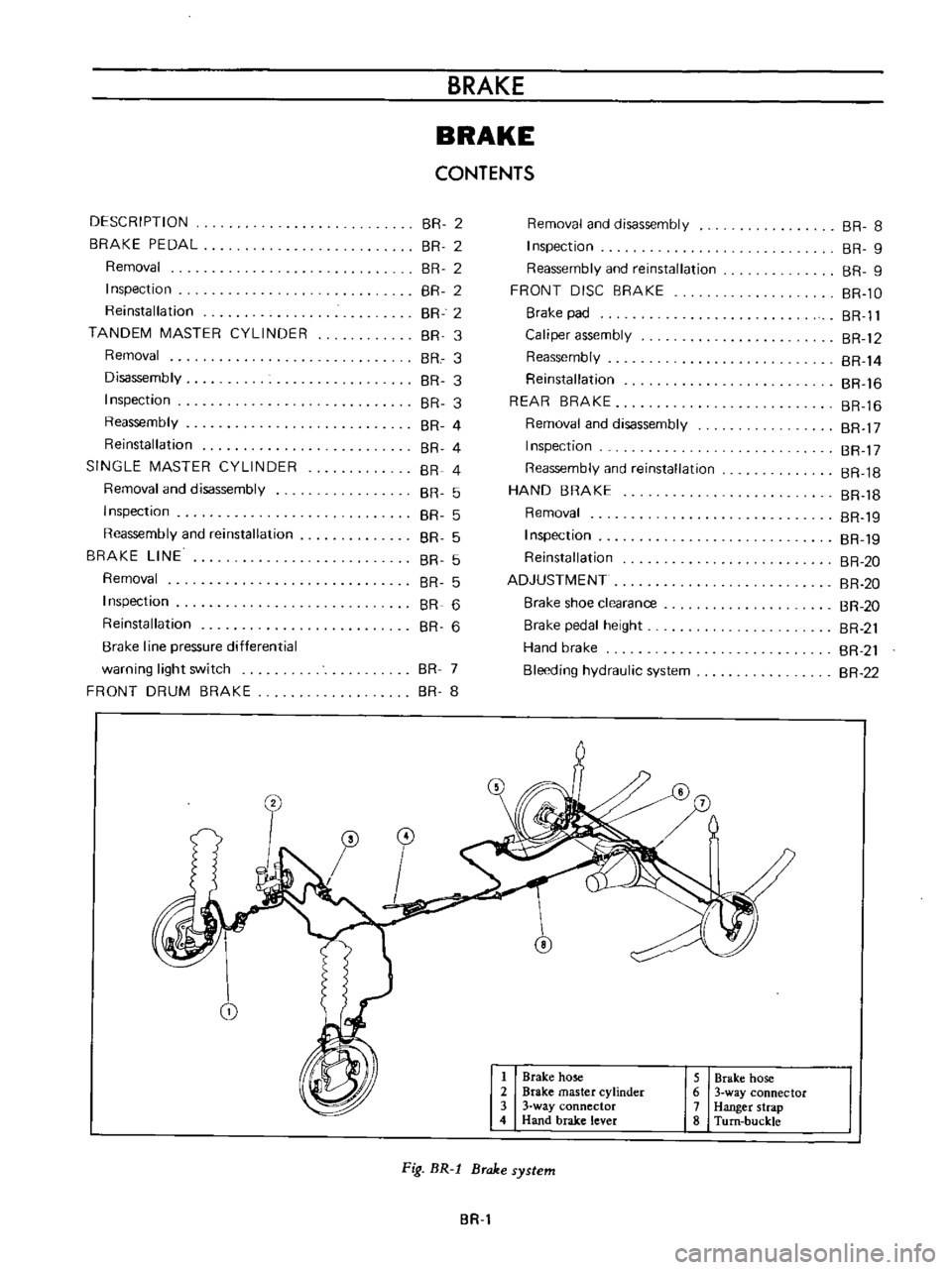
Fig
BR
l
Brake
system
BR
BR
8
BR
9
BR
9
BR
lO
BR
Il
BR
12
BR
14
BR
16
BR
16
BR
17
BR
17
BR
18
BR
18
BR
19
BR
19
BR
20
BR
20
BR
20
BR
21
BR
21
BR
22
Page 128 of 513
CHASSIS
Ii
t
L
1
J
rJ
I
e
i
L
rubber
parts
und
alcohol
long
than
30
seconds
After
the
parts
are
cleaned
dry
them
with
com
pressed
air
Check
the
cylinder
and
piston
for
damage
and
uneven
wear
on
the
sliding
surface
and
for
other
defective
conditions
Replace
as
required
2
Replace
if
the
cylinder
and
piston
clearance
is
more
than
0
15
mm
0
006
in
3
In
principle
replace
the
piston
cup
packing
and
valves
with
new
ones
whenever
the
master
cylinder
is
disassembled
Be
sure
to
replace
if
damaged
worn
weakened
or
expanded
4
Check
the
return
springs
for
wear
damage
and
other
defective
conditions
and
replace
as
required
5
Replace
others
if
deformed
damaged
or
defective
Reassembly
Assemble
the
master
cylinder
in
reverse
sequence
of
SINGLE
MASTER
CYLINDER
s
m
e
disassembly
noting
the
following
matters
Apply
brake
fluid
to
the
component
parts
such
as
cylinder
bore
piston
etc
and
carry
out
the
operations
carefully
so
that
the
component
parts
are
not
damaged
or
no
dust
and
other
foreign
matters
enter
the
cylinder
and
brake
fluid
reselVoir
Moreover
for
rubber
parts
such
as
piston
cup
etc
apply
rubber
grease
slightly
Tightening
torque
Valve
cap
2
5
to
3
5
kg
m
I8
to
25
3
ft
Ib
Bleeder
screw
0
5
kg
m
3
6
ft
lb
Stopper
bolt
0
5
to
0
3
kg
m
l
I
to
2
2ft
lb
Reinstallation
Reinstall
the
master
cylinder
in
reverse
sequence
of
removal
After
air
bleeding
make
sure
that
no
brake
fluid
leaks
from
the
circuit
For
the
pedal
height
adjustment
refer
to
lhe
paragraph
pedal
adjustment
r
11L
y
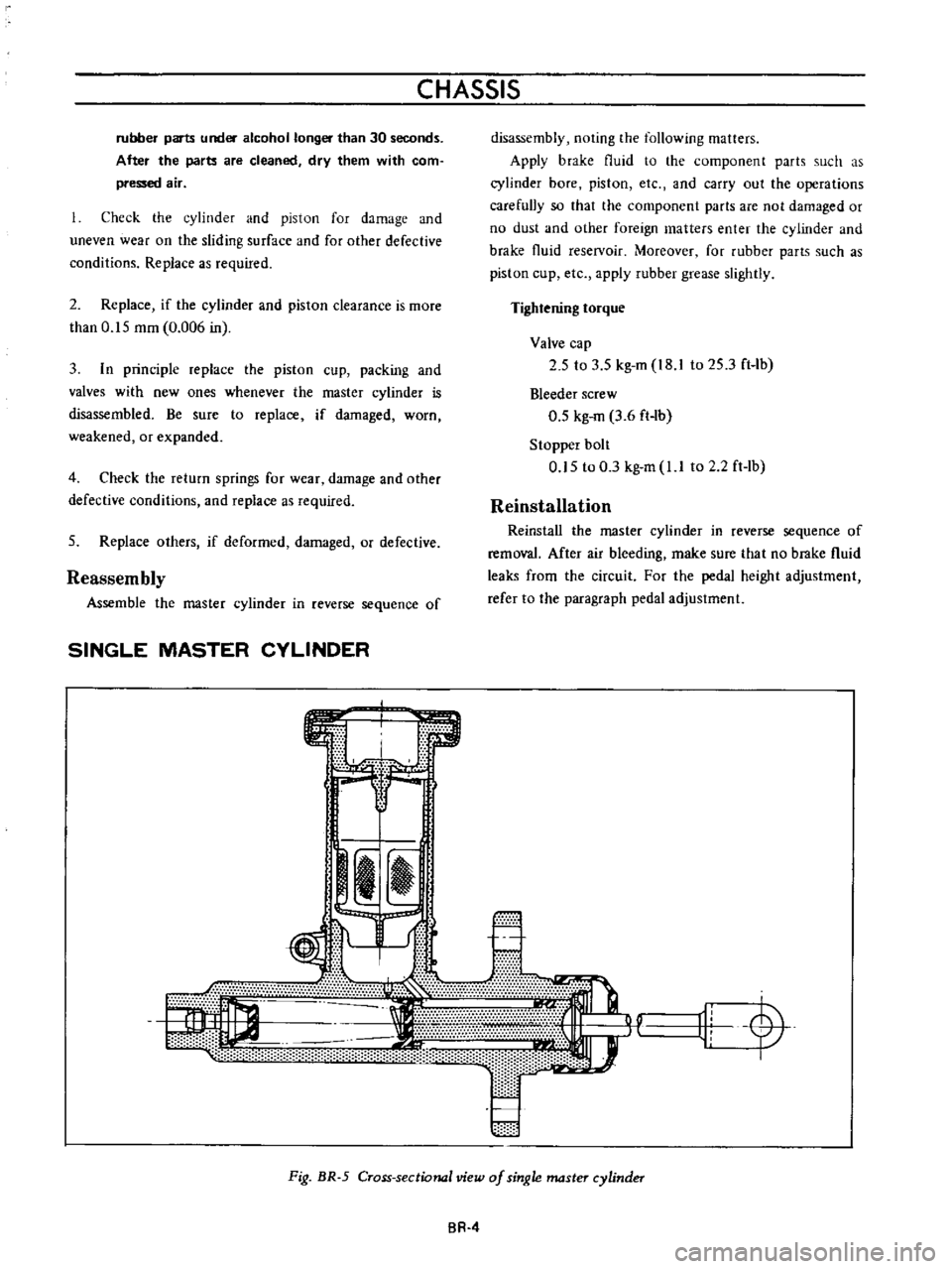
Fig
BR
5
Cross
sectional
view
of
single
master
cylinder
BR
4
Page 131 of 513
Tightening
torque
3
way
connector
1
5
to
1
8
kg
m
10
8
to
13
0
ft
lh
1
5
to
1
8
kg
m
10
8
to
13
0
ft
lh
1
5
to
1
8
kg
m
10
8
to
13
0
ft
lb
0
7
to
0
9
kg
m
5
1
to
6
5
ft
1b
Master
cylinder
Brake
hose
Air
bleeder
5
Fill
the
master
cylinder
brake
fluid
reservoir
with
brake
fluid
and
perform
air
bleeding
complele1y
Note
a
Do
not
use
brake
fluid
other
than
specified
b
The
specified
brake
fluid
is
used
for
both
single
and
tandem
type
master
cylinders
6
Upon
completion
of
air
bleeding
make
sure
that
the
brake
operates
correctly
and
check
the
brake
tube
and
hose
connectors
for
fluid
leaking
Fully
depress
the
brake
pedal
continue
to
depress
the
brake
pedal
for
several
seconds
and
make
sure
that
no
brake
fluid
leaks
from
any
part
of
the
brake
line
Replace
defective
part
if
required
Brake
line
pressure
differential
warning
light
switch
A
warning
light
is
located
on
the
instrument
panel
to
warn
the
driver
when
a
pressure
difference
of
13
to
17
kg
cm2
185
to
2421bJsq
in
exists
between
the
front
and
rear
b
rake
systems
A
hydraulically
actuated
warning
light
switch
is
located
in
the
engine
compartment
Both
front
and
rear
brake
systems
are
connected
to
this
switch
assembly
When
a
pressure
difference
of
13
to
17
kgJcm2
185
to
242
lbJsq
in
occurs
between
the
front
and
rear
brake
systems
the
valves
will
shuttle
toward
the
side
with
the
low
pressure
The
valve
contacts
with
the
switch
terminal
BRAKE
the
ground
circuit
for
the
warning
light
is
completed
and
thus
the
warning
light
lights
In
this
case
correct
the
hydraulic
brake
problem
and
bleed
the
brakes
Check
the
warning
light
switch
assembly
for
a
proper
operation
Check
the
switch
assembly
for
fluid
leakage
Note
Do
not
attempt
to
repair
switch
for
any
reason
replace
switch
assembly
completely
1
To
front
brake
L
H
2
From
master
cylinder
F
3
From
master
cylinder
R
4
To
rear
brake
L
B
R
M
5
To
front
brake
R
H
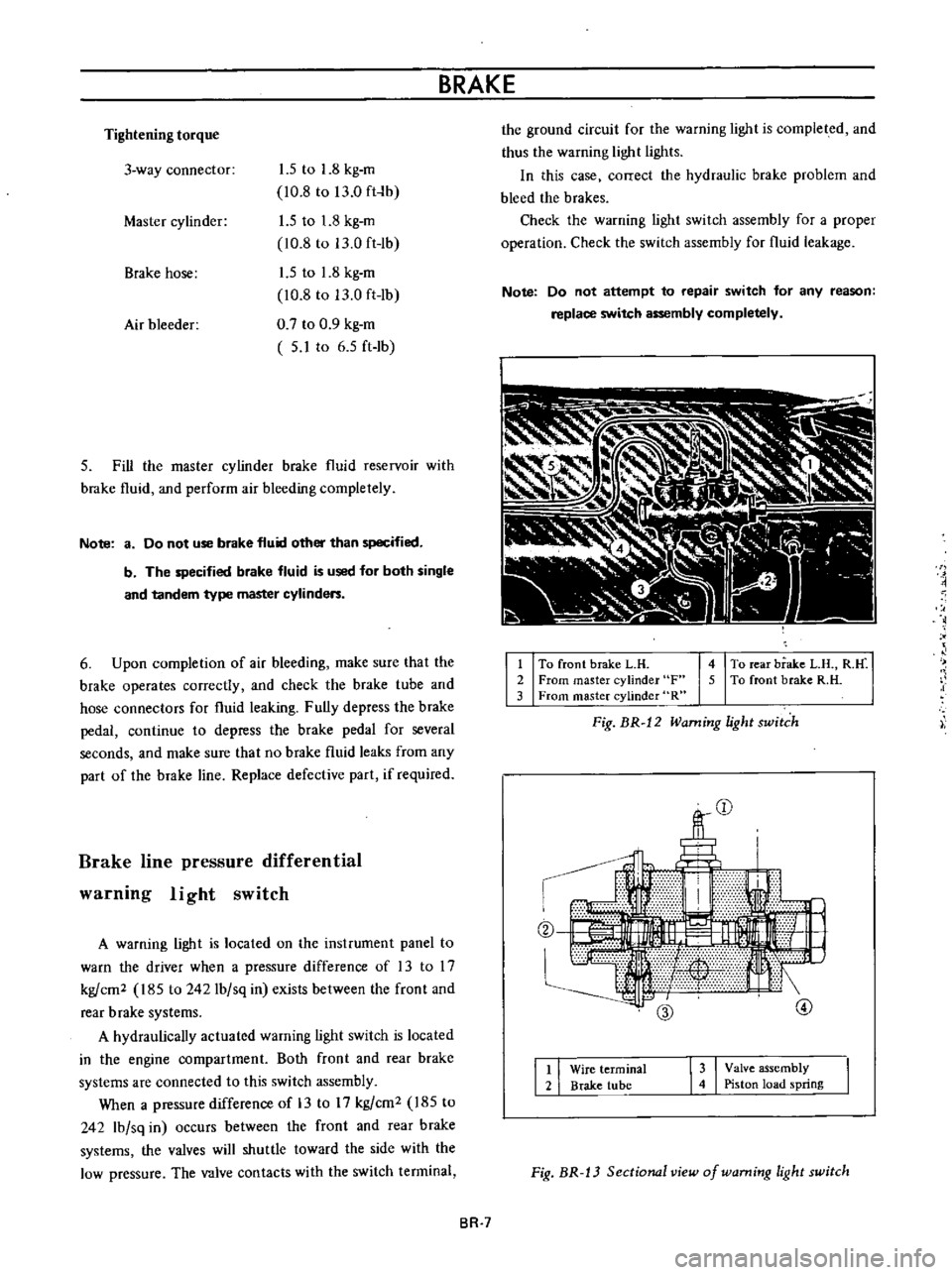
Fig
BR
12
Warning
light
switch
r
I
@
I
I
3
I
Valve
assembly
4
Piston
load
spring
Wire
terminal
Brake
tube
Fig
BR
13
Sectional
view
of
warning
light
switch
BR
7
Page 133 of 513
7
Remove
the
brake
disc
installation
bolt
and
remove
the
brake
disc
from
the
spindle
8
Disassemble
the
wheel
cylinders
Inspection
l
Drums
If
they
show
score
excessive
out
of
round
and
so
forth
reconditioning
by
machining
is
required
Brake
drum
inner
diameter
203
2
mm
8
00
in
Drum
inside
out
of
roundness
Below
0
02
mm
0
0008
in
Max
allowable
drum
inner
diameter
204
5
mm
8
051
in
2
Linings
If
brake
shoe
linings
are
incomp1etedly
seated
soiled
or
greasy
or
deteriorated
due
to
excessive
heating
repair
or
replace
them
If
the
thickness
of
the
lining
is
less
than
1
5
mm
0
0591
in
replace
it
Note
a
If
oil
or
grease
is
found
on
linings
clean
thoroughly
with
carbon
tetrachloride
or
gasoline
b
After
installing
and
bonding
lining
grind
the
lining
face
to
a
diameter
equal
to
the
brake
drum
3
Check
the
adjusting
cams
for
their
smooth
operation
4
Return
springs
If
they
are
considerably
weak
replace
them
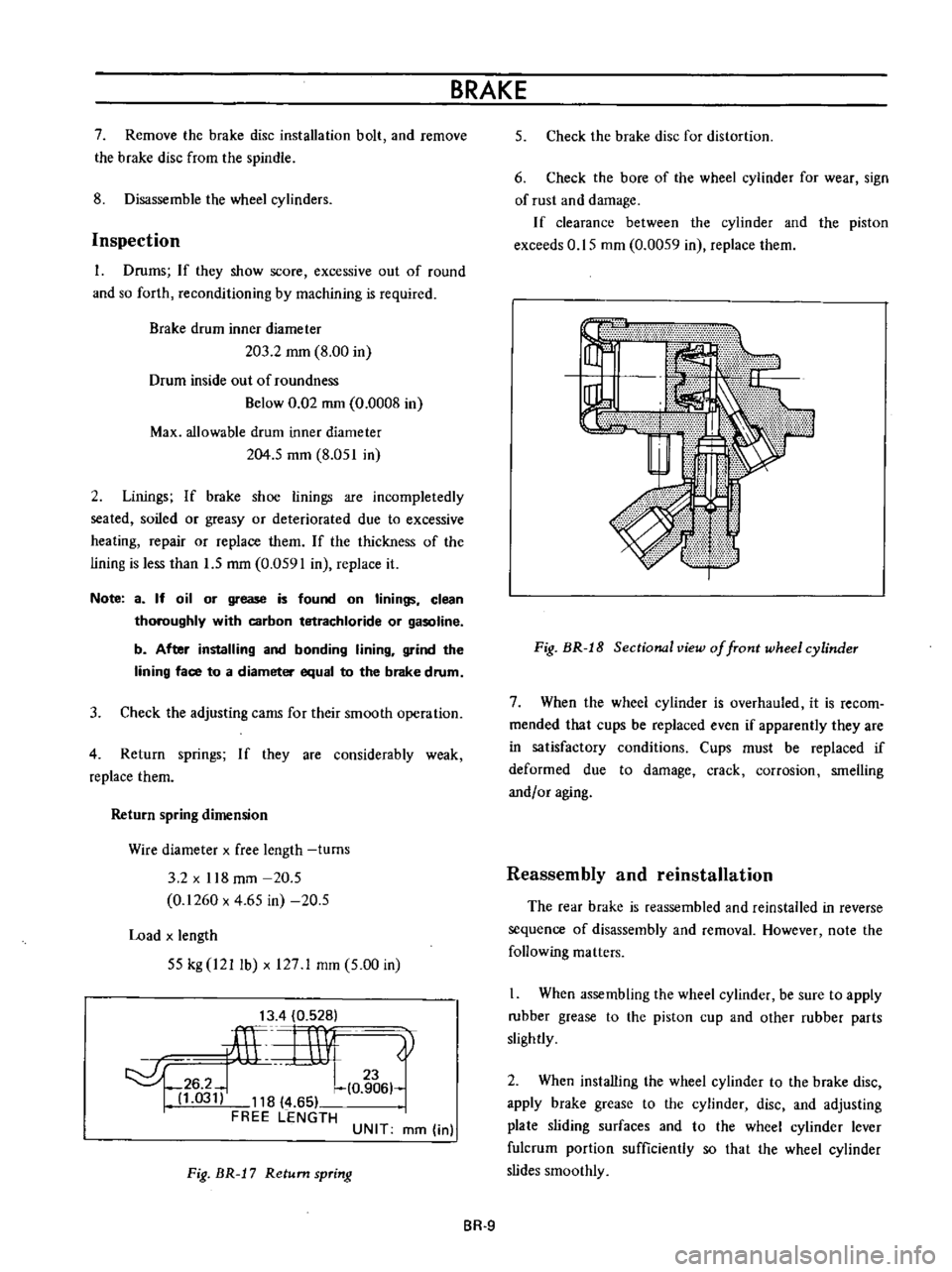
Return
spring
dimension
Wire
diameter
x
free
length
turns
3
2
x
118
mm
20
5
0
1260
x
4
65
in
20
5
Load
x
length
55
kg
I21
lb
x
127
1
mm
5
00
in
13
4
0
528
ilL
rnv
0
t
6
hl
03
118
4
65
FREE
LENGTH
UNIT
mm
in
Fig
BR
J
7
Return
spring
BRAKE
5
Check
the
brake
disc
for
distortion
6
Check
the
bore
of
the
wheel
cylinder
for
wear
sign
of
rust
and
damage
If
clearance
between
the
cylinder
and
the
piston
exceeds
0
15
mm
0
0059
in
replace
them
Fig
BR
J
8
Sectional
view
of
front
wheel
cylinder
7
When
the
wheel
cylinder
is
overhauled
it
is
recom
mended
that
cups
be
replaced
even
if
apparently
they
are
in
satisfactory
conditions
Cups
must
be
replaced
if
deformed
due
to
damage
crack
corrosion
smelling
andf
or
aging
Reassembly
and
reinstallation
The
rear
brake
is
reassembled
and
reinstalled
in
reverse
sequence
of
disassembly
and
removal
However
note
the
following
matters
When
assembling
the
wheel
cylinder
be
sure
to
apply
rubber
grease
to
the
piston
cup
and
other
rubber
parts
slightly
2
When
installing
the
wheel
cylinder
to
the
brake
disc
apply
brake
grease
to
the
cylinder
disc
and
adjusting
plate
sliding
surfaces
and
to
the
wheel
cylinder
lever
fulcrum
portion
sufficiently
so
that
the
wheel
cylinder
slides
smoothly
BR
9
Page 139 of 513
BRAKE
i
f
F
PISTON
A
PISTON
S
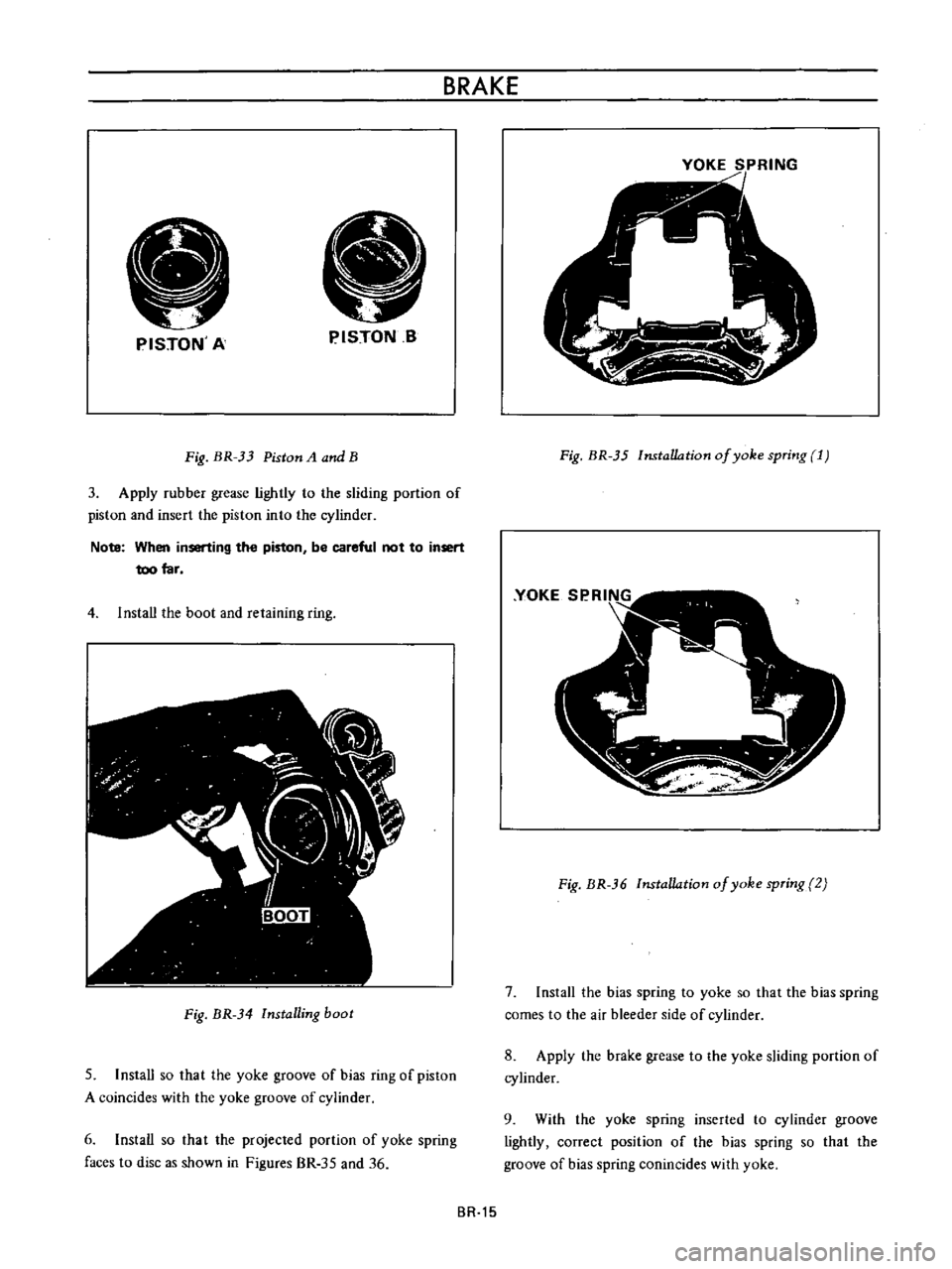
Fig
BR
33
Piston
A
and
B
3
Apply
rubber
grease
lightly
to
the
sliding
portion
of
piston
and
insert
the
piston
into
the
cylinder
Note
When
inserting
the
piston
be
careful
not
to
insert
too
far
4
1
nstaU
the
boot
and
retaining
ring
Fig
BR
34
Installing
boot
5
Install
so
that
the
yoke
groove
of
bias
ring
of
piston
A
coincides
with
the
yoke
groove
of
cylinder
6
Install
so
that
the
projected
portion
of
yoke
spring
faces
to
disc
as
shown
in
Figures
BR
35
and
36
BR
15
YOKE
SPRING
Fig
BR
35
Installation
of
yoke
spring
1
Fig
BR
36
Installation
of
yoke
spring
2
7
Install
the
bias
spring
to
yoke
so
that
the
bias
spring
comes
to
the
air
bleeder
side
of
cylinder
8
Apply
the
brake
grease
to
the
yoke
sliding
portion
of
cylinder
9
With
the
yoke
spring
inserted
to
cylinder
groove
lightly
correct
position
of
the
bias
spring
so
that
the
groove
of
bias
spring
conincides
with
yoke
Page 140 of 513
CHASSIS
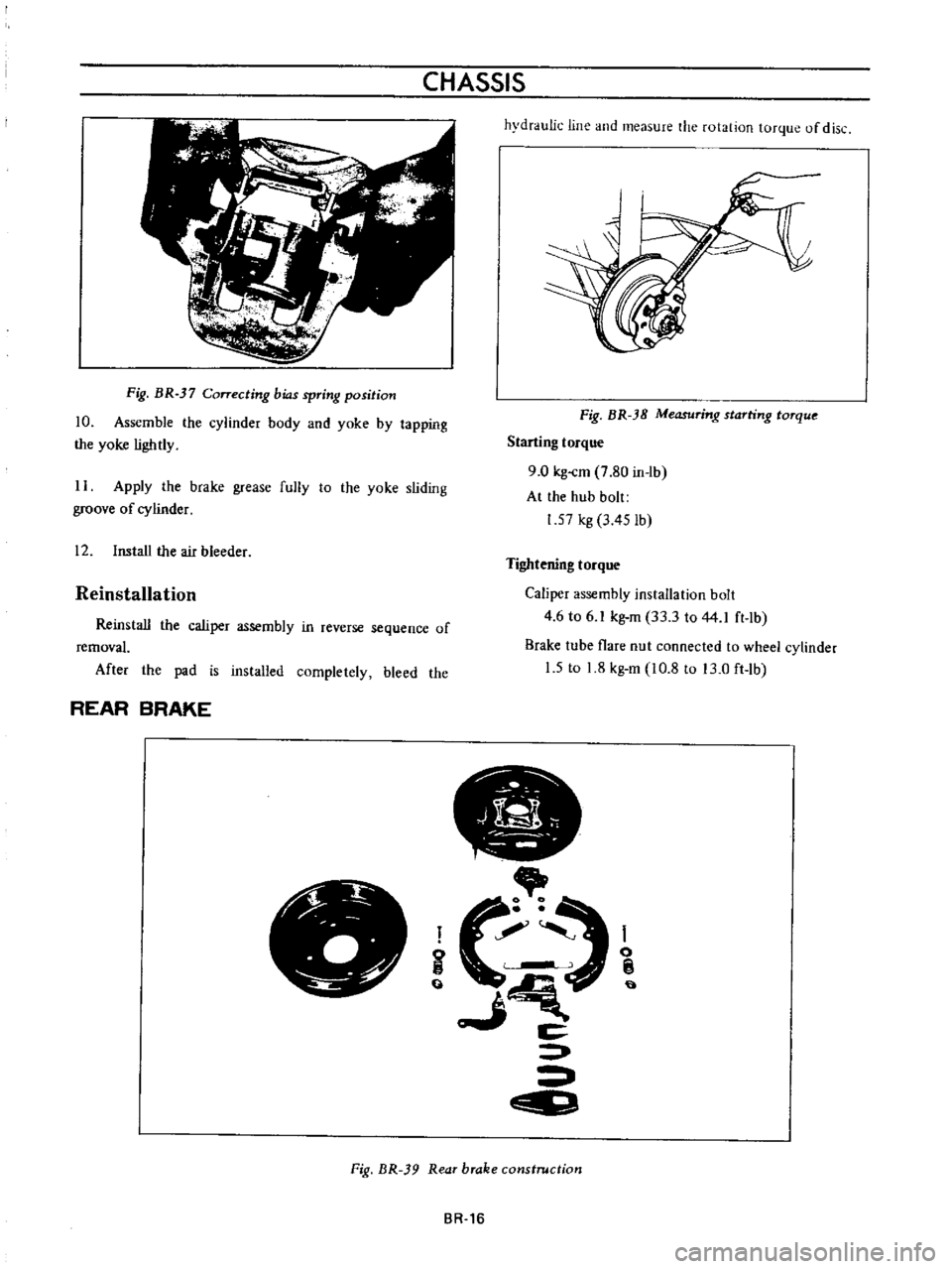
Fig
BR
37
Correcting
bias
spring
position
10
Assemble
the
cylinder
body
and
yoke
by
tapping
the
yoke
lightly
11
Apply
the
brake
grease
fully
to
the
yoke
sliding
groove
of
cylinder
12
Install
the
air
bleeder
Reinstallation
Reinstall
the
caliper
assembly
in
reverse
sequence
of
removal
After
the
pad
is
installed
completely
bleed
the
REAR
BRAKE
r
e
hydraulic
line
and
measure
the
rotation
torque
of
disc
Fig
BR
38
Measuring
starting
torque
Starting
torque
9
0
kg
cm
7
80
in
lb
At
the
hub
bolt
1
57
kg
3
45
lb
Tightening
torque
Caliper
assembly
installation
bolt
4
6
to
6
kg
m
33
3
to
44
1
ft
lb
Brake
tube
flare
nut
connected
to
wheel
cylinder
1
5
to
1
8
kg
m
10
8
to
3
0
ft
lb
JJ
i
o
C
EID
I
o
fj
t
Fig
BR
39
Rear
brake
construction
BR
16
Page 144 of 513

CHASSIS
4
With
the
hand
brake
lever
pulled
depress
the
push
button
and
make
sure
that
the
pawl
disengages
the
teeth
when
the
push
button
is
depressed
5
to
6
mm
0
1969
to
0
2362
in
completely
5
Make
sure
that
the
cable
dust
cover
is
not
damaged
or
warped
Reinstallation
Reinstall
the
hand
brake
in
reverse
sequence
of
removal
noting
the
following
matters
Be
careful
not
to
damage
or
twist
the
dust
cover
2
Tighten
the
hanger
strap
and
the
cable
connecting
nut
to
0
8
to
1
0
kg
m
5
8
to
7
2
ft
1b
3
When
adjusting
rear
brake
shoe
clearance
be
sure
to
loosen
the
inner
cable
sufficiently
4
Grease
the
sliding
parts
with
multi
purpose
grease
MIL
G
2108
or
G
10924
AD
JUSTMENT
Brake
shoe
clearance
Front
drum
brake
Jack
up
the
vehicle
and
remove
the
wheeL
2
With
the
brake
drum
installed
tighten
the
cam
adjusting
stud
clockwise
up
to
such
an
extent
that
the
brake
shoe
comes
into
contact
with
the
brake
drum
by
applying
your
hand
and
tool
from
reverse
side
of
the
brake
disc
Fig
BR
50
Adjusting
front
brake
shoe
clearance
Turn
the
cam
adjusting
5
ud
counterclockwise
up
to
such
an
extent
that
the
brake
shoe
is
separated
slightly
from
the
brake
drum
4
Turn
the
brake
drum
and
if
the
brake
shoe
interferes
the
brake
drum
readjust
the
clearance
In
addition
depress
the
brake
pedal
and
make
sure
that
the
brake
operates
effectively
and
correctly
Front
disc
brake
Ordinarily
adjustment
is
not
required
because
clear
ance
between
pad
and
rotor
is
adjusted
automatically
by
elasticity
of
the
piston
seal
Rear
brake
Jack
up
the
vehicle
and
remove
the
wheeL
2
Appiying
your
hand
and
tool
from
reverse
side
of
the
brake
disc
tighten
the
brake
adjuster
wedge
clockwise
up
to
such
an
extent
that
the
brake
shoe
comes
into
contact
with
the
brake
drum
Fig
BR
51
Adjusting
rear
brake
shoe
clearance
3
Return
the
adjuster
wedge
properly
so
that
the
brake
shoe
is
separated
from
the
brake
drum
slightly
4
Turn
the
brake
drum
and
if
the
brake
shoe
interferes
the
brake
drum
readjust
In
addition
de
press
the
brake
pedal
and
make
sure
that
the
brake
operates
effectively
and
correctly
BR
20