2020 PEUGEOT PARTNER TEPEE lock
[x] Cancel search: lockPage 49 of 216
47
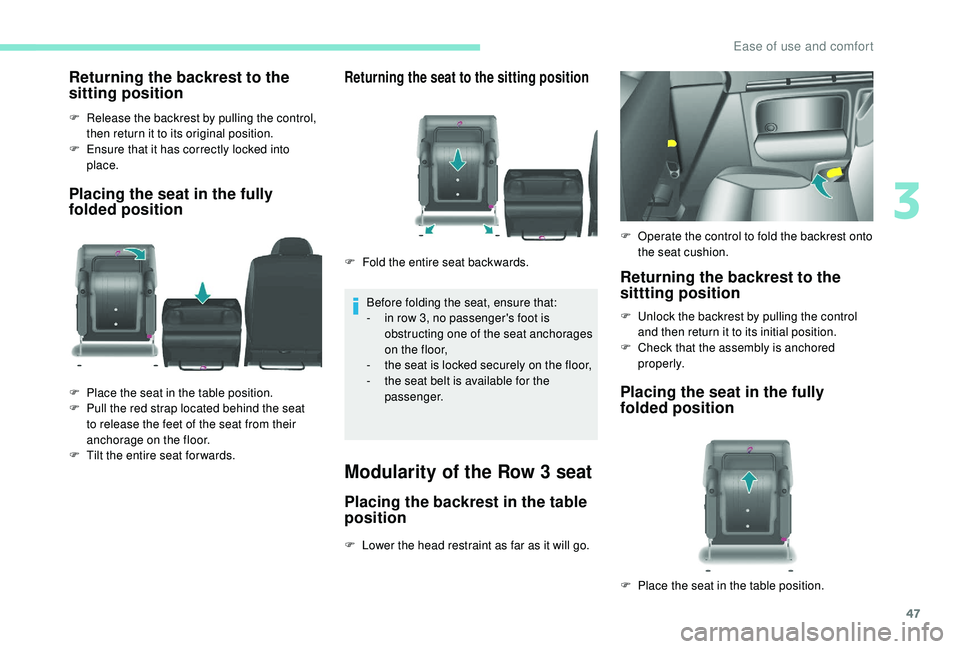
Returning the backrest to the
sitting position
F Release the backrest by pulling the control, then return it to its original position.
F
E
nsure that it has correctly locked into
place.
Placing the seat in the fully
folded position
Returning the seat to the sitting position
Before folding the seat, ensure that:
- i n row 3, no passenger's foot is
obstructing one of the seat anchorages
on the floor,
-
t
he seat is locked securely on the floor,
-
t
he seat belt is available for the
passenger.
Modularity of the Row 3 seat
Placing the backrest in the table
position
F Lower the head restraint as far as it will go.
F
P
lace the seat in the table position.
F
P
ull the red strap located behind the seat
to release the feet of the seat from their
anchorage on the floor.
F
T
ilt the entire seat for wards. F
F
old the entire seat backwards.
Returning the backrest to the
sittting position
F Unlock the backrest by pulling the control
and then return it to its initial position.
F
C
heck that the assembly is anchored
properly.
Placing the seat in the fully
folded position
F Operate the control to fold the backrest onto the seat cushion.
F
P
lace the seat in the table position.
3
Ease of use and comfort
Page 50 of 216
48
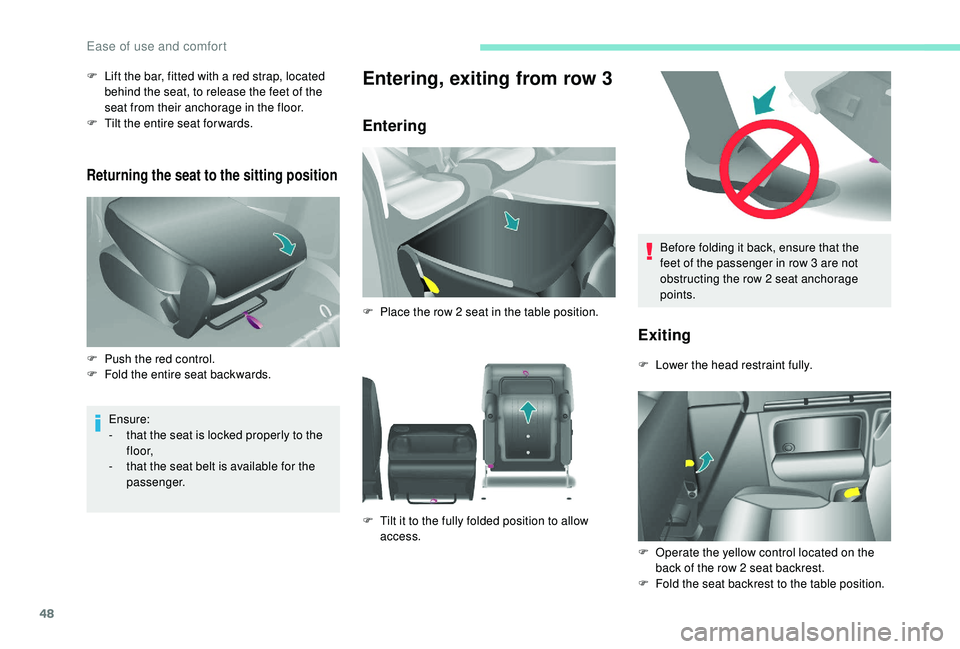
Before folding it back, ensure that the
feet of the passenger in row 3 are not
obstructing the row 2 seat anchorage
points.
Exiting
F Lower the head restraint fully.
F
O
perate the yellow control located on the
back of the row 2 seat backrest.
F
F
old the seat backrest to the table position.
Returning the seat to the sitting position
Ensure:
- t hat the seat is locked properly to the
f l o o r,
-
t
hat the seat belt is available for the
passenger.
Entering, exiting from row 3
Entering
F Lift the bar, fitted with a red strap, located behind the seat, to release the feet of the
seat from their anchorage in the floor.
F
T
ilt the entire seat for wards.
F
P
ush the red control.
F
F
old the entire seat backwards. F
P
lace the row 2 seat in the table position.
F
T
ilt it to the fully folded position to allow
access.
Ease of use and comfort
Page 51 of 216
49
Ensure that the centre seat belt is stowed
correctly in its housing in the headlining.
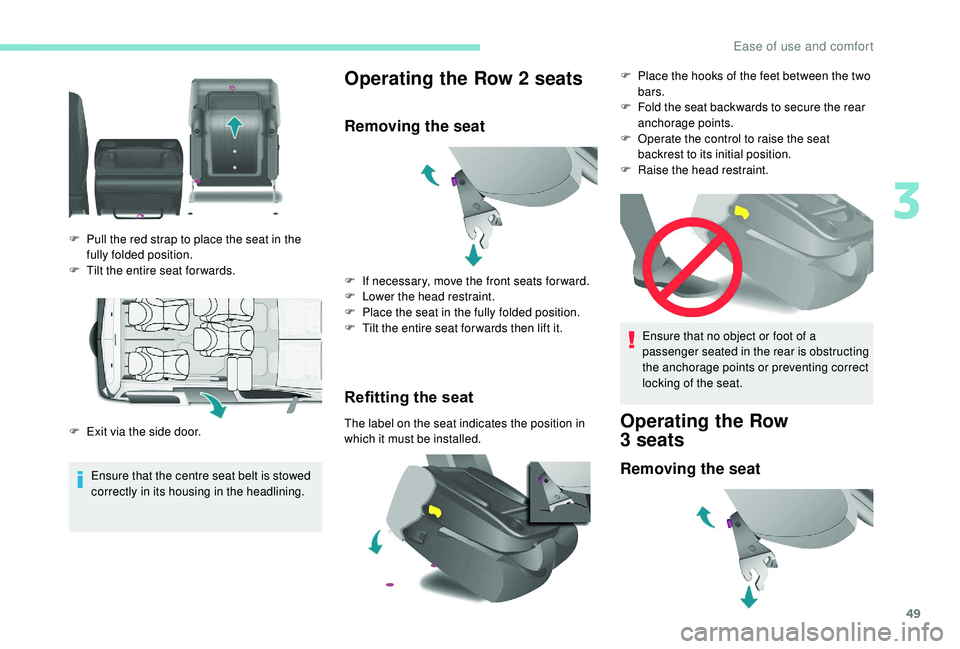
Operating the Row 2 seats
Removing the seat
Refitting the seat
The label on the seat indicates the position in
which it must be installed.
F
P
ull the red strap to place the seat in the
fully folded position.
F
T
ilt the entire seat for wards.
F
E
xit via the side door. F
I
f necessary, move the front seats for ward.
F
L
ower the head restraint.
F
P
lace the seat in the fully folded position.
F
T
ilt the entire seat for wards then lift it.
Ensure that no object or foot of a
passenger seated in the rear is obstructing
the anchorage points or preventing correct
locking of the seat.Operating the Row
3 seats
Removing the seat
F Place the hooks of the feet between the two
bars.
F
F
old the seat backwards to secure the rear
anchorage points.
F
O
perate the control to raise the seat
backrest to its initial position.
F
Ra
ise the head restraint.
3
Ease of use and comfort
Page 53 of 216
51
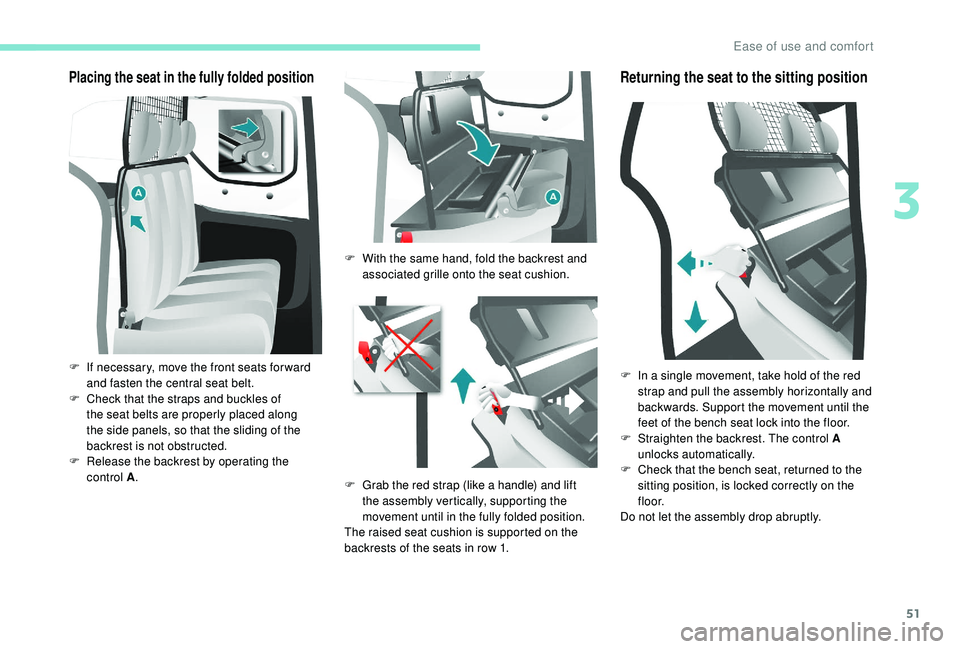
Placing the seat in the fully folded position
F If necessary, move the front seats for ward and fasten the central seat belt.
F
C
heck that the straps and buckles of
the seat belts are properly placed along
the side panels, so that the sliding of the
backrest is not obstructed.
F
R
elease the backrest by operating the
control
A. F
W
ith the same hand, fold the backrest and
associated grille onto the seat cushion.
F
G
rab the red strap (like a handle) and lift
the assembly vertically, supporting the
movement until in the fully folded position.
The raised seat cushion is supported on the
backrests of the seats in row 1.
Returning the seat to the sitting position
F In a single movement, take hold of the red strap and pull the assembly horizontally and
backwards. Support the movement until the
feet of the bench seat lock into the floor.
F
S
traighten the backrest. The control A
unlocks automatically.
F
C
heck that the bench seat, returned to the
sitting position, is locked correctly on the
f l o o r.
Do not let the assembly drop abruptly.
3
Ease of use and comfort
Page 60 of 216

58
Flow adjustment
Removing the fragrance diffuser
Replacing a cartridge
F Turn the chrome button to adjust the diffusion:
-
t
o the left to decrease,
-
t
o the right to increase.
F
T
o stop the diffusion, turn the chrome button
fully to the left. F
P
ress the button while turning it a quarter
turn to the left as far as it will go.
F
R
emove the fragrance diffuser from the
dashboard.
F
R
eplace your cartridge.
The fragrance diffuser refill consists of a
cartridge B and its sealed container C .
F
R
emove the protective film D.
F
P
ut the head of cartridge B on button A on
the fragrance diffuser.
F
T
urn it a quarter turn to lock it on the button
and remove the cover.
F
I
nsert the fragrance diffuser into its housing.
You can replace cartridges at any time and
keep cartridges that have already been opened
in their original sealed container.
The fragrance diffuser button A is independent
of the cartridge. The cartridges are delivered
without button A . The fragrance diffuser button A can only be
attached to the multifunction roof by using a
cartridge.
For that reason you should always keep button
A and a cartridge.
The cartridges are available from PEUGEOT
dealers.
Inserting the fragrance diffuser
After installing or replacing the cartridge:
F
p ut the fragrance diffuser back in its
housing,
F
t
urn it a quarter turn to the right.
Ease of use and comfort
Page 61 of 216
59
Courtesy lamps
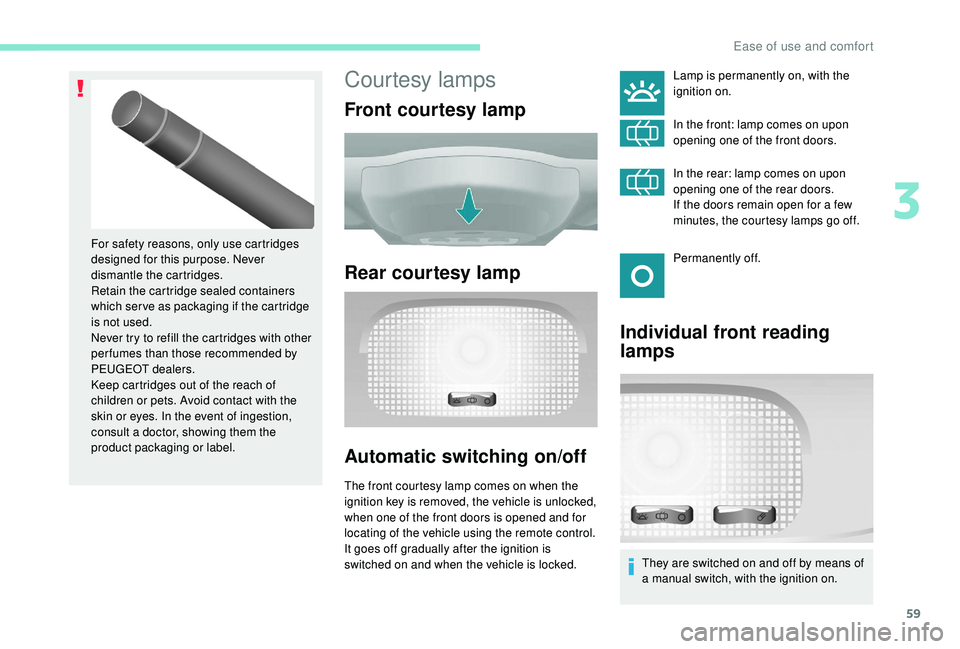
Front courtesy lamp
Rear courtesy lamp
Automatic switching on/off
The front courtesy lamp comes on when the
ignition key is removed, the vehicle is unlocked,
when one of the front doors is opened and for
locating of the vehicle using the remote control.
It goes off gradually after the ignition is
switched on and when the vehicle is locked.
For safety reasons, only use cartridges
designed for this purpose. Never
dismantle the cartridges.
Retain the cartridge sealed containers
which ser ve as packaging if the cartridge
is not used.
Never try to refill the cartridges with other
per fumes than those recommended by
PEUGEOT dealers.
Keep cartridges out of the reach of
children or pets. Avoid contact with the
skin or eyes. In the event of ingestion,
consult a doctor, showing them the
product packaging or label.
Individual front reading
lamps
Lamp is permanently on, with the
ignition on.
In the front: lamp comes on upon
opening one of the front doors.
In the rear: lamp comes on upon
opening one of the rear doors.
If the doors remain open for a few
minutes, the courtesy lamps go off.
Permanently off.
They are switched on and off by means of
a manual switch, with the ignition on.
3
Ease of use and comfort
Page 81 of 216
79
Anti-lock braking system
(ABS/EBFD)
The ABS and EBFD (electronic brake force
distribution) systems improve the stability and
manoeuvrability of your vehicle when braking,
in particular on poor or slippery sur faces.
The ABS prevents the wheels from locking,
and the EBFD provides control of the braking
pressure wheel by wheel.
The anti-lock braking system comes into
operation automatically when there is a risk
of wheel lock. It does not reduce the braking
distance.
On very slippery sur faces (ice, oil, etc.), the
ABS may increase the braking distance. When
braking in an emergency, do not hesitate to
press the brake pedal firmly without releasing
the pressure, even on a slippery sur face; you
will then be able to continue to manoeuvre the
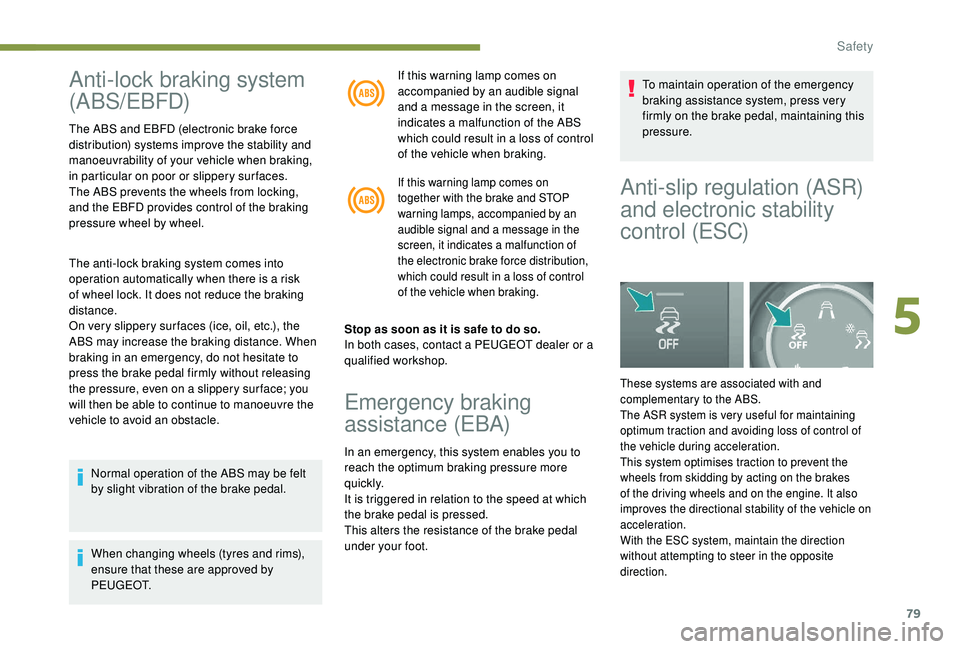
vehicle to avoid an obstacle.If this warning lamp comes on
accompanied by an audible signal
and a message in the screen, it
indicates a malfunction of the ABS
which could result in a loss of control
of the vehicle when braking.
If this warning lamp comes on
together with the brake and STOP
warning lamps, accompanied by an
audible signal and a message in the
screen, it indicates a malfunction of
the electronic brake force distribution,
which could result in a loss of control
of the vehicle when braking.
Stop as soon as it is safe to do so.
In both cases, contact a PEUGEOT dealer or a
qualified workshop.
Emergency braking
assistance (EBA)
In an emergency, this system enables you to
reach the optimum braking pressure more
quickly.
It is triggered in relation to the speed at which
the brake pedal is pressed.
This alters the resistance of the brake pedal
under your foot.To maintain operation of the emergency
braking assistance system, press very
firmly on the brake pedal, maintaining this
pressure.
Normal operation of the ABS may be felt
by slight vibration of the brake pedal.
When changing wheels (tyres and rims),
ensure that these are approved by
P E U G E O T.
Anti-slip regulation (ASR)
and electronic stability
c ont rol (ESC)
These systems are associated with and
complementary to the ABS.
The ASR system is very useful for maintaining
optimum traction and avoiding loss of control of
the vehicle during acceleration.
This system optimises traction to prevent the
wheels from skidding by acting on the brakes
of the driving wheels and on the engine. It also
improves the directional stability of the vehicle on
acceleration.
With the ESC system, maintain the direction
without attempting to steer in the opposite
direction.
5
Safety
Page 86 of 216

84
Advice
The driver must ensure that passengers use
the seat belts correctly and that they are all
fastened before setting off.
Wherever you are seated in the vehicle,
always fasten your seat belt, even for short
journeys.
Do not interchange the seat belt buckles as
they will not fulfil their role fully.
The seat belts are fitted with an inertia reel
permitting automatic adjustment of the length
of the strap to your size. The seat belt is
stowed automatically when not in use.
Before and after use, ensure that the seat belt
is reeled in correctly.
The lower part of the strap must be positioned
as low as possible on the pelvis.
The upper part must be positioned in the
hollow of the shoulder.
The inertia reels have a device for automatic
locking in the event of a collision, sudden
braking or if the vehicle turns over. You can
release the device by pulling the strap firmly
and then releasing it so that it reels in slightly.In order to be effective, a seat belt must:
-
b e tightened as close to the body as
possible,
-
b
e pulled in front of you with a smooth
movement, checking that it does not twist,
-
b
e used to restrain only one person,
-
n
ot show any signs of cuts or fraying,
-
n
ot be converted or modified to avoid
affecting its performance.
In accordance with current safety regulations,
for all repairs on your vehicle's seat belts, go
to a qualified workshop with the skills and
equipment needed, which a PEUGEOT dealer
is able to provide.
Have your seat belts checked regularly by a
PEUGEOT dealer or a qualified workshop,
particularly if the straps show signs of
damage.
Clean the seat belt straps with soapy water or
a textile cleaning product, sold by PEUGEOT
dealers.
After folding or moving a seat or rear bench
seat, ensure that the seat belt is positioned
and reeled in correctly. Recommendations for children
Use a suitable child seat if the passenger is
less than 12
years old or shorter than one and
a half metres.
Never use the same seat belt to secure more
than one person.
Never allow a child to travel on your lap.
For more information on Child seats , refer to
the corresponding section.
In the event of an impact
Depending on the nature and seriousness
of the impact , the pyrotechnic device may
be deployed before and independently of the
airbags. Deployment of the pretensioners
is accompanied by a slight discharge of
harmless smoke and a noise, due to the
activation of the pyrotechnic cartridge
incorporated in the system.
In all cases, the airbag warning lamp comes
on.
Following an impact, have the seat belts
system checked and, if necessary, replaced,
by a PEUGEOT dealer or a qualified
workshop.
Safety