2016 NISSAN NOTE ESP
[x] Cancel search: ESPPage 1877 of 3641
FUEL TANKFL-11
< REMOVAL AND INSTALLATION >
C
DE
F
G H
I
J
K L
M A
FL
NP
O
3. Open fuel filler lid.
4. Open fuel filler cap and release
the pressure inside fuel tank.
5. Remove the rear seat cushion. Refer to SE-26, "
SEAT CUSHION : Removal and Installation".
6. Remove the inspection hole cover. NOTE:
Inspection hole cover is held by an adhesive.
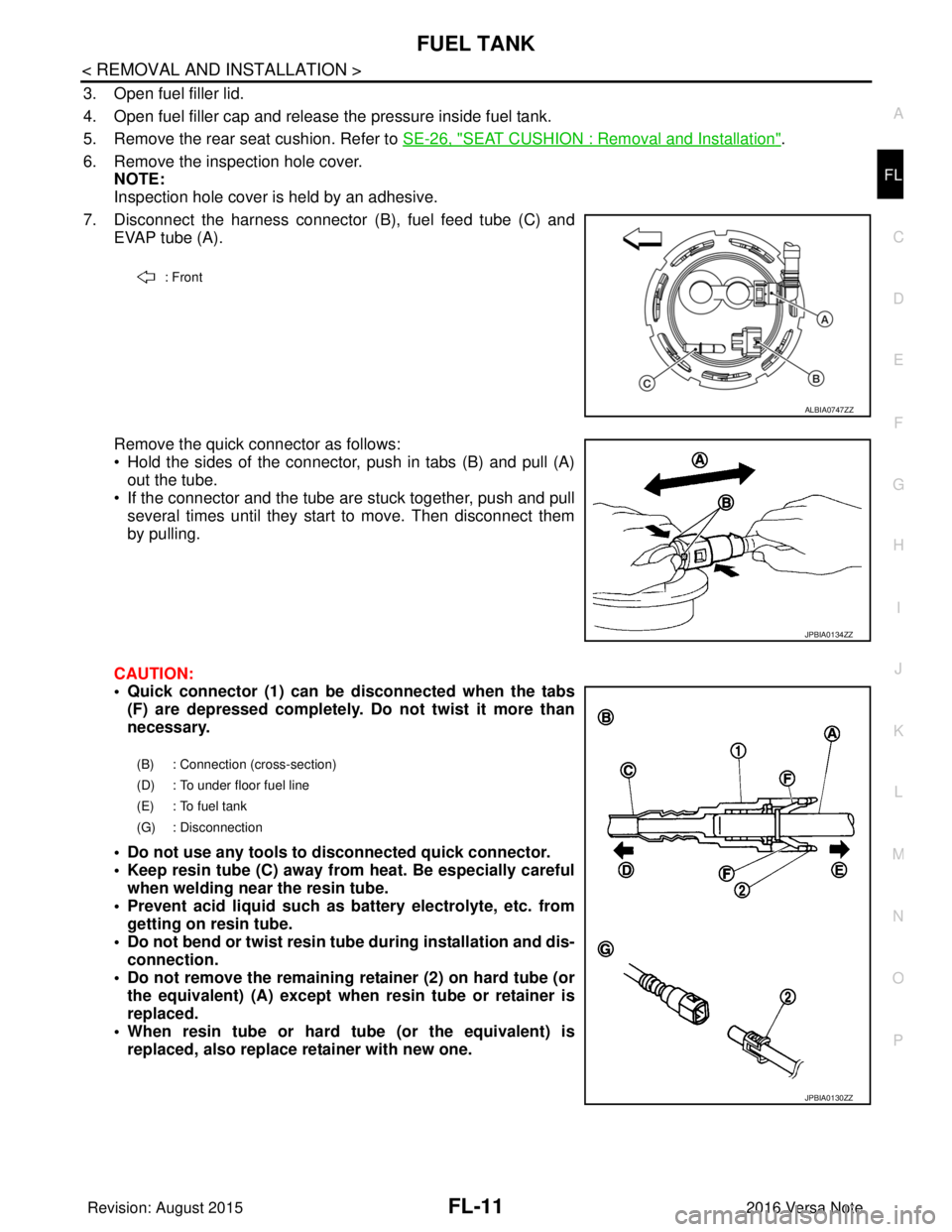
7. Disconnect the harness connector (B), fuel feed tube (C) and
EVAP tube (A).
Remove the quick connector as follows:
• Hold the sides of the connector, push in tabs (B) and pull (A) out the tube.
• If the connector and the tube are stuck together, push and pull several times until they start to move. Then disconnect them
by pulling.
CAUTION:
• Quick connector (1) can be disconnected when the tabs (F) are depressed completely. Do not twist it more than
necessary.
• Do not use any tools to disconnected quick connector.
• Keep resin tube (C) away from heat. Be especially careful when welding near the resin tube.
• Prevent acid liquid such as battery electrolyte, etc. from getting on resin tube.
• Do not bend or twist resin tube during installation and dis- connection.
• Do not remove the remaining retainer (2) on hard tube (or the equivalent) (A) except when resin tube or retainer is
replaced.
• When resin tube or hard tube (or the equivalent) is replaced, also replace retainer with new one.
: Front
ALBIA0747ZZ
JPBIA0134ZZ
(B) : Connection (cross-section)
(D) : To under floor fuel line
(E) : To fuel tank
(G) : Disconnection
JPBIA0130ZZ
Revision: August 2015 2016 Versa Note
cardiagn.com
Page 1897 of 3641
HOW TO READ WIRING DIAGRAMSGI-9
< HOW TO USE THIS MANUAL >
C
DE
F
G H
I
J
K L
M B
GI
N
O PHOW TO READ WIRING DIAGRAMS
Connector SymbolsINFOID:0000000012433151
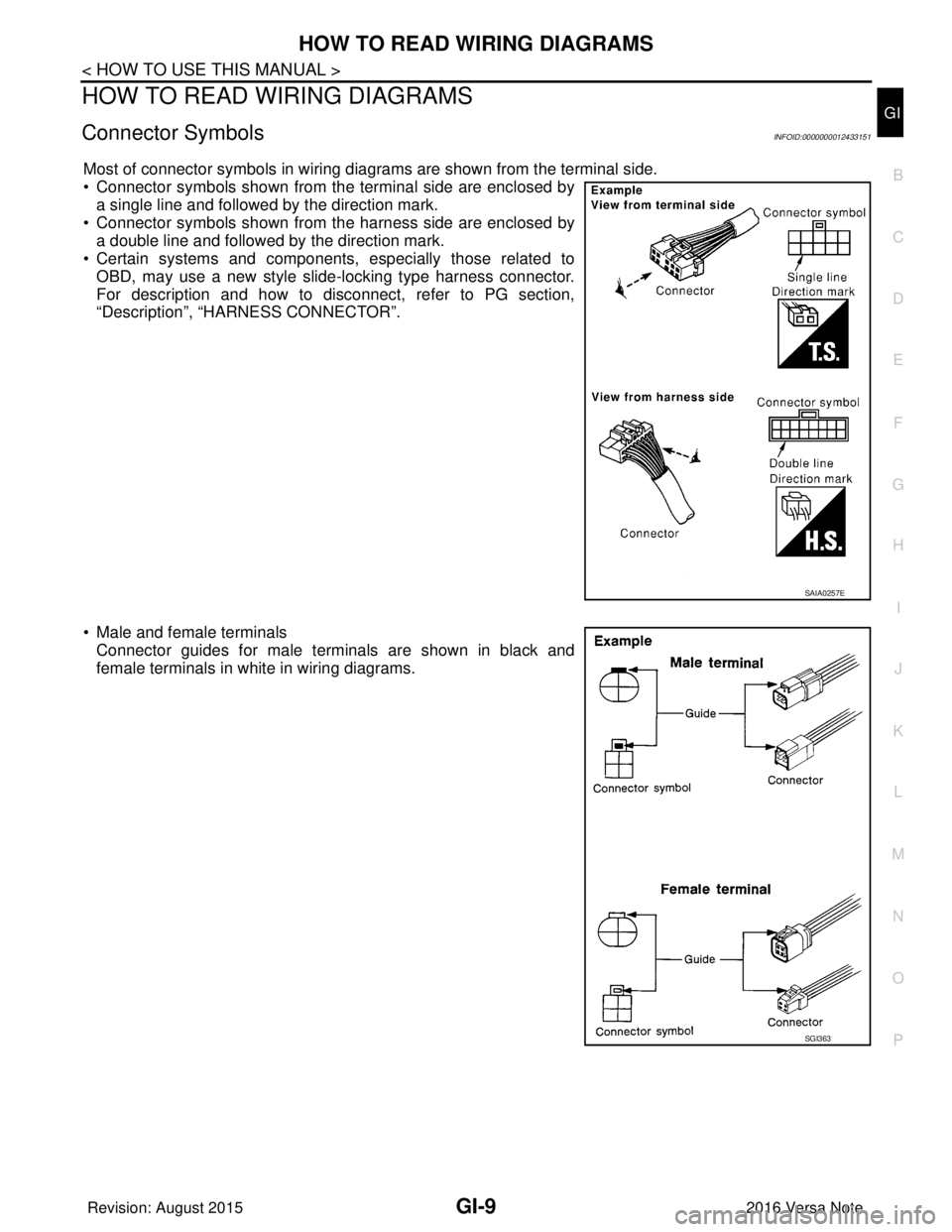
Most of connector symbols in wiring diagrams are shown from the terminal side.
• Connector symbols shown from the terminal side are enclosed by a single line and followed by the direction mark.
• Connector symbols shown from the harness side are enclosed by a double line and followed by the direction mark.
• Certain systems and components, especially those related to
OBD, may use a new style slide-locking type harness connector.
For description and how to disconnect, refer to PG section,
“Description”, “HARNESS CONNECTOR”.
• Male and female terminals Connector guides for male terminals are shown in black and
female terminals in white in wiring diagrams.
SAIA0257E
SGI363
Revision: August 2015 2016 Versa Note
cardiagn.com
Page 1903 of 3641

ABBREVIATIONSGI-15
< HOW TO USE THIS MANUAL >
C
DE
F
G H
I
J
K L
M B
GI
N
O P
E
F
G
H
DLC Data link connector
DTC Diagnostic trouble code
ABBREVIATION DESCRIPTION
E/T Exhaust temperature
EBD Electric brake force distribution
EC Engine control
ECL Engine coolant level
ECM Engine control module
ECT Engine coolant temperature
ECV Electrical control valve
EEPROM Electrically erasable programmable read only memory EFT Engine fuel temperature
EGR Exhaust gas recirculation
EGRT Exhaust gas recirculation temperature EGT Exhaust gas temperature
EOP Engine oil pressure
EP Exhaust pressure
EPR Exhaust pressure regulator
EPS Electronically controlled power steering
ESP Electronic stability program system
EVAP canister Evaporative emission canister EVSE Electric vehicle supply equipment
EXC Exhaust control
ABBREVIATION DESCRIPTION
FC Fan control
FCW Forward collision warning
FIC Fuel injector control
FP Fuel pump
FR Front
FRP Fuel rail pressure
FRT Fuel rail temperature
FTP Fuel tank pressure
FTT Fuel tank temperature
ABBREVIATION DESCRIPTION
GND Ground
GPS Global positioning system
GST Generic scan tool
ABBREVIATION DESCRIPTION
HBMC Hydraulic body-motion control system HDD Hard disk drive
HO2S Heated oxygen sensor
ABBREVIATION
DESCRIPTION
Revision: August 2015 2016 Versa Note
cardiagn.com
Page 1912 of 3641
GI-24
< PRECAUTION >
PRECAUTIONS
General Precautions
INFOID:0000000012433162
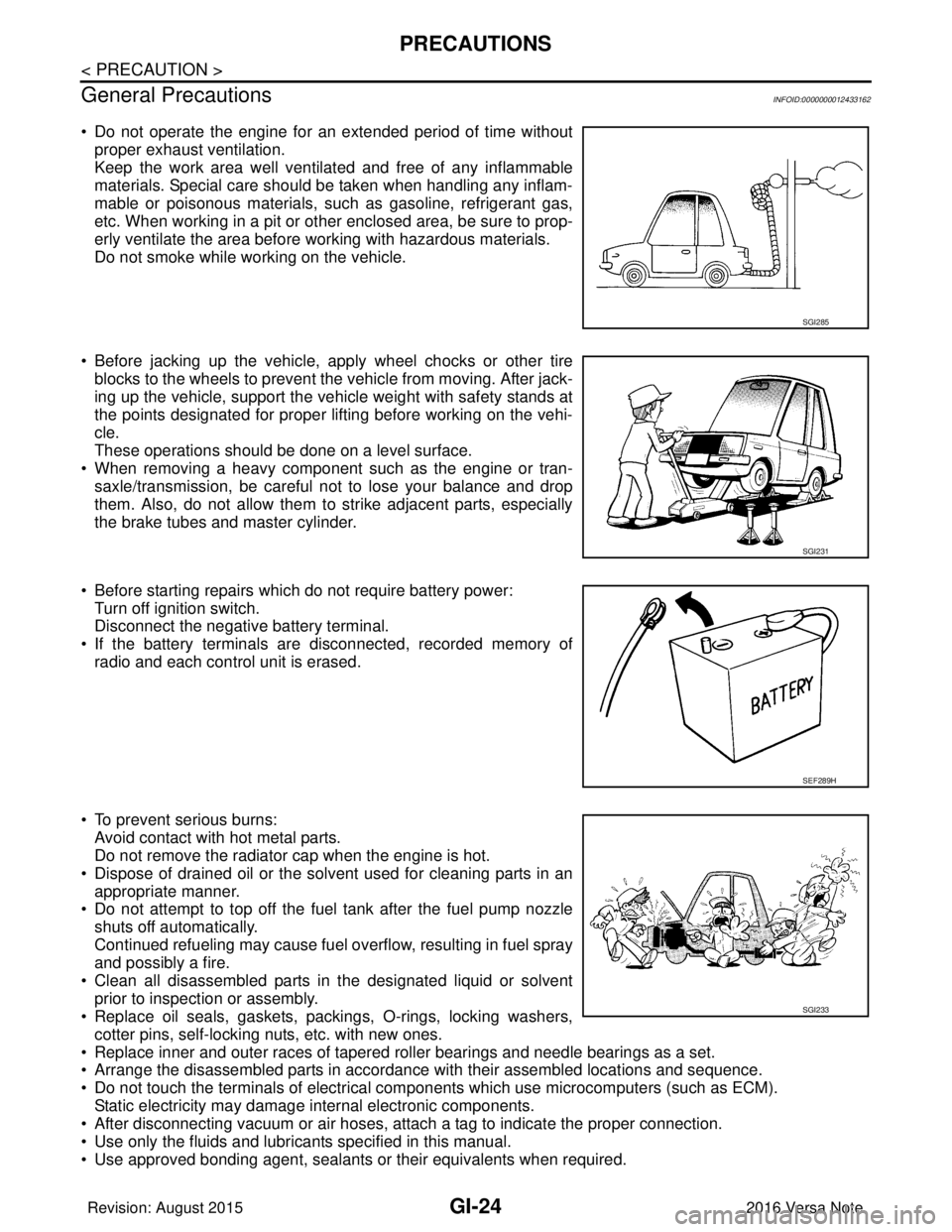
• Do not operate the engine for an extended period of time without proper exhaust ventilation.
Keep the work area well ventilated and free of any inflammable
materials. Special care should be taken when handling any inflam-
mable or poisonous materials, such as gasoline, refrigerant gas,
etc. When working in a pit or other enclosed area, be sure to prop-
erly ventilate the area before working with hazardous materials.
Do not smoke while working on the vehicle.
• Before jacking up the vehicle, apply wheel chocks or other tire blocks to the wheels to prevent the vehicle from moving. After jack-
ing up the vehicle, support the vehicle weight with safety stands at
the points designated for proper lifting before working on the vehi-
cle.
These operations should be done on a level surface.
• When removing a heavy component such as the engine or tran- saxle/transmission, be careful not to lose your balance and drop
them. Also, do not allow them to strike adjacent parts, especially
the brake tubes and master cylinder.
• Before starting repairs which do not require battery power: Turn off ignition switch.
Disconnect the negative battery terminal.
• If the battery terminals are disconnected, recorded memory of radio and each control unit is erased.
• To prevent serious burns: Avoid contact with hot metal parts.
Do not remove the radiator cap when the engine is hot.
• Dispose of drained oil or the solvent used for cleaning parts in an appropriate manner.
• Do not attempt to top off the fuel tank after the fuel pump nozzle
shuts off automatically.
Continued refueling may cause fuel overflow, resulting in fuel spray
and possibly a fire.
• Clean all disassembled parts in the designated liquid or solvent prior to inspection or assembly.
• Replace oil seals, gaskets, packings, O-rings, locking washers,
cotter pins, self-locking nuts, etc. with new ones.
• Replace inner and outer races of tapered roller bearings and needle bearings as a set.
• Arrange the disassembled parts in accordance with their assembled locations and sequence.
• Do not touch the terminals of electrical com ponents which use microcomputers (such as ECM).
Static electricity may damage internal electronic components.
• After disconnecting vacuum or air hoses, atta ch a tag to indicate the proper connection.
• Use only the fluids and lubricants specified in this manual.
• Use approved bonding agent, sealants or their equivalents when required.
SGI285
SGI231
SEF289H
SGI233
Revision: August 2015 2016 Versa Note
cardiagn.com
Page 1945 of 3641
SQUEAK AND RATTLE TROUBLE DIAGNOSESGW-5
< SYMPTOM DIAGNOSIS >
C
DE
F
G H
I
J
L
M A
B
GW
N
O P
SYMPTOM DIAGNOSIS
SQUEAK AND RATTLE TROUBLE DIAGNOSES
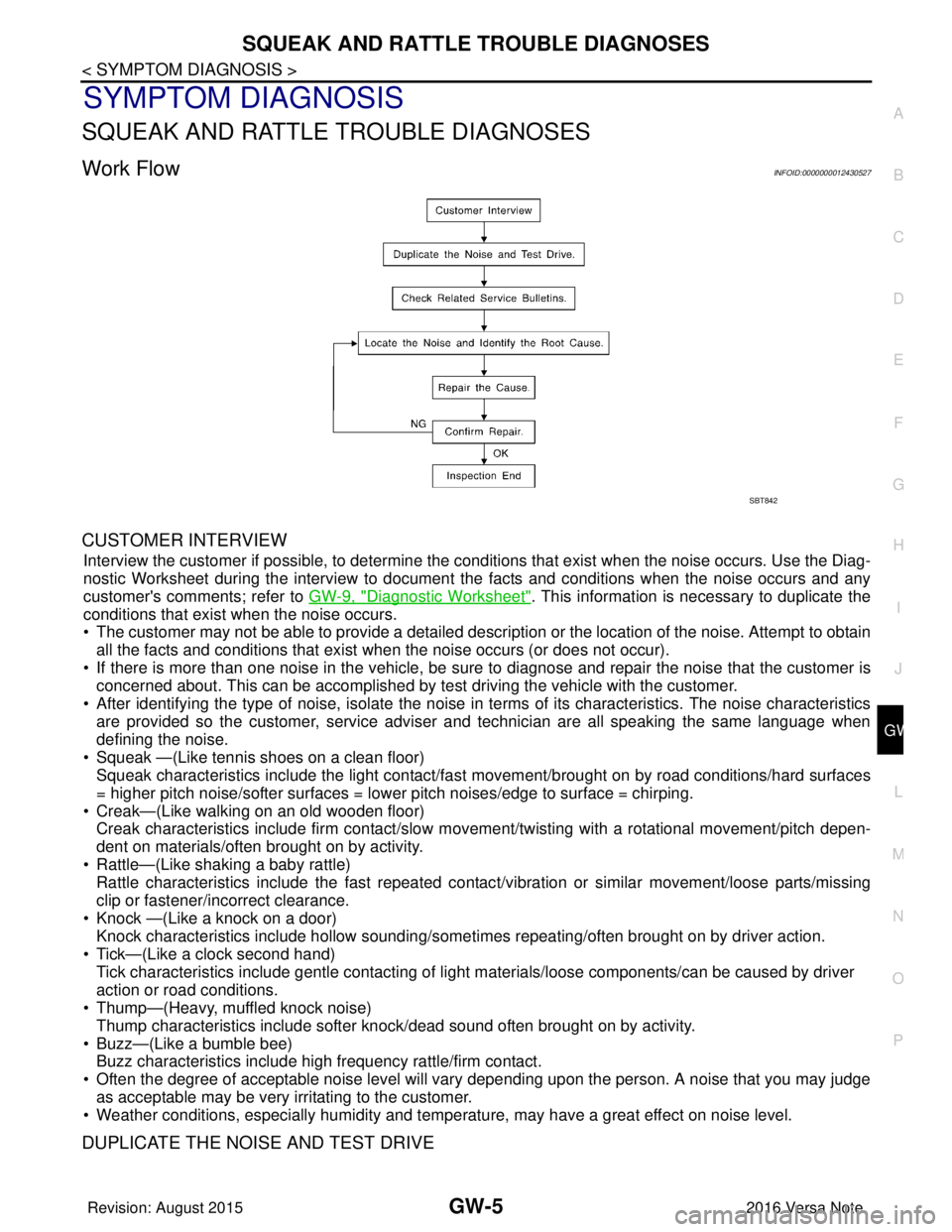
Work FlowINFOID:0000000012430527
CUSTOMER INTERVIEW
Interview the customer if possible, to determine the conditions that exist when the noise occurs. Use the Diag-
nostic Worksheet during the interv iew to document the facts and conditions when the noise occurs and any
customer's comments; refer to GW-9, "
Diagnostic Worksheet". This information is necessary to duplicate the
conditions that exist when the noise occurs.
• The customer may not be able to provide a detailed descr iption or the location of the noise. Attempt to obtain
all the facts and conditions that exist when the noise occurs (or does not occur).
• If there is more than one noise in the vehicle, be sure to diagnose and repair the noise that the customer is
concerned about. This can be accomplished by test driving the vehicle with the customer.
• After identifying the type of noise, isolate the noise in terms of its characteristics. The noise characteristics are provided so the customer, service adviser and technician are all speaking the same language when
defining the noise.
• Squeak —(Like tennis shoes on a clean floor) Squeak characteristics include the light contact/fast movement/brought on by road conditions/hard surfaces
= higher pitch noise/softer surfaces = lower pitch noises/edge to surface = chirping.
• Creak—(Like walking on an old wooden floor) Creak characteristics include firm contact/slow mo vement/twisting with a rotational movement/pitch depen-
dent on materials/often brought on by activity.
• Rattle—(Like shaking a baby rattle) Rattle characteristics include the fast repeated contac t/vibration or similar movement/loose parts/missing
clip or fastener/incorrect clearance.
• Knock —(Like a knock on a door) Knock characteristics include hollow sounding/someti mes repeating/often brought on by driver action.
• Tick—(Like a clock second hand) Tick characteristics include gentle contacting of li ght materials/loose components/can be caused by driver
action or road conditions.
• Thump—(Heavy, muffled knock noise)
Thump characteristics include softer k nock/dead sound often brought on by activity.
• Buzz—(Like a bumble bee) Buzz characteristics include high frequency rattle/firm contact.
• Often the degree of acceptable noise level will vary depending upon the person. A noise that you may judge as acceptable may be very irritating to the customer.
• Weather conditions, especially humidity and temperature, may have a great effect on noise level.
DUPLICATE THE NOISE AND TEST DRIVE
SBT842
Revision: August 2015 2016 Versa Note
cardiagn.com
Page 2016 of 3641
![NISSAN NOTE 2016 Service Repair Manual HAC-48
< SYMPTOM DIAGNOSIS >[MANUAL AIR CONDITIONING]
INSUFFICIENT COOLING
INSUFFICIENT COOLING
DescriptionINFOID:0000000012430750
Symptom
• Insufficient cooling
• No cool air comes out. (Air flow](/manual-img/5/57363/w960_57363-2015.png "NISSAN NOTE 2016 Service Repair Manual HAC-48
< SYMPTOM DIAGNOSIS >[MANUAL AIR CONDITIONING]
INSUFFICIENT COOLING
INSUFFICIENT COOLING
DescriptionINFOID:0000000012430750
Symptom
• Insufficient cooling
• No cool air comes out. (Air flow")
HAC-48
< SYMPTOM DIAGNOSIS >[MANUAL AIR CONDITIONING]
INSUFFICIENT COOLING
INSUFFICIENT COOLING
DescriptionINFOID:0000000012430750
Symptom
• Insufficient cooling
• No cool air comes out. (Air flow volume is normal.)
Diagnosis ProcedureINFOID:0000000012430751
NOTE:
Perform self-diagnosis with CONSULT before performing
symptom diagnosis. If any malfunction result or DTC
is detected, perform the corresponding diagnosis.
1.CHECK MAGNET CLUTCH OPERATION
1. Turn ignition switch ON.
2. Turn fan control dial ON.
3. Press A/C switch.
4. Check that A/C indicator turns ON. Check visually and by sound that compressor operates.
5. Press A/C switch again.
6. Check that A/C indicator turns OFF. Check that compressor stops.
Is the inspection result normal?
YES >> GO TO 2.
NO >> Check compressor operation. Refer to HAC-50, "
Diagnosis Procedure".
2.CHECK DRIVE BELT
Check tension of drive belt. Refer to EM-17, "
Inspection".
Is the inspection result normal?
YES >> GO TO 3.
NO >> Adjust or replace drive belt depending on the inspection results.
3.CHECK REFRIGERANT CYCLE PRESSURE
Connect the recovery/recycling recharging equipment to the vehicle and perform the pressure inspection
using gauge. Refer to HA-15, "
Symptom Table".
Is the inspection result normal?
YES >> GO TO 4.
NO >> Repair or replace parts depending on the inspection results.
4.CHECK AIR LEAKAGE FROM EACH DUCT
Check duct and nozzle, etc. of t he air conditioner system for leakage.
Is the inspection result normal?
YES >> Check air mix door cable installation and air mix door operation.
NO >> Repair or replace parts depending on the inspection results.
Revision: August 2015 2016 Versa Note
cardiagn.com
Page 2017 of 3641
![NISSAN NOTE 2016 Service Repair Manual INSUFFICIENT HEATINGHAC-49
< SYMPTOM DIAGNOSIS > [MANUAL AIR CONDITIONING]
C
D
E
F
G H
J
K L
M A
B
HAC
N
O P
INSUFFICIENT HEATING
DescriptionINFOID:0000000012430752
Symptom
• Insufficient heating
â€](/manual-img/5/57363/w960_57363-2016.png "NISSAN NOTE 2016 Service Repair Manual INSUFFICIENT HEATINGHAC-49
< SYMPTOM DIAGNOSIS > [MANUAL AIR CONDITIONING]
C
D
E
F
G H
J
K L
M A
B
HAC
N
O P
INSUFFICIENT HEATING
DescriptionINFOID:0000000012430752
Symptom
• Insufficient heating
â€")
INSUFFICIENT HEATINGHAC-49
< SYMPTOM DIAGNOSIS > [MANUAL AIR CONDITIONING]
C
D
E
F
G H
J
K L
M A
B
HAC
N
O P
INSUFFICIENT HEATING
DescriptionINFOID:0000000012430752
Symptom
• Insufficient heating
• No warm air comes out. (Air flow volume is normal.)
Diagnosis ProcedureINFOID:0000000012430753
NOTE:
Perform self-diagnosis with CONSULT before performing sy mptom diagnosis. If any malfunction result or DTC
is detected, perform the corresponding diagnosis.
1.CHECK COOLING SYSTEM
1. Check engine coolant level and check for leakage. Refer to CO-8, "
Inspection".
2. Check radiator cap. Refer to CO-12, "
RADIATOR CAP : Inspection".
3. Check water flow sounds of the engine coolant. Refer to CO-9, "
Refilling".
Is the inspection result normal?
YES >> GO TO 2.
NO >> Refill engine coolant and repair or replace the parts depending on the inspection results.
2.CHECK HEATER HOSE
Check installation of heater hose by visually or touching.
Is the inspection result normal?
YES >> GO TO 3.
NO >> Repair or replace parts depending on the inspection results.
3.CHECK HEATER CORE
1. Check temperature of inlet hose and outlet hose of heater core.
2. Check that inlet side of heater core is hot and the outle t side is slightly lower than/almost equal to the inlet
side.
CAUTION:
Always perform the temperature inspection in a sh ort period of time because the engine coolant
temperature is very hot.
Is the inspection result normal?
YES >> GO TO 4.
NO >> Replace heater core. Refer to HA-35, "
HEATER CORE : Removal and Installation".
4.CHECK AIR LEAKAGE FROM EACH DUCT
Check duct and nozzle, etc. of air conditioning system for air leakage.
Is the inspection result normal?
YES >> Check air mix door cable inst allation and air mix door operation.
NO >> Repair or replace parts depending on the inspection results.
Revision: August 2015 2016 Versa Note
cardiagn.com
Page 2018 of 3641
![NISSAN NOTE 2016 Service Repair Manual HAC-50
< SYMPTOM DIAGNOSIS >[MANUAL AIR CONDITIONING]
COMPRESSOR DOES NOT OPERATE
COMPRESSOR DOES NOT OPERATE
DescriptionINFOID:0000000012430754
SYMPTOM
Compressor does not operate.
Diagnosis Procedu](/manual-img/5/57363/w960_57363-2017.png "NISSAN NOTE 2016 Service Repair Manual HAC-50
< SYMPTOM DIAGNOSIS >[MANUAL AIR CONDITIONING]
COMPRESSOR DOES NOT OPERATE
COMPRESSOR DOES NOT OPERATE
DescriptionINFOID:0000000012430754
SYMPTOM
Compressor does not operate.
Diagnosis Procedu")
HAC-50
< SYMPTOM DIAGNOSIS >[MANUAL AIR CONDITIONING]
COMPRESSOR DOES NOT OPERATE
COMPRESSOR DOES NOT OPERATE
DescriptionINFOID:0000000012430754
SYMPTOM
Compressor does not operate.
Diagnosis ProcedureINFOID:0000000012430755
NOTE:
• Perform self-diagnosis with CONSULT before performi
ng symptom diagnosis. If any malfunction result or
DTC is detected, perform the corresponding diagnosis.
• Check that refrigerant system is fully charged. If the refrigerant charge is low, perform the inspection for refrigerant leakage
1.CHECK MAGNET CLUTCH OPERATION
Check magnet clutch. Refer to HAC-45, "
Component Function Check".
Does it operate normally?
YES >> GO TO 2.
NO >> Repair or replace malfunctioning parts.
2.CHECK REFRIGERANT PRESSURE SENSOR
Check refrigerant pressure sensor. Refer to EC-462, "
Component Function Check".
Is the inspection result normal?
YES >> GO TO 3.
NO >> Repair or replace malfunctioning parts.
3.CHECK A/C ON SIGNAL
Check A/C ON signal. Refer to HAC-32, "
Component Function Check".
Is the inspection result normal?
YES >> GO TO 4.
NO >> Repair or replace malfunctioning parts.
4.CHECK DEFROSTER POSITION SIGNAL
Check defroster position signal. Refer to HAC-37, "
Component Function Check".
Is the inspection result normal?
YES >> GO TO 5.
NO >> Repair or replace malfunctioning parts.
5.CHECK BLOWER FAN ON SIGNAL
Check blower fan ON signal. Refer to HAC-35, "
Component Function Check".
Is the inspection result normal?
YES >> GO TO 6.
NO >> Repair or replace malfunctioning parts
6.CHECK BCM OUTPUT SIGNAL
With CONSULT
1. Select “Data Monitor” of “ECM”.
2. Select “AIR COND SIG” and “HEATER FAN SW”, and check status under the following conditions.
Is the inspection result normal?
Monitor item Condition Status
AIR COND SIG A/C switchOFF (A/C indicator: OFF)
Off
ON (A/C indicator: ON) On
HEATER FAN SW Blower motor OFF
Off
ON On
Revision: August 2015 2016 Versa Note
cardiagn.com