2014 MERCEDES-BENZ B-CLASS SPORTS oil change
[x] Cancel search: oil changePage 152 of 360
Problems with the transmission
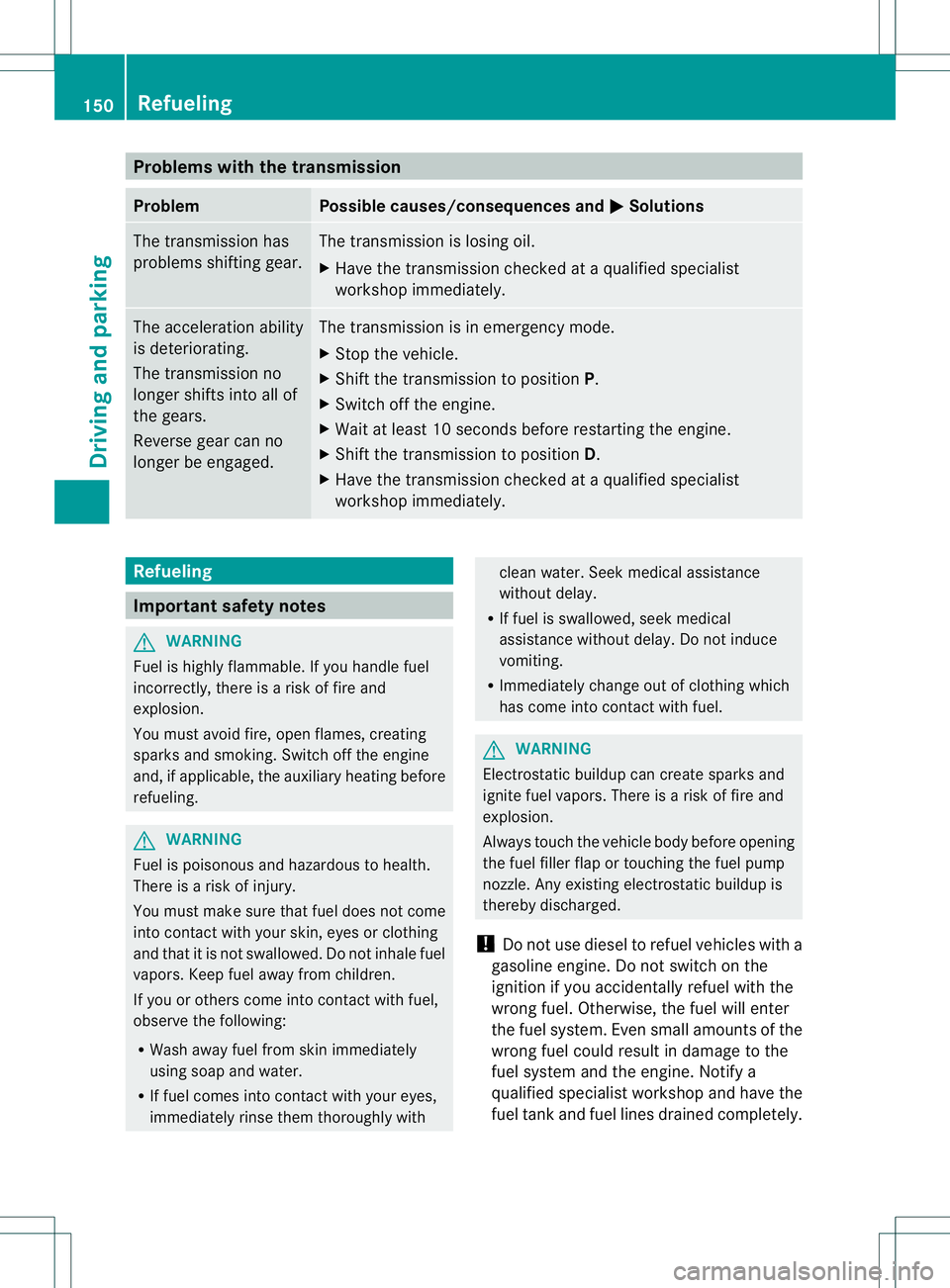
Problem Possible causes/consequences and
000B Solutions
The transmission has
problems shifting gear. The transmission is losing oil.
X
Have the transmission checked at aqualified specialist
workshop immediately. The acceleration ability
is deteriorating.
The transmission no
longer shifts into all of
the gears.
Reverse gear can no
longer be engaged. The transmission is in emergency mode.
X
Stop the vehicle.
X Shift the transmission to position P.
X Switch off the engine.
X Wait at least 10 seconds before restarting the engine.
X Shift the transmission to position D.
X Have the transmission checked at aqualified specialist
workshop immediately. Refueling
Important safety notes
G
WARNING
Fuel is highly flammable. If you handle fuel
incorrectly, there is arisk of fire and
explosion.
You must avoid fire, open flames, creating
sparks and smoking. Switch off the engine
and, if applicable, the auxiliary heating before
refueling. G
WARNING
Fuel is poisonous and hazardous to health.
There is arisk of injury.
You must make sure that fuel does not come
into contact with your skin, eyes or clothing
and that it is not swallowed. Do not inhale fuel
vapors. Keep fuel away from children.
If you or others come into contact with fuel,
observe the following:
R Wash away fuel from skin immediately
using soap and water.
R If fuel comes into contact with your eyes,
immediately rinse them thoroughly with clean water. Seek medical assistance
without delay.
R If fuel is swallowed, seek medical
assistance without delay.Don ot induce
vomiting.
R Immediately change out of clothin gwhich
has come into contact with fuel. G
WARNING
Electrostatic buildu pcan create sparks and
ignite fuel vapors. There is arisk of fire and
explosion.
Always touch the vehicle body before opening
the fuel filler flap or touching the fuel pump
nozzle. Any existin gelectrostatic buildu pis
thereby discharged.
! Do not use diesel to refuel vehicles with a
gasoline engine. Do not switch on the
ignition if you accidentally refuel with the
wrong fuel. Otherwise, the fuel will enter
the fuel system. Even small amounts of the
wrong fuel could result in damage to the
fuel system and the engine. Notify a
qualified specialist workshop and have the
fuel tank and fuel lines drained completely. 150
RefuelingDriving and parking
Page 287 of 360
Hiding
aservice message X
Pres sthe 000C or0002 button on the
steerin gwheel.
Displaying service messages X
Switch on th eignition.
X Pres sthe 000A or0004 button to selec tthe
Serv. menu.
X Press the 0006or0005 button to select the
ASSYST PLUS submenu and confirm by
pressing the 000Cbutton.
The service due date appears in the
multifunction display.
Information about Service Resetting the ASSYST PLUS service
interval display
!
If the ASSYST PLUS service interval
displayh as been inadvertently reset, this
settingc an be corrected at aqualified
specialist workshop.
Have service work carried out as described
in the MaintenanceB ooklet. This may
otherwise lead to increased wear and
damage to the major assemblies or the
vehicle.
Aq ualified specialist workshop, e.g. an
authorize dMercedes-Ben zCenter, will reset
the ASSYST PLUS servic einterval display
after the servic ework has been carried out.
You can also obtain further information on
maintenanc ework, for example.
Special service requirements
The specified maintenanc einterval takes only
the normal operation of the vehicle into
account. Under arduous operatin gconditions
or increased load on the vehicle,
maintenanc ework must be carried out more
frequently, for example:
R regular city driving with frequent
intermediate stops
R if the vehicle is primarily used to travel
short distances R
use in mountainous terrain or on poor road
surfaces
R if the engin eisoften left idling for long
periods
Under these or similar conditions ,have, for
example, the air filter, engin eoil and oil filter
replaced or changed more frequently. Under
arduous operatin gconditions ,the tires must
be checked more often .Further information
can be obtained at aqualified specialist
workshop, e.g. an authorized Mercedes-Benz
Center.
Driving abroad
An extensive Mercedes-BenzS ervice network
is also available in other countries. You can
obtain further information from any
authorized Mercedes-BenzC enter. Care
General notes
H
Environmental note
Dispose of empty packagin gand cleaning
cloth sinane nvironmentally responsible
manner.
! For cleanin gyour vehicle, do not use any
of the following:
R dry, rough or hard cloths
R abrasive cleanin gagents
R solvents
R cleanin gagents containin gsolvents
Do not scrub.
Do not touch the surfaces or protective
films with hard objects, e.g. aring or ice
scraper. You could otherwise scratch or
damage the surfaces and protective film.
! Do not park the vehicle for an extended
period straight after cleanin git, particularly
after having cleaned the wheels with wheel
cleaner. Wheel cleaners could cause
increased corrosion of the brake discs and
brake pads/linings. For this reason, you Care
285Maintenance and care Z
Page 292 of 360
Cleaning th
eexhaust pipe Impurities combined wit
hthe effect sofroad
grit and corrosive environmenta lfactors may
cause flash rust to form on the surface. You
can restore the original shine of the exhaust
pip ebyc leaning it regularly ,especially in
winter and after washing.
! Do not clea nthe exhaust pipe with acid-
based cleaning agents such as sanitary
cleansers or wheel cleaners.
X Cleant he exhaust pipe with acare product
tested and approved by Mercedes-Benz. Interior care
Cleaningt he display !
For cleaning, do not use any of the
following:
R alcohol-based thinner or gasoline
R abrasive cleaning agents
R commercially-available household
cleaning agents
These may damage the displays urface. Do
not put pressure on the displays urface
when cleaning. This could lead to
irreparable damage to the display.
X Before cleaning the display, make sure that
it is switched off and has cooled down.
X Cleant he displays urface using a
commerciallya vailable microfiber cloth
and TFT/LCD displayc leaner.
X Dry the displays urface usingadry
microfiber cloth.
Cleaningt he plastic trim G
WARNING
Care products and cleaning agents containing
solvents cause surfaces in the cockpit to
become porous. As aresult, plastic parts may
come loose in the event of air bag
deployment. There is arisk of injury. Do not use any care products and cleaning
agents to clean the cockpit.
! Do not affix the following to plastic
surfaces:
R stickers
R films
R scented oil bottles or similar items
You can otherwise damage the plastic.
! Do not allow cosmetics, insect repellent
or sunscreen to come into contact with the
plastic trim. This maintains the high-quality
look of the surfaces.
X Wipe the plastic trim with adamp, lint-free
cloth, e.g. amicrofiber cloth.
X Heavy soiling: use care and cleaning
products recommended and approved by
Mercedes-Benz.
The surface may change color temporarily.
Wait until the surface is dry again.
Cleaningt he steering wheel and gear or
selector lever X
Thoroughly wipe with adamp cloth or use
leather care agents that have been
recommended and approved by Mercedes-
Benz.
Cleaningg enuine wooda nd trim
elements !
Do not use solvent-based cleanin gagents
such as tar remover ,wheel cleaners,
polishes or waxes. There is otherwise arisk
of damaging the surface.
! Do not use chrom epolish on trim pieces.
The trim pieces have achrom elook but are
mostly made of anodized aluminum and
can lose their shine if chrom epolish is
used. Use adamp, lint-free cloth instead
when cleanin gthe trim pieces.
If the chrome-plated trim pieces are very
dirty, you can use achrom epolish. If you
are unsure as to whether the trim pieces 290
CareMaintenance and care
Page 338 of 360
Changing
awheel Flat tire
You can find information on wha ttodointhe
event of aflat tire in the "Flat tire" section
(Y page 295). Information on driving with
MOExtended tires in the event of aflat tire
can be found under "MOExtended tires (tires
with run-flat characteristics" (Y page 295).
Vehicle with emergency sparew heel:in
the event of aflat tire, the emergenc yspare
wheel is mounted as described under
"Mounting awheel" ( Ypage 337). Rotating the wheels
G
WARNING
Interchangin gthe front and rear wheels may
severely impair the driving characteristics if
the wheels or tires have different dimensions.
The wheel brakes or suspension components
may also be damaged. There is arisk of
accident.
Rotate front and rear wheels only if the wheels
and tires are of the same dimensions.
! On vehicles equipped with atire pressure
monitor, electronic components are
located in the wheel.
Tire-mounting tools should not be used
near the valve. This could damage the
electronic components.
Only have tires changed at aqualified
specialist workshop.
Always pay attention to the instructions and
safety notes when changing awheel
(Y page 336).
The wear pattern sonthe front and rear tires
differ, depending on the operating conditions.
Rotate the wheels before aclear wear pattern
has formed on the tires. Frontt ires typically
wear more on the shoulders and the rear tires
in the center.
If your vehicle's tire configuration allows, you
can rotatet he wheels according to the intervals in the tire manufacturer's warranty
book in your vehicle documents. If no
warranty book is available, the tires should be
rotated every 3,000 to 6,000 miles
(5,000 to
10,000 km), or earlier if tire wear requires. Do
not change the direction of wheel rotation.
Clean the contac tsurface softhe wheel and
the brake disc thoroughly every time awheel
is rotated. Check the tire pressure and, if
necessary, restart the tire pressure loss
warning system or the tire pressure monitor. Direction of rotation
Tires with aspecified direction of rotation
have additional benefits, e.g. if there is arisk
of hydroplaning. You will only gain these
benefits if the correct direction of rotation is
maintained.
An arrow on the sidewall of the tire indicates
its correct direction of rotation. Storing wheels
Storew heels that are not being used in acool,
dry and preferably dark place. Protect the
tires from oil, grease, gasoline and diesel. Cleaningt
he wheels G
WARNING
The water jet from acircular jet nozzle (dirt
blasters) can cause invisible exterior damage
to the tires or chassis components.
Components damaged in this way may fail
unexpectedly. There is arisk of an accident.
Do not use power washers with circular jet
nozzles to clean the vehicle. Have damaged
tires or chassis components replaced
immediately. 336
Changing
awheelWheels and tires
Page 351 of 360
R
M30 (gasoline with 30% methanol)
R M85 (gasoline with 85% methanol)
R M100 (100% methanol)
R Gasoline with metalliferous additives
R Diesel
Do not mix such fuels with the fuel
recommended for your vehicle. Do not use
additives. This can otherwise lead to engine
damage. This does not include cleaning
additives for the removal and prevention of
residue build-up. gasoline may only be
mixed with cleaning additives
recommended by Mercedes-Benz; see
"Additives". You can obtain further
information from any authorized Mercedes-
Benz Center.
! To ensure the longevity and full
performance of the engine, only premium-
grade unleaded gasoline must be used.
If standard premium-grade unleaded
gasoline is unavailable and unleaded
gasoline of alower grade is used for
refueling, observe the following
precautions:
R only fill the fuel tank to half full with
regular unleaded gasoline and fill the rest
with premium-grade unleaded gasoline
as soon as possible.
R do not drive at the maximum speed.
R avoid sudden acceleration and engine
speeds above 3000 rpm.
R never refuel using fuel with an octane
number lower than 87. Otherwise,
engine failure could occur.
Using mixtures of methanol and ethanol is not
permitted. E10 fuel or E15 fuel (unleaded
gasoline with 10% or 15% ethanol) can be
used.
You will usually find information about the fuel
grade on the pump. If you cannot find the
label on the pump, ask the staff for
assistance.
i For further information ,consult a
qualified specialist workshop or on the Internet at http://www.mbusa.com (USA
only).
Information on refueling (Y page 150).
Additives
! Operating the engine with fuel additives
added later can lead to engine failure. Do
not mix fuel additives with fuel. This does
not include additives for the removal and
prevention of residue buildup. gasoline
must only be mixed with additives
recommended by Mercedes-Benz. Comply
with the instructions for use on the product
label.M ore information about
recommended additives can be obtained
from any authorized Mercedes-Benz
Center.
Mercedes-Benz recommends that you use
fuel brands that have the additives.
The quality of the fuel available in some
countries may not be sufficient .Residue
could build up as aresult. In such cases, and
in consultation with an authorized Mercedes-
BenzC enter, the gasoline may be mixed with
the cleanin gadditive recommended by
Mercedes-Benz( part no. A000989254512).
You must observe the notes and mixin gratios
specified on the container. Engine oil
General notes !
Never use engin eoil or an oil filter of a
specification other than is necessary to
fulfill the prescribed servic eintervals. Do
not change the engine oi loroilfilter in
order to achieve longe rreplacement
intervals than those prescribed. You could
otherwise cause engin edamage or damage
to the exhaust gas aftertreatment.
Follow the instructions in the service
interval display regarding the oil change.
Otherwise, you may damage the engin eand
the exhaust gas aftertreatment. Service products and filling capacities
349Technical data Z
Page 352 of 360
When handling engine oil, observe the
important safety notes on service products
(Y page 347).
The engine oils are matched to the
performance of Mercedes-Benz engines and
service intervals. You should therefore only
use engine oils and oil filters that are
approved for vehicles with maintenance
systems.
For alist of approved engine oils and oil filters,
consult an authorized Mercedes-Benz
Center .Orvisit the website
http://bevo.mercedes-benz.com.
The table shows which engine oils have been
approved for your vehicle. Model Engine
model MB
Approval B2
50 270 229.5
i
MB approval is indicated on the oil
containers.
Filling capacities The following values refer to an oil change
includin
gthe oil filter. Model Capacity
B2
50 5.9 US qt
(5.6 l) Additives
!
Do no tuse any additives in the engine oil.
This could damage the engine. Engineo
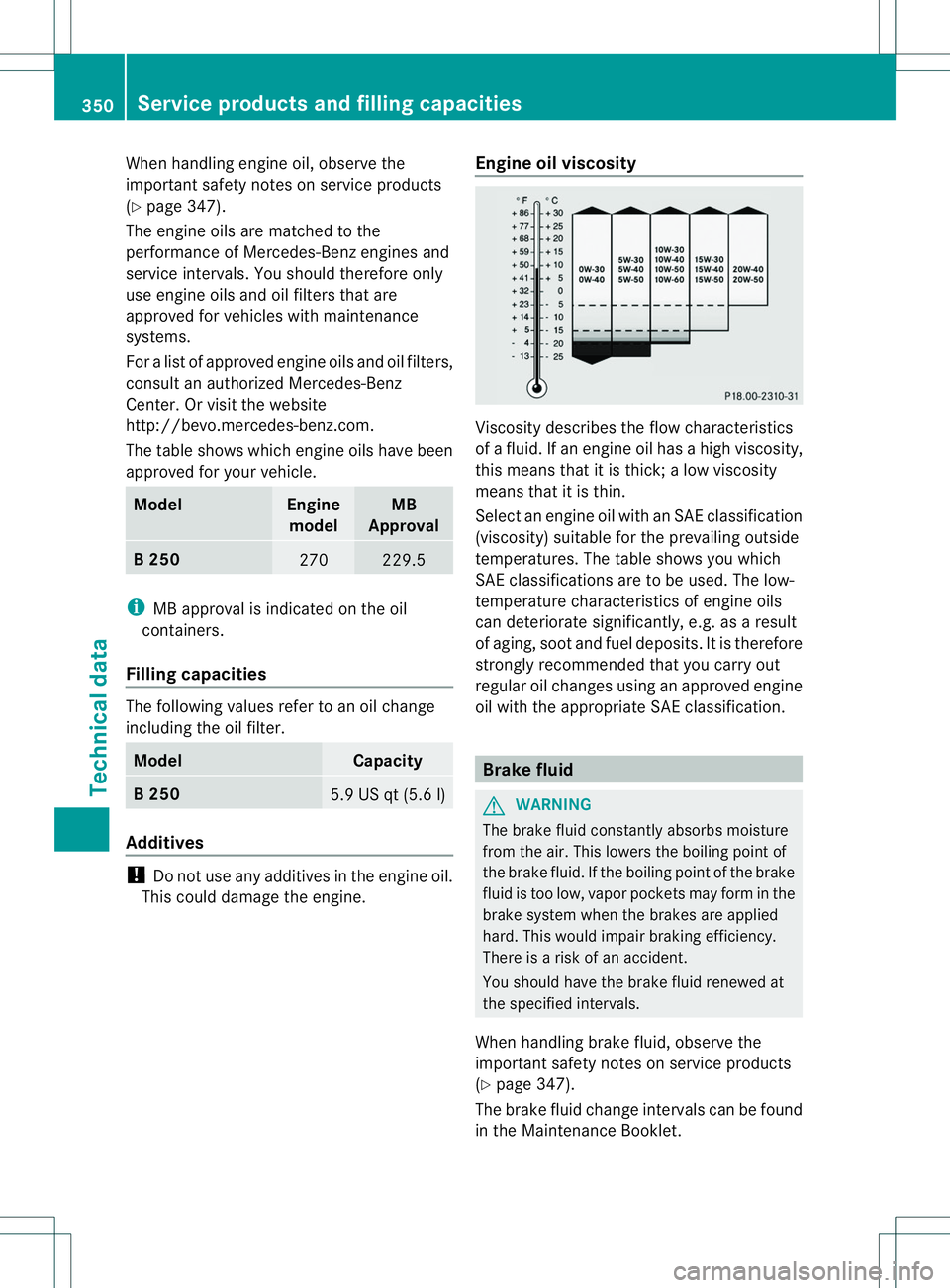
il viscosity Viscosity describes the flow characteristics
of
afluid. If an engine oil has ahigh viscosity,
this means that it is thick; alow viscosity
means that it is thin.
Select an engine oil with an SAE classification
(viscosity) suitablef or the prevailing outside
temperatures. The table shows you which
SAE classifications are to be used. The low-
temperature characteristics of engine oils
can deteriorate significantly, e.g. as aresult
of aging, soot and fuel deposits. It is therefore
strongly recommended that you carry out
regularo il changes using an approved engine
oil with the appropriate SA Eclassification. Brake fluid
G
WARNING
The brak efluid constantly absorb smoisture
fro mt he air. This lowers the boiling point of
the brake fluid. If the boiling point of the brake
fluid is too low, vapor pockets may form in the
brake system when the brakes are applied
hard. This would impair braking efficiency.
There is arisk of an accident.
You should have the brake fluid renewed at
the specified intervals.
When handling brake fluid, observe the
important safety notes on service products
(Y page 347).
The brake fluid change intervals can be found
in the MaintenanceB ooklet.350
Service products and fillingc
apacitiesTechnical data