2014 MERCEDES-BENZ B-CLASS SPORTS belt
[x] Cancel search: beltPage 7 of 360
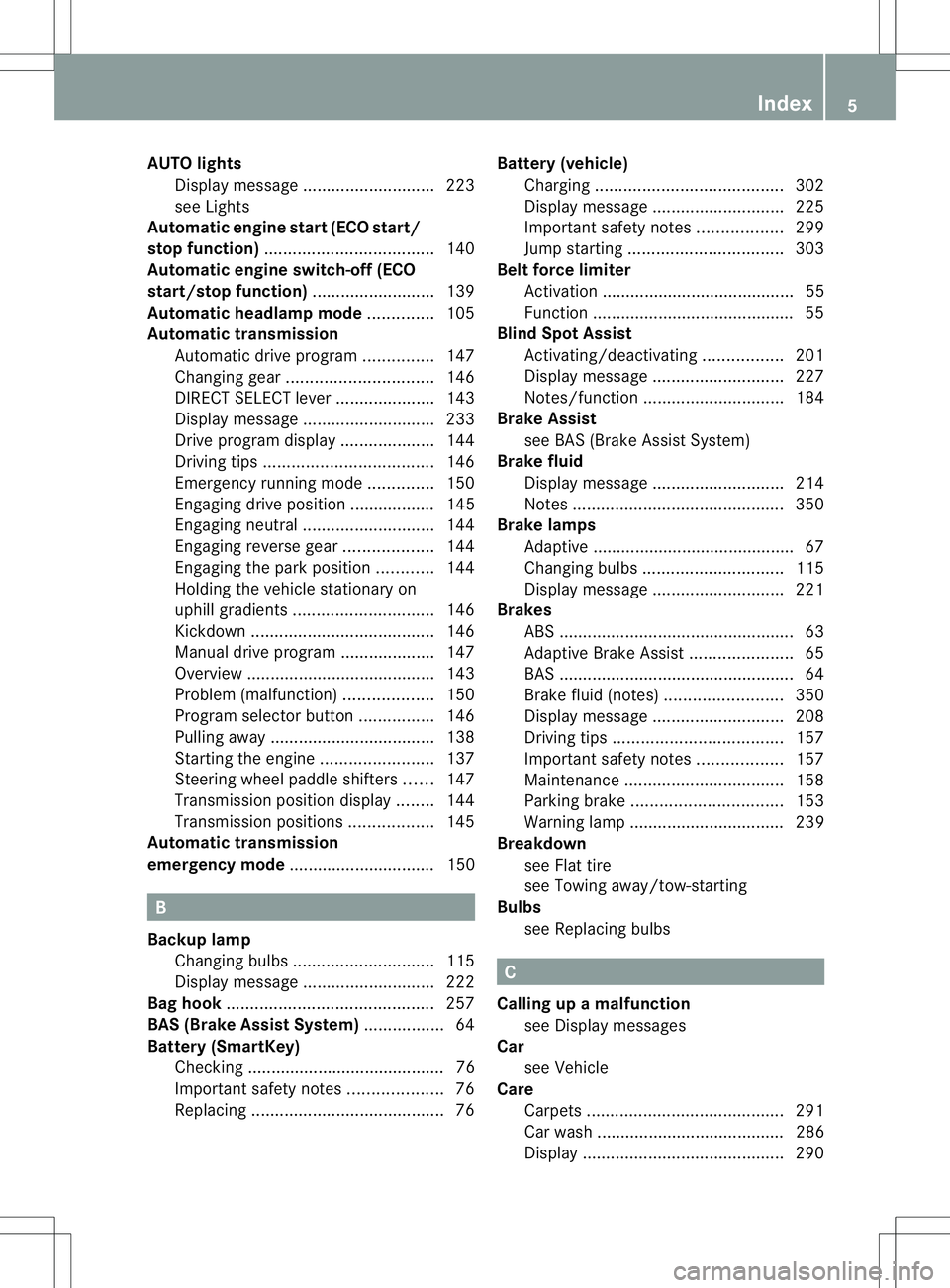
AUT
Olights
Display message ............................ 223
see Lights
Automatic engine start (ECO start/
stop function) .................................... 140
Automatic engine switch-off (ECO
start/stop function) ..........................139
Automatic headlamp mode ..............105
Automatic transmission Automatic drive program ...............147
Changing gea r............................... 146
DIRECT SELECT leve r..................... 143
Display message ............................ 233
Drive program displa y.................... 144
Driving tips .................................... 146
Emergency running mode ..............150
Engaging drive position .................. 145
Engaging neutra l............................ 144
Engaging revers egear ................... 144
Engaging the par kposition ............ 144
Holding the vehicle stationary on
uphill gradients .............................. 146
Kickdow n....................................... 146
Manual drive program ....................147
Overview ........................................ 143
Problem (malfunction) ...................150
Progra mselecto rbutton ................ 146
Pulling away ................................... 138
Starting the engine ........................137
Steering wheel paddle shifters ......147
Transmission position displa y........ 144
Transmission positions ..................145
Automatic transmission
emergency mode ............................... 150 B
Backup lamp Changing bulbs .............................. 115
Display message ............................ 222
Bag hook ............................................ 257
BAS (Brake Assist System) .................64
Battery (SmartKey) Checking .......................................... 76
Important safety notes ....................76
Replacing ......................................... 76Battery (vehicle)
Charging ........................................ 302
Display message ............................ 225
Important safety notes ..................299
Jump starting ................................. 303
Belt force limiter
Activatio n......................................... 55
Function .......................................... .55
Blind Spo tAssist
Activating/deactivating .................201
Display message ............................ 227
Notes/function .............................. 184
Brake Assist
see BAS (Brake Assist System)
Brake fluid
Display message ............................ 214
Notes ............................................. 350
Brake lamps
Adaptive .......................................... .67
Changin gbulbs .............................. 115
Display message ............................ 221
Brakes
ABS .................................................. 63
Adaptive Brake Assist ......................65
BAS .................................................. 64
Brake fluid (notes) .........................350
Display message ............................ 208
Driving tips .................................... 157
Important safety notes ..................157
Maintenance .................................. 158
Parking brake ................................ 153
Warning lamp ................................. 239
Breakdown
see Flat tire
see Towing away/tow-starting
Bulbs
see Replacing bulbs C
Calling up amalfunction
see Display messages
Car
see Vehicle
Care
Carpets .......................................... 291
Carw ash. ....................................... 286
Display ........................................... 290 Index
5
Page 17 of 360
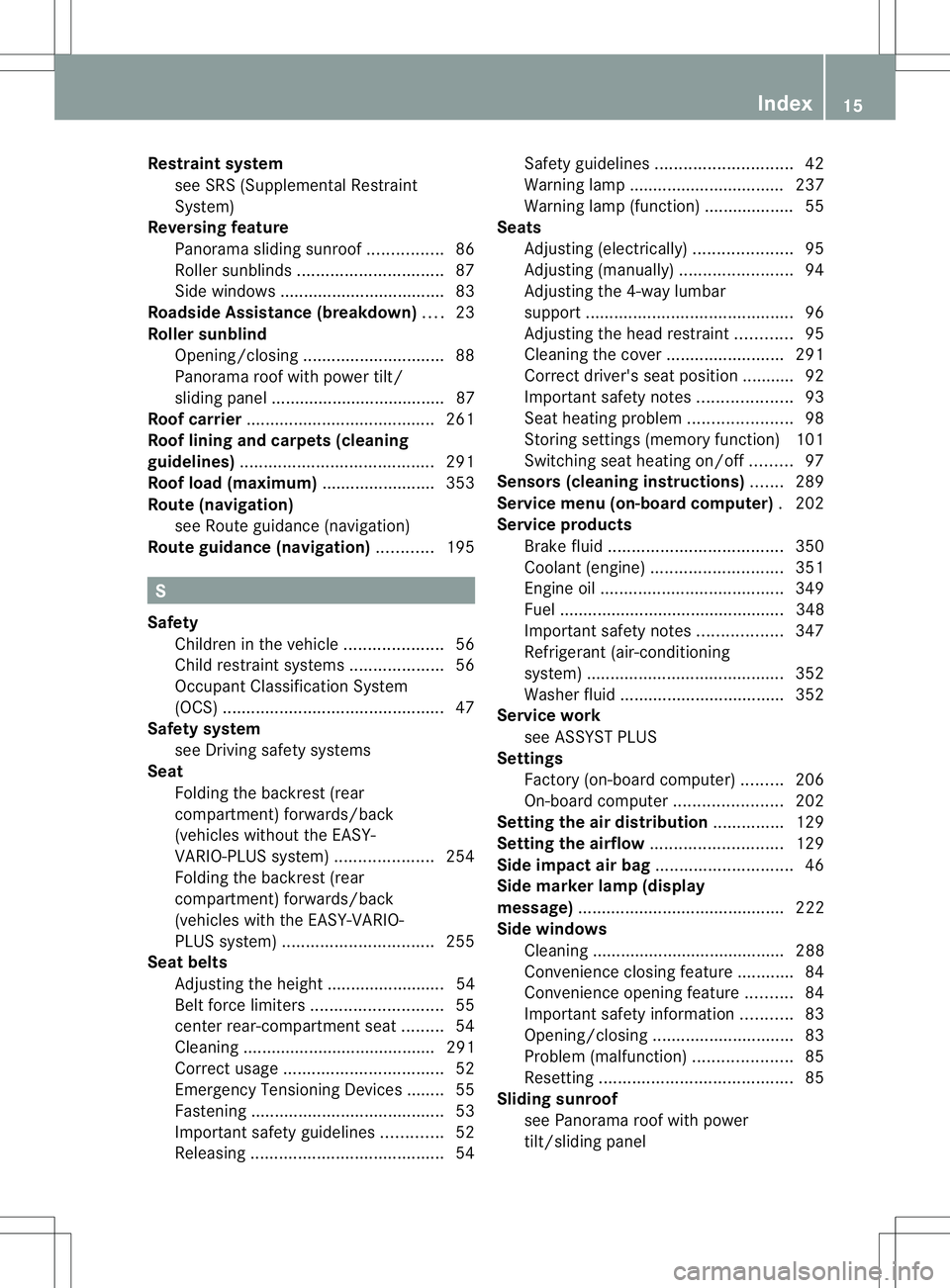
Restraint system
see SRS (Supplemental Restraint
System)
Reversin gfeature
Panorama sliding sunroof ................86
Roller sunblinds ............................... 87
Side windows ................................... 83
Roadside Assistanc e(breakdown) ....23
Roller sunblind Opening/closing .............................. 88
Panorama roof with power tilt/
sliding pane l..................................... 87
Roof carrier ........................................ 261
Roof lining and carpets (cleaning
guidelines) ......................................... 291
Roof load (maximum) ........................353
Route (navigation) see Route guidance (navigation)
Route guidance (navigation) ............195 S
Safety Childre ninthe vehicle ..................... 56
Child restraint systems ....................56
Occupant Classification System
(OCS) ............................................... 47
Safety system
see Driving safety systems
Seat
Folding the backres t(rear
compartment) forwards/back
(vehicles withou tthe EASY-
VARIO-PLUS system) .....................254
Folding the backres t(rear
compartment) forwards/back
(vehicles with the EASY-VARIO-
PLUS system) ................................ 255
Seat belts
Adjusting the height ......................... 54
Belt force limiters ............................ 55
center rear-compartment sea t......... 54
Cleaning ......................................... 291
Correct usage .................................. 52
Emergency Tensioning Devices ....... .55
Fastening ......................................... 53
Important safety guidelines .............52
Releasing ......................................... 54Safety guidelines
............................. 42
Warning lamp ................................. 237
Warning lamp (function) ................... 55
Seats
Adjusting (electrically). ....................95
Adjusting (manually). .......................94
Adjusting the 4-way lumbar
support ............................................ 96
Adjusting the hea drestraint ............ 95
Cleaning the cover .........................291
Correct driver's sea tposition ........... 92
Important safety notes ....................93
Seat heating problem ......................98
Storing settings (memory function) 101
Switching sea theating on/off .........97
Sensors (cleaning instructions) .......289
Service menu (on-board computer) .202
Service products Brake fluid ..................................... 350
Coolant (engine) ............................ 351
Engine oil ....................................... 349
Fuel ................................................ 348
Important safety notes ..................347
Refrigerant (air-conditioning
system) .......................................... 352
Washer fluid .................................. .352
Service work
see ASSYST PLUS
Settings
Factory (on-board computer) .........206
On-board computer .......................202
Settin gthe air distribution ...............129
Settin gthe airflow ............................ 129
Side impact air bag .............................46
Side marker lamp (display
message) ............................................ 222
Side windows Cleaning ......................................... 288
Convenience closing feature ............84
Convenience opening feature ..........84
Important safety information ...........83
Opening/closing .............................. 83
Problem (malfunction) .....................85
Resetting ......................................... 85
Sliding sunroof
see Panorama roof with power
tilt/sliding panel Index
15
Page 28 of 360
The following text is published as required of
manufacturers under Title 49, Code of U.S.
Federal Regulations, Part 575 pursuant to the
"National Traffic and Motor Vehicle Safety Act
of 1966".
If you believe that your vehicle has adefect
which could cause acrash or could cause
injury or death, you should immediately
inform the National Highway Traffic Safety
Administration (NHTSA )inadditionto
notifying Mercedes-Benz USA, LLC.
If NHTS Areceive ssimilar complaints ,itmay
open an investigation, and if it find sthata
safety defect exists in agroup of vehicles, it
may order arecall and remedy campaign.
However, NHTSA cannot become involved in
individualp roblems between you, your
dealer, or Mercedes-Benz USA, LLC.
To contact NHTSA,y ou may call the Vehicle
Safety Hotline toll-free at
1-888-327-4236(TTY: 1-800-424-9153) ;go
to http://www.safercar.gov;orw rite to:
Administrator,N HTSA,400 SeventhS treet,
SW., Washington, DC 20590.
You can also obtain other information about
motor vehicle safety from
http://www.safercar.gov Limited Warranty
! Follow the instructions in this manual
aboutt he proper operation of your vehicle
as well as about possible vehicle damage.
Damage to your vehicle that arises from
culpablec ontraventionsa gainst these
instructions is not covered either by the
Mercedes-Ben zLimited Warranty or by the
New or Used-Vehicle Warranty. Data stored in th
evehicle Information about electronic data
acquisition in th
evehicle
(Includin gnotice pursuan ttoCalifornia Code
§9 951) Please notet
hat your vehicle is equipped with
devices that can record vehicle systems data.
If your vehicle is equipped with mbrace
(Canada: TELE AID), data is transmitted in the
event of an accident.
This information helps, for example, to test
vehicle systems after an accident and to
continually improve vehicle safety.
Daimler AG can access these data and submit
them:
R for safety research or vehicle diagnosis
purposes
R with the consen tofthe vehicle owner
R on the instruction of prosecuting
authorities
R for use in arbitration of disputes that
involve Daimler AG, its subsidiaries or its
sales and service organizations
R as otherwise required or permitted by law
Please check your mbrace (Canada:T ELE
AID) purchase agreement to fin doutmore
abou tdata that can be recorded and
transmitte dbythiss ystem.
This vehicle is equippe dwithane vent data
recorder (EDR). The main purpose of an EDR
is to record dat athatw ill assis tin
understandin ghow avehicle’s systems
performed in certain crash or near crash-like
situations, suc hasduringair bag deployment
or when hitting aroad obstacle .The EDR is
designed to record data related to vehicle
dynamics and safety systems for ashort
period of time, typically 30 seconds or less.
The EDR in this vehicle is designed to record
such data as:
R how various systems in your vehicle are
operating
R whether or not the driver and passenger
seat belts are fastened
R how far (if at all) the driver is depressing the
accelerator and/or brake pedal and
R how fast the vehicle is traveling
This data can help provide abetter
understanding of the circumstances in which
crashes and injuries occur .NOTE :EDR data 26
Introduction
Page 34 of 360
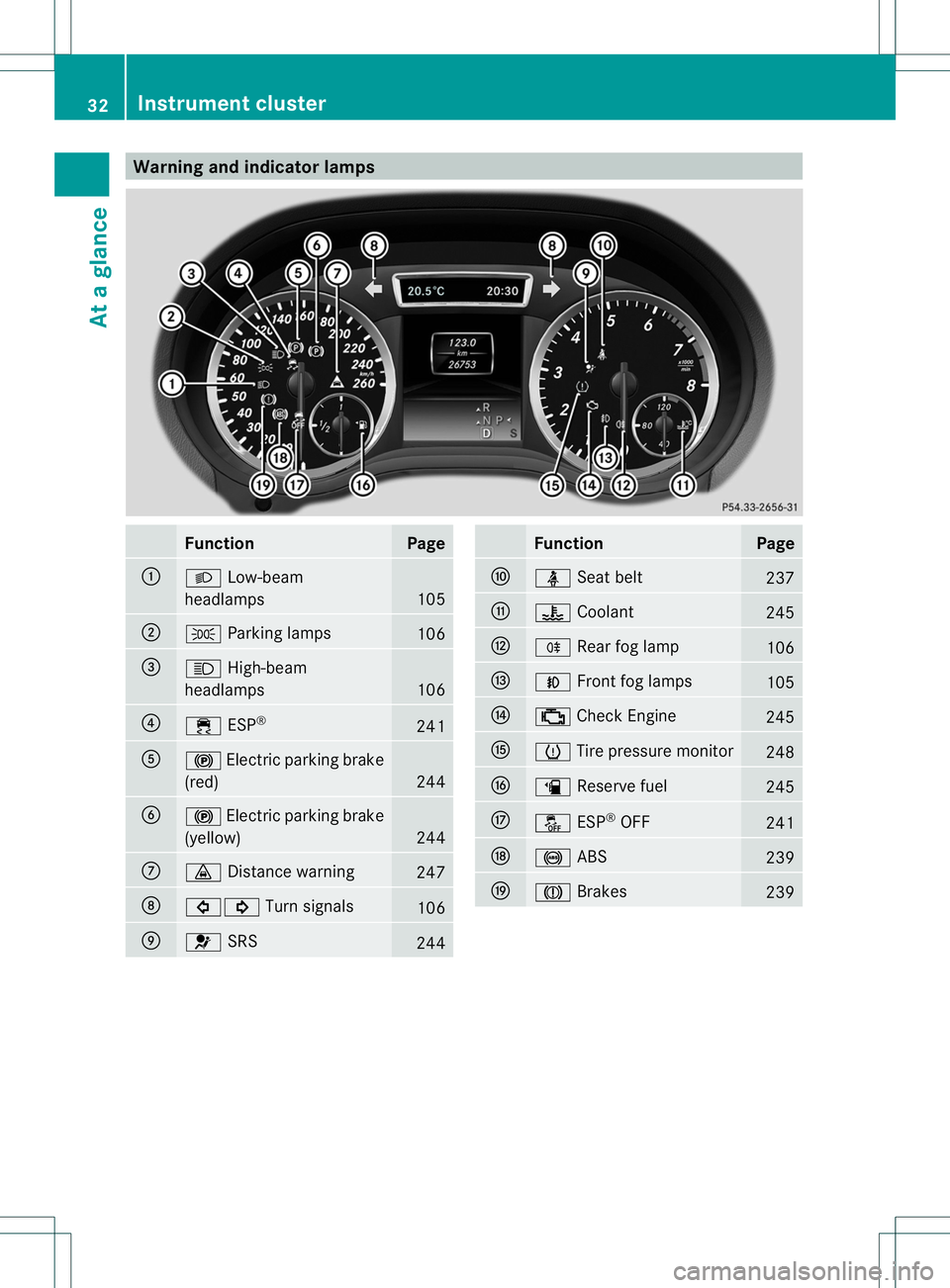
Warning and indicator lamps
Function Page
001A
0005
Low-beam
headlamps 105
0010
000F
Parking lamps 106
0023
0011
High-beam
headlamps 106
0021
000A
ESP® 241
001E
000A
Electric parking brake
(red) 244
0024
000A
Electric parking brake
(yellow) 244
0007
0008
Distance warning 247
0008
00020001
Turn signals 106
0009
0021
SRS 244 Function Page
0016
0016
Seat belt 237
001D
0010
Coolant 245
0004
0006
Rearfog lamp 106
000B
0019
Frontf og lamps 105
001C
000A
Check Engine 245
000E
0005
Tire pressure monitor 248
0013
0007
Reserve fuel 245
0017
0004
ESP®
OFF 241
0022
001C
ABS 239
0020
0001
Brakes 23932
Instrument clusterAt
ag lance
Page 42 of 360
Useful information
i This Operator's Manual describes all
models and all standard and optional
equipment of your vehicle available at the
time of publication of the Operator's
Manual. Country-specific differences are
possible. Please not ethat your vehicle may
not be equipped with all features
described. This also applies to safety-
related system sand functions.
i Read the information on qualified
specialist workshops: (Y page 25).Panic alarm
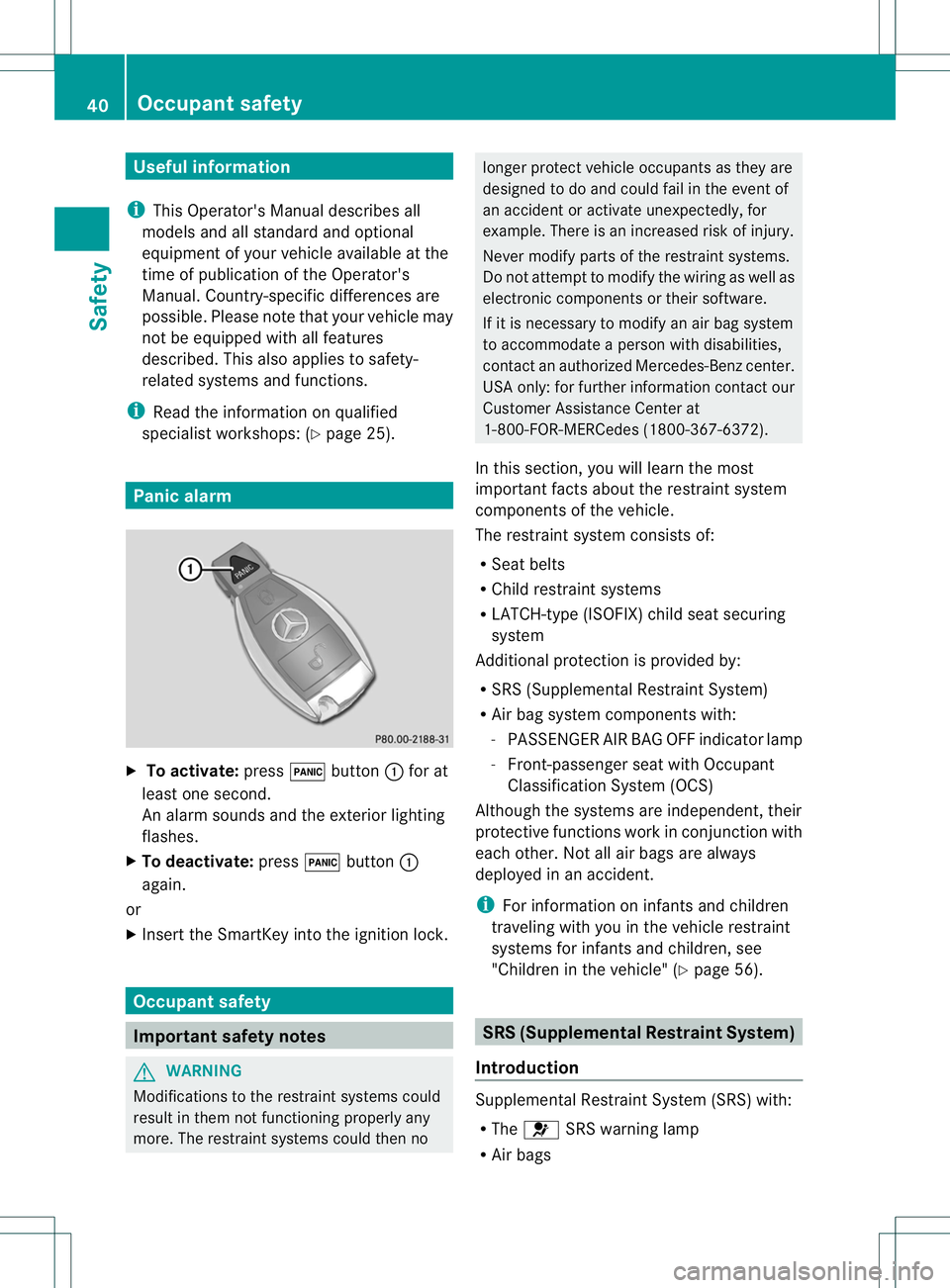
X
To activate: press0004button 001Afor at
least one second.
An alarm sounds and the exterior lighting
flashes.
X To deactivate: press0004button 001A
again.
or
X Insert the SmartKey int othe ignition lock. Occupant safety
Important safet
ynotes G
WARNING
Modifications to the restraint system scould
result in them not functioning properly any
more. The restraint system scould then no longer protect vehicle occupants as they are
designed to do and could fail in the even
tof
an acciden toractivat eunexpectedly, for
example. Ther eisanincreased risk of injury.
Never modify part softherestraint systems.
Do no tattemp ttomodify the wiring as well as
electronic components or their software.
If it is necessary to modify an air bag system
to accommodat eaperson with disabilities,
contact an authorized Mercedes-Benz center.
USA only: for further information contact our
Customer Assistance Center at
1-800-FOR-MERCedes (1800-367-6372).
In this section ,you will learn the most
important facts about the restraint system
components of the vehicle.
The restraint system consist sof:
R Seat belts
R Child restraint systems
R LATCH-type (ISOFIX) child seat securing
system
Additional protection is provided by:
R SRS (Supplemental Restraint System)
R Air bag system components with:
-PASSENGER AIR BAG OFF indicator lamp
- Front-passenger seat with Occupant
Classification System (OCS)
Although the systems are independent ,their
protective functions work in conjunction with
each other. Not all air bags are always
deployed in an accident.
i For information on infant sand children
traveling with you in the vehicle restraint
systems for infant sand children, see
"Children in the vehicle" (Y page 56). SRS (Supplemental Restraint System)
Introduction Supplemental Restraint System (SRS) with:
R
The 0021 SRS warning lamp
R Air bags 40
Occupant safetySafety
Page 43 of 360
R
Air ba gcontro lunit( with crash sensors)
R Emergenc yTensioning Device for th efront
seat belt sand th eoute rseat belts in the
rear
R Seat belt forc elimiter for the fron tseat
belts and the outer seat belts in the rear
SRS reduces the risk of vehicle occupants
comin gintoc ontact with parts of the
vehicle's interior in the event of an accident.
It can also reduce the forces to which vehicle
occupants are subjected during an accident.
SRS warning lamp G
WARNING
If SRS is malfunctioning, child restraint
system component smay be triggered
unintentionally or might not be triggered at all
in the event of an acciden twith ahigh rate of
vehicle deceleration. There is an increased
risk of injury, possibly even fatal.
Have SRS checked and repaire dimmediately
at aq ualified specialist workshop.
SRS function sare checked regularly when
you switc honthe ignition and when the
engin eisrunning. Therefore, malfunctions
can be detected in good time.
The 0021 SRS warnin glamp in the instrument
cluster light supwhen the ignition is switched
on. It goes out no later than afew seconds
after the engin eisstarted.
The SRS component sare in operational
readiness when the 0021SRS indicator lamp
goes out while the engin eisrunning.
There is amalfunction if:
R the 0021 SRS warnin glamp does not light
up when the ignition is switched on
R the engin eisrunning and the 0021SRS
warnin glamp does not go out after afew
seconds
R the engin eisrunning and the 0021SRS
warnin glamp light supagain Triggering of Emergency Tensioning
Devices and air bags Durin
gthe firs tstag eofac ollision, the ai rbag
control unit evaluates important physical
dat arelating to vehicle deceleratio nor
acceleration, suc has:
R duration
R direction
R magnitude
Based on th eevaluation of this data, th eair
bag control unit pre-emptivel ytrigger sthe
Emergency Tensioning Devic einthefirst
stage.
If there is an eve nhigher rat eofvehicle
deceleratio noracceleration in alon gitudinal
direction, the front ai rbags are also deployed.
Your vehicle has adaptive, two-stag efront air
bags. The air bag control unit evaluates
vehicle deceleration or acceleration in the
even tofa collision. In the firs tdeployment
stage, the fron tair bag is filled with enough
propellan tgas to reduc ethe ri sk of injuries.
The front air bag is fully deployed if asecond
deploymen tthreshold is reached within afew
milliseconds.
The Emergency Tensioning Device and air bag
triggering thresholds are variable and are
adapted to the detected rate of deceleration
or acceleration of the vehicle. This process is
pre-emptive in nature. The triggering process
must take place in good time at the start of
the collision.
The rate of vehicle deceleration or
acceleration and the direction of the force are
essentially determined by:
R the distribution of forces during the
collision
R the collision angle
R the deformation characteristics of the
vehicle
R the characteristics of the object with which
the vehicle has collided
Factors that can only be seen and measured
after acollision has occurred do not play a Occupant safety
41Safety Z
Page 44 of 360
decisive role in the deployment of an air bag,
nor do they provide an indication of air bag
deployment.
The vehicle may be deformed significantly,
e.g. the hood or the fender ,without an air bag
being deployed. This is the case if only parts
which are relatively easily deformed are
affected and the rate of deceleration is not
high. Conversely, air bags may be deployed
even though the vehicle suffers only minor
deformation. This is the case if, for example,
very rigid vehicle parts such as longitudinal
body members are hit, and sufficient
deceleration occurs as aresult.
i The fron tEmergenc yTensioning Devices
can only be triggered if the seat belt
tongues on the fron tseats are correctly
engaged in the seat belt buckles.
i Not all air bags are deployed in an
accident. The differen tair bag systems
work independently of each other.
How the air bag system work sis
determined by predictin gthe severity of
the accident ,especially vehicle
deceleration or acceleration, and the type
of accident:
R head-on collision
R side impact
R rollover
Safety guidelines for seat belts,
Emergency Tensioning Devices (ETDs)
and air bags G
WARNING
R Damaged seat belts or seat belts that have
been subjected to stress in an accident
must be replaced. Their anchorin gpoints
must also be checked. Only use seat belts
installed or supplied by an authorized
Mercedes-Ben zCenter.
R Air bags and pyrotechnic Emergency
Tensionin gDevices (ETDs) contain
perchlorat ematerial, which may require
special handlin gand regar dfor the environment. Check your national disposal
guidelines. In California, see
www.dtsc.ca.gov/HazardousWaste/
Perchlorate/index.cfm.
R Air bags and ETD sare designed to function
on aone-time-only basis. An air bag or ETD
that has deployed must be replaced.
R Do not pass seat belts over sharp edges.
They could tear.
R Do not make any modification that could
change the effectiveness of the seat belts.
R Do not bleach or dye seat belts ,asthis may
severely weaken them. In acrash, the ymay
not be able to provide adequate protection.
R Do not make any modifications to the SRS
wirin gorc omponents.
R Do not modif yorremove any components
or part softhe SRS.
R Do not install additional trim material, seat
covers, badges, etc .tothe:
- padded steering wheel boss
- knee bag covers
- front-passenger air bag cover
- outer side of front seat bolsters
- outer seat bolsters of the rear bench seat
backrest
- roof frame trim
R Do not install additional electrical/
electronic equipment on or near SRS
components and wiring.
R Keep the area between the air bags and
occupant sfree of object s(e.g. packages,
handbags, umbrellas etc.).
R Do not hang any objects such as coat
hangers on the coat hooks or the grab
handle above the door. These items may be
thrown around in the vehicle and cause
head and other injuries when the window
curtain air bag is deployed.
R Air bag system componentsw ill be hot after
an air bag has inflated. Do not touch them.
R Never rest your feet on the dashboard or
the seat. Always keep both feet on the floor
in fron tofthe seat. 42
Occupant safetySafety
Page 45 of 360
R
Improper repairw ork on the SRS creates a
risk of rendering the SRS inoperative or
causing unintended air bag deployment.
Work on the SRS must therefor eonly be
performed by qualified technicians.
Consult an authorized Mercedes-Benz
Center.
R For your protection and the protection of
others, when scrapping the air bag unit or
ETD, our safety instructions must be
followed. These are available from any
authorized Mercedes-Benz Center.
R Given the considerable deployment speed,
required inflation volume, and the material
of the air bags, there is the possibility of
abrasions or other, potentially more serious
injuries resulting from air bag deployment.
If you sell your vehicle, Mercedes-Benz
strongly recommends that you inform the
subsequent owner that the vehicle is
equipped with SRS. Also, refer them to the
applicabl esection in the Operator's Manual. Air bags
Important safety notes NEVERu
searearward facing child restraint
system on aseat protected by an ACTIVE AIR
BAG in front of it, DEATH or SERIOUS INJURY
to the CHILD can occur. G
WARNING
Using unsuitable seat covers could restric tor
even preven tdeployment of the air bags
integrated into the seats. Consequently, the
air bags cannot protec tvehicle occupant sas
they are designed to do. In addition, the
function of the air bag deactivation system
could be restricted. This poses an increased
risk of injury or even fatal injury.
You should only use seat cover sthat have
been approved for the respective seat by
Mercedes-Benz. G
WARNING
The air bag parts are hot after the airbag has
been deployed. There is arisk of injury.
Do not touch the air bag parts. Have the
deployed air bags replaced at aqualified
specialist workshop as soon as possible. G
WARNING
Air bags are designed to reduce the incidence
of injuries and fatalities in certain situations:
R frontal impacts (driver's and front-
passenger fron tair bags and driver's knee
bag)
R side impact s(side impact air bags and
window curtain air bags)
R rollover (window curtain air bags)
However, no system available today can
completely eliminate injuries and fatalities.
When the air bags are deployed, asmall
amount of powder is released .The powder
generally does not constitute ahealth hazard
and does not indicate that there is afire in the
vehicle. In order to prevent potential
breathing difficulties, you should leave the
vehicle as soon as it is safe to do so. If you
have any breathing difficulty but cannot get
out of the vehicle after the air bag inflates,
then get fresh air by opening awindow or
door. G
WARNING
In order to reduce the potential danger of
injuries caused during the deployment of the
front air bags, the driver and front passenger
must always be correctly seated and wear
their seat belts.
For maximum protection in the event of a
collision, you must always be in the normal
seat position with your back against the
backrest. Fasten your seat belt and make sure
that it is correctly positioned on your body. Occupant safety
43Safety
Z