Page 745 of 3039
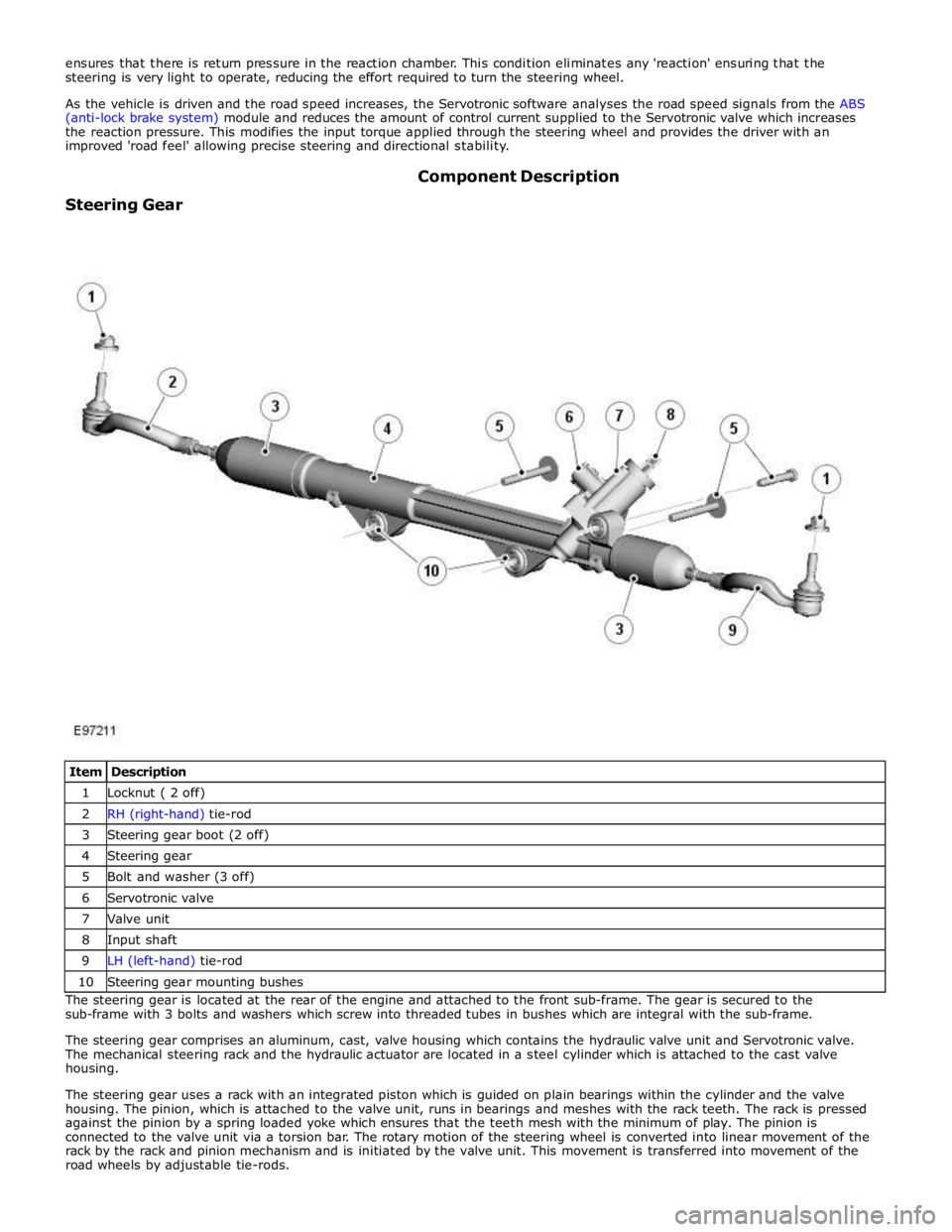
1 Locknut ( 2 off) 2 RH (right-hand) tie-rod 3 Steering gear boot (2 off) 4 Steering gear 5 Bolt and washer (3 off) 6 Servotronic valve 7 Valve unit 8 Input shaft 9 LH (left-hand) tie-rod 10 Steering gear mounting bushes The steering gear is located at the rear of the engine and attached to the front sub-frame. The gear is secured to the
sub-frame with 3 bolts and washers which screw into threaded tubes in bushes which are integral with the sub-frame.
The steering gear comprises an aluminum, cast, valve housing which contains the hydraulic valve unit and Servotronic valve.
The mechanical steering rack and the hydraulic actuator are located in a steel cylinder which is attached to the cast valve
housing.
The steering gear uses a rack with an integrated piston which is guided on plain bearings within the cylinder and the valve
housing. The pinion, which is attached to the valve unit, runs in bearings and meshes with the rack teeth. The rack is pressed
against the pinion by a spring loaded yoke which ensures that the teeth mesh with the minimum of play. The pinion is
connected to the valve unit via a torsion bar. The rotary motion of the steering wheel is converted into linear movement of the
rack by the rack and pinion mechanism and is initiated by the valve unit. This movement is transferred into movement of the
road wheels by adjustable tie-rods.
Page 750 of 3039
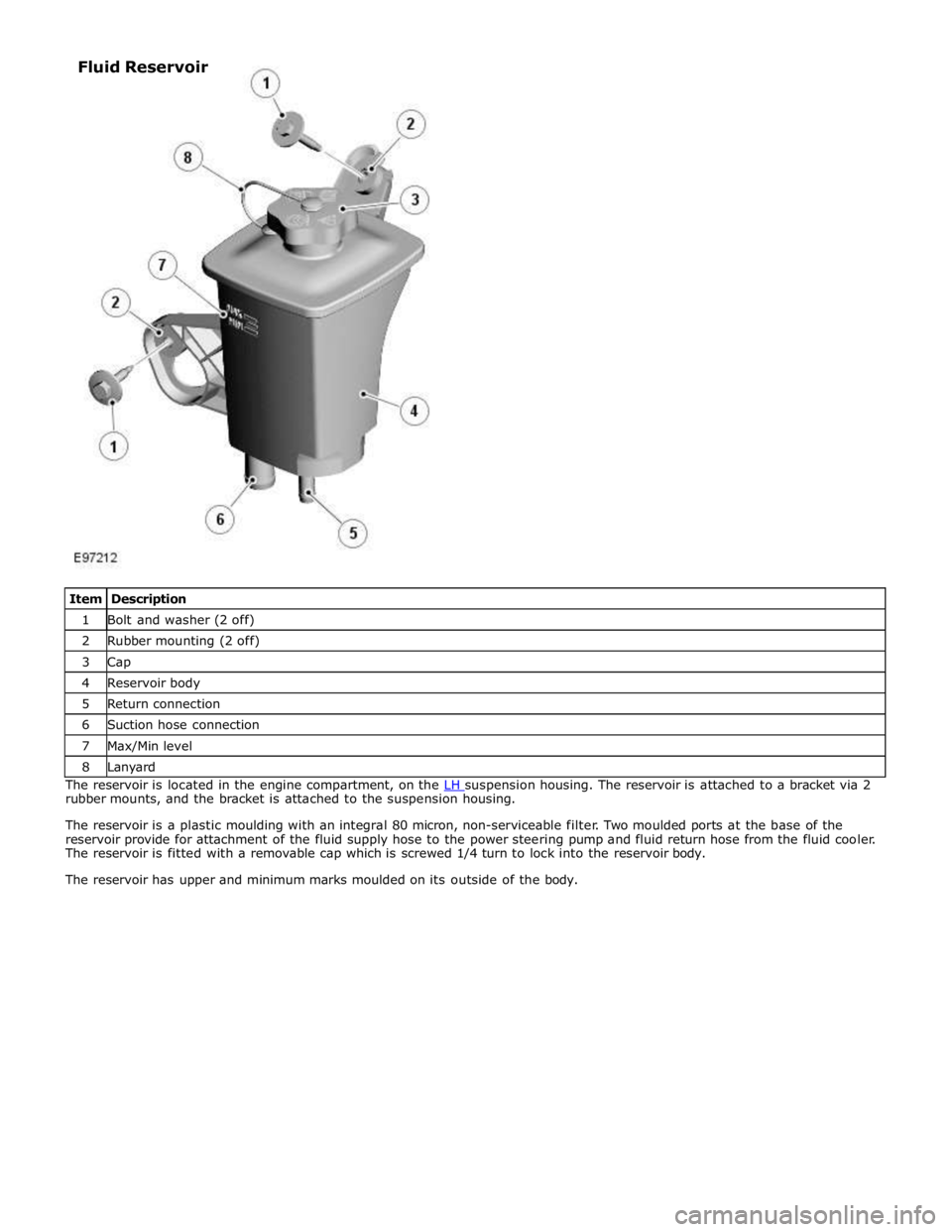
1 Bolt and washer (2 off) 2 Rubber mounting (2 off) 3 Cap 4 Reservoir body 5 Return connection 6 Suction hose connection 7 Max/Min level 8 Lanyard The reservoir is located in the engine compartment, on the LH suspension housing. The reservoir is attached to a bracket via 2 rubber mounts, and the bracket is attached to the suspension housing.
The reservoir is a plastic moulding with an integral 80 micron, non-serviceable filter. Two moulded ports at the base of the
reservoir provide for attachment of the fluid supply hose to the power steering pump and fluid return hose from the fluid cooler.
The reservoir is fitted with a removable cap which is screwed 1/4 turn to lock into the reservoir body.
The reservoir has upper and minimum marks moulded on its outside of the body. Fluid Reservoir
Page 753 of 3039
Power Steering - Steering Gear
Removal and Installation Published: 04-Jul-2013
CAUTIONS: Removal
Make sure that only the manufacturers' recommended four wheel alignment equipment is used.
Do not turn the steering wheel with the steering column lower shaft disconnected as damage to the clockspring and
steering wheel switches may occur.
NOTES:
Make sure the steering is in the straight ahead position.
RHD illustration shown, LHD is similar.
Some variation in the illustrations may occur, but the essential information is always correct.
1. Raise and support the vehicle.
2. Center the steering wheel.
Lock in position and remove the ignition key.
3. Remove the front wheels and tires.
For additional information, refer to: Wheel and Tire (204-04 Wheels and Tires, Removal and Installation).
4. Remove the air deflector.
For additional information, refer to: Air Deflector (501-02 Front End Body Panels, Removal and Installation).
Page 754 of 3039
5. Make sure the alignment mark, on the steering gear pinion
seal protection cover, is central to the steering gear pinion
casting.
6. CAUTION: Do not allow the gaiter to twist.
Release both track rods from tie rod ends, note the number
of turns for installation.
Loosen the tie-rod ends lock nuts.
7. Disconnect the power steering control valve actuator
electrical connector.
Page 768 of 3039
Tie-rod end retaining nut 133 98 - Tie-rod end lock nut 55 41 -
Page 769 of 3039
1 Steering gear boot 2 Inner tie-rod arm 3 Locknut 4 Outer tie-rod arm 5 Taper ball joint 6 Locknut
Page 771 of 3039
Published: 11-May-2011
Steering Linkage - Steering Linkage - System Operation and Component Description
Description and Operation
TIE-ROD System Operation
The threads on the tie rods allow the position of the outer tie rod to be adjusted in order to set the correct toe angle for each
front wheel.
TIE-ROD Component Description
Each tie rod comprises two parts; an inner and outer tie rod. The inner and outer tie rods are screwed into each other and
locked with a locknut to prevent inadvertent movement.
The outer tie rod incorporates a non-serviceable tapered ball joint which locates in a tapered hole in the front wheel knuckle
and is secured with a self-locking nut. The ball joint has an internal hexagonal drive which enables the joint to be held
stationary when the self-locking nut is tightened.
Page 773 of 3039
Tires, Removal and Installation).
3. Loosen the tie-rod end lock nut.
4. CAUTION: Make sure that the ball joint ball does not
rotate.
Remove and discard the tie rod end retaining nut.
5. Remove the tie-rod end, note the number of turns for
installation.