2010 JAGUAR XFR lock
[x] Cancel search: lockPage 726 of 3039

Hum
Continuous sound of varying frequencies, like a wire humming in the wind.
Knock
Heavy, loud repeating sound like a knock on a door.
Ping
Similar to knock, except at higher frequency.
Rattle
A sound suggesting looseness, such as marbles rolling around in a can.
Roar
Deep, long, prolonged sound like an animal, or winds and ocean waves.
Rumble
Low, heavy continuous sound like that made by wagons or thunder.
Scrape
Grating noise like one hard plastic part rubbing against another.
Squeak
High-pitched sound like rubbing a clean window.
Squeal
Continuous, high-pitched sound like running finger nails across a chalkboard.
Tap
Light, hammering sound like tapping pencil on edge of table. May be rhythmic or intermittent.
Whirr/Whine
High-pitched buzzing sound, like an electric motor or drill.
Whistle
Sharp, shrill sound, like wind passing a small opening.
Specific Steering System Noise Types
Belt Squeal
Belt squeal is a high frequency air-borne noise generated by slippage of the ribbed Vee belt on the power steering pump
pulley. Squeal increases with system loading and at full lock.
Clonk
Clonk is a structure-borne noise heard as a loose-sounding rattle or vibration coming from the steering column. Clonk can be
identified by driving and turning over cobblestones, rough roads, or high frequency bumps such as 25-50 mm tall tar strips.
Clonk requires a tie-rod load impact.
Column Knock
Column knock is a loose-sounding rattle or vibration generated by the steering column shaft contacting other portions of the
column assembly. The noise is both audible and tactile. Column knock is generated by driving over cobblestones or rough
pavement. It is not necessary to turn the steering wheel to create this noise.
Column Rattle
Column rattle is a metallic sounding noise created when applying a highly impulsive force to the steering wheel. Column rattle
is often used to combine the more general group of column noises including clonk and column knock. Column rattle noises can
be caused by clonk, knock, loose column components, bonus parts etc. A series of parked, straight-line driving, and cornering
tests should be carried out to isolate the source/sources.
Grinding/Scrape
Grinding is a low frequency noise in the column when the steering wheel is turned. It is generally caused by interference
Page 727 of 3039

between moving components such as the steering wheel to steering column shroud.
Grunt (Squawk/Whoop)
Grunt is a 'honking' sound elicited when coming off one of the steering stops. Grunt is generally excited during parking
manoeuvres with a low to medium speed steering input.
Hiss (Swish)
Hiss or Valve Hiss is a high-frequency sound coming from the steering gear when the system is loaded. It is a rushing or
'swish' noise that doesn't change frequency with RPM. Hiss is the general noise generated by the flow of hydraulic fluid through
restrictions in the steering system. Restrictions include the rotary steering valve, power steering tubes, connectors, tuning
orifices, etc. Hiss can be air-borne and structure-borne, but the structure-borne path through the steering intermediate shaft is
usually dominant.
Moan (Groan)
Moan is the general structure-borne noise of the steering system. Moan is primarily transmitted to the driver via the body
structure through the pump mount, engine mounts, power steering lines and power steering brackets. On some vehicles, moan
is a loud humming noise, often present when the wheel is turned and the system is loaded. It may change frequency with
engine RPM and if the system is loaded or unloaded.
Steering Gear Knock (Steering Gear Slap)
CAUTION: DO NOT attempt to adjust the steering gear yoke. Failure to follow this instruction will invalidate the steering
gear warranty.
Steering gear knock is a rattle sound and steering wheel vibration caused by separation of the steering gear and pinion while
driving over bumps. It is a structure-borne noise transmitted through the intermediate shaft and column. Steering gear knock
can also be heard as a 'thump' or impact noise that occurs with the vehicle stationary when the steering wheel is released
from a loaded position and allowed to return to rest. Noise occurs with the engine on or off.
Rattles
Rattles are noises caused by knocking or hitting of components in the steering system. Steering rattles can occur in the engine
compartment, the suspension, or the passenger compartment. Rattles can be caused by loose components, movable and
flexible components, and improper clearances.
Squeaks/Scrapes
Squeaks/Scrapes are noises due to friction or component rubbing anywhere in the steering system. Squeaks/Scrapes have
appeared in steering linkages and joints, in column components and in column and steering wheel trim.
Weep
Weep is an air-borne noise, occasionally generated when turning the steering across lock at a constant rate. When present on
a vehicle the noise, once initiated can often be maintained across a large proportion of the available steering movement.
Whistle
Whistle is similar to hiss but is louder and of a higher frequency. It is also more of a pure tone noise than hiss. Whistle is
air-borne and is generated by a high flow rate of hydraulic fluid through a small restriction.
Zip
Zip noise is the air-borne noise generated by power steering pump cavitation when power steering fluid does not flow freely
through the suction hose from the reservoir to the pump. Zip primarily occurs during cold weather at start-up.
Steering System Vibrations and Harshness
Buzz
Buzz is a tactile rotary vibration felt in the steering wheel when steering inputs are slow. Buzz can also be called a grinding
feel and it is closely related to grunt and is caused by high system gain with low damping. Buzz is generally excited during
parking manoeuvres with low to medium speed steering input.
Buzz (Electrical)
A different steering buzz can be caused by pulse width modulated (PWM) electric actuators used in variable assist steering
systems. This buzz is felt by turning the ignition key to run without starting the engine and holding onto the steering wheel.
In extreme cases, the buzz can be felt with the engine running also.
Column/Steering Wheel Shake
Column shake is a low frequency vertical vibration excited by primary engine vibrations.
Nibble (Shimmy)
Page 728 of 3039

Steering nibble is a rotary oscillation or vibration of the steering wheel, which can be excited at a specific vehicle speed.
Nibble is driven by wheel and tire imbalance exciting a suspension recession mode, which then translates into steering gear
travel and finally steering wheel nibble.
Shudder (Judder)
Shudder is a low frequency oscillation of the entire steering system (tire, wheels, steering gear and linkage, etc.) when the
vehicle is steered during static-park or at low speeds. Shudder is very dependent on road surface.
Torque/Velocity Variation (Phasing/Effort Cycling)
Steering wheel torque variation occurring twice in one revolution is normally as a result of problems with the lower steering
column (intermediate shaft), but foul conditions generally result in either constant stiffness or single point stiffness.
Depending upon the orientation of the joints, the steering can feel asymmetric (torque falling off in one direction and rising in
the other) or else it can simply have pronounced peaks and troughs as the steering moves from lock to lock.
Wheel Fight (Kick Back)
Wheel fight is excess feedback of sudden road forces through the steering system and back to the driver. It is evaluated at all
vehicle speeds over cobblestones, rough roads, and potholes. The tires, wheels, and suspension generate forces into the
steering systems. Steering friction, hydraulic damping, hydraulic compliance, mechanical compliance, steering ratio, and assist
gain all affect how much is transmitted to the driver.
Page 729 of 3039
Published: 07-Jul-2011
Steering System - General Information - Power Steering System Bleeding
General Procedures
NOTE: Some variation in the illustrations may occur, but the essential information is always correct.
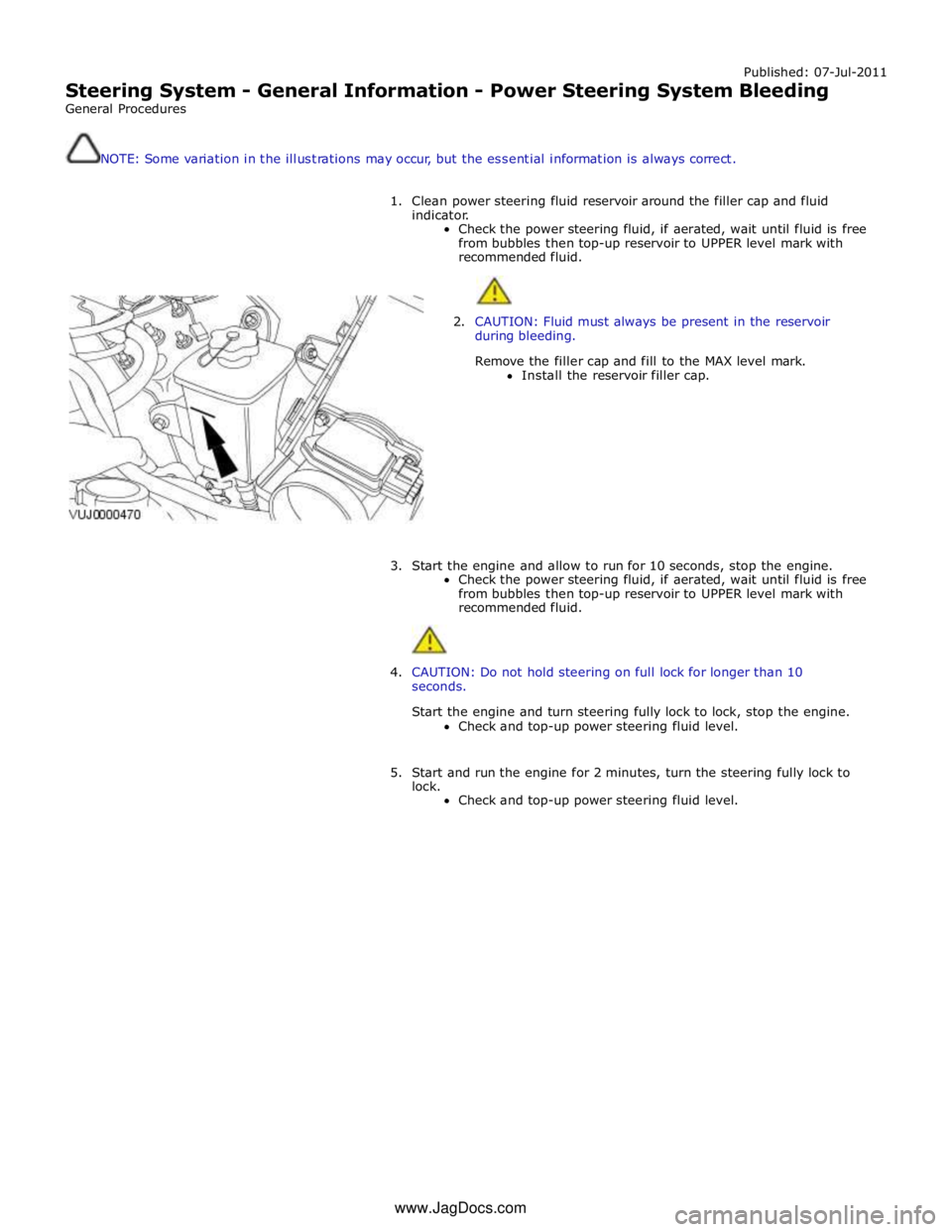
1. Clean power steering fluid reservoir around the filler cap and fluid
indicator.
Check the power steering fluid, if aerated, wait until fluid is free
from bubbles then top-up reservoir to UPPER level mark with
recommended fluid.
2. CAUTION: Fluid must always be present in the reservoir
during bleeding.
Remove the filler cap and fill to the MAX level mark.
Install the reservoir filler cap.
3. Start the engine and allow to run for 10 seconds, stop the engine.
Check the power steering fluid, if aerated, wait until fluid is free
from bubbles then top-up reservoir to UPPER level mark with
recommended fluid.
4. CAUTION: Do not hold steering on full lock for longer than 10
seconds.
Start the engine and turn steering fully lock to lock, stop the engine.
Check and top-up power steering fluid level.
5. Start and run the engine for 2 minutes, turn the steering fully lock to
lock.
Check and top-up power steering fluid level. www.JagDocs.com
Page 732 of 3039
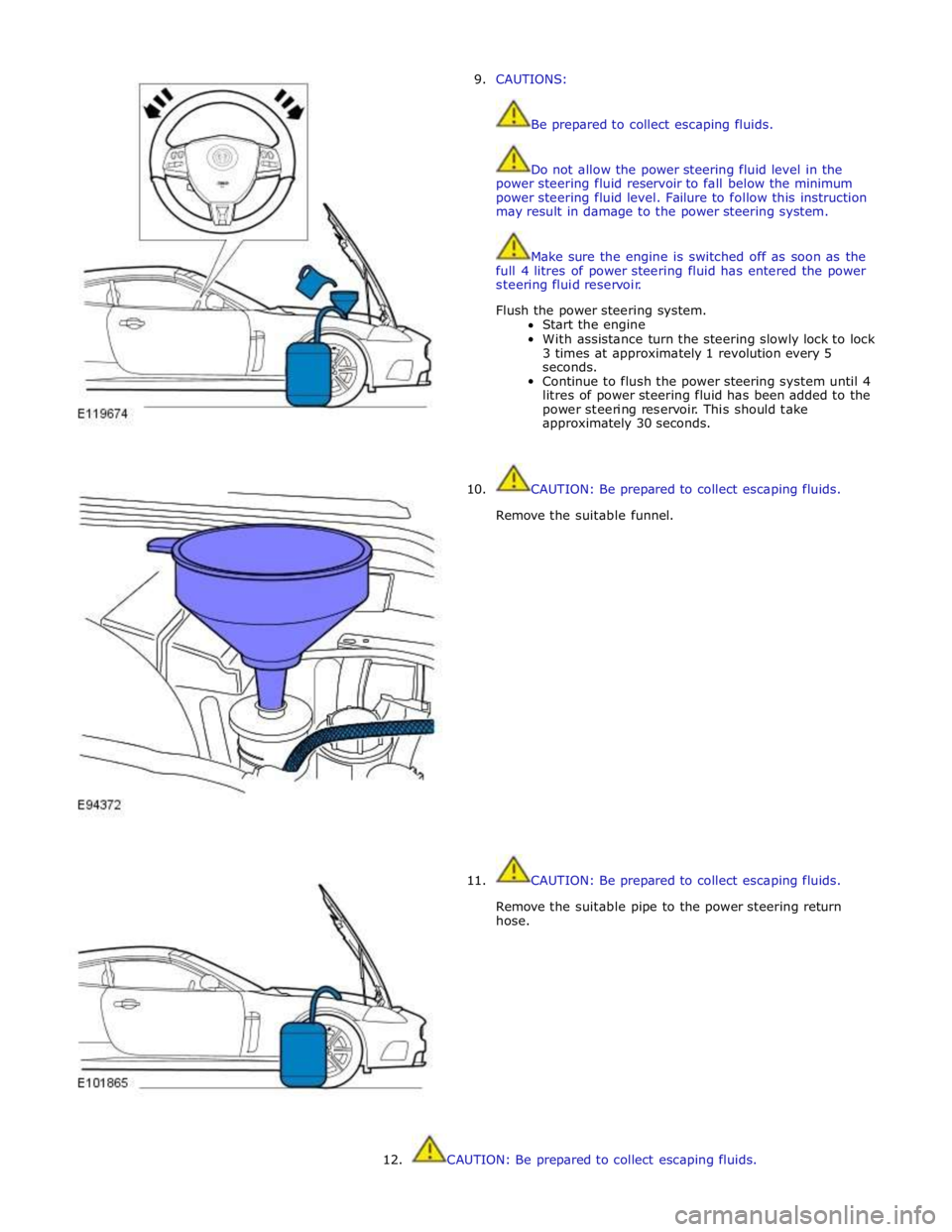
9. CAUTIONS:
Be prepared to collect escaping fluids.
Do not allow the power steering fluid level in the
power steering fluid reservoir to fall below the minimum
power steering fluid level. Failure to follow this instruction
may result in damage to the power steering system.
Make sure the engine is switched off as soon as the
full 4 litres of power steering fluid has entered the power
steering fluid reservoir.
Flush the power steering system.
Start the engine
With assistance turn the steering slowly lock to lock
3 times at approximately 1 revolution every 5
seconds.
Continue to flush the power steering system until 4
litres of power steering fluid has been added to the
power steering reservoir. This should take
approximately 30 seconds.
10.
11. CAUTION: Be prepared to collect escaping fluids.
Remove the suitable funnel.
CAUTION: Be prepared to collect escaping fluids.
Remove the suitable pipe to the power steering return
hose.
12.
CAUTION: Be prepared to collect escaping fluids.
Page 736 of 3039
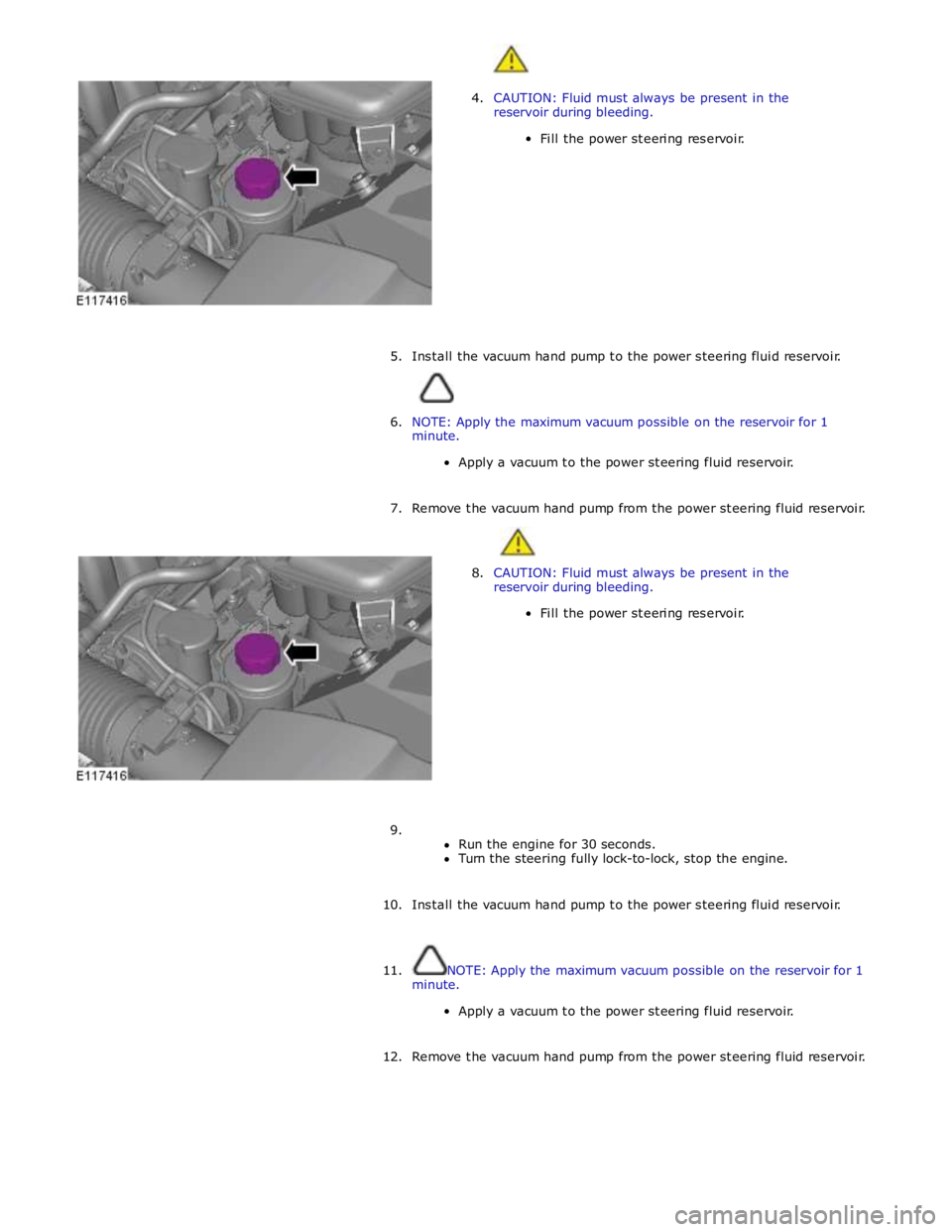
4. CAUTION: Fluid must always be present in the
reservoir during bleeding.
Fill the power steering reservoir.
5. Install the vacuum hand pump to the power steering fluid reservoir.
6. NOTE: Apply the maximum vacuum possible on the reservoir for 1
minute.
Apply a vacuum to the power steering fluid reservoir.
7. Remove the vacuum hand pump from the power steering fluid reservoir.
8. CAUTION: Fluid must always be present in the
reservoir during bleeding.
Fill the power steering reservoir.
9.
Run the engine for 30 seconds.
Turn the steering fully lock-to-lock, stop the engine.
10. Install the vacuum hand pump to the power steering fluid reservoir.
11. NOTE: Apply the maximum vacuum possible on the reservoir for 1
minute.
Apply a vacuum to the power steering fluid reservoir.
12. Remove the vacuum hand pump from the power steering fluid reservoir.
Page 737 of 3039

13. CAUTION: Fluid must always be present in the
reservoir during bleeding.
Fill the power steering reservoir.
14.
Run the engine for 30 seconds.
Turn the steering fully lock-to-lock, stop the engine.
15. Install the vacuum hand pump to the power steering fluid reservoir.
16. NOTE: Apply the maximum vacuum possible on the reservoir for 1
minute.
Apply a vacuum to the power steering fluid reservoir.
17. Remove the vacuum hand pump from the power steering fluid reservoir.
18. CAUTION: Fluid must always be present in the
reservoir during bleeding.
Fill the power steering reservoir.
19.
Run the engine for 30 seconds.
Turn the steering fully lock-to-lock, stop the engine.
Page 744 of 3039

1 Return fluid control groove 2 Radial groove 3 Feed fluid control groove 4 Radial groove 5 Axial groove 6 Feed fluid control edge 7 Feed fluid radial groove 8 Return fluid control edge 9 Return fluid chamber 10 Cut-off valve 11 Radial groove 12 Servotronic transducer valve 13 Feed fluid radial groove 14 Radial groove 15 Orifice 16 Balls 17 Compression spring 18 Torsion bar 19 Power steering fluid reservoir 20 Valve rotor 21 Reaction piston 22 Reaction chamber 23 Centering piece 24 Pressure relief/flow limiting valve 25 Power steering pump 26 Inner tie-rod 27 Pinion 28 Valve sleeve 29 Steering gear rack 30 Steering gear housing 31 Power assist cylinder - right 32 Piston 33 Power assist cylinder - left When the steering wheel is turned to the right, the steering rack and piston moves to the left in the piston bore. The valve
rotor is rotated to the right (clockwise) and pressurized fluid is directed over the further opened feed fluid control edges and to
the associated axial grooves, the radial groove and via an external pipe to the left power assist cylinder chamber. The pressure
applied to the piston from the left power assist cylinder chamber provides the hydraulic assistance.
An adaptable pressure build-up is achieved by the partially or fully closed feed fluid control edges restricting or preventing a
connection between the fluid pressure inlet and the other axial grooves connected to the radial groove.
Simultaneously, the fluid pressure outlet to the pressurized axial grooves are restricted or partially restricted by the closing
return fluid control edges. The fluid displaced by the piston from the right power assist cylinder chamber, flows through an
external pipe to the radial grooves. From there the fluid passes to the associated axial grooves and on to the return fluid
control grooves, via the further opened return fluid control edges.
The return flow of fluid to the reservoir passes via interconnecting bores which lead to the return fluid chamber. When the
steering wheel is turned to the left the operating sequence is as above but the pressure is applied to the opposite side of the
piston.
Servotronic Operation
The Servotronic software contains a number of steering maps which are selected via the car configuration file depending on the
vehicle mode and tire fitment.
If a failure of the Servotronic valve or software occurs, the system will suspend Servotronic assistance and only normal power
steering wheel be available. Fault codes relating to the fault are stored, but no warning lamps are illuminated and the driver
may be aware of the steering being 'heavier' than usual.
When the vehicle is manoeuvred into and out of a parking space (or other similar manoeuvre), the Servotronic software uses
road speed data from the ABS module to determine the vehicle speed, which in this case will be slow or stationary. The
Servotronic software analyses the signals and outputs an appropriate control current to the Servotronic transducer valve. The
Servotronic valve closes and prevents fluid flowing from the feed fluid radial groove to the reaction chamber. An orifice also