Page 333 of 2453
AC-7
General Description
HVAC SYSTEM (HEATER, VENTILATOR AND A/C)
(1) Heater unit case LH (9) Evaporator cover (17) Heater Core
(2) Separator (10) Power transistor (18) Heater pipe clamp
(3) Mode door RR (11) Pipe cover (19) Heater core cover
(4) Mode door FR (12) Drain hose (20) Air mix door actuator LH
(5) Air mix door LH (13) Air mix door actuator RH (21) Aspirator
(6) Air mix door RH (14) Expansion valve
(7) Heater unit case RH (15) Evaporator sensorTightening torque: N·m (kgf-m, ft-lb)
(8) Mode door actuator (16) EvaporatorT: 7.5 (0.76, 5.5)
Page 335 of 2453
AC-9
General Description
HVAC SYSTEM (HEATER, VENTILATOR AND A/C)
Rear
3. CONTROL PANEL
(1) Inner case (5) Blower motorTightening torque: N·m (kgf-m, ft-lb)
(2) Evaporator (6) Expansion valveT: 7.5 (0.76, 5.5)
(3) Outer case (7) Expansion tube
(4) Blower resistor (8) Cover
(1) Audio ASSY (3) Center duct (RH) (5) Navigation, MFD control switch
(2) Control panel (4) Center duct (LH)
AC-01315
(1)
(2)
(6)
(7)
(3)
(5)
(4)
(8)
AC-01270
(1)
(2)
(3)
(4)
(5)
Page 340 of 2453

AC-14
General Description
HVAC SYSTEM (HEATER, VENTILATOR AND A/C)
C: CAUTION
1. HFC-134A A/C SYSTEM
•The cooling system components for the HFC-
134a system such as the refrigerant and compres-
sor oil are different from the conventional CFC-12
system components and they are incompatible with
each other.
•Vehicles with the HFC-134a system can be iden-
tified by the label (A) attached to the vehicle.
Before maintenance, check which A/C system is in-
stalled to the vehicle.
2. COMPRESSOR OIL
•HFC-134a compressor oil has no compatibility
with that of CFC-12 system.
•Use only Denso Oil 8, the manufacturer-autho-
rized compressor oil for the HFC-134a system.
•Do not mix multiple compressor oils.
If CFC-12 compressor oil is used in the HFC-134a
A/C system, the compressor may become stuck
due to poor lubrication, or the refrigerant may leak
due to swelling of rubber parts.
On the other hand, if HFC-134a compressor oil is
used in a CFC-12 A/C system, the durability of the
A/C system will be lowered.
•HFC-134a compressor oil is very hygroscopic.
When replacing or installing/removing A/C parts,
immediately isolate the oil from atmosphere using a
plug or tape. In order to avoid moisture, store the oil
in a container with its cap tightly closed.
3. REFRIGERANT
•CFC-12 refrigerant cannot be used in a HFC-
134a A/C system. HFC-134a refrigerant, also can-
not be used in a CFC-12 A/C system.
•If an incorrect or no refrigerant is used, it will re-
sult in poor lubrication and the compressor itself
may be damaged.
4. HANDLING OF REFRIGERANT
•The refrigerant boils at approx. –30°C (22°F).
When handling it, be sure to wear protective gog-
gles and protective gloves. Direct contact of the re-
frigerant with skin may cause frostbite.
If the refrigerant gets into your eye, avoid rubbing
your eyes with your hands. Wash your eye with
plenty of water, and receive medical treatment from
an eye doctor.
•Do not heat a service can. If a service can is di-
rectly heated, or put into boiling water, the inside
pressure will become extremely high. This may
cause the can to explode. If a service can must be
warmed up, use warm water of 40°C (104°F) or less.
•Do not drop or subject a service can to impacts.
(Observe the precautions and operation procedure
described on the refrigerant can.)
•When the engine is running, do not open the
high-pressure valve of the manifold gauge. High-
pressure gas can back-flow resulting in an explo-
sion of the can.
•Provide good ventilation and do not work in a
closed area.
•In order to prevent global warming, avoid releas-
ing HFC-134a into the atmosphere. Using a refrig-
erant recovery system, discharge and recycle the
gas.
AC-01380
(A) Goggles
(B) Gloves
(C) Avoid open flame
(D) No direct heat on container
(E) Do not discharge
(F) Loosen
(A)(B)
(C) (D)
(E)
(F)
AC-00007
Page 346 of 2453
AC-20
Refrigerant Recovery Procedure
HVAC SYSTEM (HEATER, VENTILATOR AND A/C)
3. Refrigerant Recovery Proce-
dure
A: PROCEDURE
CAUTION:
•During operation, be sure to wear protective
goggles and protective gloves.
•Connect the refrigerant recovery system with
the manifold gauge set to discharge the refrig-
erant from the A/C system and recycle the gas.
•When recycling the discharged refrigerant,
keep service cans on hand. Because the recov-
ery rate with the recovery system is approx.
90%, service cans are necessary to charge the
refrigerant.
•Follow the detailed operation procedure de-
scribed in the operation manual attached to the
refrigerant recovery system.
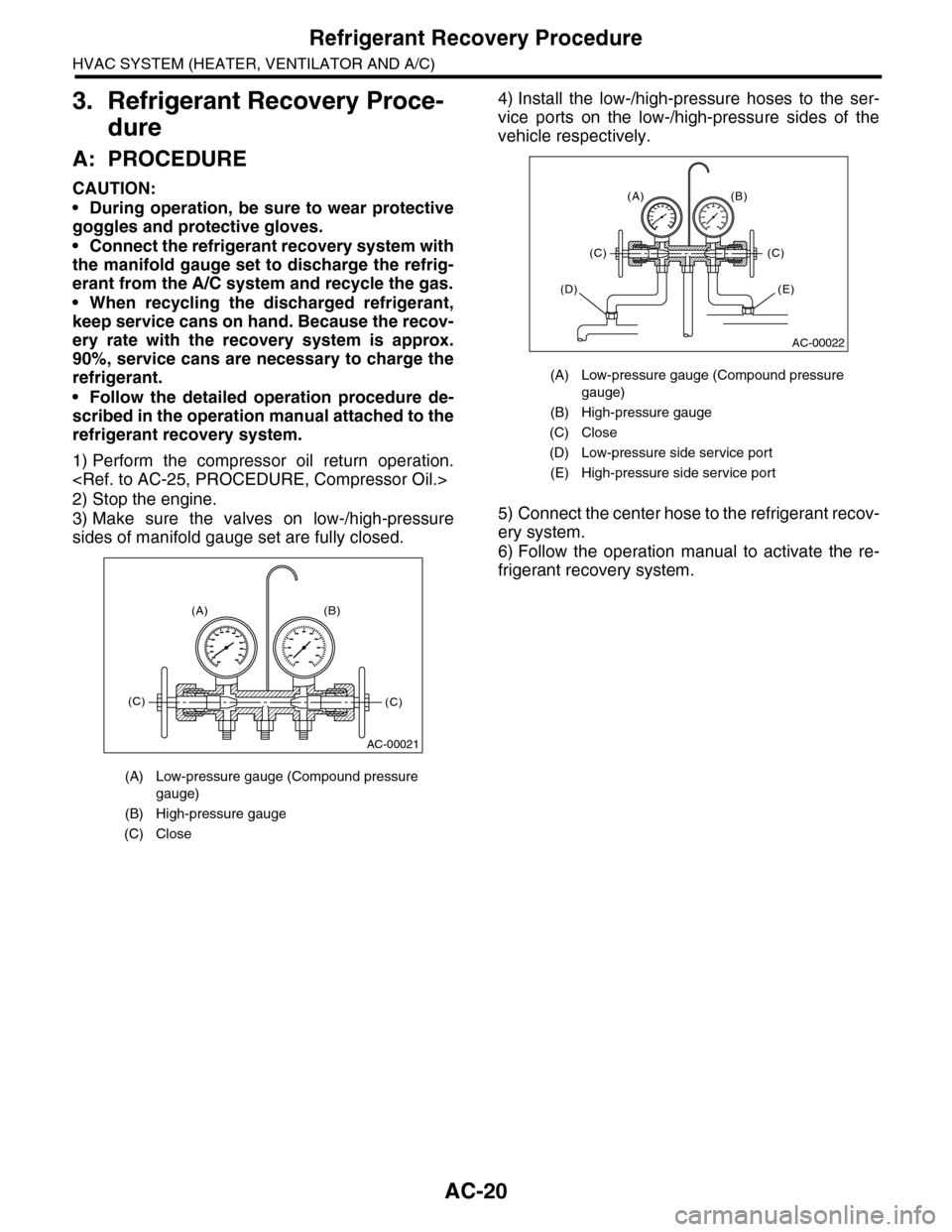
1) Perform the compressor oil return operation.
2) Stop the engine.
3) Make sure the valves on low-/high-pressure
sides of manifold gauge set are fully closed.
4) Install the low-/high-pressure hoses to the ser-
vice ports on the low-/high-pressure sides of the
vehicle respectively.
5) Connect the center hose to the refrigerant recov-
ery system.
6) Follow the operation manual to activate the re-
frigerant recovery system.
(A) Low-pressure gauge (Compound pressure
gauge)
(B) High-pressure gauge
(C) Close
AC-00021
(A) (B)
(C)(C)
(A) Low-pressure gauge (Compound pressure
gauge)
(B) High-pressure gauge
(C) Close
(D) Low-pressure side service port
(E) High-pressure side service port
AC-00022
(A) (B)
(C)(C)
(E)(D)
Page 361 of 2453
AC-35
Heater and Cooling Unit
HVAC SYSTEM (HEATER, VENTILATOR AND A/C)
16.Heater and Cooling Unit
A: REMOVAL
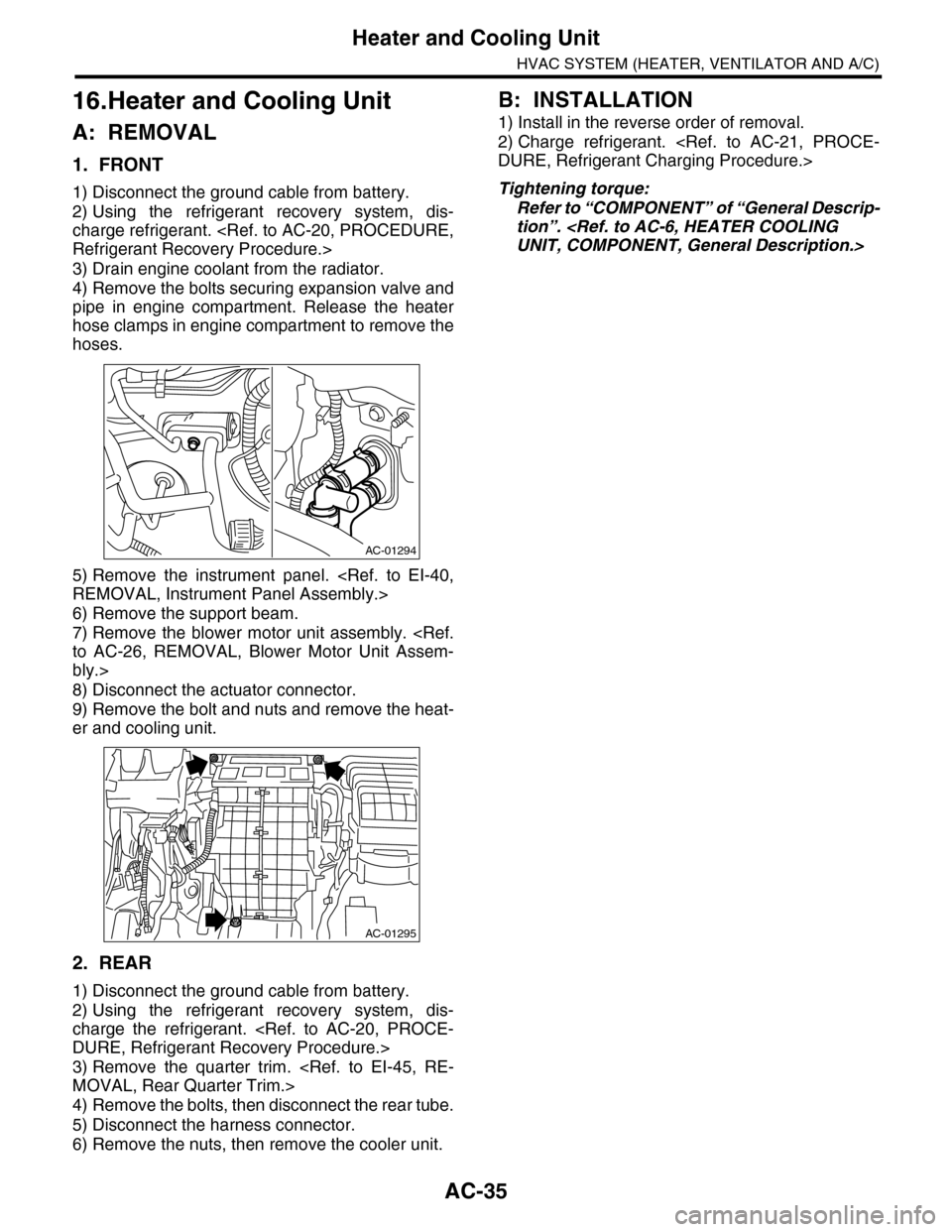
1. FRONT
1) Disconnect the ground cable from battery.
2) Using the refrigerant recovery system, dis-
charge refrigerant.
Refrigerant Recovery Procedure.>
3) Drain engine coolant from the radiator.
4) Remove the bolts securing expansion valve and
pipe in engine compartment. Release the heater
hose clamps in engine compartment to remove the
hoses.
5) Remove the instrument panel.
REMOVAL, Instrument Panel Assembly.>
6) Remove the support beam.
7) Remove the blower motor unit assembly.
to AC-26, REMOVAL, Blower Motor Unit Assem-
bly.>
8) Disconnect the actuator connector.
9) Remove the bolt and nuts and remove the heat-
er and cooling unit.
2. REAR
1) Disconnect the ground cable from battery.
2) Using the refrigerant recovery system, dis-
charge the refrigerant.
DURE, Refrigerant Recovery Procedure.>
3) Remove the quarter trim.
MOVAL, Rear Quarter Trim.>
4) Remove the bolts, then disconnect the rear tube.
5) Disconnect the harness connector.
6) Remove the nuts, then remove the cooler unit.
B: INSTALLATION
1) Install in the reverse order of removal.
2) Charge refrigerant.
DURE, Refrigerant Charging Procedure.>
Tightening torque:
Refer to “COMPONENT” of “General Descrip-
tion”.
UNIT, COMPONENT, General Description.>
AC-01294
AC-01295
Page 362 of 2453

AC-36
Evaporator
HVAC SYSTEM (HEATER, VENTILATOR AND A/C)
17.Evaporator
A: REMOVAL
1. FRONT
1) Using the refrigerant recovery system, dis-
charge refrigerant.
Refrigerant Recovery Procedure.>
2) Disconnect the ground cable from battery.
3) Remove the blower motor unit assembly.
to AC-26, REMOVAL, Blower Motor Unit Assem-
bly.>
4) Disconnect the connector, remove the screw
and then remove the air-mix door actuator and
mode door actuator.
5) Remove the bolts holding the expansion valve,
and remove the expansion valve.
6) Remove the screws and pull out the evaporator.
7) Remove the pipe cover from the evaporator.
8) Remove the bolt which holds the pipe to evapo-
rator, and remove the evaporator.
CAUTION:
If the evaporator is replaced, add an appropri-
ate amount of compressor oil to the evaporator.
Oil.>
2. REAR
1) Using the refrigerant recovery system, dis-
charge the refrigerant.
DURE, Refrigerant Recovery Procedure.>
2) Disconnect the ground cable from battery.
3) Remove the rear cooler unit.
REMOVAL, Heater and Cooling Unit.>
4) Remove the pipe bracket bolts and remove the
bracket.
AC-01296
AC-01298
AC-01300
AC-01317
AC-01299
AC-01343
Page 885 of 2453

PS-5
General Description
POWER ASSISTED SYSTEM (POWER STEERING)
•Gearbox
(1) Pipe C (20) Adapter (39) O–ring
(2) Pipe D (21) Clamp (40) Bracket
(3) Clamp plate (22) Cotter pin (41) Bushing
(4) Universal joint (23) Castle nut (42) Lock washer
(5) Dust seal (24) Dust cover
(6) Valve housing (25) ClipTightening torque: N·m (kgf-m, ft-lb)
(7) Gasket (26) Tie–rod endT1: 3.9 (0.4, 2.9)
(8) Oil seal (27) ClipT2: 10 (1.02, 7.4)
(9) Bushing (28) BootT3: 15 (1.5, 10.8)
(10) Seal ring (29) BandT4: 17 (1.7, 12.5)
(11) Pinion & valve ASSY (30) Tie–rodT5: 20 (2.0, 14.8)
(12) Oil seal (31) Pipe BT6: 24 (2.4, 17.4)
(13) Back–up washer (32) Pipe AT7: 25 (2.5, 18.1)
(14) Ball bearing (33) Steering bodyT8: 27 (2.75, 19.9)
(15) Snap ring (34) Oil sealT9: 29 (3.0, 21.4)
(16) Lock nut (35) Piston ringT10: 37 (3.8, 27.3)
(17) Adjusting screw (36) RackT11: 60 (6.1, 44.1)
(18) Spring (37) Rack bushingT12: 85 (8.7, 62.7)
(19) Sleeve (38) HolderT13: 130 (13.3, 95.9)
PS-00729
T11
T8
T3
T12
T8
T13
T4
T13
T12
T8
(2)
(3)
T10
T5
T9
T6
T6T2
(22)
(20)
(23)
(24)
(25)
(26)
(27)
(28)(29)
(30)
(37)
(32)
(36)
(35)
(30)
(28)
(27)
(26)
(25)
(24)
(7)
(8)
(9)
(10)
(11)
(22)(23)
(5)
(6)
(4)
(1)
(3)
(12)
(13)
(15)(42)
(38)(42)
(14)(33)
(19)(18)(17)(16)(21)
(34)
(31)(39)
(39)
T7T1
(29)
(40)
T11
(41)
Page 902 of 2453
PS-22
Steering Gearbox
POWER ASSISTED SYSTEM (POWER STEERING)
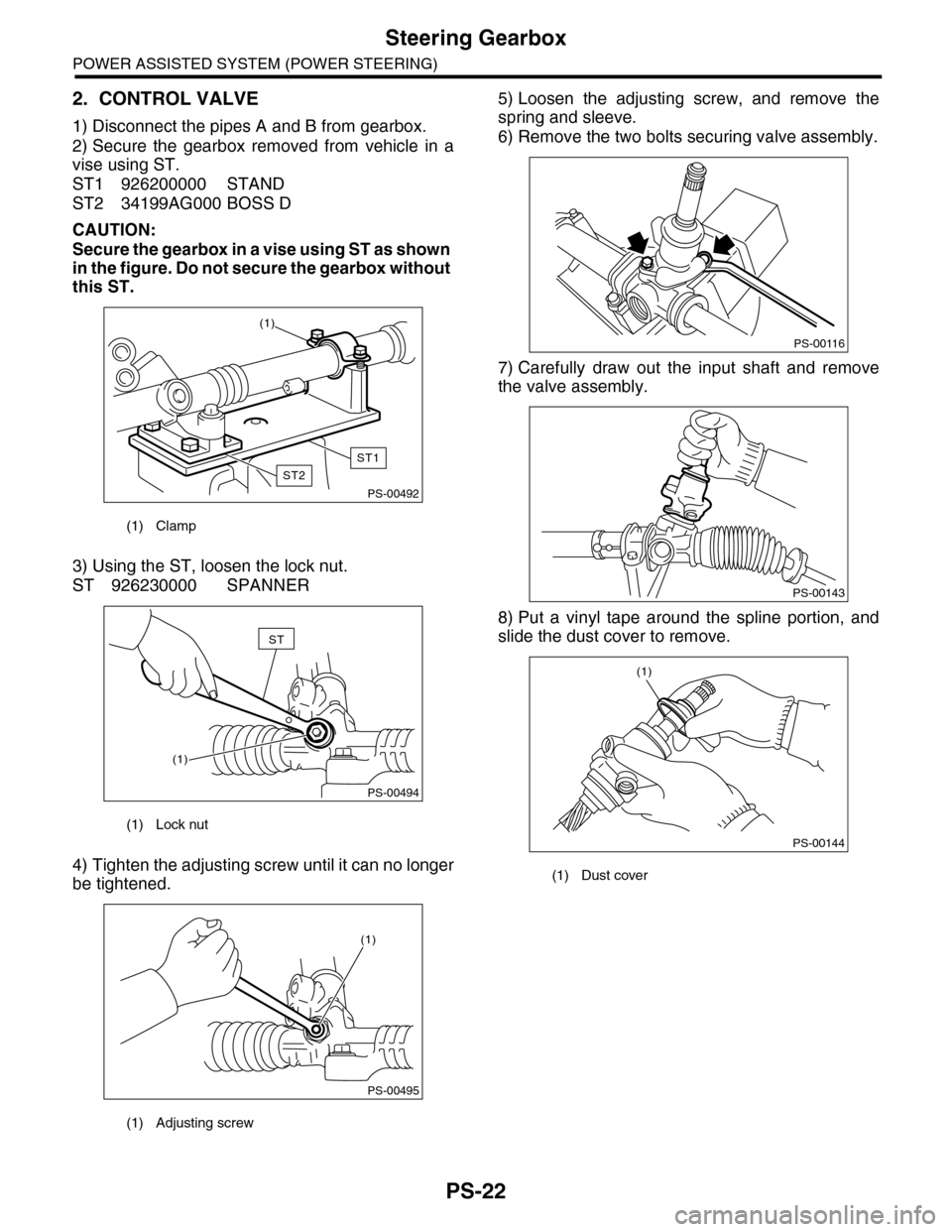
2. CONTROL VALVE
1) Disconnect the pipes A and B from gearbox.
2) Secure the gearbox removed from vehicle in a
vise using ST.
ST1 926200000 STAND
ST2 34199AG000 BOSS D
CAUTION:
Secure the gearbox in a vise using ST as shown
in the figure. Do not secure the gearbox without
this ST.
3) Using the ST, loosen the lock nut.
ST 926230000 SPANNER
4) Tighten the adjusting screw until it can no longer
be tightened.
5) Loosen the adjusting screw, and remove the
spring and sleeve.
6) Remove the two bolts securing valve assembly.
7) Carefully draw out the input shaft and remove
the valve assembly.
8) Put a vinyl tape around the spline portion, and
slide the dust cover to remove.
(1) Clamp
(1) Lock nut
(1) Adjusting screw
PS-00492
(1)
ST1
ST2
PS-00494
ST
(1)
PS-00495
(1)
(1) Dust cover
PS-00116
PS-00143
PS-00144
(1)