2009 SUBARU TRIBECA Valve cover
[x] Cancel search: Valve coverPage 906 of 2453
PS-26
Steering Gearbox
POWER ASSISTED SYSTEM (POWER STEERING)
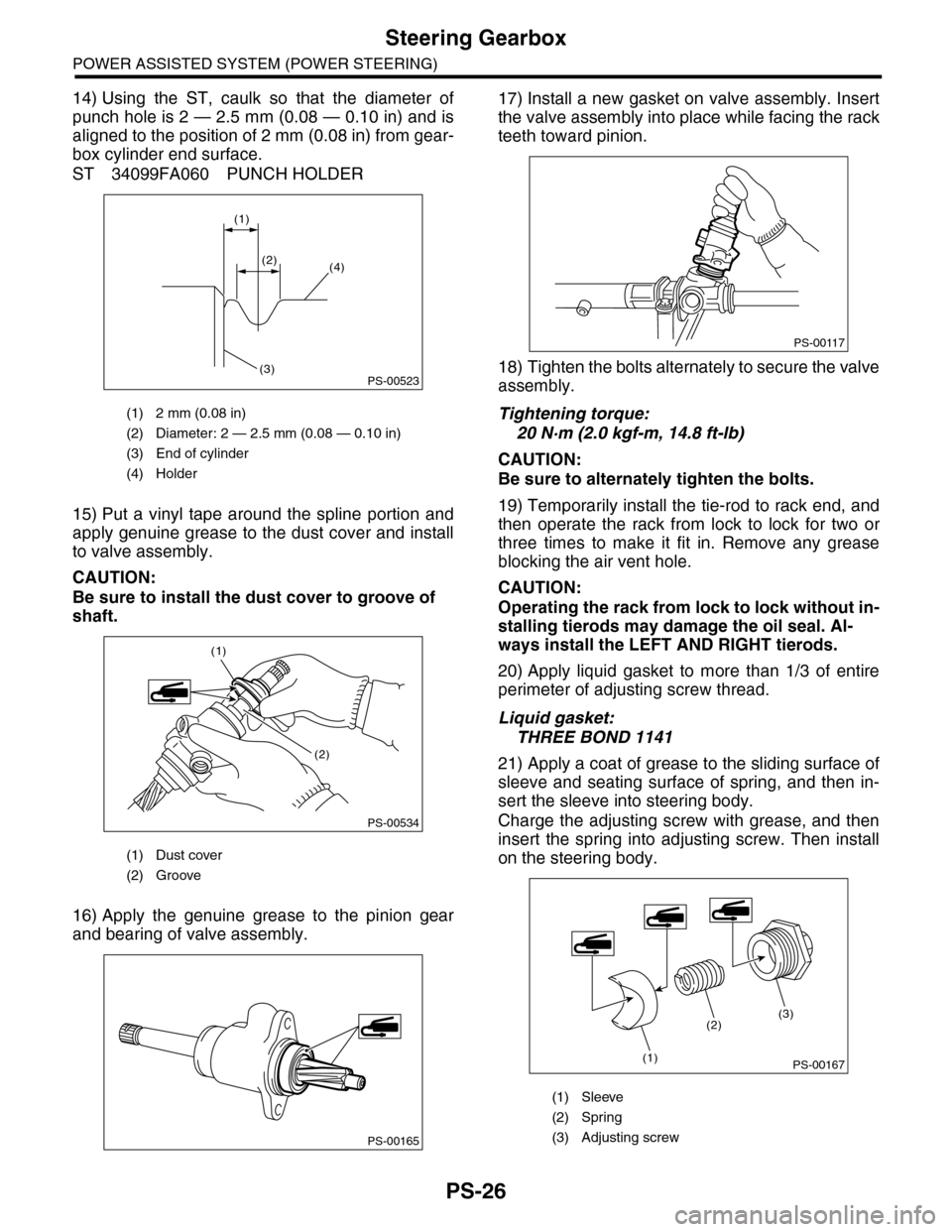
14) Using the ST, caulk so that the diameter of
punch hole is 2 — 2.5 mm (0.08 — 0.10 in) and is
aligned to the position of 2 mm (0.08 in) from gear-
box cylinder end surface.
ST 34099FA060 PUNCH HOLDER
15) Put a vinyl tape around the spline portion and
apply genuine grease to the dust cover and install
to valve assembly.
CAUTION:
Be sure to install the dust cover to groove of
shaft.
16) Apply the genuine grease to the pinion gear
and bearing of valve assembly.
17) Install a new gasket on valve assembly. Insert
the valve assembly into place while facing the rack
teeth toward pinion.
18) Tighten the bolts alternately to secure the valve
assembly.
Tightening torque:
20 N·m (2.0 kgf-m, 14.8 ft-lb)
CAUTION:
Be sure to alternately tighten the bolts.
19) Temporarily install the tie-rod to rack end, and
then operate the rack from lock to lock for two or
three times to make it fit in. Remove any grease
blocking the air vent hole.
CAUTION:
Operating the rack from lock to lock without in-
stalling tierods may damage the oil seal. Al-
ways install the LEFT AND RIGHT tierods.
20) Apply liquid gasket to more than 1/3 of entire
perimeter of adjusting screw thread.
Liquid gasket:
THREE BOND 1141
21) Apply a coat of grease to the sliding surface of
sleeve and seating surface of spring, and then in-
sert the sleeve into steering body.
Charge the adjusting screw with grease, and then
insert the spring into adjusting screw. Then install
on the steering body.
(1) 2 mm (0.08 in)
(2) Diameter: 2 — 2.5 mm (0.08 — 0.10 in)
(3) End of cylinder
(4) Holder
(1) Dust cover
(2) Groove
PS-00523
(1)
(2)(4)
(3)
PS-00534
(1)
(2)
PS-00165
(1) Sleeve
(2) Spring
(3) Adjusting screw
PS-00117
PS-00167
(2)
(1)
(3)
Page 910 of 2453
PS-30
Steering Gearbox
POWER ASSISTED SYSTEM (POWER STEERING)
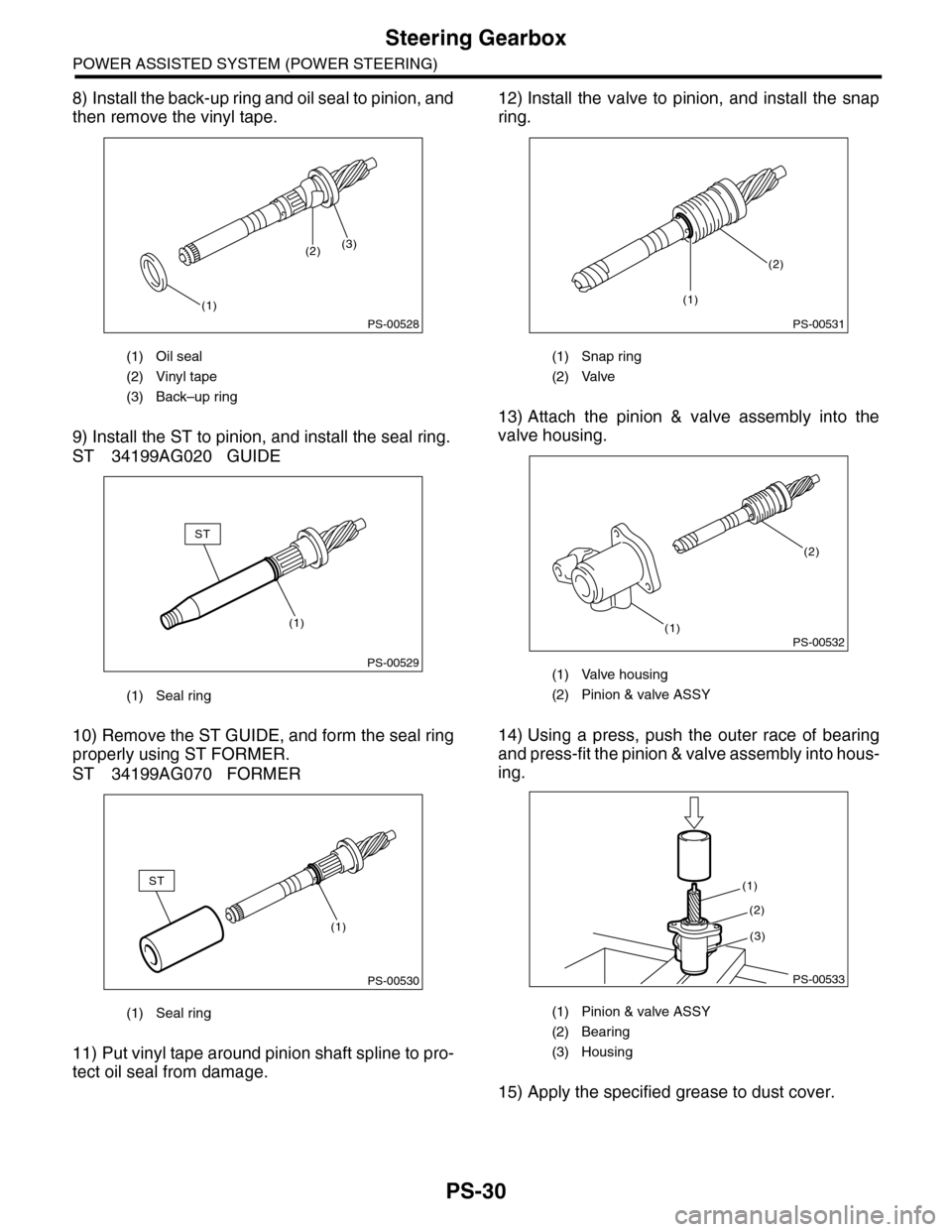
8) Install the back-up ring and oil seal to pinion, and
then remove the vinyl tape.
9) Install the ST to pinion, and install the seal ring.
ST 34199AG020 GUIDE
10) Remove the ST GUIDE, and form the seal ring
properly using ST FORMER.
ST 34199AG070 FORMER
11) Put vinyl tape around pinion shaft spline to pro-
tect oil seal from damage.
12) Install the valve to pinion, and install the snap
ring.
13) Attach the pinion & valve assembly into the
valve housing.
14) Using a press, push the outer race of bearing
and press-fit the pinion & valve assembly into hous-
ing.
15) Apply the specified grease to dust cover.
(1) Oil seal
(2) Vinyl tape
(3) Back–up ring
(1) Seal ring
(1) Seal ring
PS-00528
(1)
(2)(3)
PS-00529
(1)
ST
PS-00530
ST
(1)
(1) Snap ring
(2) Valve
(1) Valve housing
(2) Pinion & valve ASSY
(1) Pinion & valve ASSY
(2) Bearing
(3) Housing
PS-00531
(2)
(1)
PS-00532(1)
(2)
PS-00533
(1)
(2)
(3)
Page 911 of 2453
PS-31
Steering Gearbox
POWER ASSISTED SYSTEM (POWER STEERING)
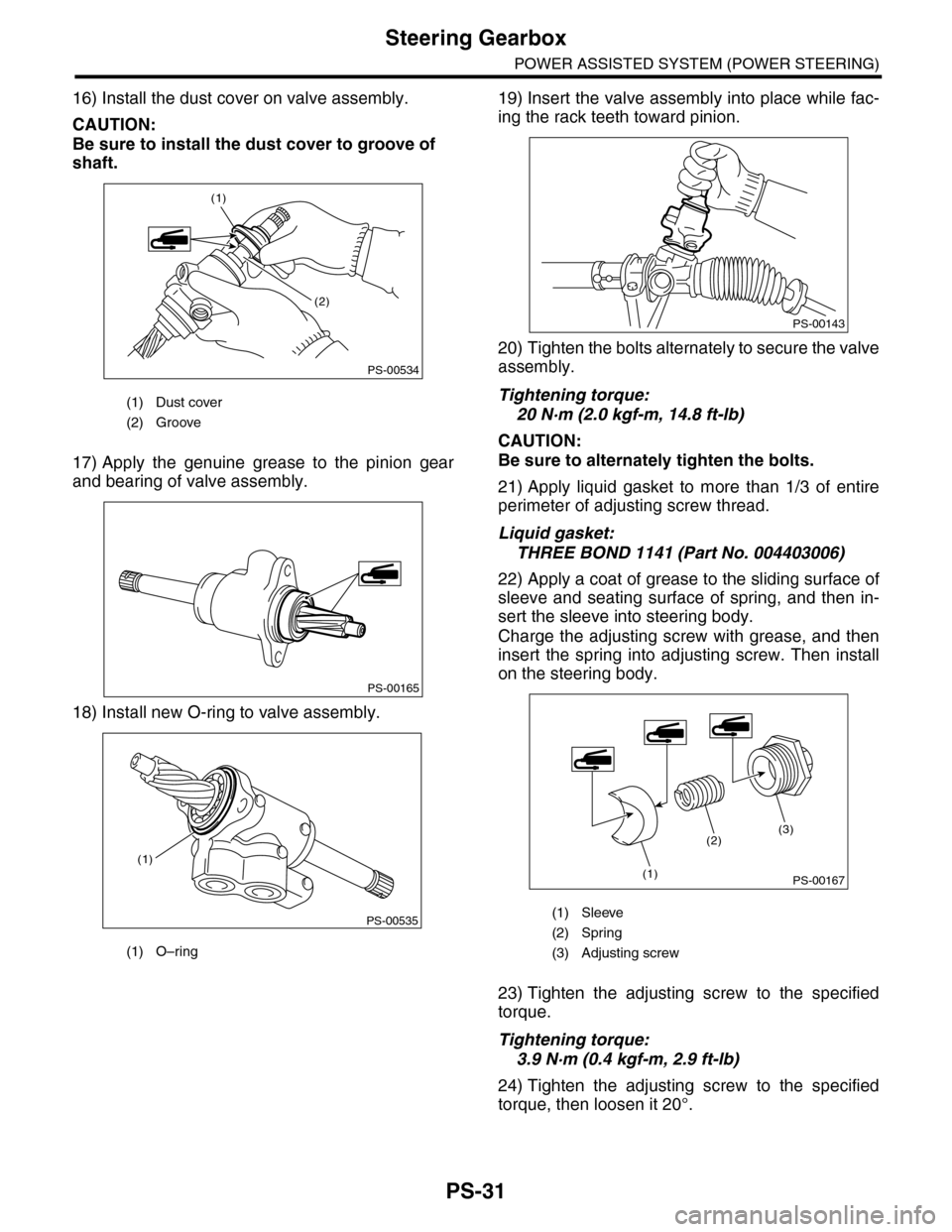
16) Install the dust cover on valve assembly.
CAUTION:
Be sure to install the dust cover to groove of
shaft.
17) Apply the genuine grease to the pinion gear
and bearing of valve assembly.
18) Install new O-ring to valve assembly.
19) Insert the valve assembly into place while fac-
ing the rack teeth toward pinion.
20) Tighten the bolts alternately to secure the valve
assembly.
Tightening torque:
20 N·m (2.0 kgf-m, 14.8 ft-lb)
CAUTION:
Be sure to alternately tighten the bolts.
21) Apply liquid gasket to more than 1/3 of entire
perimeter of adjusting screw thread.
Liquid gasket:
THREE BOND 1141 (Part No. 004403006)
22) Apply a coat of grease to the sliding surface of
sleeve and seating surface of spring, and then in-
sert the sleeve into steering body.
Charge the adjusting screw with grease, and then
insert the spring into adjusting screw. Then install
on the steering body.
23) Tighten the adjusting screw to the specified
torque.
Tightening torque:
3.9 N·m (0.4 kgf-m, 2.9 ft-lb)
24) Tighten the adjusting screw to the specified
torque, then loosen it 20°.
(1) Dust cover
(2) Groove
(1) O–ring
PS-00534
(1)
(2)
PS-00165
PS-00535
(1)
(1) Sleeve
(2) Spring
(3) Adjusting screw
PS-00143
PS-00167
(2)
(1)
(3)
Page 933 of 2453

PS-53
General Diagnostic Table
POWER ASSISTED SYSTEM (POWER STEERING)
3. INSPECTION OF CLEARANCE
This table lists various clearances that must be correctly adjusted to ensure the normal vehicle driving with-
out interfering noise, or any other faults.
Install locations Minimum allowance mm (in)
(1) Crossmember-to-Hose assembly 10 (0.39)
(2) Front frame side-to-Hose assembly 15 (0.59)
(3) Air bag sensor to cooler pipe assembly 10 (0.39)
(4) Air cleaner case-to-Suction hose 10 (0.39)
(5) VDCH/U to Reservoir tank bracket 10 (0.39)
(6) Air boots to Hose clip15 (0.59)
(7) Air boot-to-Hose assembly15 (0.59)
(8) Protector to Hose assembly10 (0.39)
(9) Intake manifold to Suction hose 10 (0.39)
(10) Intake manifold to hose assembly 10 (0.39)
(11) Air cleaner case to Cooler pipe joint block 5 (0.20)
(12) Chain cover to Cooler pipe joint block 20 (0.79)
(13) Oil pipe to Cooler pipe joint block 20 (0.79)
(14) Suction hose to Hose assembly 10 (0.39)
(15) Air boot to Reservoir tank10 (0.39)
(16) Brake pipe to Reservoir tank10 (0.39)
(17) Harness to Hose assembly10 (0.39)
(18) Relay box to Hose assembly15 (0.59)
(19) Bumper beam to Cooler pipe assembly 10 (0.39)
(20) Radiator bracket to Cooler pipe assembly 10 (0.39)
(21) ATF cooler to Cooler pipe assembly 10 (0.39)
(22) Undercover to cooler pipe assembly 10 (0.39)
(23) Protector to Hose assembly10 (0.39)
(24) Protector to Hose assembly15 (0.59)
(25) Return hose to Hose assembly 10 (0.39)
(26) Air cleaner case to Hose assembly 10 (0.39)
(27) Suction hose to Hose assembly 10 (0.39)
(28) Air cleaner case to Return hose 3 (0.12)
(29) Valve housing to DOJ12 (0.47)
(30) Valve housing to Crossmember 1 (0.04)
(31) Mount to Crossmember There must be no contact.
(32) Feed tube to Crossmember3 (0.12)
(33) Elbow to Crossmember3 (0.12)
(34) Cylinder pipe to Crossmember 3 (0.12)
(35) Feed tube to Exhaust pipe18 (0.71)
(36) Tie-rod end to Brake dust cover 2.5 (0.10)
(37) Coupling rubber to AT level gage 10 (0.39)
(38) Yoke to Brake booster5 (0.20)
Page 1093 of 2453
VDC-12
ABS Sequence Control
VEHICLE DYNAMICS CONTROL (VDC)
3. ABS Sequence Control
A: OPERATION
1) While the ABS sequence control is being per-
formed, the operation of the hydraulic unit can be
checked using the brake tester or pressure gauge
after the hydraulic unit solenoid valve operation.
2) ABS sequence control can be started by the
Subaru Select Monitor.
1. ABS SEQUENCE CONTROL WITH SUB-
ARU SELECT MONITOR
NOTE:
In the event of any trouble, the ABS sequence con-
trol will not operate.
1) Connect the Subaru Select Monitor to data link
connector under the driver's side instrument panel
lower cover.
2) Turn the ignition switch ON.
3) Set the Subaru Select Monitor switch to ON.
4) Set the Subaru Select Monitor to “Brake Control”
mode.
5) When the “Function check sequence” is select-
ed, the “ABS sequence control” will start.
6) Execute the following operations when the mes-
sage “Press the brake pedal so that the brake ped-
al force is between 100 and 150 kgf” is displayed.
(1) [When the brake tester is used, press brake
pedal pad with a force of 1,000 N (102 kgf, 225
lb). ]
(2) When using a pressure gauge, press the
brake pedal so that the pressure gauge indi-
cates 3,500 kPa (36 kg/cm2, 511 psi).
7) “Press the “YES” key” will be displayed. Press
the [YES] key.
8) The brake system being operated is displayed
on the Subaru Select Monitor.
Page 1096 of 2453
VDC-15
VDC Sequence Control
VEHICLE DYNAMICS CONTROL (VDC)
4. VDC Sequence Control
A: OPERATION
1) While the VDC sequence control is performed,
the operation of the hydraulic unit can be checked
using the brake tester or pressure gauge after the
hydraulic unit solenoid valve is operated.
2) VDC sequence control can be started by Subaru
Select Monitor.
1. VDC SEQUENCE CONTROL WITH SUB-
ARU SELECT MONITOR
NOTE:
In the event of any trouble, sequence control will
not operate.
1) Connect the Subaru Select Monitor to data link
connector under the driver's side instrument panel
lower cover.
2) Turn the ignition switch ON.
3) Set the Subaru Select Monitor switch to ON.
4) Set the Subaru Select Monitor to “Brake Control”
mode.
5) When the “VDC Inspection Mode” is selected
from the “Function check sequence” menu, the
“VDC sequence control” will start.
6) ”Press the “YES” key” will be displayed. Press
the [YES] key.
7) Operation points will be displayed on Subaru Se-
lect Monitor.
Page 1129 of 2453
CO(H6DO)-10
Engine Coolant
COOLING
3. Engine Coolant
A: REPLACEMENT
1. DRAINING OF ENGINE COOLANT
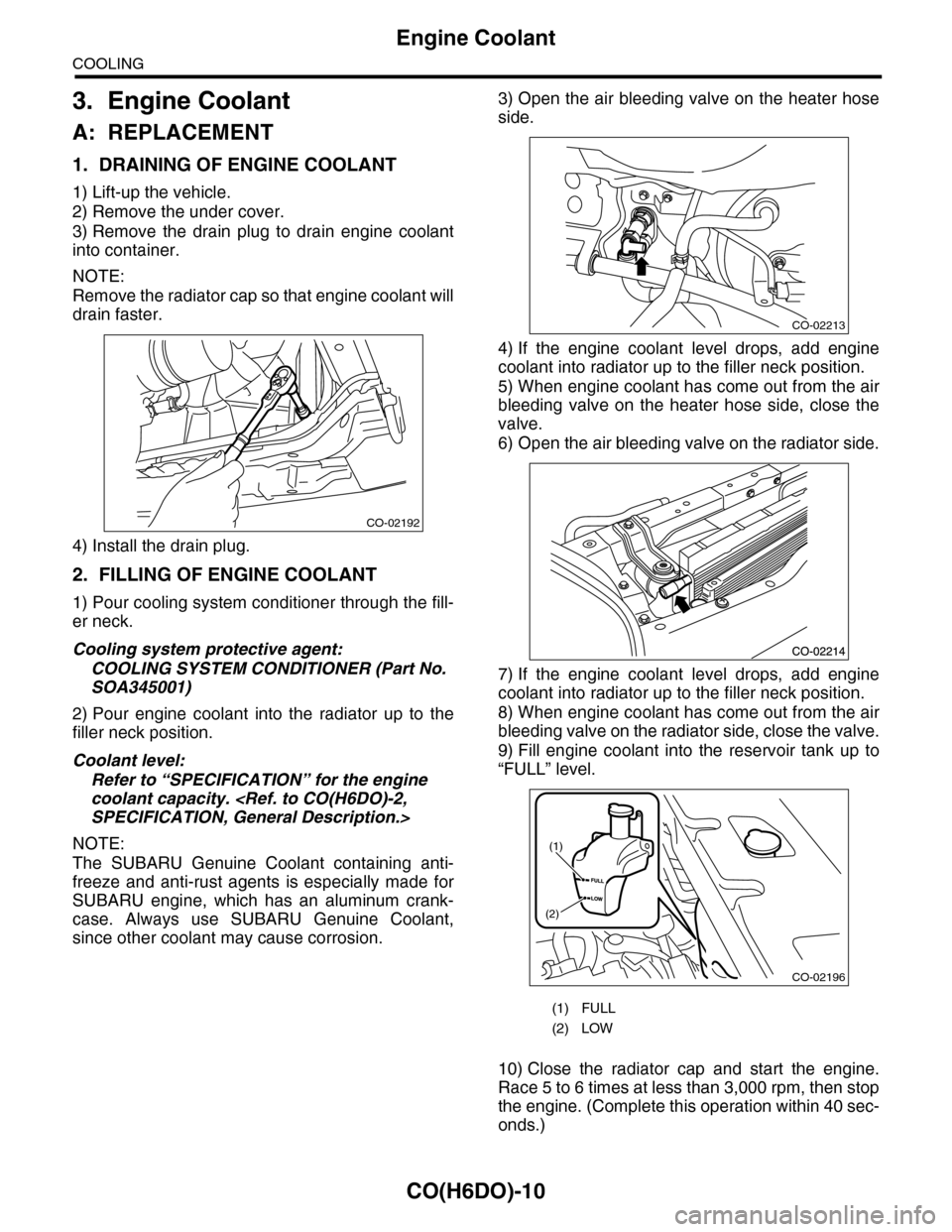
1) Lift-up the vehicle.
2) Remove the under cover.
3) Remove the drain plug to drain engine coolant
into container.
NOTE:
Remove the radiator cap so that engine coolant will
drain faster.
4) Install the drain plug.
2. FILLING OF ENGINE COOLANT
1) Pour cooling system conditioner through the fill-
er neck.
Cooling system protective agent:
COOLING SYSTEM CONDITIONER (Part No.
SOA345001)
2) Pour engine coolant into the radiator up to the
filler neck position.
Coolant level:
Refer to “SPECIFICATION” for the engine
coolant capacity.
NOTE:
The SUBARU Genuine Coolant containing anti-
freeze and anti-rust agents is especially made for
SUBARU engine, which has an aluminum crank-
case. Always use SUBARU Genuine Coolant,
since other coolant may cause corrosion.
3) Open the air bleeding valve on the heater hose
side.
4) If the engine coolant level drops, add engine
coolant into radiator up to the filler neck position.
5) When engine coolant has come out from the air
bleeding valve on the heater hose side, close the
valve.
6) Open the air bleeding valve on the radiator side.
7) If the engine coolant level drops, add engine
coolant into radiator up to the filler neck position.
8) When engine coolant has come out from the air
bleeding valve on the radiator side, close the valve.
9) Fill engine coolant into the reservoir tank up to
“FULL” level.
10) Close the radiator cap and start the engine.
Race 5 to 6 times at less than 3,000 rpm, then stop
the engine. (Complete this operation within 40 sec-
onds.)
CO-02192
(1) FULL
(2) LOW
CO-02213
CO-02196
(1)
(2)
Page 1133 of 2453
CO(H6DO)-14
Thermostat
COOLING
5. Thermostat
A: REMOVAL
1) Set the vehicle on a lift.
2) Lift-up the vehicle.
3) Remove the under cover.
4) Drain engine coolant completely.
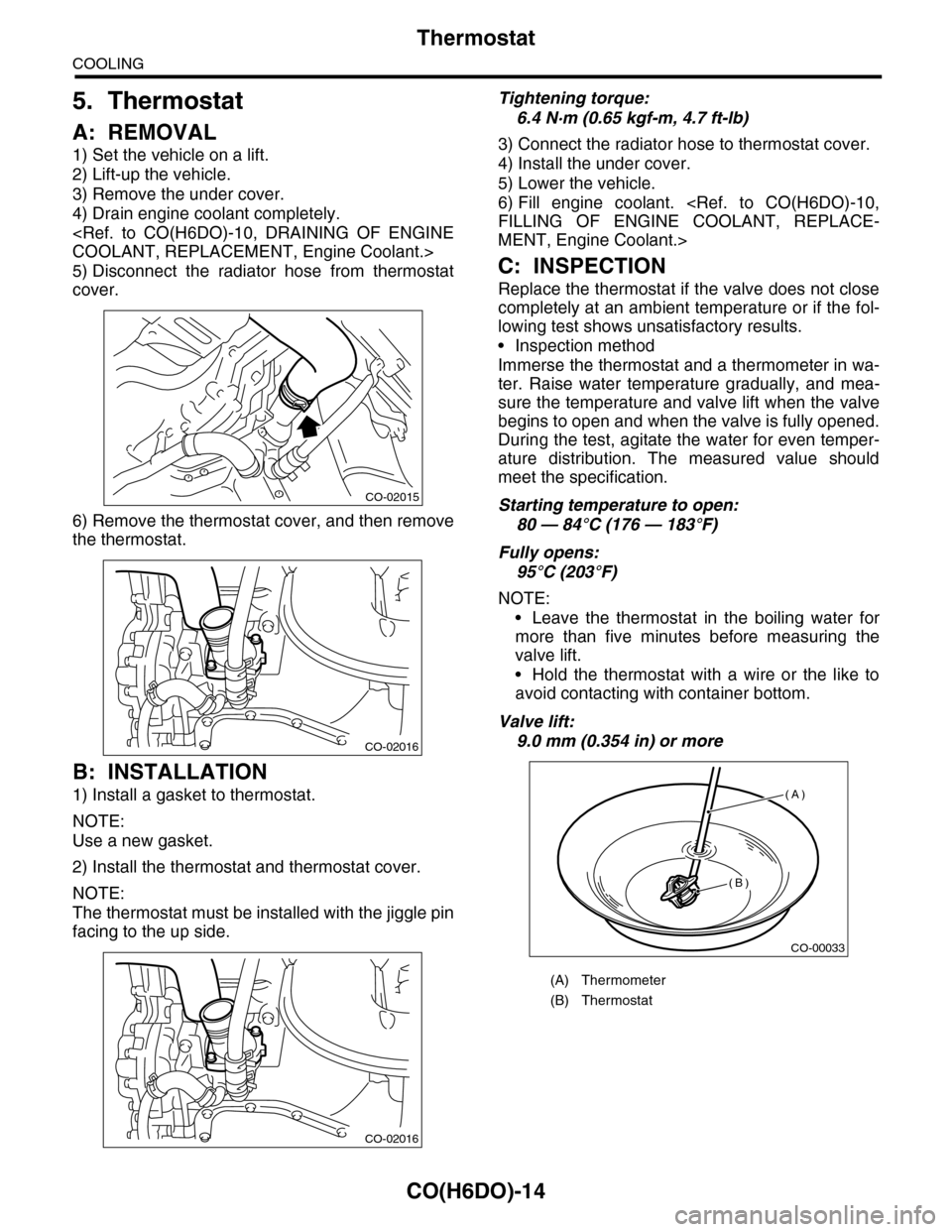
5) Disconnect the radiator hose from thermostat
cover.
6) Remove the thermostat cover, and then remove
the thermostat.
B: INSTALLATION
1) Install a gasket to thermostat.
NOTE:
Use a new gasket.
2) Install the thermostat and thermostat cover.
NOTE:
The thermostat must be installed with the jiggle pin
facing to the up side.
Tightening torque:
6.4 N·m (0.65 kgf-m, 4.7 ft-lb)
3) Connect the radiator hose to thermostat cover.
4) Install the under cover.
5) Lower the vehicle.
6) Fill engine coolant.
MENT, Engine Coolant.>
C: INSPECTION
Replace the thermostat if the valve does not close
completely at an ambient temperature or if the fol-
lowing test shows unsatisfactory results.
•Inspection method
Immerse the thermostat and a thermometer in wa-
ter. Raise water temperature gradually, and mea-
sure the temperature and valve lift when the valve
begins to open and when the valve is fully opened.
During the test, agitate the water for even temper-
ature distribution. The measured value should
meet the specification.
Starting temperature to open:
80 — 84°C (176 — 183°F)
Fully opens:
95°C (203°F)
NOTE:
•Leave the thermostat in the boiling water for
more than five minutes before measuring the
valve lift.
•Hold the thermostat with a wire or the like to
avoid contacting with container bottom.
Valve lift:
9.0 mm (0.354 in) or more
CO-02015
CO-02016
CO-02016
(A) Thermometer
(B) Thermostat
CO-00033
(A)
(B)