Page 1678 of 2453
GD(H6DO)-66
Diagnostic Trouble Code (DTC) Detecting Criteria
GENERAL DESCRIPTION
AM:DTC P0133 O2 SENSOR CIRCUIT SLOW RESPONSE (BANK 1 SENSOR 1)
1. OUTLINE OF DIAGNOSIS
Detect the slow response of front oxygen (A/F) sensor.
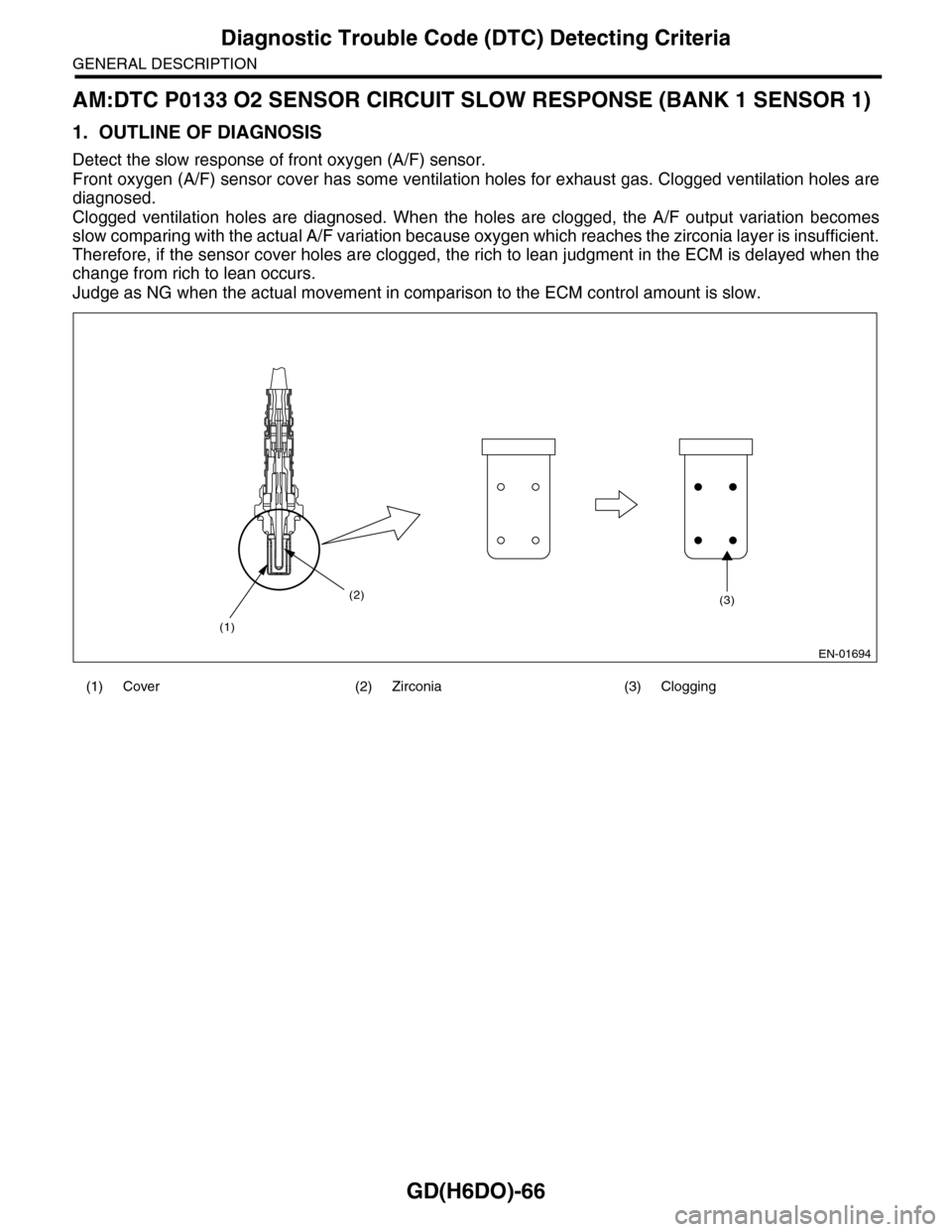
Front oxygen (A/F) sensor cover has some ventilation holes for exhaust gas. Clogged ventilation holes are
diagnosed.
Clogged ventilation holes are diagnosed. When the holes are clogged, the A/F output variation becomes
slow comparing with the actual A/F variation because oxygen which reaches the zirconia layer is insufficient.
Therefore, if the sensor cover holes are clogged, the rich to lean judgment in the ECM is delayed when the
change from rich to lean occurs.
Judge as NG when the actual movement in comparison to the ECM control amount is slow.
(1) Cover (2) Zirconia (3) Clogging
EN-01694
(1)
(2)(3)
Page 1679 of 2453
GD(H6DO)-67
Diagnostic Trouble Code (DTC) Detecting Criteria
GENERAL DESCRIPTION
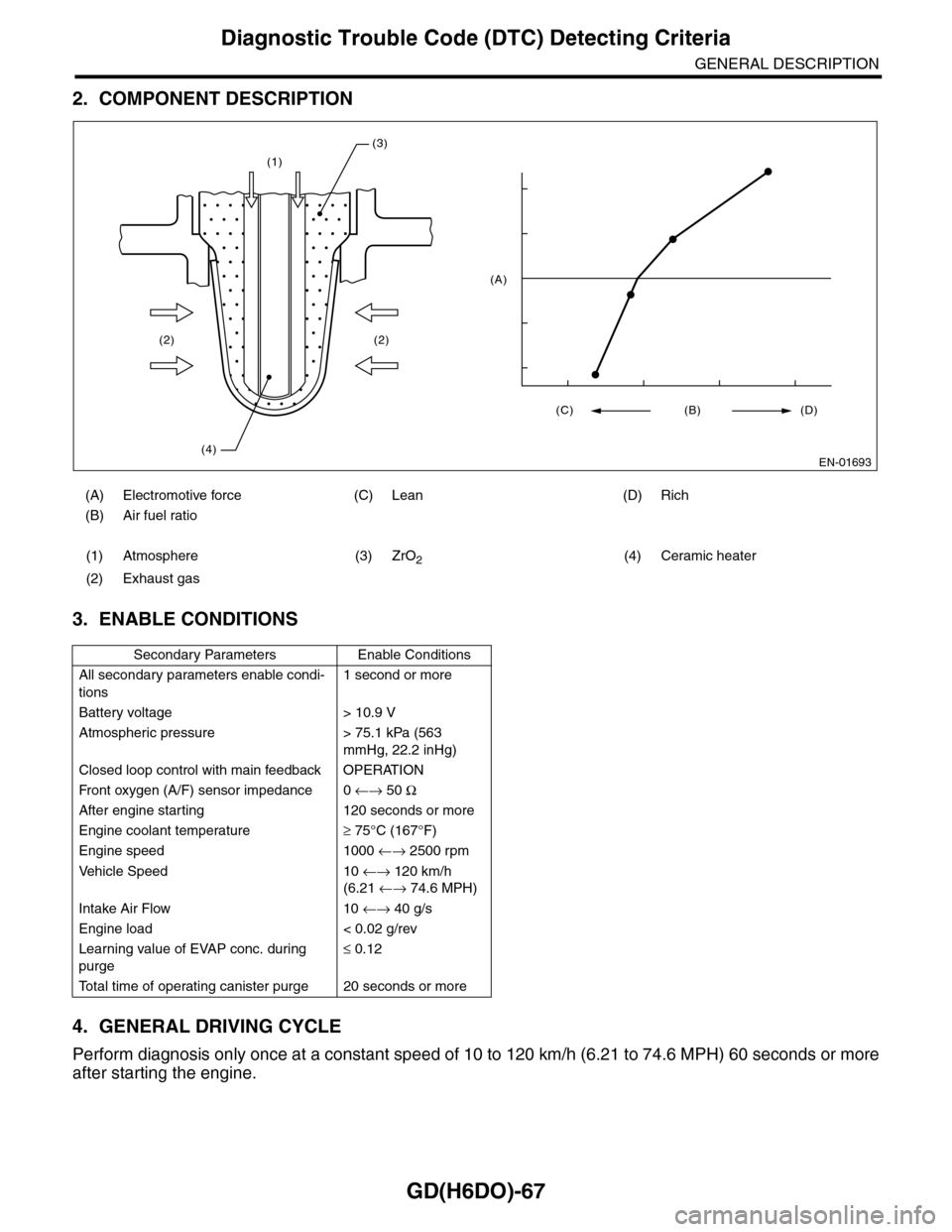
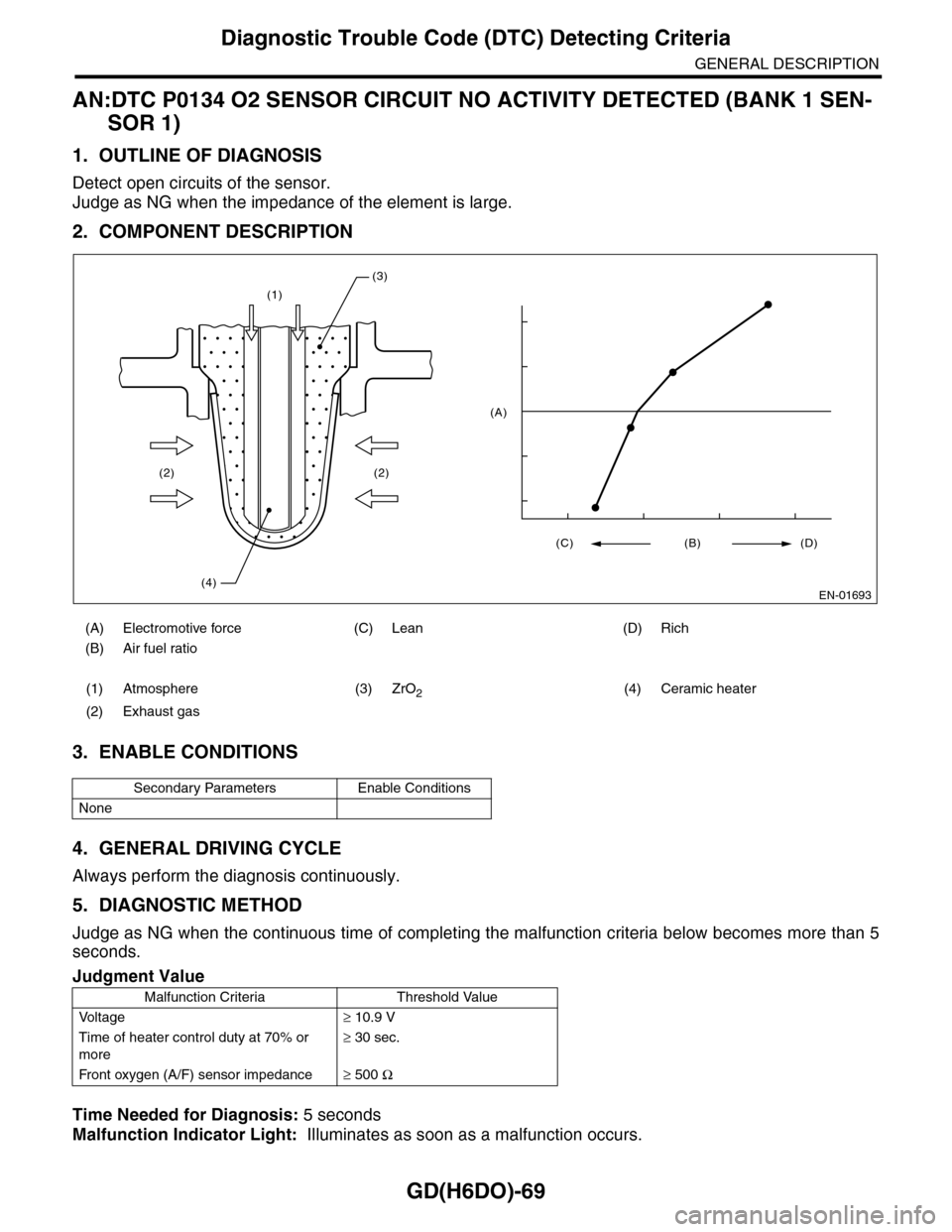
2. COMPONENT DESCRIPTION
3. ENABLE CONDITIONS
4. GENERAL DRIVING CYCLE
Perform diagnosis only once at a constant speed of 10 to 120 km/h (6.21 to 74.6 MPH) 60 seconds or more
after starting the engine.
(A) Electromotive force (C) Lean (D) Rich
(B) Air fuel ratio
(1) Atmosphere (3) ZrO2(4) Ceramic heater
(2) Exhaust gas
Secondary Parameters Enable Conditions
All secondary parameters enable condi-
tions
1 second or more
Battery voltage > 10.9 V
Atmospheric pressure > 75.1 kPa (563
mmHg, 22.2 inHg)
Closed loop control with main feedback OPERATION
Fr o nt ox yg e n ( A / F) s en so r im pe d an c e 0 ←→ 50 Ω
After engine starting 120 seconds or more
Engine coolant temperature≥ 75°C (167°F)
Engine speed 1000 ←→ 2500 rpm
Ve h i c l e S p e e d 1 0 ←→ 120 km/h
(6.21 ←→ 74.6 MPH)
Intake Air Flow 10 ←→ 40 g/s
Engine load < 0.02 g/rev
Learning value of EVAP conc. during
purge
≤ 0.12
To t a l t i m e o f o p e r a t i n g c a n i s t e r p u r g e 2 0 s e c o n d s o r m o r e
(1)
(2)
(4)
(2)
(3)
EN-01693
(C) (B) (D)
(A)
Page 1681 of 2453
GD(H6DO)-69
Diagnostic Trouble Code (DTC) Detecting Criteria
GENERAL DESCRIPTION
AN:DTC P0134 O2 SENSOR CIRCUIT NO ACTIVITY DETECTED (BANK 1 SEN-
SOR 1)
1. OUTLINE OF DIAGNOSIS
Detect open circuits of the sensor.
Judge as NG when the impedance of the element is large.
2. COMPONENT DESCRIPTION
3. ENABLE CONDITIONS
4. GENERAL DRIVING CYCLE
Always perform the diagnosis continuously.
5. DIAGNOSTIC METHOD
Judge as NG when the continuous time of completing the malfunction criteria below becomes more than 5
seconds.
Time Needed for Diagnosis: 5 seconds
Malfunction Indicator Light: Illuminates as soon as a malfunction occurs.
(A) Electromotive force (C) Lean (D) Rich
(B) Air fuel ratio
(1) Atmosphere (3) ZrO2(4) Ceramic heater
(2) Exhaust gas
Secondary Parameters Enable Conditions
None
Judgment Value
Malfunction Criteria Threshold Value
Vo l t a g e≥ 10.9 V
Time of heater control duty at 70% or
more
≥ 30 sec.
Fr o nt ox yg e n ( A / F) s en so r im pe d an c e≥ 500 Ω
(1)
(2)
(4)
(2)
(3)
EN-01693
(C) (B) (D)
(A)
Page 1683 of 2453
GD(H6DO)-71
Diagnostic Trouble Code (DTC) Detecting Criteria
GENERAL DESCRIPTION
AO:DTC P0137 O2 SENSOR CIRCUIT LOW VOLTAGE (BANK 1 SENSOR 2)
1. OUTLINE OF DIAGNOSIS
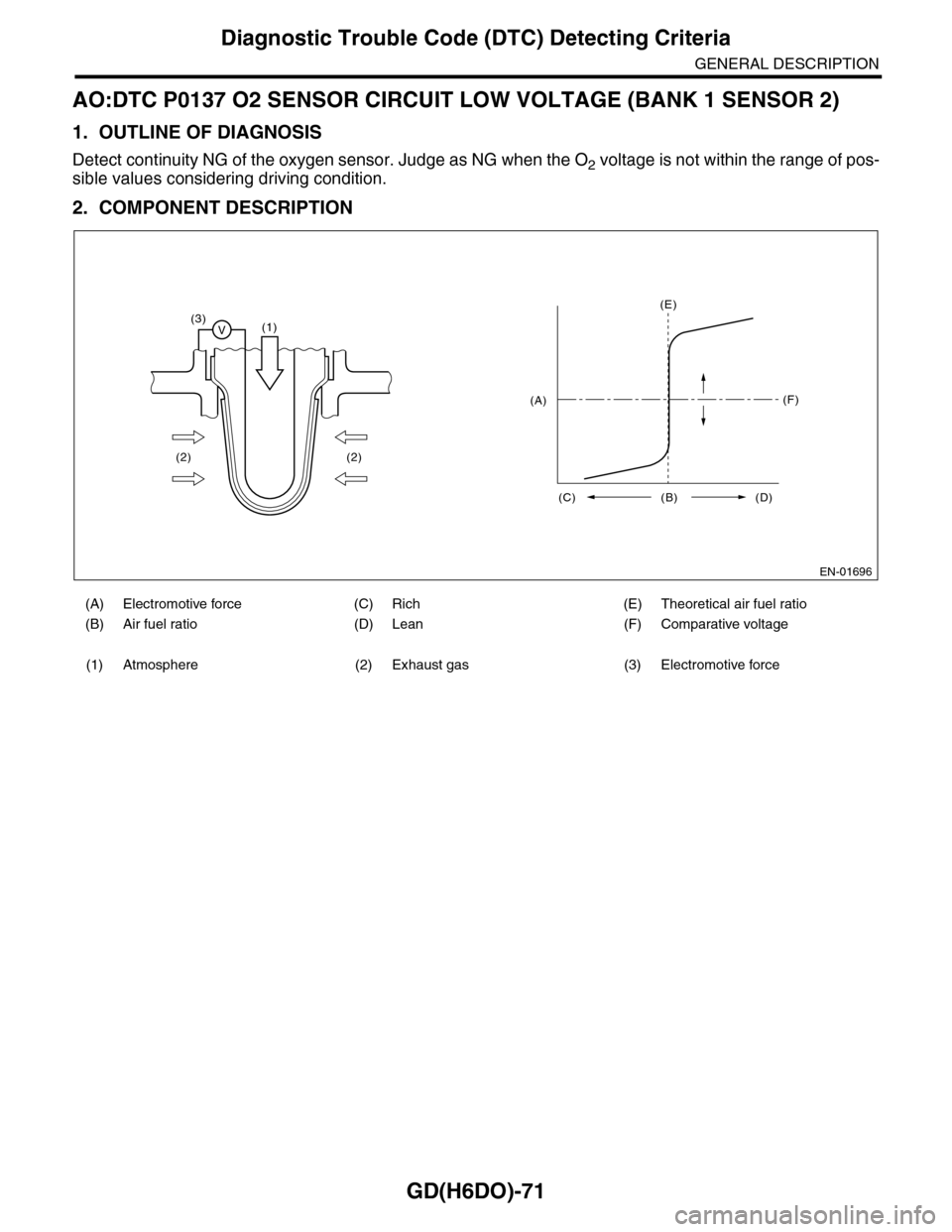
Detect continuity NG of the oxygen sensor. Judge as NG when the O2 voltage is not within the range of pos-
sible values considering driving condition.
2. COMPONENT DESCRIPTION
(A) Electromotive force (C) Rich (E) Theoretical air fuel ratio
(B) Air fuel ratio (D) Lean (F) Comparative voltage
(1) Atmosphere (2) Exhaust gas (3) Electromotive force
EN-01696
(3)V(1)
(2) (2)
(E)
(F)
(C) (B) (D)
(A)
Page 1687 of 2453
GD(H6DO)-75
Diagnostic Trouble Code (DTC) Detecting Criteria
GENERAL DESCRIPTION
AQ:DTC P0139 O2 SENSOR CIRCUIT SLOW RESPONSE (BANK 1 SENSOR 2)
1. OUTLINE OF DIAGNOSIS
Detect the slow response of the oxygen sensor.
Judge as NG if either the rich to lean response diagnosis or lean to rich response diagnosis is NG, and Judge
as OK if both are OK.
[Rich → Lean diagnosis response]
1. Measure the response time for oxygen sensor output changes when the A/F ratio changes to rich to lean.
If the measured response time is larger than the threshold value, it is NG. If it is smaller, it is OK.
2. Judge as NG when the oxygen sensor voltage is large (rich) when recovering from a deceleration fuel cut.
[Lean → Rich diagnosis response]
1. Measure the response time for oxygen sensor output changes when the A/F ratio changes to lean to rich.
If the measured response time is larger than the threshold value, it is NG.
2. Judge as NG when the oxygen sensor voltage remains small when recovering from a deceleration fuel cut.
Diagnostic method
Measure the response time of the output change of the oxygen sensor when the A/F ratio changes to rich to
lean. And Judge as NG when the measured response time is larger than the threshold value.
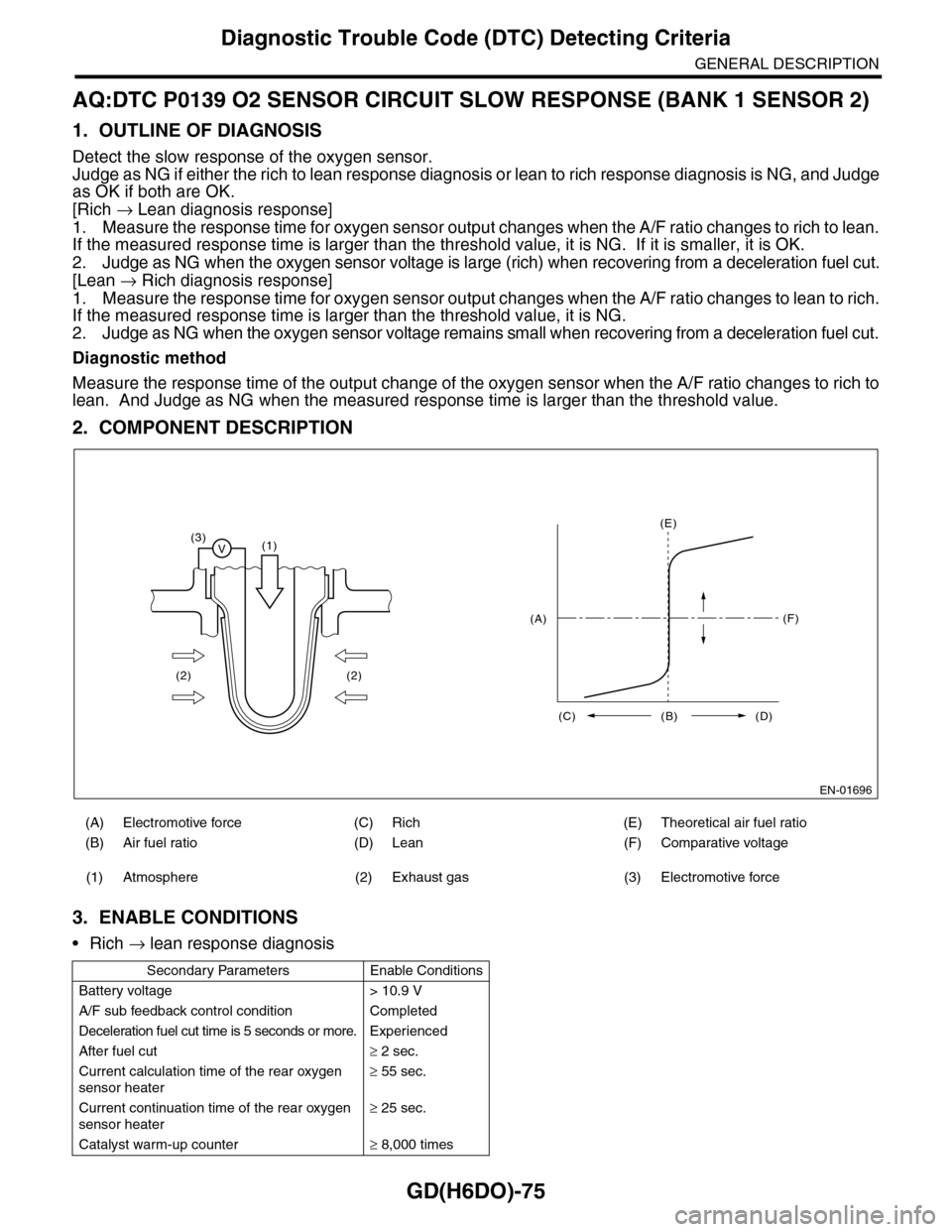
2. COMPONENT DESCRIPTION
3. ENABLE CONDITIONS
•Rich → lean response diagnosis
(A) Electromotive force (C) Rich (E) Theoretical air fuel ratio
(B) Air fuel ratio (D) Lean (F) Comparative voltage
(1) Atmosphere (2) Exhaust gas (3) Electromotive force
Secondary Parameters Enable Conditions
Battery voltage > 10.9 V
A/F sub feedback control condition Completed
Deceleration fuel cut time is 5 seconds or more. Experienced
After fuel cut≥ 2 sec.
Current calculation time of the rear oxygen
sensor heater
≥ 55 sec.
Current continuation time of the rear oxygen
sensor heater
≥ 25 sec.
Catalyst warm-up counter≥ 8,000 times
EN-01696
(3)V(1)
(2) (2)
(E)
(F)
(C) (B) (D)
(A)
Page 1692 of 2453
GD(H6DO)-80
Diagnostic Trouble Code (DTC) Detecting Criteria
GENERAL DESCRIPTION
AR:DTC P0140 O2 SENSOR CIRCUIT NO ACTIVITY DETECTED (BANK 1 SEN-
SOR 2)
1. OUTLINE OF DIAGNOSIS
Detect the rear oxygen sensor open or short circuit. Judge as NG when the rear oxygen sensor voltage can
be determined to be abnormal considering conditions such as intake air amount, engine coolant tempera-
ture, main feedback control and deceleration fuel cut.
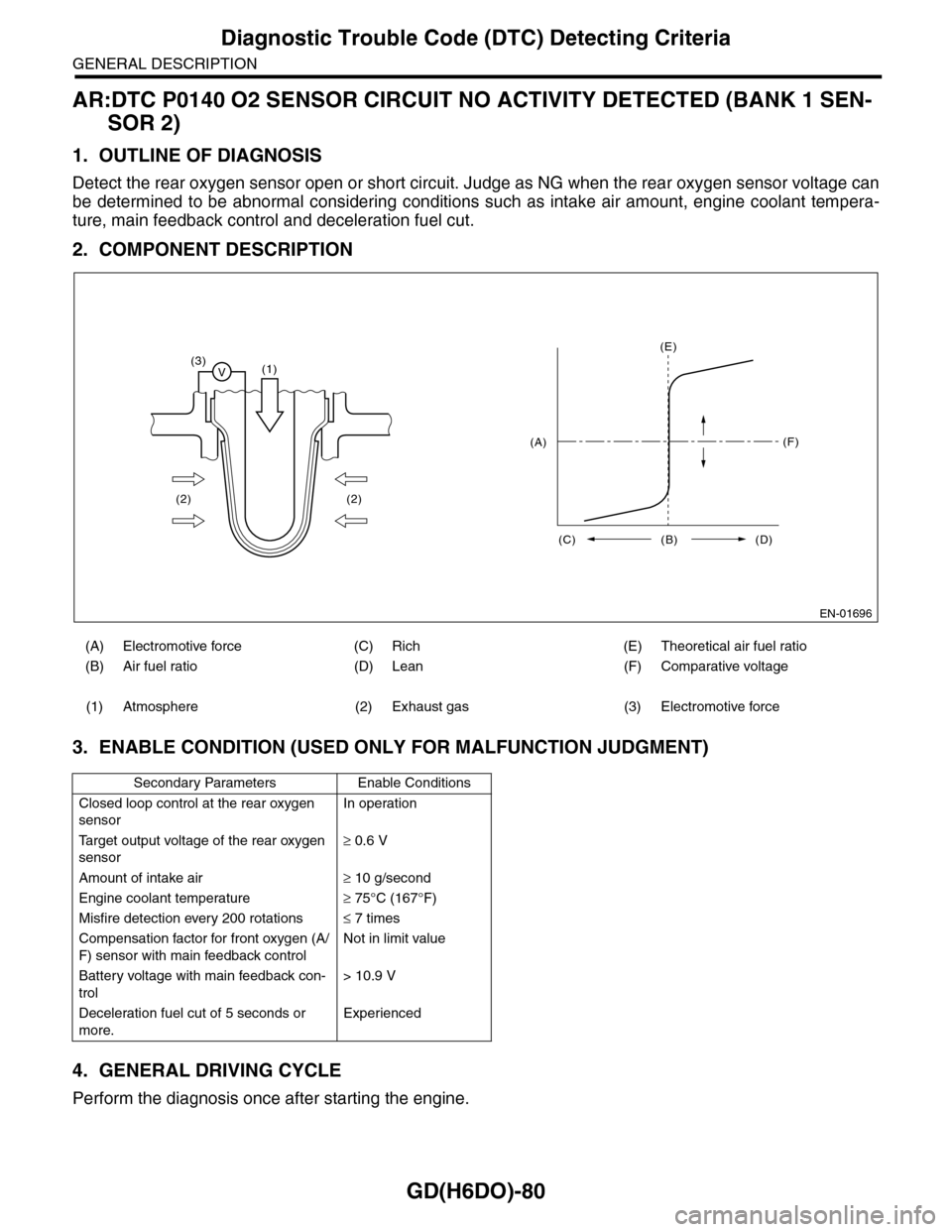
2. COMPONENT DESCRIPTION
3. ENABLE CONDITION (USED ONLY FOR MALFUNCTION JUDGMENT)
4. GENERAL DRIVING CYCLE
Perform the diagnosis once after starting the engine.
(A) Electromotive force (C) Rich (E) Theoretical air fuel ratio
(B) Air fuel ratio (D) Lean (F) Comparative voltage
(1) Atmosphere (2) Exhaust gas (3) Electromotive force
Secondary Parameters Enable Conditions
Closed loop control at the rear oxygen
sensor
In operation
Ta r g e t o u t p u t v o l t a g e o f t h e r e a r o x y g e n
sensor
≥ 0.6 V
Amount of intake air≥ 10 g/second
Engine coolant temperature≥ 75°C (167°F)
Misfire detection every 200 rotations≤ 7 times
Compensation factor for front oxygen (A/
F) sensor with main feedback control
Not in limit value
Battery voltage with main feedback con-
trol
> 10.9 V
Deceleration fuel cut of 5 seconds or
more.
Experienced
EN-01696
(3)V(1)
(2) (2)
(E)
(F)
(C) (B) (D)
(A)
Page 1716 of 2453
GD(H6DO)-104
Diagnostic Trouble Code (DTC) Detecting Criteria
GENERAL DESCRIPTION
BN:DTC P0301 CYLINDER 1 MISFIRE DETECTED
1. OUTLINE OF DIAGNOSIS
Detect the presence of misfire occurrence. (Revolution fluctuation method)
Monitoring Misfire which influences exhaust deterioration (1.5 times of FTP) and catalyst damage is made
obligatory by the law. Misfire affecting these two has three patterns below. Intermittent misfire (Different cyl-
inders misfire intermittently.):
•Intermittent misfire (The same cylinder misfires in random, or different cylinders misfire in random.): FTP
1.5 times misfire
•Every time misfire (The same cylinder misfires every time.): FTP 1.5 times misfire, Catalyst damage misfire
The following detecting methods are adopted for these detection.
1) Intermittent misfire: FTP 1.5 times misfire
•120° Interval Difference Method
•360° Interval Difference Method (whole range)
•720° Interval Difference Method (3,000 rpm or less)
2) Misfire every time: FTP 1.5 times misfire, Catalyst damage misfire
•360° Interval Difference Method
2. ENABLE CONDITIONS
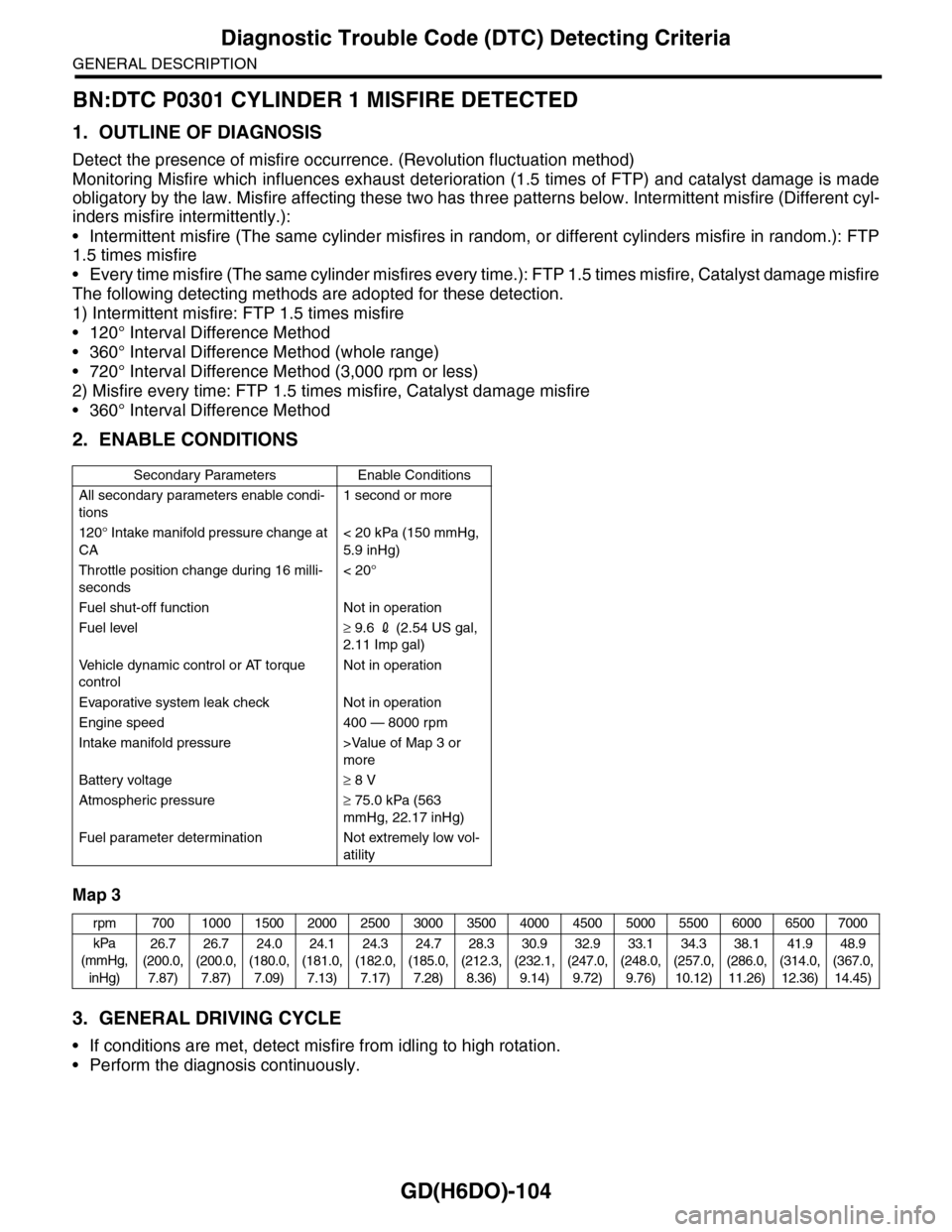
Map 3
3. GENERAL DRIVING CYCLE
•If conditions are met, detect misfire from idling to high rotation.
•Perform the diagnosis continuously.
Secondary Parameters Enable Conditions
All secondary parameters enable condi-
tions
1 second or more
120° Intake manifold pressure change at
CA
< 20 kPa (150 mmHg,
5.9 inHg)
Throttle position change during 16 milli-
seconds
< 20°
Fuel shut-off function Not in operation
Fuel level≥ 9.6 2 (2.54 US gal,
2.11 Imp gal)
Ve h i c l e d y n a m i c c o n t r o l o r AT t o r q u e
control
Not in operation
Evaporative system leak check Not in operation
Engine speed 400 — 8000 rpm
Intake manifold pressure >Value of Map 3 or
more
Battery voltage≥ 8 V
Atmospheric pressure≥ 75.0 kPa (563
mmHg, 22.17 inHg)
Fuel parameter determination Not extremely low vol-
atility
rpm 700 1000 1500 2000 2500 3000 3500 4000 4500 5000 5500 6000 6500 7000
kPa
(mmHg,
inHg)
26.7
(200.0,
7.87)
26.7
(200.0,
7.87)
24.0
(180.0,
7.09)
24.1
(181.0,
7.13)
24.3
(182.0,
7.17)
24.7
(185.0,
7.28)
28.3
(212.3,
8.36)
30.9
(232.1,
9.14)
32.9
(247.0,
9.72)
33.1
(248.0,
9.76)
34.3
(257.0,
10.12)
38.1
(286.0,
11.26)
41.9
(314.0,
12.36)
48.9
(367.0,
14.45)
Page 1719 of 2453
GD(H6DO)-107
Diagnostic Trouble Code (DTC) Detecting Criteria
GENERAL DESCRIPTION
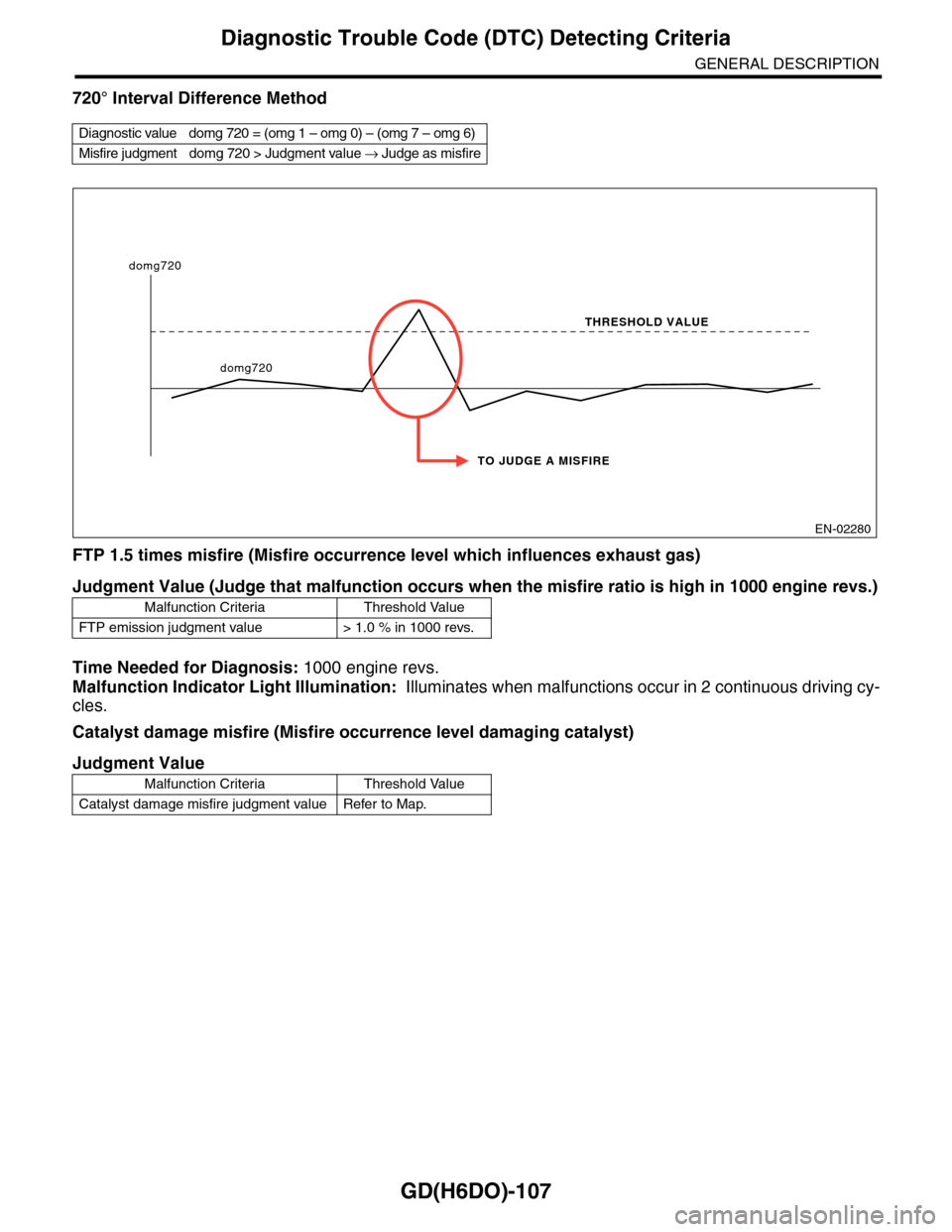
720° Interval Difference Method
FTP 1.5 times misfire (Misfire occurrence level which influences exhaust gas)
Time Needed for Diagnosis: 1000 engine revs.
Malfunction Indicator Light Illumination: Illuminates when malfunctions occur in 2 continuous driving cy-
cles.
Catalyst damage misfire (Misfire occurrence level damaging catalyst)
Diagnostic value domg 720 = (omg 1 – omg 0) – (omg 7 – omg 6)
Misfire judgment domg 720 > Judgment value → Judge as misfire
Judgment Value (Judge that malfunction occurs when the misfire ratio is high in 1000 engine revs.)
Malfunction Criteria Threshold Value
FTP emission judgment value > 1.0 % in 1000 revs.
Judgment Value
Malfunction Criteria Threshold Value
Catalyst damage misfire judgment value Refer to Map.
EN-02280
TO JUDGE A MISFIRE
THRESHOLD VALUE
domg720
domg720