Page 1151 of 2453
EC(H6DO)-3
Front Catalytic Converter
EMISSION CONTROL (AUX. EMISSION CONTROL DEVICES)
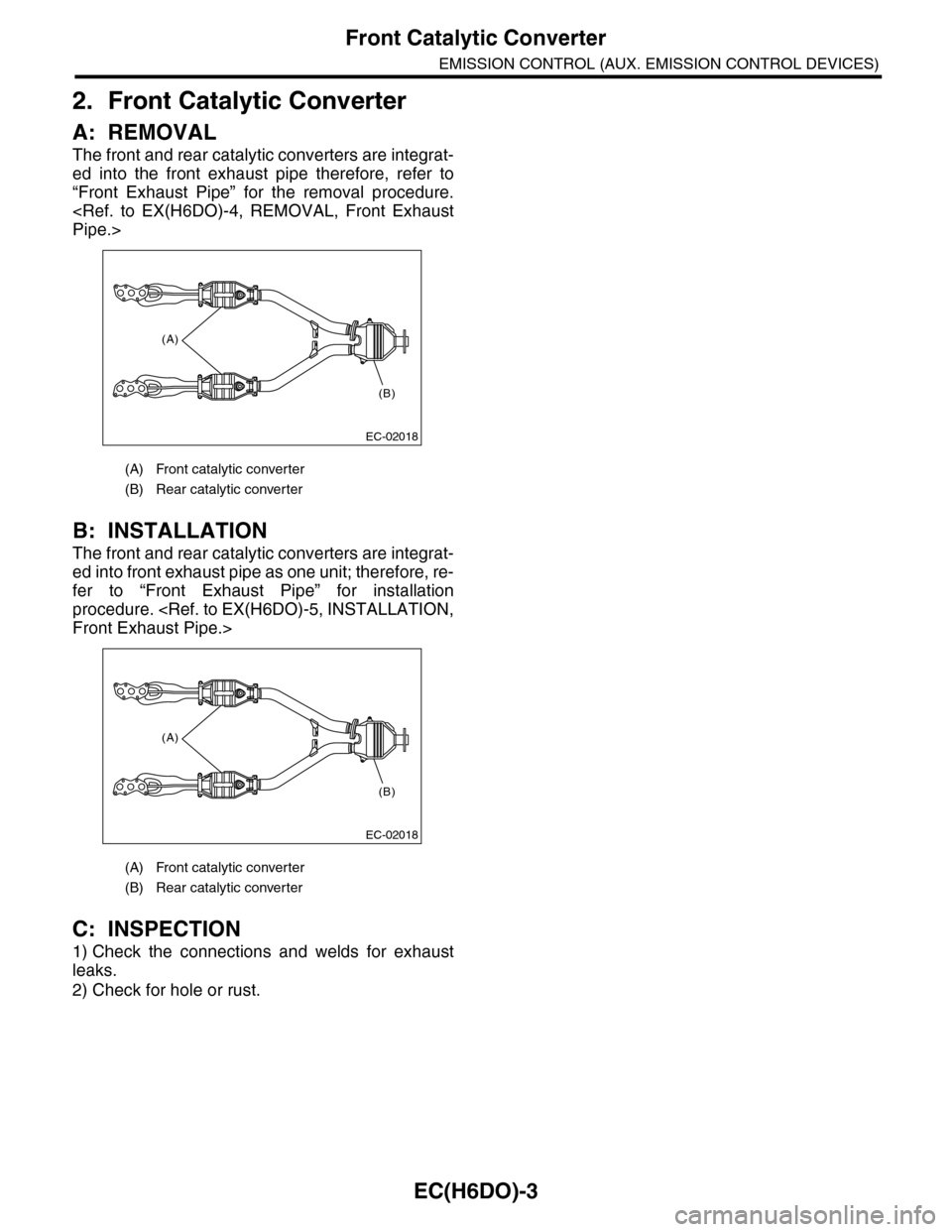
2. Front Catalytic Converter
A: REMOVAL
The front and rear catalytic converters are integrat-
ed into the front exhaust pipe therefore, refer to
“Front Exhaust Pipe” for the removal procedure.
Pipe.>
B: INSTALLATION
The front and rear catalytic converters are integrat-
ed into front exhaust pipe as one unit; therefore, re-
fer to “Front Exhaust Pipe” for installation
procedure.
Front Exhaust Pipe.>
C: INSPECTION
1) Check the connections and welds for exhaust
leaks.
2) Check for hole or rust.
(A) Front catalytic converter
(B) Rear catalytic converter
(A) Front catalytic converter
(B) Rear catalytic converter
(A)
(B)
EC-02018
(A)
(B)
EC-02018
Page 1152 of 2453
EC(H6DO)-4
Rear Catalytic Converter
EMISSION CONTROL (AUX. EMISSION CONTROL DEVICES)
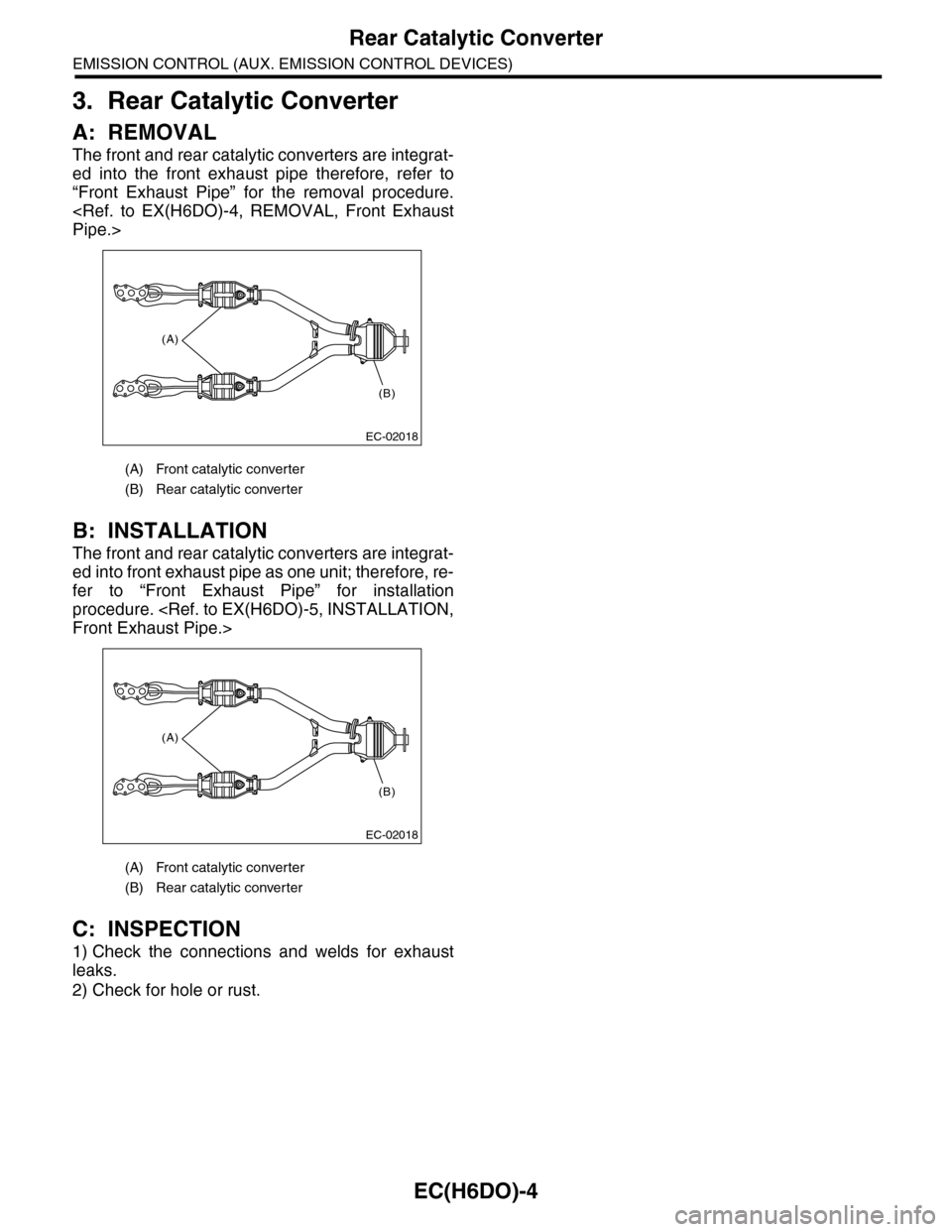
3. Rear Catalytic Converter
A: REMOVAL
The front and rear catalytic converters are integrat-
ed into the front exhaust pipe therefore, refer to
“Front Exhaust Pipe” for the removal procedure.
Pipe.>
B: INSTALLATION
The front and rear catalytic converters are integrat-
ed into front exhaust pipe as one unit; therefore, re-
fer to “Front Exhaust Pipe” for installation
procedure.
Front Exhaust Pipe.>
C: INSPECTION
1) Check the connections and welds for exhaust
leaks.
2) Check for hole or rust.
(A) Front catalytic converter
(B) Rear catalytic converter
(A) Front catalytic converter
(B) Rear catalytic converter
(A)
(B)
EC-02018
(A)
(B)
EC-02018
Page 1167 of 2453
EN(H6DO)(diag)-6
General Description
ENGINE (DIAGNOSTICS)
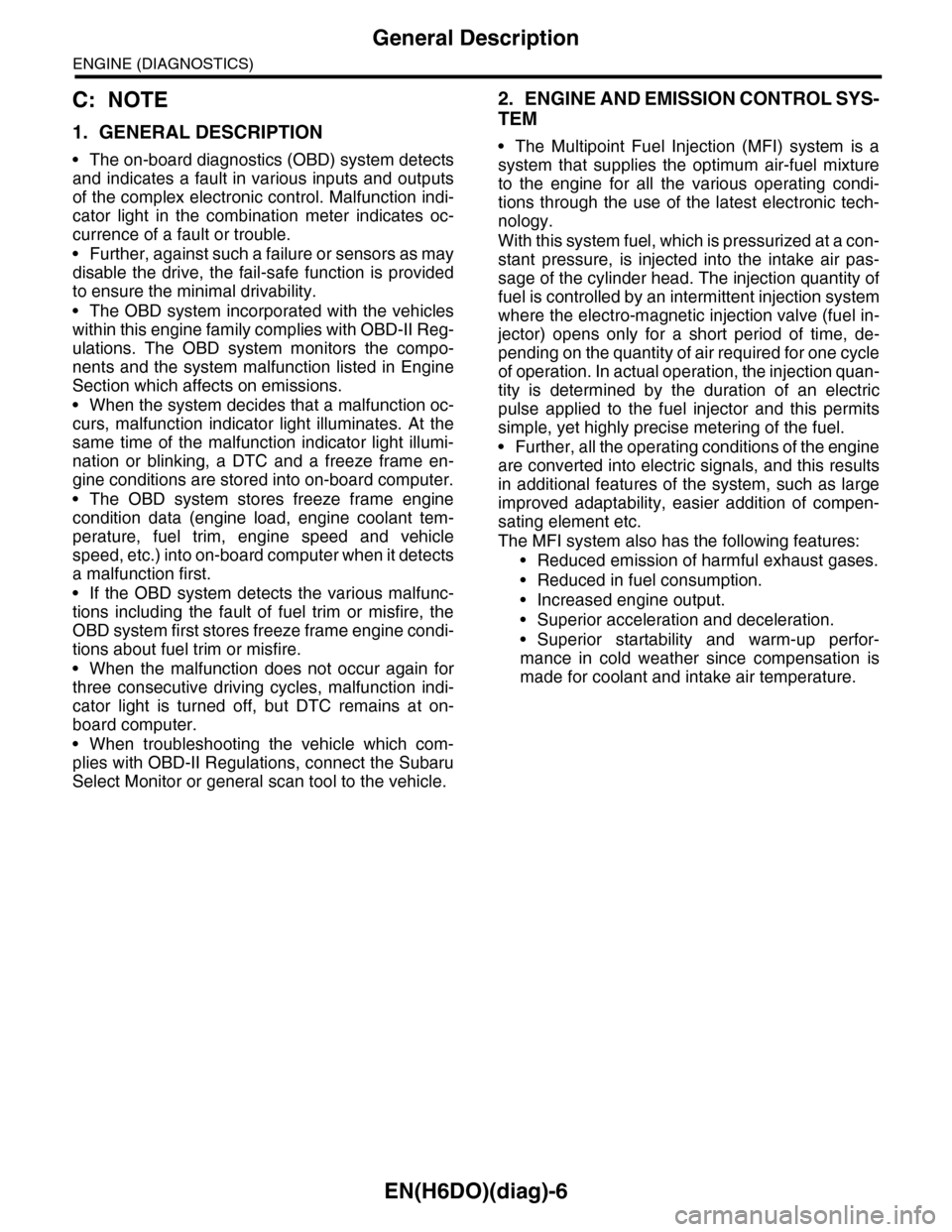
C: NOTE
1. GENERAL DESCRIPTION
•The on-board diagnostics (OBD) system detects
and indicates a fault in various inputs and outputs
of the complex electronic control. Malfunction indi-
cator light in the combination meter indicates oc-
currence of a fault or trouble.
•Further, against such a failure or sensors as may
disable the drive, the fail-safe function is provided
to ensure the minimal drivability.
•The OBD system incorporated with the vehicles
within this engine family complies with OBD-II Reg-
ulations. The OBD system monitors the compo-
nents and the system malfunction listed in Engine
Section which affects on emissions.
•When the system decides that a malfunction oc-
curs, malfunction indicator light illuminates. At the
same time of the malfunction indicator light illumi-
nation or blinking, a DTC and a freeze frame en-
gine conditions are stored into on-board computer.
•The OBD system stores freeze frame engine
condition data (engine load, engine coolant tem-
perature, fuel trim, engine speed and vehicle
speed, etc.) into on-board computer when it detects
a malfunction first.
•If the OBD system detects the various malfunc-
tions including the fault of fuel trim or misfire, the
OBD system first stores freeze frame engine condi-
tions about fuel trim or misfire.
•When the malfunction does not occur again for
three consecutive driving cycles, malfunction indi-
cator light is turned off, but DTC remains at on-
board computer.
•When troubleshooting the vehicle which com-
plies with OBD-II Regulations, connect the Subaru
Select Monitor or general scan tool to the vehicle.
2. ENGINE AND EMISSION CONTROL SYS-
TEM
•The Multipoint Fuel Injection (MFI) system is a
system that supplies the optimum air-fuel mixture
to the engine for all the various operating condi-
tions through the use of the latest electronic tech-
nology.
With this system fuel, which is pressurized at a con-
stant pressure, is injected into the intake air pas-
sage of the cylinder head. The injection quantity of
fuel is controlled by an intermittent injection system
where the electro-magnetic injection valve (fuel in-
jector) opens only for a short period of time, de-
pending on the quantity of air required for one cycle
of operation. In actual operation, the injection quan-
tity is determined by the duration of an electric
pulse applied to the fuel injector and this permits
simple, yet highly precise metering of the fuel.
•Further, all the operating conditions of the engine
are converted into electric signals, and this results
in additional features of the system, such as large
improved adaptability, easier addition of compen-
sating element etc.
The MFI system also has the following features:
•Reduced emission of harmful exhaust gases.
•Reduced in fuel consumption.
•Increased engine output.
•Superior acceleration and deceleration.
•Superior startability and warm-up perfor-
mance in cold weather since compensation is
made for coolant and intake air temperature.
Page 1208 of 2453
![SUBARU TRIBECA 2009 1.G Service Workshop Manual EN(H6DO)(diag)-47
Compulsory Valve Operation Check Mode
ENGINE (DIAGNOSTICS)
13) Pressing the [NO] key completes the compul-
sory valve operation check mode. The display will
then return to](/manual-img/17/7322/w960_7322-1207.png "SUBARU TRIBECA 2009 1.G Service Workshop Manual EN(H6DO)(diag)-47
Compulsory Valve Operation Check Mode
ENGINE (DIAGNOSTICS)
13) Pressing the [NO] key completes the compul-
sory valve operation check mode. The display will
then return to")
EN(H6DO)(diag)-47
Compulsory Valve Operation Check Mode
ENGINE (DIAGNOSTICS)
13) Pressing the [NO] key completes the compul-
sory valve operation check mode. The display will
then return to the «Actuator ON/OFF Operation»
screen.
•A list of the support data is shown in the following
table.
NOTE:
•The following parts will be displayed but not
functional.
•For detailed operation procedure, refer to the
“SUBARU SELECT MONITOR OPERATION
MANUAL”.
Description Display
Compulsory fuel pump relay oper-
ation checkFuel Pump
Compulsory radiator fan relay
operation checkRadiator Fan Relay
Compulsory air conditioning relay
operation checkA/C Compressor Relay
Compulsory purge control sole-
noid valve operation checkCPC Solenoid
Compulsory drain valve operation
checkVe n t C o n t r o l S o l e n o i d
Display
EGR Solenoid
ASV Solenoid
FICD Solenoid
Pressure Switching Solenoid 1
Pressure Switching Solenoid 2
Wa st e g at e Con t r ol S ol e no i d
AAI Solenoid
Exhaust Bypass Valve Control Permit Flag
PCV Solenoid
Fuel tank sensor control valve
Page 1333 of 2453
EN(H6DO)(diag)-172
Diagnostic Procedure with Diagnostic Trouble Code (DTC)
ENGINE (DIAGNOSTICS)
Step Check Yes No
1CHECK ANY OTHER DTC ON DISPLAY.Is any other DTC displayed? Check DTC using
“List of Diagnostic
Tr o u b l e C o d e
(DTC)”.
EN(H6DO)(diag)-
69, List of Diag-
nostic Trouble
Code (DTC).>
NOTE:
In this case, it is
not necessary to
inspect DTC
P0133.
Go to step 2.
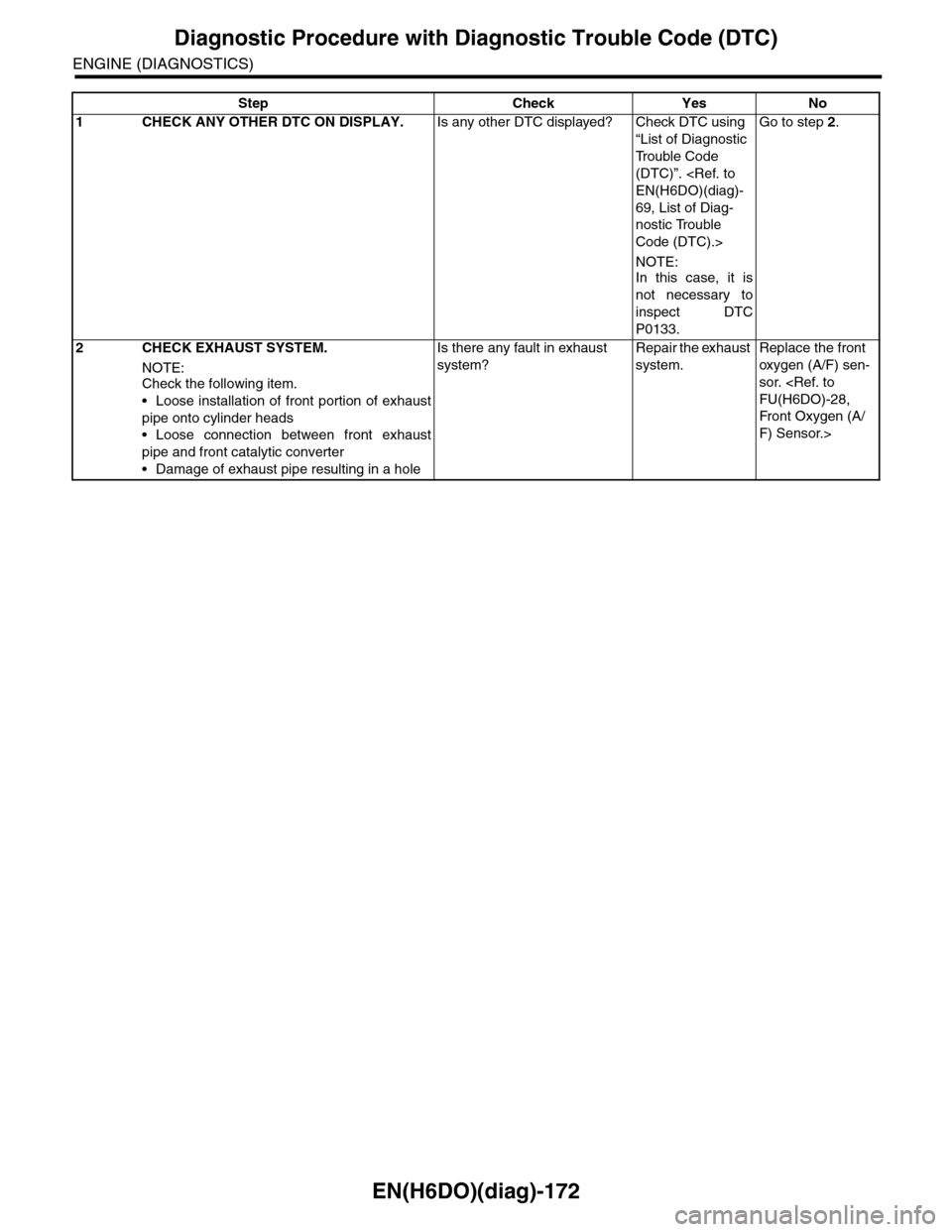
2 CHECK EXHAUST SYSTEM.
NOTE:Check the following item.
•Loose installation of front portion of exhaust
pipe onto cylinder heads
•Loose connection between front exhaust
pipe and front catalytic converter
•Damage of exhaust pipe resulting in a hole
Is there any fault in exhaust
system?
Repair the exhaust
system.
Replace the front
oxygen (A/F) sen-
sor.
FU(H6DO)-28,
Fr o nt Ox yg en ( A /
F) Sensor.>
Page 1340 of 2453
EN(H6DO)(diag)-179
Diagnostic Procedure with Diagnostic Trouble Code (DTC)
ENGINE (DIAGNOSTICS)
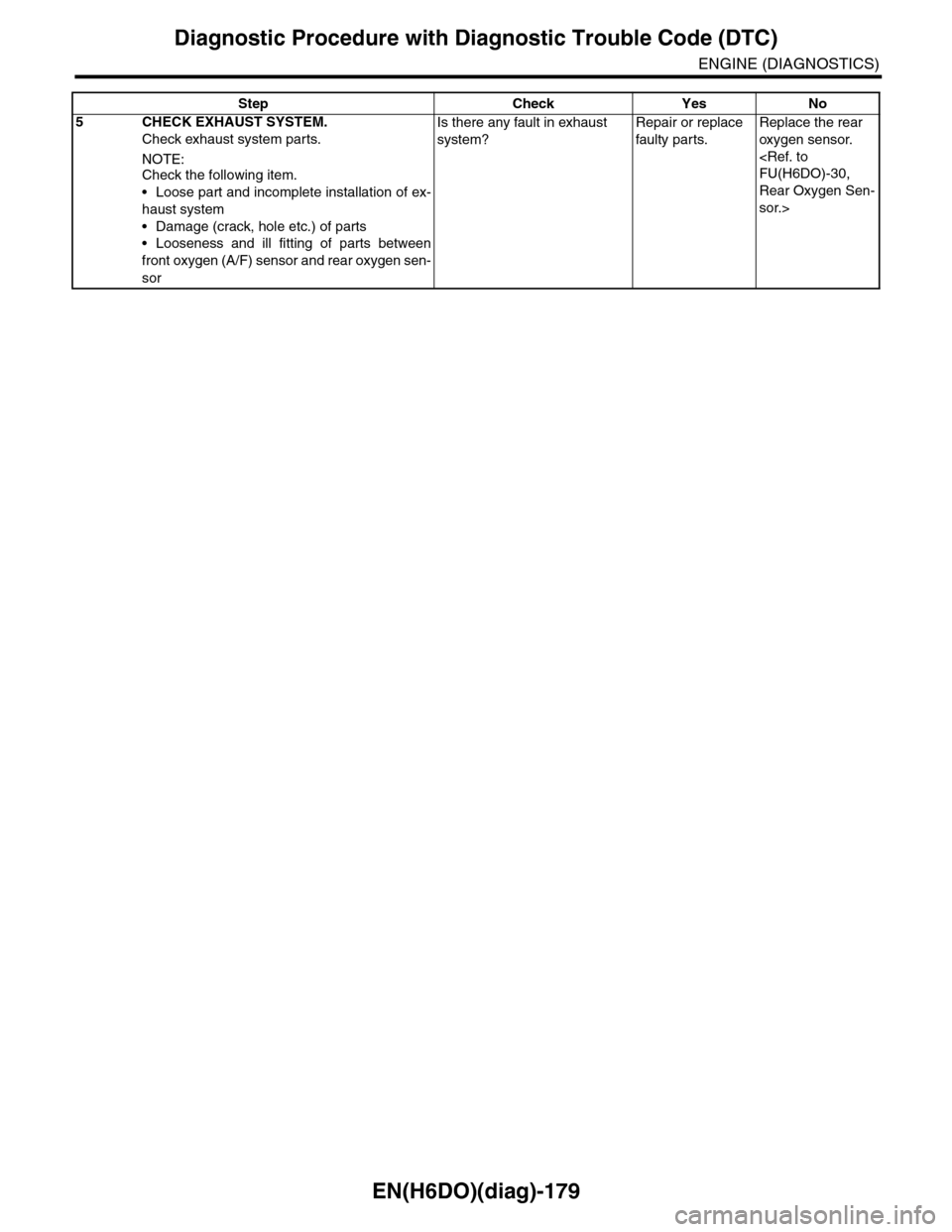
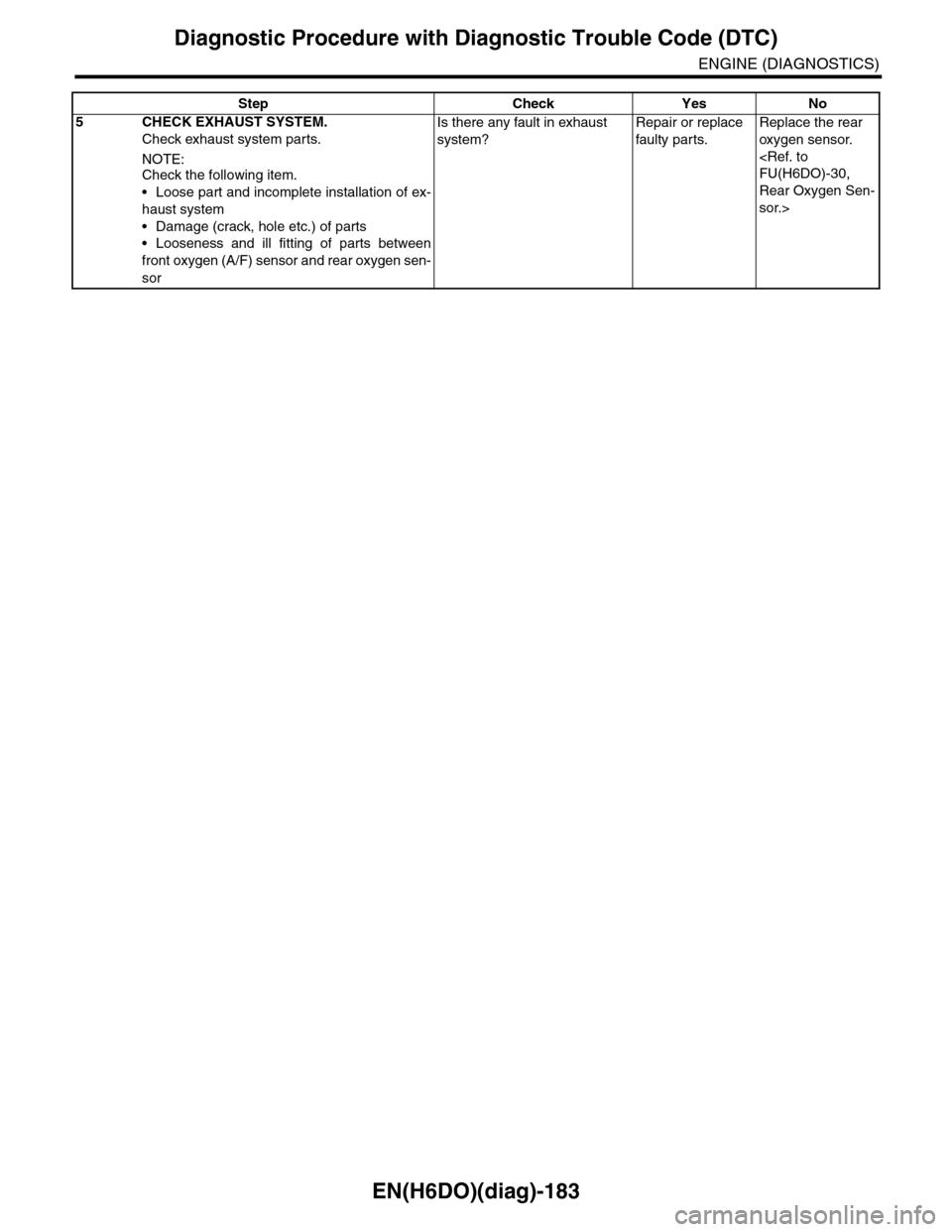
5 CHECK EXHAUST SYSTEM.
Check exhaust system parts.
NOTE:
Check the following item.
•Loose part and incomplete installation of ex-
haust system
•Damage (crack, hole etc.) of parts
•Looseness and ill fitting of parts between
front oxygen (A/F) sensor and rear oxygen sen-
sor
Is there any fault in exhaust
system?
Repair or replace
faulty par ts.
Replace the rear
oxygen sensor.
FU(H6DO)-30,
Rear Oxygen Sen-
sor.>
Step Check Yes No
Page 1344 of 2453
EN(H6DO)(diag)-183
Diagnostic Procedure with Diagnostic Trouble Code (DTC)
ENGINE (DIAGNOSTICS)
5 CHECK EXHAUST SYSTEM.
Check exhaust system parts.
NOTE:
Check the following item.
•Loose part and incomplete installation of ex-
haust system
•Damage (crack, hole etc.) of parts
•Looseness and ill fitting of parts between
front oxygen (A/F) sensor and rear oxygen sen-
sor
Is there any fault in exhaust
system?
Repair or replace
faulty par ts.
Replace the rear
oxygen sensor.
FU(H6DO)-30,
Rear Oxygen Sen-
sor.>
Step Check Yes No
Page 1351 of 2453
EN(H6DO)(diag)-190
Diagnostic Procedure with Diagnostic Trouble Code (DTC)
ENGINE (DIAGNOSTICS)
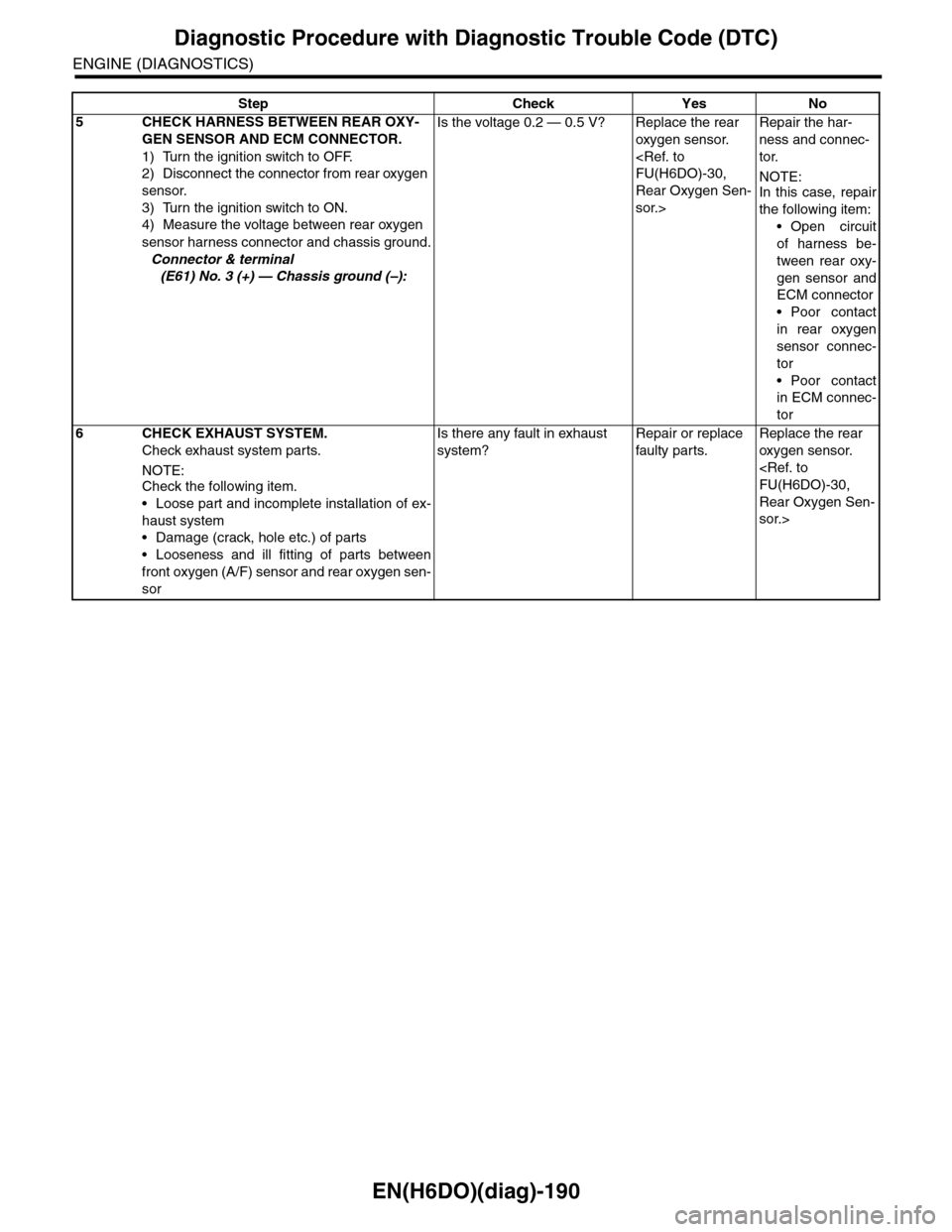
5CHECK HARNESS BETWEEN REAR OXY-
GEN SENSOR AND ECM CONNECTOR.
1) Turn the ignition switch to OFF.
2) Disconnect the connector from rear oxygen
sensor.
3) Turn the ignition switch to ON.
4) Measure the voltage between rear oxygen
sensor harness connector and chassis ground.
Connector & terminal
(E61) No. 3 (+) — Chassis ground (–):
Is the voltage 0.2 — 0.5 V? Replace the rear
oxygen sensor.
FU(H6DO)-30,
Rear Oxygen Sen-
sor.>
Repair the har-
ness and connec-
tor.
NOTE:In this case, repair
the following item:
•Open circuit
of harness be-
tween rear oxy-
gen sensor and
ECM connector
•Poor contact
in rear oxygen
sensor connec-
tor
•Poor contact
in ECM connec-
tor
6 CHECK EXHAUST SYSTEM.
Check exhaust system parts.
NOTE:Check the following item.
•Loose part and incomplete installation of ex-
haust system
•Damage (crack, hole etc.) of parts
•Looseness and ill fitting of parts between
front oxygen (A/F) sensor and rear oxygen sen-
sor
Is there any fault in exhaust
system?
Repair or replace
faulty par ts.
Replace the rear
oxygen sensor.
FU(H6DO)-30,
Rear Oxygen Sen-
sor.>
Step Check Yes No