2008 AUDI TT ROADSTER lock
[x] Cancel search: lockPage 138 of 316
• ....__D_ ri_v _i_n ..;;:g :;._ S_a_ f_ e_ l..:.y _______________________________________________ _
& WARNING (continued)
• If you absolutely must drive with the rear lid open, observe the
following notes to reduce the risk of poisoning:
-Close all windows,
- Close the folding top,
- Open all air outlets in the instrument panel,
- Switch off the air recirculation,
- Set the fresh air fan to the highest speed.
& WARNING
Always make sure that the doors, all windows, the folding top and
the rear lid are securely closed and locked to reduce the risk of
injury when the vehicle is not being used.
• After closing the rear lid, always make sure that it is properly
closed and locked .
• Never leave your vehicle unattended especially with the rear lid
left open. A child could crawl into the vehicle through the luggage
compartment and close the rear lid becoming trapped and unable
to get out. Being trapped in a vehicle can lead to serious personal
injury.
• Never let children play in or around the vehicle.
• Never let passengers ride in the luggage compartment. Vehicle
occupants must always be properly restrained in one of the
vehicle's seating positions.
[ i) Tips
• Air circulation helps to reduce window fogging. Stale air escapes
to the outside through vents in the trim panel, on the left side of the
luggage compartment. Be sure to keep these slots free and open.
• The tire pressure must correspond to the load -see the tire pres
sure sticker on driver 's side B-pillar. •
Reporting safety defects
If you believe that your vehicle has a defect
which could cause a crash or could cause
injury or death, you should immediately inform
the National Highway Traffic Safety Adminis
tration (NHTSA) in addition to notifying Audi of
America, Inc. If NHTSA receives similar complaints, it may open an investigation, and
if it finds that a safety defect exists in a group
of vehicles, it may order a recall and remedy
campaign. However, NHTSA cannot become involved in individual problems between you,
your dealer, or Audi of America, Inc.
To contact NHTSA, you may call the Vehicle
Safety Hotline toll-free at 1-888-327-4236 (TTY: 1-800-424-9153);
go to
http://www.safercar.gov;
or write to: Administrator, NHTSA, 400 Seventh Street, SW., Washington, DC 20590.
You can also obtain other information about motor vehicle safety from
http://www.safercar.gov. •
Page 143 of 316

& WARNING !continue d)
• Torn or fr ayed safety b elt s can tear and damaged b elt hard
ware can bre ak in an ac cident. Inspect belt s regularly . If webb ing ,
bind ings , buckles , or retra ctors are d am aged , have belts repla ced
by an authori zed Audi dealer or qualified work shop.
• Safety belt s th at have been worn and lo aded in an accident
mu st be repl aced with the correc t replacement saf ety belt by an
autho riz ed Audi de aler o r qualified work shop . Repla cement may
be nece ssary even if d amage cannot b e clea rly seen. Anchorage s
that wer e loaded must also be inspe cted .
• Never rem ove, modif y, dis ass em ble , or tr y to r epa ir the safety
belts your self .
• Alway s keep the belt s cle an. Dirty belt s may not work properly
and can impair the fun ction of the inertia reel=>
page 212 , "Safety
belts ".•
Safety belts
Fastening safety belts
Seat first -everybody buckle up!
Safety first
Fig . 126 Belt bu ckle
a nd ton gue on th e
driv er's s eat
Safety b elts
To provid e ma ximum protec tion, sa fety belts m ust always
be pos itioned c orrect ly on the wear er's bod y.
- Adjust the front seat and head restraint properly
=> page 87, "General recommend atio ns".
- Hold the belt by the tongue and pull it evenly across the
c h es t and pelvis=> &.
- Inse rt the tongue into the correct buckle of your seat
unti l you hea r it latch securely => fig. 126 .
- Pull on t he b elt t o mak e sur e tha t it is se curely l atc hed in
t h e buckle .
Automatic safety belt retra cto rs
Every safety belt is equipped with an automatic be lt retractor on the
shoulder belt . This feature locks the belt when the belt is pulled out
f ast, during hard braking and in an accident. The be lt may a lso lock
when you drive up or down a steep hill or through a sharp curve.
During norma l d riving the belt lets you move free ly .
Safety be lt pretensioners
The safety belts are equipped with a be lt pretensioner that helps to
tighten the safety belt and remove slack when the pretensioner is
activated. T he funct io n of the pretensioner is mon itored by a
warning light =>
page 19, "Airbag system
t!! (USA models)/!,~ · (Canada models)".
Swit chable locking featur e
Every safety belt except the one on the driver seat is equipped with
a switchable locking feature that
must be used when the safety be lt
is used to attach a chi ld seat. Be sure to read the important info rma-
tion about this feature =>
page 177. ._
Vehicle care I I Technical data
Page 144 of 316
___ S_a_ f_ e_ t-= y_ b_e_ l_ t _s _______________________________________________ _
& WARNING
Improperly positioned safety belts can cause serious injury in an
accident =:> page
142, "Safety belt position".
• Safety belts offer optimum protection only when the seat back
is upright and belts are properly positioned on the body.
• Never attach the safety belt to the buckle for another seat.
Attaching the belt to the wrong buckle will reduce safety belt effectiveness and can cause serious personal injury.
• A passenger who is not properly restrained can be seriously
injured by the safety belt itself when it moves from the stronger
parts of the body into critical areas like the abdomen.
• Always lock the convertible locking retractor when you are
securing a child seat in the vehicle=:> page
179. •
Safety belt position
Correct belt position is the key to getting maximum
protection from safety belts.
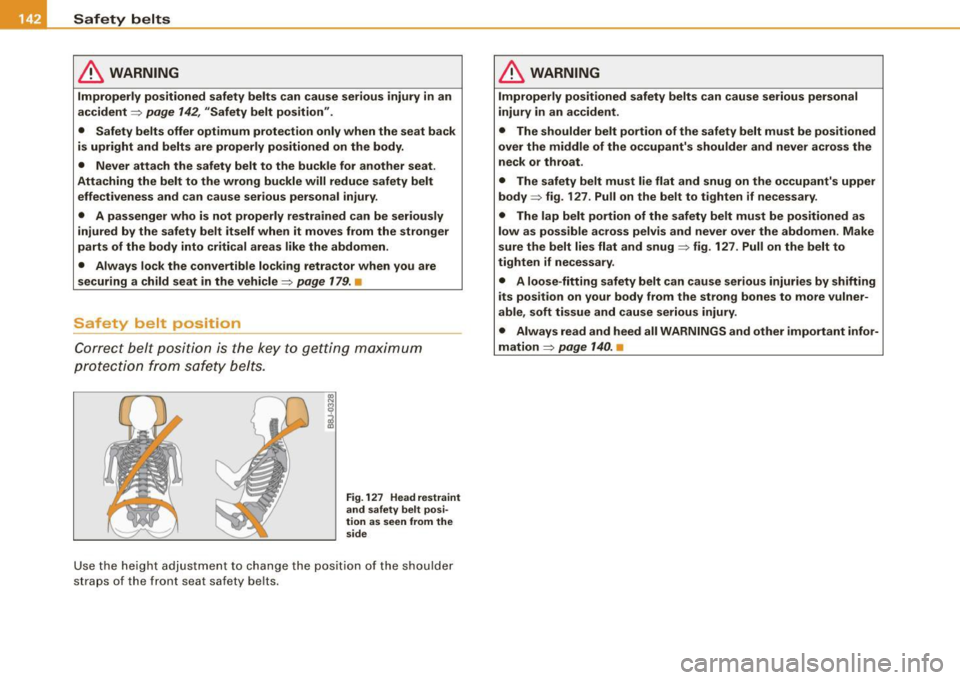
Fig. 127 Head restraint
and safety belt posi
tion as seen from the side
Use the height adjustment to change the position of the shoulder
straps of the front seat safety belts.
& WARNING
Improperly positioned safety belts can cause serious personal
injury in an accident.
• The shoulder belt portion of the safety belt must be positioned
over the middle of the occupant's shoulder and never across the
neck or throat .
• The safety belt must lie flat and snug on the occupant's upper
body
=> fig. 127 . Pull on the belt to tighten if necessary.
• The lap belt portion of the safety belt must be positioned as
low as possible across pelvis and never over the abdomen. Make
sure the belt lies flat and snug => fig. 127. Pull on the belt to
tighten if necessary.
• A loose -fitting safety belt can cause serious injuries by shifting
its position on your body from the strong bones to more vulner
able, soft tissue and cause serious injury.
• Always read and heed all WARNINGS and other important infor
mation => page
140. •
Page 160 of 316

___ A_ ir_ b_ a-g _ s_y _s_ t_ e_ m _________________________________________________ _
• a car bed has been installed on the front seat, or
• a rearward-facing child restraint has been installed on the front
passengerseat,or
• a forward-facing child restraint has been insta lled on the front
passenger seat, or
• the weight registered on the front passenger seat is equal to or
less than the combined weight of a typical 1 year -old restrained in
one of the rear-facing or forward-facing infant restraints listed in Federal Motor Vehicle Safety Standard 208 with which the Advanced
Airbag Sys tem in your vehicle was certified.
If the front passenger seat is not occupied, the front airbag wi ll not
deploy, and the
P ASS ENGER AIR B AG OFF light will stay on. Never
install a rearward -facing child restraint on the front passenger seat,
the safest place for a chi ld in any kind of child restraint is at one of
the seating positions on the rear seat=>
page 147, "Child restraints
on the front seat -some important things to know" and=>
page 168,
"Chi ld Safety" .
If the PA SS ENG ER A IR BAG OFF l ight com es on when one of the
conditions listed above is met, be sure to check the light regularly
to make certain that the
P ASSE NG ER AIR BAG OFF light stays on
continuously whenever the ignition is on. If the
PASSENGER AIR
B AG OFF
light does not appear and not stay on all the time, stop as
soon as it is safe to do so and
• reactivate the system by turning the ignition off and then turning
it on again;
• remove and re install the child restraint. Make sure that the chi ld
restraint is properly insta lled and that the safety belt for the front
passenger seat has been correct ly routed around the ch ild restraint
as described in the child restraint manufacturer's instructions;
• make sure that the convertible locking feature on the safety belt
for the front passenger seat has been activated and that the safety
belt has been pulled tight. The be lt must not be loose or have loops
of slack so that the sensor below the safety belt latch on the seat can
do its job=>
page 177 .
• make sure that things that may increase the weight of the child
and child safety seat are not being t ransported on the front
passenger seat;
• make sure that the safety belt tension sensor is no t blocked.
Shake the safety belt latch on the front passenger seat back and
forth;
• If a strap or tether is being used to tie the chi ld safety seat to the
front passenger seat, make sure that it is no t so tigh t that it causes
the weight -sensing mat to measure more weight than is actually on
t he seat .
If the PA SSEN GER AIR BAG OFF lig ht still doe s no t c om e on and does
not stay on continuously (when the ignition is switched on),
• t ake the child restraint off the front passenger seat and install it
proper ly at one of the rear seat positions. Have the airbag system
inspected by your Audi dealer immediately.
• move the child to a rear seat position and make sure that the
child is properly restrained in a child restra int that is appropriate for
its size and age .
T he
PASSENGER AIR BAG OFF light shou ld NOT come on when the
ignition is on and an adult is sitting in a proper seating position on
the front passenger seat . If the
PASSENGER AIR BAG O FF light
comes on and stays on or flashes for about 5 seconds wh ile driving,
under these circumstances, make sure that:
• the adu lt on the front passenger seat is properly seated on the
center of the seat cushion with his or her back up against the back
rest and the backrest is not reclined=>
page 130, "Proper occupant
seating positions",
• t he adu lt is not taking weight off the seat by holding on to the
passenger assist handle above the front passenger door or
supporting their weight on the armrest,
• the safety belt is being proper ly worn and that there is not a lot
of slack in the safety belt webbing,
• accessory seat covers or cushions or other things that may cause
an incorrect reading or impress ion on the weight-sensing mat ...
Page 173 of 316

Child Safety -
--------------------''---
& WARNING
To reduce the risk of serious injury, make sure that the PASSENGER
AIR BAG OFF light comes on and stays on whenever a child restraint is installed on the front passenger seat and the ignition
is switched on.
• Never install a rearward facing child safety seat on the front
passenger seat unless the PASSENGER AIR BAG OFF light comes
on and stays on. If the PASSENGER AIR BAG OFF light does not
come on and stay on the inflating airbag will hit the child safety
seat or infant carrier with great force and will smash the child
safety seat and child against the backrest, door or roof. Have the
airbag system inspected immediately by your Audi dealer.
[ i] Tips
The child seats listed in categories A to C have been tested by Audi
only for the Advanced Airbag function. •
Important safety instructions for
using child safety seats
Correct use of child safety seats substantially reduces the
risk of injury in an accident!
As the driver, you are responsible for the safety of every
body in the vehicle, especially children:
- Always use the right child safety seat for each child and
always use it properly ::::>
page 173.
-Always carefully follow the child safety seat manufac
turer's instructions on how to route the safety belt prop
erly through the child safety seat.
Controls and equip ment Safety first Vehicle operation
-
When using the vehicle safety belt to install a child safety
seat, you must first activate the convertible locking retractor on the safety belt to prevent the child safety
seat from moving ::::>
page 177.
-Push the child safety seat down with your full weight to
get the safety belt really tight so that the seat cannot
move forward or sideways more than one inch (2.5 cml.
Always remember: Even though your vehicle is equipped with an
Advanced Airbag system, a child should always ride in the seat
properly restrained for its age and size.
& WARNING
Not using a child safety seat, using the wrong child safety seat or
improperly installing a child restraint increases the risk of serious
personal injury and death.
• All vehicle occupants and especially children must always be
restrained properly whenever riding in a vehicle.
-An unrestrained or improperly restrained child can be injured
or killed by being thrown against the inside of the vehicle or by
being ejected from it during a sudden maneuver or impact.
- An unrestrained or improperly restrained child is at much
greater risk of injury or death by being struck by an inflating
airbag.
• Commercially available child safety seats are required to
comply with U.S. Federal Motor Vehicle Safety Standard (FMVSS)
213 (in Canada CMVSS 213).
- When buying a child restraint, select one that fits your child
and the vehicle.
- Only use child restraint systems that fully contact the flat
portion of the seat cushion. The child restraint must not tip or
lean to either side. Audi does not recommend using child safety
seats that rest on legs or tube-like frames. They do not provide
adequate contact with the seat. ..
Vehicle care Do-it-yourself service Technical data
Page 175 of 316
Child safety seats
Infant seats
Babies and infants up to about one year old and 22 lbs or
10 kg need special rearward-facing child restraints that
support the back, neck and head in a crash.
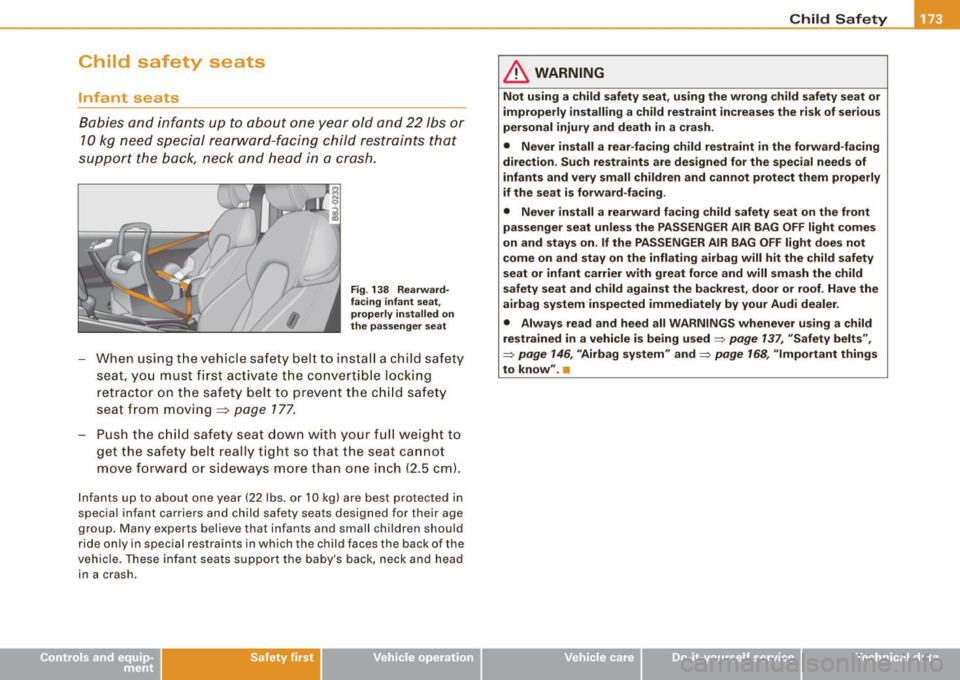
Fig. 138 Rearward
facing infant seat,
properly installed on
the passenger seat
- When using the vehicle safety belt to install a child safety
seat, you must first activate the convertible locking
retractor on the safety belt to prevent the child safety
seat from moving ::::,
page 177.
-Push the child safety seat down with your full weight to
get the safety belt really tight so that the seat cannot
move forward or sideways more than one inch (2.5 cm).
Infants up to about one year (22 lbs. or 10 kg) are best protected in
special infant carriers and child safety seats designed for their age
group. Many experts believe that infants and small children should
ride only in special restraints in which the child faces the back of the
vehicle. These infant seats support the baby's back, neck and head
in a crash.
Safety first
Child Safety
& WARNING
Not using a child safety seat, using the wrong child safety seat or
improperly installing a child restraint increases the risk of serious
personal injury and death in a crash .
• Never install a rear-facing child restraint in the forward-facing
direction. Such restraints are designed for the special needs of
infants and very small children and cannot protect them properly
if the seat is forward-facing.
• Never install a rearward facing child safety seat on the front
passenger seat unless the PASSENGER AIR BAG OFF light comes
on and stays on. If the PASSENGER AIR BAG OFF light does not
come on and stay on the inflating airbag will hit the child safety
seat or infant carrier with great force and will smash the child
safety seat and child against the backrest, door or roof. Have the
airbag system inspected immediately by your Audi dealer.
• Always read and heed all WARNINGS whenever using a child
restrained in a vehicle is being used~
page 137, "Safety belts",
::::, page 146, "Airbag system" and::::, page 168, "Important things
to know". •
Vehicle care I I irechnical data
Page 176 of 316
___ C_h _i_ld _ S_a_ f_e _t .:..y ____________________________________________ _
Convertible child safety seats
Properly used convertible child safety seats can help
protect toddlers and children over age one who weigh between 20 and 40 lbs. (10 and 20 kg) in a crash.
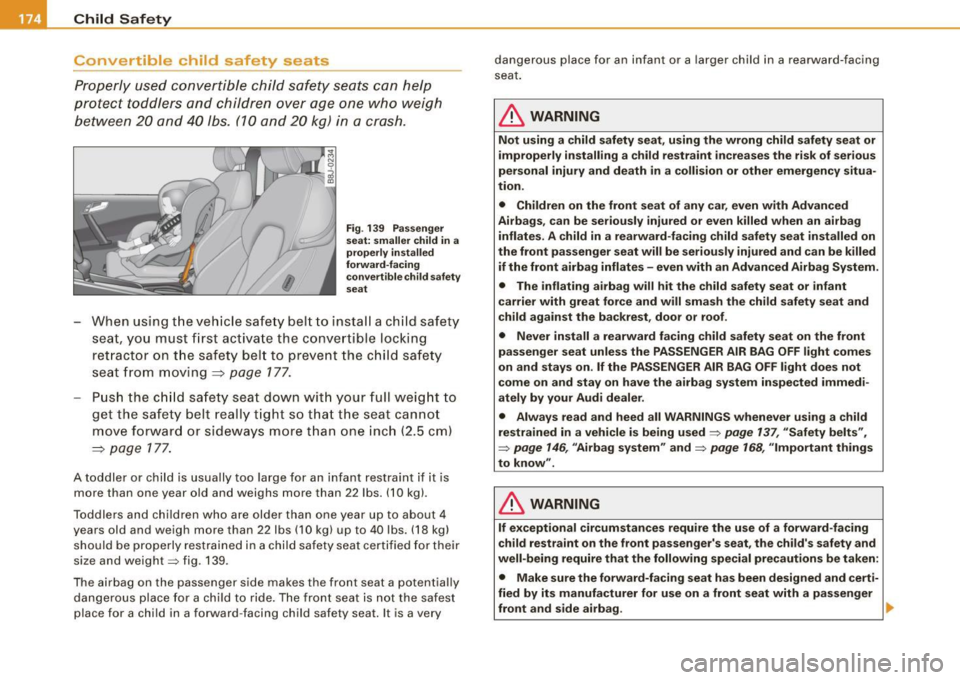
Fig. 139 Passenger
seat: smaller child in a
properly installed
forward-facing
convertible child safety
seat
When us ing the vehicle safety belt to install a child safety
seat, you must first activate the convert ible locking
retractor on the safety belt to prevent the child safety
seat from moving ~
page 177.
Push the child safety seat down with your full weight to
get the safety belt really tight so that the seat cannot move forward or sideways more than one inch (2.5 cm)
~ page 177.
A toddler or child is usually too large for an infant restraint if it is
more than one year old and weighs more than 22 lbs. (1 0 kg).
Toddlers and children who are older than one year up to about 4
years old and weigh more than 22 lbs (10 kg) up to 40 lbs. (18 kg) should be properly restrained in a child safety seat certified for their
size and weight=> fig. 139 .
The airbag on the passenger side makes the front seat a potentially dangerous place for a child to ride. The front seat is not the safest place for a child in a forward -facing child safety seat. It is a very dangerous place for an infant or a
larger child in a rearward-facing
seat.
& WARNING
Not using a child safety seat, using the wrong child safety seat or
improperly installing a child restraint increases the risk of serious
personal injury and death in a collision or other emergency situa
tion.
• Children on the front seat of any car, even with Advanced
Airbags, can be seriously injured or even killed when an airbag
inflates. A child in a rearward-facing child safety seat installed on
the front passenger seat will be seriously injured and can be killed
if the front airbag inflates -even with an Advanced Airbag System.
• The inflating airbag will hit the child safety seat or infant
carrier with great force and will smash the child safety seat and
child against the backrest, door or roof.
• Never install a rearward facing child safety seat on the front
passenger seat unless the PASSENGER AIR BAG OFF light comes
on and stays on. If the PASSENGER AIR BAG OFF light does not
come on and stay on have the airbag system inspected immedi
ately by your Audi dealer.
• Always read and heed all WARNINGS whenever using a child
restrained in a vehicle is being used=>
page 137, "Safety belts",
=>
page 146, "Airbag system" and=> page 168, "Important things
to know".
& WARNING
If exceptional circumstances require the use of a forward-facing
child restraint on the front passenger's seat, the child's safety and
well-being require that the following special precautions be taken:
• Make sure the forward-facing seat has been designed and certi
fied by its manufacturer for use on a front seat with a passenger
front and side airbag . .,
Page 177 of 316
& WARNING !continued)
• Always follow the manufacturer's instructions provided with
the child safety seat or carrier.
• Always move the front passenger seat into the rearmost posi
tion of the passenger seat's fore and aft adjustment range, and as
far away from the airbag as possible before installing the child
restraint.
• Always make sure that nothing prevents the front passenger's
seat from being moved to the rearmost position in its fore and aft
adjustment range.
• Always make sure the backrest is in an upright position.
• Make sure that the PASSENGER AIR BAG OFF light comes on
and stays on all the time whenever the ignition is switched on.
• If the light does not stay on, perform the checks~
page 157,
uMonitoring the Advanced Airbag System".
• If the PASSENGER AIR BAG OFF light does not come on and stay
on have the airbag system inspected immediately by your Audi
dealer. •
Safety first
Child Safety
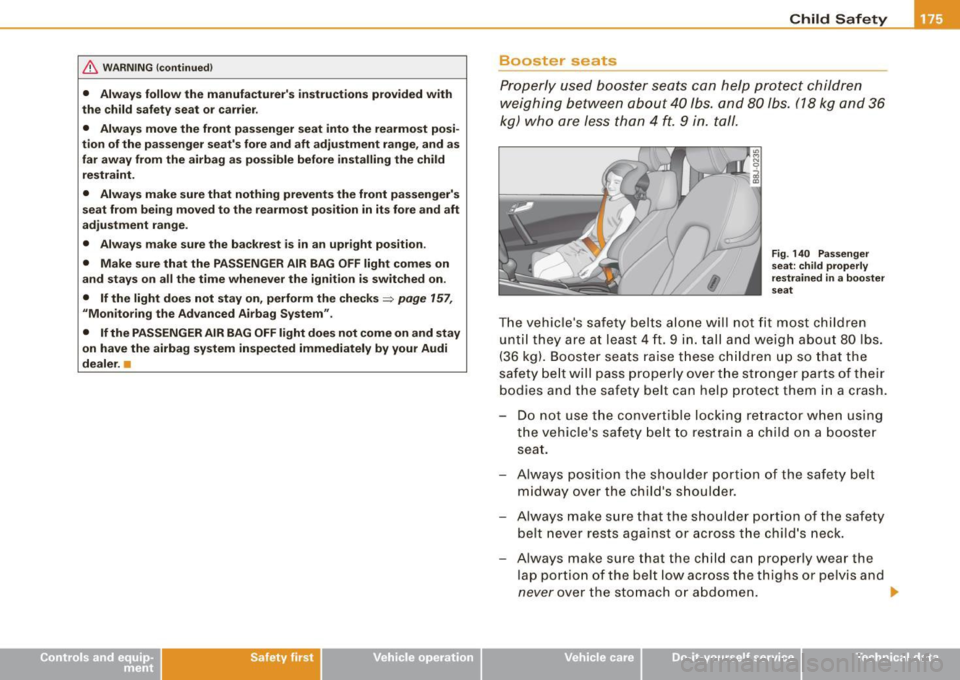
Booster seats
Properly used booster seats can help protect children
weighing between about 40 lbs. and 80 lbs. (18 kg and 36
kg) who are less than
4 ft. 9 in. tall.
II
Fig . 140 Passenger
seat: child properly
restrained
in a booster
seat
The vehicle 's safety belts alone will not fit most children
until they are at least
4 ft. 9 in. tall and weigh about 80 lbs.
(36 kg). Booster seats raise these children up so that the
safety belt will pass properly over the stronger parts of their bodies and the safety belt can help protect them in a crash .
- Do not use the convertible locking retractor when using
the vehic le 's safety belt to restrain a child on a booster
seat.
- Always posit ion the shoulder portion of the safety belt
midway over the child's shoulder.
- Always make sure that the shoulder port ion of the safety
belt never rests against or across the child's neck .
- Always make sure that the child can properly wear the
lap portion of the belt low across the thighs or pelvis and
never over the stomach or abdomen. •
Vehicle care I I irechnical data