2008 AUDI TT ROADSTER lock
[x] Cancel search: lockPage 204 of 316
___ C_ le_ a _ n_i_n ~g _ a_ n_ d __ p_r _o _t _e _c_ t_ i_o _n ___________________________________________ _
& WARNING
• Do not cl ean th e under side o f the ch ass is, fender s, whe el
c over s, or other hard to r ea ch part s without protecting your h and s
a nd a rms. Yo u may cut you rse lf on sh ar p-edged m eta l p art s.
• Alway s read and h eed all WARNINGS and other informat ion
~ p age 2 00 .
0 Note
• Never try to remove dirt, mud or dust if the surface of the vehicle
is dry . Never use a dry cloth or sponge, s ince this cou ld scratch your
vehic le's paint or w indows .
• Never wash your car in br ight sunl ight. Drops of wa ter act as
magnifying lenses and may damage your paint .
• When you wash your car in the winter : if you rinse your vehicle
with a hose, be careful not to aim the stream of water directly at
locks, or at door or ha tch openings - they can freeze shut.
• Never use sponges designed to remove insects, or any kitchen
scouring sponges or simila r products. They can damage your paint
finish .
• Never use a dry cloth or sponge to c lean the head lights. Only use
wet cloths or sponges to prevent scratches . It is best to use soapy
water.
c£> For the sake of the environment
In the interest of the environment, the vehicle shou ld on ly be
washed in special wash bays. •
Washing your vehicle with a power washer
Cleaning the exterior of your car with a high-pressure
power washer is safe as long as you observe a few simple rules .
-Before us ing the powe r washer, make sure you have read
and understood the WARNINGS~
& in "General infor
mation" o n
page 200.
Always follow the operating instructions for the power
washer.
Make sure that the jet o n th e sp ray hose produces a "fan
shaped sp ray".
Do
not hold the spray n ozzle too close to soft ma terials .
Never u se a power washer to clean the power top itself .
When cleaning the vehicle with a power washer
always follow the
operating instructions. This applies particula rly to the
operating
pre ssure
and the spraying di stanc e. Maintain a sufficient distance
to soft materia ls such as rubber hoses and sound/vibration dead
ening materia ls (particularly on the underside of the engine hood).
Do not use a jet which sprays water in a
di re ct stre am or one that
has a
rotating jet.
Water temperature shou ld not exceed 140 °F (60 °Cl.
in. WARNING
Never wash tires with a jet that sp rays water in a dire ct stream .
Thi s could cause invisib le damage to the tire s and weaken them ,
even if the spra y is fr om a re lative ly lo ng d istanc e and f or a s ho rt
tim e. Damaged and we akened tire s can f ail and cau se ac cident s
a nd pers ona l i njur y. .,,_
Page 210 of 316
., __ C_ le_ a _ n_i_n ~g _ a_ n_ d __ p_r _o _t _e _c_ t_ i_o _n ___________________________________________ _
& WARN ING (c o ntinu ed )
• Do not apply additional und ercoating or ru stpr oofing on or
near the e xhaust man ifold , ex h aust p ipe s, ca talyt ic con verte r or
heat sh ields . W hile driving , the sub stan ce used for underco atin g
c ould overh eat and cause a fire .
• Alw ays read and heed all WARNINGS and oth er inform ation
~ p ag e200 .•
Care of interior
Aluminum trim
Use on ly neutral -pH products to remove spots and deposits from
a luminum surfaces. Chrome care products and alka line cleaners
wi ll attack aluminum surfaces and can damage them over t ime.
& WARNING
Alway s read and heed all WARNIN GS and the inform ation
~ page 200 . •
Fabrics and fabric coverings
Fabrics and fabric coverings (e .g. seats, door trim pane ls, etc.)
should be cleaned at regu lar intervals with a vacuum cleaner. This
removes surface dirt particles which could become embedded in
the fabric through use . Steam c leaners should not be used, because
the steam tends to push the dirt deeper into the fabric and lock it
there .
Norm al c leanin g
Generally, we recommend using a so ft sponge or a l int -free
microfiber cloth to the clean fabric. Brushes should only be used for carpets and floor mats, since other fabric surfaces could be harmed
b
y brushes .
Normal surface stains can be cleaned using a commercially avail
able foam cleaner . Spread the foam on the surface of the fabric with
a soft sponge and work it in gently. Do not saturate the fabric. Then
pat the foam dry using absorbent, dry cloths (e.g. microfiber c loth)
and vacuum it af ter it has dried complete ly .
C leaning st ains
Stains caused by beverages (e.g . coffee, fruit juice, etc.) can be
treated with a mild detergent solution. Apply the detergent so lution
with a sponge . In the case of stubborn stains, a de tergent paste can
be applied directly to the stain and worked into the fabric. After
wa rds, use copious amounts of clean wa ter to remove the
remaining detergent . App ly the water with a damp cloth or sponge
and pat the fabric dry w ith an absorbent, dry c lo th.
Stains from choco late or makeup shou ld have detergent paste (e .g.
ox -gall soap) rubbed into them . Afterwards, remove the soap with
water (damp sponge).
Alcoho l can be used to treat stains from grease, oi l, lipstick or a ba ll
point pen . Melted grease or dye must be patted off using absorbe nt
material. It may be necessary to retreat the areas with detergent
p aste and wa ter.
I n the case of general soiling of the upholstery and cover material,
we recommend hiring a specialist that has the equipment to clean
the seat covers and other fabr ic surfaces by shampooing and spray
extraction.
& WARNING
Alway s read and heed all WARNINGS and the information
~ page 200 .
Page 212 of 316
___ C_ le_ a _ n_i_n ~g _ a_ n_ d __ p_r _o _t _e _c_ t_ i_o _n ___________________________________________ _
clothing materials can discolor leather seats (especially if such
clothing is damp and was not dyed correctly). Dust and dirt particles
in pores, folds, and seams can have an abrasive effect and can
damage the leather surface as well as weaken seams.
The leather should be cleaned regularly as needed. After having
been used for a relatively long time, your leather seats will acquire
a rich aged finish. This is a characteristic of natural leather and a
sign of true quality.
In order to maintain the value of this natural product over the life of
your vehicle, you should follow the recommendations below:
0 Note
• To keep your leather from bleaching out, do not allow it to be
exposed to bright sunlight for long periods of time. If you have to
leave the vehicle parked outside for long periods, cover the leather
to protect it from direct exposure to sunlight.
• Sharp objects on clothing, such as zippers, rivets or sharp pieces
on belts can leave permanent scratches or scrape marks on the
surface of the leather.
[ i J Tips
• After each time you clean the leather and at regular intervals, use
a leather preservative creme that contains UV -blockers and that
works into the leather. This creme will nourish and moisturize the leather, helping it to breathe and stay supple. It also helps to build
up a protective coating on the surface.
• Clean the leather every 2 -3 months, and clean any areas that get
soiled.
• Remove fresh marks made by ballpoint pens, ink, lipstick, shoe
polish, etc. as soon as possible.
• Preserve the color of the leather as needed by using a special
colored leather care creme to touch up areas of uneven color. •
Applies to vehicles: w ith natu ral leather
Cleaning and caring for leather upholstery
and trim
Natural leather requires special care and attention.
Normal cleaning
-Clean soiled areas with a slightly moistened cotton or
woolen cloth.
More stubborn dirt
- More stubborn dirt can be removed using a cloth satu
rated with a mild soap solution (2 tablespoons mild
liquid soap).
- Never allow the soap solution to saturate the leather, and
make certain that no water soaks into the seams.
Wipe off the soap solution with a soft, dry cloth.
Cleaning spots
-Remove fresh water-based spots (such as coffee, tea,
juices, blood) with an absorbent cloth or paper towel.
- Remove fresh
grease or oil-based spots (such as butter,
mayonnaise, chocolate) with an absorbent cloth or paper
towel, or use the cleaner from the leather care kit if the
spot has not yet penetrated into the surface of the
leather.
- Use an oil/grease dissolving spray, if
oil/grease spots
have dried on.
- Remove specific kinds of spots (ballpoint pen, felt
marker, fingernail polish, water-based paint, shoe polish,
etc.) with a spot remover specifically formulated for leather. ..,_
Page 214 of 316

-Cleaning and prot
ection
-~--------------
Safety belts
Only well-maintained safety belts work reliably when
needed.
H eavily soiled safety be lts may no t retract properly.
- Keep belts c lean.
- For clean ing, use a mild soa p an d wa ter so luti on. Let
belts dry thoroughly and away from d irect sunlight.
- D o not allo w inertia reel safe ty belts to retra ct before
they are com pletely dry .
- Check the condition of your safety belts
regularly .
& WARNING
Damaged safety belt s can break in a crash .
• Anything that might damage your safety belts could mean that
y ou and yo ur pas senger s would not be adequatel y prote cted in an
accident .
• Safety belt performance depend s on correct in stallation . Never
remove belt s from the vehicle to clean them.
• Do not u se chemi cal cleaning agents , blea ch or dyes . They h ave
c orrosive propertie s wh ich weaken the webbing.
• When cleaning your safety belts , in spect them for dam age . If
you discover damage, see your Audi dealer .
• Alway s read and heed all WARNINGS and the infor mation
=> page 200 . •
Engine compartment
Be es pecially caref ul when cle aning the engine compart
ment.
Alwa ys swit ch off the ignition before cle aning the engine => & .
Plenum pan el
Remove leaves from the plenum pane l in front of the w indshield
under the engine hood. This prevents the water drain holes from
becoming blocked, and it prevents debris from entering the vehicle
inter ior through the heating and ventilation ducts.
Corrosion protection
The engine compartment and transmission have been corrosion
pro tected at the factory.
Good anti -co rros io n treatment is very important, particularly in the
winter. If the vehicle is frequent ly driven on salt treated roads, the
enti re eng ine compartmen t and p lenum panel should be thor
oughly cleaned at the end of winter and retreated to prevent salt
damage . At the same time, the unde rside o f the vehicle shou ld be
washed as we ll.
I f the engine compartment is cleaned at any time with grease
removing solut ions
ll, or if you have the engine washed, the anti
corrosion treatment is almost a lways removed as well. It is therefore
essential to have a long-lasting corrosio n pro tec tion reapp lied to a ll
surfaces, seams, joints and components in the engine compart
ment .
& WARNING
Be awa re: Th e engine comp artment of any motor vehicle is a
potentially hazardou s area .
• Befo re working in the eng ine compartme nt, be sure to read the
i nformat ion =>
page 212 . .,.
11 Use on ly the correct cleaning so lutions. Never use gasol ine or diesel fuel.
Page 217 of 316

Fuel supply and filling your fuel tank -___________ ...:._:......:,_______;::;...a,__ __
•
Blend of gasoline and ethanol (grain alcohol or ethyl alcohol)
• Anti -knock index must be 87 AKI or higher.
• Blend must not contain more than
10% ethanol.
Blend of gasoline and MTBE
• Anti-knock index must be 87 AKI or higher.
• Blend must contain not more than
15% MTBE.
Seasonally adjusted gasoline
Many gasoline grades are blended to perform especially well for
winter or summer driving . During seasona l change -over, we suggest
that you fil l up at busy gas stations where the seasonal adjustment
is more likely to be made in time.
0 Note
• Methanol fuels which do not meet these requirements may
cause corrosion and damage to p lastic and rubber components in
the fue l system.
• Do not use fue ls that fail to meet the specified criteria in this
chapter .
• If you are unable to determine whether or not a particu lar fuel
blend meets the specifications, ask your service station or its fuel
suppl ier.
• Do not use fue l for which the contents cannot be identified.
• Fuel system damage and performance problems resu lting from
the use of fuels different from those specified are not the responsi
bility of Audi and are not covered under the New Vehicle or the
Emission Control System Warranties.
• If you experience a loss of fuel economy or driveability and
performance problems due to the use of one of these fuel blends,
we recommend that you switch to unblended fuel. •
Gasoline additives
A major concern among many auto manufacturers is carbon
depos it build -up caused by the type of gasoline you use.
Although gasoline grades differ from one manufacturer to another,
they have certain things in common. All gaso line grades contain
substances that can cause deposits to collect on vita l engine parts,
such as fue l injectors and intake valves. Although most gasoline
brands include additives to keep engine and fue l systems clean,
they are not equally effective.
Audi recommends using TOP TIER Detergen t Gasoline. For more
information on TOP TIER Detergent Gasoline, please go to the offi
cial website (www.toptiergas .coml.
A ft er an extended period of using inadequate fuels, built-up carbon
deposits can rob you r engine of peak performance.
(D Note
Damage or malfunction due to poor fuel qua lity is not covered by
the Audi New Vehicle Limited Warranty .•
Fuel tank
Fuel filler neck
The fuel filler neck is located on the right rear side panel behind the
fue l filler f lap.
If the unlocking system should fai l, you can stil l open the flap manu
a lly -for detai led instructions see=>
page 218.
You can find the fuel tank capacity of your vehicle in Technical Data
=> page 291. _.,
Vehicle care I t •
Page 218 of 316
Fuel supply and filling your fuel tank
The label on the inside of the fuel filler flap tells you the correct fuel
for your vehicle. For more information about fuel specifications, see
~ page 214.
Your vehicle fuel tank has an on -board refuelling vapor recovery
system. This feature helps to prevent fuel vapors from escaping
from the tank and polluting the environment while you refuel your
vehicle. In order to fill the tank properly while protecting the envi
ronmen t, please follow this refueling procedure carefully.
& WARNING
Under normal operating conditions, never carry additional fuel
containers in your car. Gas canisters and other containers used to
transport fuel can be dangerous. Such containers, full or empty,
may leak and could cause a fire in a collision. If you must transport
fuel to use for your lawn mower, snow blower, etc ., be very careful
and always observe local and state laws regarding the use, trans
portation and storage of such fuel containers . Make certain the
container meets industry standards (ANSI/ASTM F852 -861.
0 Note
Never drive your vehicle until the fuel tank is completely dry. The
irregular supply of fuel can cause misfiring . Gasoline could enter
into the exhaust system and damage the catalytic converter. •
Refuelling
Fig. 144 Driver's door:
Unlocking fuel filler
flap
Fig . 145 Fuel cap
hooked on the opened
fuel filler flap
When adding fuel, the ignition and any cellular phones in
the vehicle must be switched
off.
Taking the fuel cap off
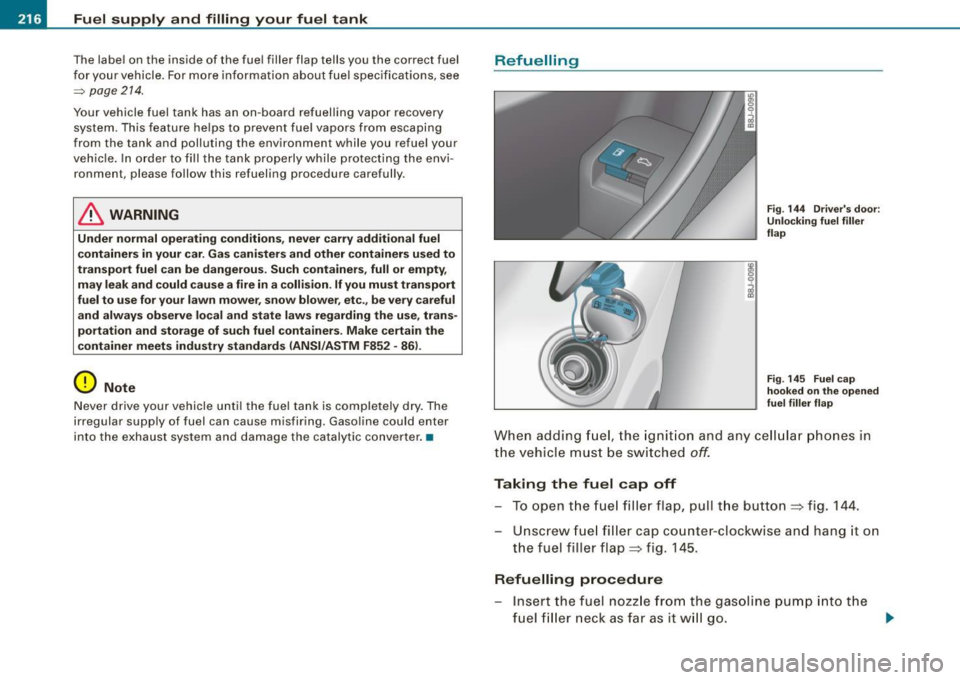
To open the fuel filler flap, pull the button ~ fig. 144.
Unscrew fuel filler cap counter-clockwise and hang it on
the fuel filler flap~ fig. 145 .
Refuelling procedure
Insert the fuel nozzle from the gasoline pump into the
fuel filler neck as far as
it will go. .,_
Page 219 of 316

_____________________________________ F_ u_ e_l _s _u-= pc...:... p_ly =--- a_ n_ d_ f_ i_ ll _in -=: gc.. y -=--- o-u_ r_ fu_ e_l _t _a _n_ k __ fflllll
•
- Select a medium refuelling rate so that the nozzle
switches off automatically when the tank is full.
Putting the fuel cap back on
- After filling your tank, twist the fuel filler cap clockwise
until you hear a definite click.
- Close the fuel filler flap.
To avoid fuel spilling or evaporating from the fuel tank always close
fuel filler cap properly and completely. An improperly closed fuel
filler cap may also cause a message in the driver information system =>
page 24 or cause the MIL lamp=> page 26 to come on.
& WARNING
Improper refueling or handling of fuel can cause fire, explosion
and severe burns .
• Fuel is highly flammable and can cause severe burns and other
injuries.
• Failure to shut the engine off while refueling and/or to insert
the pump nozzle fully into the fuel filler neck could cause fuel to
spray out of filler neck or to overflow. Fuel spray and overflowing
fuel can cause a fire.
• Never use a cellular telephone while refueling . The electromag
netic radiation can cause sparks that can ignite fuel vapors and
cause a fire .
• Never get back into your vehicle while refueling. If in excep
tional circumstances you must get back in your vehicle while refu
eling, make certain that you close the door and touch metal to
discharge static electricity before touching the filler nozzle again.
Static electricity can cause sparks that can ignite fuel vapors
released during refueling.
• Never smoke or have an open flame anywhere in or near your
vehicle when refueling or filling a portable fuel container.
& WARNING (continued)
• For your safety, we strongly recommend that you do not travel
with a portable fuel container in your vehicle. The container, full or empty may leak and could cause a fire, especially in a crash .
• If, under exceptional circumstances, you must transport a
portable fuel container, please observe the following: -Never fill a portable fuel container while it is anywhere in or
on the vehicle (for example, in the luggage compartment, or on
the trunk). Static electricity can build up while filling and can ignite fuel vapors causing a fire.
- Always place a portable fuel container on the ground before
filling.
- Always keep the filler nozzle completely inside the portable
container before and during filling.
- If filling a portable container made of metal, the filler nozzle
must always be in contact with the container. This will help
prevent static electricity from discharging and cause a fire.
- Never spill fuel inside the vehicle or luggage compartment.
Fuel vapors are highly flammable.
- Always observe local and state/provincial laws regarding the
use, storage and transportation of fuel containers
- Make certain the fuel container meets industry standards
(ANSI / ASTM F852-86l.
(D Note
If any fuel has spilled onto the car, it should be removed immedi
ately to prevent damage to the paint.
<£> For the sake of the environment
As soon as the correctly operated nozzle switches off automatically
for the first time, the tank is full. Do not try to add more fuel because
fuel may spill out. In addition, the expansion space in the fuel tank ..,_
Vehicle care
I t •
Page 220 of 316
![AUDI TT ROADSTER 2008 Owners Manual Fuel supply and filling y our fu el ta nk
will be filled -causing the fuel to overflow when it becomes warm
and pollute the environment.
[ i ] Tips
• Running your engine wh](/manual-img/6/57671/w960_57671-219.png "AUDI TT ROADSTER 2008 Owners Manual Fuel supply and filling y our fu el ta nk
will be filled -causing the fuel to overflow when it becomes warm
and pollute the environment.
[ i ] Tips
• Running your engine wh")
Fuel supply and filling y our fu el ta nk
will be filled -causing the fuel to overflow when it becomes warm
and pollute the environment.
[ i ] Tips
• Running your engine while refuel ling may cause vapors to
escape or even fuel to spill out of the tank . This would then shut off
the fue l nozzle before the tank is full.
• Do not refuel your vehicle with the ignition switched on . The fuel
gauge may otherwise not indicate the correct fuel level after
refuel ling .•
Unlocking the fuel filler flap by hand
You c an open the fuel filler flap by hand i f the p ower
locking system should fail .
Fig . 14 6 Lugg age
co mp artm ent : Cove r in
t h e r igh t-side interi or
tri m
If the power loc king syst em sho uld fa il, you can still open
the flap manually :
- Ope n the rear lid .
Open the round cover in the right -s ide interior trim.
Remove the red plastic knob from its reta iner . -
Pull the plastic cord in the direction of the arrow to
unlock the fuel filler flap~ fig. 146 . •