2008 AUDI TT ROADSTER lock
[x] Cancel search: lockPage 179 of 316
& WARNING !continued)
• If the PASSENGER AIR BAG OFF light does not come on and stay
on whenever the ignition is switched on the inflating airbag will
hit the child safety seat or infant carrier with great force and will
smash the child safety seat and child against the backrest, door or
roof. Have the airbag system inspected immediately by your Audi
dealer.
• Always read and heed all WARNINGS whenever using a child
restrained in a vehicle is being used=>
page 137, "Safety belts",
=>
page 146, "Airbag system" and=> page 168, "Important things
to know". •
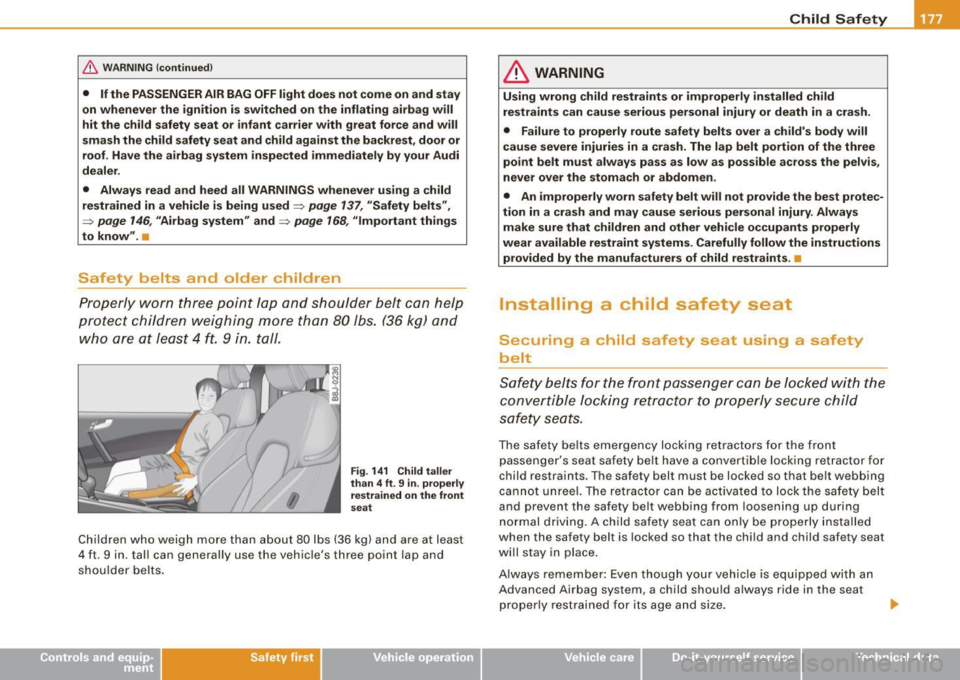
Safety belts and older children
Properly worn three point lap and shoulder belt can help
protect children weighing more than 80 lbs. (36 kg) and
who are at least 4 ft. 9 in. tall.
I
Fig. 141 Child taller
than 4 ft. 9 in. properly
restrained on the front
seat
Children who weigh more than about 80 lbs (36 kg) and are at least
4 ft . 9 in . tall can generally use the vehicle's three point lap and
shoulder belts.
Safety first
Child Safety
& WARNING
Using wrong child restraints or improperly installed child
restraints can cause serious personal injury or death in a crash.
• Failure to properly route safety belts over a child's body will
cause severe injuries in a crash. The lap belt portion of the three
point belt must always pass as low as possible across the pelvis,
never over the stomach or abdomen.
• An improperly worn safety belt will not provide the best protec
tion in a crash and may cause serious personal injury. Always
make sure that children and other vehicle occupants properly
wear available restraint systems. Carefully follow the instructions provided by the manufacturers of child restraints. •
Installing a child safety seat
Securing a child safety seat using a safety
belt
Safety belts for the front passenger can be locked with the
convertible locking retractor to properly secure child
safety seats.
The safety belts emergency locking retractors for the front
passenger's seat safety belt have a convertible locking retractor for
child restraints. The safety belt must be locked so that belt webbing
cannot unreel. The retractor can be activated to lock the safety belt
and prevent the safety belt webbing from loosening up during
normal driving. A child safety seat can only be properly installed
when the safety belt is locked so that the child and child safety seat
will stay in place.
Always remember: Even though your vehicle is equipped with an
Advanced Airbag system, a child should always ride in the seat properly restrained for its age and size. .,_
Vehicle care
I I irechnical data
Page 180 of 316
___ C_ h_ il_d _S_ a_f _e _ty ~----------------------------------------------
& WARNING
Improperly installed child safety seats increase the risk of serious
personal injury and death in a collision.
• Always make sure that the safety belt retractor is locked when
installing a child safety seat. An unlocked safety belt retractor
cannot hold the child safety seat in place during normal driving or
in a crash.
• Always buckle the child safety seat firmly in place even if a
child is not sitting in it. A loose child safety seat can fly around
during a sudden stop or in a collision
• The inflating airbag will hit the child safety seat or infant
carrier with great force and will smash the child safety seat and
child against the backrest, door or roof.
• Forward-facing child safety seats or infant carriers installed on
the front passenger's seat may interfere with the deployment of
the airbag and cause serious injury to the child .
• Always read and heed all WARNINGS whenever using a child
restrained in a vehicle is being used=>
page 168. Special precau
tions apply when installing a child safety seat on the front passenger seat=>
page 147, "Child restraints on the front seat -
some important things to know" .
& WARNING
Always take special precautions if you must install a forward or
rearward-facing child restraint on the front passenger's seat in
exceptional situations :
• Whenever a forward or rearward-facing child restraint is
installed on the front passenger seat , the PASSENGER AIR BAG
OFF light must come on and stay on whenever the ignition is
switched on.
• If the PASSENGER AIR BAG OFF light does not come on and stay
on , perform the checks described=>
page 157, ''Monitoring the
Advanced Airbag System".
& WARNING (continued)
• If the PASSENGER AIR BAG OFF light does not come on and stay
on whenever the ignition is switched on the inflating airbag will
hit the child safety seat or infant carrier with great force and will
smash the child safety seat and child against the backrest , door or
roof . Have the airbag system inspected immediately by your Audi
dealer.
• Improper installation of child restraints can reduce their effec
tiveness or even prevent them from providing any protection .
• An improperly installed child restraint can interfere with the
airbag as it deploys and seriously injure or even kill the child.
• Always carefully follow the manufacturer's instructions
provided with the child safety seat or carrier .
• Never place additional items on the seat that can increase the
total weight registered by the weight -sensing mat and can cause
injury in a crash .
in. WARNING
Forward-facing child restraints:
• Always make sure the forward-facing seat has been designed
and certified by its manufacturer for use on a front seat with a
passenger front and side airbag .
• Never put the forward-facing child restraint up , against or very
near the instrument panel.
• Always move the passenger seat into its rearmost position in
the seat's fore and aft adjustment range, as far away from the
airbag as possible before installing the forward -facing child
restraint. The backrest must be adjusted to an upright position.
• Make sure that the PASSENGER AIR BAG OFF light comes on
and stays on all the time whenever the ignition is switched on.
~
Page 181 of 316

_______________________________________________ C_h _ i_ld _ S_ a_ f_ e_ t..,:c y __ __
& WARNING
Rearward-facing child restraints:
• A child in a rearward-facing child safety seat installed on the
front passenger seat will be seriously injured and can be killed if
the front airbag inflates -even with an Advanced Airbag System.
• The inflating airbag will hit the child safety seat or infant
carrier with great force and will smash the child safety seat and
child against the backrest, door or roof.
• Always be especially careful if you must install a rearward
facing child safety seat on the front passenger seat in exceptional
circumstances.
• Make sure that the PASSENGER AIR BAG OFF light comes on
and stays on all the time whenever the ignition is switched on.
• Never install a rearward facing child safety seat on the front
passenger seat unless the PASSENGER AIR BAG OFF light comes
on and stays on. If the PASSENGER AIR BAG OFF light does not
come on and stay on have the airbag system inspected immedi
ately by your Audi dealer. •
Activating the convertible locking retractor
Use the convertible locking retractor to secure a child
restraint.
Always heed the child safety seat manufacturer's instruc
tions when installing a child restraint in your vehicle . To
activate the convertible locking retractor:
- Place the child restraint on a seat .
- Slowly pull the belt
all the way out.
- Route it around or through the child restraint belt path
~& -
Controls and equip
ment Safety first
Vehicle operation
-Push the child safety seat down with your full weight to
get the safety belt really tight.
- Insert the belt tongue into the buckle for that seating
position .
- Guide the safety belt back into the retractor unt il the belt
lies flat and snug on the child safety seat.
- You should hear a "clicking" noise as the belt winds back
into the inertia reel. Test the convertible locking retractor
by pul ling on the belt. You should no longer be able to
pull the belt out of the retractor. The convertible locking
retractor is now activated .
- Make sure that the red release button is facing away from
the child restraint so that it can be unbuckled quickly.
- Pull on the belt to make sure the safety belt is properly
tight and fastened so that the seat cannot move forward
or sideways more than one inch (2.5 cm).
& WARNING
Using the wrong child restraint or an improperly installed child
restraint can cause serious personal injury or death in a crash.
• Always make sure that the safety belt retractor is locked when
installing a child safety seat. An unlocked safety belt retractor
cannot hold the child safety seat in place during normal driving or
in a crash.
• Always buckle the child safety seat firmly in place even if a
child is not sitting in it. A loose child safety seat can fly around
during a sudden stop or in a crash.
• Always make sure the seat backrest to which the child restraint
is installed is in an upright position. Otherwise, the seat back with
the child safety seat attached to it could fly forward in the event of
an accident or other emergency situation. ..,
Vehicle care Do-it-yourself service Technical data
Page 182 of 316
___ C_ h_ il_ d _S_ a_f e _ ty ______________________________________________ _
& WARNIN G (co ntinued )
• Always read and heed all WARNINGS whenever u sing a child
re strained in a v ehicle i s being used
=> page 168 . Special p re ca u
tion s appl y when inst alling a chi ld safety se at o n the front
pa sseng er sea t =>
page 14 7, "Child restr aint s on the front seat -
s ome important thing s to know ".•
Deactivating the convertible locking retractor
The convertible locking retractor for child restraints will
be deactivated automatically when the belt is wound all
the way back into the retractor.
- Press the red button on the safety belt buckle. The belt
tongue will pop out of the buckle.
- Guide t he belt a ll the way back into its stowed position.
Always let the safety belt retract complete ly into its stowed position .
The safety belt can now be used as an ordinary safety belt without
the convertible locking retractor for child restraints.
If the conve rtible locking retractor should be activa ted inadvert
ently, the safety belt must be unfastened and guided completely
back in to its stowed posi tion to deactiva te this feature. If the
convertible locking retractor is not deactivated, the safety belt will
gradually become tighter and uncom fortable to wear .
& WARNING
Improperly in stalled child safe ty seat s inc rea se th e risk of serious
personal injur y and death in a c ollisio n.
• Never unfa sten the safet y belt to deacti vate the convertibl e
lo cking retr actor for ch ild restra int s w hile the veh icle is movin g.
You would not be re strained and could be seriou sly injured in an
acc ident .
& WARN IN G (c ontinued )
• Always read and h eed all WARNINGS whenever u sing a child
restr ained in a vehi cle is being u sed
=> page 1 68 . Spe cial pre cau
tio ns appl y when inst alling a child safet y s eat on the front
p ass enger seat =>
pag e 147 , "Child re strain ts on the front seat -
s ome i mport ant things to know ".•
Additional Information
Where can I get additional information about
child restraint application and usage?
T here are a number of sources of additional information about child
r estraint selection, installation and usage:
NH TSA advises that the best child safety seat is the one that fits
you r child and fits in your vehicle, and that you wi ll use correctly and
consistently.
T ry before you buy!
N atio nal High way Tra ffi c Safety Ad ministr ati on
Tel. : (888) DASH -2 -DOT
www.nhtsa.dot.gov
Nat iona l SAFE KID S Campaign
Tel.: (202) 662 -0600
www .sa fekids.org
Safety BeltSafe U .S .A
Tel.: (800) 745 -SAFE (Eng lish)
Tel. : (800) 747 -SANO (Spanish)
www.carseat.org
Tran sport Canad a
Tel.: (800! 333-0371
www .tc .gc .ca
Page 186 of 316

_1--_l_ n _t _ e _ll _,ig ,_,_ e_n _t _ t_ e_ c_ h_n _o_ l_ o ~g""- y.e- __________________________________________ _
Intelligent technology
Notice about data recorded by
vehicle control modules
Your vehicle is not equipped with an Event Data Recorder (EDR),
installed by some manufacturers for the express purpose of
capturing data for retrieval after an accident or crash event . EDR's
are sometimes called "crash recorders".
Some state laws restrict the retrieval or downloading of data stored
by EDR's that were installed in a vehicle for the express purpose of
retrieving data after an accident or crash event w ithout the owner's
consent.
Although your vehicle is not equipped with an EDR, it is equipped
with a number of electronic control modules for various vehicle systems such as, for example, engine function, emission control, as
well as for the airbags and safety belts.
These electronic control modules also record vehic le-related data
during norma l vehicle opera tion for diagnostic and repair purposes .
The recording capacity of the electronic control modules is limited
to data (no sound is recorded) and only a small amount of data is
actually recorded over a very limited period of time and stored when
a system fault or other condition is sensed by a control unit. Some
of the data then stored may relate to vehic le speed, direction,
braking as well as restraint system use and performance in the
even t of a crash or other condition . Stored data can only be read and
downloaded with special equipment.
Electronic Stabilization Program (ESP)
Genel'61
The Electronic Stability Program increases driving
sta bility.
Fig . 142 Cente r
cons ole with ESP
sw itch
With ESP, control over the veh icle is increased in situations when
the vehicle is close to the limits of grip, such as during acce leration
and in curves. ESP reduces the risk of skidding a nd improves vehicle
stability under all road conditions . It operates at all speeds .
The Anti-Lock Brake System (ABS), E lec tronic Differentia l Lock (EDS)
and Anti-Slip Regulation System (ASR) are integrated in the Elec
tronic Stability Program .
H ow ESP work s
The ESP control unit processes the following data from high-sensi
tive sensors: the rotational speed of the vehicle about its vertica l
axis, fore -and -aft and lateral acceleration forces, brake pressure and
steering angle.
Using steering ang le and vehicle speed, the direction the driver
wishes to travel is determined and continuously compared with
actual vehicle behavior . If the two do not match, for example when
Page 188 of 316

___ ln_ t _e_ ll-'"ig ...,_ e_ n_t _t_ e_ c_ h _ n_o _ l_o _,.g= y,_ __________________________________________ _
Electronic differential lock (EOL)
The electronic differential lock monitors the rotational
speed of the drive wheels.
General notes
The electronic differential lock (EDU helps the car to start moving,
accelerate and climb a gradient on surfaces providing poor or
almost no grip. Without EDL, this would be difficult, if not impos
sible.
How the system works
Th e EDL operates automatically. It monitors the rotational speed of
the drive wheels on an axle with the help of the ABS sensors
=> page 189. If a noticeable difference in rotational speed between
the drive wheels on one axle is detected (e.g. on slippery ground
on
one side),
the spinning wheel is braked, thereby transferring power
to the other drive wheel or wheels (all-wheel drivel. This is done up
to a speed of about 60 mph (100 km/hl. Noises from the brake
system signal that wheel spin is being controlled.
Driving off
When driving off, always be sure to keep road conditions in mind as
you accelerate . If one drive wheel spins because it is on a surface
with less grip, gradually increase the pressure on the accelerator
pedal until the car starts to move. The wheel less able to transfer
power spins.
Overheating of brakes
To prevent the disc brake of the braked wheel from overheating if
subjected
to excessive loads, the EDL cuts out temporarily . The
vehicle remains operational and behaves in the same way as a
vehicle without EDL.
As soon as the brake has cooled down, EDL switches on again auto
matically.
& WARNING
• When accelerating on slippery surfaces, such as on ice or snow,
always be careful when depressing the accelerator pedal. Even
with the EDL working, the drive wheels can spin and reduce your ability to control your car. -Risk of crash!
• The increased safety afforded by EDL does not mean that you
can take safety risks. Always adapt your driving style to the road
conditions and traffic situation.
[ i] Tips
If a fault occurs in the ABS, the EDL is also not functioning . This is
indicated by the ABS warning light=>
page 20. •
Anti-Slip Regulation System (ASR)
The Anti-Slip Regulation System prevents the driven
wheels from spinning when the car is accelerating.
General notes
The Anti-Slip Regulation System (ASR) is integrated in the electronic
stabilization program (ESP). When the vehicle starts up and acceler
ates , the wheels are prevented from spinning by adjusting the
engine power to match the amount of grip available from the road
surface .
How the system works
ASR performs automatically, i.e. without the driver's intervention .
With the aid of the ABS sensors =>
page 189, ASR monitors the
speed of the driven wheels. If the wheels start to spin, the engine
torque is reduced automatically until the tires find enough grip to
lock onto the road surface . The system is active across the entire
speed range.
The ASR works in conjunction with the ABS. If a malfunction should
occur in the ABS, the ASR will also be out of action .
~
Page 191 of 316

Faults in the brake syst em
If you shou ld notice a sudden i ncrease in brake pedal travel, then
one of the two brake circuits may have failed=>
& -
Low brake fluid level
Ma lfunctions can occur in the brake system if the brake fluid leve l is
t oo low. The brake fluid level is moni tored e lect ronica lly .
Brake pow er assist unit
The brake p ow er assist un it increas es th e pressure that you
generate with the brake peda l. It works only when the engine is
running.
& WARNING
• You should perform braking maneuver s for the purpose of
c leaning the brake system only if road conditions permit . Other
road users must not be put at ri sk -you may cause an accident!
• Before des cending a steep grade , redu ce speed and sh ift trans
mi ssion into a lower gear or lower driving position . Do not ride the
br akes or hold the pedal down too long or too often . This could
cause the brakes to get hot and diminish braking efficiency .
• Do not "ride the brakes " by resting your foot on the pedal when
you do not intend to brake . Thi s may cause the brakes to overheat,
premature we ar and increased stopping distan ce .
• Under certain cl imatic and operating condit ions such as
pas sing through water , driv ing in heavy rain or after washing the
vehicle, the effectiveness of the brake s can be reduced . In winter ,
ice can ac cumulate on the brake pads , linings , discs and drums .
Cautiously apply brakes for a te st. Brakes will dry and ice coatings
will be cleaned off after a few cautious brake appli cations .
• Driving for an extended period of time on salt -covered road s
without using your brakes can also affect brak ing effic iency . Clean
off accumulated salt coating from brake discs and pads with a few
c autiou s brake applications .
Controls and equip ment Safety first Vehicle operation
Intelligent technology
& W
ARNING (continued )
• If you damage the front spo iler , or if you install a different
s poiler , be sure the air flow to the front brakes is not obstructed.
Otherwise the brake system could overheat redu cing the effective
ness of the entire br ake system.
• Failure of one brake circuit will impair the braking capability
resulting in an increa sed stopping distance. Avoid driving the
vehicle and have it towed to the nearest Audi dealer or qualified
workshop.
• Never let the veh icle roll to a stop with the engine shut off .
• If the b rake booster is not working , for e xample when towing
your vehicle, or because the brake booster has somehow been
damaged , the brake pedal must be pre ssed considerably harder to
make up for the lack of booster assistance . •
Anti- lock brake system (ABS)
ABS p revents the wheel s from loc king unde r br ak ing.
The anti -lock brake sys te m (ABS) makes a major contri but ion to
i ncreasing act ive d riv in g sa fety . You should not expect that brakin g
distances wi ll be
shortened unde r all c ircums tances wi th ABS.
B rak in g distance may even become somewhat
longer , for e xa m ple ,
on gravel or in new snow on s lippery ground, even if you are driving
carefully and slowly.
ABS operation
W hen a veh icle speed o f about 10 mph (20 km/ h) is reac hed , an au to
matic test sequence is run. Some noise from the pum p may be
audible.
I f the speed of a wheel s lows down too much re lative to vehicle
speed and i t starts to lock, br ake pressu re to th is whee l is reduce d.
T his adjustment process can be felt as a
pulsing motion of the b rake
pedal ,
accompanied by some noises. Yo u as the d rive r are in tent io n
a lly being g iven the in fo rmation that the wh eels a re tendin g to lock
Vehicle care Do-it-yourself service Technical data
Page 193 of 316
![AUDI TT ROADSTER 2008 Owners Manual [ i ] Tips
• If the pow er st eering sy stem sho uld fa il, or if the e ng ine is not
running (for examp le , whi le being towed), you will stil l be able to
st eer the ve hicl](/manual-img/6/57671/w960_57671-192.png "AUDI TT ROADSTER 2008 Owners Manual [ i ] Tips
• If the pow er st eering sy stem sho uld fa il, or if the e ng ine is not
running (for examp le , whi le being towed), you will stil l be able to
st eer the ve hicl")
[ i ] Tips
• If the pow er st eering sy stem sho uld fa il, or if the e ng ine is not
running (for examp le , whi le being towed), you will stil l be able to
st eer the ve hicle . How eve r, more e ffort w ill be required to do so.
• I f the powe r steering system is not f unctioning pr ope rly, contact
your authorized Audi dea ler immediate ly.
Ap plies to vehicles : wit h A ll Wheel Driv e
Driving w ith your quattro®
With All Wheel Drive, all four w heels ar e dri ven.
General information
With All W hee l Dr ive, power is d is tr ibute d to all fou r whee ls . T his
happens automat ica lly depending on your driving style and the
r oad cond itio ns at the time. See also =>
page 186, "E lec tronic diffe r
entia l lock ( EDU" .
Winter tires
When driving in the winter, your vehic le with All Wheel Drive has an
advantage, even wi th regula r t ir es . In winter road conditions it may
be advisable to mount winter tires (or all -season tires) for improved
driveabi lit y an d braking : these tires m ust be mounted on
all four
wheels .
See also=> page 254 , "Win ter t ires" .
Snow chains
Where tire cha ins are mandatory on certain roads, this normally
a lso a pplies t o vehic le s wi th Al l Wheel Drive =>
page 255, "Sn ow
chains".
Replacing wheels /tires
Vehicles with A ll Wheel Drive must always have tires of the same
s iz e. Also av oid t ires w it h d iff eren t tr ead dep ths. For details see
page=>
page 249, " New tires and replacing tires and whee ls " .
Controls and equip
ment Safety first Vehicle operation
Intelligent technology
Off
-Road driving?
Your Audi d oes not have en ough gr ound clea rance to be use d as a n
off -road vehicle. It is therefore best to avoid roug h tracks and
u neven terrain as much as possible. A lso refer to=>
page 194.
& WARNING
Always adjust your driving to road and traffic conditions. Do not
let the extra safety afforded by All Wheel Drive tempt you into
taking extra risks .
• Although the All Wheel Drive is very effective , always
remember that braking capacity is limited by tire traction. You
should therefore not drive at e xcessive speeds on icy or slippery
road surfaces.
• On wet road su rfaces , be careful not to dr ive too fast because
the front wheels could begin to slide on top of the water (aqua
planing ).
If this should occur , you will have no warning from a
sudden increase in engine speed as with a front -wheel drive
vehicle . Always d rive at speeds which are suited to the road condi
tions. -risk of cra sh. •
Vehicle care Do-it-yourself service Technical data